
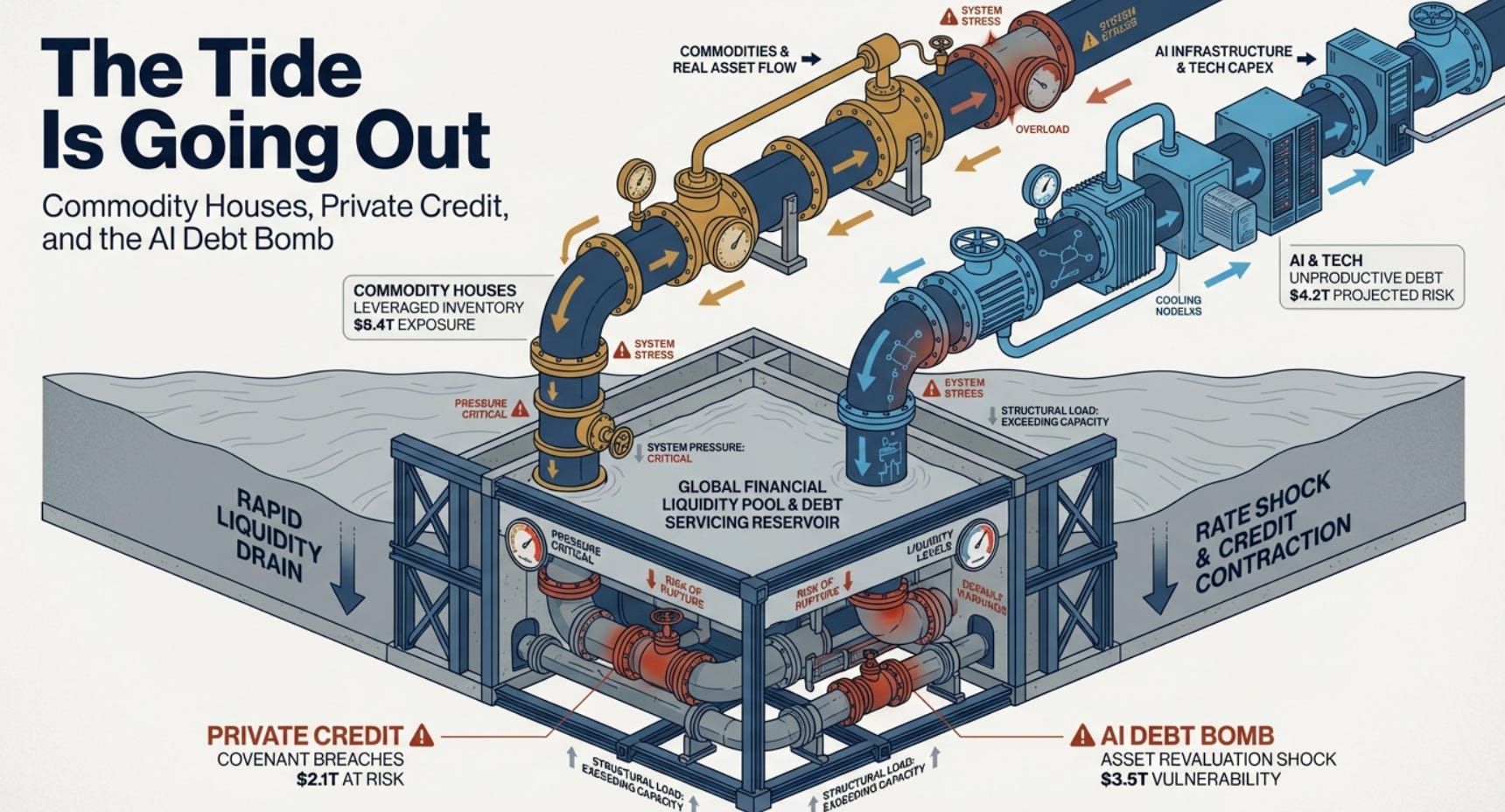
Start Here: What This Article Is About
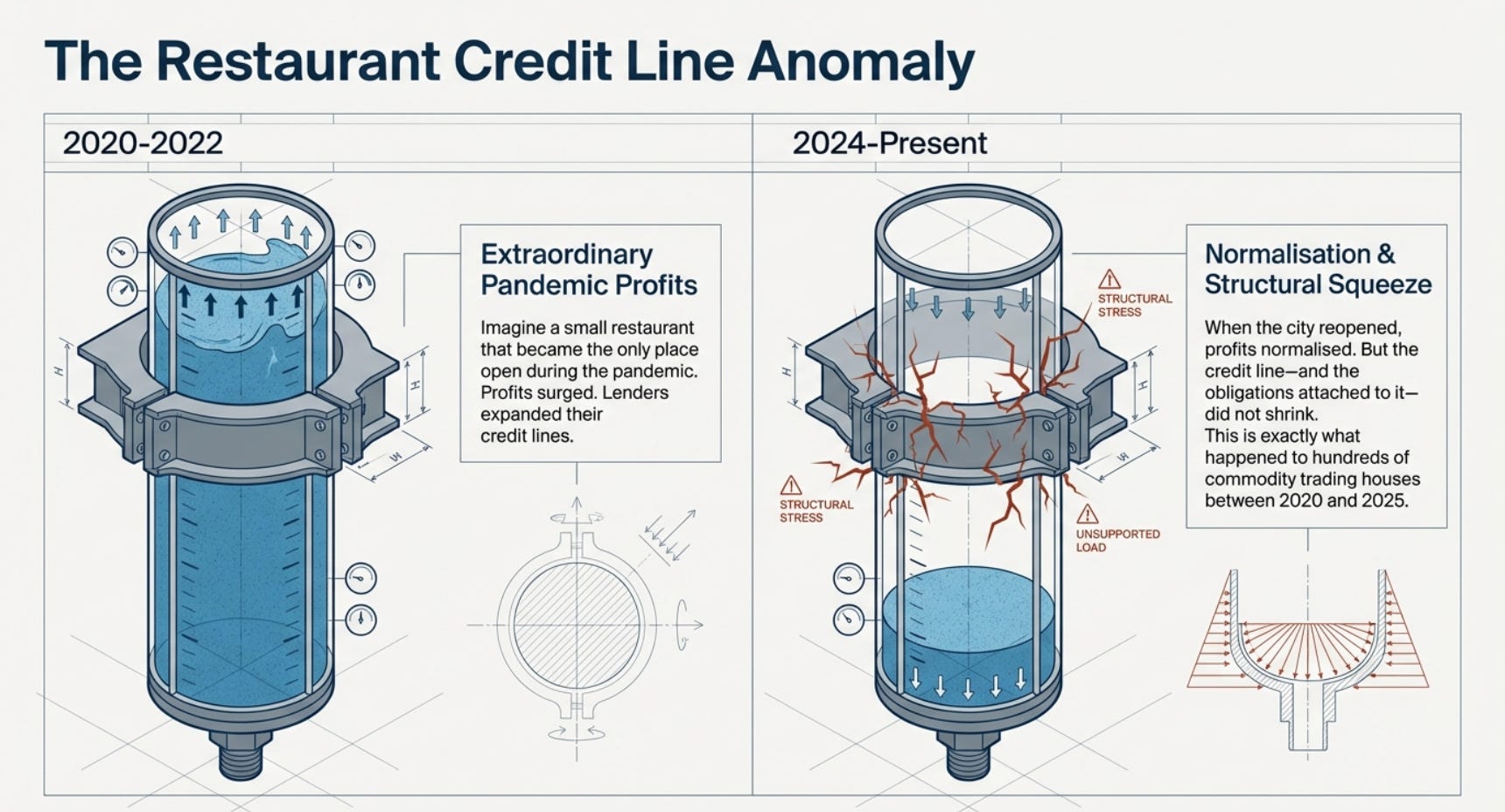
Imagine a friend who owns a small business. During the pandemic, her business became the only restaurant open in the city. She made extraordinary profits for two years. On the strength of those profits, she went to a lender and said: “Look at my books — I’m killing it. Give me a bigger credit line.” She got it. Then all the other restaurants reopened. Her profits returned to normal. But the credit line — and the obligations that came with it — didn’t shrink with her profits. The bill is still the same size.
That is, in rough outline, what happened to hundreds of commodity trading houses between 2020 and 2025. This article is about why that matters, who lent them the money, what those lenders are also doing with AI data centres, and why the combination of these two things is creating a pressure point inside the part of the financial system with the least public visibility.
We’ll take it piece by piece.
Part 1: What a Commodity Trading House Actually Does
Before anything else, it helps to understand what a commodity trading house actually is — because they operate mostly in the background, and most people have never heard of the biggest ones.
A commodity trading house is essentially a logistics and arbitrage business. It buys physical commodities — oil, natural gas, copper, wheat, corn — in one place, and sells them in another, profiting from the difference. Trafigura, one of the world’s largest, had revenues of $244 billion in 2023. Vitol, which is privately owned and doesn’t publish financials, is believed to trade more oil annually than any company in the world. These are enormous businesses that almost never appear in mainstream news.
To do what they do, trading houses need a lot of cash — constantly. Think about it: to buy a million barrels of crude oil in the Middle East, ship it to Europe, and sell it to a refinery, you need to pay for the oil before you receive the money from the sale. That gap — sometimes 30 days, sometimes 60, sometimes 90 days — has to be bridged with borrowed money. In the finance world, this is called working capital.
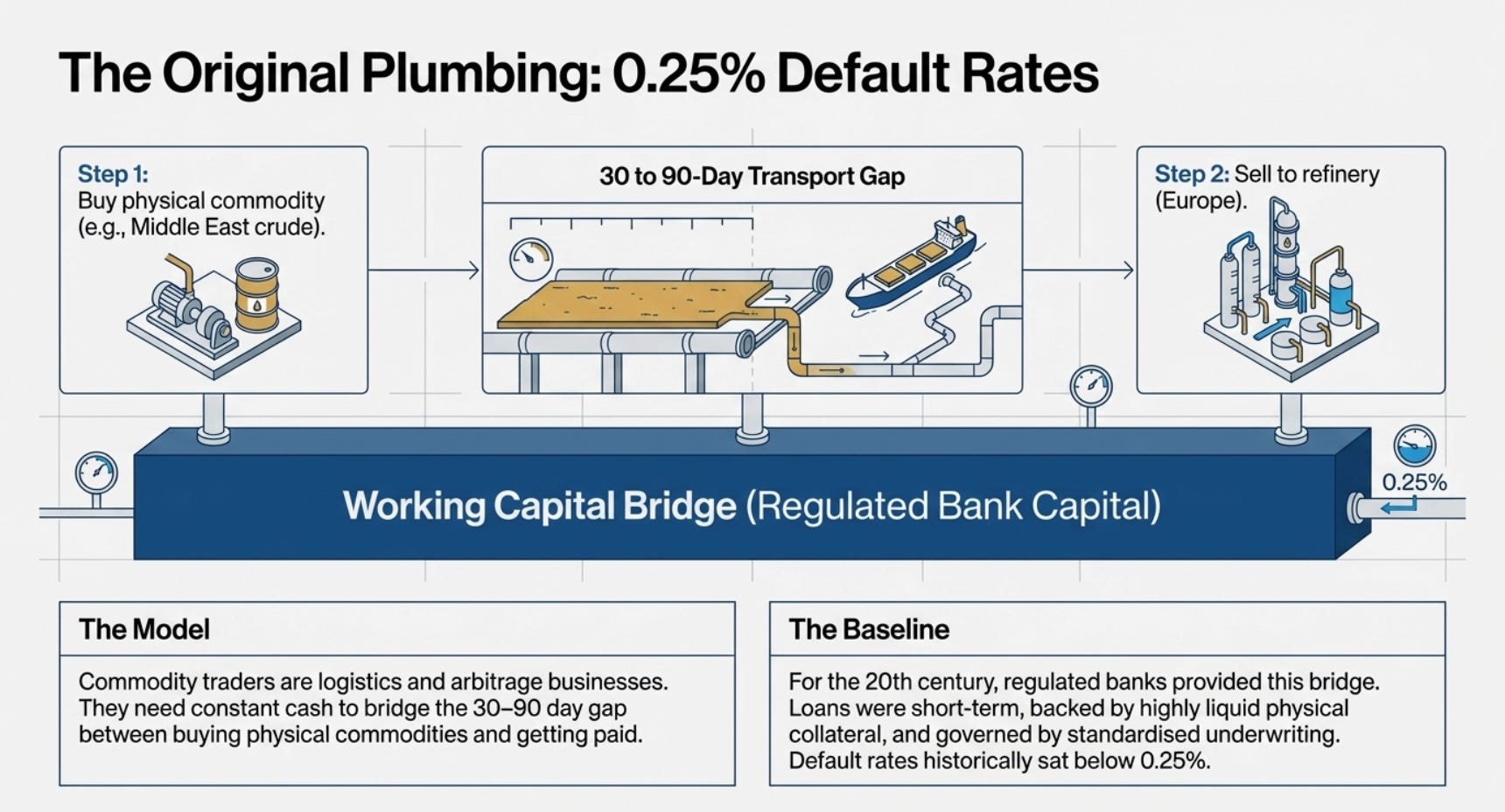
For most of the 20th century, banks provided this working capital. The arrangement suited everyone. The loans were short-term, backed by a physical commodity as collateral, and almost never went wrong. Default rates across the industry historically sat below 0.25%.
Then, between 2019 and 2022, several things happened that changed the structure of this market permanently.
Part 2: Why the Banks Left — The Dollar Weapon and the $9 Billion Warning
The story of why banks fled commodity trade finance isn’t really a story about capital rules. It’s a story about geopolitics, the extraordinary power of the US dollar, and one of the largest criminal fines in banking history.
To understand why, you need to grasp one structural fact about how global commodity trading works: almost all of it is priced and settled in US dollars. Oil, metals, grain — the price is in dollars, the payment is in dollars, and the settlement runs through US correspondent banks. This seems like a minor technical detail. It isn’t. It means that any bank anywhere in the world — French, Dutch, German, Swiss — that processes a commodity trade is, in a meaningful legal sense, operating within the reach of US law the moment that transaction touches the American financial system.
The US government understood this. And it used it.
Between roughly 2008 and 2015, the US Department of Justice and the Treasury’s Office of Foreign Assets Control (OFAC) launched an aggressive enforcement campaign against foreign banks that had been processing dollar transactions involving countries under US sanctions — primarily Sudan, Iran, and Cuba. The theory was simple: if you used the dollar system to move money for sanctioned regimes, you violated US law, regardless of where your headquarters was or whether any of the actual activity occurred on American soil.
OFAC investigated BNP Paribas for systematically concealing or obscuring references to sanctioned parties across nearly 4,000 financial and trade transactions routed through the US financial system between 2005 and 2012 — covering Sudan, Iran, Cuba, and Burma. The scale of what they found was staggering. BNP pleaded guilty to two criminal charges in 2014 and agreed to pay $8.97 billion. In an unprecedented move, regulators also imposed a one-year ban on BNP’s ability to conduct US dollar transactions — focused specifically on its Oil and Gas Energy and Commodity Finance business line. The punishment didn’t land on some abstract division of the bank. It landed directly on commodity trade finance — the exact business being discussed in this article.
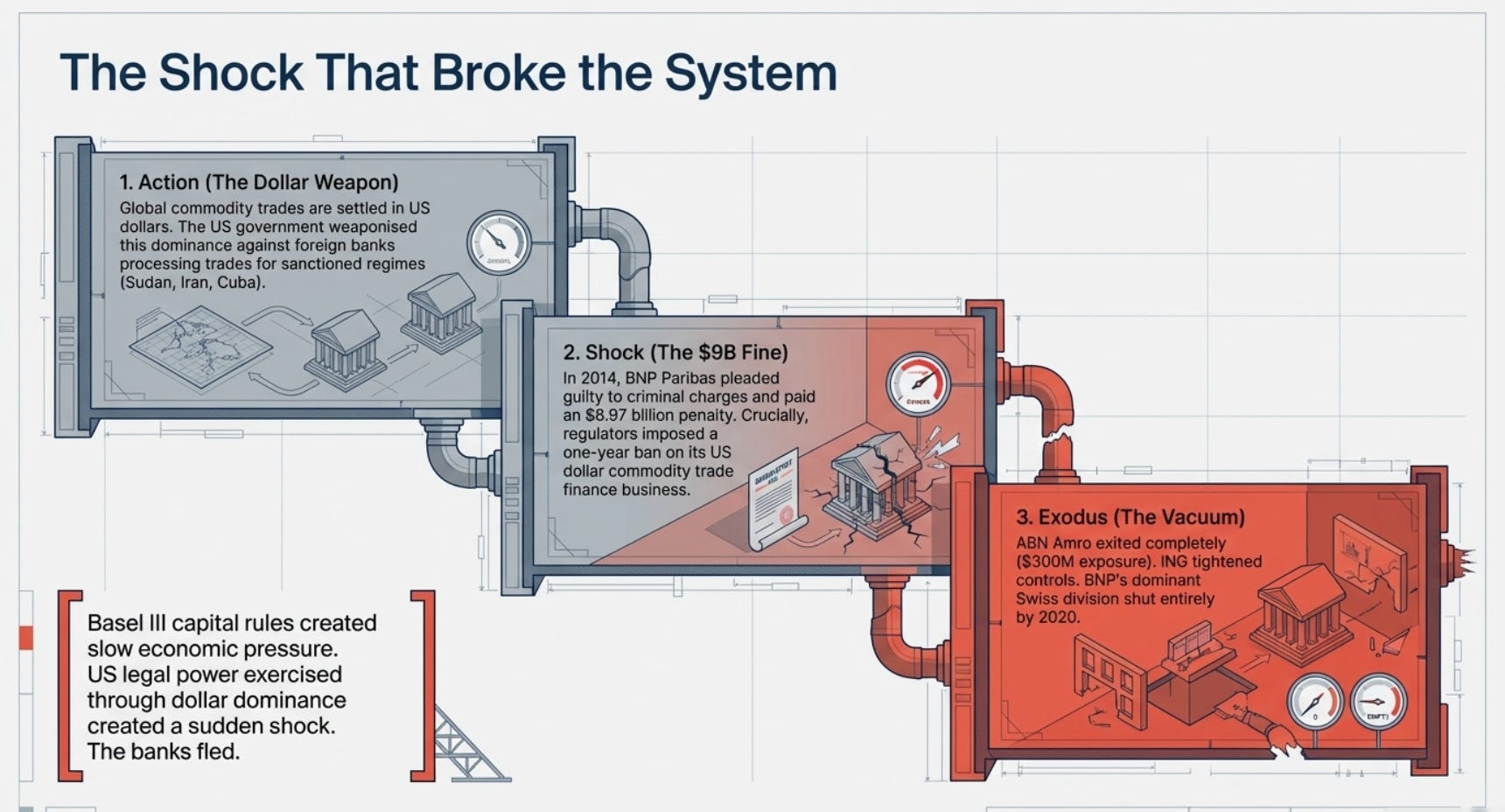
The DOJ made clear this was a message to the industry. “The sentencing of BNP Paribas and the $9 billion penalty should sound the alarm to international financial institutions,” prosecutors said at sentencing. That alarm was heard loudly. Many of the violations had centred specifically on BNP’s commodity trade finance operations in Geneva and Paris. BNP had been the dominant lender in the business, accounting for as much as half of some trading houses’ bank lines. From 2014 onward, it shrank steadily, and by 2020 its Swiss division — which had helped pioneer oil-trade letters of credit in the 1970s — shut entirely.
BNP was not alone. Deutsche Bank, Standard Chartered, and Commerzbank were all hit with large US enforcement actions during the same period. Each settlement sent the same message to every bank’s board: commodity trade finance, touching oil deals that routinely involved jurisdictions with US sanctions exposure, was now a legal liability. The result was industry-wide “de-risking” — not a careful recalibration, but a blunt withdrawal from entire business lines and geographies to eliminate any possible OFAC exposure. ABN Amro exited trade and commodity finance entirely. ING moved to stricter controls. BNP continued its retreat.
Then, in 2020, Hin Leong Trading — one of Asia’s largest fuel trading houses — collapsed with $3.85 billion in liabilities, and its founder admitted to hiding $800 million in losses while pledging the same oil cargo as collateral to multiple lenders simultaneously. For banks already looking for reasons to pull back, it was the final straw. ABN Amro, with $300 million in exposure, was gone. The pool of bank capital available to commodity traders — especially mid-tier and smaller ones — shrank dramatically and did not recover.
One footnote on Basel III, for completeness: it was a real but secondary headwind. The new capital rules treated commodity trade loans unfavourably relative to their actual collateral, making the economics marginally less attractive. The industry lobbied hard against this treatment, with some success. But Basel III created a slow economic pressure. The US sanctions actions were a sudden shock. They caused specific banks to make specific decisions on specific timelines. The primary mechanism driving banks out of commodity trade finance was American legal power exercised through dollar dominance — not capital weightings on a spreadsheet.
Part 3: Who Moved In — and Why They’re Different
Nature abhors a vacuum. So does capital.
Non-bank lenders stepped into the gap left by the banks. This category includes hedge funds, private equity firms, specialist trade finance funds, insurance companies looking for yield, and pension funds seeking returns above government bonds. Collectively, these are called “private credit” — meaning credit that doesn’t go through regulated banks, doesn’t trade on public markets, and isn’t subject to the same oversight.
The economic logic was sound. Because private lenders aren’t subject to Basel III capital requirements, they could lend to commodity traders on terms that banks could no longer justify economically. One mid-sized U.S. oil trader reported that non-bank financial institutions grew from providing zero percent of its credit lines to twenty percent within a single year.
But this substitution came with a hidden structural change that matters enormously.
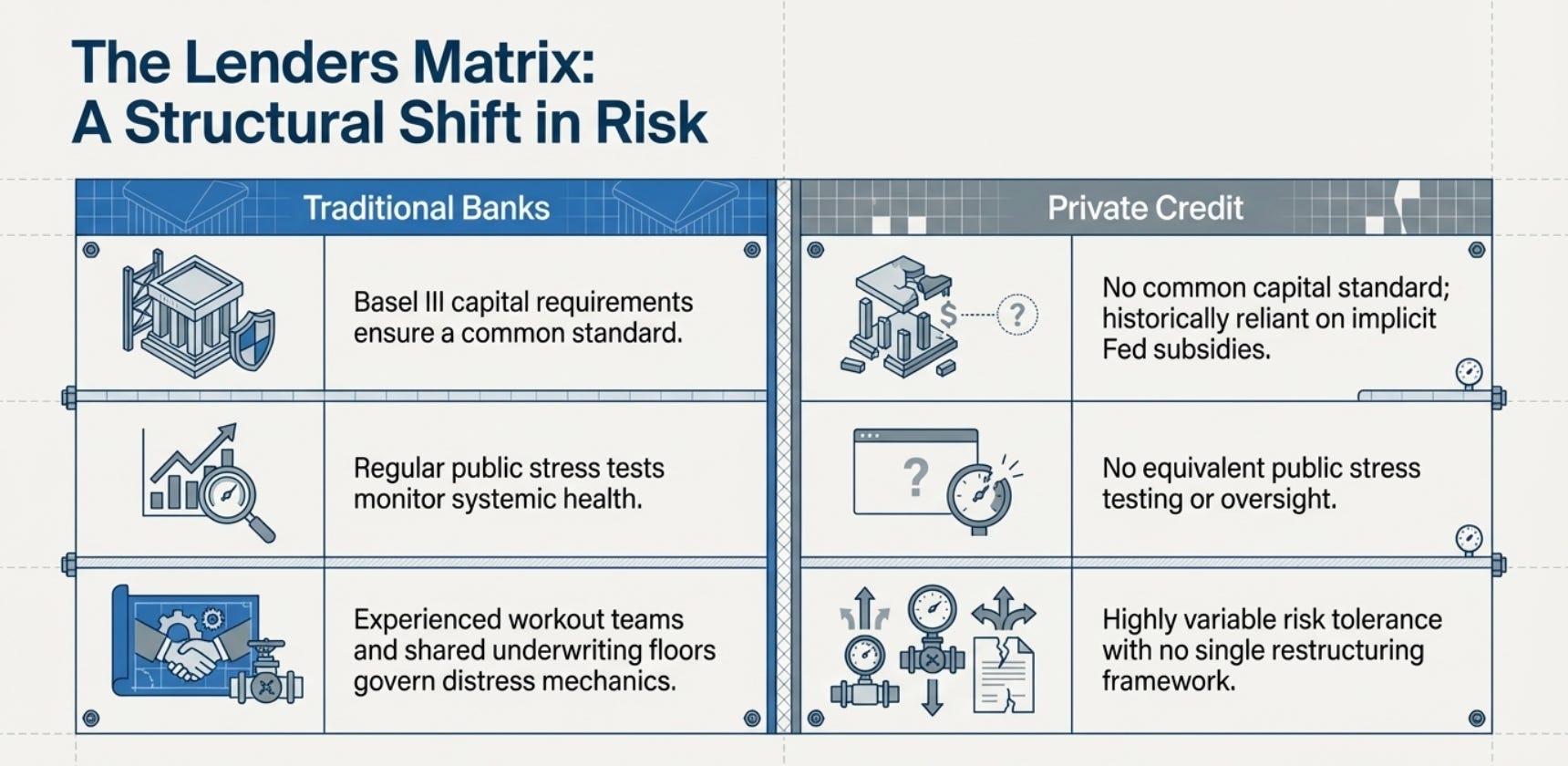
Banks, for all their bureaucratic slowness, operated inside a regulated system. They had standardised underwriting practices. They faced regular stress tests. When things went wrong, they had workout teams with experience in restructuring distressed loans. Critically, they were all subject to the same capital rules, which meant they had roughly comparable risk tolerances.
Private credit lenders are none of these things. There is no equivalent stress test. No common capital standard. No shared underwriting floor. Some are sophisticated funds with deep expertise in commodity markets; others are generalist direct lending vehicles that moved into commodity finance because yields looked attractive. Their mandates vary widely. Their risk tolerances vary widely. When a borrower gets into trouble, there is no single framework governing how private creditors respond.
As the American Banking Association noted, the concern is that “nonbank lenders will provide credit when times are good but disappear when times are tough.” The Federal Reserve highlighted that private credit’s current success is “partially based on an implicit subsidy from the Fed” — meaning that years of low interest rates made it profitable to lend aggressively, and that environment no longer exists.
Part 4: The Boom Years — When Everything Looked Fine
Between 2021 and 2023, commodity traders made extraordinary profits. The numbers are almost hard to believe.
Russia’s invasion of Ukraine in February 2022 scrambled the energy markets that had been stable for decades. Natural gas that normally flowed from Russia to Germany suddenly had to be rerouted. Oil markets went haywire. Grain prices spiked because Ukraine is one of the world’s great wheat exporters. For a trading house with the logistics network to navigate this chaos — finding alternative supply chains, exploiting arbitrage between disrupted and undisrupted markets — it was like being paid to solve a puzzle that nobody else could.
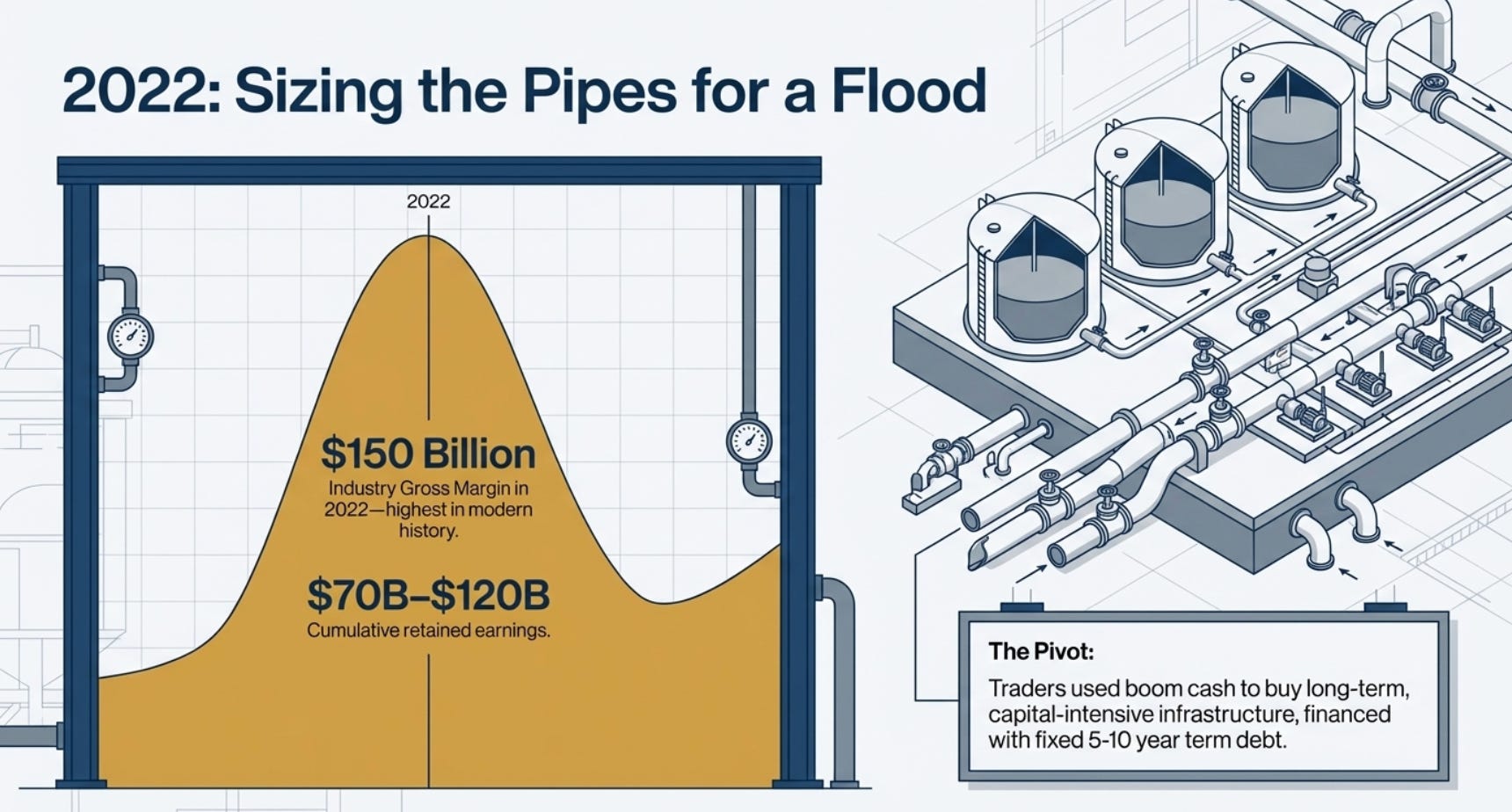
According to McKinsey’s research, commodity traders collectively generated around $150 billion in gross margin in 2022 — the highest in modern history. Trafigura alone reported net income of $7.4 billion in 2023 on revenues of $244 billion. Oliver Wyman, another consulting firm that tracks the industry, estimated that commodity firms retained somewhere between $70 billion and $120 billion in cumulative earnings during the boom years.
During this period, two things happened that are critical to understanding what came next.
First, traders used the boom to expand. They bought infrastructure — storage terminals, logistics networks, pipelines, refineries. These are long-term, capital-intensive assets. They require long-term debt to finance. A storage terminal doesn’t pay for itself in 90 days the way a commodity shipment does. So traders were now carrying genuine long-term debt on their balance sheets, not just short-term working capital borrowings.
Second, and this is the mechanism that creates most of the credit risk, traders expanded their revolving credit facilities — the core instrument of their business — to sizes that reflected their boom-era financial health.
Part 5: Answering the Critical Question — Aren’t Trades Short-Term?
This is the most important question in this whole story, and it requires a careful answer.
You might be thinking: if a commodity trade is only 30 to 90 days long, and it’s backed by a physical commodity as collateral, how does profit normalisation create a default problem? If the trade goes wrong, you just close it out and repay the loan. The loan is short. The collateral is real. Where’s the risk?
The answer lies in understanding that individual trades and the credit facility they’re drawn from are two completely different things.
Think of it like a credit card. Each individual purchase you make on a credit card is, in a sense, a short-term transaction — you buy something, you get value from it. But the credit card agreement itself is a multi-year relationship with your bank. The bank set your credit limit, your interest rate, and your terms based on your income at the time you applied. If your income later falls significantly, the bank can reduce your limit, increase your rate, or close the account entirely at renewal. The individual transactions don’t default. The relationship breaks down.
For commodity traders, the equivalent of your credit card agreement is a Revolving Credit Facility, or RCF. This is a multi-year commitment from a group of lenders — typically renewed annually for large traders, every 1 to 3 years for smaller ones — that sets how much a trader can borrow in total. Individual trades are drawn from this facility and repaid within 30 to 180 days. The facility itself, however, was sized and priced based on the trader’s financial health at the time it was established or last renewed.
Here’s where the problem lives. During 2022 and 2023, with profits at record highs, traders went to their lenders and said, in effect: “Look at our financials. We’re incredibly profitable. We want a bigger facility.” They got it. The facility was sized to match their boom-era balance sheet. Now profits have normalised — they’re still making money, just much less. When the facility comes up for renewal, lenders look at the new financials and do one of three things: they reduce the facility size, they raise the interest rate to reflect higher perceived risk, or in the worst cases, they decline to renew at all.
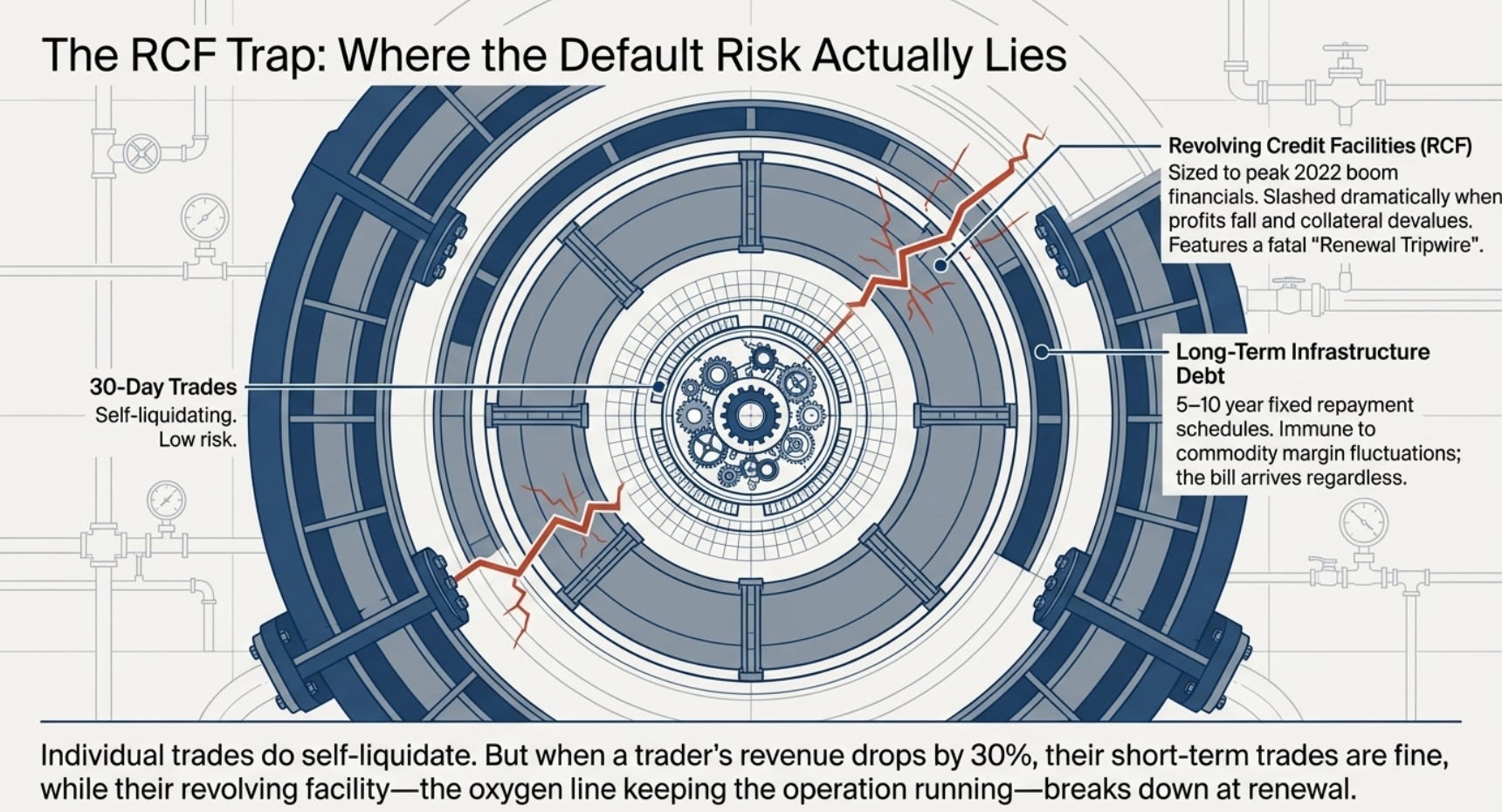
The second mechanism is the borrowing base. Many commodity trade facilities are structured so that the amount you can borrow is directly tied to the current market value of your inventory and receivables. If commodity prices fall — say, crude oil drops from $90 to $70 a barrel — the value of your collateral falls, and your available credit automatically shrinks. This happens in real time, regardless of when the facility renews. You might suddenly find yourself with $500 million less available credit than you had last month, with no change in your outstanding positions.
The third mechanism is the most direct: long-term debt for infrastructure. The storage terminals, logistics networks, and refinery stakes that traders bought during the boom were financed with genuine term debt — fixed repayment schedules, often 5 to 10 years. These don’t care what commodity margins are doing this quarter. The bill arrives on schedule.
So the complete answer to the short-term question is: individual trades do self-liquidate. But commodity trading companies carry three layers of credit exposure — short-term trade draws, medium-term revolving facilities, and long-term infrastructure debt. The middle and outer layers are where profit normalisation creates default risk. When a trader’s revenue drops by 30%, their short-term trades are fine. Their long-term infrastructure debt is a problem. And their revolving facility — the oxygen line that keeps the whole operation running — becomes uncertain at renewal time.
Part 6: Profits Have Normalised — By a Lot
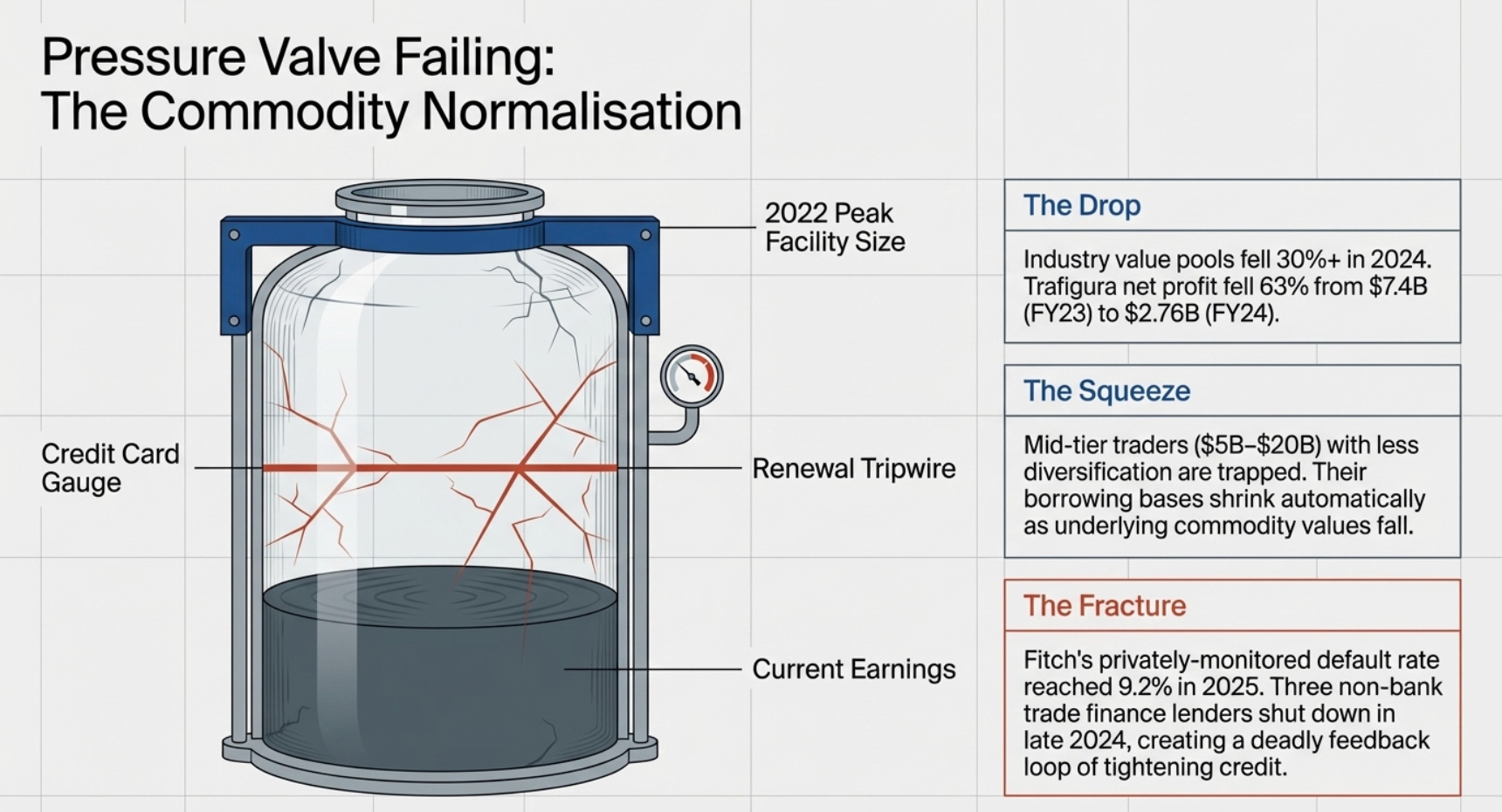
The boom is over. McKinsey’s 2025 research shows that commodity trading industry value pools fell by more than 30% in 2024 compared to 2023, with 2025 looking similar. Oliver Wyman is blunter: profits are trending 20% to 60% below 2023 levels across major trading books.
Trafigura is the clearest illustration. The company’s net profit fell from $7.4 billion in FY2023 to $2.76 billion in FY2024 — a drop of about 63%. Some of this was a specific fraud event (a $1.1 billion nickel fraud), but most of it was market normalisation. The extraordinary arbitrage opportunities created by Russia’s invasion had worked through the system. Other traders had entered the market to capture the same premiums. The special conditions that made 2022 and 2023 extraordinary no longer existed.
The smaller, mid-tier traders — those with revenues between $5 billion and $20 billion — experienced an even sharper squeeze. They had less diversification, less access to sophisticated derivatives hedging, and less balance sheet resilience. These are exactly the companies that lost bank access after Hin Leong and turned most aggressively to private credit lenders. They are also the companies whose boom-era credit facilities were sized most aggressively relative to their underlying earning power.
Part 7: The Numbers on Defaults
The data is now clear enough to say this is not a theoretical risk.
Fitch Ratings tracks a portfolio of privately-rated credit — companies too small or too risky to issue public bonds, who borrow entirely from private lenders. In 2025, the default rate in this portfolio reached 9.2%, up from 8.1% in 2024. The highest concentration of defaults is among the smallest issuers — companies with annual earnings below $25 million. These are the most leveraged, most reliant on private credit, and least able to absorb earnings declines.
A broader measure from J.P. Morgan puts the private credit default rate at around 2.4%. This lower figure reflects a wider universe that includes large, investment-grade borrowers. Both numbers are real — they’re measuring different cuts of the market. The commodity trade house stress shows up most sharply in the Fitch figure because it captures the segment most exposed: smaller, higher-leverage borrowers with concentrated commodity exposure.
At the end of 2024, a further signal appeared: three non-bank trade finance lenders shut down operations within a short period. When the lenders themselves start failing, the companies that depend on them face a further tightening of available credit, independent of anything they’ve done wrong. It becomes a feedback loop.
Part 8: Now Enter the AI Data Centres
This is where the story takes a turn from “specific industry stress” to “potential systemic problem.”
Private credit is now massively exposed to the AI infrastructure boom — and the structure of those loans has a strikingly similar problem to commodity trade finance, only worse.
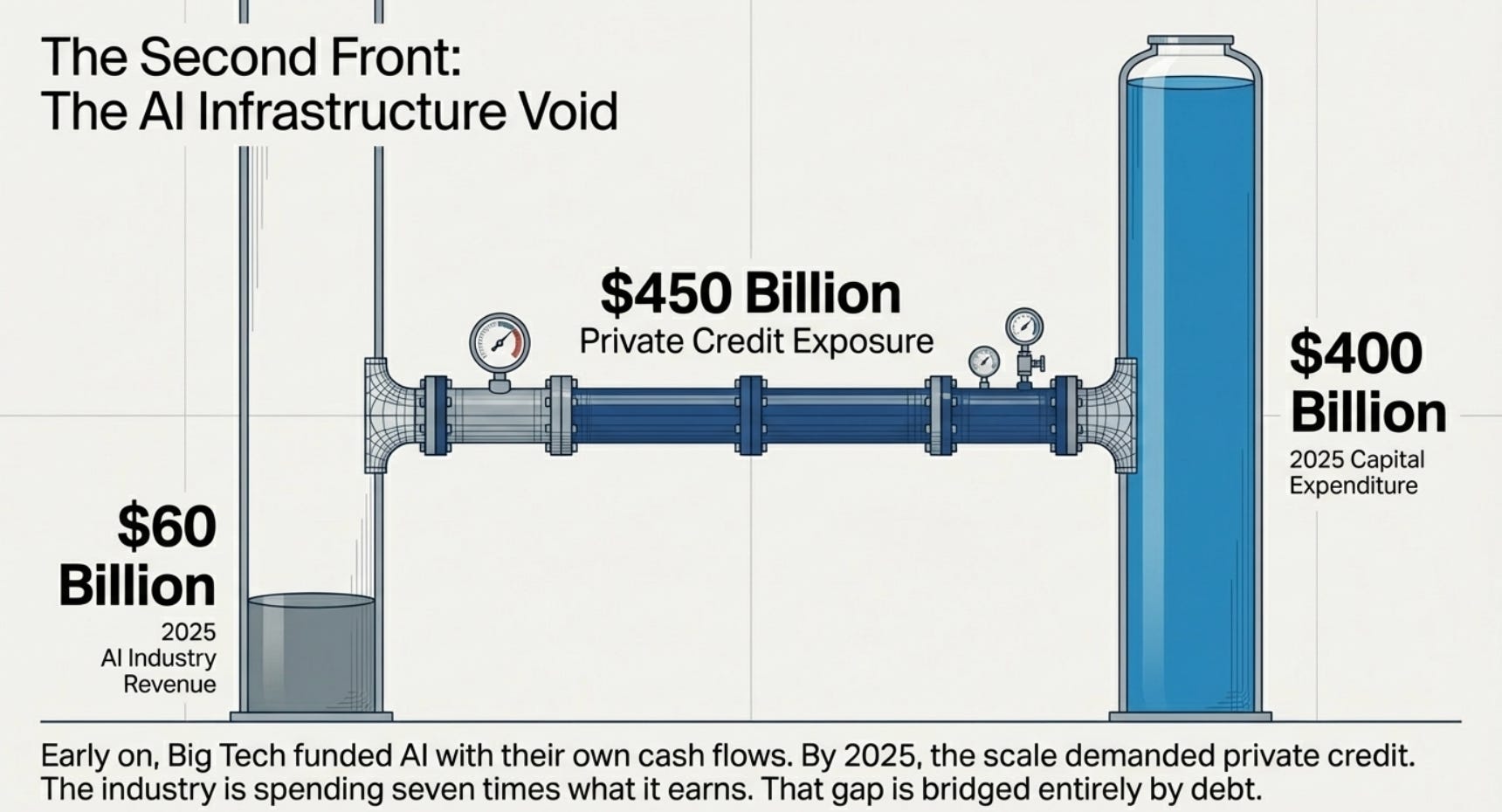
Here is the basic picture. Building the physical infrastructure needed to run advanced artificial intelligence requires enormous amounts of money. Data centres full of the specialised chips that AI models run on, the power infrastructure to keep them cool and running, the network connections that move data in and out — all of this costs hundreds of billions of dollars. Early in the AI boom, the big technology companies — Google, Microsoft, Meta, Amazon — funded this from their own cash flows. By 2025, that was no longer sufficient at the scale they wanted to build.
So they turned to private credit.
According to UBS data reported by Bloomberg, private credit funds had lent approximately $450 billion to the technology sector as of early 2025. Fortune reported that private credit funding for AI was running at around $50 billion per quarter — roughly $200 billion per year. At least $175 billion in data-centre-related US credit deals were struck in 2025 alone. JPMorgan and Mitsubishi UFJ are leading a $22 billion loan to support just one data centre company’s building plan. Meta is getting $29 billion from private credit investors for a single facility in Louisiana.
These numbers are extraordinary. The AI industry brought in approximately $60 billion in revenue in 2025 against roughly $400 billion in capital expenditure. The industry is spending seven times what it earns. That gap is being bridged entirely by debt — and a large portion of that debt is private credit.
Part 9: The Same Problem, But Backwards
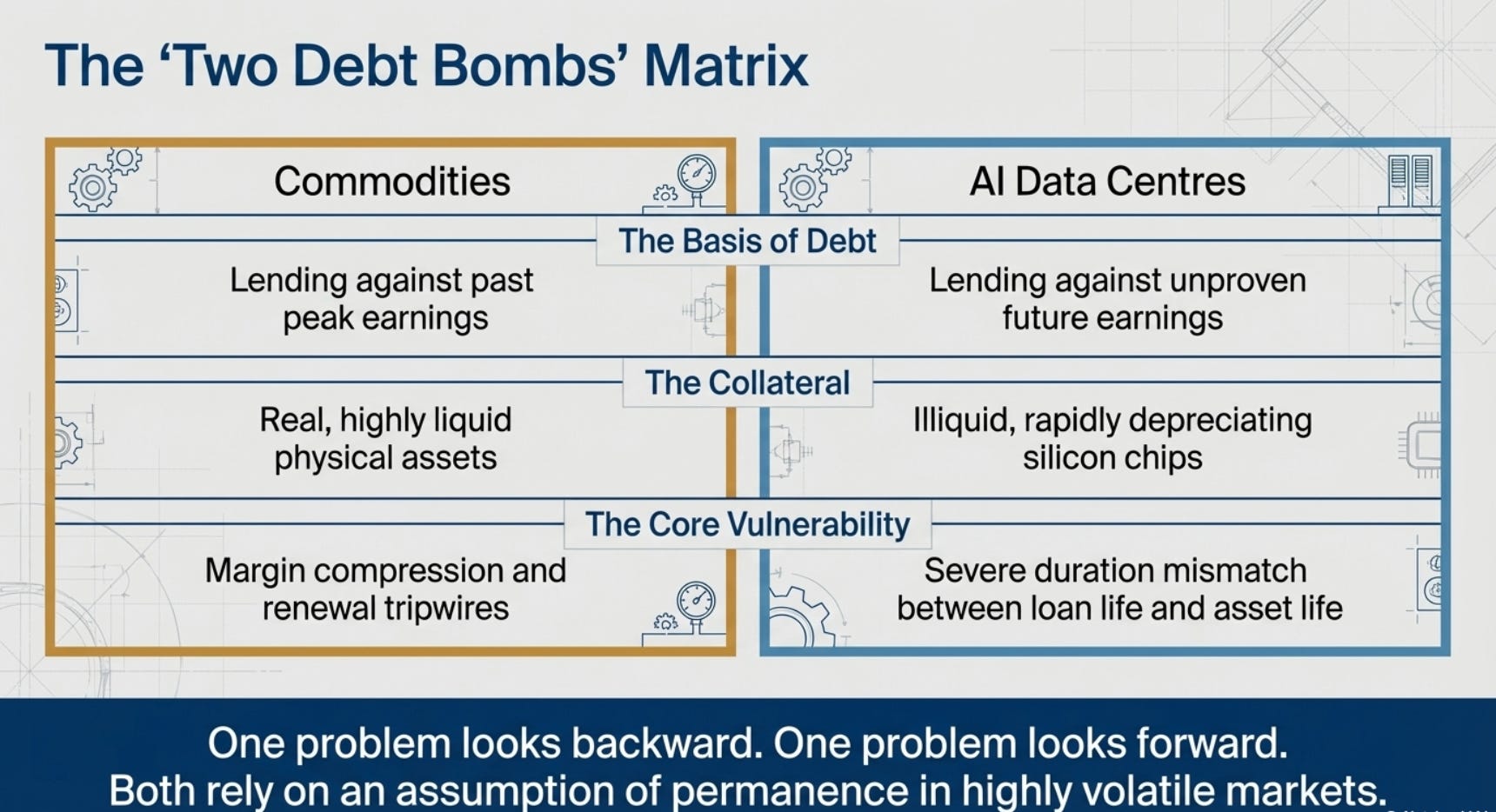
The commodity trade house problem is that lenders gave credit based on peak earnings, and now earnings have normalised. The AI data centre problem is the inverse, but equally structural: lenders are giving credit based on the assumption of future earnings that have not yet materialised, against collateral that depreciates faster than almost anything else in the investment universe.
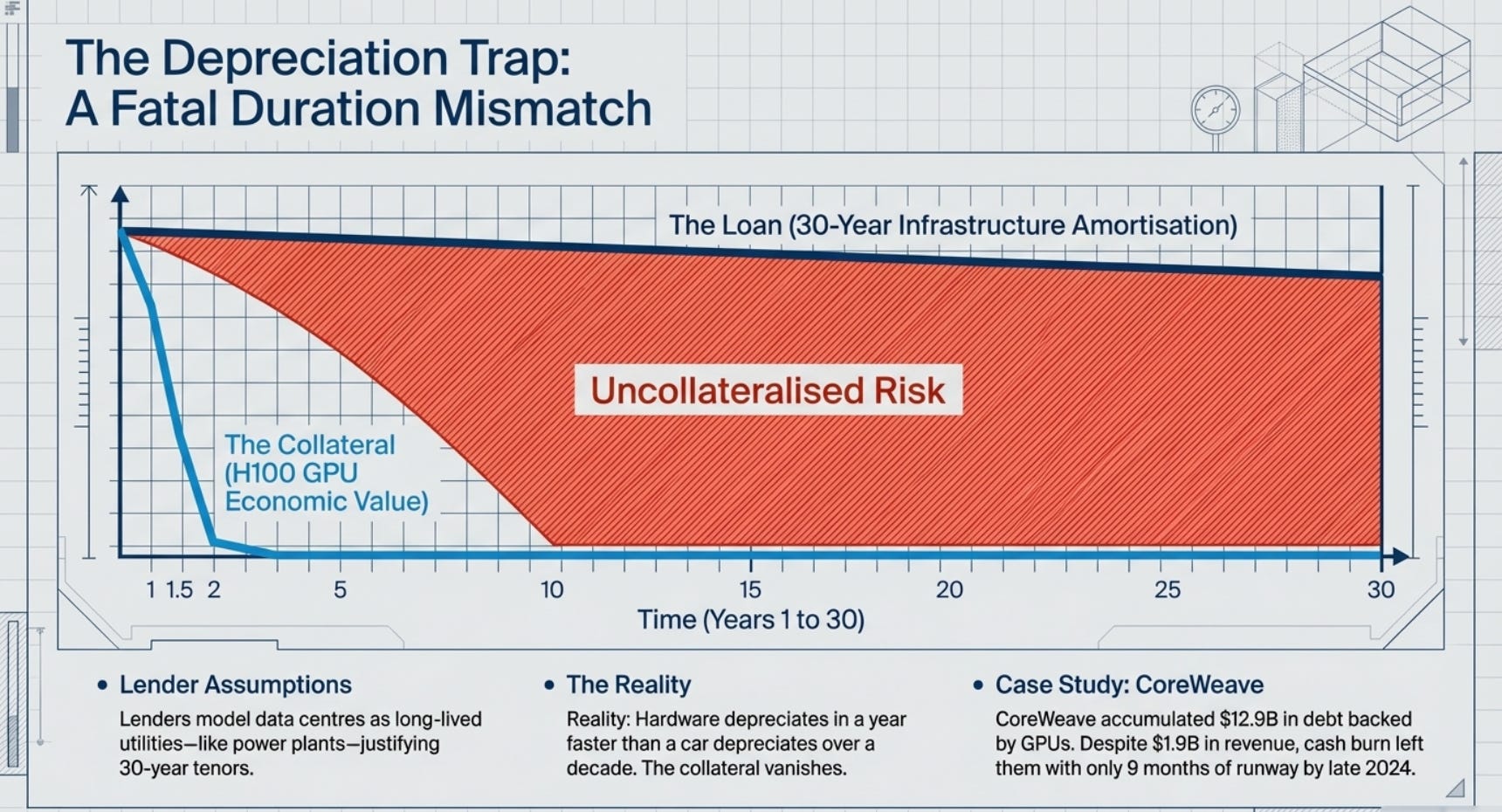
Consider what Man Group, a major hedge fund manager, identified in their research. Private credit lenders funding data centres believe they are financing long-lived infrastructure — comparable to commercial real estate or a power utility. Their models assume the assets they’re lending against will last 7 to 15 years and hold their value. This is how they justify long-term loans at relatively modest interest rates.
The problem, as Man Group put it, is that “the effective economic life of GPU and ASIC chips is approximately one year.” A data centre full of Nvidia’s H100 chips — the cutting edge of 2024 — faces severe competitive disadvantages against a facility with the next generation of chips. The hardware depreciates in a year the way a car depreciates over a decade, except faster. The collateral that the lender thinks they hold is, in real terms, depreciating at a rate their loan contract doesn’t account for.
S&P Global’s head of private market analytics put the tension plainly: “Data center deals are 20 to 30 year tenor fundings for a technology that we don’t even know what they will look like in five years.”
This is a structural mismatch between the duration of the debt and the real lifespan of the assets backing it. And as the BIS — the central bank for central banks — warned in March 2026, investment in AI infrastructure via off-balance-sheet debt is “increasing the exposure of insurers and private credit funds to hyperscalers,” with “structures that strengthen links between hyperscalers and non-bank investors” in ways that create concentrated risk.
The most vivid illustration is CoreWeave, an AI cloud provider. It accumulated $12.9 billion in debt in just two years, backed primarily by its GPU inventory and customer contracts. It attempted an IPO in early 2025 targeting a $35 billion valuation; it eventually priced at $23 billion and barely held that level on the first day. Despite revenue growing from $16 million in 2022 to $1.9 billion in 2024, the company was burning cash fast enough that, as of December 2024, it had only about nine months of runway. Shortly after the IPO, it sought $1.5 billion in additional high-yield debt — bonds that by definition carry elevated default risk.
Part 10: Why These Two Stories Are Actually One Story
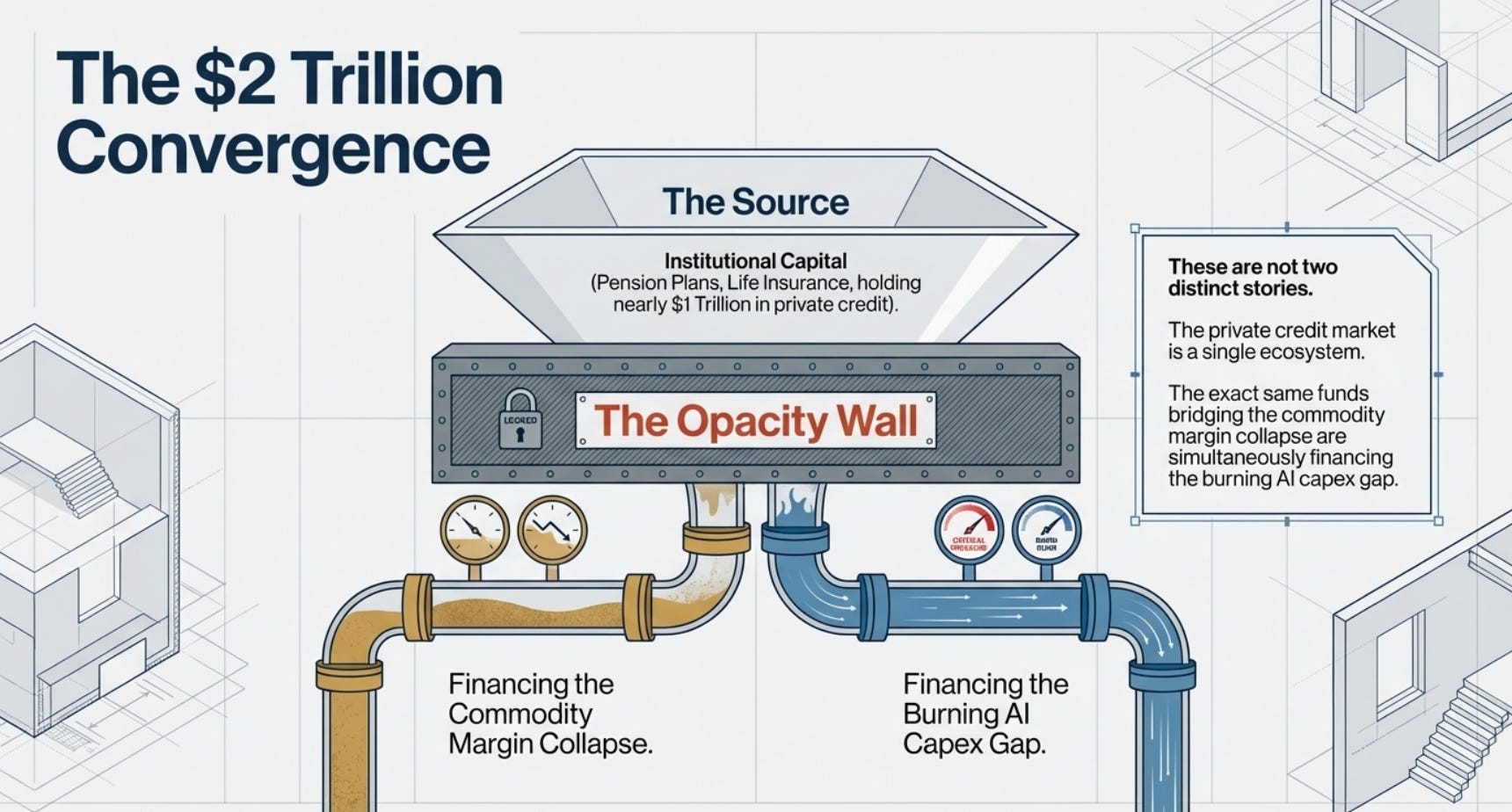
The private credit market is a single ecosystem. The same funds that lend to commodity trading houses to finance oil shipments are also lending to data centre operators to finance GPU farms. They pool these loans into funds and sell them to pension funds, insurance companies, and retail investment vehicles seeking yield above government bonds.
This matters because both stress points are hitting simultaneously. AND the risk is hidden from public eyes.
On the commodity side, you have profit normalisation compressing the earnings power of borrowers whose credit facilities were sized against peak performance. On the AI side, you have enormous new lending commitments against assets with deceptively short lifespans and against revenues that, on an industry-wide basis, don’t yet exist at a scale sufficient to service the debt.
A February 2026 study by the Federal Reserve Bank of Chicago found that while banks’ direct exposure to AI-adjacent industries averaged only 0.8% of their total assets, “banks most likely have additional exposure to AI-adjacent industries through lending to nonbank financial institutions” — meaning the private credit funds themselves. Separately, the Fed found that up to a quarter of all bank loans to non-bank financial institutions now go to private credit firms — up from just 1% in 2013. Major life insurance companies have nearly $1 trillion tied up in private credit. New York and Pennsylvania state pension plans are invested in funds directly financing AI data centres.
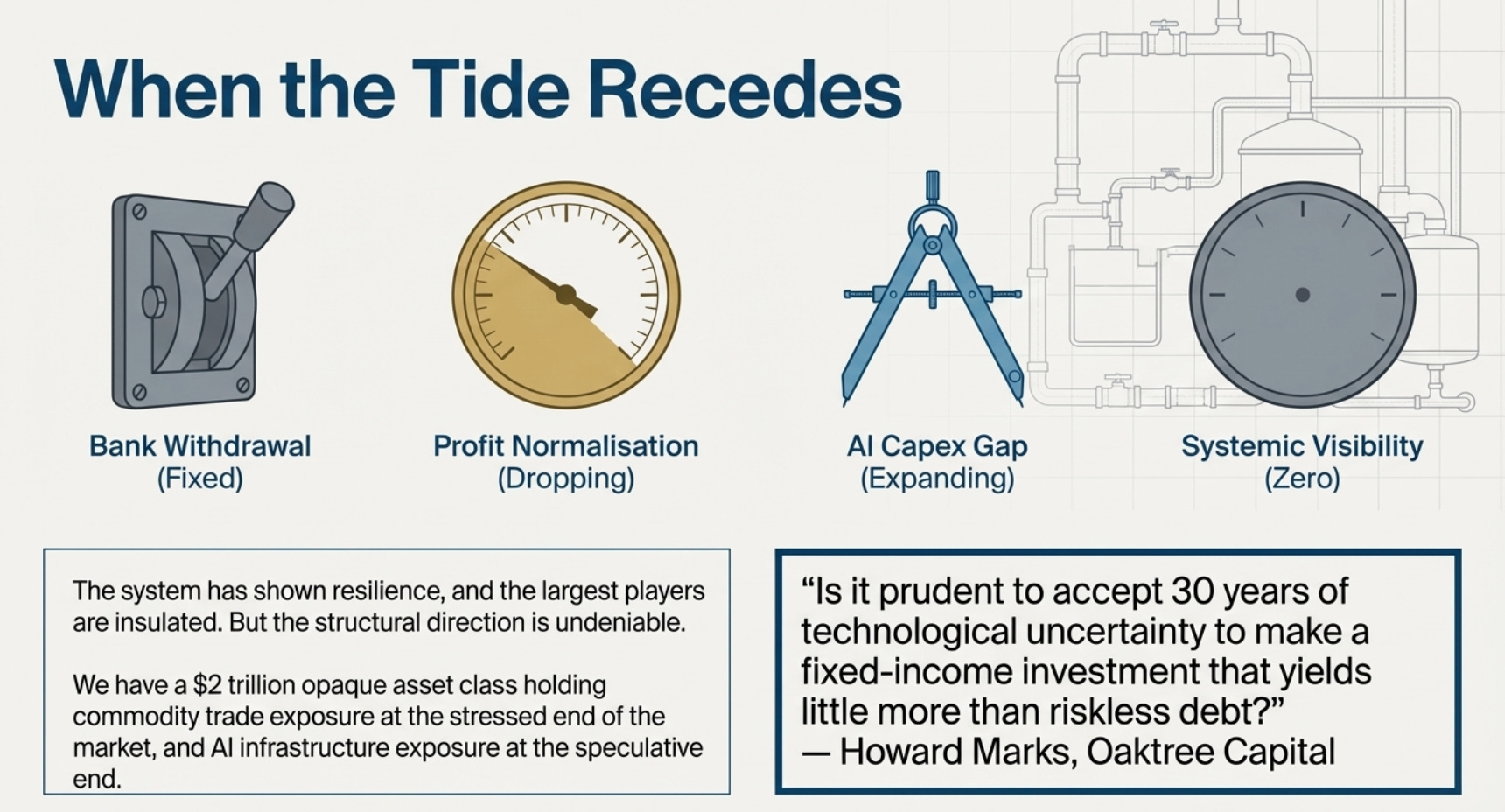
The private credit market is no longer a small alternative to mainstream lending. It is a $2 trillion asset class that is now deeply embedded in the broader financial system — holding commodity trade exposure at the stressed end of the market and AI infrastructure exposure at the speculative end.
When Howard Marks of Oaktree Capital publicly questioned whether it was “prudent to accept 30 years of technological uncertainty to make a fixed-income investment that yields little more than riskless debt,” he was asking exactly the right question. The market is pricing AI data centre loans as if they are utility-grade infrastructure. They are not.
Part 11: The Transparency Problem
There is one more structural feature that makes this harder to manage than comparable risk in public markets: almost none of it is visible in real time.
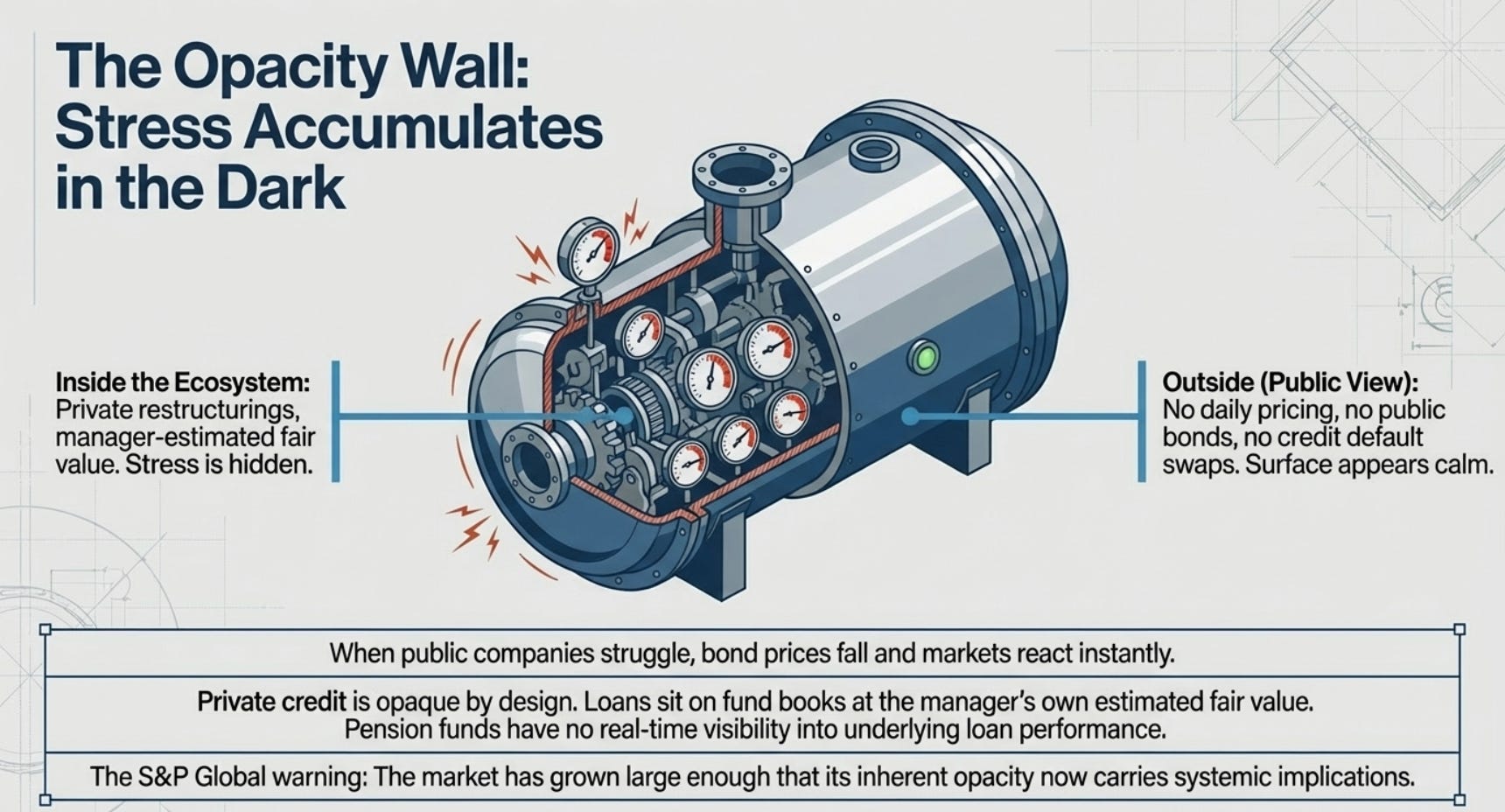
When a publicly traded company struggles to repay its bonds, you can see it. The bond price falls. Credit default swap spreads widen. Analysts cover it. Journalists write about it. The pressure on the borrower to address the problem is public and immediate.
Private credit is opaque by design. Loans sit on fund books at cost or at the fund manager’s own estimated fair value. There are no daily prices. Restructurings happen in private negotiations between the borrower and a small group of lenders who have every incentive to handle things quietly. Pension funds and insurance companies that are ultimately exposed to this risk often have no real-time visibility into whether the underlying loans are performing.
The result is that stress can accumulate in the system for a long time before it becomes visible — and when it does surface, it tends to surface suddenly. This is not a hypothetical; it is a documented feature of private credit markets. The S&P Global analysis noted that “questions about the transparency and measurement of credit risk in private credit funds” are increasingly prominent precisely because the market has grown large enough that its opacity now carries systemic implications.
What the Data Is Telling Us
Taken together, the picture is this.
The banks retreated from commodity trade finance for structural regulatory reasons. Private credit filled the gap, providing credit to exactly the traders most exposed to earnings volatility. That credit was extended most aggressively during a period of historically elevated profits. Repayment terms and facility sizes were calibrated to those elevated profits. Profits have since normalised by 30% to 60%, creating a mismatch between what was borrowed and what can be repaid — not on individual trades (which are indeed short-term and self-liquidating), but on the multi-year revolving facilities and infrastructure debt that underpin those trades.
At the same time, the same private credit market has committed hundreds of billions of dollars to AI data centre infrastructure — loans structured as if they’re financing 30-year power plants, against assets that depreciate in 12 months, for an industry spending seven times its revenue on building out capacity. The industry brought in $60 billion in revenue in 2025 against $400 billion in capex.
Fitch’s privately-monitored default rate has risen to 9.2% — the highest since the metric was tracked. Three non-bank trade finance lenders shut down in late 2024. The BIS, the Federal Reserve, and the Bank of England have all issued formal warnings. And the private credit market, which is now large enough to matter to the broader financial system, remains fundamentally opaque.
None of this means a crisis is imminent. The largest commodity traders are fine. The major AI hyperscalers — Google, Microsoft, Meta — are borrowing against cash flows that genuinely exist. The system has shown resilience.
But the direction is clear. The question is not whether there is stress. There is. The question is whether it can be absorbed gradually as it becomes visible, or whether the opacity and interconnectedness of the private credit market allows it to accumulate to a level that causes a more disorderly unwinding.
That is a question nobody in this market can answer with confidence. And that uncertainty, for a $2 trillion asset class underpinning pension funds, insurance policies, and the AI buildout of the decade, is itself worth paying attention to.
The Numbers, Plain and Simple
Commodity trading profit collapse: Industry gross margins fell from $150B in 2022 to $95B in 2024 — a 37% decline. Oliver Wyman projects 20-60% below 2023 levels across trading books.
Trafigura: Net profit fell from $7.4B (FY2023) to $2.76B (FY2024) — a 63% decline.
Private credit default rate: Fitch’s privately-monitored portfolio reached 9.2% in 2025, up from 8.1% in 2024. Highest concentration in small borrowers with EBITDA below $25M.
AI private credit exposure: $450B lent to tech sector (UBS/Bloomberg, early 2025). Running at ~$50B per quarter. At least $175B in data-centre credit deals struck in 2025 alone.
AI revenue vs. spending: ~$60B in industry revenue against ~$400B in capital expenditure in 2025. The gap is financed by debt.
Private credit market size: ~$2 trillion globally, roughly 10 times larger than in 2007. Morgan Stanley projects growth to $2.8 trillion by 2028.
Bank withdrawal: ABN Amro, BNP Paribas, and others exited commodity trade finance, triggering the structural shift to private lenders.
Sources: McKinsey & Company (2025 and 2024 Commodity Trading reports); Oliver Wyman (2025 Commodity Trading report); Fitch Ratings (2025, Privately Monitored Ratings); J.P. Morgan (Q1 2025 Private Credit Commentary); Man Group (The AI Bubble, 2025); Fortune (August 2025, December 2025); Alternative Credit Investor (November 2025); BIS Bulletin No.120 (March 2026); Federal Reserve Bank of Chicago (February 2026); Bank for International Settlements (March 2026); Quinn Emanuel Client Alert (March 2026); Prime Buchholz Research (February 2026); UBS/Bloomberg; S&P Global Market Intelligence; Global Trade Review; Watson Farley & Williams; American Banking Association.