
This is Part 2 of a continuing analysis of California Resources Corp (CRC). Part 1 built the foundational investment case: a company trading at $44 per share against a conservative intrinsic value of $108–$156, built on 567 million barrels of proved developed oil reserves in California, and a management team spending hundreds of millions buying back its own stock. If you have not read Part 1, start there. This piece builds directly on that foundation.
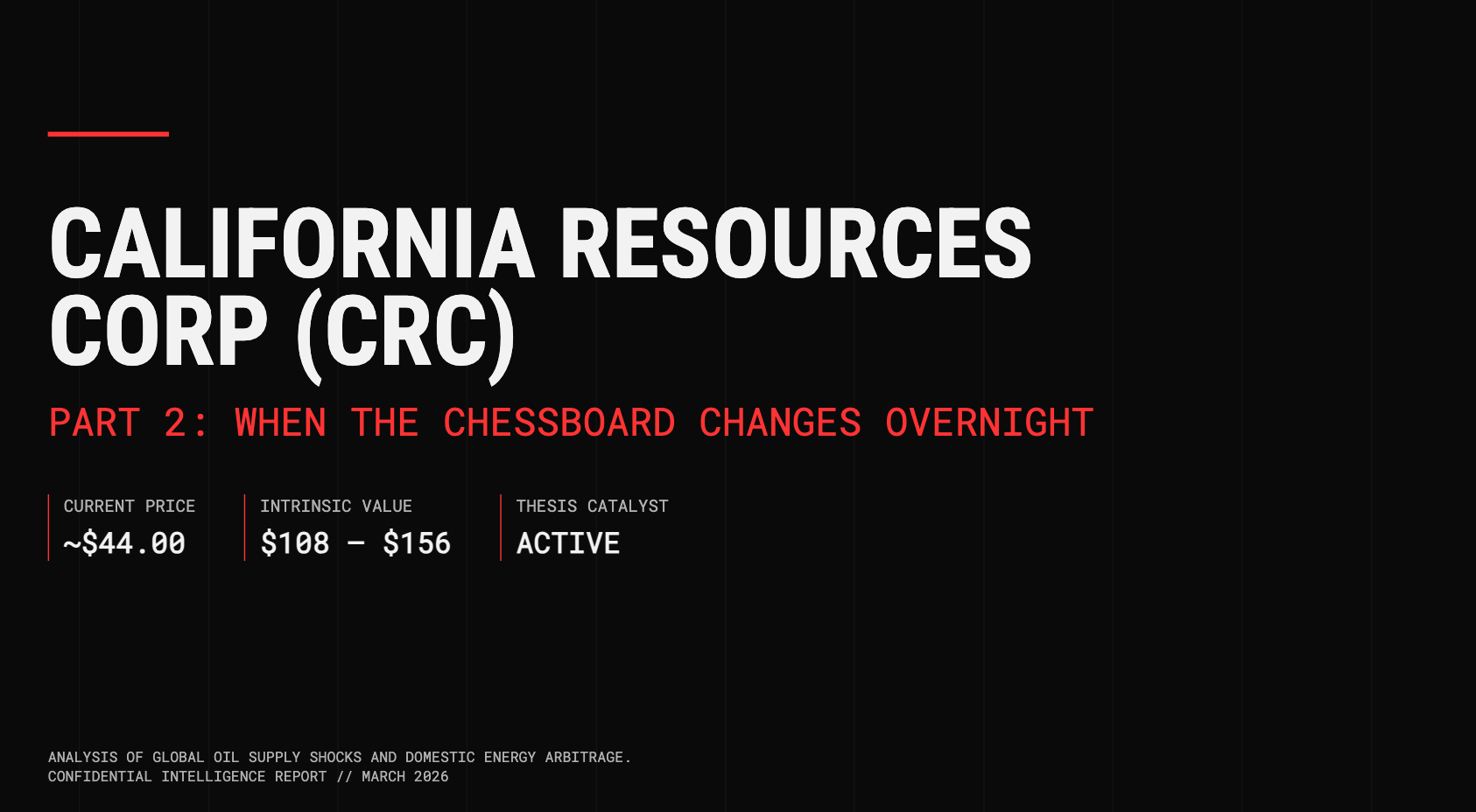
When I wrote Part 1, I was direct about the constraint on the thesis. The birds were in the bush. We were sufficiently sure they were there. But the honest answer to how long until you get them out was: not immediately. The oil market was in structural oversupply. The IEA was projecting supply surpluses stretching through 2026. Brent was drifting toward $58. The mechanism for the market to finally recognize CRC’s value — rising oil prices — looked like a 2–4 year waiting game.
As of March 2, 2026, that wait is over.
Not because supply and demand gradually corrected. Not because OPEC finally held discipline. But because 20% of the world’s oil supply vanished through a 21-mile waterway in 48 hours, and the reasons it will not return quickly are rooted in some of the oldest and most stubborn forces in military organization, geopolitical psychology, and institutional behavior.
This article explains clearly and in full what happened, why the disruption will last months rather than the weeks Washington is claiming, and why California Resources Corporation is positioned to be the single most direct domestic beneficiary of what just began.
Part I: The Artery That Bled Out Overnight
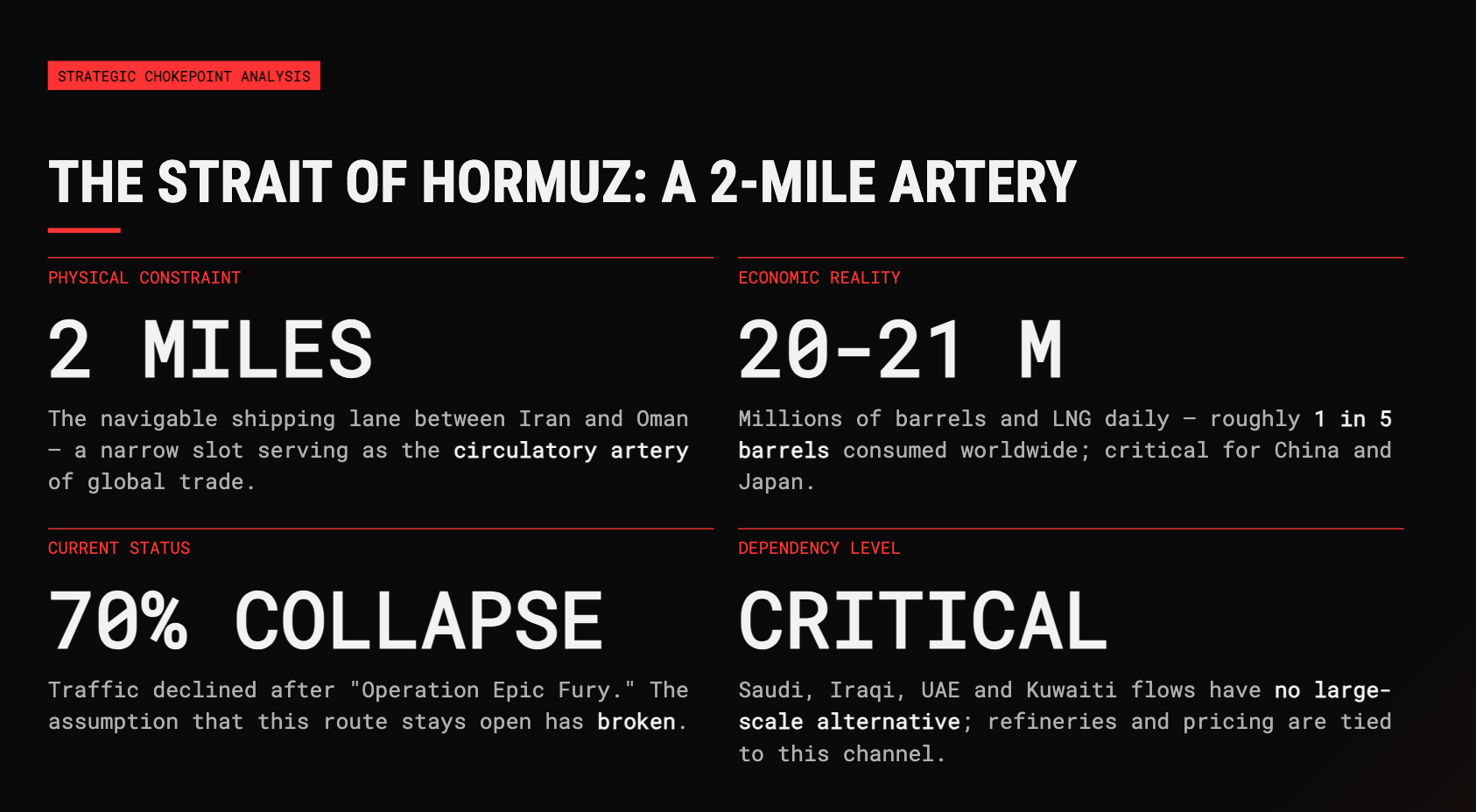
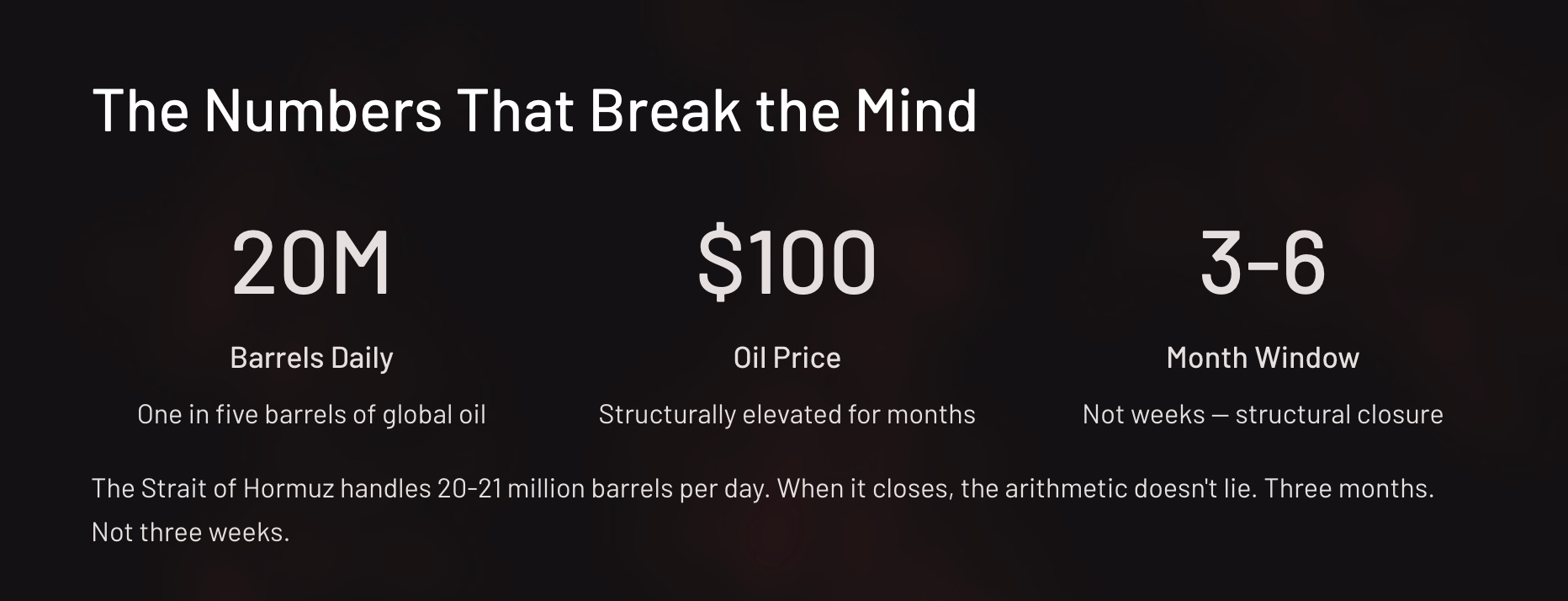
The global oil market is, at its core, a logistics bottleneck. While most chokepoints handle a fraction of global flow, the Strait of Hormuz controls 20% of the entire world’s oil supply. This two-mile-wide gap between Iran and Oman is the narrowest, most critical “slot” on the planet. To put that in your driveway: one in every five barrels of oil consumed on Earth passes through this single point.
When this artery bleeds out, the impact isn’t just a statistic—it’s a systemic shock to your daily life:
The Gas Pump: Imagine 20% of gas stations simply running dry. Prices don’t just rise; they verticalize as nations frantically outbid each other for the remaining supply to keep their power grids alive.
The Grocery Store: Almost everything you eat is moved by diesel. When that 20% vanishes, the cost of shipping a box of cereal can suddenly exceed the cost of the food itself, leading to empty shelves and “delivery unavailable” notices.
The Tech Supply Chain: The Strait also carries the Liquefied Natural Gas (LNG) that powers the massive factories in Japan and South Korea. If their lights go out, the production of the semiconductors in your phone and the parts for your car stops dead.
The nation’s electricity: Approximately 95% of Singapore’s electricity is generated from imported natural gas. A significant portion of this gas is piped from Malaysia and Indonesia, Liquefied Natural Gas (LNG) — primarily from the Middle East (specifically Qatar, which provides 45%) — constitutes a substantial and increasing share of the total fuel mix. Do the math.
For seventy years, the global economy operated on one load-bearing assumption: this waterway stays open. It was a foundation so fundamental it was rarely even modeled for risk. On March 2, 2026, that assumption shattered.
What Has Confirmed As of March 5, 2026
Here is the confirmed picture, not the speculative one.
The IRGC Navy — the maritime branch of the Islamic Revolutionary Guard Corps — has been broadcasting VHF (radio) warnings on standard maritime emergency channels, telling commercial vessels that no ship is permitted to pass. This is not a press statement from a government spokesperson. It is the real-time operational warning that a ship captain receives on his bridge, in the same moment his crew is watching Iranian fast attack boats in the water around him. Tanker tracking data shows a roughly 70% collapse in traffic through the Strait in the 72 hours following Operation Epic Fury — not a marginal disruption but a near-total halt of one of the world’s most critical logistics corridors.
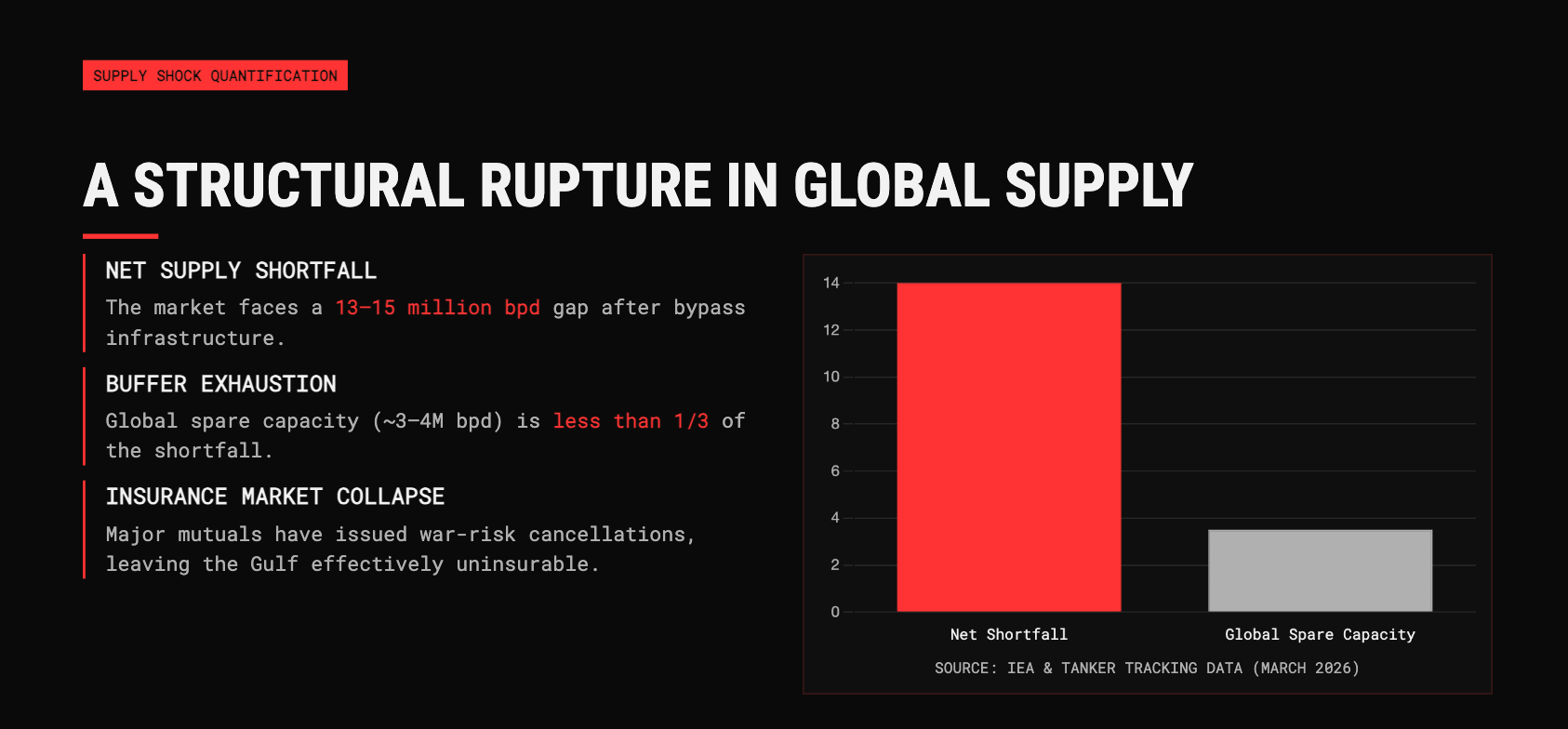
Saudi Arabia’s Ras Tanura refinery — approximately 550,000 barrels per day of processing capacity and one of the most strategically critical pieces of energy infrastructure on Earth — was struck by an Iranian drone and forced into a temporary shutdown. Dubai International Airport, a hub critical for the logistics coordination that the regional energy industry depends on, has been disrupted. Marine insurers including Gard, Skuld, NorthStandard, and The American Club issued war-risk cancellation notices effective March 5, making commercial transit through the Persian Gulf effectively uninsurable at standard terms.
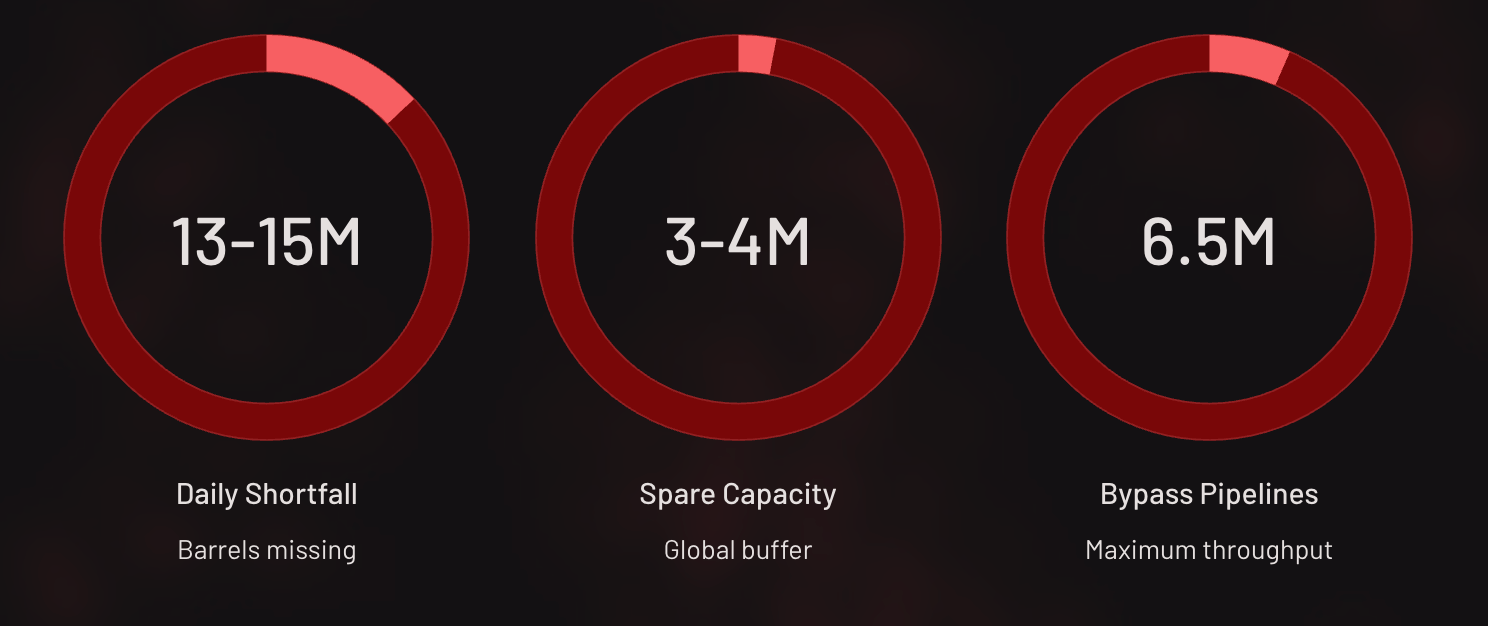
The global oil market is staring at a net supply shortfall of roughly 13–15 million barrels per day after accounting for all bypass infrastructure. To understand what that number means: the entire global spare production capacity — every idle barrel that all producers in the world could theoretically bring online quickly — was estimated by the IEA at roughly 3–4 million barrels per day before this crisis began. The shortfall is more than three times the size of the world’s entire available buffer. There is no slack in the system to absorb it.
This is not a geopolitical flare-up. It is a structural rupture in the plumbing of the global economy — and the question that matters for investors is not whether it happened but how long it lasts.
Part II: The Three Escape Valves — And Why None of Them Work
When a critical system breaks, the first instinct of engineers — and markets — is to reach for the bypass. Where else does the oil come from? How does the market compensate? This is the right question. The problem is that when you do the actual arithmetic instead of the hand-waving, none of the three most commonly cited solutions comes close to filling the hole.
Bypass Pipeline One: Saudi Arabia’s East-West Pipeline
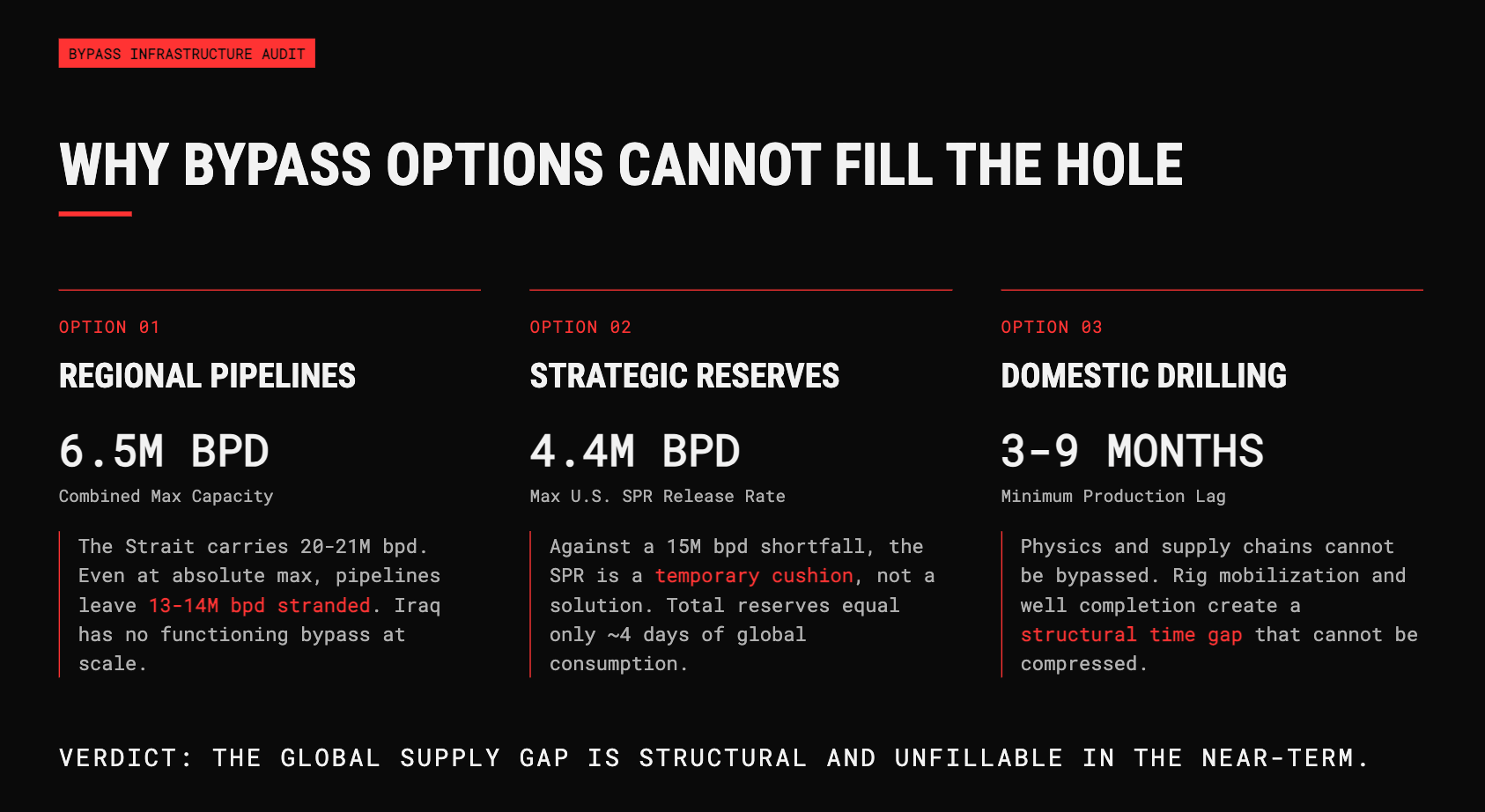
Saudi Arabia built the East-West Pipeline specifically to reduce its dependency on Hormuz, running westward from the oil fields of the Eastern Province across the full width of the Arabian Peninsula to the Red Sea port of Yanbu. Its maximum practical throughput is approximately 5 million barrels per day. The UAE has the Habshan-Fujairah pipeline, routing crude from inland production to the Gulf of Oman coast, bypassing the Strait entirely, at a capacity of 1.5–1.8 million barrels per day.
Together — assuming both pipelines are running at absolute maximum capacity without disruption from the ongoing Iranian drone campaign that has already struck Ras Tanura nearby — you can reroute approximately 6.5–6.8 million barrels per day around the blockade.
The Strait carries 20–21 million. The pipelines cover 6.5 million. The remaining 13–14 million barrels per day have nowhere to go. No pipe, no port, no rail line, and no shipping route can absorb that volume on any near-term timeline. The bypass infrastructure that Gulf states spent decades building handles roughly one-third of their normal export volume. The other two-thirds of normal exports has no alternative path to market.
Iraq adds another dimension that rarely gets mentioned. Iraq exports approximately 3.4 million barrels per day, almost entirely through the Basra Oil Terminal on the Shatt al-Arab waterway at the northern end of the Persian Gulf. Iraq has no functioning bypass pipeline to the Mediterranean or the Red Sea at meaningful scale. Iraqi oil is effectively landlocked by the closure.
Bypass Option Two: The Strategic Petroleum Reserve
The United States Strategic Petroleum Reserve holds approximately 415 million barrels of crude oil in underground salt caverns along the Gulf Coast — the world’s largest government-held reserve, built for exactly this kind of emergency. At its maximum release rate of about 4.4 million barrels per day, a full SPR drawdown over 95 days would put roughly 4.4 million barrels per day into the market.
That sounds meaningful. Against a 13–15 million barrel per day shortfall, it contributes roughly 30% — a meaningful cushion but not a solution. The current administration has publicly stated it is not considering an SPR release. Even setting that aside, the arithmetic has a harder constraint: 415 million barrels at global consumption of approximately 100 million barrels per day is roughly four days of world consumption. The SPR was sized for temporary disruptions of weeks, not for structural closures measured in months. Releasing it does not solve the shortage; it defers the price impact while depleting the reserve, which then becomes unavailable for the actual resolution phase of the crisis.
Bypass Option Three: Ramping Up Domestic Production
This is the option that sounds most powerful and is the most commonly misunderstood — because it treats the decision to produce more oil as equivalent to the arrival of that oil in the market. They are separated by a physical gap that no price signal, political directive, or executive order can compress.
The United States produces approximately 13.5 million barrels per day and is the world’s largest oil producer. High prices will absolutely trigger additional drilling — that is how the market functions and it will function. But here is the precise physical sequence between a producer deciding to drill a new well and the first additional barrel reaching a refinery: a drilling rig must be contracted and mobilized (rig availability is finite — roughly 480 active land rigs were operating in the U.S. in late 2025, and you cannot manufacture new ones quickly); steel casing, wellbore equipment, and completion materials must be ordered and delivered on 6–12 week lead times; the well must be drilled over 2–6 weeks depending on depth and formation; the well must be hydraulically fractured using specialized pressure pumping equipment and crews that are also in finite supply; production equipment must be installed; the well must be connected to a gathering system. Only then does any new barrel flow.
This complete sequence takes a minimum of 3–9 months for the fastest shale plays in America — the Permian Basin, Eagle Ford, and Bakken. For conventional projects, deepwater Gulf developments, or Canadian oil sands expansion, the timeline extends to years. This is not a regulatory problem that could be streamlined away. It is physics and supply chain logistics. You cannot drill a well faster than steel can be manufactured, shipped, and installed.
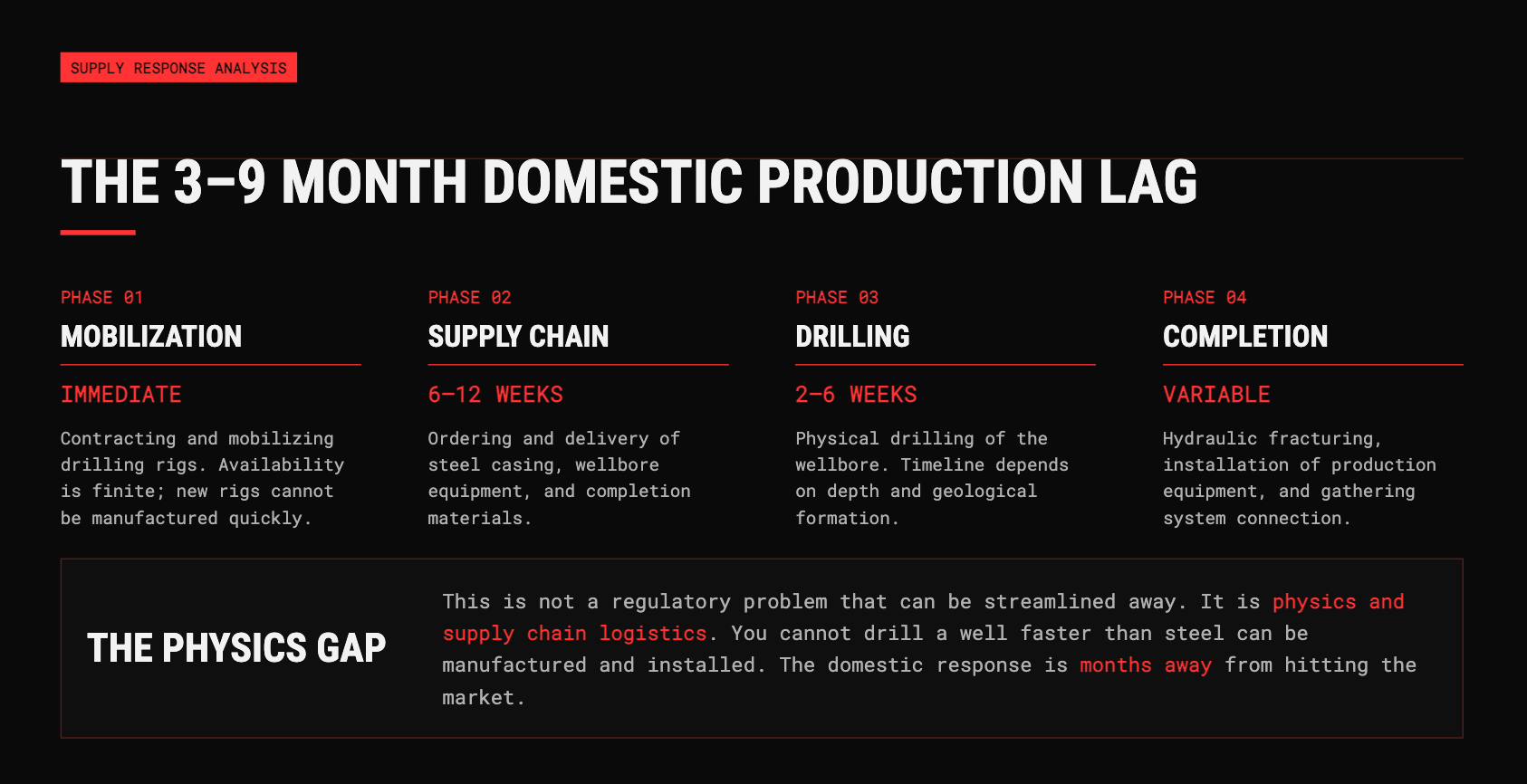
What this means is precise: in the first 3–9 months of this supply shock, the domestic production response that will eventually come has not arrived yet. The world has lost 13–15 million barrels per day, the global buffer is 3–4 million barrels per day of spare capacity, and the domestic response is months away. That gap is real, structural, and the defining feature of the window that this crisis creates.
The Boom-Bust Cycle That Closes the Window
Intellectual honesty requires acknowledging what happens after the opening phase. The domestic production response will eventually arrive — and when it does, it typically overshoots.
The mechanism is well-established in commodity market history. High prices incentivize every producer, large and small, to drill aggressively. Those decisions are made independently by hundreds of operators without coordination, each one rationally responding to the price signal in front of them. When all of those decisions materialize into actual production 9–18 months later, the combined supply addition often exceeds what is needed to close the original gap — particularly if the geopolitical situation has also partially resolved by then. The price that justified the drilling is no longer sustainable once the new supply arrives, and it corrects sharply. We saw exactly this pattern after 2008, after 2014, after 2022. High prices sow the seeds of their own correction by inducing the very production surge that ends the price regime.
But the oversupply arrives after the boom. The window — the period of structurally elevated prices — exists between now and when the domestic production surge hits the market. The question for investors is not whether prices eventually normalize (they will), but whether they remain elevated long enough for well-positioned producers to capture the economics of the crisis period. For reasons addressed in the conclusion, CRC’s position makes it the optimal vehicle for capturing that window without committing to the capital that exposes new drillers to the post-boom correction.
First, we need to establish why the window lasts months rather than the weeks being claimed in Washington.
Part III: Why the Window Lasts Months, Not Weeks
What Is Actually Keeping the Strait Closed — And Why It Is Not Simply Removed
The first thing to be clear about is what the blockade consists of. There are no mines in the Strait. The closure is not a passive physical barrier. It is an active military denial operation being conducted by the IRGC Navy and coastal defense forces, in real time, against vessels attempting to transit.
The IRGC maintains a substantial network of capabilities specifically designed for this mission. Along the Iranian coastline above the Strait, it operates shore-based anti-ship missile batteries carrying systems including the Noor, Qader, and Khalij Fars missiles — the last of which is specifically optimized for striking large surface vessels at relatively close range, including supertankers. Alongside the fixed coastal batteries, the IRGC deploys large flotillas of fast attack craft — small, low-profile, high-speed boats capable of swarming tactics around larger vessels — as well as drone launch infrastructure dispersed across coastal positions. This is not a single target. It is a distributed network of threats operating from a coastline that the IRGC controls, which ranges from fixed hardened installations to mobile units that can be repositioned and concealed.
The practical effect on commercial shipping is not that tankers are hitting obstacles in the water. It is that every ship captain who approaches the Strait knows that IRGC fast boats may swarm his vessel, that shore-based missiles have his ship in their targeting solution, and that commercial marine insurance has been withdrawn. The rational commercial response — the response that every professional mariner with a $200 million vessel and 30 crew members is making — is to not transit. Not because it is physically blocked by a barrier, but because the military threat makes it operationally suicidal.
Suppressing that threat requires a distributed network. Intelligence assessments put Iran’s total inventory of anti-ship capable missiles and drones in the tens of thousands, distributed across 32 provincial IRGC commands. U.S. air strikes can and have hit known fixed positions. But targeting a mobile, dispersed network of missiles, fast attack boats, coastal drone launchers, and their supporting logistics across hundreds of miles of Iranian coastline — and doing so thoroughly enough that a commercial tanker captain would feel confident transiting — is a task measured not in days but in months of sustained operations. That is why Trump’s 4–5 week claim does not survive contact with the physical reality of what needs to happen.
The Governance Vacuum — Why “Removing the Regime” Doesn’t Solve the Strait
There is a second, deeper problem with the 4–5 week narrative that is rarely examined clearly: it assumes that if the U.S. succeeds in removing the Islamic Republic’s central government, the Strait problem is solved. It is not. In fact, a successful regime removal without a functioning replacement government could make the Strait problem worse, not better, and could extend the closure for far longer than a scenario in which the regime survives in degraded form.
To understand why, consider what “regime change” has actually looked like in the two most comparable modern cases: Iraq in 2003 and Libya in 2011.
In Iraq, the United States removed Saddam Hussein’s government in 21 days. The statue came down. The regime was gone. And then began a decade of sectarian warfare, insurgency, and political chaos during which Iraqi oil production — which should have recovered and expanded rapidly given the country’s enormous reserves — instead took years to approach pre-invasion levels. The Basra oil terminal was disrupted repeatedly. Infrastructure was sabotaged. Competing factions fought for control of oil revenues. The physical capability to produce and export Iraqi oil existed throughout this period. The political and security conditions to do so reliably did not.
Libya in 2011 followed the same pattern. NATO air power removed Gaddafi’s government. The regime was gone. What followed was a civil war between competing armed factions that is, in meaningful ways, still ongoing more than a decade later. Libyan oil production, which stood at 1.6 million barrels per day before the revolution, collapsed to near zero and took years of fragile political arrangements just to recover to a fraction of its former level.
How do we get there?
In order to get there, the new government must overcome the 31 surviving, fully intact, autonomous IRGC provincial commands — each with its own weapons, funding, and operational independence. These organizations do not cease to exist when Iran’s key authority collapses. They become de facto warlord territories: armed, ideologically committed, and locally entrenched across the geography of the country. The coastline adjacent to the Strait of Hormuz is physically controlled by these provincial commands. They do not leave because a government in Tehran has been removed. They are already operating autonomously. In a power vacuum, they may actually become more intractable, not less, because the formal government that could theoretically negotiate on their behalf no longer exists.
This is the paradox at the heart of the regime-change strategy: with the assassination of the 48 leaders along with Ali Khamenei, the U.S. literally destroyed their only route that could negotiate a diplomatic resolution to the Strait closure. Removing it without a viable replacement does not produce a post-conflict stabilization. It produces a fragmented, unaccountable collection of armed factions controlling Iranian territory, with no single authority capable of agreeing to anything and no mechanism for enforcing any agreement that was reached.
The Four Locks
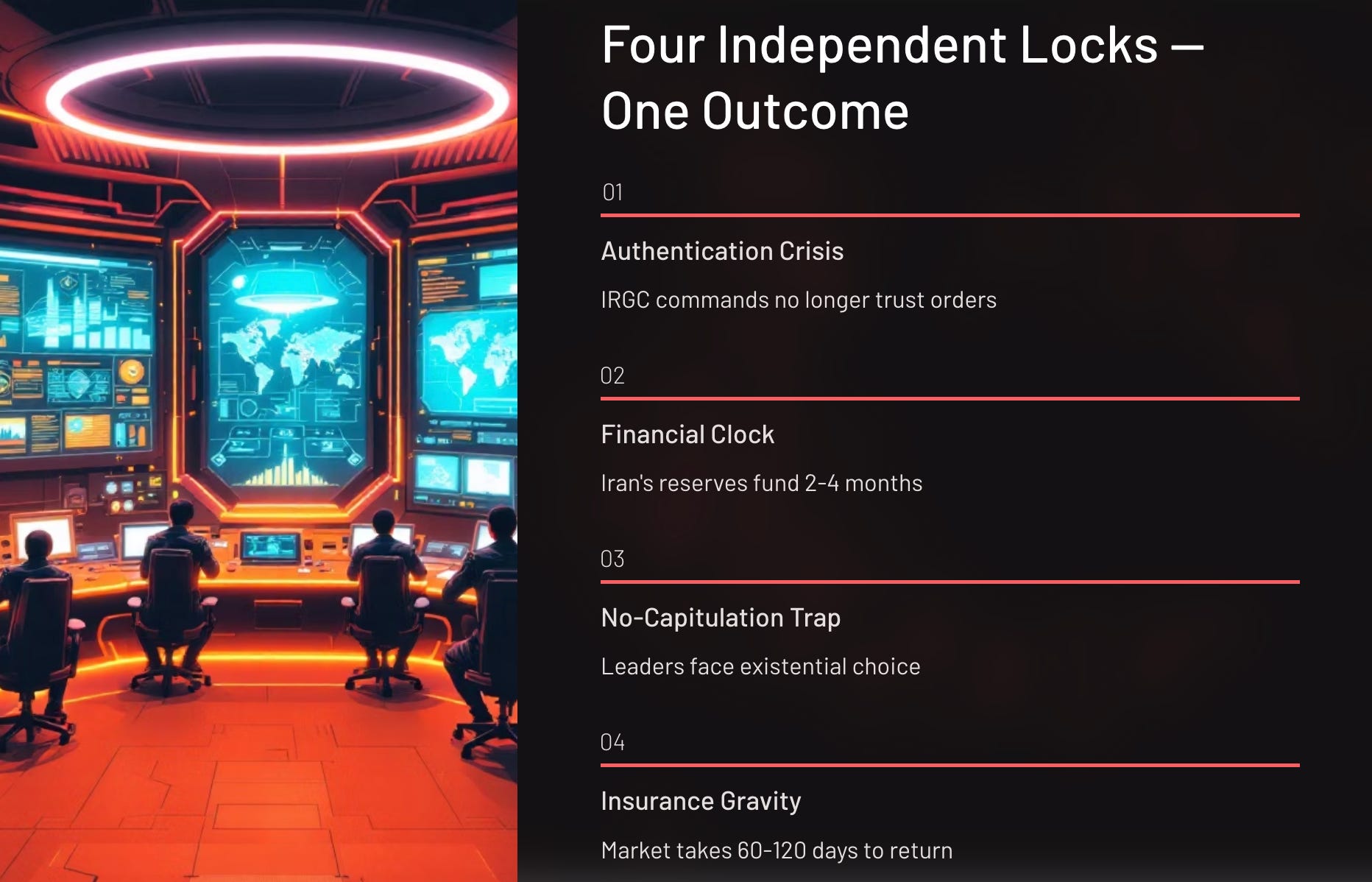
With that framework in place, we can now examine the four independent mechanisms that each, on their own, would extend the Strait closure beyond any 4–5 week timeline. Together, they are the reason that months — not weeks — is the correct unit of analysis.
Part IV: Lock One — The Starfish Has No Off Switch
The Regime Is Not The Country — Getting The War Participants Right
Before going further, there is an important distinction that must be made precisely, because conflating these two entities leads to systematic errors in how this conflict is analyzed. The regime is a function of the ideology, it is built to advance and safeguard the ideology. On the other hand, the country is the function of the economy. Trump wants to destroy the regime, the ideology, but the regime is extremely robust. In order to understand why, we have to understand how the IRGC (Islamic Revolutionary Guards Corp) is structured to carry out actions that protect the ideology.
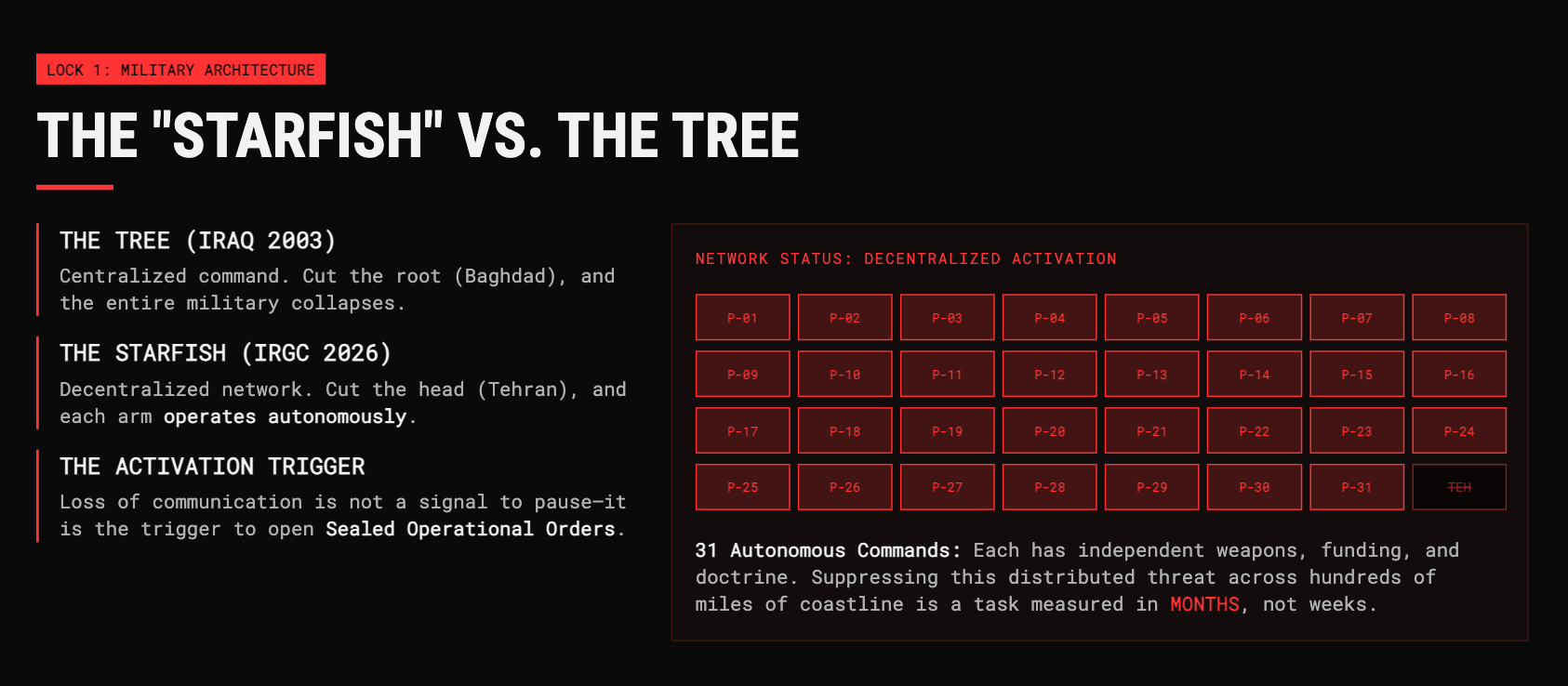
Most systems in the world are organized like a tree. There is a root — the supreme commander — and from that root extends a trunk, then branches, then leaves. Orders flow from the root outward. The system works because every part of the tree is connected to the same root. Cut the root, and the tree dies.
The regime watched the United States test this logic in Iraq in 2003. In roughly 72 hours, U.S. forces dismantled Saddam Hussein’s centralized command structure in Baghdad, and the entire Iraqi military — organized in exactly this hierarchical manner — collapsed without coherent resistance. The lesson was absorbed at the highest levels of IRGC strategic planning.
General Mohammad Ali Jafari, who took command of the IRGC in 2007, spent the following decade redesigning the organization from a tree into something structurally different: a distributed network of 32 self-sufficient provincial commands, one for each of Iran’s 31 provinces plus a dedicated Tehran command. Not only that, the IRGC controls the Axis of resistance/ proxy powers (Hamas, Hezbollah, Houthi movement.etc). The critical word is self-sufficient. Each “node” or party in the organization was given its own independent weapons stockpiles, its own communications infrastructure, its own funding channels, and — crucially — its own pre-written sealed operational orders covering the exact scenarios in which it might have to act without central direction. These commands do not need Tehran to function. They do not need each other. Each one was engineered to continue operating at full offensive capacity even if every other node in the network was destroyed.
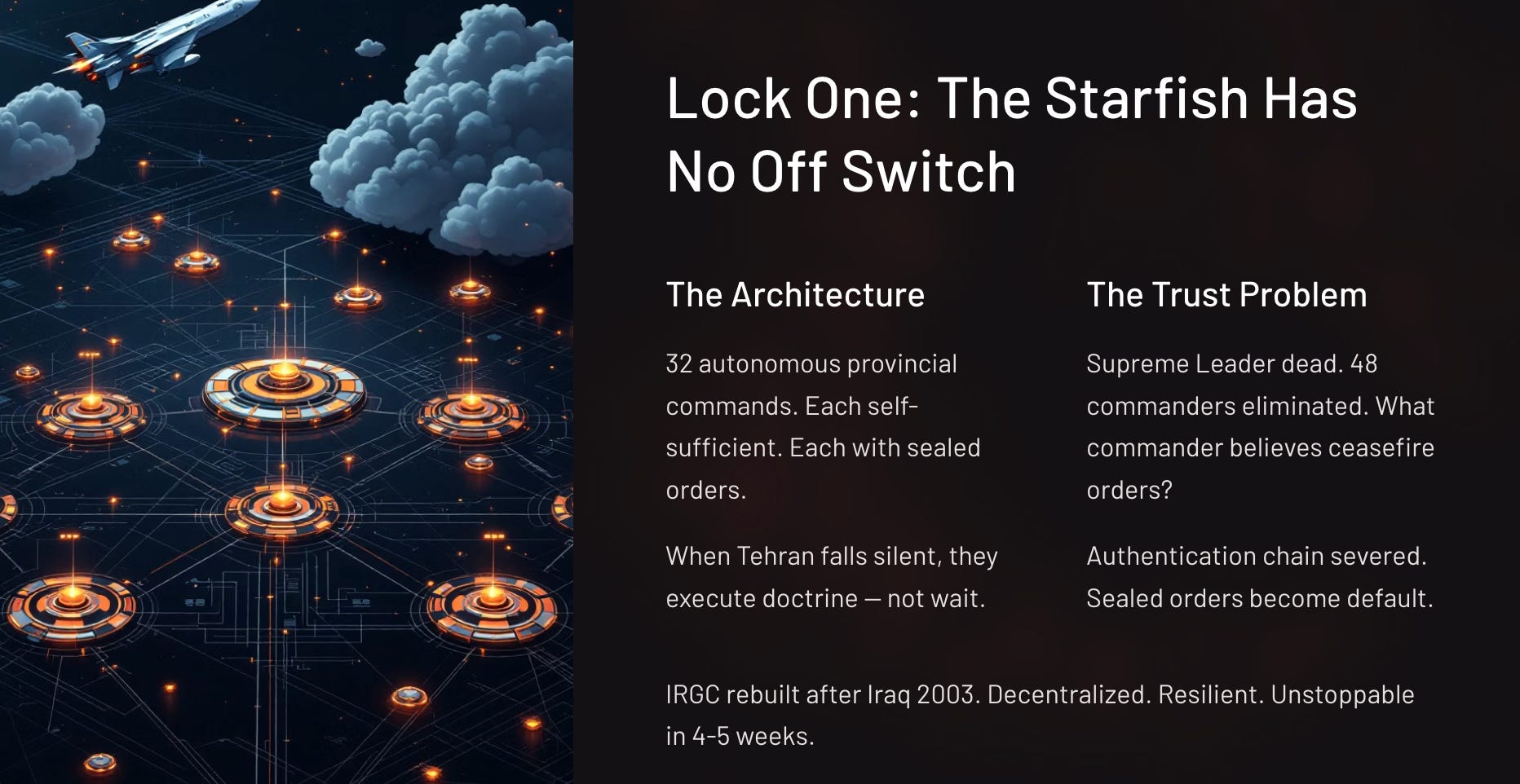
Operation Epic Fury eliminated the Tehran node — Node 32. Nodes 1 through 31 along with the proxy powerts, are intact, armed, and operating on the standing orders they received when their sealed packages were opened.
And here is the part that makes this architecture particularly durable: within the IRGC’s design, the loss of communications with central command is not a signal to pause and wait for new instructions. It is an activation trigger. When Tehran goes silent, local commanders are not standing by awaiting orders. They are executing pre-planned offensive operations autonomously. The U.S. jamming of Iranian communications during the strikes did not paralyze the network. It simultaneously activated 31 independent systems, each one executing its own standing doctrine. The coastal defense units above the Strait fall into this category. Their standing doctrine is to deny passage to all vessels. They are doing exactly what they were built to do.
There Will Be No Negotiations (At Least Not So Soon) — The US Just Destroyed All Possibilities
The Islamic Republic’s civilian governance still nominally exists. The Interim Leadership Council — President Pezeshkian, Chief Justice Mohseni-Ejei, and Arafi — holds the constitutional authority of the state. Brigadier General Vahidi has been appointed IRGC Commander-in-Chief. These are the formal structures of authority. The question is whether IRGC field commanders at coastal batteries above the Strait are following orders from those structures. The answer, given everything we know after the violent removal of their supreme authority, is: not reliably.
Think about this from the perspective of a specific IRGC commander at a coastal battery position above the Strait. His Supreme Leader is dead. 48 of the most senior commanders in his organization have been killed in a 48-hour strike. The US has jammed all communications and hence, requiring him to open his sealed orders. Those orders tell him to deny passage to all vessels and to treat any vessel attempting to transit as a legitimate military target. Without a recognized authentication source, the default is the sealed orders. The coastal batteries continue denying passage, continue executing on phases which will hit the US and world economy hard.
The IRGC is not monolithic. It is a collection of factions with different institutional cultures, different provincial power bases, and different commanders who each have their own relationships with each other and their own assessments of what the organization should do. Imposing coherent operational authority over 31+ autonomous commands, each of which has been designed to act independently and each of which has leaders who spent decades building their own power base, is not a 72-hour project. It is a months-long process of political consolidation within the organization. During that consolidation period, individual provincial commanders exercise the authority their sealed orders gave them.
When that authority is decapitated, the IRGC does not become a free agent that serves whoever claims the title next. It defaults to the doctrine it was built on — protect the revolution, deny the enemy, maintain operations. The IRGC persists, fragmented across not just Iran, but various nations. Capable of operating with autonomous capability regardless of what Tehran declares.
This is why the distinction between a country and a regime is important — the country is fragile but the regime is not. As long as the IRGC and its nodes exists, orders to protect the regime will continue to be executed (and at this point, it is to disrupt the energy markets and cause a global crash). The US is trying to destroy the regime, not the country. But the regime is very willing to sacrifice the country to protect its ideology and survival. Uprooting such a regime is an extremely difficult (near impossible task). Hence this is a campaign of months, not weeks. And without a replacement government to fill the void, the US has no recourse. Iran loses. US loses. But the regime continues.
The Practical Bottom Line
For the Strait to reopen, two things must happen in this order: IRGC coastal defense capability must be suppressed to the point where commercial vessels can transit without credible threat of attack, and then that suppressed state must be maintained long enough for the insurance market to re-enter (addressed in Part VII). The suppression task is not a matter of hitting a headquarters building and declaring success. It is the sustained, distributed degradation of mobile missile batteries, fast attack boat flotillas, and coastal drone infrastructure operated by 31 autonomous provincial commands across hundreds of miles of Iranian coastline. That task is measured in months.
Part V: Lock Two — The Economic Hostage Strategy and Iran’s Financial Clock
Why the Economic Damage Is Not a Reason to Stop — Understanding the Logic of Loss
The most common argument for a quick resolution goes like this: Iran cannot afford to keep the Strait closed. The Iranian economy depends on oil revenues. Economic self-interest will eventually force the regime to stand down. This sounds like common sense. It is wrong — and the error is specific enough to be worth examining carefully.
The mistake is applying gain-domain reasoning to a loss-domain situation. Let me explain that distinction with a simple example.
Imagine you have $100,000 in savings and a stable income. Someone threatens to take your house unless you pay them $50,000. In that situation, you calculate carefully. You weigh the legal costs, consider your options, look for the least expensive way out. You behave like a rational economic actor because, however unpleasant the situation, you are still choosing between outcomes that each leave you with something. You are in the domain of gains.
Now imagine the same person is not threatening your house but your life — they will kill you regardless of whether you pay or comply. The economic calculation vanishes entirely. No financial outcome matters if you are dead. Every resource you have becomes instrumental to a single goal: survival. The cost of fighting becomes essentially irrelevant because the alternative is certain death.
This is the position the regime’s leadership actually occupies. Trump’s explicit regime-change declaration made this plain: the objective is to end the Islamic Republic as a governing system. For the IRGC commanders and political leaders still functioning, there is no version of compliance or surrender in which they keep their lives, their freedom, or their relevance. Their entire rationale for existing — the revolutionary project that defined their careers and their identities — ends under regime change. Against that outcome, the economic cost of keeping the Strait closed is not a deterrent. It is noise. The Strait is not being kept closed despite the cost. It is being kept closed because it is the last available weapon, and against certain elimination you use every weapon you have until you run out of them or until the pressure on your adversary breaks.
The Strategic Bet — Whose Clock Runs Out First?
The regime’s actual strategy is not to defeat the United States militarily. That is not a realistic goal and no serious IRGC commander believes otherwise. The strategy is to make the war economically and politically costly enough for the American public that the U.S. political system terminates the campaign before the regime’s financial reserves reach zero.
The mechanism is well-documented in American political history. When oil sustains above $100 per barrel for three months, the pain lands everywhere simultaneously and personally — $7 gasoline in Iowa, heating bills up 40% in New England, airfares rising, food prices rising, every sector of the economy touched by the cost of energy. That political pressure operates entirely independently of what is happening militarily on the other side of the world. American voters do not follow the details of suppressing IRGC provincial commands. They follow the price on the pump when they fill their tank that morning.
Iran is explicitly betting on the pattern it has observed across American military engagements: the United States withdrew from Vietnam under domestic pressure. It withdrew from Somalia after Black Hawk Down. It set exit timelines from Afghanistan that were driven more by political exhaustion at home than by battlefield outcomes abroad. In each case, the adversary did not need to win militarily. It needed to make the cost of continuing feel greater than the benefit of winning. Iran is running the same playbook, using global oil prices as the primary mechanism of domestic American pressure.
Whether this bet succeeds depends on a single race: does American political patience run out before Iran’s financial reserves do? And those financial reserves have an arithmetic floor that can be calculated.
Iran’s Financial Runway — The Precise Numbers
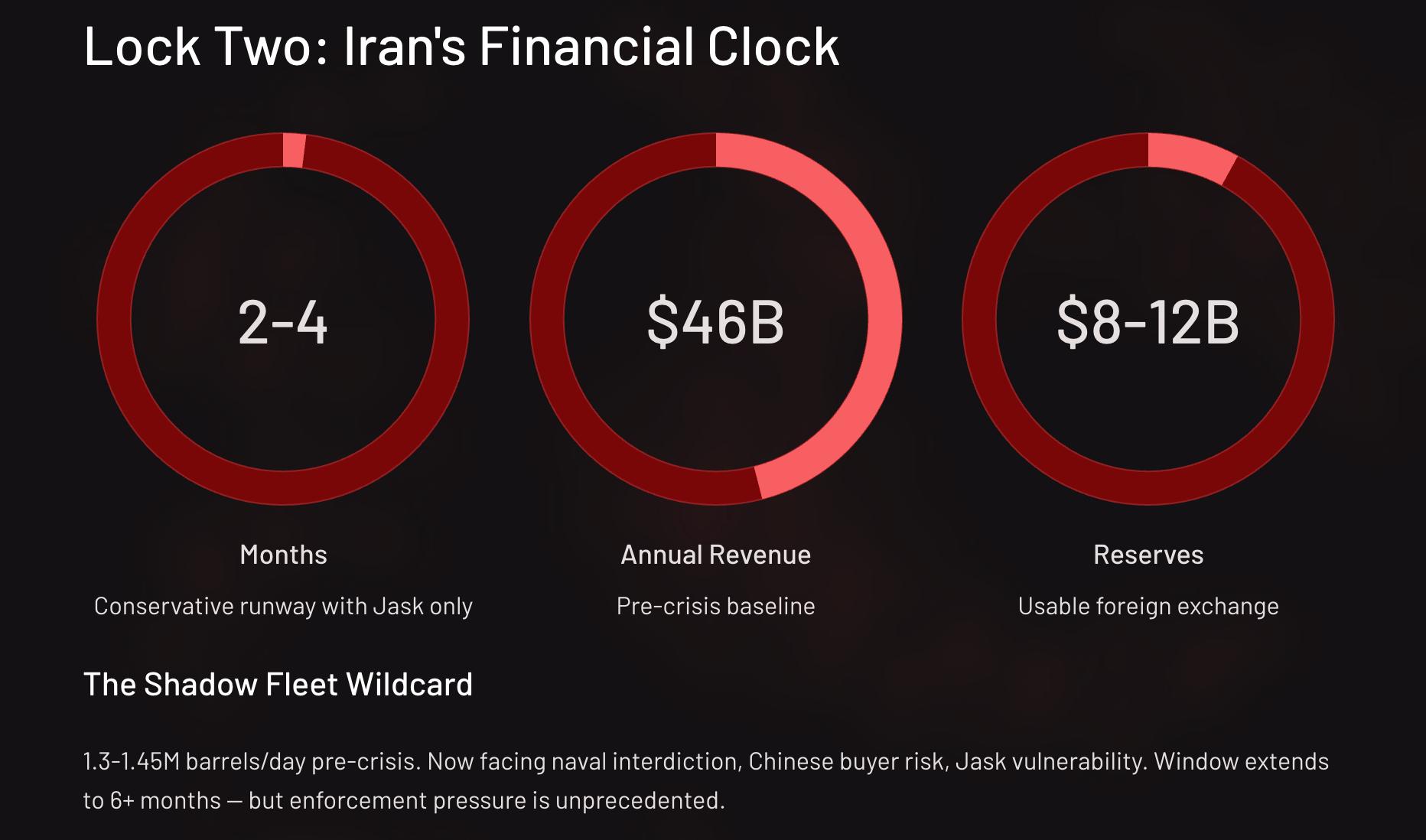
Before the crisis, Iran was generating estimated annual oil revenues of approximately $46–53 billion — roughly $3.8–4.4 billion per month — combining official export programs with a substantial clandestine operation that routed Iranian crude primarily to Chinese refineries through a network of opaque-ownership vessels known as the shadow fleet.
With Hormuz effectively closed, Iran’s only functioning official export route is the Goreh–Jask pipeline, which terminates at the Jask terminal on the Gulf of Oman, outside the Strait’s chokepoint. At its maximum functional capacity, Jask can export approximately 300,000 barrels per day. At a crisis-era oil price of $100 per barrel, gross revenue from Jask is approximately $900 million per month. After the mandatory discounts that buyers extract from a captive seller who has no alternative route, the elevated logistics costs, and the middlemen fees involved in moving sanctioned crude, realistic net receipts are closer to $600–750 million per month.
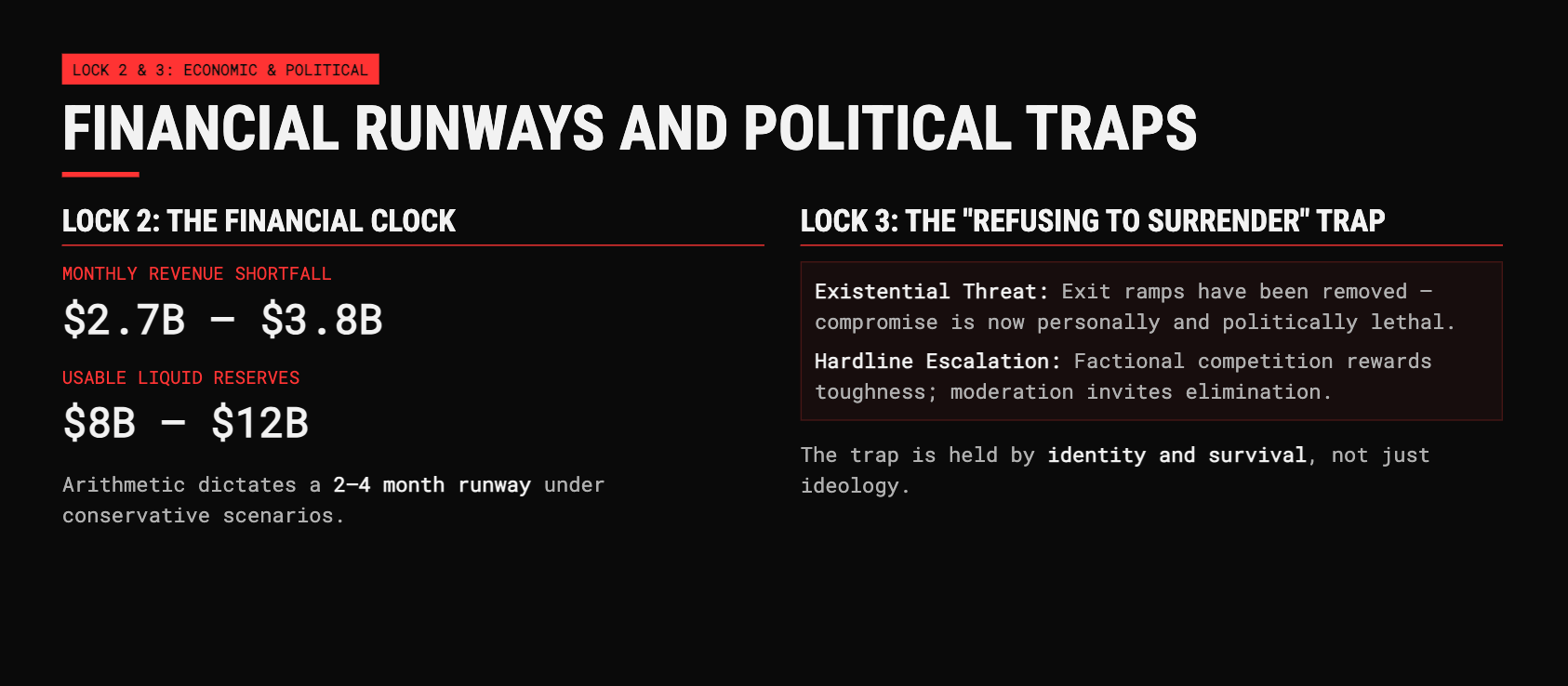
Monthly shortfall against pre-crisis revenue: $2.7–3.8 billion. Every month, continuously.
Iran’s available financial buffer — the National Development Fund plus liquid foreign exchange reserves that it can actually access and deploy — is estimated by independent analysts at somewhere between $8 billion and $12 billion in usable form. This is a strikingly small number for a major oil producer. Saudi Arabia holds over $400 billion in foreign reserves. Iran, after four decades of increasingly severe sanctions that restricted its ability to accumulate and access reserves, holds a fraction of that. Divide the $8–12 billion buffer by the $2.7–3.8 billion monthly shortfall and the answer is mechanical: 2–4 months of coverage under the conservative scenario where Jask is the only functioning export channel.
The Shadow Fleet — Iran’s Backup Plan and Its Fractures
The shadow fleet is Iran’s insurance policy against the 2–4 month conservative window. Before the crisis, tanker-tracking firms including Vortexa documented Iranian crude flowing to Chinese refineries at up to 1.3–1.45 million barrels per day in peak months, moving through vessels with obscured ownership, falsified port documentation, and ship-to-ship transfers in international waters. Chinese independent refineries — the “teapot” refiners in Shandong province — accepted discounted Iranian crude because the economics were attractive and the political risk, in peacetime, was manageable.
If the shadow fleet continues to operate at close to its pre-crisis volumes, monthly oil revenues could reach $2.4–4.2 billion gross — largely closing the financial gap and potentially extending the regime’s runway from 2–4 months to 6–24 months or beyond.
But the shadow fleet now faces three simultaneous pressures that have fundamentally changed its operational environment.
The first is active naval interdiction. In peacetime, seizing shadow fleet tankers was legally complicated, diplomatically sensitive, and required careful intelligence work to identify specific vessels. Under current wartime rules of engagement, with two U.S. carrier strike groups in the region and an explicit presidential mandate to reduce Iranian oil exports to zero, the U.S. Navy can board and seize shadow fleet tankers as routine naval operation. One publicized seizure of a large tanker bound for China sends an immediate deterrent signal to every operator in the network: this route is no longer merely sanctioned, it is actively interdicted by a military force currently engaged in combat operations against Iran.
The second is Chinese buyer risk aversion. Chinese independent refineries bought discounted Iranian crude in peacetime because the political exposure was manageable. Continuing to purchase Iranian crude through covert channels during active U.S. military operations against Iran means defying U.S. sanctions enforcement at precisely the moment when Washington is in its most aggressive posture. The risk is not merely a fine — it is having U.S. dollar clearing accounts severed by the Treasury Department. No crude oil discount compensates for losing access to dollar-denominated global finance.
The third is the vulnerability of the Jask terminal itself. Jask is a known, fixed target on a coastline fully mapped by U.S. military intelligence. It is lightly defended and has historically operated well below its theoretical capacity. Strategic planners who are reportedly considering scenarios for Kharg Island — Iran’s primary oil export hub — have certainly mapped Jask. A targeted strike on the Jask terminal would collapse Iran’s official bypass revenue to near zero and push the conservative 2–4 month timeline downward.
The honest synthesis: Iran can sustain the closure financially for 2–4 months without the shadow fleet, and potentially 6+ months with it — but the shadow fleet is facing the highest enforcement pressure it has ever operated under. The financial window and the supply disruption window converge in the same 3–6 month range. The resolution happens when Iran runs out of options, not when a diplomatic opening presents itself.
Part VI: Lock Three — The “Refusing To Surrender” Trap
What Regime Change Declarations Do to the People They Target
There is an intuitive and well-documented human response to being told, explicitly and publicly, that your freedom and existence are going to be removed. It is not compliance. It is resistance — often intensified well beyond what seems rational from the outside, because the act of resisting becomes the act of maintaining identity and demonstrating that you have not been broken.
Trump’s address after Operation Epic Fury was not a negotiating position. It was an explicit public declaration that the Islamic Republic — the system these men spent their careers building and defending — would be ended. That message was received, in real time, by every surviving senior figure in the regime. And it produced the response that anyone who has studied the psychology of existential threats would predict: You are telling us we will be eliminated regardless of what we do. You have removed every incentive to do anything other than fight to the death.
The regime-change declaration did not intimidate Iranian leadership into compliance. It permanently closed the exit ramp that might have allowed them to choose a negotiated outcome. Before that speech, a scenario existed in which the regime absorbed a military strike, accepted some humiliation, and negotiated a settlement that left the Islamic Republic’s core structure intact. That scenario required Washington to be willing to accept a surviving Iranian regime as a negotiating partner. The explicit regime-change declaration made that impossible: you cannot negotiate a settlement with a global super power that have publicly declared to eliminate you.
Why the Power Vacuum Pushes Everyone Toward Hardline Positions
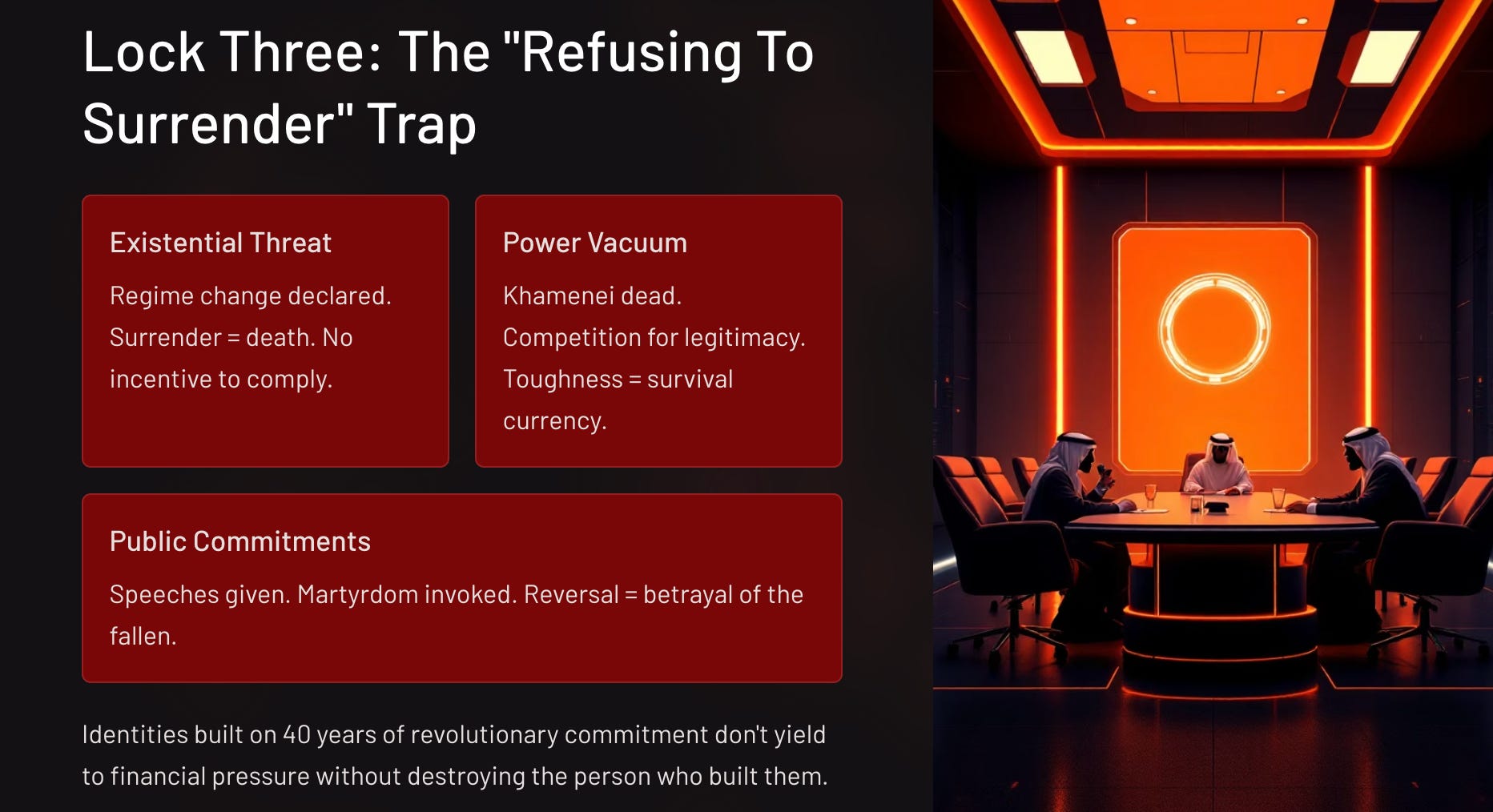
Underneath the strategic logic sits a specific internal dynamic that makes individual moderation politically suicidal. When Khamenei was alive, the Islamic Republic had a single, unchallengeable apex of authority. Everyone in the system — whether they agreed with specific decisions or not — operated within a framework where Khamenei’s authority was the final word. That constraint kept factional competition within bounds.
Khamenei is dead. The single apex is gone, and what remains is a competition among surviving factions — IRGC commanders, clerical figures, political leaders, regional power brokers — over who inherits legitimacy, resources, and authority. In that competition, toughness is not merely a value. It is the primary currency of survival.
Any figure who signals willingness to compromise, to reopen the Strait, to engage with ceasefire proposals, to stop attacks on key energy infrastructure, without first extracting a major visible concession, has just handed every competitor a weapon: proof of weakness, proof of willingness to surrender what others died defending, proof of softness at the moment the revolution needed its hardest men. In the specific cultural and institutional context of the IRGC — built over forty years on an explicit revolutionary honor code — weakness is not a liability. It is an opening for elimination. So every competing faction tries to out-signal the others on hardline commitment. The positions that emerge publicly are more extreme than any individual actor would choose in isolation, not because they are all personally fanatical, but because the competition structure punishes moderation and rewards escalation.
The Commitments That Cannot Be Publicly Reversed
The third and most practical dimension is simply this: the surviving leaders have already made public statements. They have given speeches invoking Khamenei’s martyrdom. They have described the Strait closure as the revolution’s active response to an act of war. They have made these commitments publicly, on record, in front of subordinates, peers, and the portion of the Iranian public that the regime still controls.
Reopening the Strait now means standing in front of everyone who heard those commitments and demonstrating that they were theater. It means acknowledging that the sacrifice of the Supreme Leader and 48 commanders purchased nothing — that after all of that, the regime opened the door as soon as the economic pressure became uncomfortable. In the political ecology the regime inhabits, where revolutionary honor is not merely rhetoric but the actual basis of authority and legitimacy, that reversal is not just embarrassing. It is a betrayal of the martyred leadership that every competitor will use to justify the removal of anyone who commits it.
Identities built on forty years of revolutionary commitment do not yield to financial pressure without destroying the person who built them.
The Two Exits — and Why Neither Is Available Quickly
There are two theoretical ways out of the “refusing to surrender” trap. The first is a face-saving concession from Washington — a visible political prize that allows Iranian leadership to reframe reopening the Strait as a negotiated victory. This requires Washington to offer something substantial and credible, which requires Washington to be willing to negotiate with a regime it has publicly declared it intends to destroy. That is not the current posture, and changing it involves its own set of domestic political commitments and institutional momentum on the American side.
The second is attrition (reducing Iran’s strength) — months of financial deterioration, internal pressure, and gradual erosion of capacity that eventually shifts the political landscape enough for a different narrative to emerge. This is a months-long process, running in parallel with the financial clock from Part V.
Neither exit is available in 4–5 weeks, but rather, months.
Part VII: Lock Four — The Insurance Market That Will Not Return Quickly
Why Insurance Is the Actual Gate for Commercial Shipping
There is a gap between a government declaring a waterway open and commercial ships actually moving through it. That gap is filled by marine insurance — specifically war-risk coverage, the policy that compensates a ship owner if their vessel is damaged or destroyed in a conflict zone. Without it, no commercial shipping company moves a $150–200 million supertanker and a crew of 25–30 people into an actively contested waterway. The asset is too large, the personal liability too risky. Insurance is not a formality. It is the mechanism that actually determines whether commercial vessels move.
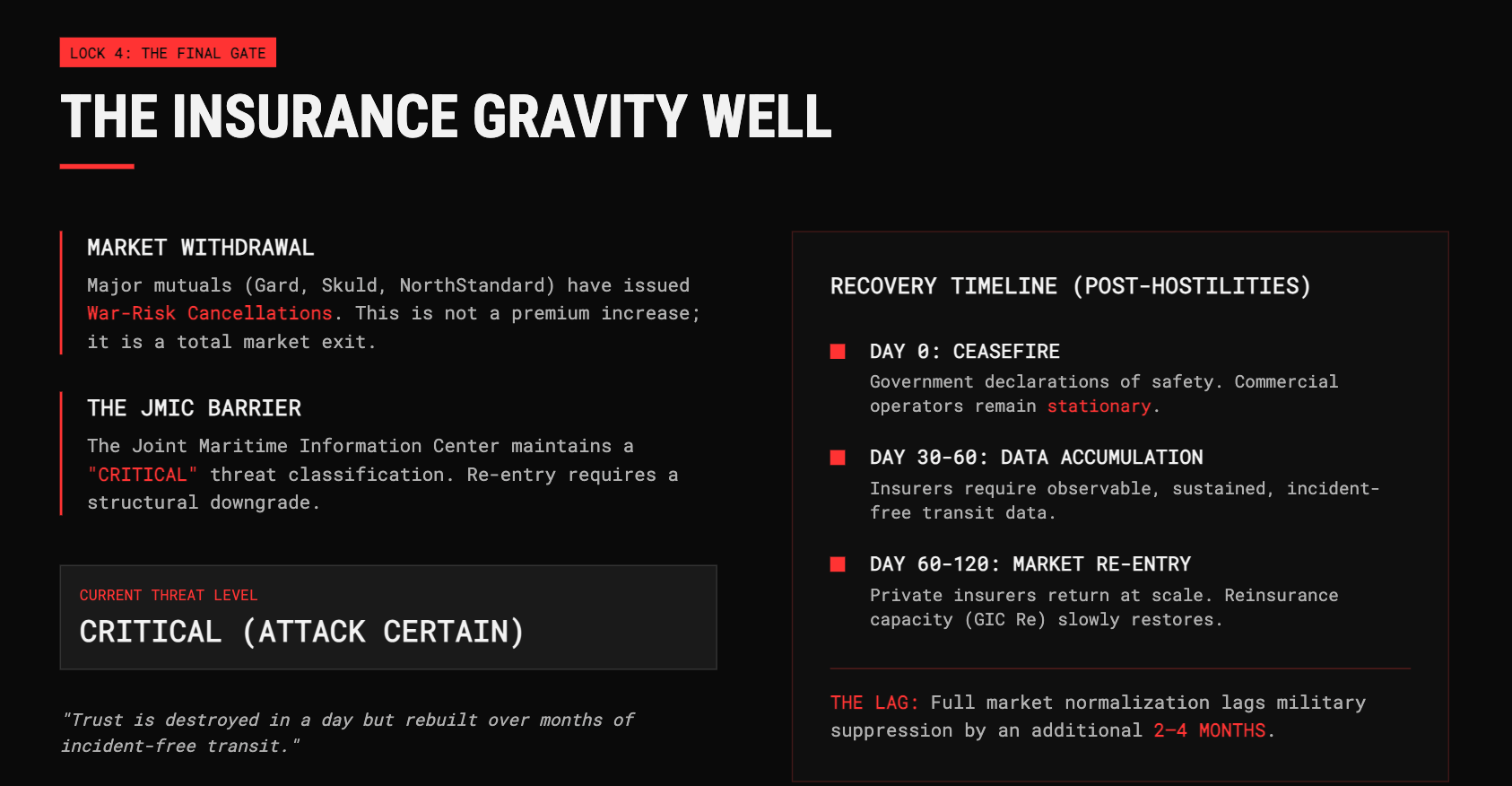
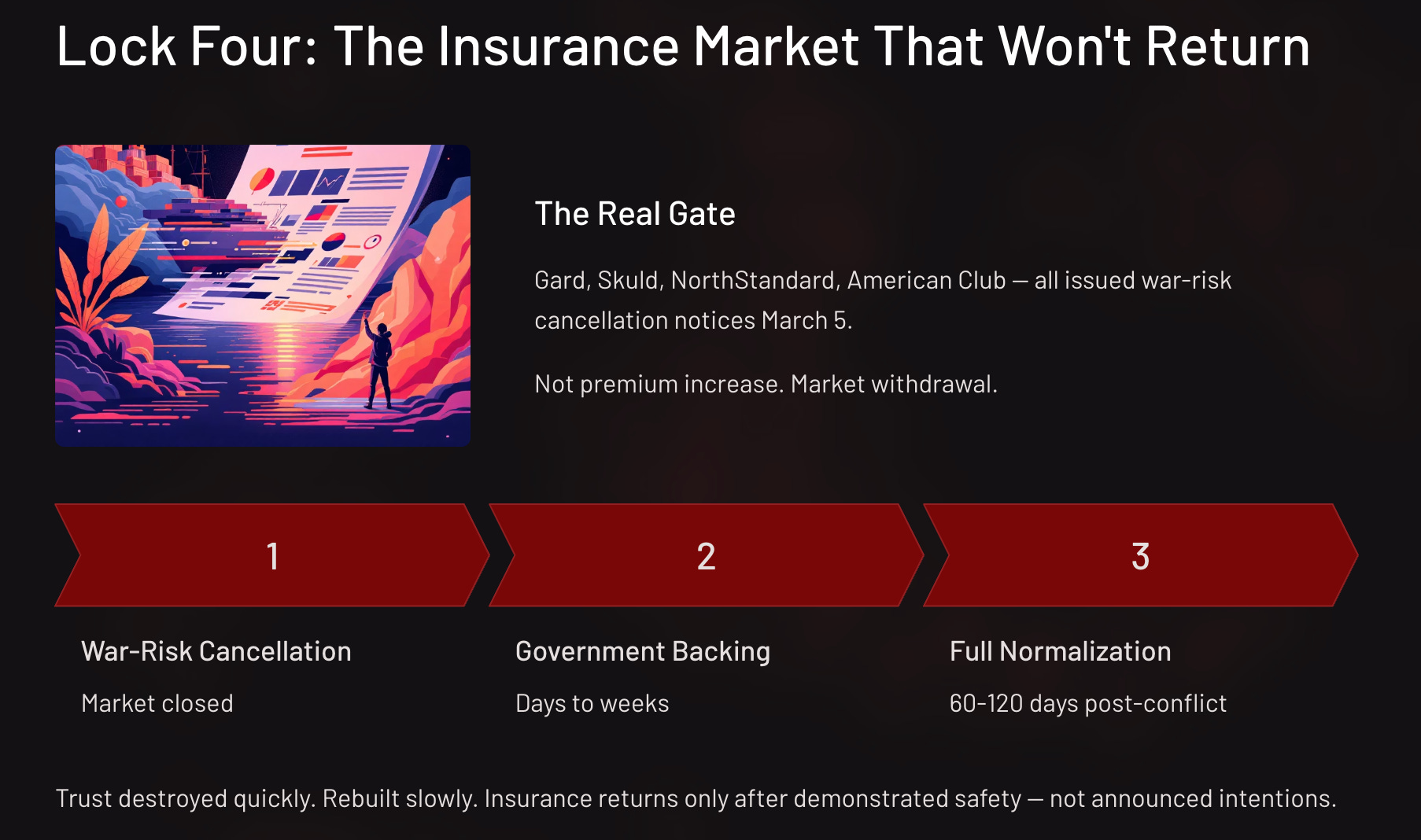
As of March 5, 2026, Gard, Skuld, NorthStandard, and The American Club — among the most experienced and largest marine insurance mutuals in the world — have issued war-risk cancellation notices for the Persian Gulf. This is not a premium increase. It is a market withdrawal. The underwriters who have spent careers modeling maritime risk in conflict environments have looked at the confirmed evidence — IRGC naval forces actively targeting vessels, coastal missile batteries in active use, drone swarms from coastal positions — and concluded that the risk cannot be bounded at any commercially viable premium. The market is closed.
How Human Risk Perception Works — and Why It Recovers Slowly
To understand why the insurance market takes months to re-enter, you need to understand something specific about how human beings assess risk, particularly risk that involves vivid recent negative events.
People do not assess risk by reviewing actuarial tables and running probability calculations in their heads. They assess risk primarily through memory and recent experience. When a risk is abstract and distant, it tends to be underweighted. When there is recent, vivid, specific evidence that something bad happens — when a person can close their eyes and picture exactly what the bad outcome looks like — that risk gets overweighted relative to its true statistical frequency. An insurance underwriter who has spent two weeks watching real-time footage of IRGC fast boats swarming commercial vessels, anti-ship missiles tracking tankers, and burning ships on the shipping news does not reset that mental reference point because a government makes an announcement. Those images remain the dominant experiential anchor for what a Hormuz transit looks like. They fade slowly, over time, as new evidence accumulates that the situation has genuinely changed.
The practical consequence is that re-entering a war-risk market requires not a declaration of safety but a demonstration of safety — observable, repeated, incident-free transits over a sustained period that shifts the dominant risk picture. That accumulation takes weeks to months, not days.
The second issue is what risk managers call the problem of unknown unknowns. In peacetime, insuring a tanker through the Strait involved a known, modelable risk. You could look at incident rates, probability of hostile action, and produce a defensible pricing model. In the current environment, the set of things underwriters cannot know has expanded dramatically. Are IRGC coastal units still following autonomous stand-down orders? Are there active patrol operations in parts of the shipping lane not currently tracked? Will a ceasefire declared in Tehran reach every provincial IRGC command? Professional underwriters respond to unquantifiable uncertainty by withdrawing rather than pricing. They cannot insure what they cannot model.
The Three Reinstatement Paths — And Their Real Constraints
Three pathways to restoring coverage are currently being discussed, and they deserve honest assessment.
Commercial reinstatement is already being offered by specialist brokers including Aon and Marsh — but the terms are unrecognizable compared to pre-crisis coverage. Pre-crisis hull war-risk premiums in the Gulf ran at approximately 0.25% of vessel value. Current reinstatement is being offered at an estimated 1.0% per voyage, meaning a single transit of a $100 million tanker now costs $1,000,000 in insurance alone. Beyond the cost, each voyage requires individual underwriting — 48–72 hours advance notice, specific security confirmation, and case-by-case approval. Major reinsurers including GIC Re have exited entirely to avoid aggregation risk: the catastrophic scenario where a single coordinated attack generates simultaneous claims across a reinsurer’s entire portfolio. Without reinsurance capacity behind them, primary insurers’ ability to write meaningful volumes is limited.
Government-backed reinsurance was announced on March 3, when the US administration directed the Development Finance Corporation to provide political risk insurance at a “reasonable price.” The fastest implementation path — using existing MARAD (U.S. Maritime Administration) facilities (agreement between lender and borrower) for U.S.-flagged vessels — could theoretically be operational within days. Creating a comprehensive facility covering non-U.S. flagged shipping requires establishing administrative and legal frameworks, eligibility criteria, and claims-processing infrastructure. Experts estimate weeks in implementation time. The deeper constraint is that government insurance covers financial loss — it reimburses the ship owner for a destroyed vessel. It does not cover what is actually preventing crews from making the transit: the credible risk of being killed. A government policy that pays for the wreck does not help the 30 crew members who died in it. Ship operators are not refusing primarily because the financial loss would be uninsured. They are refusing because their people would be dead.
Full market normalization — private insurers returning to the Persian Gulf at anything approaching pre-crisis rates and capacity — requires the Joint Maritime Information Center to downgrade its current threat classification from “CRITICAL” (attack almost certain) to “Severe” or lower. That downgrade requires observable, sustained, incident-free transit conditions — confirmed reduction in IRGC hostile activity, actual safe-transit data accumulated over time, a credible assessment that the threat has structurally changed. Based on historical precedent from comparable situations, this process takes 60–120 days of demonstrated safety after active hostilities have meaningfully subsided — not from the date of a ceasefire announcement, but from the date when actual incidents stop occurring and stay stopped.
In the current environment, where 31 autonomous IRGC provincial commands are still operating and the active naval threat continues, the conditions for a JMIC threat downgrade are not present on any near-term horizon.
The Asymmetric Speed of Trust
The governing principle across all three paths is this: trust in a maritime security environment is destroyed quickly and rebuilt slowly. One IRGC missile strike on a commercial vessel establishes that the threat is real. Rebuilding from that point requires accumulating enough consecutive safe-transit data points to statistically overwhelm the weight of the confirmed attack events. An insurance market that observed active targeting for several weeks will not re-enter after several weeks of calm. The institutional memory is longer than that, and the re-entry decision is made by risk professionals who are professionally trained to require demonstrated evidence rather than announced intentions.
Even in the optimistic scenario where the military situation is substantially suppressed within 60–90 days, the insurance market’s return to full functional capacity lags that military achievement by another 60–90 days of demonstrated safety. The Strait reopens for commercial traffic when the insurance market decides it is safe — not when a government says it is.
The Convergence: Why All Four Locks Point to the Same Window
The four mechanisms do not operate in sequence. They operate simultaneously, and each one needs to be substantially resolved — not just partially improved — before commercial oil traffic returns to anything approaching pre-crisis volumes.
The authentication gap and active threat in Lock One require sustained military suppression of distributed IRGC coastal capability across 31+ autonomous command nodes. The governance vacuum problem means that even a collapsed Islamic Republic does not produce a cooperative replacement government — it produces ungoverned armed factions with no authority to agree to anything, potentially making the Strait problem more intractable rather than less.
The financial arithmetic in Lock Two puts a hard clock on the regime’s ability to sustain the strategy at 2–4 months under the conservative scenario — and that clock’s endpoint converges with the period of maximum supply disruption in the global oil market.
The “refusing to surrender” trap in Lock Three has two exits, both measured in months: either a face-saving concession from Washington (not the current posture) or the gradual internal attrition that comes from financial deterioration over time.
The insurance gravity well in Lock Four activates only after Locks One and Two have substantially resolved, then adds its own 60–120 day recovery timeline before commercial shipping resumes at scale.
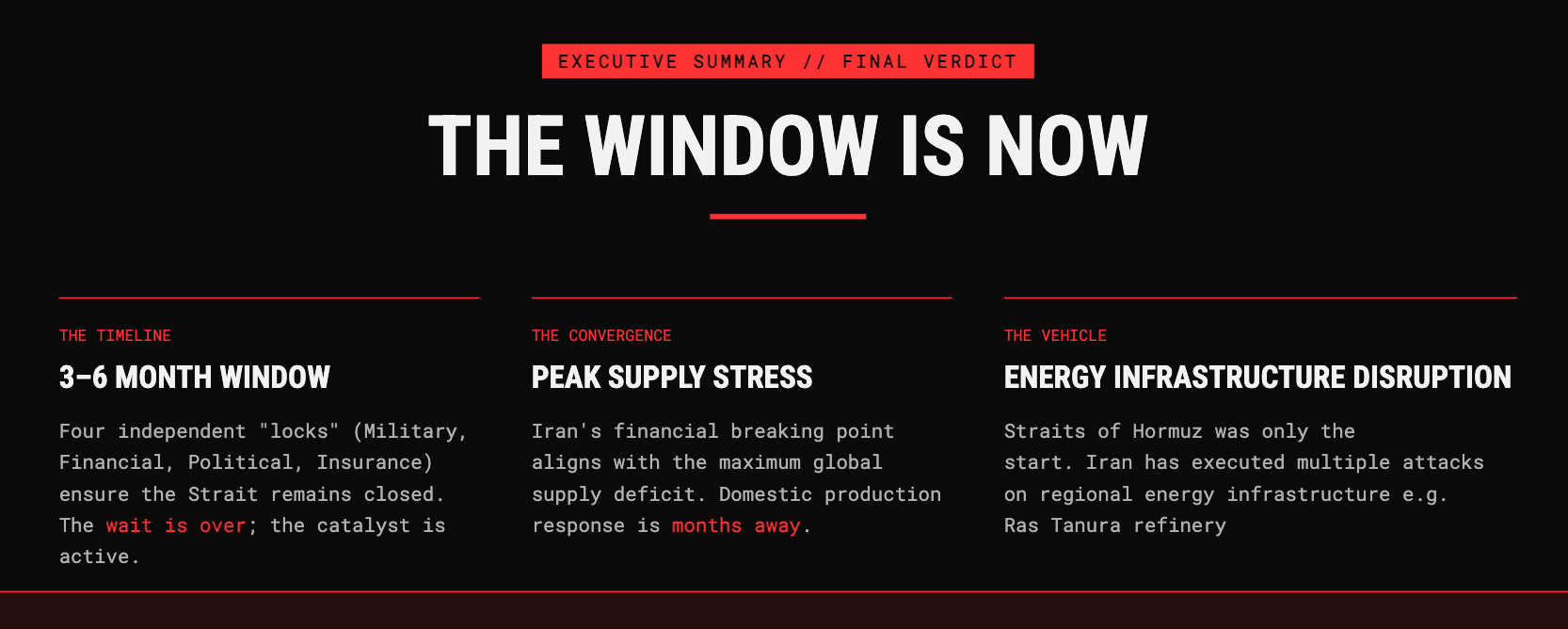
These timelines map onto a single axis in the 3–6 month range as the minimum period during which the Strait remains effectively closed. Not because of one hard bottleneck but because all four locks must open, none of them opens quickly, and solving one does not automatically solve the others.
This is the window.
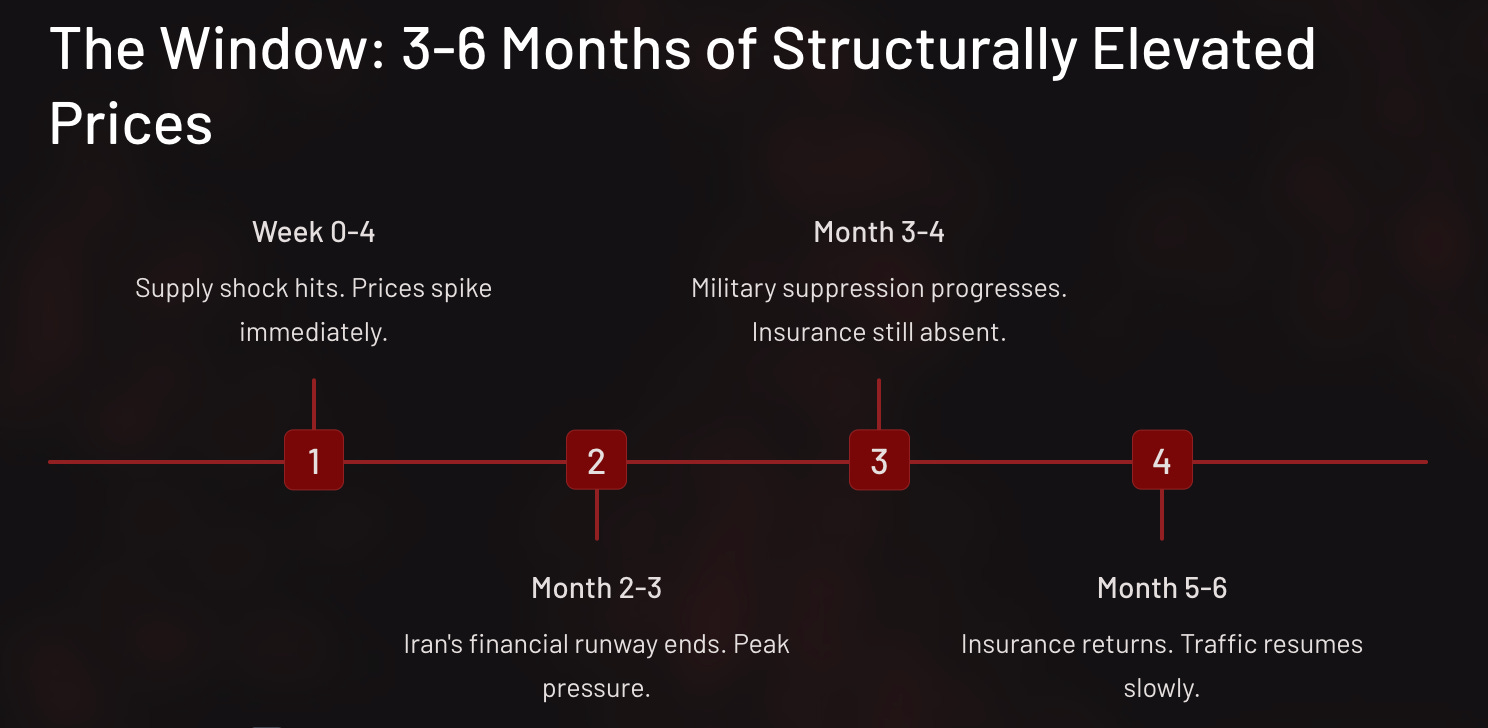
The Strait Is Not the Only Question — Why Oil Prices May Stay Elevated Regardless of What Happens at Hormuz
Before examining each mechanism that locks the Strait closed, it is worth stepping back and asking the question that this entire analysis is actually trying to answer. That question is not “is the Strait of Hormuz closed?” We already know it is. The question — the one that determines whether the CRC investment thesis is realized — is simpler and more direct: will oil prices remain significantly elevated for a sustained period of months?
The Strait is the most dramatic and visible answer to that question. But it is not the only answer. And investors who anchor their entire thesis on the Strait reopening or staying closed are missing a second mechanism that operates completely independently of what happens in the shipping lane.
The IRGC and its regional proxy network have demonstrated, repeatedly and in confirmed real-world events, the capability to strike major global oil infrastructure directly — refineries, processing facilities, pipelines, export terminals, and offshore platforms — without requiring the Strait to be closed. These are not theoretical capabilities being war-gamed in think tanks. They are documented operational realities with a track record.
In September 2019, coordinated drone and cruise missile strikes hit Saudi Aramco’s Abqaiq processing facility and the Khurais oil field simultaneously. Abqaiq is not a marginal piece of infrastructure. It is the single largest oil processing facility in the world, responsible for stabilizing roughly 7% of global oil supply before it can be exported. The strikes temporarily knocked out approximately 5.7 million barrels per day of Saudi output — more than 5% of global consumption — overnight. The event demonstrated plainly that the IRGC-aligned network could reach the heart of the Gulf’s oil production infrastructure with precision, at scale, and essentially without warning.
In January 2022, Houthi forces — the Yemen-based IRGC proxy that has operated with Iranian weapons, training, and strategic direction — struck Abu Dhabi directly. Drones hit an ADNOC fuel storage facility near Abu Dhabi International Airport and caused fires at an industrial area. This was not a strike on military infrastructure. It was a strike on civilian energy infrastructure in the capital of the UAE, one of the world’s largest oil exporters.
Beginning in late 2023 and running through 2024, Houthi forces conducted an extended campaign of anti-ship missile and drone attacks against commercial vessels in the Red Sea — not the Persian Gulf, not near Iran, but in an entirely separate global shipping corridor. The campaign forced the majority of container shipping to reroute around the Cape of Good Hope, adding 10–14 days to transit times and significantly disrupting global trade flows. The world’s largest shipping companies — Maersk, MSC, CMA CGM — suspended Red Sea transits entirely at peak. This was a proxy force, operating from Yemen, effectively closing a second major global shipping artery using capabilities supplied and directed by the IRGC’s Quds Force.
The Ras Tanura refinery strike that has already been confirmed in the current crisis is not an anomaly. It is the continuation of a decade-long demonstrated pattern.
The practical implication for the oil price thesis is significant. Even in a scenario where diplomatic or military progress allows some resumption of commercial shipping through the Strait of Hormuz — even if some of the four locks described in this article begin to ease — the IRGC and its proxy network retain the independent capability to strike the Gulf’s export infrastructure, processing facilities, and regional energy supply chain. Saudi Arabia’s Eastern Province, where the vast majority of the Kingdom’s oil production and export infrastructure is concentrated, sits within comfortable range of IRGC-aligned systems. The UAE’s offshore and onshore energy infrastructure has already been demonstrated as a reachable target. Iraq’s southern oil terminals, which handle the majority of Iraqi exports, are exposed. Qatar’s LNG facilities, which supply a significant fraction of Europe’s natural gas, represent another node in the network.
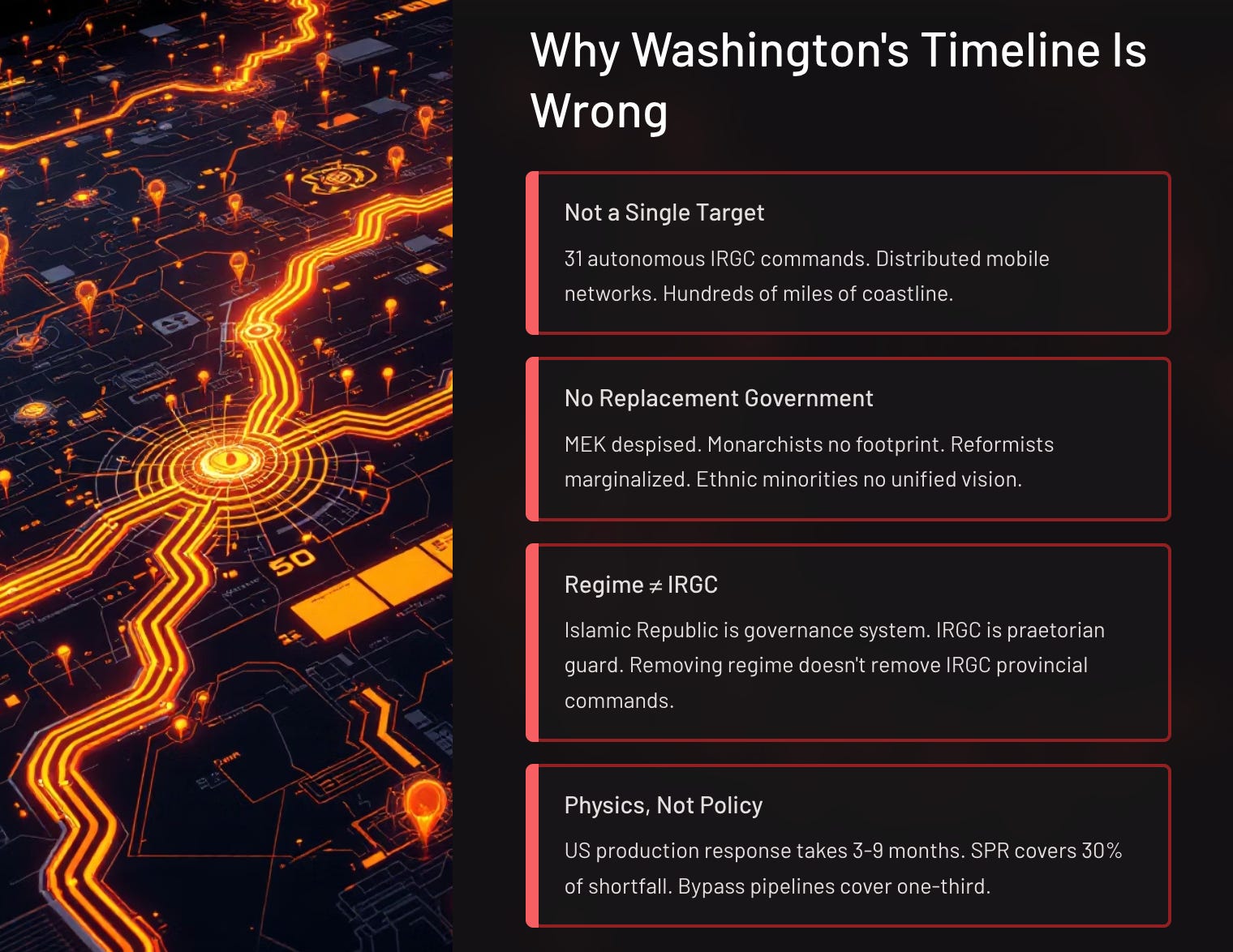
This means the elevated oil price environment does not require the Strait to remain permanently closed. It requires only that the security environment in the Persian Gulf region remains credibly hostile to the movement and production of oil — which it will, for as long as the IRGC and its proxy network retain the capability and the motivation to use it. The Strait closure is the most acute and visible expression of that environment. But the environment itself is the underlying condition, and it persists independently of any single waterway’s status.
Click here for my CRC (California Resources Corp) analysis 👇
The Most Overlooked Oil Company in America — And Why That Might Be the Opportunity of the Decade

Date of analysis: 28 December 2025
This article is a personal investment analysis and does not constitute financial advice. All valuations are based on reported SEC filings and publicly available data. Oil price scenarios are analytical frameworks, not predictions. Readers should conduct their own independent due diligence and consult a qualified financial advisor before making any investment decisions. The geopolitical situation described is evolving rapidly; this analysis reflects information available as of March 5, 2026.
Sources: Collapse Intelligence Agency, “Operation Epic Folly(Fury) — Part 1” (March 2, 2026); California Resources Corporation 10-K and investor materials; EIA Short-Term Energy Outlook (February 2026); IEA Oil Market Reports 2025–2026; CSIS Iran military capability assessments; Gard, Skuld, NorthStandard, and The American Club war-risk cancellation notices (March 2026); Aon and Marsh broker communications; Reuters war-risk insurance coverage (March 2026); Vortexa tanker-tracking data; Axios, Iran nuclear talks reporting (February 2026); EIA U.S. Strategic Petroleum Reserve inventory data; Joint Maritime Information Center threat classifications.