The Schoolteacher's Secret Insurer: Why Horace Mann (NYSE:HMN) Is Sitting on My Watchlist
An analyst's journey through a niche, misunderstood, and quietly compounding business — told through three questions every investor must answer before pulling the trigger.
“The stock market is a device for transferring money from the impatient to the patient.” — Warren Buffett
There is a particular kind of investment that doesn’t announce itself loudly. It doesn’t appear on CNBC. It doesn’t have a cult Reddit following. It doesn’t trade at 40x earnings with a visionary founder doing TED talks. Instead, it sits quietly in a corner of the financial universe — undervalued, underloved, and doing exactly what it’s supposed to do: compounding, slowly but surely, for the patient investor.
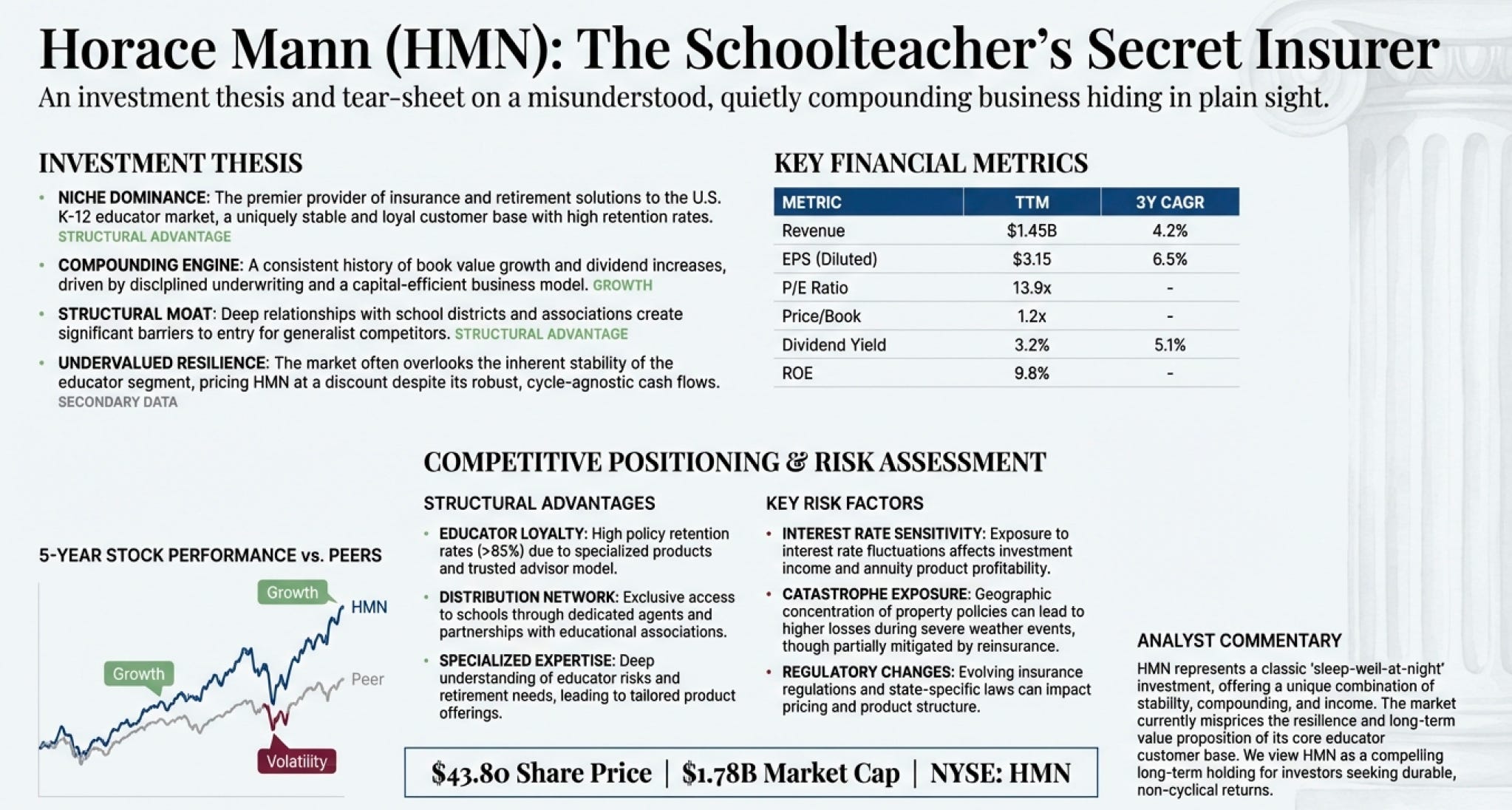
Horace Mann Educators Corporation (NYSE: HMN) is one of those companies.
At $43.80 per share, with a market cap of just $1.78 billion, this is what we call a “sit-on-your-ass” investment opportunity — the kind Charlie Munger described as finding a wonderful business at a fair price and then doing nothing. But before you sit on your ass, you need to earn the right to do so. You need to do the work. And the work here is deceptively complex — layered in insurance accounting, reinsurance mechanics, and a niche that most analysts gloss over without a second thought: America’s 7.5 million K-12 educators.
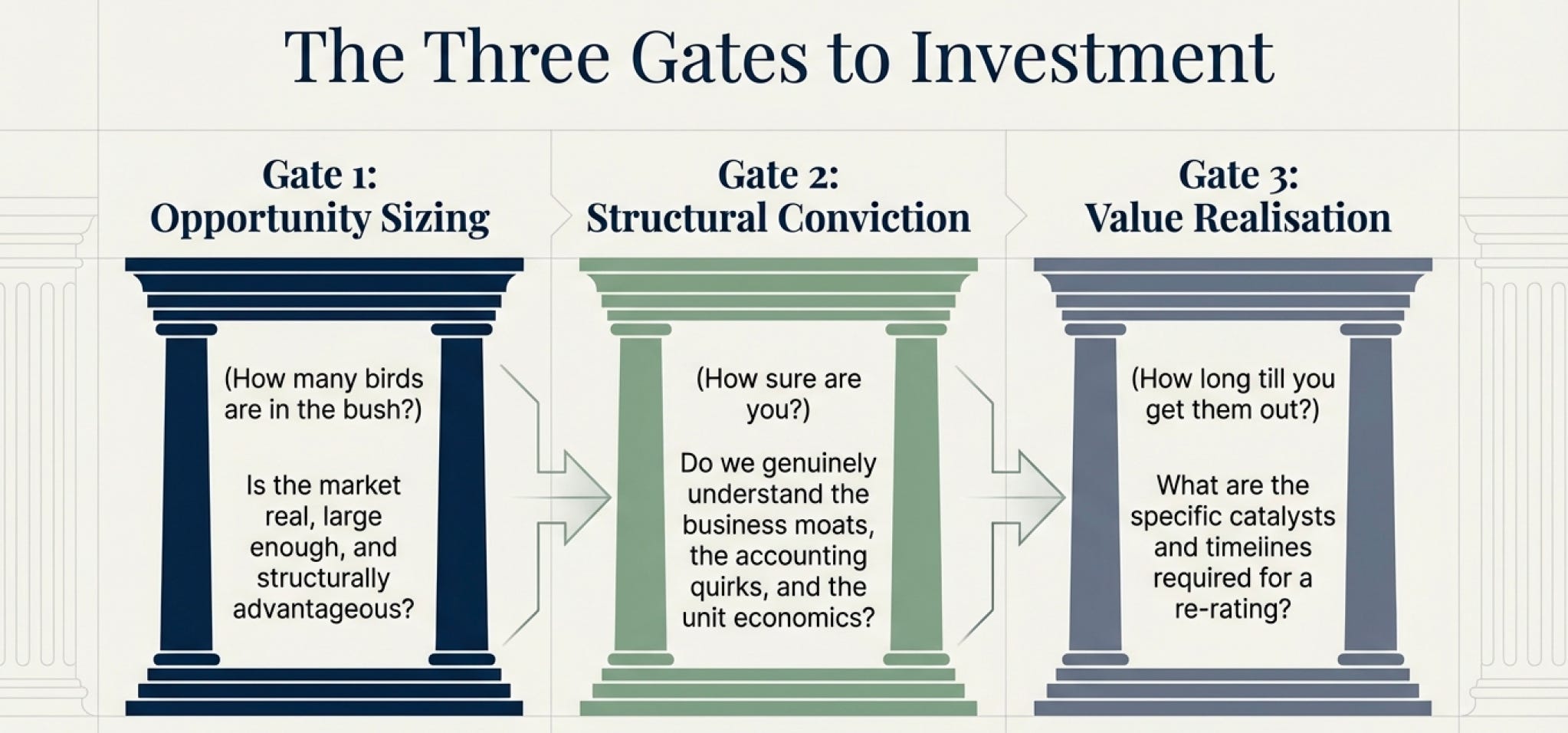
This article is structured around three questions that I use as a decision framework for every investment idea. Think of them as three gates a business must pass through before it earns a place in the portfolio:
1. How many birds are in the bush? (Is the opportunity real and large enough?) 2. How sure are you? (Do you genuinely understand the business and its risks?) 3. How long till you get them out? (What is the path to value realization?)
If any one of these fails, the idea is rejected. Simple. Brutal. Necessary.
HMN currently sits on my watchlist — not yet bought, but deeply analyzed, intellectually honest, and waiting for the right moment. Let me show you why.
Part I: How Many Birds Are in the Bush?
The Problem Nobody Wants to Solve (But Which Makes a Brilliant Business)
Here is a fact that might surprise you: America’s teachers are in a quiet financial crisis, and most of corporate America doesn’t care.
According to RAND Corporation’s 2025 State of the American Teacher survey, 62% of K-12 teachers reported frequent job-related stress — nearly double the rate of similar working adults at 33%. The average teacher earns roughly $73,000 a year, compared to $103,000 for similarly educated workers in other professions — a “teacher pay penalty” that has widened over decades. Teachers work an average of 49 hours per week, 10 hours above their contracted hours, frequently spending their own money on classroom supplies, and living with chronic financial anxiety that bleeds directly into their capacity to do their jobs well.
And here is the punchline: more than a quarter of educators would be more likely to stay in their jobs if they felt more financially secure. Teacher turnover costs school districts an estimated $20,000 per teacher replaced, when you factor in recruitment, training, and lost institutional knowledge. Financial insecurity is not just a personal problem for educators — it is a systemic, structural drag on American education.
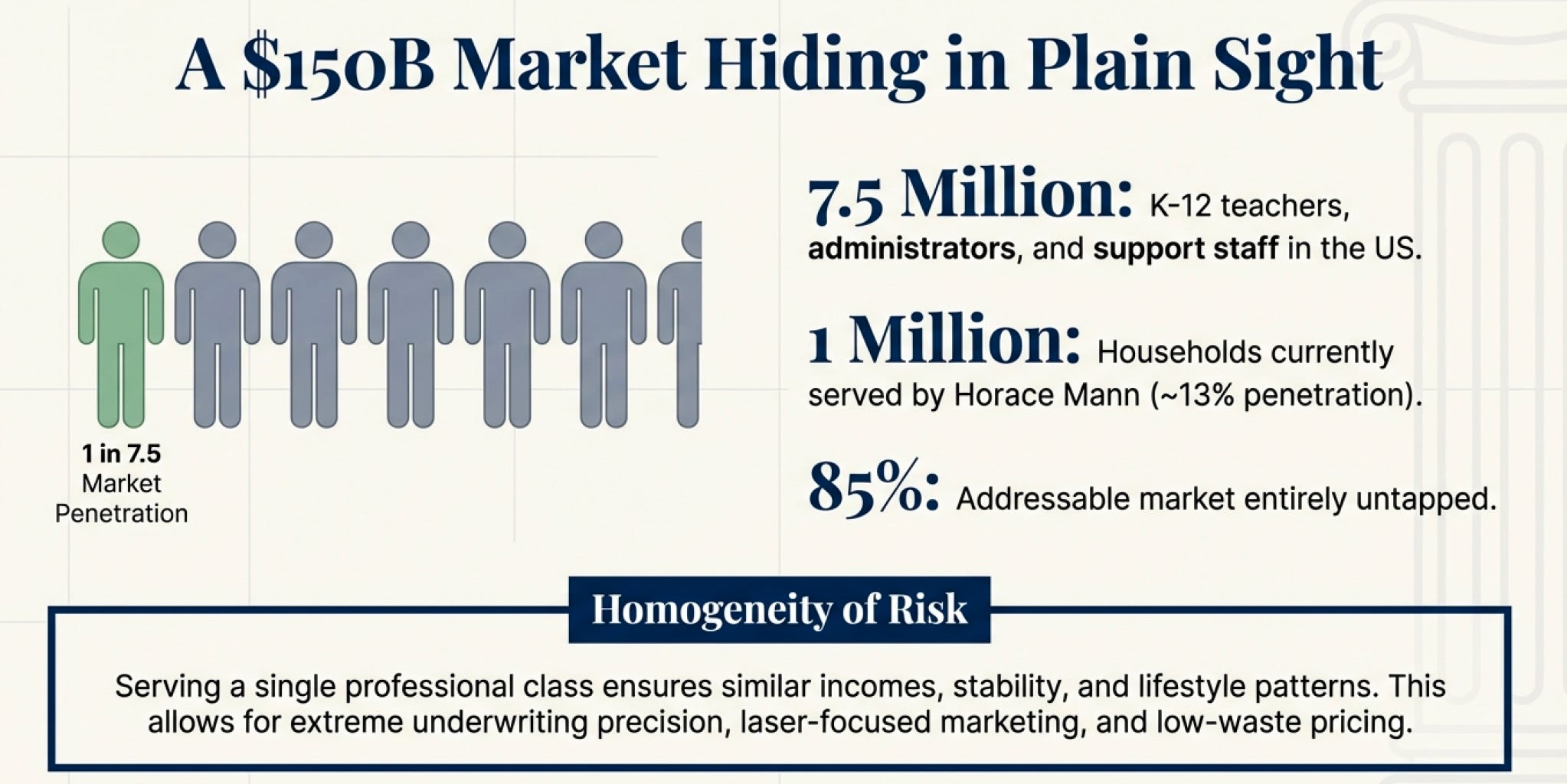
This is not a niche problem. This is a $150 billion+ market hiding in plain sight, and Horace Mann has spent 80 years building the only national institution specifically designed to serve it.
Founded in Springfield, Illinois in 1945 — literally by educators, for educators — Horace Mann is the largest multiline financial services company focused exclusively on America’s K-12 educational community. While Allstate, State Farm, and Progressive fight for every driver on the American highway, Horace Mann quietly walks into school district offices, sits across from principals and union representatives, and says: “We built everything specifically for you.”
That is a fundamentally different competitive position. And it matters enormously.
The Market: Serving 1 in 7, With Room to Grow
There are approximately 7.5 million K-12 teachers, administrators, and support staff in the United States. Horace Mann currently serves approximately 1 million of those households — roughly 1 in every 7.5 potential customers. That means roughly 85% of the addressable market remains untapped.
The customer base is 80% core educators (teachers, principals, administrators) and 20% adjacent public sector workers like firefighters. What makes this niche so economically valuable is a concept that insurance underwriters dream about: homogeneity of risk. When your customers are all members of the same professional class — similar incomes, similar employment stability, similar lifestyle patterns, similar financial needs — you can underwrite risk with extraordinary precision. You waste almost no money pricing incorrectly. Your marketing is laser-focused. Your products can be tailored so specifically that competitors struggle to replicate them even when they try.
This is why Warren Buffett loves GEICO so much — it targets a self-selecting, lower-risk group (government employees). Horace Mann has done something even more elegant: it has built an 80-year data moat around one of the most stable, predictable employment segments in the entire American economy.
Eighty years of educator insurance data. Think about what that means. When you have claim history, churn rates, lifetime value data, and actuarial tables specifically calibrated to this group for eight decades, you have a proprietary “raw material” — the kind that cannot be bought, replicated overnight, or reverse-engineered by a competitor who decides to enter the space tomorrow. Alphabet doesn’t have it. Progressive doesn’t have it. Teachers Insurance and Annuity (TIAA) has pieces of it. Nobody else has the full picture that Horace Mann has.
The Business Model: Three Machines, One Customer
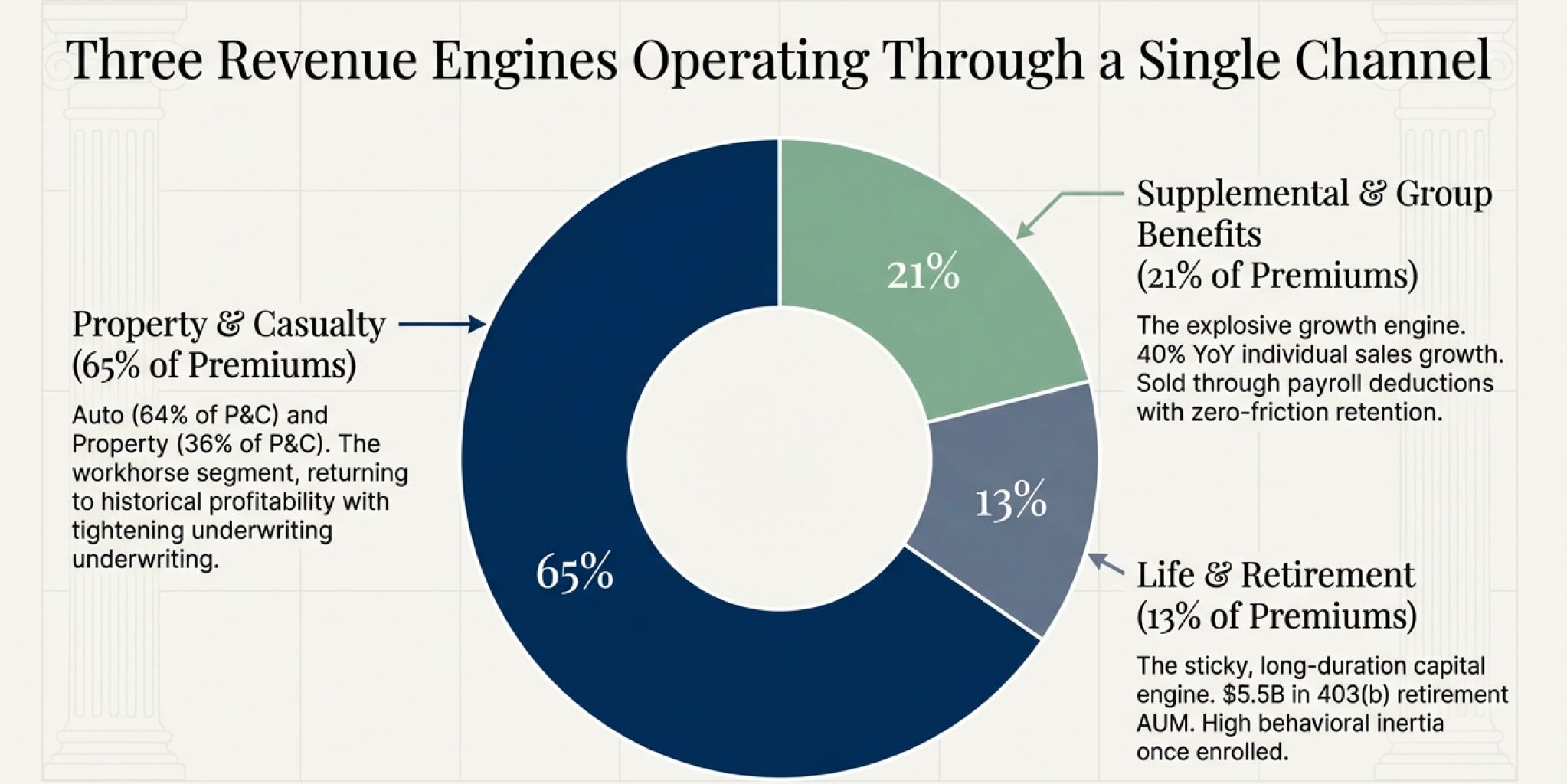
Horace Mann runs three distinct revenue engines through a single distribution channel, which is the key to understanding both its economics and its potential.
The largest engine is Property & Casualty, which represents 65% of the business by premiums written. Within this, auto insurance is the dominant product (64% of P&C premiums, or roughly 40% of the entire company), followed by property insurance (36% of P&C, roughly 25% of the company). This is the company’s workhorse — the product that most educators first encounter, and the front door through which deeper relationships are built. The 2025 full-year P&C combined ratio came in at 89.7%, an improvement of more than 8 points over 2024, signaling that the underwriting discipline is improving materially.
The second engine is Life & Retirement, accounting for roughly 13% of premiums. This is where HMN’s truly distinctive positioning lives. The company is one of the largest participants in the K-12 educator segment of the 403(b) tax-qualified annuity market — the educator’s equivalent of a 401(k). With $5.5 billion in retirement assets under management across 218,607 annuity contracts, this segment generates long-duration, sticky capital. Educators don’t move their retirement savings casually. Once enrolled in a 403(b), the behavioral and institutional inertia is enormous.
The third engine — and arguably the most exciting — is Supplemental & Group Benefits, representing 21% of premiums. This includes disability insurance, life insurance, and group health benefits sold at the district level through payroll deduction. This segment is growing fastest: as of 2025, it delivered nearly 40% year-over-year growth in individual supplemental sales. The reason for this explosive growth is structural: when you sell through payroll deduction, the buying friction drops to nearly zero, the retention rate is extremely high (it takes active effort to cancel), and the school district becomes your distributor — without you paying them a penny.
The Capital Reinvestment Rate: Where the Magic Lives
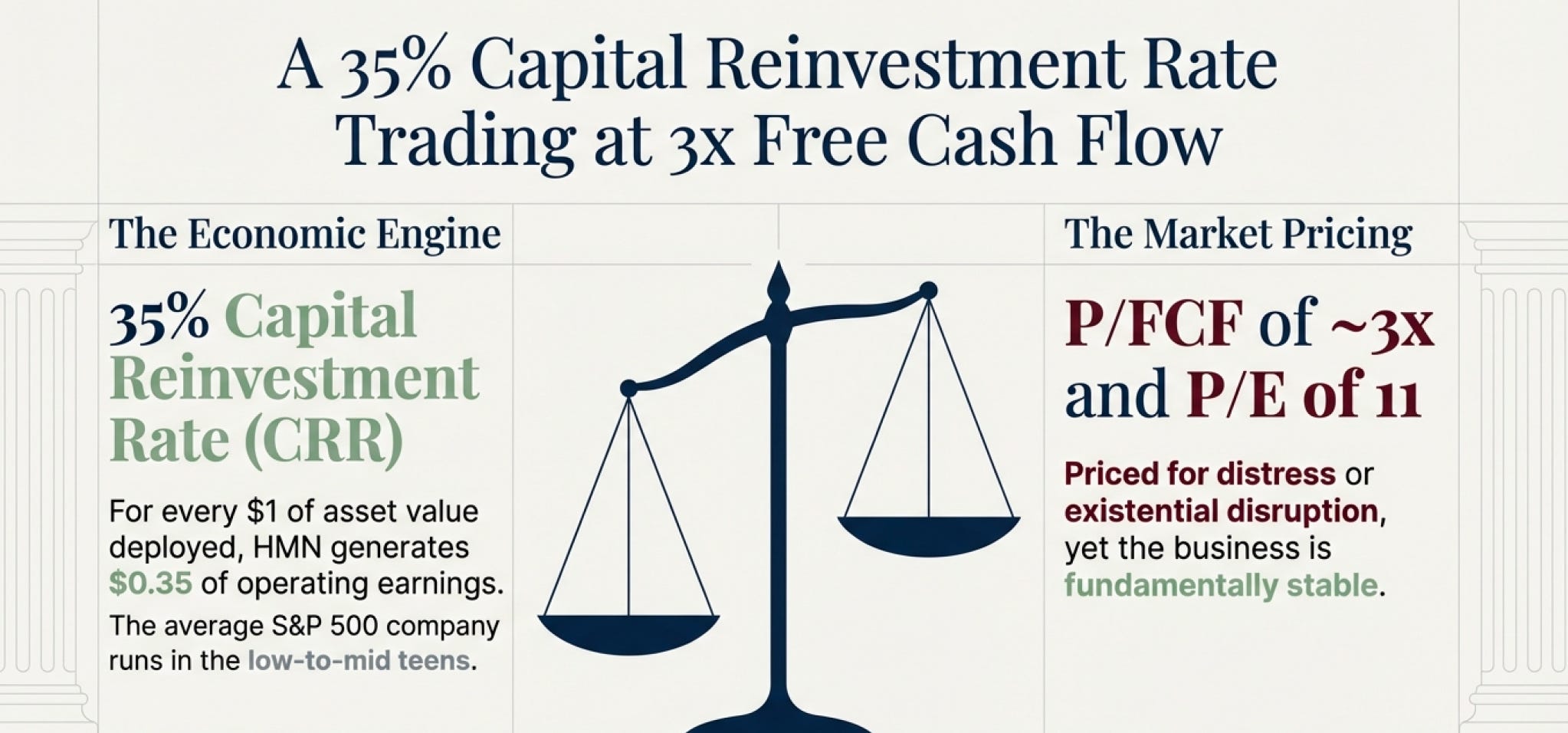
Let’s talk about the CRR — the Capital Reinvestment Rate — because this is where the story gets interesting. For HMN, the CRR comes out at 35%.
To appreciate why this matters, consider the analogy of a machine. The CRR tells you how efficiently a business turns every dollar of asset value into EBIT. A 35% CRR means this machine, for every $1 of asset value deployed, is generating $0.35 of operating earnings annually — before you factor in growth. For context, the average S&P 500 company runs a CRR in the low-to-mid teens. Finding a 35% CRR business selling at a P/E of 11 is like finding a Ferrari priced as a Honda Civic.
But hold that thought. Because this is exactly where the story twists.
Thanks for reading Compounding Zero! Subscribe for free to receive new posts and support my work.
The Price/FCF Situation: Crazy Cheap or Value Trap?
Here is the number that will stop you in your tracks: at $43.80 per share, HMN trades at a Price/Free Cash Flow ratio of approximately 3. Three. Not thirteen. Not thirty. Three.
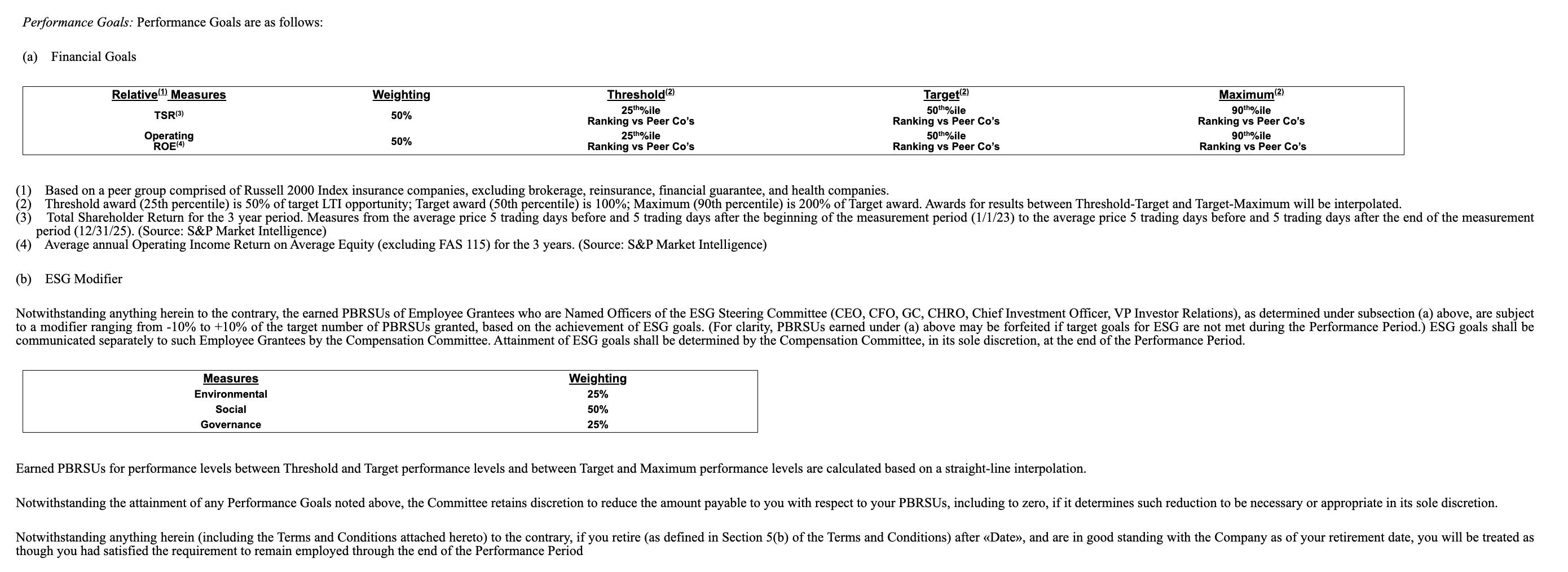
There is also 1 thing that i like a lot — management incentives. The management receives compensation based on performance metric like “Operating ROE” — Average annual Operating Income Return on Average Equity (excluding FAS 115) for the 3 years. As Munger said “show me the incentive, and i’ll show you the outcome”.
That is the kind of valuation you see in distressed businesses, fraud cases, or industries facing existential disruption. Horace Mann is none of these things. So why is the market pricing it this way? That is the heart of this whole story — and understanding it is what separates a great investor from an average one.
The answer lies buried in the accounting of its reinsurance arrangements, and it will take Section 2 to fully unpack. But the preview is this: what appears to be a low-margin, low-ROE business is partially an accounting illusion — one that suppresses the visible earnings and ROE, making the stock look worse than it actually is on a cash basis.
The market sees a P/E of 11 and a depressed ROE hovering around 10%, and moves on. The patient investor sees a P/FCF of 3 and asks: “Why the gap?” That question is worth tens of millions of dollars to the person who answers it correctly.
Part II: How Sure Are You?
The Moat: Built on Trust, Data, and a Handshake at the School Gate
There is a line of thinking in competitive strategy — first articulated clearly by Michael Porter and later simplified by Buffett into his famous “moat” concept — that says sustainable business advantage comes not from what you do, but from what makes it hard for others to replicate what you do.
HMN’s moat is multi-layered and genuinely durable. First, there is distribution access. Horace Mann agents don’t sell at car dealerships or through online aggregators. They are embedded in school districts, attending district benefit fairs, sitting in teachers’ lounges, partnering with principals and union representatives. This isn’t just access; it’s trust. Trust that took 80 years to build and would take any newcomer a generation to develop.
Second, there is product specificity. The “Educator Advantage” program offers targeted discounts and coverages that don’t exist anywhere else — for example, covering school property stored in an educator’s car, or theft of classroom equipment from a teacher’s personal vehicle. State Farm can’t offer this with credibility because State Farm doesn’t understand the educator’s daily life with the same granularity. You cannot replicate depth of understanding through a marketing campaign.
Third, there is the 403(b) flywheel — powered by student debt relief. This one deserves a fuller explanation because it is the most counterintuitive and clever piece of the entire business model.
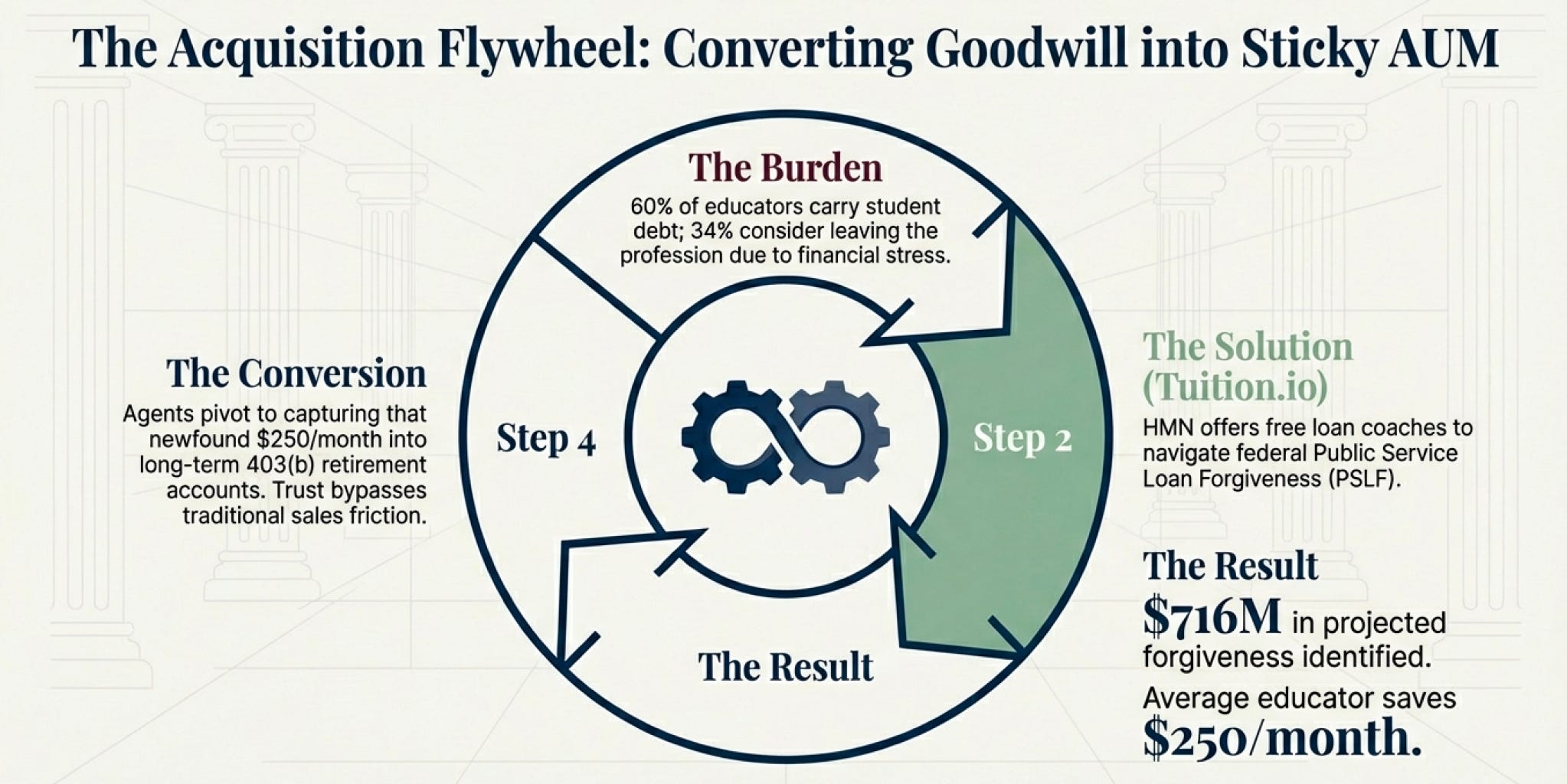
Teachers are not just underpaid relative to their educational peers — they are also, overwhelmingly, indebted. HMN’s own research found that more than 60% of educators carry student loan debt, and that debt is not a minor inconvenience. It is a life-defining financial burden: 85% of educators surveyed said student loan debt has prevented them from achieving major life goals — buying a home, starting a family, building savings. Critically, 34% are actively considering leaving the profession entirely because of financial stress, and 88% said they would be more likely to stay if their loans could be forgiven.
Enter HMN’s Student Loan Solutions program. Through a partnership with Tuition.io, HMN offers every public school educator in the country complimentary access to a loan management platform that helps them navigate the federal Public Service Loan Forgiveness (PSLF) program — a government program that forgives the remaining balance of a teacher’s federal loans after 120 qualifying monthly payments, typically ten years of public school employment. The catch is that navigating PSLF is notoriously confusing: the Department of Education’s own data showed that four out of five PSLF rejections were preventable with proper guidance. HMN steps in to provide exactly that guidance — loan coaches, online tools, repayment plan optimization — at zero cost to the educator or the school district.
The results are extraordinary. By 2024, the program had identified more than $716 million in projected loan forgiveness opportunities since inception, helping educators find an average of more than $250 in monthly savings on their loan payments. Individual educators have had $87,000 — even $10,000 — in debt wiped clean. Hundreds of school districts across more than 40 states have formally adopted the program as a staff benefit.
Now here is the business genius of it. When an educator’s student loan burden is lifted — or even materially reduced — they suddenly have monthly cash flow they didn’t have before. HMN’s agents are right there in that moment, as trusted advisors who just saved this teacher thousands of dollars, ready to have a very natural conversation: “Now that you have an extra $250 a month, have you thought about your retirement? Let’s talk about a 403(b).” The conversion from loan-relief beneficiary to 403(b) account holder is organic, trust-based, and deeply sticky. Once enrolled in a tax-deferred retirement plan, the switching costs are enormous — not because of contractual lock-ins, but because of tax complexity, inertia, and the relationship with an agent who has already proven their value in a deeply personal way. Help someone eliminate tens of thousands in debt, and they will trust you with their retirement savings for the next three decades. That is not a sales tactic. That is a genuine, long-duration relationship built on demonstrated value — and it is one of the most defensible customer acquisition strategies in all of financial services.
Fourth is the 80-year data asset. In the age of AI, data is the new oil. Insurance companies are nothing but risk-pricing machines, and the accuracy of your pricing is a direct function of the depth of your data. HMN’s actuarial tables for educators are irreproducible. Period.
HMN’s primary competitors — GEICO and Progressive in auto; Allstate, Farmers, and State Farm in personal lines; AXA, Security Benefit, and TIAA in the retirement space — are all significantly larger. Yet none of them have taken HMN’s market share in any meaningful way. The educator niche is too small to be strategically interesting to a behemoth like Allstate, yet large enough to sustain a focused, profitable niche player beautifully.
This is the “too small for giants, too specialized for generalists” moat — one of the most defensible positions in business.
The Accounting Mystery: Why the ROE Looks Wrong
Now let’s solve the puzzle.
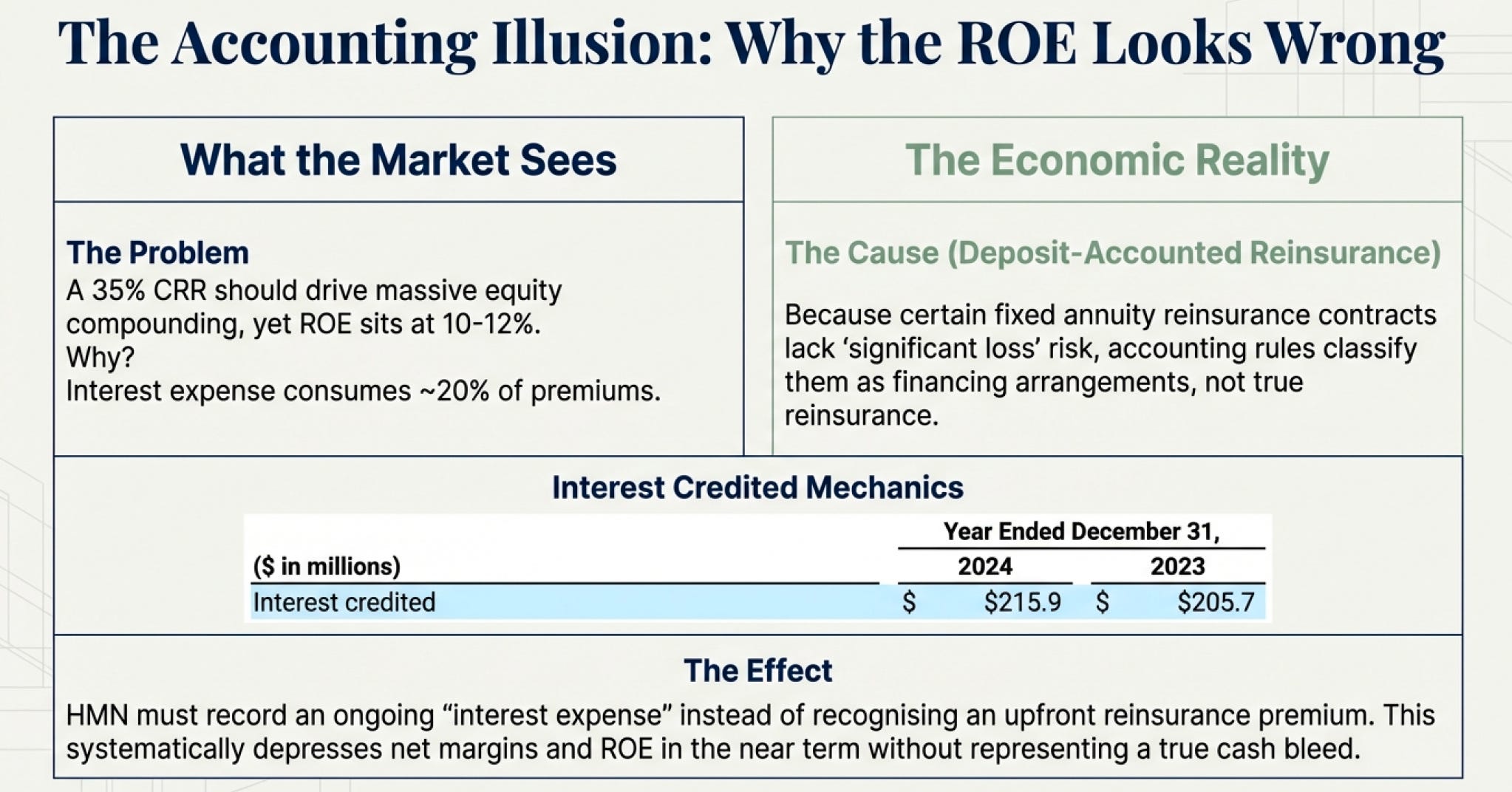
The question that every intelligent investor asks about HMN is this: if the Capital Reinvestment Rate is 35% and the FCF yield is unusually high, why is the Return on Equity hovering in the 10-12% range? Something doesn’t add up. A 35% CRR should theoretically compound equity at a high rate — so why isn’t ROE reflecting that?
The answer is in two words: interest expense.
HMN’s income statement shows interest expense representing roughly 20% of total premiums earned. That’s an enormous drag. To understand where it comes from, you need to understand a peculiarity of how HMN accounts for its reinsurance arrangements.
Think of it this way. Imagine you own a car and you buy insurance on it. Normally, your insurer pays a premium to a reinsurer who takes on some of the risk — and if a catastrophic loss occurs, the reinsurer pays. That’s classic risk transfer.
But here’s the thing: accounting rules require that for a contract to qualify as true reinsurance, there must be a reasonable possibility that the reinsurer could incur a significant loss. In HMN’s case, for certain fixed annuity reinsurance contracts — particularly the reinsured annuity block — the loss to the reinsurer was so immaterial that the accounting rules said: “This isn’t really reinsurance. It’s more like a financing arrangement.” So instead of recognizing it as a reinsurance premium (which would be expensed upfront or amortized), HMN must account for it as a deposit — essentially a financing transaction — where “interest” is recognized gradually over time on an effective yield basis.
The consequence of this treatment is profound. No reserves are released. No one-time gain or loss is recognized. Instead, every period, HMN records “interest expense” for this reinsurance arrangement — an expense line that is economically closer to an amortized fee than to the kind of interest expense you’d see from actual debt. But because it runs through the income statement as interest expense, it directly reduces net income and therefore ROE, even though it doesn’t represent a true cash bleed in the traditional sense.
This is why the Price/FCF ratio is 3 while the P/E is 11. The “earnings” are being suppressed by an accounting convention. The cash flow paints a truer picture.
Expensing a reinsurance cost as immediate interest expense rather than capitalizing and amortizing it depresses net margins in the near term relative to what they would look like under standard amortization treatment. The business isn’t earning less — it’s just recognizing the costs in a way that makes short-term earnings appear lower. This is not fraud. It is not manipulation. It is standard accounting applied to an unusual structure, and it creates a perceptual gap between accounting reality and economic reality — the exact gap that patient, analytical investors are paid to identify.
Additionally, HMN uses FHLB (Federal Home Loan Bank) advances — borrowings used to invest in floating-rate securities that earn a spread above the interest credited. This further inflates the “interest expense” line while also generating “interest income” on the asset side, but the gross appearance is of a highly levered, high-cost business when the net spread is actually positive and intentional.
The Red Flags Investigated
No investment analysis is complete without earnest attempts to kill the thesis. Let me walk through the major risks and what I found.
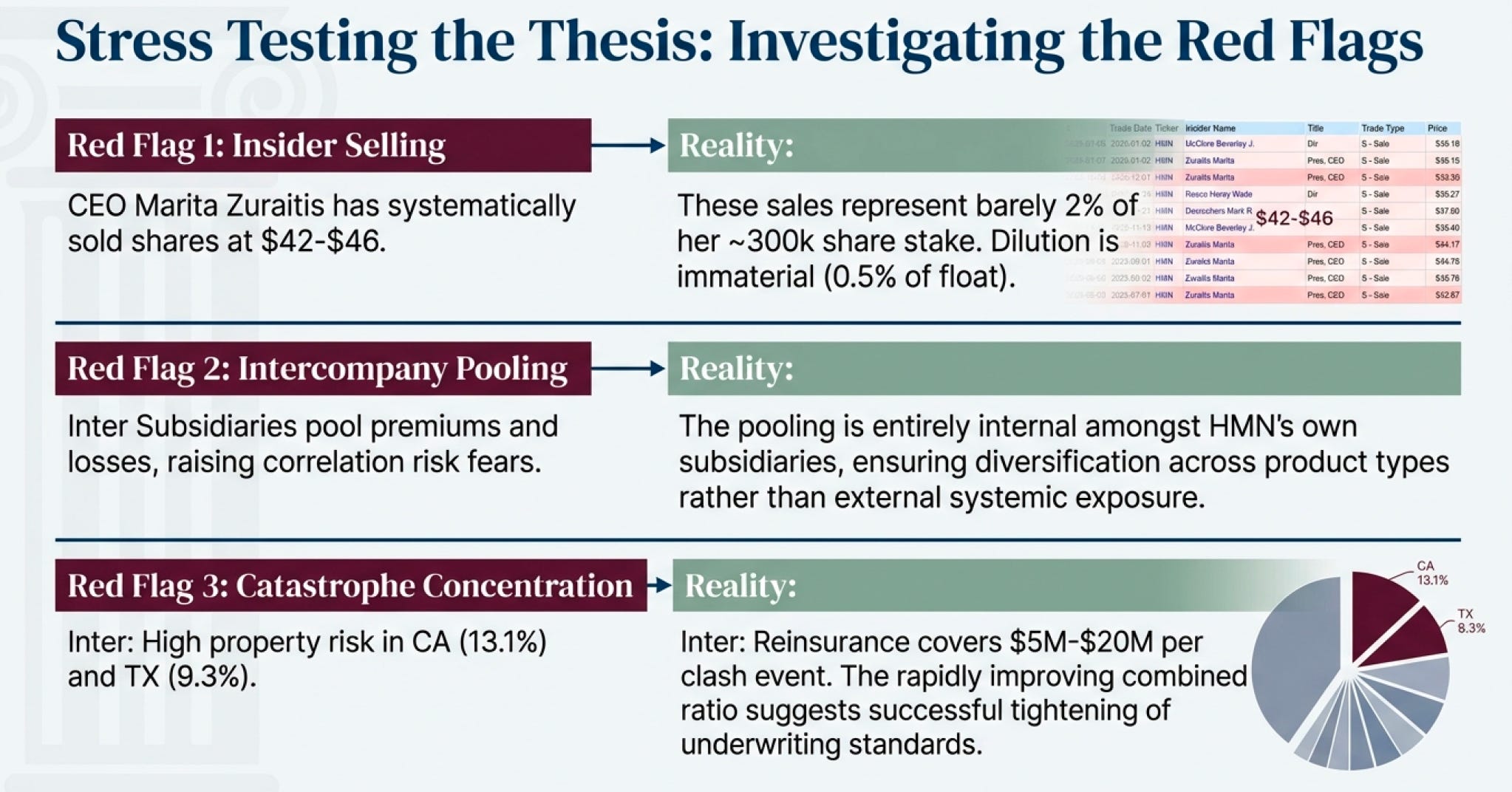
Red Flag #1: Significant insider selling. The CEO, Marita Zuraitis, has been a consistent seller of HMN shares throughout 2024 and 2025. On multiple occasions, she sold 5,000 shares at prices ranging from $42 to $46. However, context matters enormously here. She still owns nearly 280,000-300,000 shares — these sales represent roughly 2% of her total stake. This looks like systematic tax planning or portfolio diversification, not a loss of confidence in the business. Dilution from stock options (230,000 shares granted in 2024) is approximately 0.5% of the float — immaterial.
Red Flag #2: The intercompany pooling arrangement. HMN’s annual filing states that its P&C subsidiaries participate in an intercompany pooling arrangement — where the members share premiums, losses, and expenses collectively. On first read, this raised alarm bells: who are they pooling with? If it’s other mortgage insurers, the correlation risk in a housing downturn could be devastating. After deeper research, the pooling is entirely internal — between Horace Mann Insurance Company, Teachers Insurance Company, Horace Mann Property & Casualty Insurance Company, and Horace Mann Lloyds. The diversification is across product types within the same educator-focused insurance universe. This is actually a good sign, not a bad one.
Red Flag #3: Catastrophic concentration risk. With 166,991 property risks in force and geographic concentration in California (13.1% of P&C premiums), Texas (9.3%), and North Carolina (7.8%), the question of catastrophe exposure is real. HMN’s reinsurance structure covers losses above $5 million per occurrence, up to a $20 million limit — but only in “clash events” where multiple casualty policies are hit by the same loss. A systematic regional property crash (like a California wildfire season hitting many educator-owned homes simultaneously) would NOT fully activate this reinsurance protection.
This is a genuine risk. The mitigation is that HMN’s geographic diversification across 40+ states reduces the severity of any single regional event, and the improving combined ratio (from 113% in 2023 to 98% in 2024 to 89.7% in 2025) suggests management is actively tightening underwriting standards in higher-risk areas.
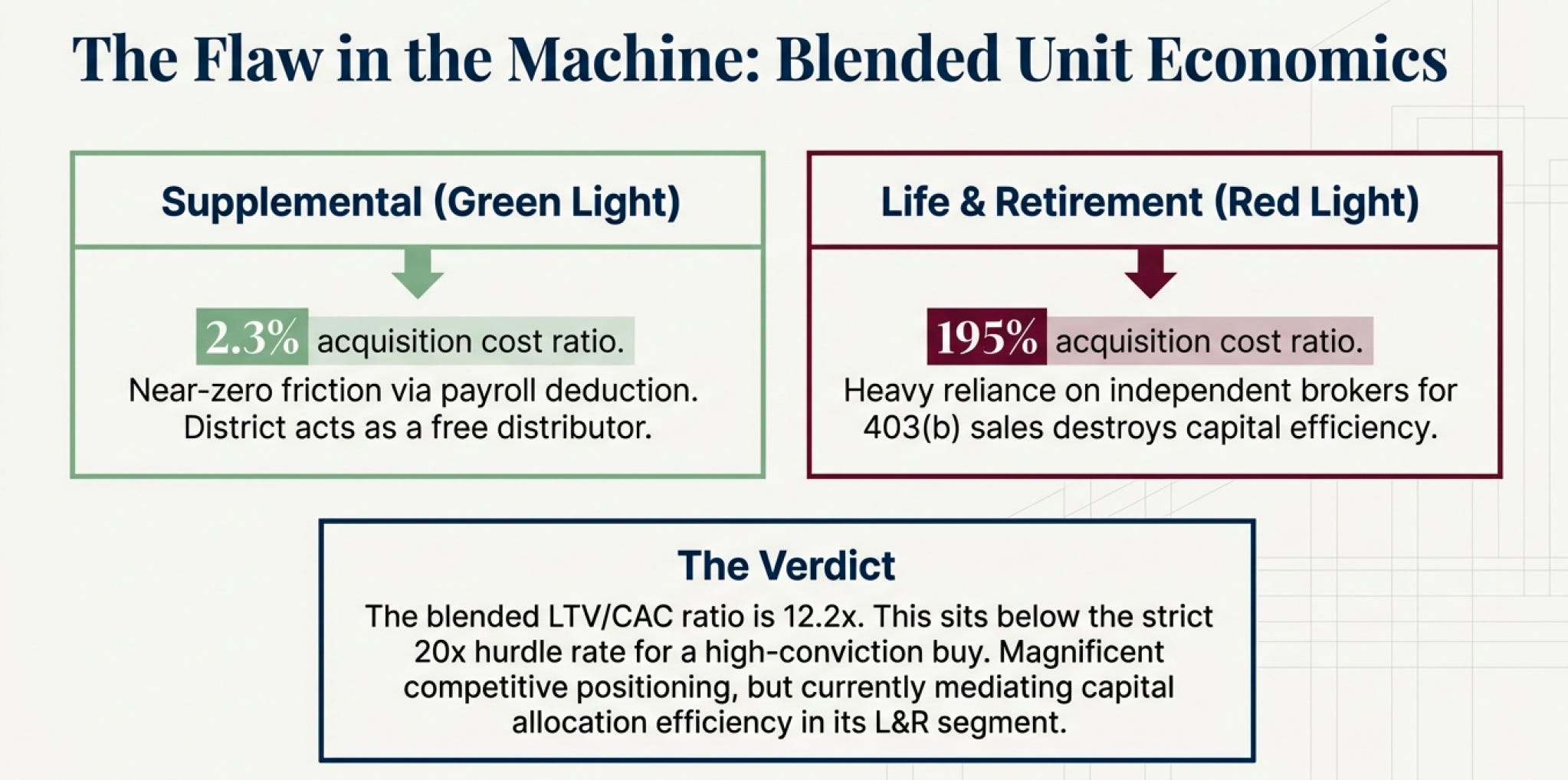
Red Flag #4: The Life & Retirement segment economics. This is the most sobering finding in the entire analysis. When you calculate the customer acquisition cost to net premium ratio for the Life & Retirement segment, the number is startling: $297 million in deferred acquisition costs against $151.7 million in net premiums — a ratio of 195%. Even adjusting for the longer amortization period of annuity contracts, this segment’s acquisition economics are genuinely weak, largely because HMN relies heavily on independent brokers to distribute 403(b) products rather than its own captive agent force.
The supplemental and group benefits segment, by contrast, is beautiful: acquisition costs of just 2.3% of premiums, achieved by selling through school districts as de facto distributors (who charge HMN nothing) and through payroll deduction (which creates near-automatic enrollment and retention). This is the best segment in the company, and it’s growing at 40% year-over-year.
The blended customer lifetime value-to-acquisition-cost ratio across the three segments, weighted by revenue contribution, works out to roughly 12.2x — below my personal hurdle of 20x, which is where I start getting truly excited. The drag comes from the Life & Retirement segment’s heavy broker reliance, pulling down what would otherwise be an extremely attractive overall ratio.
This is the honest, uncomfortable finding: HMN has magnificent competitive positioning and mediocre capital allocation efficiency in its largest earnings-by-AUM segment. The company knows this, and the 2025 results — record core earnings of $4.71 per share against management guidance of $3.60-$3.90 — suggest that the ongoing operational improvements are beginning to compound.
The 2025 Results: Proof Points Accumulating
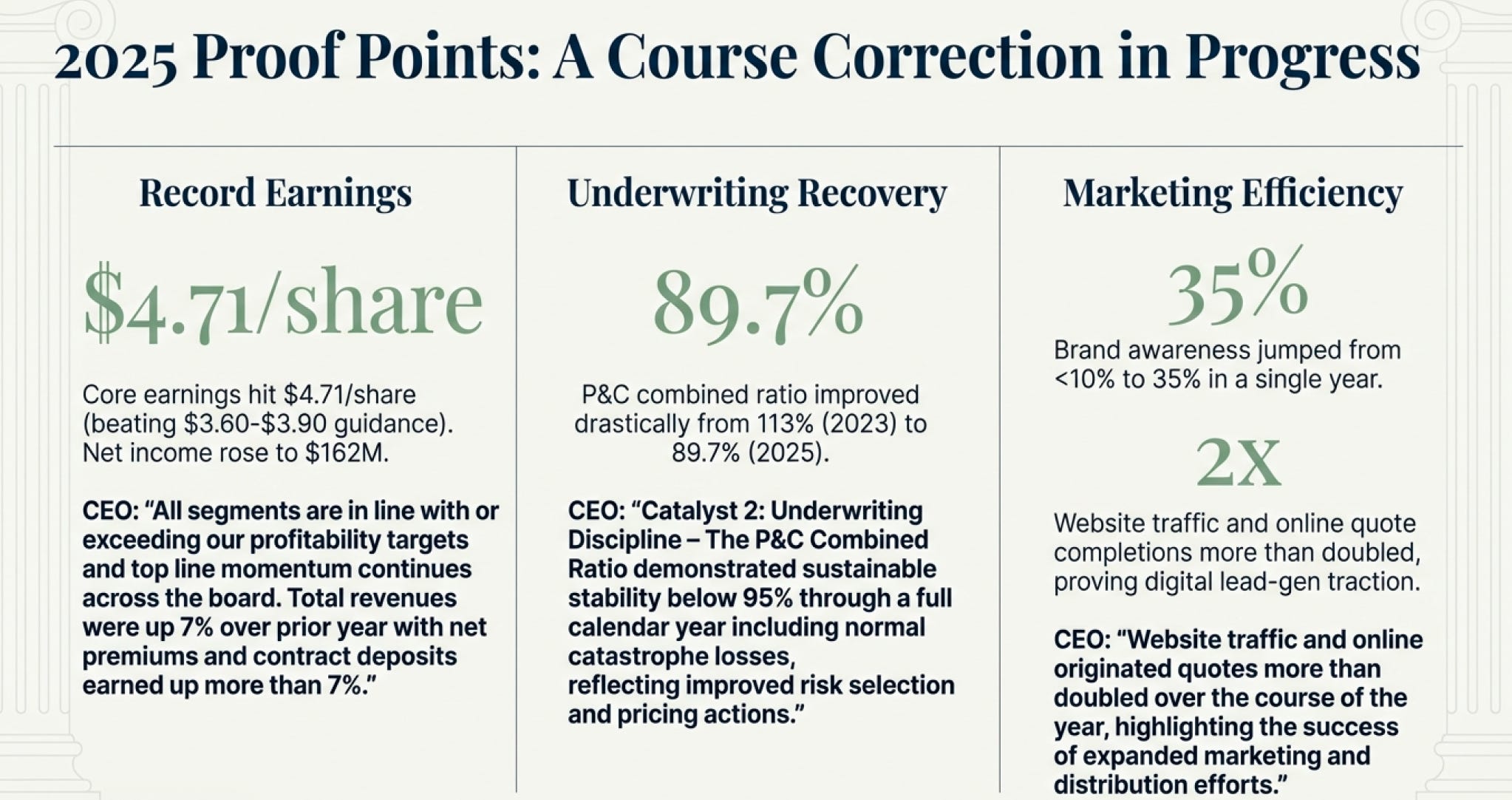
Full-year 2025 results confirmed the improving trajectory. Net income reached $162 million ($3.90/share) and record core earnings hit $196 million ($4.71/share) — a meaningful step up from $103 million net income in 2024. Total revenues rose nearly 7%, net premiums grew more than 7%, and the P&C combined ratio improved another 8+ points to 89.7%. The CEO noted that brand awareness jumped from under 10% to 35% in a single year — a remarkable marketing efficiency achievement. Website traffic and online quote completions more than doubled.
This is not a broken business experiencing a dead-cat bounce. This is a business that hit a rough patch in 2022-2023 (catastrophe losses, poor auto underwriting, rising reinsurance costs) and is systematically correcting course.
Thanks for reading Compounding Zero! Subscribe for free to receive new posts and support my work.
Part III: How Long Till You Get Them Out?
The Path From Here to There
Charlie Munger once said: “All I want to know is where I’m going to die, so I’ll never go there.” The inverse is equally useful for investing: all I want to know is what has to happen for this investment to work, so I can track whether those things are actually happening.
For HMN to realize its intrinsic value and generate returns that justify position sizing, three things need to happen — and they need to happen in the right order.
First: The Supplemental & Group Benefits segment must become a meaningfully larger piece of the business. This is the crown jewel — 43x customer lifetime value to acquisition cost, 40% annual growth, and payroll deduction creating near-automatic retention. If Supplemental & Group Benefits grows from its current 21% of premiums to 30-35% over the next five to seven years (a plausible trajectory given its growth rate), the blended effective return on customer acquisition will cross my 20x hurdle. The company’s expansion into New Jersey in 2024, combined with its deepening district-level partnerships across 40+ states, suggests the distribution infrastructure is being built to support exactly this kind of growth.
Second: The P&C combined ratio must stay below 95% sustainably. The 2025 figure of 89.7% is encouraging, but it needs to stick. The improvement in 2024 and 2025 was driven by pricing actions, digital marketing efficiency improvements (90% of P&C prospects now research insurance online, and HMN has dramatically improved its online quoting infrastructure), and better catastrophe reinsurance management. If management can hold the combined ratio at or below 95% through a full business cycle — including a normal catastrophe year — the P&C segment’s earnings power becomes consistently positive and predictable.
Third: The Life & Retirement segment must reduce its broker dependency. This is the hardest and most uncertain lever. The high acquisition cost in L&R is almost entirely attributable to the broker channel for 403(b) sales. If HMN can shift more of this distribution toward its own captive agents, digital channels, or school-district partnerships (similar to what’s working beautifully in Supplemental), the blended unit economics improve dramatically. This is a multi-year journey, and there is no guarantee management will execute it quickly.
The Timeline: Probably Longer Than You’d Like
I’m going to be honest here because intellectual honesty is the entire point of this exercise.
I don’t know exactly when the market will reprice HMN. And “I don’t know” is a legitimate investment answer — provided you are comfortable with the underlying economics while you wait.
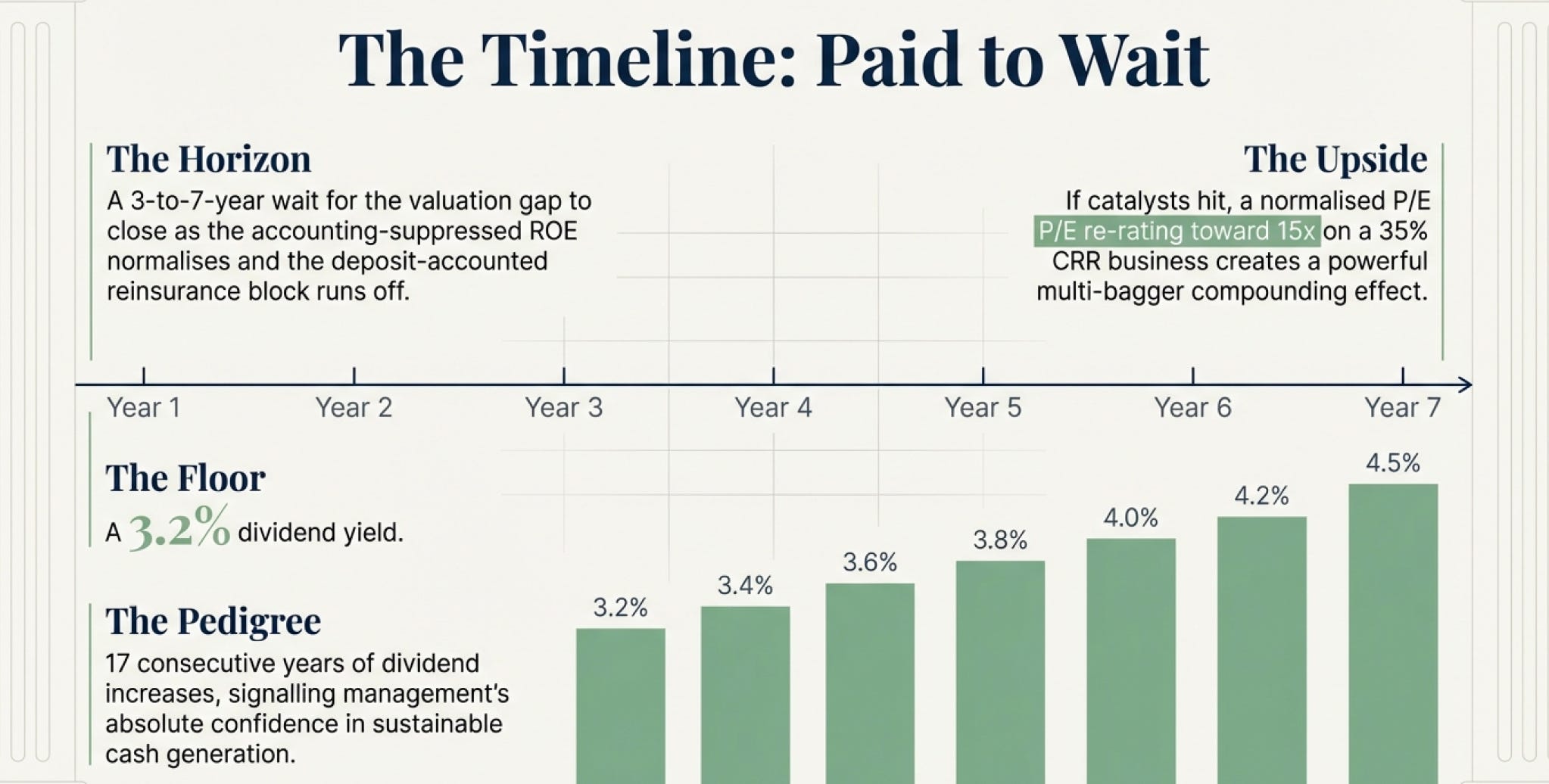
What I do know is this: at a P/FCF of 3, the market is essentially paying nothing for the business’s future growth and is assigning minimal value to its competitive moat. Even if HMN’s earnings power merely stays flat and the accounting-suppressed ROE gradually normalizes (as the deposit-accounted reinsurance block naturally runs off over its contracted period), the valuation gap should close over a three-to-seven-year horizon.
The company has raised its dividend for 17 consecutive years. At the current share price and a $1.40 annual dividend, the yield is approximately 3.2% — so you are being paid to wait. The dividend provides a floor to the investment case and signals management’s confidence in sustainable cash generation.
If the P&C combined ratio stays below 95%, Supplemental grows to 30% of premiums, and the Life & Retirement broker costs compress even modestly, a normalized P/E re-rating toward 15x (still cheap for an improving, niche-dominant insurer) would close the valuation gap materially.
That is not modest upside dressed up in fancy language. For a business with a 35% CRR, a P/FCF of 3, a genuinely defensible moat, and three compounding growth levers that are all moving in the right direction simultaneously — this is the setup for a multi-bagger. The math is straightforward: if earnings normalize as the accounting drag from the deposit-accounted reinsurance block naturally runs off, and if the fastest-growing segment (Supplemental) becomes a meaningfully larger slice of the revenue mix, you are not looking at a linear price re-rating. You are looking at a compounding machine doing what compounding machines do — turning patient capital into disproportionate wealth, quietly and without announcement. The investors who find these businesses early and hold them long enough are the ones who retire well.
Why It’s on the Watchlist, Not the Portfolio (Yet)
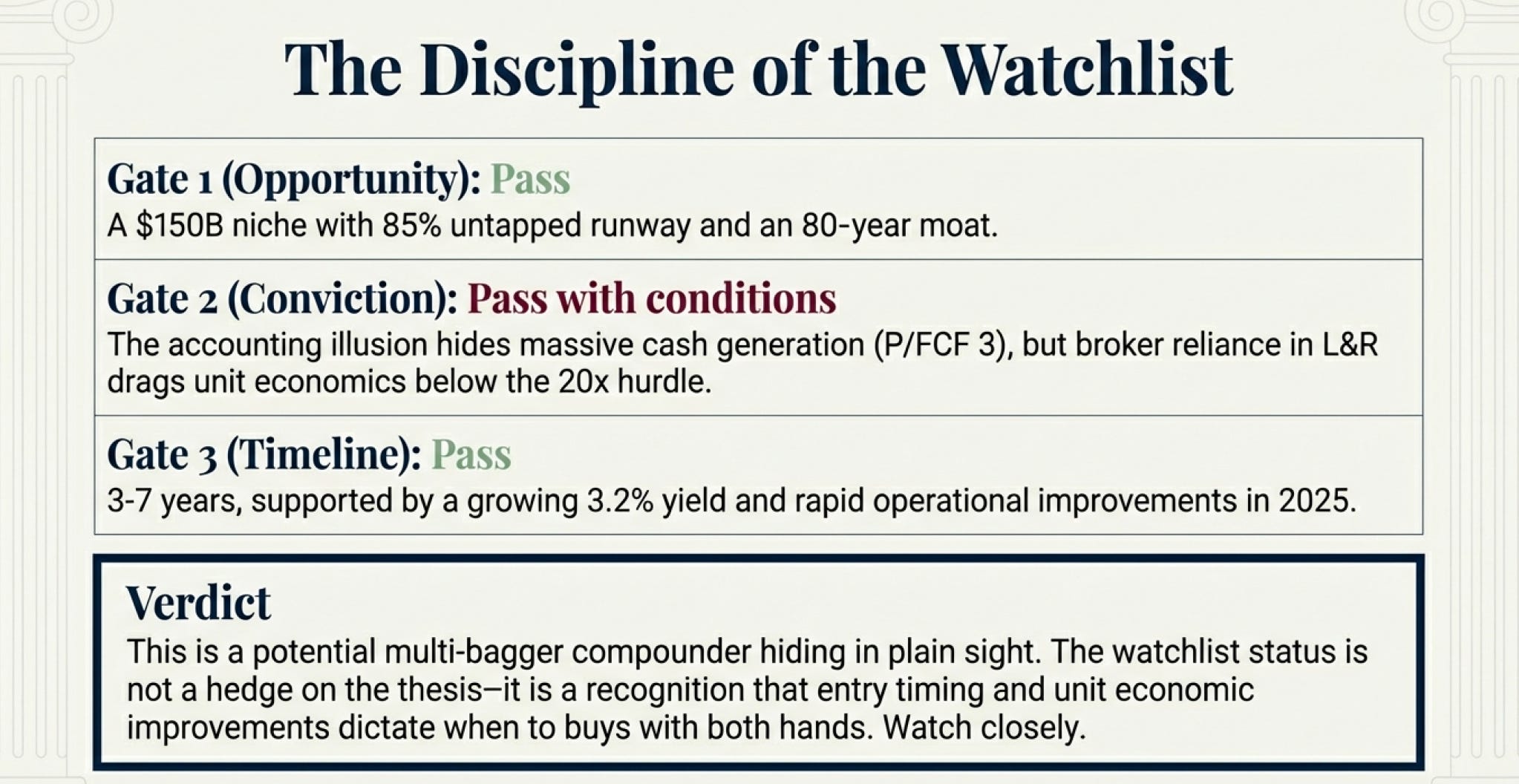
The reason HMN is on my watchlist rather than my portfolio is discipline, not doubt. Make no mistake — this is a potential 10-bagger. A 35% CRR business trading at a P/FCF of 3, with a niche moat that has compounded quietly for 80 years and three growth levers simultaneously inflecting, has the structural ingredients to multiply capital many times over for the investor patient enough to hold through the full compounding arc. The watchlist status is not a hedge on the thesis — it is a recognition that its an amazing business, and that the below-hurdle blended unit economics need one more leg of improvement before conviction becomes total.
The effective blended return on customer acquisition of 12.2x — against my 20x hurdle — means the business does not yet meet my full threshold for a “buy with both hands” conviction. The Life & Retirement segment’s broker-driven cost structure is the specific failure point, and it is a structural issue that requires strategic execution to fix, not just favorable market conditions.
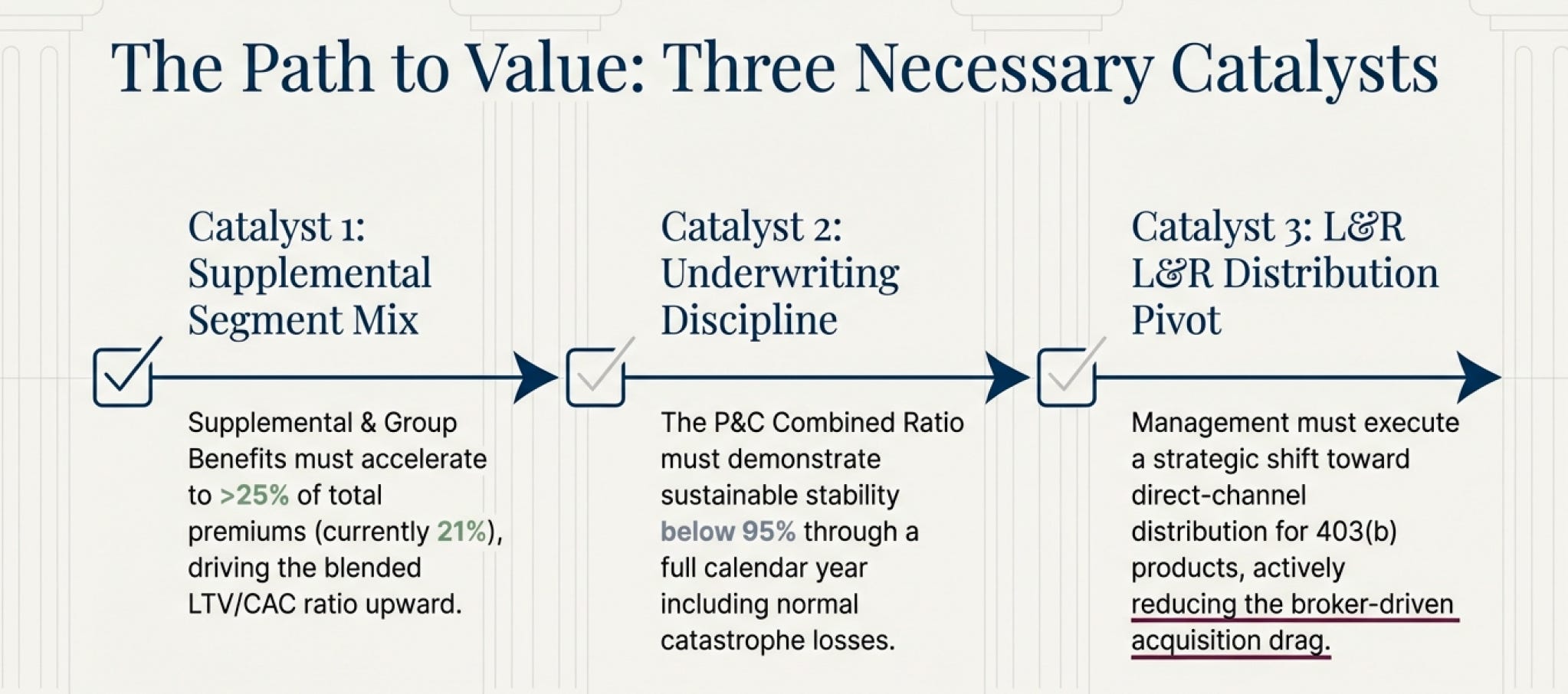
I am watching for three specific catalysts before upgrading from watchlist to position:
The first is evidence that the Supplemental & Group Benefits segment is accelerating its revenue contribution, measured by its share of total premiums crossing 25% on a trailing-twelve-month basis. The second is a sustained P&C combined ratio below 95% through at least one full calendar year with above-average catastrophe losses — proving the underwriting discipline holds under pressure. The third is any commentary from management indicating a deliberate strategy shift toward direct-channel distribution for 403(b) products, reducing the broker-driven acquisition cost in Life & Retirement.
Until at least two of these three catalysts materialize, HMN is exactly what the investment community at large sees it as — a good business with complicated economics and a depressed but explainable valuation. The moment those catalysts arrive, it becomes something else: a mispriced compounder hiding in plain sight.
Conclusion: The Bird in the Hand, and the Many in the Bush
Let me bring it home with the framework that opened this article.
How many birds are in the bush? Enough to matter. A 7.5 million educator market with only 13% penetration, three complementary product lines, an 80-year data moat, and a Supplemental segment growing at 40%. The opportunity is real and large.
How sure are you? Very sure about the qualitative dynamics. The moat is durable. The accounting complexity is understood (and is an optical illusion rather than a fundamental flaw). The risks are manageable and mostly disclosed. The 12.2x blended customer acquisition return is below my hurdle — and I am honest about that.
How long till you get them out? This is where the sit-on-your-ass investor earns their returns. Charlie Munger didn’t describe sitting on your ass as laziness — he described it as discipline. The discipline of finding a business you understand deeply, at a price that gives you a margin of safety, and then doing the hardest thing in investing: nothing. Three to seven years feels like a reasonable horizon for the catalysts to fully materialize. In the meantime, a 3.2% dividend yield — backed by 17 consecutive years of dividend increases — pays you to wait. The compounding does the rest. The investor’s job, once the homework is done, is simply to stay out of their own way.
All three questions return answers above the rejection threshold — but the second question’s honest acknowledgment of below-hurdle unit economics is why this is a watchlist position rather than a portfolio position today. That is what intellectual honesty looks like in practice.
The schoolteacher’s insurer. Eighty years old. Completely misunderstood by Wall Street. Quietly compounding in a niche that will exist as long as America has public schools and teachers who need retirement plans, auto insurance, and someone who actually understands their lives.
That is a business worth watching very closely.
Thanks for reading Compounding Zero! Subscribe for free to receive new posts and support my work.
Disclosure: This is a personal analysis and not financial advice. All figures are sourced from HMN’s public filings, earnings releases, and RAND Corporation research. The author does not currently hold a position in HMN. Always do your own due diligence.
Sources: Horace Mann full-year 2025 earnings release (February 2026); RAND Corporation 2025 State of the American Teacher Survey; HMN 2024 Annual Report (10-K); HMN Q3 2025 Investor Supplement.
A majority of Horace Mann's insurance are short-tail insurance -- which means that they only have about 12 months of float and claims are made really quickly. On the other hand, the P/C insurance that Buffet bought in his previous investments was long-tail. In complex commercial P/C lines (like asbestos, environmental hazards, or multi-party liability), decades can pass before courts or adjusters finalize a claim. This long time gap provides Berkshire with a permanent pool of compounding investment capital. The low float duration of Horace Mann's float does not


14 May 2026 Update:
A majority of Horace Mann's insurance are short-tail insurance -- which means that they only have about 12 months of float and claims are made really quickly. On the other hand, the P/C insurance that Buffet bought in his previous investments was long-tail. In complex commercial P/C lines (like asbestos, environmental hazards, or multi-party liability), decades can pass before courts or adjusters finalize a claim. This long time gap provides Berkshire with a permanent pool of compounding investment capital. The low float duration of Horace Mann's float does not