
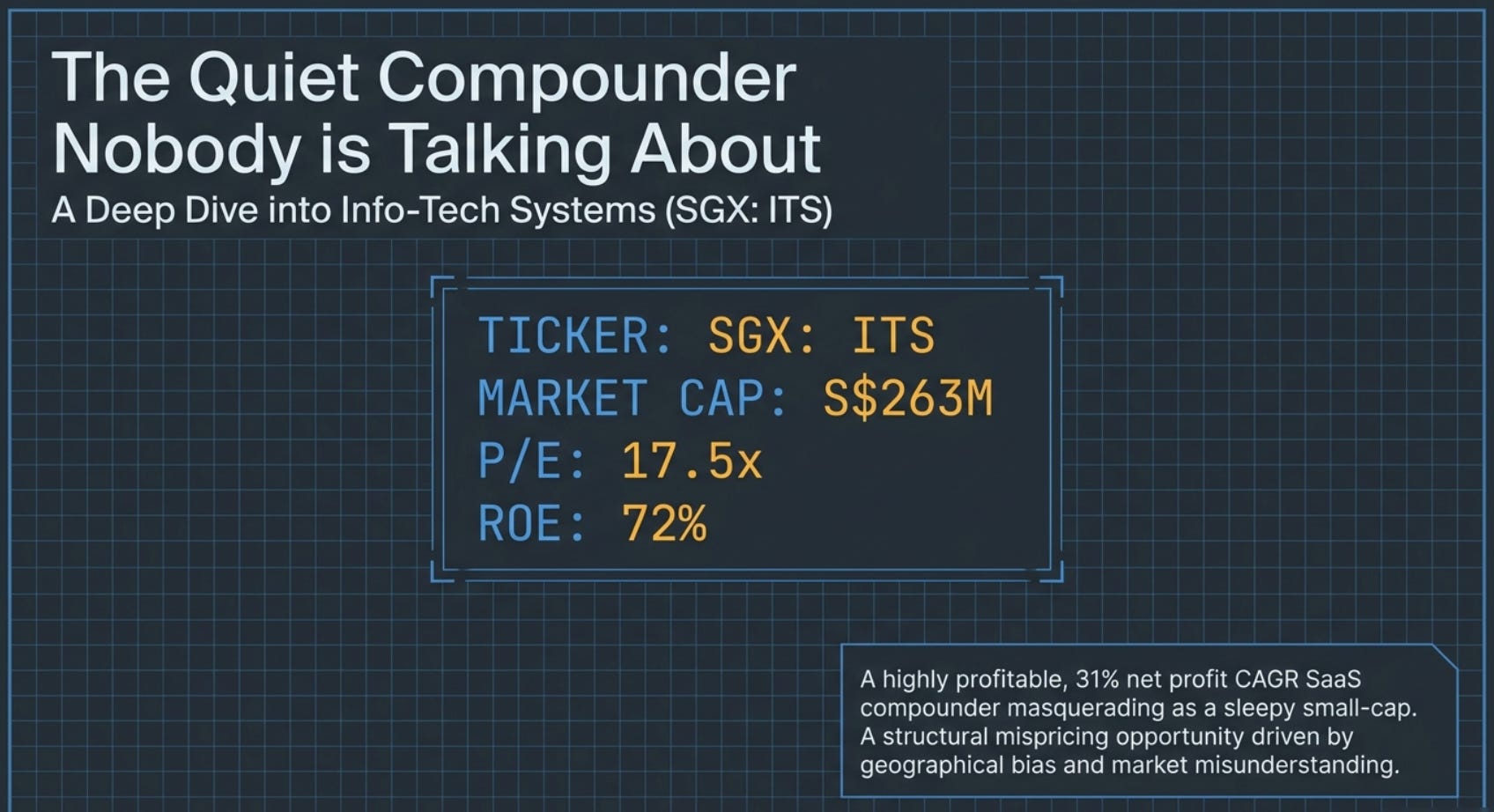
The Problem with Singapore’s Stock Market (And Why That’s Exactly Where I Want to Be)
There is a peculiar irony in investing. The market you trust least — the one journalists ignore, the one your brokerage app loads slowly, the one where the average daily volume is so thin it would make a Nasdaq trader laugh — is often the one hiding the most interesting businesses.
SGX has a reputation problem. Mention Singapore equities to any self-respecting growth investor and they will conjure images of sleepy REITs, bank stocks, and the occasional Jardine holding company with a balance sheet older than most living investors. It is not entirely wrong. The exchange has historically been dominated by capital-heavy industries, dividend-focused mandates, and conglomerates that move like glaciers.
But this is exactly the setup I love. When an entire market gets dismissed, when institutional attention is thin, when analyst coverage is sparse — the mispricing opportunity is almost always lurking right there in plain sight. Charlie Munger called it “the place where no one looks.” And in the third quarter of 2025, something quietly listed on the SGX Mainboard that I believe belongs in a completely different conversation from everything else on that exchange.
That company is Info-Tech Systems Ltd. Ticker: ITS.
I want to be transparent upfront. This is not a buy recommendation and I am not your financial advisor. What this is, however, is the most comprehensive thinking I have done on a single small-cap in a long time. It will be long. It will be honest. And at the end of it, I will tell you exactly where I think the thesis breaks — because the inverse of confidence is not uncertainty, it is intellectual honesty.
Let us begin.
The Discovery — A First Impression Worth Examining
The stock was listed in July 2025 at S$0.87 per share, and by the time I started digging into it in March 2026, it was trading around S$1.02 — roughly flat since listing aside from some early post-IPO enthusiasm. As of late April 2026, the stock sits near S$1.04, which represents a gain of only about 9.47% from the IPO price over nearly a year of trading.
That kind of sideways action, in a company posting 31% net profit CAGRs, is the kind of setup that makes me lean forward in my chair.
Info-Tech made history as the first SaaS HRMS provider to be listed on Singapore’s SGX Mainboard. That alone is worth pausing on. We are talking about a profitable, growing SaaS company — a category of business that commands 8-20x revenue multiples in the United States — listed in a market that has never seen a pure-play SaaS name of its kind before. The comparable framework simply does not exist locally. Analysts trained on REIT cap rates and bank dividend yields do not naturally know how to price recurring software revenue. And that confusion, that mismatch between what the business deserves and what the market gives it, is where the opportunity hides.
The basic numbers, as of December 2024:
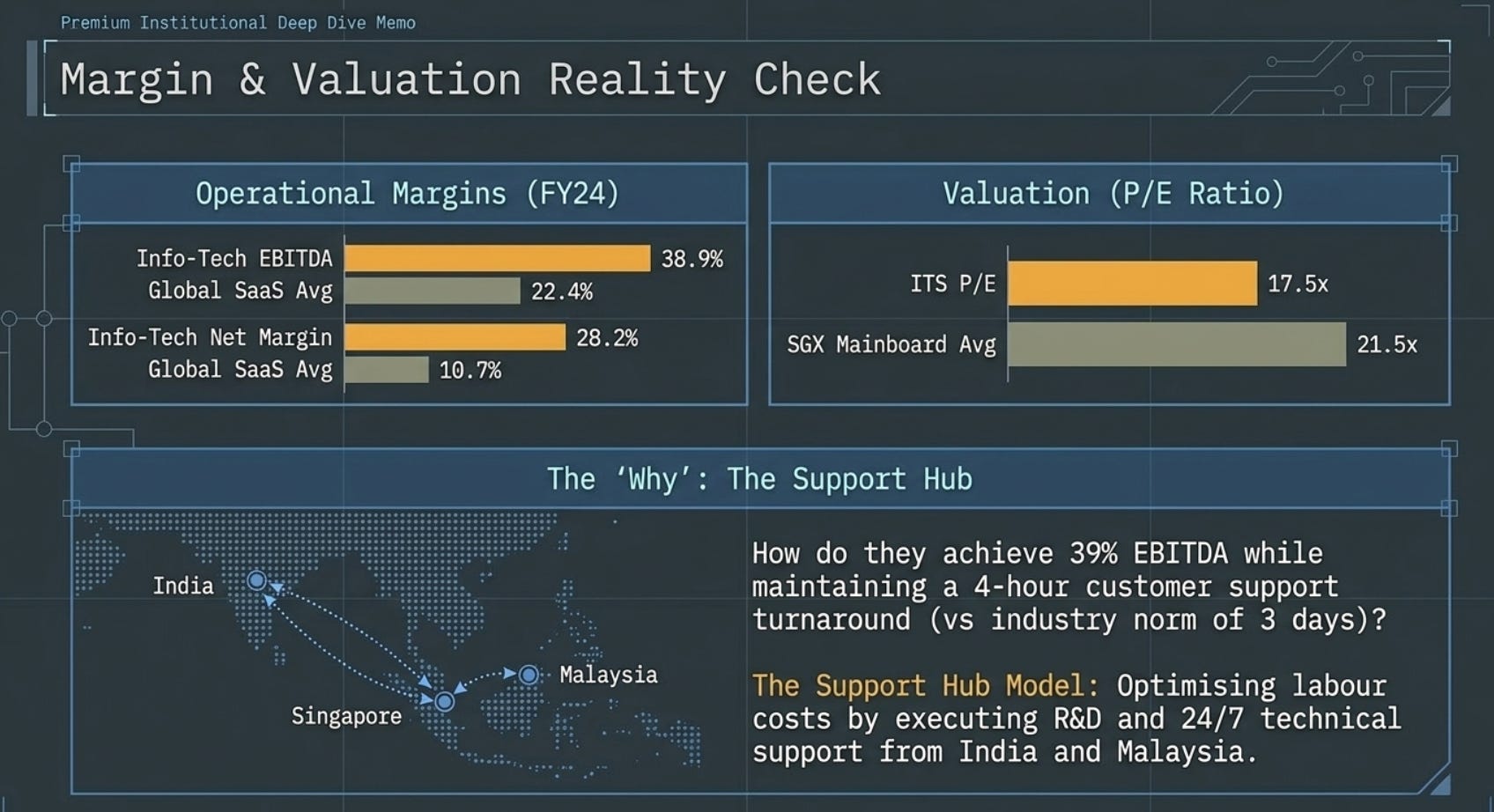
Revenue grew from S$30.8 million in FY2022 to S$43.7 million in FY2024, representing a compound annual growth rate of approximately 19%. Net profit over that same period grew from S$7.2 million to S$12.3 million, a 31% CAGR. EBITDA margins stand at 38.9% against a global industry average of 22.4%, and net profit margins at 28.2% against an industry average of 10.7%. ROE sits at a remarkable 72%. The company carries zero borrowings and had net cash of S$29.7 million on the balance sheet as of December 2024.
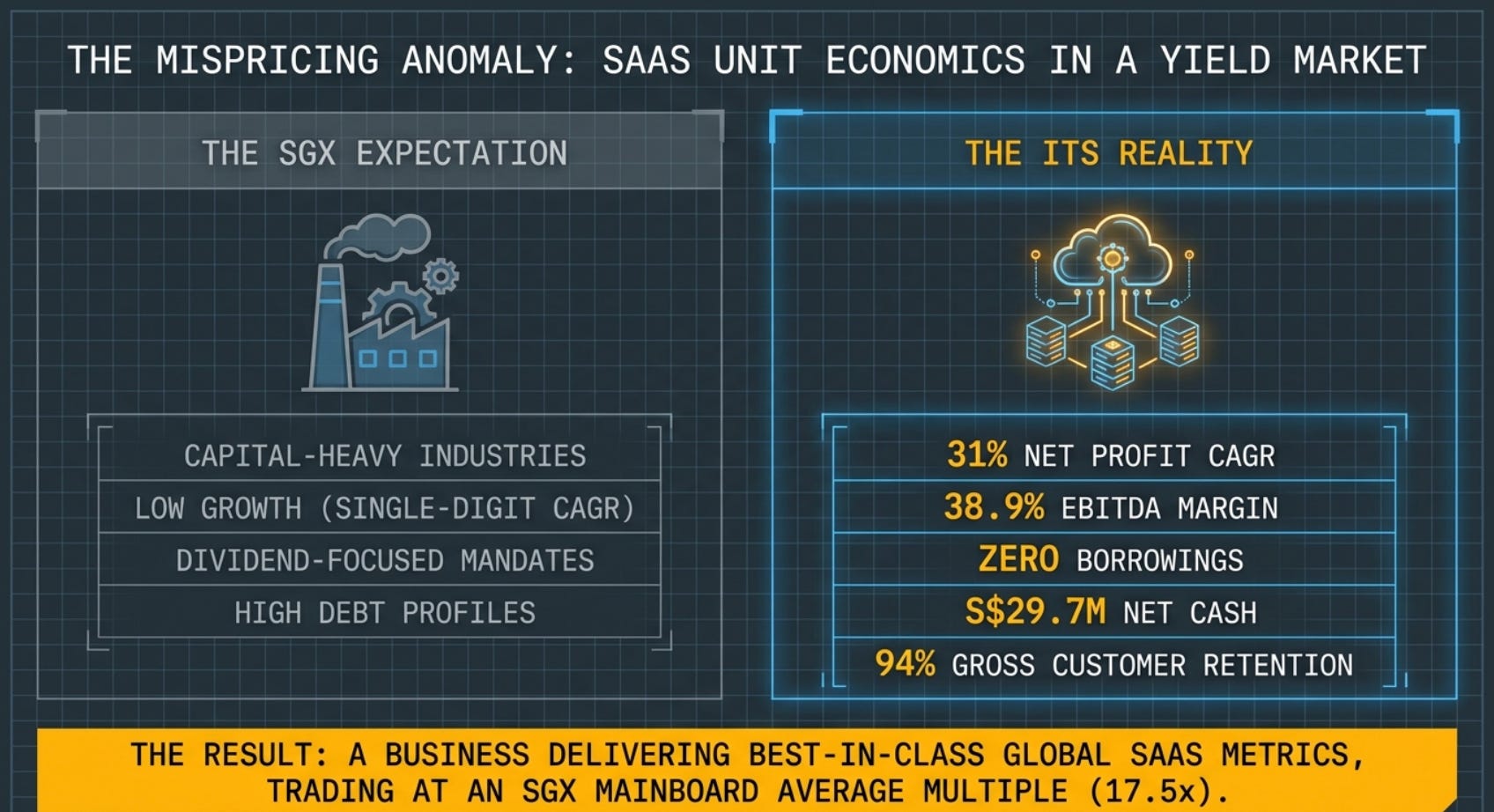
At a P/E of around 17.5x against an SGX Mainboard average of 21.5x, trading at a discount to the broader market while growing faster and earning more efficiently than almost anything else on the exchange — this is either a value trap or one of the most interesting small-caps hiding in plain sight.
I spent a considerable amount of time trying to figure out which one it is. Here is what I found.
What They Actually Do — And Why the Boring Description Misses the Point
Let me first give you the official description and then explain why it undersells the business considerably.
Officially: Info-Tech is a leading provider of cloud-based software-as-a-service (SaaS) human resource management software designed for SMEs in Singapore and Malaysia, serving 23,000 organizations and 850,000 active users. The company also provides a proprietary cloud-based accounting software to complement its HRMS, supported by comprehensive after-sales service.
So they make HR software for small businesses. Boring, right?
Wrong. And here is why the framing matters.
The moment you hear “HR software for small businesses,” your mind might jump to something fragile. SMEs churn. SMEs die. SMEs are price-sensitive. SMEs switch vendors for a twenty-dollar monthly saving. Everything about the SME customer sounds like the anti-thesis of the sticky, recurring, compounding SaaS business that every investor dreams of owning.
But this assumption — that SME SaaS customers are inherently flimsy — is the first place where conventional thinking breaks down, and where Info-Tech’s story becomes genuinely interesting.
The key insight is this: not all SME software is created equal. There is a massive difference between selling project management software to a ten-person startup (where the founder can switch to a competitor in an afternoon) and selling payroll, HR compliance, leave management, attendance tracking, and employee data management to a company with 50 employees across Singapore and Malaysia. The latter is not just software. It is infrastructure. And infrastructure, once embedded, behaves very differently from tools.
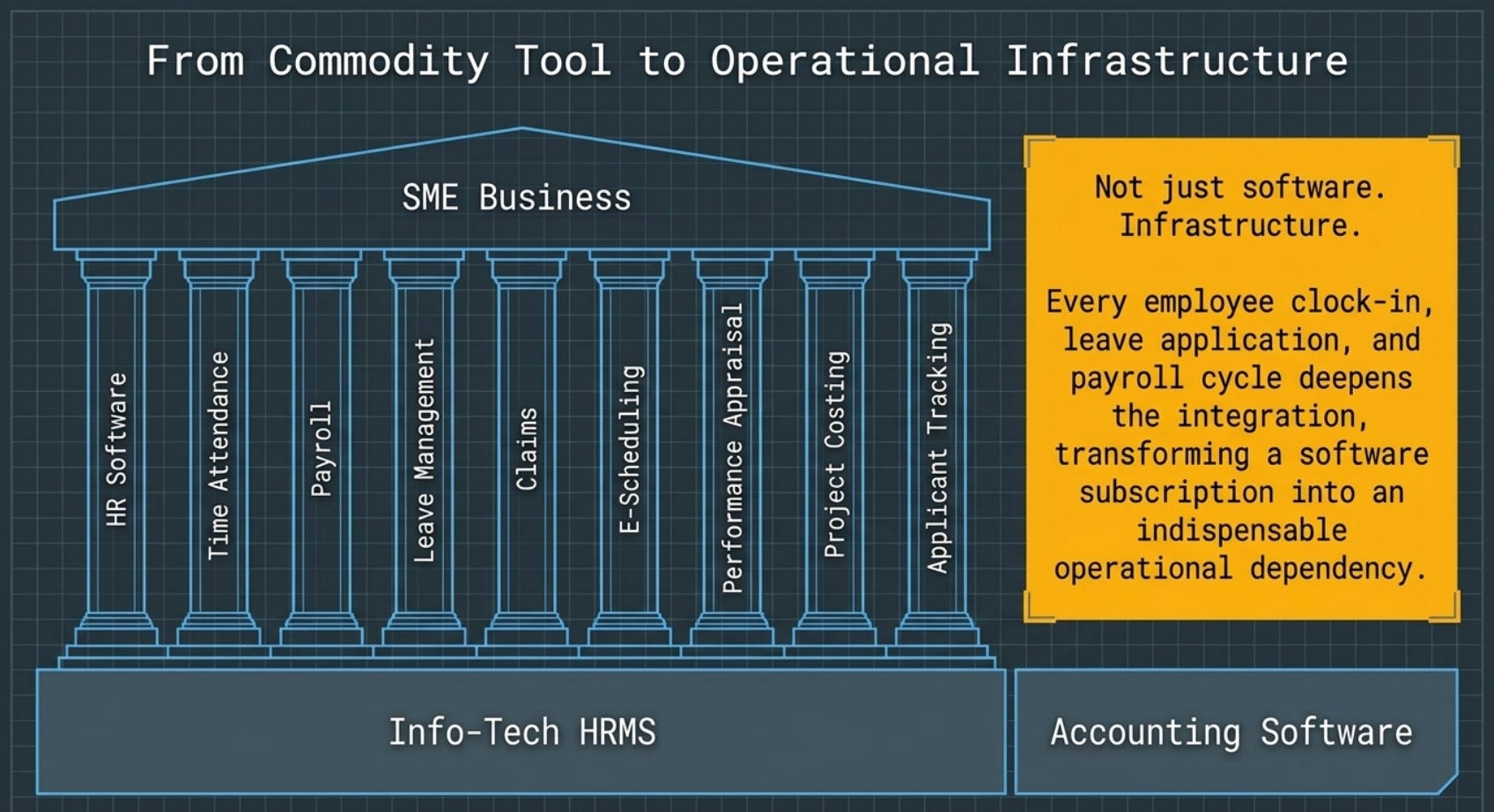
The HRMS (developed in-house) covers nine modules: HR Software, Time Attendance, Payroll, Leave Management, Claims Management, E-Scheduling, Performance Appraisal, Project Costing, and an Applicant Tracking System. These are not nine features. These are nine tentacles wrapped around the operational core of a business. Every day an employee clocks in, every leave application that goes through the system, every payroll cycle that runs — they are all deepening the integration. They are making the cost of switching not just a financial question but a deeply operational one.
I will come back to this when we talk about moats. But for now, hold this picture: a business that looks like a commodity product on the surface but behaves like critical infrastructure once installed.
The Business Model — Understanding the Machine Before Judging Its Speed
Before we can evaluate how good this business is, we need to understand how it makes money. The model has several layers, and they interact in a way that is more elegant than the prospectus lets on.
The core is recurring subscription revenue. Subscription revenue for the HRMS grew at a CAGR of 28.9% from FY2022 to FY2024 in Malaysia, compared to the market CAGR of 10.9% for the SME-focused cloud-based HR and accounting software market during the same period. That is not just growing — that is growing at nearly three times the market rate. In other markets (Hong Kong and India), subscription revenue achieved a CAGR of 42.1% from FY2022 to FY2024, compared to the market CAGR of 15.5% and 10.6% respectively.
What that tells you is that Info-Tech is not merely riding a market wave. It is gaining share. Aggressively. In multiple geographies simultaneously.
But what I find more interesting than the headline numbers is the secondary revenue architecture that has developed around the core product. There is the accounting software (launched in 2022, growing at 201% annually). There is the WSQ Academy training business (grew 115% from 2023 to 2024). There is Jobs Lah, an AI-driven job portal currently monetizing nothing but building a database of 100,000 job seekers and 7,000 employers. There is hardware (biometric and RFID devices) sold as complementary to the HRMS. And there is payroll outsourcing, which often serves as a foot-in-the-door for the full HRMS adoption.
Thinking about each of these in isolation is the wrong way to look at it. Thinking about them as a flywheel is the right way.
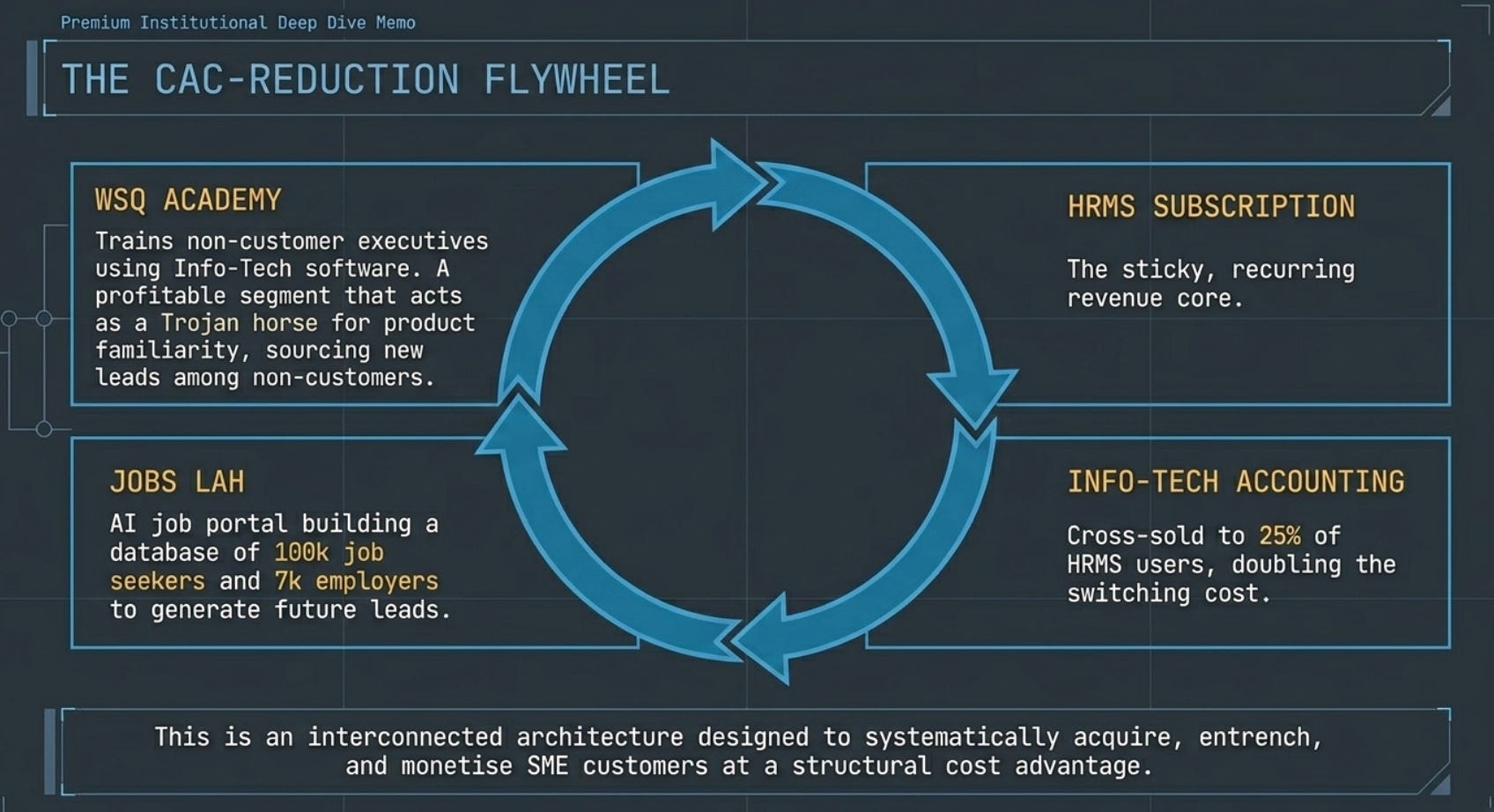
The WSQ Academy trains HR executives — often from companies that are not yet Info-Tech customers — on HR software and compliance, using Info-Tech’s own systems as the teaching tool. The trainee goes back to their company, they are already familiar with Info-Tech’s interface, and the company adoption becomes easier. The training business is essentially a subsidized marketing channel that simultaneously generates real revenue (S$3.25 million in FY2024) and reduces the customer acquisition cost for the core product. This is a beautiful design. It is the kind of thing you do not see unless you are paying very close attention.
Jobs Lah is the other piece worth thinking about carefully. It connects SME employers with job seekers. It currently generates zero revenue. Most analysts see this as a distraction or an experiment. I see it differently. Info-Tech intends to leverage the extensive database of corporates advertising their vacancies on Jobs Lah as potential leads for their products, before monetizing the platform. The company is essentially building a lead-generation engine disguised as a job board, while simultaneously positioning itself to become the operating system for SME employment in Southeast Asia. Whether Jobs Lah succeeds depends on its ability to sustain a large enough job seeker base — a chicken-and-egg problem the company has not yet fully solved — but the strategic intent is coherent.
The Stickiness Paradox — Why Rising Retention in a Rigid Product Is a Signal, Not a Coincidence
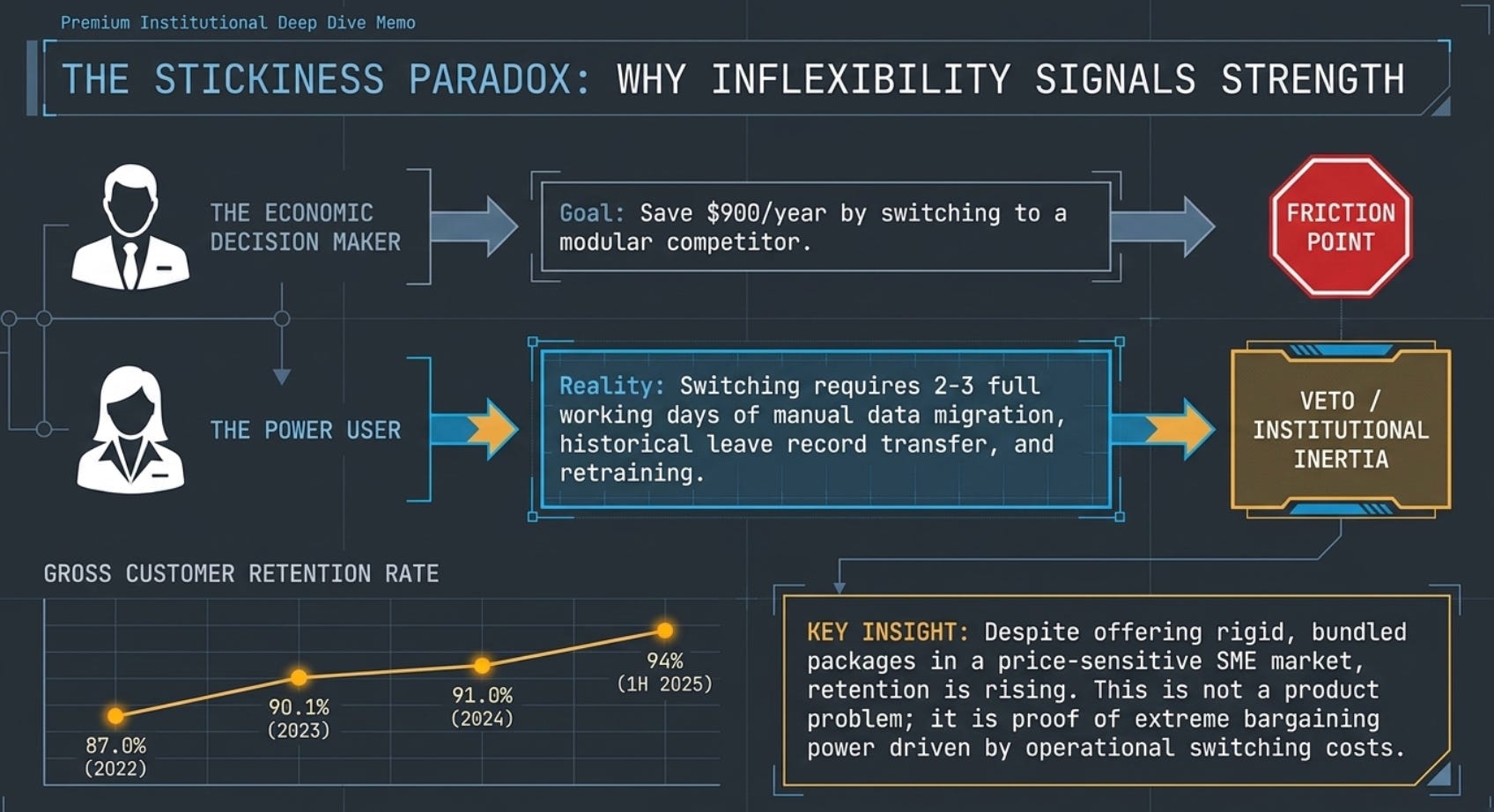
Here is the observation that stopped me cold when I first read through the analysis.
The company’s subscription packages are sold as bundles. They do not offer perfectly modular, pick-what-you-need pricing. If a business has 20 employees spread across two legal entities — a common structure in Singapore real estate and family-owned businesses — they would be paying for essentially two separate subscriptions even if the headcount is unchanged. The packages are, by any objective measure, inflexible.
And yet, customer retention has been improving every single year: 87% in 2022, 90.1% in 2023, 91% in 2024, and now the gross customer retention rate improved by a further three percentage points to 94% in the six months of 1H FY2025.
Think carefully about what this means. A product that is less flexible than competitors is retaining customers at an improving rate. That is not a product problem. That is bargaining power. And bargaining power is one of the most difficult things to manufacture in a competitive market.
The conventional wisdom would predict that inflexible packaging causes churn. The data says the opposite is happening here. Why?
I spoke to someone who had firsthand experience with the platform — an HR manager at a mid-sized Singapore SME. Her feedback was instructive. The switching cost is not primarily financial. It is operational. Moving all employee data, historical leave records, payroll histories, and compliance documentation to a new platform takes an HR team two to three full working days minimum, assuming fewer than twenty employees. For larger companies, it is a week-long project minimum. And importantly, the person who would switch platforms is the department head using the software daily — not the business owner making the cost-cutting decision from the top. This misalignment between the decision-maker (who feels the financial pain) and the power user (who bears the switching pain) creates a powerful natural brake on churn.
The company has also subsequently clarified — and the prospectus confirms — that they do in fact adjust pricing based on modules adopted and user size. The pricing structure is more nuanced than the initial bundle impression suggests. But even before that clarification, the retention numbers were improving. Which means customers were staying not because they had perfect pricing, but because the platform had become genuinely embedded in their operations.
This is what I call the stickiness paradox: the thing that looks like a weakness (inflexibility) is actually generating a signal of strength (rising retention). When you see something like this, you investigate the mechanism rather than dismissing the signal. The mechanism here is switching cost and institutional inertia — two of the most durable forces in B2B software.
The Moat — Four Walls, One Castle
The analysis I did on this company identified four distinct competitive advantages that, taken together, form a surprisingly durable moat for a company of this size.
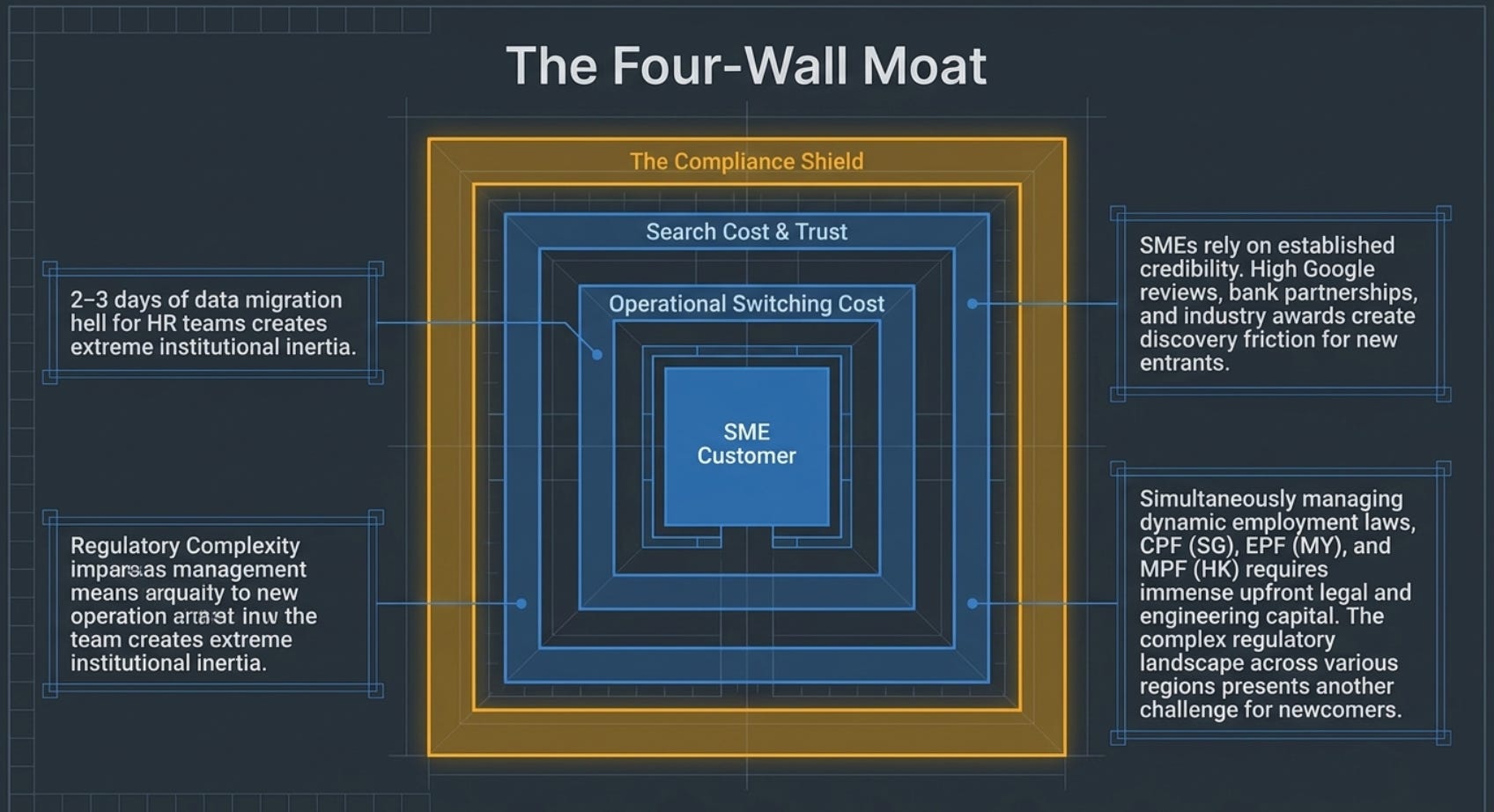
The First Wall: High Cost of Switching. We have covered this. Once HR data, payroll records, and compliance workflows are embedded in Info-Tech’s platform, extraction is expensive in time, energy, and organizational disruption. The company’s built-in compliance features help drive strong retention and extract operating leverage. Over time, this advantage compounds: the longer a customer stays, the more historical data accumulates, and the higher the switching cost becomes. It is a self-reinforcing mechanism.
The Second Wall: High Cost of Searching. This one is subtler and often overlooked. The SME market in Singapore is not sophisticated in its procurement of enterprise software. Info-Tech has spent years building brand presence, proving service quality, earning awards and recognition as a leading and award-winning HRMS and accounting software provider, partnering with financial institutions to reach their SME clients, and acquiring Google reviews that give credibility in a market where trust is a critical purchase decision. A new entrant does not just have to build better software — they have to be discoverable and trusted by a market. Most importantly, the time, effort, and information costs a user incurs to find, evaluate, and select a substitute product from Info-tech is significantly high.
The Third Wall: Technical Expertise and Regulatory Complexity. Singapore’s employment law, Central Provident Fund contribution schedules, Malaysia’s EPF requirements, Hong Kong’s MPF regulations, and India’s PF and TDS compliance rules are each complex on their own. Building a system that handles payroll compliantly across four regulatory environments simultaneously is a non-trivial engineering and legal challenge. In markets like Singapore, Malaysia and Hong Kong, strict labour laws, tax regulations, and a growing emphasis on data protection further fuel the demand for solutions that help businesses stay compliant and mitigate regulatory risks. A new entrant would need to hire both engineers and regulatory compliance specialists across multiple jurisdictions before writing a single line of customer-facing code.
The Fourth Wall: The Compliance Shield. This is the moat I find most interesting in the context of the AI disruption narrative, and I will return to it shortly. When a company uses Info-Tech’s HRMS and the payroll calculation is wrong, the legal liability sits with Info-Tech — or more precisely, Info-Tech’s system is the documented, auditable record that the company relied upon in good faith. The company offers built-in compliance features that can help drive strong retention. This is what Workday, ADP, and every other established HR SaaS player does at the enterprise level: they are not just selling software, they are selling a liability transfer arrangement. The employer can say, “our system did this,” and have a defensible documented process. This matters enormously in Singapore’s regulatory environment, and it creates an asymmetry that any DIY or AI-generated solution (e.g. Vibe coding) cannot replicate without accepting the full compliance liability themselves.
The Expansion Story — Why the Best Days Are Almost Certainly Ahead
One of my standard checks when evaluating a SGX-listed company is the scalability question. Most Singapore companies are fundamentally Singapore companies. They do well at home, they try to expand regionally, they fail, and they retreat. The domestic market is too small for a growth stock, but the regional capability is often missing. This is why I have been cautious about most SGX names.
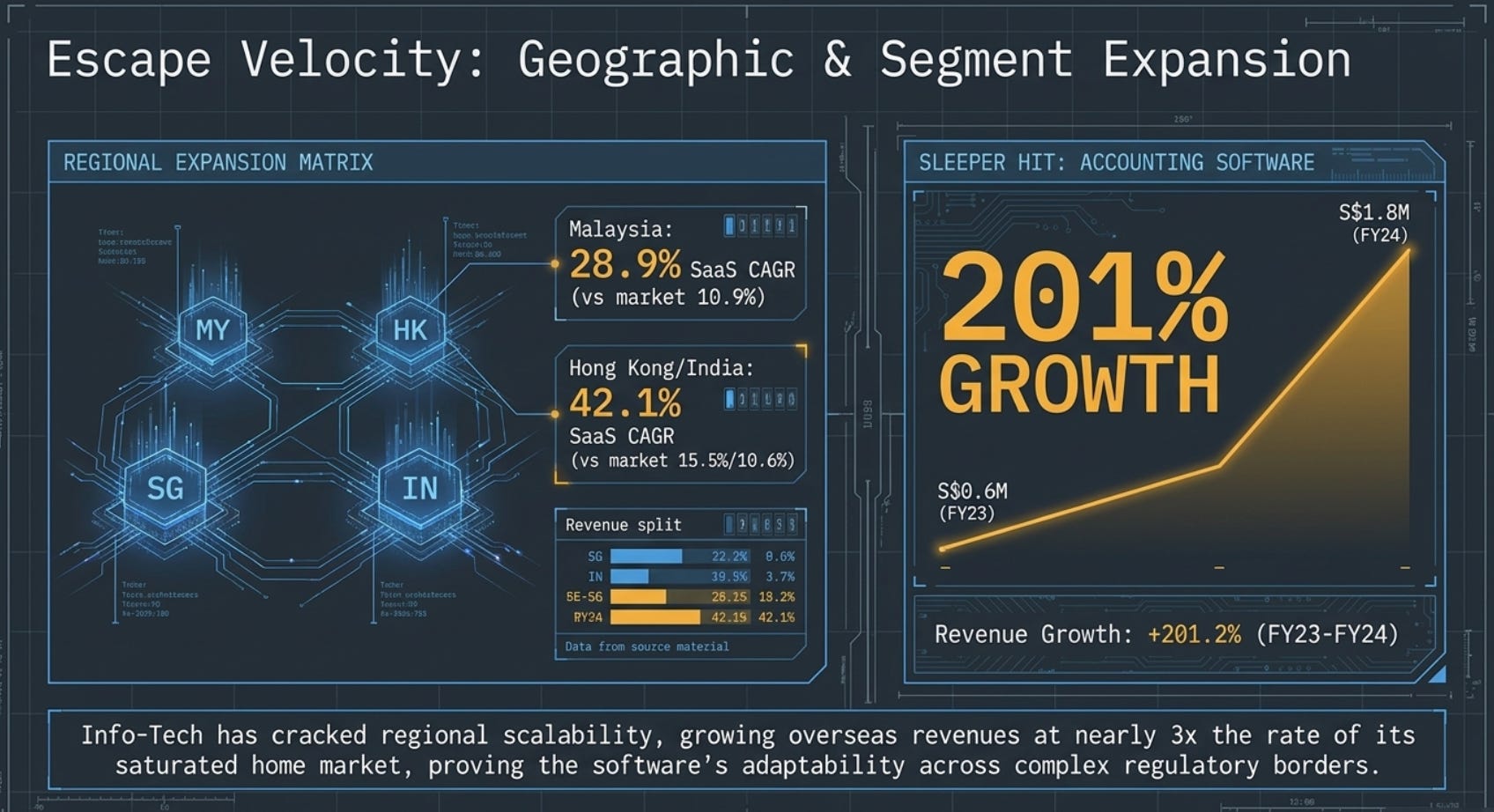
Info-Tech is a notable exception to this pattern, and the data backs it up rather than merely the management’s stated intention.
On a geographical basis, the Group continued to gain traction in its overseas markets, registering double-digit revenue growth of 28% to S$4.9 million from Malaysia and 29% to S$1.6 million from Others, which include Hong Kong and India in just the first half of FY2025. Singapore revenue remained relatively stable, which is expected in a near-saturated home market — but the overseas businesses are growing at nearly three times the Singapore rate.
The accounting software is the sleeper in this story. It grew from essentially zero in FY2022 to S$1.77 million in FY2024 — a 201% single-year growth rate. It currently serves approximately 1,000 organizations, of which 25% are also HRMS customers. The cross-sell potential here is significant: every HRMS customer who also adopts the accounting software deepens their integration with Info-Tech’s ecosystem, increases their total annual spend, and further raises the cost of switching. You are building, over time, a single-vendor dependency for two of the most compliance-sensitive functions in any business: payroll and accounting. That is an extraordinary position for a sub-$300M market-cap company to be in.
Singapore’s cloud HR and accounting software market is forecast to grow at a CAGR of 11.9% from 2025 to 2029, and Info-Tech has been growing at nearly triple that rate in most of its markets. The TAM, as estimated by the company itself, is US$17.3 billion. Even a 1% capture of that market implies a business earning approximately nine times its current earnings. The white space is real.
The Management Question — Skin in the Game and Its Limits
One of the most important questions in any investment is whether the people running the business are aligned with the people owning the shares. In Info-Tech’s case, the answer is almost uncomfortably clear.
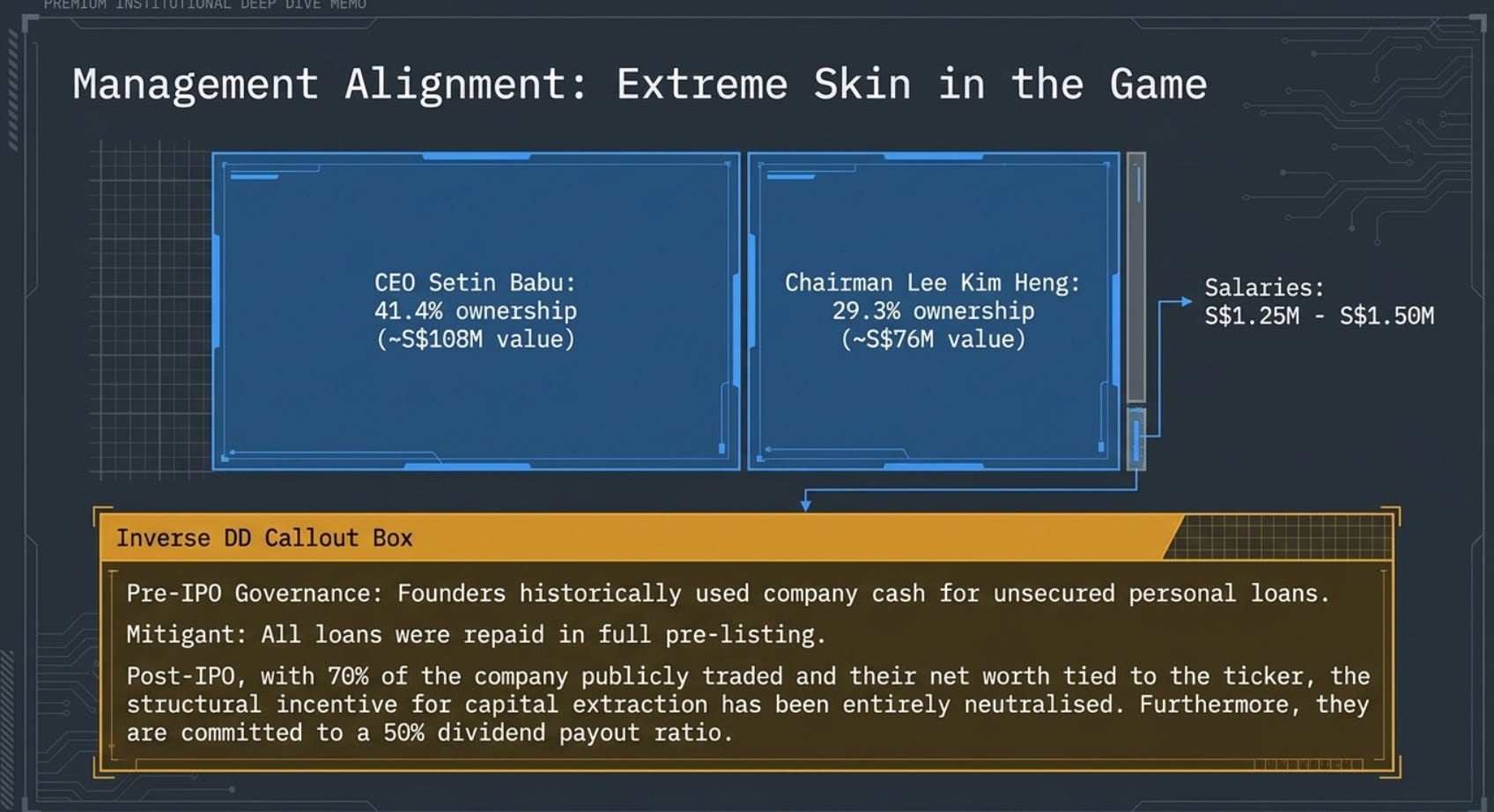
Co-founder and Executive Chairman Mr. Lee Kim Heng Peter holds approximately 27-29% of the company. Co-founder and CEO Mr. Setin Subramanian Dilip Babu holds approximately 41% of shares. Combined, the founding team controls the majority of the business. At the current market capitalization of ~S$263 million, Dilip Babu’s stake alone is worth approximately S$108 million. Peter Lee’s is worth approximately S$76 million.
Their annual compensation — falling in the S$1.25 million to S$1.5 million range — is, frankly, a rounding error relative to their equity. Even the company’s COO, Ms. Yeoh Sin Yee, holding approximately 3.7% of shares, has an equity stake worth around S$9.7 million against a salary of S$250,000 to S$500,000 per year. That is 20 to 39 years of salary tied up in equity. There is no incentive to extract cash from this business at the expense of its long-term value. The founders’ net worth rises and falls almost entirely on the fate of Info-Tech’s share price.
There is one caveat I want to address directly, and I would be doing you a disservice if I did not. Before the IPO, the company made a series of interest-free, unsecured loans to its controlling shareholders — S$2M in 2022, S$6.22M in 2023, and S$3M in 2024, all to Dilip Babu. A separate S$8.22M loan was extended to Peter Lee in July 2022. All of these loans were subsequently repaid in full before the IPO.
Does this concern me? Somewhat. The practice of a private company’s cash being used as a personal financial facility for its founders is not unusual in small-mid sized Asian businesses, but it is not best-in-class governance either. The relevant question is: does this behavior persist post-listing? The structural incentive not to repeat it is now overwhelming — the founders’ personal net worth has now increased due to the IPO and denominated almost entirely in ITS shares. Any transaction that damages the company damages them far more than whatever personal liquidity benefit they might extract. The incentive landscape has changed completely.
Importantly, the company has also committed to distributing at least 50% of net profit after tax as dividends for the period from listing to December 2025, making good its commitment at IPO. This is a meaningful signal of confidence in the cash-generating quality of the business.
The Financials — Reading the Balance Sheet Like a Radiologist, Not a Radiographer
Most people look at a balance sheet and see a snapshot. What I prefer to do is look at the direction of change in each line item and ask what it reveals about the underlying business dynamics.
The income statement is clean and accelerating. Revenue went from S$30.8M to S$38.1M to S$43.7M across FY2022-2024, and the trailing twelve months through FY2025 have pushed that to approximately S$56.5 million, while basic EPS has grown from S$0.047 to S$0.058. Operating leverage is real: gross profit margins are expanding, and the company is demonstrating that it can grow revenue faster than it grows costs.
On the balance sheet, the most interesting line item is contract liabilities — it has been growing consistently and now represents the largest single liability on the balance sheet at S$23.5M in current contract liabilities plus S$2.1M non-current as of December 2024. This is not a bad thing. It represents subscription revenue paid upfront but not yet earned. It is cash in the bank, obligations already committed by customers, revenue visibility sitting on the balance sheet like a gift that gets unwrapped over the next twelve months. It is a leading indicator of future revenue, and it has been growing consistently with the business.
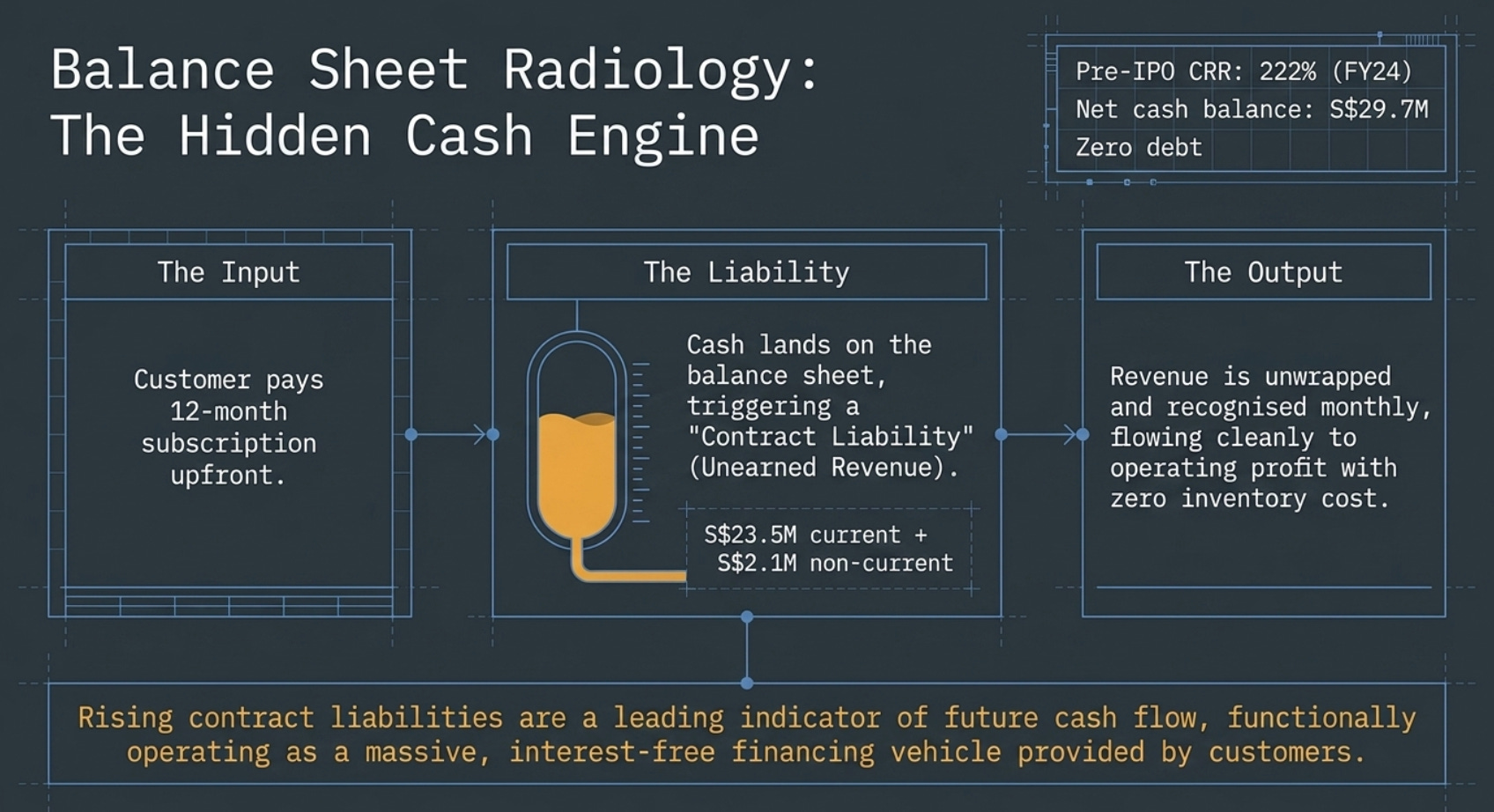
Cash position grew from S$11.8M in FY2022 to S$17.8M in FY2023 to S$29.7M in FY2024 — a 70% increase year-over-year without any external financing. The Group’s order book amounted to S$26.8 million in mid-2025, representing advance billings primarily for subscription services for the next 12 months. This provides extraordinary forward visibility for a company of this size.
The CRR (my term for the cash reinvestment rate — operating profit over deployable capital) calculation is interesting. In FY2024, we got yields of approximately 222%, which is extraordinary. Post-IPO in 2025, the denominator swells because the IPO proceeds are now sitting in cash, diluting the ratio to approximately 43% (which is still amazingly high — a good benchmark is 20%). This is not a deterioration of business quality — it is the mathematical artifact of a profitable company receiving a large cash injection that hasn’t yet been deployed. The underlying business economics have not changed.
The Threat — Confronting the Existential Risk Honestly
Let me be direct about the scariest version of how this investment fails.
We are living through an AI revolution that is making software development dramatically cheaper and faster. “Vibe coding” — the practice of using LLMs like Claude or GPT to rapidly build functional software applications — is real, and it is accelerating. In theory, a determined SME owner could instruct an AI system to build their own bespoke HR management tool in a matter of weeks, at a fraction of the cost of an annual SaaS subscription.
If this becomes widespread, does Info-Tech’s model become obsolete?
Here is where the analysis takes a turn that surprised me initially. The question “does Info-Tech have raw materials that AI platforms cannot replicate?” is actually the wrong question. The right question is one of legal liability.
When a traditional HR SaaS vendor like Info-Tech processes your payroll, they are not just running calculations. They are providing a documented, auditable, legally defensible process. The legal liability for compliance errors, under Singapore law, rests with the employer — but the employer has a documented system and a vendor relationship that they relied upon in good faith. This matters in regulatory audits, in employment disputes, and in MOM (Ministry of Manpower) inquiries. When AI makes a payroll error — and it will — the employer cannot blame the AI. There is no Workday or ADP to point to. There is only the employer, who “built their own tool” via an AI prompt, fully liable for whatever went wrong.
This is what I call the compliance shield argument: the regulatory environment in Singapore, Malaysia, Hong Kong, and India actively incentivizes businesses to use established, certified SaaS providers rather than build their own solutions. The risk transfer is not just psychological — it is structural, and it is embedded in the regulatory framework.
The remaining risk is whether that regulatory framework changes in the next 10-20 years, such that AI-generated HR tools become legally equivalent to certified SaaS platforms. This is genuinely possible. If Singapore’s MOM begins certifying AI-generated compliance tools the way it currently certifies payroll software, the moat erodes. I think this is a decade or more away, given the pace of regulatory evolution in these markets. But it is worth keeping on the radar, and I would revisit the thesis seriously if Singapore begins moving in that direction.
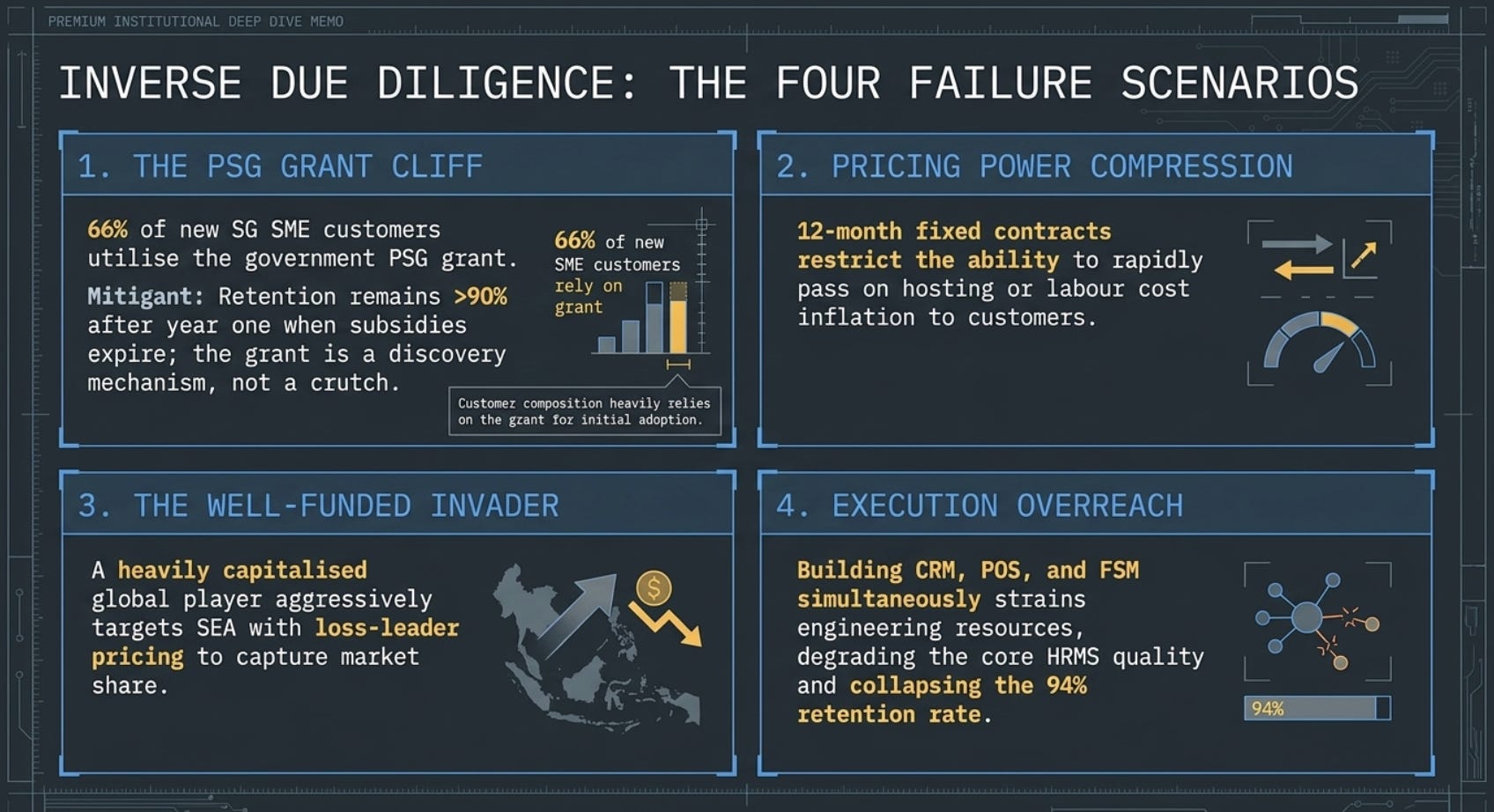
The second concern is market concentration: 66% of new Singapore SME customers adopt Info-Tech partly facilitated by the PSG (Productivity Solutions Grant) from the Singapore government, which subsidizes up to 50% of first-year subscription costs. If this grant is removed or restructured, the new customer acquisition economics for Info-Tech’s Singapore business deteriorates materially. However, the more telling data point here is that retention rates are rising even without the grant subsidy after year one. Customers who came in on the PSG-subsidized basis are staying when they have to pay full price. Hence, we can also say that the grant is a discovery mechanism and an entry-barrier reducer, not a crutch.
The Competitive Landscape — What Everyone Gets Wrong About “Competition”
The company’s prospectus names BIPO, JustLogin, Frontier e-HR, and Boss Solutions as key competitors. Most investors read this list and think about feature comparisons and pricing battles. That is the wrong frame.
The more interesting competitive analysis is about where these companies are in their lifecycle and what that implies for market structure. JustLogin and Frontier e-HR are smaller, more fragmented players. They often have tighter personal relationships with SME owners — sometimes the salesperson literally knows the business owner through a community connection. This intimacy gives them advantages in the sales cycle. They can close faster because there is less institutional friction. The downside is that these relationships do not scale, and the after-sales support models are not as systematized.
Info-Tech’s competitive response to this is interesting: they offer a 4-hour turnaround time for support inquiries in Singapore, against an industry norm of up to 3 working days. They achieve this through the “support hub” model — employing support staff in India and Malaysia where labor costs are lower, and routing queries through a centralized system that provides 24-hour coverage. This is not a revolutionary idea — every large SaaS company does something similar — but what matters is that Info-Tech is doing it at S$43 million in revenue, at EBITDA margins of 38.9%, which is significantly above the global industry average of 22.4%. They have cracked the unit economics of regional SaaS support before most of their competitors have figured out that it needs to be cracked.
The question I keep asking myself is: what prevents a better-funded competitor from replicating this? The answer is probably “nothing, eventually.” But the time and capital required to build a 23,000-customer base with 850,000 active users, multi-country regulatory compliance across four jurisdictions, a proprietary HRMS with nine integrated modules, a complementary accounting software, a training academy, and a job portal — all simultaneously — is not trivial. And by the time a new entrant gets close, Info-Tech will be at 50,000 customers in five countries with a decade more of operational data and customer feedback embedded in its product.
The Horizontal Integration Play — Building the SME Operating System
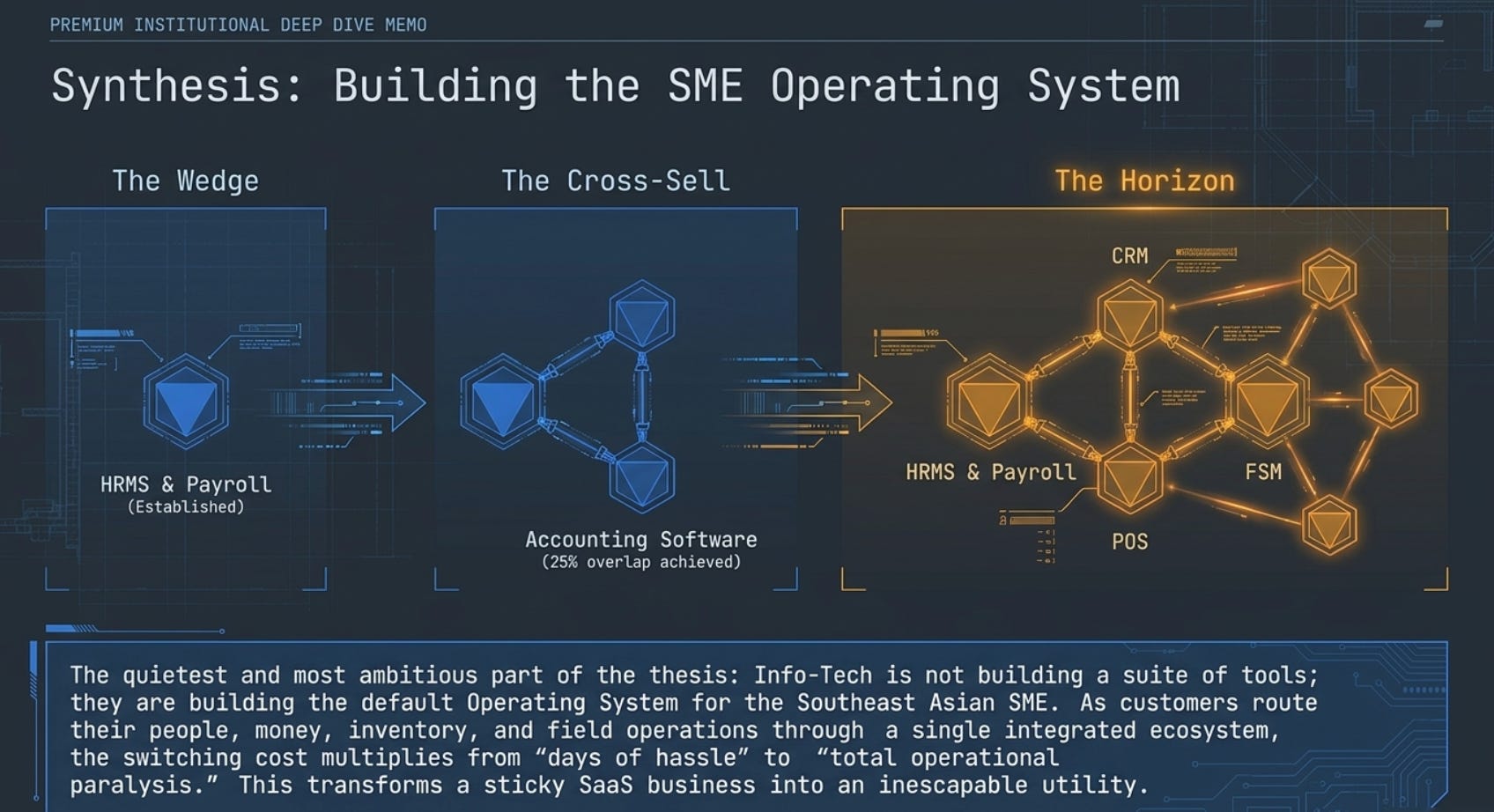
The most ambitious version of Info-Tech’s future is one that the management has been quietly signaling but not trumpeting loudly. The goal is to become the default operating system for the SME in Southeast Asia — not just the HR system, but the entire business management layer.
The product roadmap includes a CRM (Customer Relationship Management) system, a POS (Point of Sale) system, and a Field Service Management tool. Combined with the existing HRMS, accounting software, payroll outsourcing, and Jobs Lah job portal, you begin to see the outline of something genuinely ambitious: a single platform through which an SME manages its people, its money, its customers, and its operations.
This is the horizontal integration thesis. Every additional product that a customer adopts increases the switching cost and increases the total revenue per customer. The accounting software cross-sell is already working — 25% of accounting software customers are also HRMS customers as of FY2024. If the CRM and POS products launch successfully and achieve similar cross-sell rates, the total addressable revenue per customer could be two to three times what it is today without acquiring a single new organization.
The case study that comes to mind when I think about this strategy is Xero, the New Zealand accounting software company that built its SME dominance not just by being the best accounting tool but by becoming the platform to which hundreds of other apps connected. Once an SME’s accounting, payroll, banking, and inventory management all flow through Xero, the switching cost is not measured in days of migration — it is measured in months of operational disruption. Info-Tech is attempting something analogous, but it is doing it in a market (Southeast Asian SMEs) where the competition is even more fragmented and the regulatory complexity adds an additional barrier to entry for both competitors and DIY alternatives.
The key risk here is execution. Building five or six good software products simultaneously while maintaining the quality and after-sales support culture that drives retention is hard.
The Inverse DD — Four Ways This Thesis Fails
Good investing requires holding both the bull and bear case in your head simultaneously and stress-testing your conviction. Here are the four scenarios where this investment does not work:
Scenario One: PSG Grant Removal. Singapore’s government has been a significant tailwind for Info-Tech’s new customer acquisition, with 66% of new Singapore SME customers using PSG grant funds. If the government restructures the grant program — either by reducing the subsidy percentage, removing Info-Tech from the pre-approved vendor list, or changing eligibility criteria — the new customer funnel for the Singapore business contracts meaningfully. The business does not collapse (existing customers continue paying), but growth slows, and the market re-rates the growth premium accordingly.
Scenario Two: Pricing Power Compression. The company has explicitly acknowledged in its prospectus that it may not be able to pass cost increases to customers. The 12-month subscription structure provides stability but constrains the ability to adjust prices quickly in response to rising costs (hosting, employee benefits). If input costs rise faster than the company can renegotiate contracts at renewal, margins compress. Given that EBITDA margins are already well above industry average, there is room to absorb some compression — but investors who have priced in margin expansion should be aware that the structural risk runs the other direction.
Scenario Three: The Better-Funded Competitor. A well-capitalized regional player — perhaps a Zoho, a Rippling, or even an SAP SME product — decides to aggressively target the Southeast Asian SME market with deeply discounted pricing or free-tier entry. Info-Tech’s current advantage is in its local regulatory expertise and customer service model, but these advantages are replicable with sufficient capital and time. The Singapore market in particular, given its concentration and the PSG grant exposure, is vulnerable to a focused competitive push.
Scenario Four: Horizontal Integration Overreach. The company attempts to build the CRM, POS, and FSM products simultaneously, spreads its engineering and customer success resources too thin, and the quality of the core HRMS product suffers. Customer retention — which has been the single most important financial metric driving the bull case — begins to decline. If retention reverts from 91-94% back to the low 80s, the lifetime value calculation I outlined earlier collapses, and the P/E multiple would need to re-rate downward significantly.
Of these four, I am most concerned about Scenario One in the short term and Scenario Four in the medium term. Scenarios Two and Three are real but slower-moving risks that would likely be visible in the data before they become acute.
The Valuation — Is $1.02 Cheap or Just Cheap-Looking?
This is where I want to be careful not to anchor too heavily on any single valuation framework, because Info-Tech sits at an interesting intersection of value and growth that different frameworks will treat very differently.
At 17.5x trailing P/E, the stock trades at a discount to the SGX Mainboard average of approximately 21.5x. If you believe Info-Tech should trade at market multiple — which seems like a conservative argument given it is growing faster and more profitably than almost anything else on the exchange — there is 23% upside just from multiple re-rating to the market average, without any earnings growth.
The CRR calculation (43% in 2025 post-IPO cash injection, 222% in 2024 on underlying capital) tells you that the core business is generating extraordinary returns on the actual capital deployed to operate it. The 43% figure in 2025 reflects the temporarily bloated cash position from IPO proceeds that have not yet been fully deployed. As the company invests this cash into growth (new country entries, product development, strategic partnerships), the denominator normalizes and the true capital efficiency of the business becomes visible again.
But more important than the specific number is the quality of what you are buying: recurring revenue with 91-94% retention, a management team with enormous skin in the game, a regulatory tailwind from mandatory compliance requirements in four growing markets, a business with no debt and growing cash reserves, and an expansion story that is being confirmed quarter by quarter with actual data.
Why It Sits on the Watchlist — The Conditions for Conviction
I want to be transparent about why, despite the attractiveness of the thesis, this stock sits on my watchlist rather than in my portfolio at maximum weight. Conviction, for me, requires answers to three questions that I do not yet have.
The first is the Jobs Lah question. I want to understand the concrete monetization pathway. A job portal with 100,000 job seekers is not a business — it is a community with potential. The transition from “building user base” to “generating revenue” requires a clear mechanism. How does Info-Tech plan to charge employers? What is the pricing model? How does it benchmark against JobStreet and LinkedIn in Singapore and Malaysia? These questions need answers before I can value that segment of the business.
The second is the customer journey through the WSQ Academy. The academy is clearly a smart marketing strategy — but the crucial question is who is attending. If the attendees are HR professionals from companies that are currently using competing platforms, the conversion math is powerful. If they are individuals between jobs who have no organizational purchasing authority, the training business is a standalone revenue line with no meaningful CAC-reduction benefit for the core product. I want data on the corporate client profile of academy attendees.
The third is the “support hub” cost advantage durability. The company claims its above-industry margins are a result of deploying support staff in India and Malaysia. This is true as a statement. But many companies attempt this, and most fail to maintain the service quality that enables the retention rates Info-Tech has achieved. The fact that they have both — low-cost support operations and 91%+ retention — suggests they have cracked something real in the organizational design. But I want to understand the specifics: what is the SOP, what is the escalation framework, how is quality controlled across three countries, and how vulnerable is this model to labor market changes in India and Malaysia?
And the last is that the price is not very attractive to me yet.
Until I have cleaner answers on these questions, I hold the stock at watchlist status. The price is sideways, which means time is my friend. I can do more work without the pressure of watching a thesis run away from me.
The Sit-on-Your-Ass Investing Thesis — Why Patience Is the Right Strategy Here
Charlie Munger famously described the best investment strategy as “sit on your ass investing” — finding wonderful businesses and then doing nothing, because the compounding does the work. This requires identifying businesses that are structurally positioned to keep getting better — wider moats, higher margins, larger customer bases, more compelling cross-sell opportunities — without requiring heroic management decisions or large capital reinvestment.
Info-Tech, as it currently stands, has the ingredients of exactly that kind of business. A 5% improvement in retention rate can deliver 25-95% improvement in profit over time. Info-Tech’s retention is already at 91-94% and trending upward. Every percentage point of improvement is worth meaningful earnings expansion. The business generates cash faster than it can sensibly reinvest it (hence the growing cash balance). The founders are deeply aligned with shareholders. The market it serves — SME SaaS in Southeast Asia — is growing faster than the company’s home market, providing geographic expansion opportunities without needing to invent new products.
What makes this particularly interesting as a long-term position is the demographic and regulatory backdrop. Southeast Asia’s SME digitization is still in early innings. Singapore’s cloud HR and accounting software market is forecast to grow at a CAGR of 11.9% from 2025 to 2029, and Info-Tech’s own markets — Malaysia, Hong Kong, India — have comparable or faster growth trajectories. Every year that regulatory environments become more complex (more CPF requirements, more MOM reporting obligations, more data protection rules), the case for using a certified, compliant SaaS platform over a DIY alternative strengthens.
This is not a business that requires a catalyst. It does not need an acquisition, a new product launch, or a management change to unlock value. It needs time. It needs every HR manager who trains on Info-Tech’s system at the WSQ Academy to go back to their company and say, “we should be using this.” It needs every accounting software customer to realize that their HRMS and their accounting system talking to each other eliminates an hour of manual reconciliation every week. It needs every satisfied customer to refer their supplier, their tenant, their business partner.
These things are already happening. The data says they are already happening. The market, focused on the SGX’s traditionally slow-moving blue chips, has not yet fully priced in what “already happening” means for the earnings trajectory over the next five years.
Conclusion — The Boring Stock That Might Make You Rich
There is a type of investment that never makes the front page. It does not have a visionary founder posting on X about changing the world. It does not have a TAM story so large that it becomes self-parody. It does not require a leap of faith about an unproven technology or an untested market.
It is just a quietly exceptional business, doing something essential for its customers, growing steadily and profitably, run by people who have most of their personal net worth riding on the outcome. It sits in a corner of the market where nobody is looking, priced as if it were an average business when the data says it is very much not average.
Info-Tech Systems is that kind of investment. It is the kind of business that in ten years, when someone asks you what you owned in your portfolio in the late 2020s, you will either proudly say “I saw that one early” or you will quietly wish you had looked more carefully when it was sitting at S$1.02 and trading sideways.
The conclusion section of my analysis notes “xxx” — still blank, still to be decided. That is the honest reflection of where I am: deeply interested, not yet fully convicted, and doing more work. The unanswered questions are real. The risks are real. But so is the business quality. So is the moat. So is the management alignment. So is the valuation gap.
I keep watching. And for now, that is exactly the right thing to do.
This article represents my personal thought process and analysis framework and does not constitute financial advice. All financial figures are sourced from publicly available documents including the company’s IPO prospectus, SGX filings, and half-year results announcements. Please do your own due diligence before making any investment decisions.
If you like what you read, check out my other writings 👇
Rust, Rigs, and the Recurring Revenue Hidden in Plain Sight: A Deep Dive into Beng Kuang Marine (SGX: BEZ)

The Old Steel and the Sea: Why You Should Care About a Ship Maintenance Company
Investment Reflection #2 — The Grand Play: 100 Years of the World’s Nations as Characters in the Greatest Story Ever Told

“The world is not a chessboard. It is a living organism, where every cell — every nation — eats, competes, cooperates, and occasionally tries to eat the others. Understanding it requires not just memorizing moves, but understanding hunger.”

The Tide Is Going Out: Commodity Houses, Private Credit, and the AI Debt Bomb

Start Here: What This Article Is About
Why I Passed on Graftech (EAF): Riding The Battery Hype, Or Perhaps Not...

There is a kind of company that is the most dangerous thing in investing. It is not the fraudulent company. It is not the obviously bad company with terrible products and incompetent management. Those are easy — you just avoid them. The truly dangerous company is the one with a
The Beautiful Trap: Why I'm Passing on The Hour Glass (SGX: AGS)

There’s a peculiar kind of investment that keeps you up at night — not because it’s bad, but because it’s genuinely good. Good enough to admire. Not good enough to buy.
The Diamond in the Rough That Isn't Quite Yours: Why I Passed on Boustead (SGX: F9D)

There is an old saying that investors have borrowed, bent, and quoted so many times it has nearly lost its sharpness: a bird in the hand is worth two in the bush. Warren Buffett, characteristically, gave it a precise mathematical form. The value of any investment, he wrote, is determined by three questions:
The Schoolteacher's Secret Insurer: Why Horace Mann (NYSE:HMN) Is Sitting on My Watchlist

“The stock market is a device for transferring money from the impatient to the patient.” — Warren Buffett

The Dormitory King That Couldn't Leave Home: Why I Passed on Centurion (SGX: OU8)

There is a deceptively simple question that Warren Buffett borrowed from Aesop’s ancient fable, and has repeated across decades of shareholder letters: “How many birds are in the bush? How sure are you they’re there? And how long until you get them out?”
The Children's Place: A $90 Million Bet on a Company That Used to Be Worth $2 Billion (NYSE: PLCE)

There is a classic scene in every heist movie. The detective walks into a room, sees the chalk outline, the scattered evidence, the broken window, and immediately knows something went terribly wrong long before anyone called the police. You do not need the full autopsy report to read the body.
World War 3 In Iran and Why Oil Price Will Continue Increasing — It Arrived Sooner Than Anyone Expected

This is Part 2 of a continuing analysis of California Resources Corp (CRC). Part 1 built the foundational investment case: a company trading at $44 per share against a conservative intrinsic value of $108–$156, built on 567 million barrels of proved developed oil reserves in California, and a management team spending hundreds of millions buying back its…
The Most Overlooked Oil Company in America — And Why That Might Be the Opportunity of the Decade

Date of analysis: 28 December 2025
The Art Of Saying No - MYPS: Playstudios Inc

PLAYSTUDIOS (MYPS) is a Las Vegas-based mobile gaming company that operates free-to-play social casino games and a loyalty platform called playAWARDS, which lets players redeem points for real-world rewards at places like MGM Resorts, Norwegian Cruise Line, and Wolfgang Puck restaurants. On the surface, this sounds like a clever moat. A loyalty program.…
The Art Of Saying No - UGP: Ultrapar Participacoes S.A (Part 2 of 2)

Question 2: How Certain Are You?
The Art Of Saying No - GLIBK: GCI Liberty Inc

Picture this: a single telecommunications company — the dominant one — serves over 200 communities scattered across the largest state in the United States. Alaska. A state with just over one person per square mile. A state where 39% of residents are underserved by broadband. A state where, until recently, some villages received internet via satellite li…

The Art Of Saying No - UGP: Ultrapar Participacoes S.A (Part 1 of 2)

The Setup: A Value Investor Dream?


The Art of Saying No - RIG: Transocean LTD

“The difference between successful people and really successful people is that really successful people say no to almost everything.” — Warren Buffett
The Art of Saying No - KPRX: Kiora Pharmaceuticals Inc

“The difference between successful people and really successful people is that really successful people say no to almost everything.” — Warren Buffett
The Art of Saying No - DNUT: Krispy Kreme Inc

“The difference between successful people and really successful people is that really successful people say no to almost everything.” — Warren Buffett

🎓 A Business Strategy Primer Part 7 - Learning From Great Companies

The Billion-Dollar Playbook: How Market-Based Management Powered Koch Industries’ Unstoppable Rise
The Art of Saying No - MRX: Marex Group PLC

“The difference between successful people and really successful people is that really successful people say no to almost everything.” — Warren Buffett


The Art of Saying No - SFIX: Stitch Fix Inc

“The difference between successful people and really successful people is that really successful people say no to almost everything.” — Warren Buffett
🎓 A Business Strategy Primer Part 2 - Brainstorming Solutions With Value At The Core

Creating An Irresistible Offer
The Art of Saying No - TDOC: Teladoc Health Inc

“The difference between successful people and really successful people is that really successful people say no to almost everything.” — Warren Buffett

The Art of Saying No - MDU: Mdu Resources Group Inc

“The difference between successful people and really successful people is that really successful people say no to almost everything.” — Warren Buffett


The Art of Saying No - AFCG: Advanced Flower Capital Inc

“The difference between successful people and really successful people is that really successful people say no to almost everything.” — Warren Buffett
The Art Of Saying No - VYX: NCR Voyix Corp

“The difference between successful people and really successful people is that really successful people say no to almost everything.” — Warren Buffett
The Art of Saying No - VSTS: Vestis Corp

“The difference between successful people and really successful people is that really successful people say no to almost everything.” — Warren Buffett

🛢️Basic Energy Primer Part 2 - Business and Competitive Landscape

The Man Who Bet Everything on Being Wrong
The Art of Saying No - CISS: C3is Inc

“The difference between successful people and really successful people is that really successful people say no to almost everything.” — Warren Buffett
The Art of Saying No - PSHG: Performance Shipping Inc

“The difference between successful people and really successful people is that really successful people say no to almost everything.” — Warren Buffett

The Art Of Saying No - MAGN: Magnera Corp

The Magnera Corporation Analysis Nobody Asked For (But Everyone Needs)
The Art of Saying No - CHR: Cheer Holding Inc

“The difference between successful people and really successful people is that really successful people say no to almost everything.” — Warren Buffett
The Art of Saying No - WIMI: WiMi Hologram Cloud Inc.

“The difference between successful people and really successful people is that really successful people say no to almost everything.” — Warren Buffett
⚡️Alternative Energy Primer Part 3 - Industry and Sector Technicals

The €2.2 Billion Mistake That Revealed Everything
⚡️Alternative Energy Primer Part 2 - Business & Competitive Landscape

The Shipwreck That Changed Everything

🏥 A U.S. Health Insurance (Managed Care Organizations) Sector Primer

1️⃣ Industry Fundamentals & Macro View

