
Before We Start: A Story That Explains Everything
There is an executive I know (for real, and not a AI generated story) — no longer in aluminium, now an executive in a low-key biopharma startup — who spent a decade inside the industry before most analysts covering aluminium companies had visited a smelter. She is, in the old Millionaire Next Door sense, quietly comfortable. She does not appear on CNBC. She does not manage a public fund. She made her money the way people who genuinely understand industrial businesses make it: by identifying the variable that everybody else models incorrectly and betting on it with conviction.
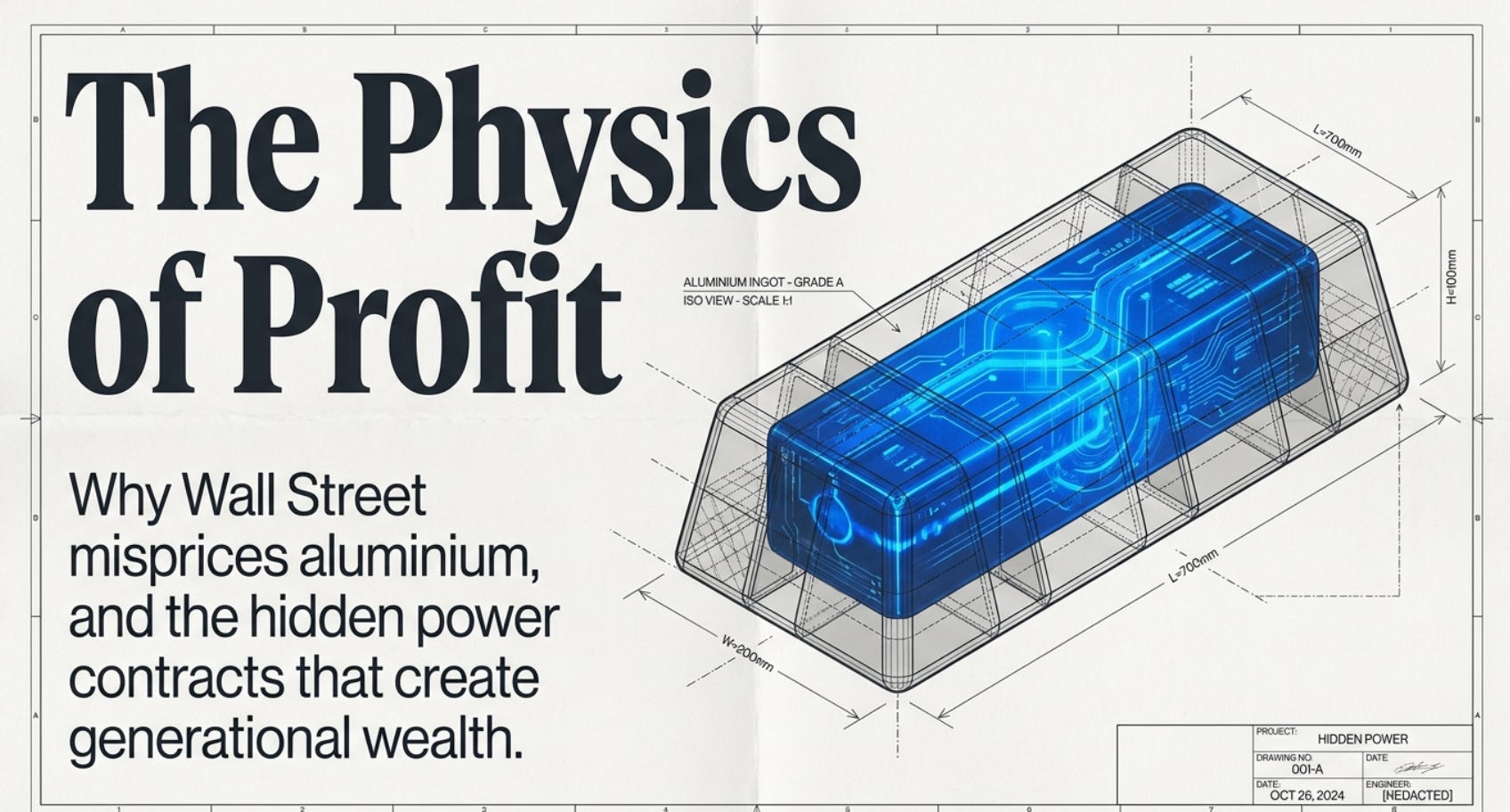
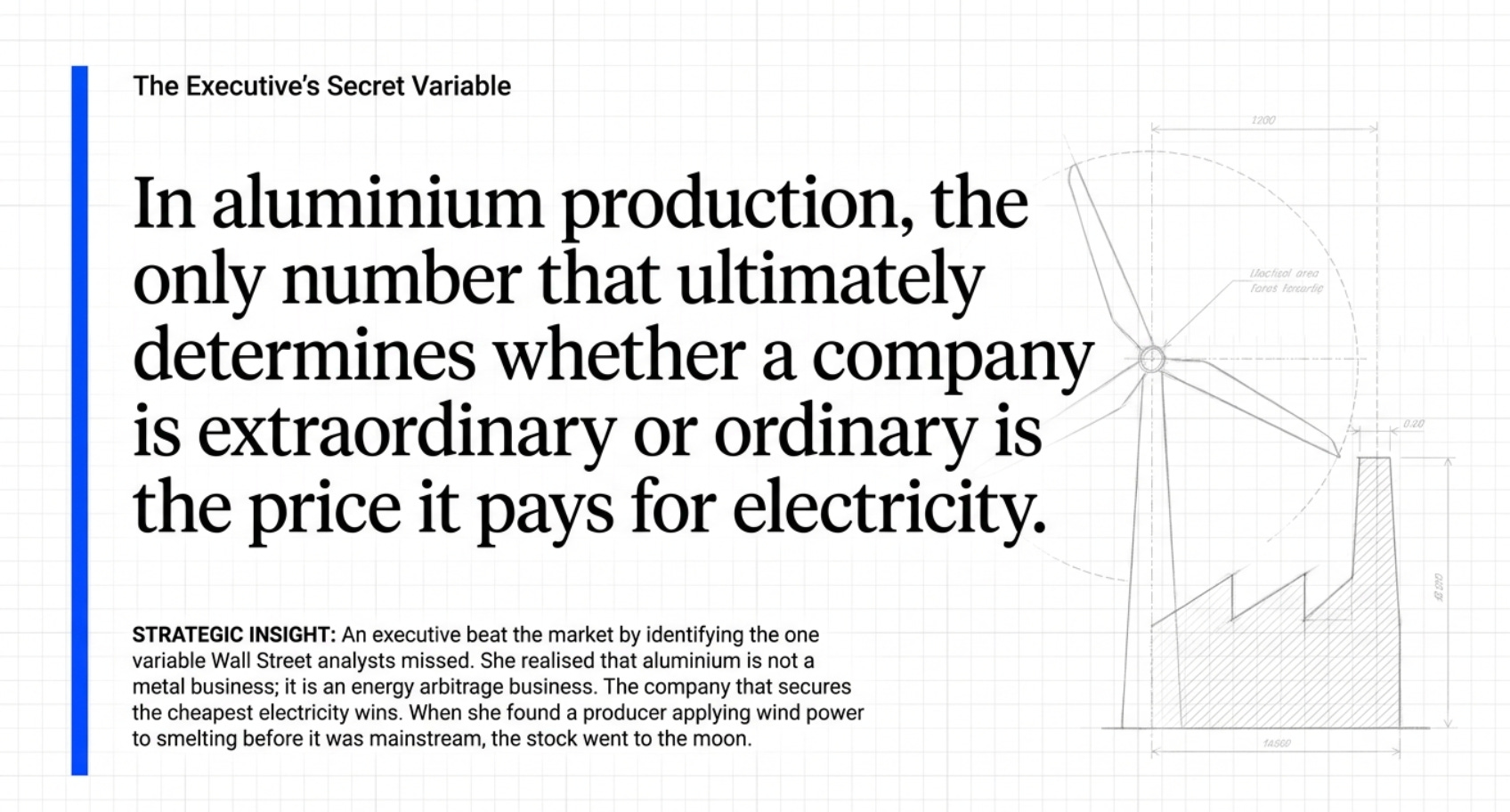
Her insight, stated plainly, was this: in aluminium production, the only number that ultimately determines whether a company is extraordinary or ordinary is the price it pays for electricity. Not the aluminium price. Not the revenue per tonne. Not the EBITDA margin. Those are all downstream consequences of the energy cost. The company that gets its electricity cheapest wins. And the company that figured out how to get electricity from wind turbines — when wind was still considered exotic for heavy industrial applications — went to the moon.
She does not name the company publicly. She does not need to. The principle she identified is so clear, so mechanical, and so consequential that once you see it, you cannot unsee it. This paper will show you exactly what she saw, why the market chronically fails to price it correctly, and where — right now — the same gap exists between what accountants record, what financial models produce, and what a business owner paying for the real asset would calculate.
PART I: THE PHYSICS BEFORE THE FINANCE
Why Electricity Is Not One Cost Among Many
Most manufacturing businesses have a range of meaningful input costs. Labour, raw materials, logistics, energy. None of them individually dominates the economics. In a typical automotive parts manufacturer, energy might represent 5 to 8 percent of total production cost. In a food processing plant, perhaps 3 to 5 percent. These are significant but not singular.
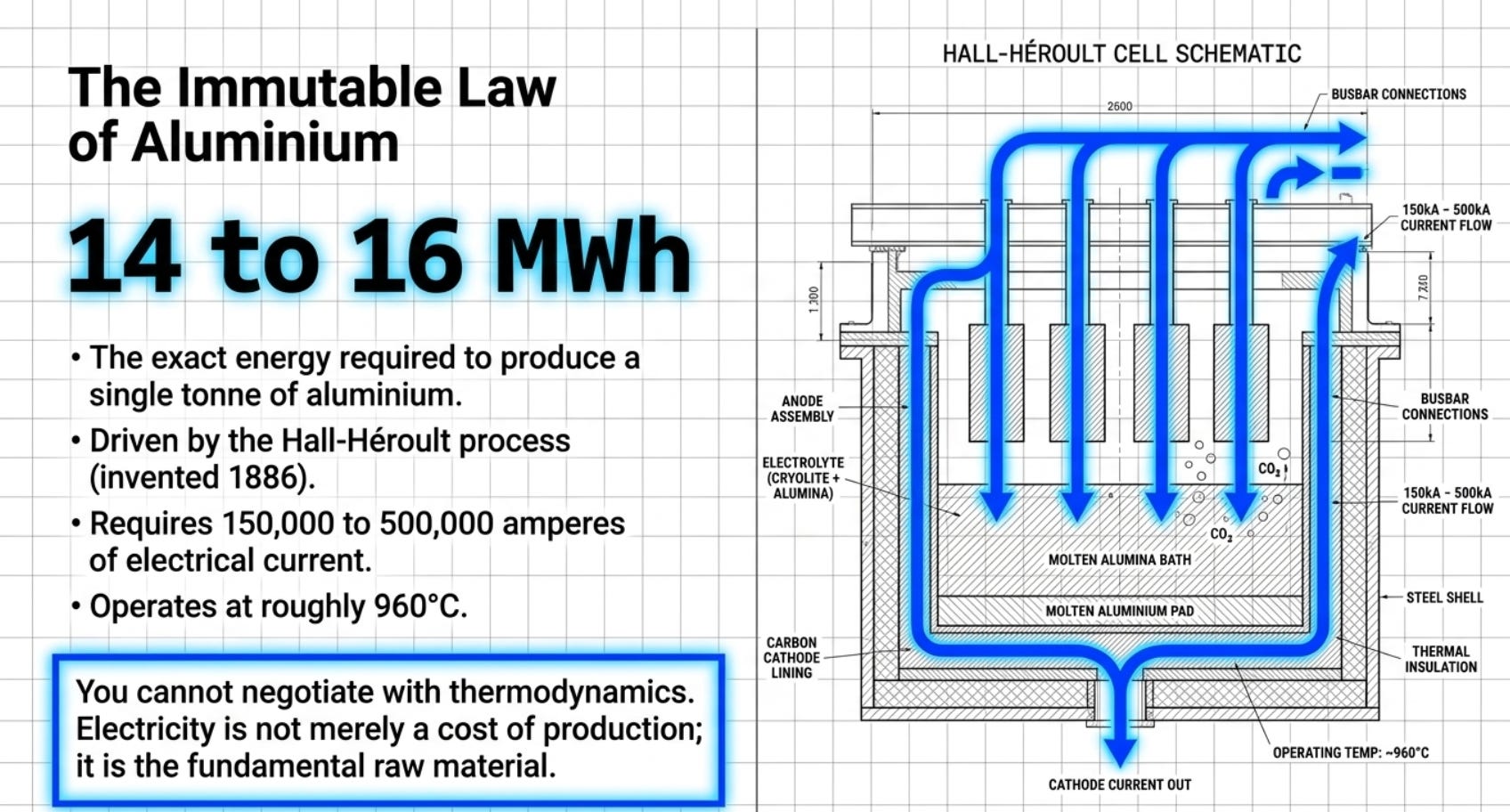
Aluminium smelting is categorically different. The Hall-Héroult process — invented independently in 1886 by Charles Martin Hall in Ohio and Paul Héroult in France, and unchanged in its fundamental physics ever since — converts aluminium oxide (alumina) into aluminium metal by passing enormous electrical current through a molten bath of cryolite at approximately 960 degrees Celsius. The electrolytic cells, called pots, each draw roughly 150,000 to 500,000 amperes of current. A modern smelter with 200,000 tonnes per year of capacity runs approximately 400 to 800 of these pots simultaneously, consuming roughly 14 to 16 megawatt-hours of electricity for every tonne of aluminium produced.
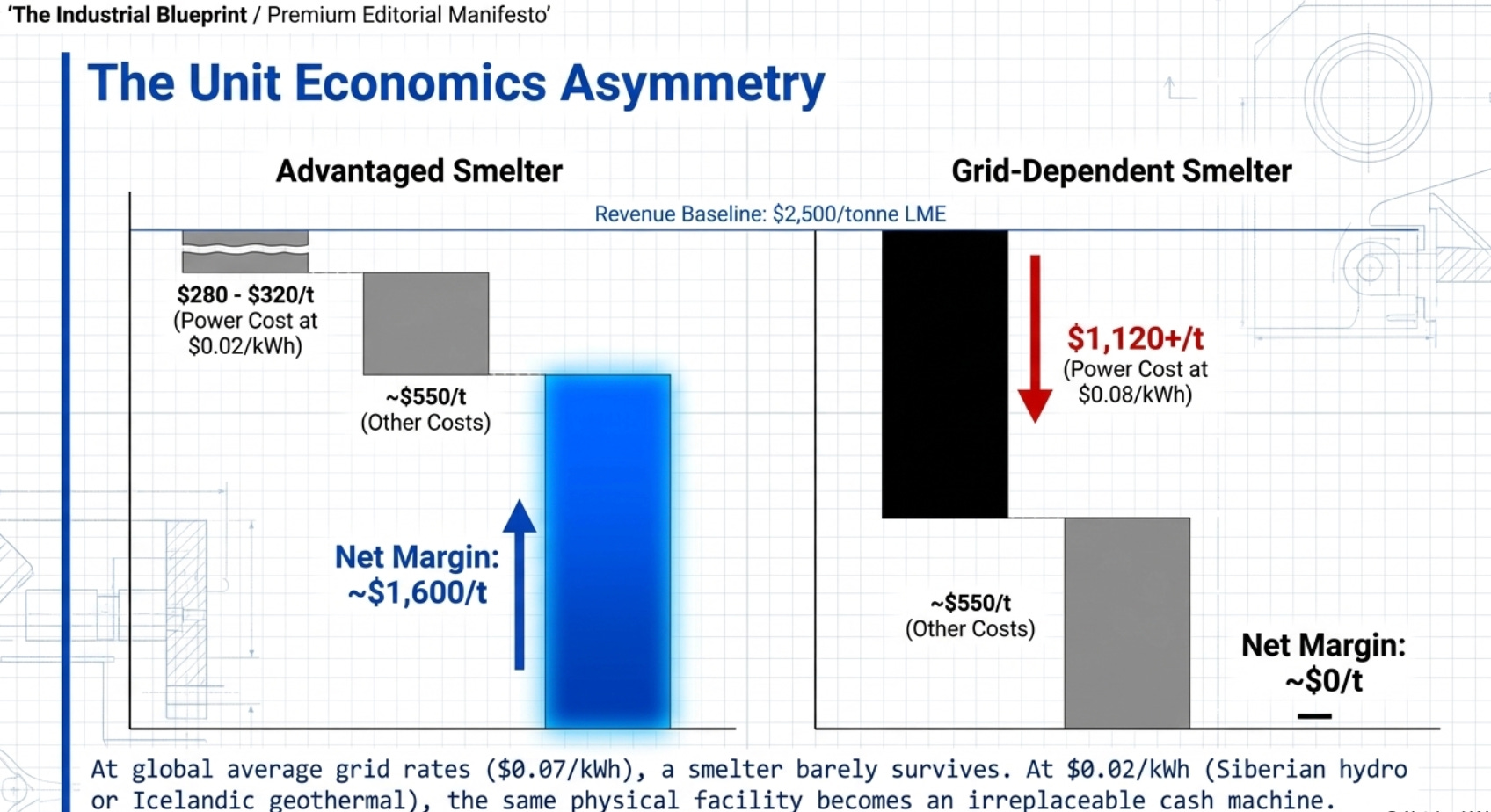
Pause on that number. Fourteen to sixteen MWh per tonne. At a global average electricity price of approximately $0.07 per kWh, that is $980 to $1,120 per tonne in electricity cost alone. Aluminium’s current market price is approximately $2,400 to $2,600 per tonne. This means electricity represents 38 to 47 percent of the total revenue of every tonne sold. Remove the electricity cost from the business and you have revealed a powerful, high-margin manufacturing operation. Leave electricity priced at global average rates and the business barely survives. Change the electricity price from $0.07 to $0.02 per kWh — which is exactly what Siberian hydropower and Icelandic geothermal deliver — and you have created a structural competitive advantage that no competitor can replicate without access to the same physical geography.
This is the axis around which the entire aluminium industry rotates. Not the aluminium price. Not the bauxite grade. Not the labour cost. The electricity cost. The executive who understood this — who looked at companies not through their earnings models but through their power contracts — was not making a financial insight. She was making a physics insight.
And the finance followed from the physics, exactly as it always does when you are looking at the right thing.
PART II: THE ASSET, PRECISELY DEFINED
The Smelter and the Power Contract — Two Assets in One Package
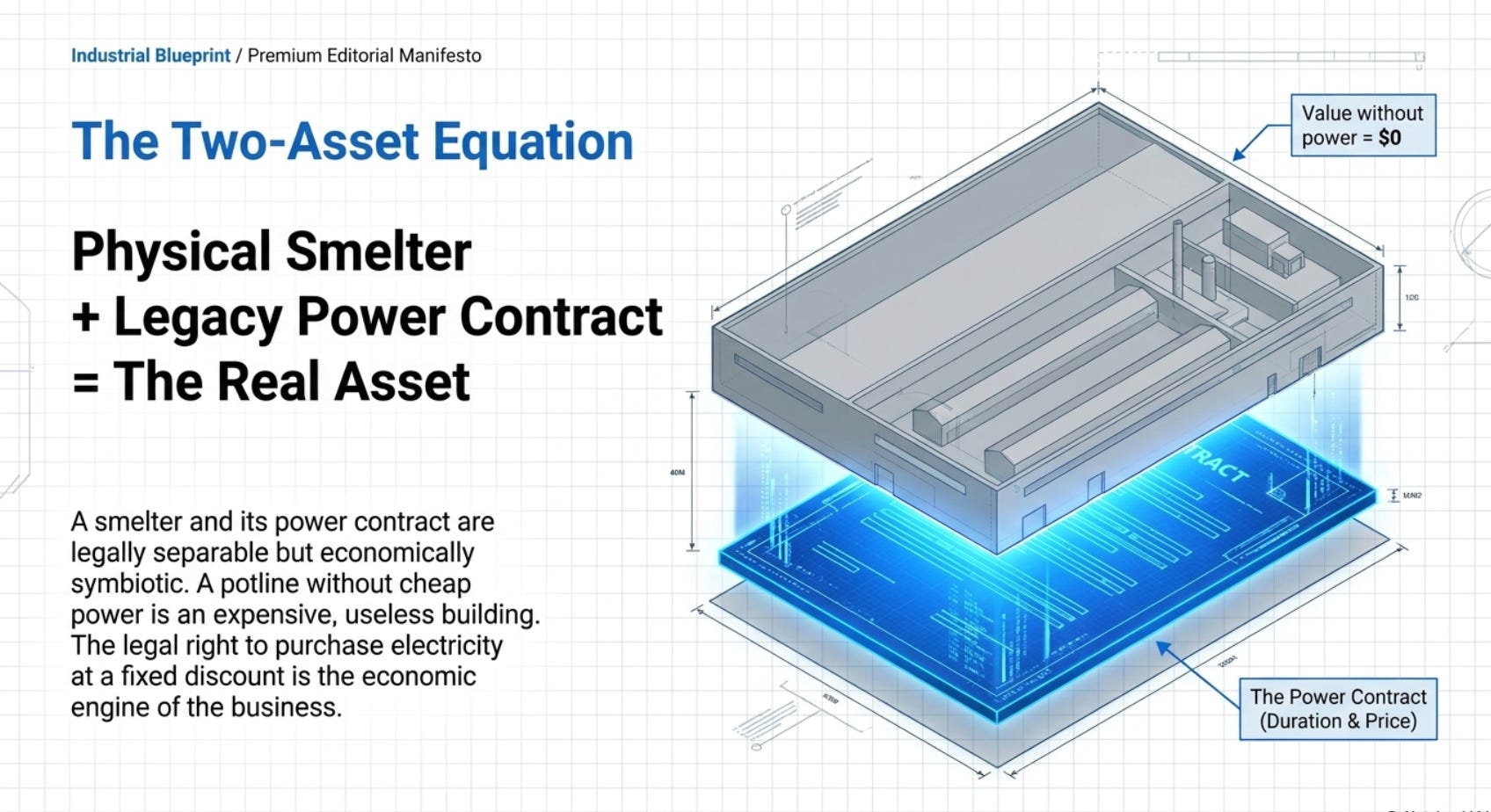
The primary income-generating asset of an aluminium producer is a combination of two things that are legally and physically inseparable in practice but completely separable in valuation terms. The first is the smelter: the physical potroom, with its reduction cells, rectifiers, alumina handling systems, metal casting infrastructure, and permitted environmental controls. The second is the power contract: the long-term agreement that delivers electricity to the smelter at a specific price per kilowatt-hour, for a specific number of years, at a specific volume.
The smelter without the power contract is an expensive building with no economic purpose. The power contract without the smelter is an electricity purchase agreement with no industrial application. Together, they are the machine that converts electrical energy into aluminium metal at whatever cost structure the power contract specifies. A smelter with a $0.02/kWh power contract is a licence to print money when aluminium prices are anywhere above $2,000/tonne. A smelter with a $0.06/kWh power contract loses money at $2,200/tonne and survives only when prices spike above $2,600/tonne.
This is why the executive’s insight was so valuable. She was not looking at earnings models. She was asking a prior question: what does this company pay for its electricity? That single number, applied to the physics of the Hall-Héroult process, gives you the cost structure of every tonne the company will ever produce, for the duration of the power contract. The earnings model calculates the margin after the fact. The owner’s analysis starts from the power price and works forward.
What a Business Owner Would Pay Right Now
The owner’s valuation of an aluminium smelter has three inputs, all of which can be calculated today without a single forecast.
Input one: the net margin per tonne at current aluminium prices and current power cost. At $2,500/tonne aluminium and $0.02/kWh power cost, the electricity component of production cost is approximately $280 to $320 per tonne. Add alumina cost of approximately $350 to $400/tonne, and other direct costs of approximately $200 to $250/tonne, and total cash production cost is approximately $830 to $970/tonne. Net operating margin: approximately $1,530 to $1,670 per tonne. At $0.05/kWh power cost, the electricity component is approximately $700 to $800/tonne, total cash cost rises to $1,250 to $1,450/tonne, and the net margin collapses to $1,050 to $1,250/tonne — still positive but already dramatically different. At $0.08/kWh — the approximate current European grid electricity cost for industrial users after the post-Ukraine energy crisis adjustments — cash production cost exceeds $1,600/tonne and the margin is essentially zero, or negative at times.
Input two: annual production capacity. A modern potline of 200,000 tonnes per year produces 200,000 tonnes of aluminium per year. This is a physical fact about the smelter that does not change materially with commodity cycles.
Input three: the remaining term of the power contract. A power contract with 20 years remaining at $0.02/kWh locks in the cost advantage for 20 years. This is the duration of the asset’s value. No forecast required. The contract exists. Its terms are known. The physical throughput is calculable from operating capacity data.
Multiply net margin by annual tonnage and you have the gross annual operating income from the asset. The owner then asks: what is the remaining life of this margin stream? And what would it cost to replicate it? The answer to the last question — what would it cost to replicate it — is the most important number in the analysis, and it is the number that GAAP entirely fails to capture.
PART III: WHY YOU CANNOT BUILD A NEW ALUMINIUM SMELTER IN THE DEVELOPED WORLD
The Greenfield Problem
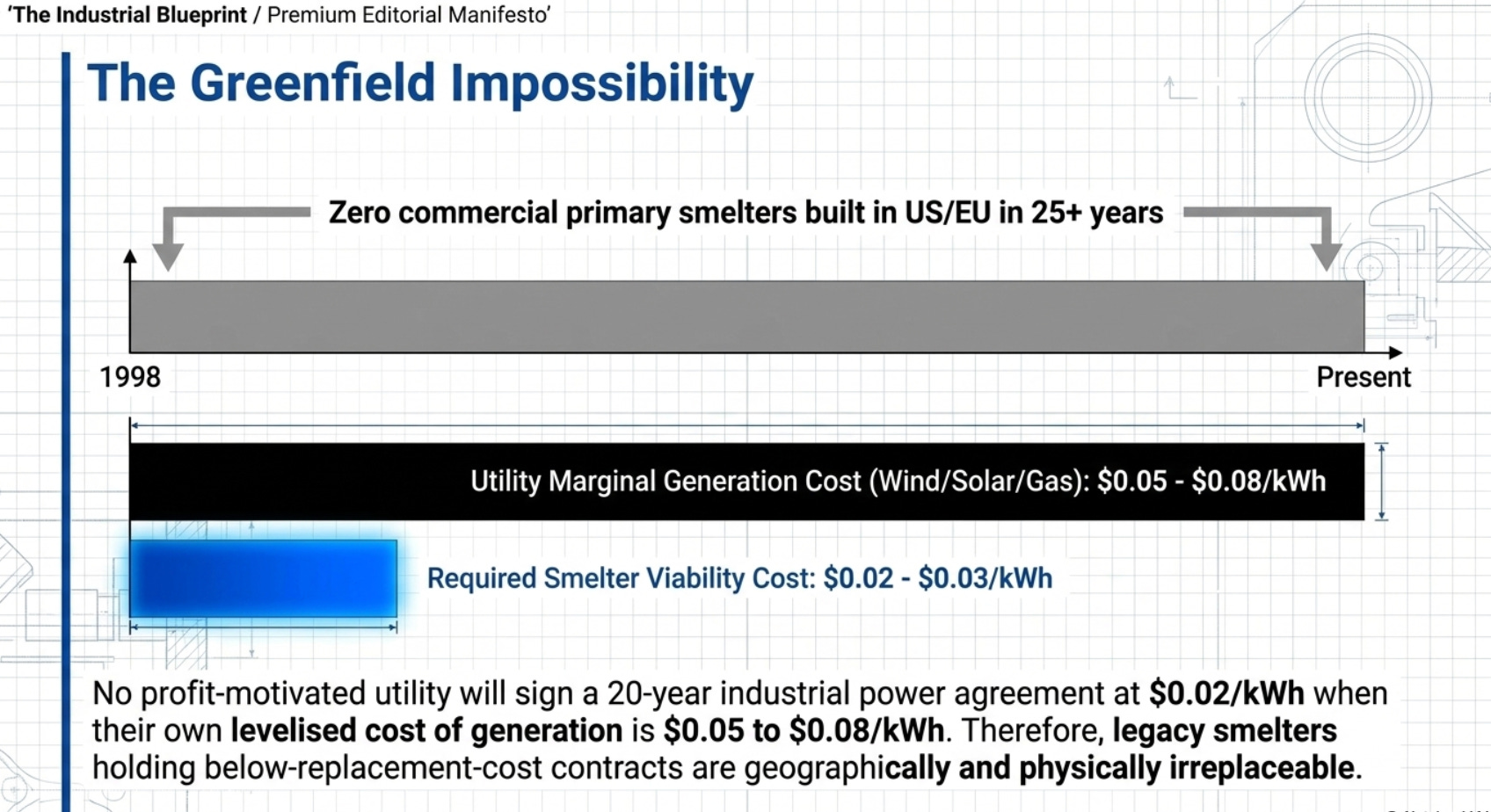
Century Aluminum’s Robards, Kentucky facility, completed in the late 1990s, was the last significant greenfield primary aluminium smelter built in the United States. In the roughly 25 years since its completion, not a single new primary aluminium smelter has been built in the US at commercial scale. In Europe, the story is similar: the last major new European smelter was Alcoa’s Fjarðaál facility in Reyðarfjörður, Iceland, which began production in 2007 — and Iceland is an outlier precisely because of its renewable energy abundance, not despite it.
The reason is simple and physical. A new aluminium smelter requires a long-term power supply contract at approximately $0.02 to $0.03 per kWh to be economically viable in today’s aluminium price environment. At $0.05/kWh or above, the smelter’s cash cost of production is structurally uncompetitive against the global cost curve. No US utility will offer a 20-year industrial power contract at $0.02/kWh today, because the utility’s own marginal cost of new generation — whether from wind, solar, gas, or nuclear — is approximately $0.05 to $0.08 per kWh at the levelised cost level. Offering industrial users a price below the cost of generating the electricity is not something a profit-motivated utility will do.
This creates a category of asset that has no parallel in most industries: a fully functioning, operating smelter with a legacy power contract at below-replacement-cost electricity prices is not merely cheap relative to its replacement cost — it is irreplaceable in practice. You cannot build a new one. The power contract that makes the existing one economically valuable cannot be reproduced on any timeline at any capital budget. The asset’s advantage is not a patent, not a customer relationship, not a network effect. It is physics and geography. The Bratsk hydropower dam on the Angara River in Siberia, commissioned in 1961 and producing 4,500 megawatts of electricity at a variable operating cost close to zero, is a geological and engineering fact that cannot be moved, replicated, or competed away.
PART IV: THE GAAP PROBLEM — AN ASSET THAT GETS CHEAPER ON PAPER AS IT BECOMES MORE VALUABLE IN REALITY
Straight-Line Depreciation and the Fully-Amortised Potroom
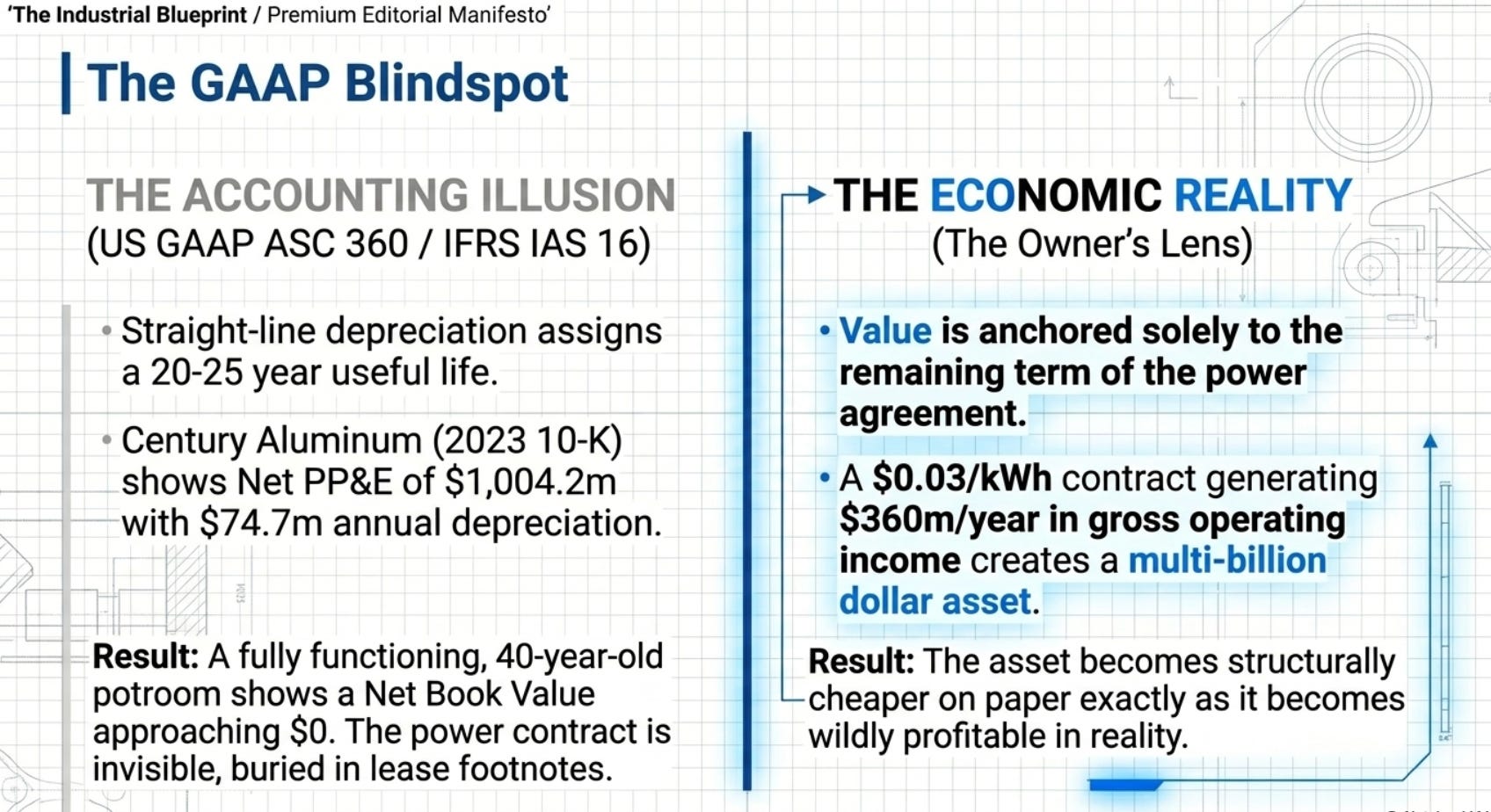
Under US GAAP (ASC 360) and IFRS (IAS 16), property, plant, and equipment is carried at historical cost minus accumulated depreciation. The useful life assigned to a primary aluminium smelter in standard accounting practice is typically 20 to 25 years for the potline infrastructure — the reduction cells, the pot shells, the electrical busbars, and the rectifier equipment. A smelter built in 1995 on a 20-year accounting life was fully depreciated by 2015. If that smelter is still producing aluminium in 2026 — which many are — its net book value on the balance sheet is approximately zero, or whatever residual scrap value the accountants assigned at the outset.
This is where the gap between accounting value and economic value becomes most acute. A fully depreciated potroom that continues operating has a balance sheet value approaching zero. Its economic value — the value to an owner who understands what it produces and what it costs to produce it — is determined entirely by the power contract and the margin spread, neither of which appears on the balance sheet.
In Century Aluminum’s December 31, 2023 10-K, the company reported net PP&E of $1,004.2 million across all its operations, including smelting capacity in Kentucky, South Carolina, and Iceland. The annual depreciation charge was $74.7 million. The critical question is not what these assets cost to build or what their depreciated book value is — it is what the power contract attached to each of these facilities costs per kilowatt-hour and how many years of that contract remain. The balance sheet tells you nothing about either of those questions. The power contract is not an asset recognised on the balance sheet.
It is disclosed in operating lease commitments and contractual obligations tables, buried in the back half of the annual report, in language that requires industry-specific knowledge to interpret correctly.
The earnings model — which most analysts apply as the primary valuation tool — uses the reported EBITDA figure and applies a sector multiple. The EBITDA is a product of the current aluminium price and the current production cost, which includes the current power cost under the existing contracts. But the earnings model treats the power cost as a variable input — something that will fluctuate with energy markets — rather than as a fixed contractual right at a specific price for a specific remaining term. This is the core error. The power contract is not a variable. It is a signed legal commitment. It is as fixed and certain as a government bond, for the duration of its term.
PART V: STORIES FROM THE POTROOM — HOW THE POWER CONTRACT CREATED AND DESTROYED FORTUNES
The Siberian Miracle: How RUSAL’s Founders Saw What Nobody Else Saw
In March 2000, two oligarchs — Oleg Deripaska of Sibirsky Aluminium and Roman Abramovich of Millhouse Capital — merged their Russian aluminium assets to create United Company RUSAL. The transaction was not primarily a bet on aluminium prices. It was a bet on a specific physical reality that Soviet planners had created decades earlier without fully understanding its long-term commercial implications.
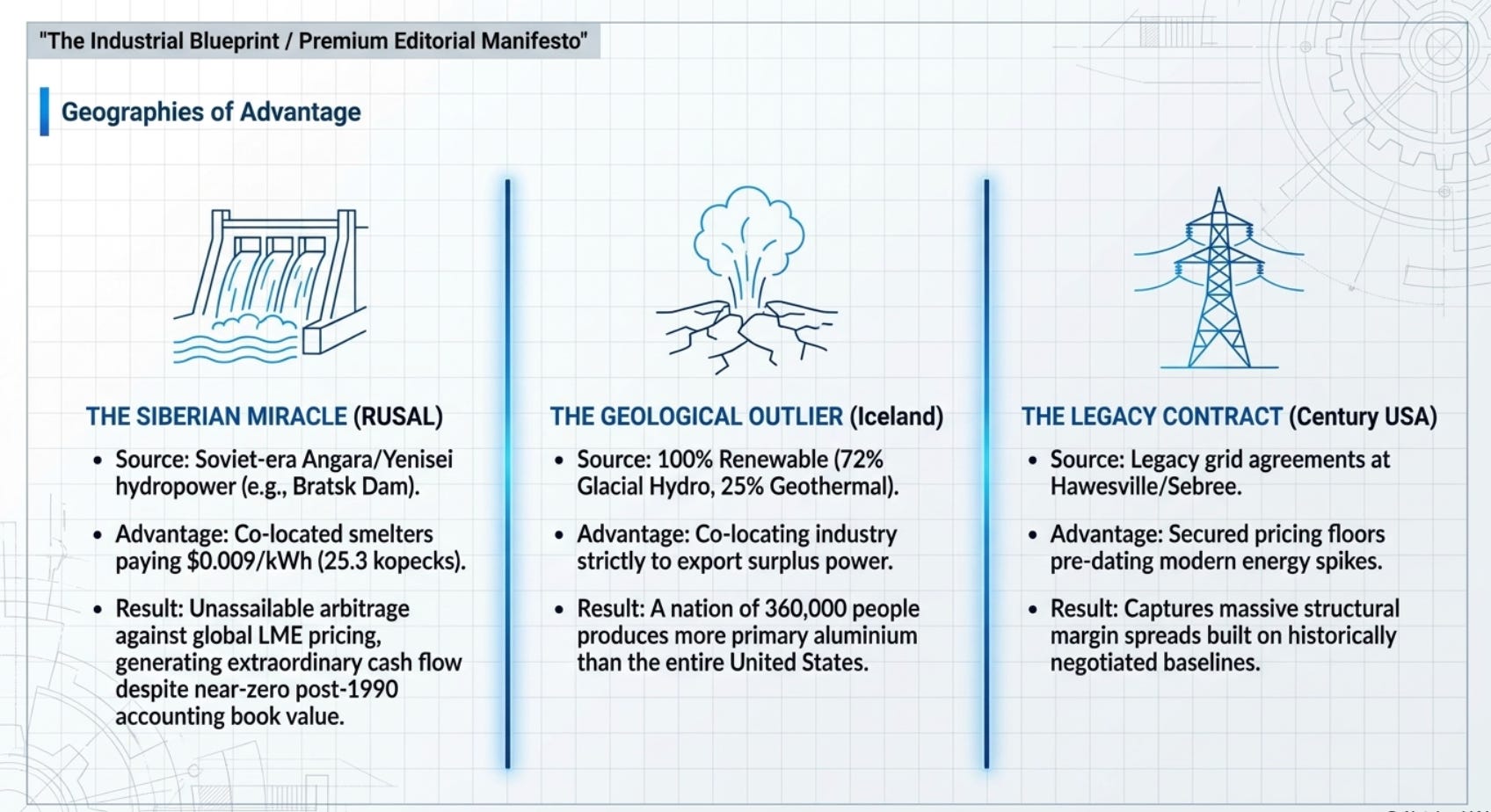
Soviet industrial planners in the 1950s and 1960s, designing the electrification of Siberia, had a problem: the enormous hydroelectric stations they were building on the Angara and Yenisei river systems — dams of extraordinary scale, including the 4,500-megawatt Bratsk dam on the Angara and the 6,000-megawatt Krasnoyarsk dam on the Yenisei — were producing electricity far in excess of what the sparse Siberian population needed for residential and light industrial use. The solution was to build aluminium smelters directly adjacent to the dams, specifically to consume the surplus electricity that could not be transmitted efficiently to distant population centres.
The Bratsk aluminium smelter, commissioned in 1966, was built literally 20 kilometres from the Bratsk hydropower station. The smelter consumed approximately 75% of the power station’s total output. The Krasnoyarsk smelter, commissioned in 1964, was similarly co-located with the Krasnoyarsk hydropower dam. The electricity price the smelters paid to the power stations was set administratively by Soviet planners at levels designed to utilise the generation capacity — not at market-clearing rates. By the time Deripaska and Abramovich were assembling their aluminium empire in the late 1990s, these Soviet-era power agreements had evolved into commercial contracts that still reflected the fundamental reality: electricity generated by a fully amortised 1960s hydropower dam, with no fuel cost and minimal operating cost, is among the cheapest electricity available on earth.
A Canadian Mining Journal journalist who toured the Bratsk facility in 2004 documented the power price: 25.3 kopecks per kilowatt-hour — at then-prevailing exchange rates, approximately $0.009 per kilowatt-hour. Less than one US cent per kilowatt-hour. Apply the Hall-Héroult physics: at $0.009/kWh and 15 MWh per tonne of aluminium, the electricity cost per tonne of metal was approximately $135. At London Metal Exchange aluminium prices of $1,600 to $1,800 per tonne in the mid-2000s, and an all-in cash cost including alumina, labour, and overhead of perhaps $700 to $800 per tonne, the gross operating margin from Bratsk was approximately $800 to $1,000 per tonne — extraordinary by any industrial standard, sustained at scale across a million tonnes of annual capacity.
This is what Deripaska saw that the Western financial press, focused on the geopolitics of Russian oligarchs rather than the thermodynamics of Siberian hydro, missed entirely. The Bratsk and Krasnoyarsk smelters were not just industrial assets. They were machines attached to essentially free power sources, producing a commodity that trades on a global exchange at prices set by global supply and demand rather than by Russian production costs. The arbitrage between a $0.009/kWh electricity cost and global aluminium prices was structural, physical, and — for as long as the power agreements held — unassailable.
When RUSAL listed its shares on the Hong Kong Stock Exchange in January 2010, raising approximately $2.24 billion, it became possible for the first time to buy equity in a company whose primary competitive advantage was this power cost arbitrage. The listing prospectus disclosed that RUSAL obtained 93% of its electricity from hydroelectric sources at costs dramatically below global market rates. The balance sheet, per standard IFRS treatment, carried the Siberian smelters at historical Soviet-era construction cost less decades of depreciation — near zero for the oldest facilities. The economic value of those same facilities — powered by hydro electricity at $0.01/kWh or below, producing aluminium that sells at $2,400/tonne globally — was orders of magnitude above their accounting carrying value.
Iceland: When Cheap Electricity Moves the Smelter to the Power Source
Around the same time the Siberian hydro story was playing out quietly, a parallel story was developing in Iceland that illustrated the same principle from a different angle — and that eventually produced the insight the former executive is known for, in a slightly different form.
Iceland’s electricity grid is powered entirely by renewable energy: approximately 72% hydropower from glacially-fed rivers, 25% geothermal energy from the volcanic geology beneath the island, and an emerging contribution from wind. The levelised cost of hydropower from Iceland’s geologically ideal river systems — high flow rates, large elevation drops, minimal silt — is among the lowest in the world. Iceland’s national power company, Landsvirkjun, had surplus generation capacity that far exceeded the small island nation’s domestic residential and commercial demand.
The solution was the same one Soviet planners had reached in Siberia: co-locate industrial electricity consumers directly at the generation source. Iceland had no indigenous aluminium ore, no particular industrial tradition in metalworking, and no geographic proximity to any major aluminium market. It had one thing: extraordinary surplus electricity at extraordinarily low cost, in a politically stable jurisdiction with a well-educated workforce and functional rule of law.
By 2017, Iceland — a nation of approximately 360,000 people — was producing more primary aluminium than the entire United States. The three Icelandic smelters — Norðurál (Century Aluminum), Fjarðaál (Alcoa), and ISAL (Rio Tinto) — between them produced approximately 800,000 tonnes of aluminium per year, powered entirely by renewable electricity at costs that US domestic smelters, paying commercial industrial rates for grid power, could not come close to matching.
Century Aluminum’s Norðurál smelter in Grundartangi, Iceland, which began production in 1998, signed power contracts with Landsvirkjun that have been structured and renegotiated multiple times. The disclosed power costs at Norðurál — while not stated as a precise kWh price in Century’s US public filings — are reflected in the smelter’s C1 cash cost of production, which has historically been among the lowest in Century’s portfolio. The smelter’s net book value on Century’s consolidated balance sheet — after 25+ years of straight-line depreciation — approaches a small fraction of its 1990s construction cost. Its economic value — anchored to the remaining term of its Iceland power agreement, to the renewable electricity cost advantage that makes it one of the most competitive smelters on earth, and to the physical impossibility of replicating either the Icelandic hydro resource or the smelter’s permitted operating status — is vastly higher than any balance sheet figure suggests.
The Wind Energy Pivot: The Company That Went to the Moon
The executive’s story points to something more recent and more instructive than RUSAL’s Soviet hydro inheritance or Iceland’s geological fortune. Those were advantages that came from where the smelters happened to be built. Her insight was about a company that actively went and found its power advantage — that made a strategic decision to secure cheap, renewable electricity when the market did not yet understand why that decision would be worth many multiples of its apparent cost.
The principle is the same regardless of whether the energy source is Siberian hydropower, Icelandic geothermal, or industrial-scale wind. The variable that matters is dollars per kilowatt-hour paid for electricity at the smelter fence. The company that reduces that number by 30 to 50 percent relative to grid-connected competitors does not reduce its costs by 30 to 50 percent — it transforms its margin structure entirely, because electricity is 35 to 45 percent of total cost. A 40 percent reduction in electricity cost, applied to a 40 percent cost share, reduces total production cost by 16 percentage points and expands the gross margin per tonne by the same absolute dollar amount.
At $2,500/tonne aluminium, moving a smelter’s electricity cost from $0.05/kWh to $0.03/kWh saves approximately $280 to $320 per tonne in direct electricity cost. On a 200,000-tonne smelter, that is $56 to $64 million per year in additional operating income — every year, for the life of the power agreement. Capitalised at a modest 8 to 10 percent rate, this single cost reduction creates $560 to $800 million in net present value for a smelter whose balance sheet carrying value might be $100 million or less. The power contract is the asset. The balance sheet does not show it. The earnings model does not isolate it. Only the owner who asks the right question — what do you pay per kilowatt-hour and for how long? — sees the full picture.
PART VI: THE ACCOUNTING TREATMENT AND THE GAP IN NUMBERS
What GAAP Records vs. What the Owner Calculates
For Century Aluminum specifically: the company’s December 31, 2023 balance sheet shows net PP&E of $1,004.2 million across its US and Iceland operations. Annual depreciation is $74.7 million. The PP&E figure has grown in recent years due to capital expenditures rather than reflecting any revaluation (which far outweighs the value of any CAPEX improvements) — there is no mechanism under US GAAP to write up the value of a fully depreciated smelter, even when its earning power has increased because aluminium prices have risen while its power contracts have locked in a fixed electricity cost.
Century’s US smelters — Hawesville, Kentucky (approximately 244,000 tonnes/year capacity) and Sebree, Kentucky (approximately 166,000 tonnes/year) — have operated since the 1960s and 1970s respectively. Their net book values are minimal after 50+ years of depreciation. The power contracts that allow Hawesville and Sebree to operate are disclosed in Century’s contractual obligations tables. These contracts run for specific terms at specific prices. They are not on the balance sheet. They are the primary determinant of whether the smelter earns $200/tonne or $800/tonne in gross operating margin. They are, in every meaningful economic sense, the asset — and they are invisible in the PP&E line.
The owner’s perspective for a Century Aluminum smelter with a legacy power contract at, say, $0.03/kWh:
Annual production: 200,000 tonnes
Revenue at $2,500/tonne: $500 million
Electricity cost at $0.03/kWh × 15 MWh/tonne × 200,000 tonnes: $90 million
Alumina and other direct costs: ~$550 million combined
Gross operating income: ~$360 million per year
A business owner willing to buy this cash stream for 5 years of gross operating income would pay approximately $1.8 billion for a single smelter — a facility that might carry $150 to $200 million in net book value on the balance sheet, from a company with a total market capitalisation that has ranged from under $500 million to approximately $1.5 billion across the 2020 to 2024 period. But will the smelter only last 5 years? — The book value says one thing, the owner’s perspective tells us another.
The RUSAL Book-to-Value Chasm
For RUSAL, the gap between accounting value and economic value is even more extreme, for three compounding reasons. First, the Siberian smelters were built with Soviet-era capital — accounted for at official exchange rates that bore no relationship to market prices — and have been depreciated under various accounting regimes over decades, leaving carrying values that reflect neither current construction costs nor the economic productivity of the assets. Second, the power contracts that underpin the Siberian smelters’ structural cost advantage are internal agreements between RUSAL and the hydro assets that RUSAL itself partly owns — they are eliminated on consolidation and do not appear in disclosed contractual obligations in the same way a third-party power contract does. Third, the Russian regulatory and political environment adds geopolitical risk discounts to RUSAL’s valuation that further suppress the market price relative to the physical asset value.
The Bratsk smelter alone, the world’s largest at approximately 1,020,000 tonnes per year of aluminium output, is connected directly to the Bratsk hydropower station with electricity costs at a fraction of global industrial rates. The gross operating income from Bratsk, at mid-cycle aluminium prices and Bratsk’s disclosed cost structure, is extraordinary relative to any accounting book value of the asset. The carrying value of Soviet-built industrial infrastructure on a post-1990 accounting basis is essentially a historical fiction. The economic value — tonnes per year times the net margin generated by the power cost arbitrage — is the real number.
PART VII: THE WALL STREET PROBLEM — MODELS THAT MEASURE EVERYTHING EXCEPT THE RIGHT THING
How the Earnings Model Fails Aluminium Producers
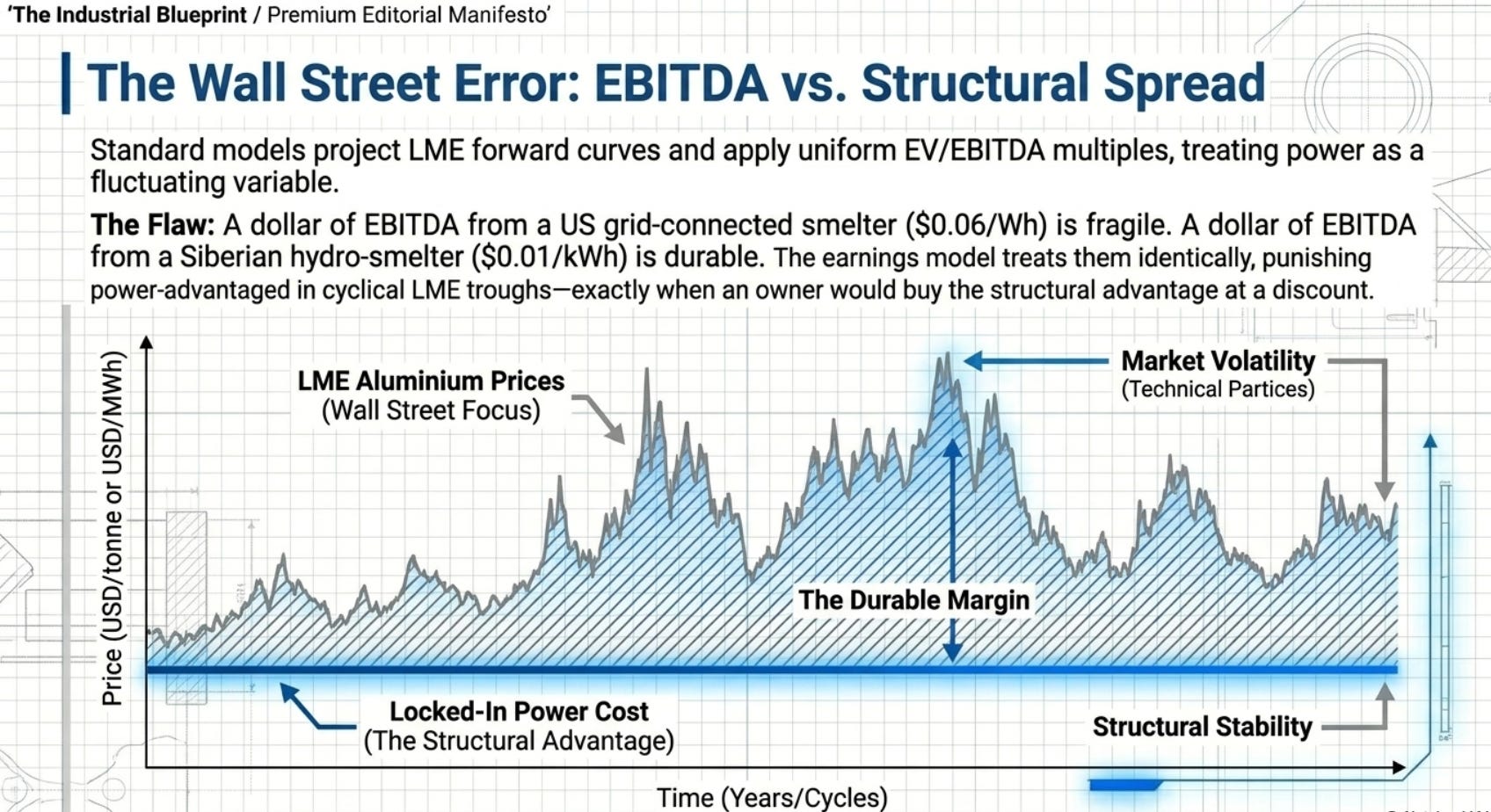
The standard approach for covering an aluminium producer on Wall Street begins with the LME aluminium forward curve. The analyst takes the market’s forward price for aluminium — which embeds consensus views about Chinese demand, supply curtailments, and global inventory levels — and uses it as the revenue driver. They then model production volumes (capacity times utilisation rate), subtract estimated cash costs, arrive at EBITDA, and apply a sector multiple.
This model has several structural problems for primary aluminium producers with power contract advantages.
The first problem is that the aluminium price is the most visible and most volatile input, so it dominates the model. When LME aluminium is at $2,100/tonne, analysts produce bearish price targets. When it is at $2,700/tonne, they produce bullish ones. But the competitive advantage of a Siberian or Icelandic smelter exists at every point in the aluminium price cycle — the low power cost is a fixed structural advantage, not a cyclical variable. The earnings model treats cost structure as relatively fixed and price as the swing variable. In reality, for a power-advantaged smelter, the variable is the spread between the locked-in power cost and the aluminium price — a spread that widens every time aluminium rises and narrows only in extreme downturns when aluminium falls below total cash cost.
The second problem is that the multiple applied to EBITDA treats all EBITDA equivalently. A dollar of EBITDA from a US grid-connected smelter paying $0.06/kWh, which will disappear if power costs rise, is not the same as a dollar of EBITDA from a Siberian hydro-powered smelter paying $0.01/kWh, which will persist regardless of external energy market conditions. The first EBITDA stream is fragile and contingent. The second is structural and durable. The multiple that correctly values the second is higher than the multiple that correctly values the first — but the earnings model, applying a uniform sector EV/EBITDA multiple, treats them identically.
The third problem is that earnings models perform their worst exactly when the valuation opportunity is greatest. In periods when aluminium prices are depressed — the 2015 to 2016 trough, the COVID trough of 2020 — earnings models show low or negative EBITDA for marginal producers, and even power-advantaged smelters show reduced earnings as the aluminium price compresses the margin spread. The earnings model says: sell. The owner’s analysis says: the power contract is unchanged, the production capacity is unchanged, and I am now buying the durable cost advantage at a lower aluminium price than it requires to be profitable. Buy.
PART VIII: STORIES FROM THE MARKET — THREE CASE STUDIES IN ALUMINIUM VALUE ARBITRAGE
Century Aluminum: The Smelter That Was Worth Nothing and Then Everything
In the aftermath of the 2008 global financial crisis, aluminium prices collapsed from over $3,200/tonne at their mid-2008 peak to below $1,300/tonne by early 2009. For aluminium producers without low-cost power, the collapse was existential. The Hawesville, Kentucky smelter — one of Century’s primary US assets — cut production and operated at reduced capacity. Century’s debt load, accumulated during earlier expansion, became a serious concern. The stock, which had been in the $60 to $80 range during 2007 and early 2008, fell to under $5 per share in early 2009.
At that stock price, Century’s market capitalisation was under $200 million. Its US smelter capacity — Hawesville and Sebree combined — was approximately 400,000 tonnes per year. The power contracts at those facilities, negotiated in prior years, had remaining terms and price structures that, at normalised aluminium prices, would generate hundreds of millions of dollars in annual operating income. The balance sheet showed minimal PP&E after decades of depreciation. The earnings model showed losses at $1,300/tonne aluminium. The owner’s analysis showed something different: these are the last remaining primary aluminium smelters in the United States with pre-negotiated, legacy power agreements, and I am buying 400,000 tonnes of capacity — infrastructure that cannot be replicated in the current US power market at any price — for approximately $500 per tonne of annual capacity in total market value. At normalised aluminium prices and the locked-in power cost, this capacity will generate $200 to $400 per tonne in annual gross operating income.
By 2011, as aluminium prices recovered and the macroeconomic situation stabilised, Century’s stock had recovered to $25 to $30 per share — a 5 to 6 times return from the 2009 trough. The smelters were the same smelters. The power contracts were the same power contracts. The aluminium production capacity was the same. Only the market’s willingness to price the asset at its owner’s value, rather than its current earnings, had changed.
The lesson is the same one the executive with the biopharma startup learned: the power contract is the asset. The earnings model at a cyclical trough does not reflect the asset’s value. An owner who calculates what the asset produces per year at normalised prices and costs — and pays for it based on that calculation, not on current earnings — earns extraordinary returns when the cycle turns.
The European Smelter Catastrophe: When the Power Contract Expires and Nobody Has a Plan
The story of European aluminium smelters since 2021 is the mirror image of the Siberian and Icelandic stories — and it illustrates the power cost dependency from the disaster direction.
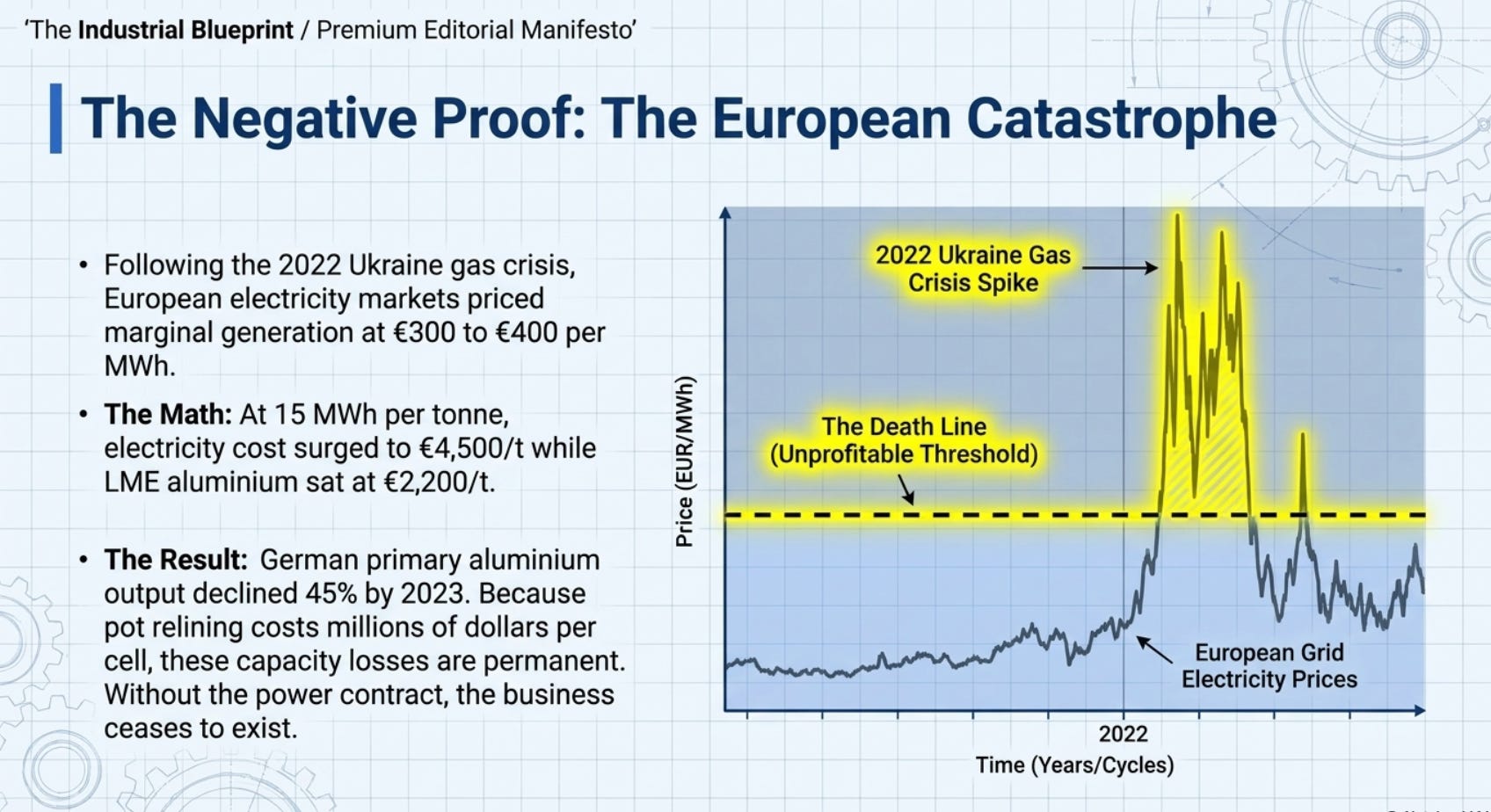
Germany was once home to a meaningful primary aluminium smelting industry. Aluminium Norf, operated by Novelis and Hydro, is the world’s largest aluminium rolling mill by volume — but it processes recycled aluminium, not primary metal. Germany’s primary aluminium capacity, relying on German grid electricity at industrial rates, was already under pressure before 2021. When Russia’s invasion of Ukraine in February 2022 triggered a spike in European natural gas prices — and because European electricity markets are marginal-cost priced off gas generation — German industrial electricity prices surged from approximately €50 to €60 per MWh in 2021 to over €300 to €400 per MWh at the height of the energy crisis in late 2022.
At €300/MWh electricity and the Hall-Héroult physics of 15 MWh per tonne of aluminium, the electricity cost per tonne of aluminium surged to €4,500 — nearly double the LME aluminium price of approximately €2,200/tonne equivalent at the time. German primary aluminium production became not merely unprofitable but catastrophically uneconomic. German primary aluminium output reportedly declined 30% in 2022 and a further 45% in 2023. One in four German aluminium smelters closed. The European Aluminium industry association warned of permanent capacity loss.
The closures were not temporary curtailments. When a potline is shut down completely — when the electrolytic cells are allowed to cool and the molten cryolite bath solidifies — the restart cost is enormous and the timeline is long. Pot relining, the process of rebuilding the insulating interior of each reduction cell, takes months and costs millions of dollars per cell across hundreds of cells. In many cases, the closed German smelters will not restart because the economics at European grid electricity prices do not support aluminium production at any foreseeable LME price.
This is the negative proof of the core thesis. The power contract — or the lack of one — is the entire business. Germany’s smelters, reliant on grid electricity with no long-term power price protection, were running a business that was structurally dependent on a cost input over which they had no control. When that input moved adversely, the business ceased to exist. The Bratsk smelter, powered by a hydroelectric dam on the Angara River at $0.009/kWh, was still producing aluminium profitably through the same period. The difference between the two outcomes is not management quality, not technology, not customer relationships. It is the price per kilowatt-hour.
Metro Mining and Capral: The Upstream and Downstream Perspectives
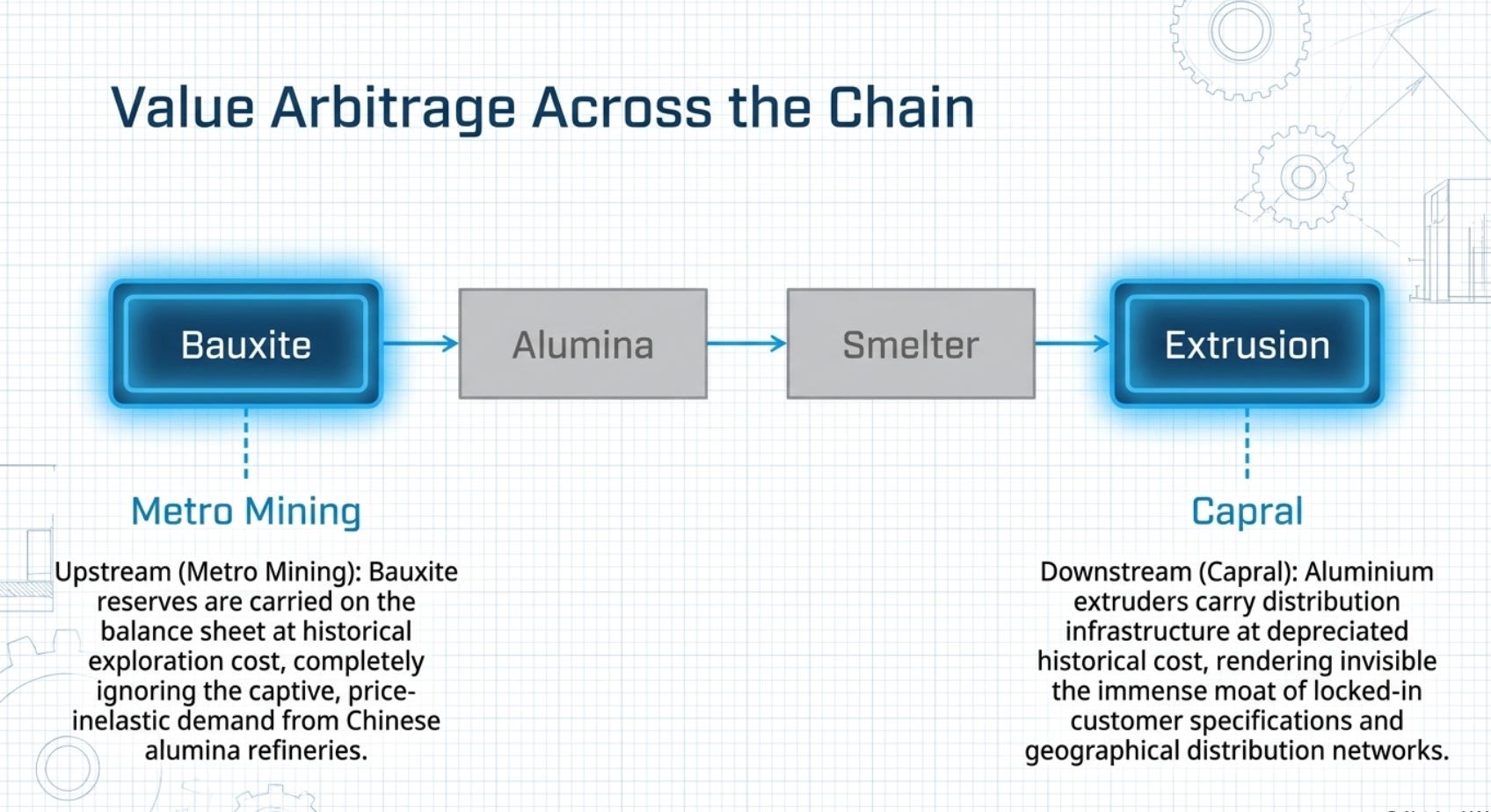
Metro Mining Limited (ASX: MMI) operates the Bauxite Hills mine in Queensland, Australia, producing bauxite — the raw ore from which alumina is refined and ultimately aluminium is smelted. Metro’s position in the supply chain is upstream of the smelter — it provides the bauxite feedstock that flows to Chinese alumina refineries, which in turn supply Chinese smelters. The value arbitrage in Metro’s case is slightly different from the smelter-level story but illustrates the same accounting gap.
Bauxite is the primary ore of aluminium, with over 90% of global production utilized to produce alumina via the Bayer process, which is then refined into aluminium metal.
Metro’s Bauxite Hills deposit contains substantial proven reserves of bauxite carried at the historical cost of exploration and development. The bauxite trades in a market where Chinese demand is essentially price-inelastic within a reasonable range — Chinese aluminium production requires bauxite from external sources because China’s own bauxite deposits are lower quality than its aluminium production scale demands. The shipping cost from Queensland’s cape ports to Chinese refineries is a known, calculable variable. The net margin per tonne — bauxite sale price minus mining cost minus shipping minus royalties — is calculable from disclosed production data and current contract prices. The owner’s analysis of Metro’s reserve base applies the same methodology used throughout this paper series: tonnes in reserve times net margin per tonne at current prices, compared to the enterprise value. The balance sheet shows bauxite mineral rights at capitalised exploration and development cost. The owner sees raw material supply for a structurally inelastic industrial demand.
Capral Limited (ASX: CAA) sits at the opposite end of the supply chain — it fabricates and distributes aluminium extrusions to Australian construction, manufacturing, and industrial customers. Capral does not smelt primary aluminium; it purchases aluminium billets as its raw material input and converts them into finished profiles for window frames, curtain wall systems, solar panel racking, and industrial components.
The value arbitrage in Capral’s case is not about power contracts or mineral reserves. It is about the installed customer base, the long-term specification approvals for its products in major construction projects, and the distribution infrastructure — warehouses, service centres, and regional logistics — that a competitor would require years and substantial capital to replicate.
These assets are largely invisible on Capral’s balance sheet, which carries distribution infrastructure at depreciated historical cost with no recognition of the customer relationships, product approvals, or geographic coverage value that a new market entrant would need to pay for through years of below-cost pricing to win business.
PART IX: CONFIRMED CATALYSTS — WHAT IS ALREADY HAPPENING
Catalyst 1: Green Aluminium Premium — Already Priced Into Contracts, Invisible on Balance Sheets
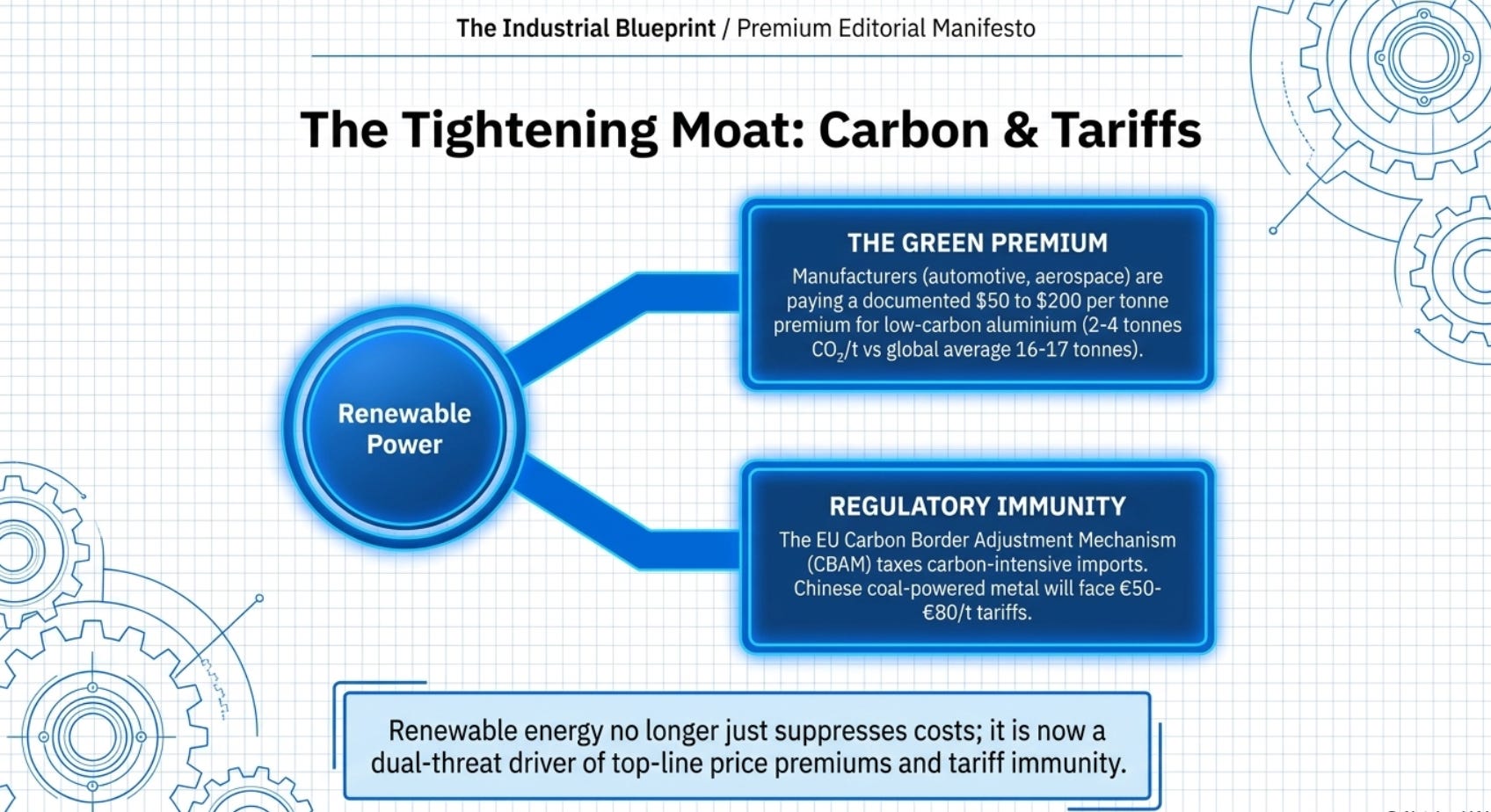
The aluminium market has quietly bifurcated into two parallel products: conventional primary aluminium with a global average carbon footprint of approximately 16 to 17 tonnes of CO₂ per tonne of metal, and low-carbon or green aluminium produced from renewable energy sources with footprints of 2 to 4 tonnes CO₂ per tonne. RUSAL’s hydropower-produced “Allow” brand aluminium and Iceland’s geothermal and hydro-sourced metal command documented premiums in the market.
This premium has been growing as automotive, aerospace, and consumer electronics manufacturers — under pressure from their own customers and from regulatory bodies — commit to reducing the embedded carbon in their products. A Mercedes-Benz or BMW that uses Icelandic aluminium in its body panels has a lower Scope 3 emissions footprint than one using Chinese coal-powered aluminium. This is now a quantifiable, commercially relevant distinction that buyers are willing to pay for.
The premium for certified low-carbon aluminium has been reported in the range of $50 to $200 per tonne above the LME price, depending on certification standard and buyer requirements. For a power-advantaged smelter already producing at low cost — say, the Iceland or Siberian facilities — this is pure incremental margin on top of the existing cost advantage. The renewable energy infrastructure that creates the low power cost simultaneously creates the low-carbon product that commands the premium. One asset produces both advantages. Neither is fully reflected on the balance sheet.
RUSAL’s explicit strategy to market its Siberian hydro-powered aluminium as a premium product — evidenced by its corporate agreements with downstream manufacturers including the Budweiser Brewing Group for aluminium cans produced at the Krasnoyarsk hydropower smelter — is the beginning of a market segmentation that will structurally advantage renewable-powered producers over coal-powered ones. As the premium becomes more widely quoted and contracted, the value of the renewable power supply arrangement — which is not on any balance sheet — becomes more explicitly a component of the product’s commercial value.
Catalyst 2: Carbon Border Adjustment Mechanism (CBAM) — Already Enacted, Phasing In
The European Union’s Carbon Border Adjustment Mechanism came into force on October 1, 2023, and moves into its full phase-in period from January 2026 through 2034, at which point it will impose a carbon price on imports of carbon-intensive products — including aluminium — based on the difference between the carbon price embedded in the imported product and the EU’s own carbon price under the Emissions Trading System.
The practical effect: Chinese aluminium produced with coal-fired electricity will face a carbon import tariff of approximately €50 to €80 per tonne or more, depending on the EU carbon price, when entering the European market. Icelandic aluminium produced with renewable electricity faces near-zero CBAM cost. Siberian aluminium — geopolitically complicated by Russia sanctions — faces its own structural access barriers. The net result is that renewable-powered Western producers gain a structural market access advantage in the EU market that is proportional to the carbon intensity difference between their production method and the global average.
CBAM is not a proposal. It is enacted law, in implementation. The aluminium industry is one of the six sectors explicitly covered in the initial CBAM scope. The mechanism will apply to aluminium ingot, alloyed aluminium, and aluminium products. Companies with renewable-powered smelters have a confirmed, legally mandated competitive advantage in the EU market from January 2026 forward.
Catalyst 3: US Trade Policy and the Section 232 Tariff Stack on Aluminium
The United States reimposed and strengthened Section 232 tariffs on aluminium imports in 2025, adding to the existing tariff framework that had been in place since 2018. The 25% aluminium import tariff creates a domestic price floor that advantages US domestic producers — of which there are very few remaining — over imported metal. Century Aluminum, with its domestic US smelting capacity at Hawesville and Sebree, is one of a small number of US domestic producers with existing, operating capacity.
This is a direct policy confirmation of the irreplaceable value of existing domestic smelting capacity. The US government has now, across multiple administrations and political configurations, consistently chosen to protect domestic aluminium production capacity with tariffs — precisely because new capacity cannot be built economically, making the existing capacity a national industrial asset of strategic significance. The tariff makes the existing power contracts embedded in domestic US smelters worth more, because the market premium for tariff-protected domestic production adds to the spread between production cost and sale price.
Catalyst 4: AI Data Centre and EV Battery Demand Increasing Electricity Demand, Tightening the Power Advantage Moat
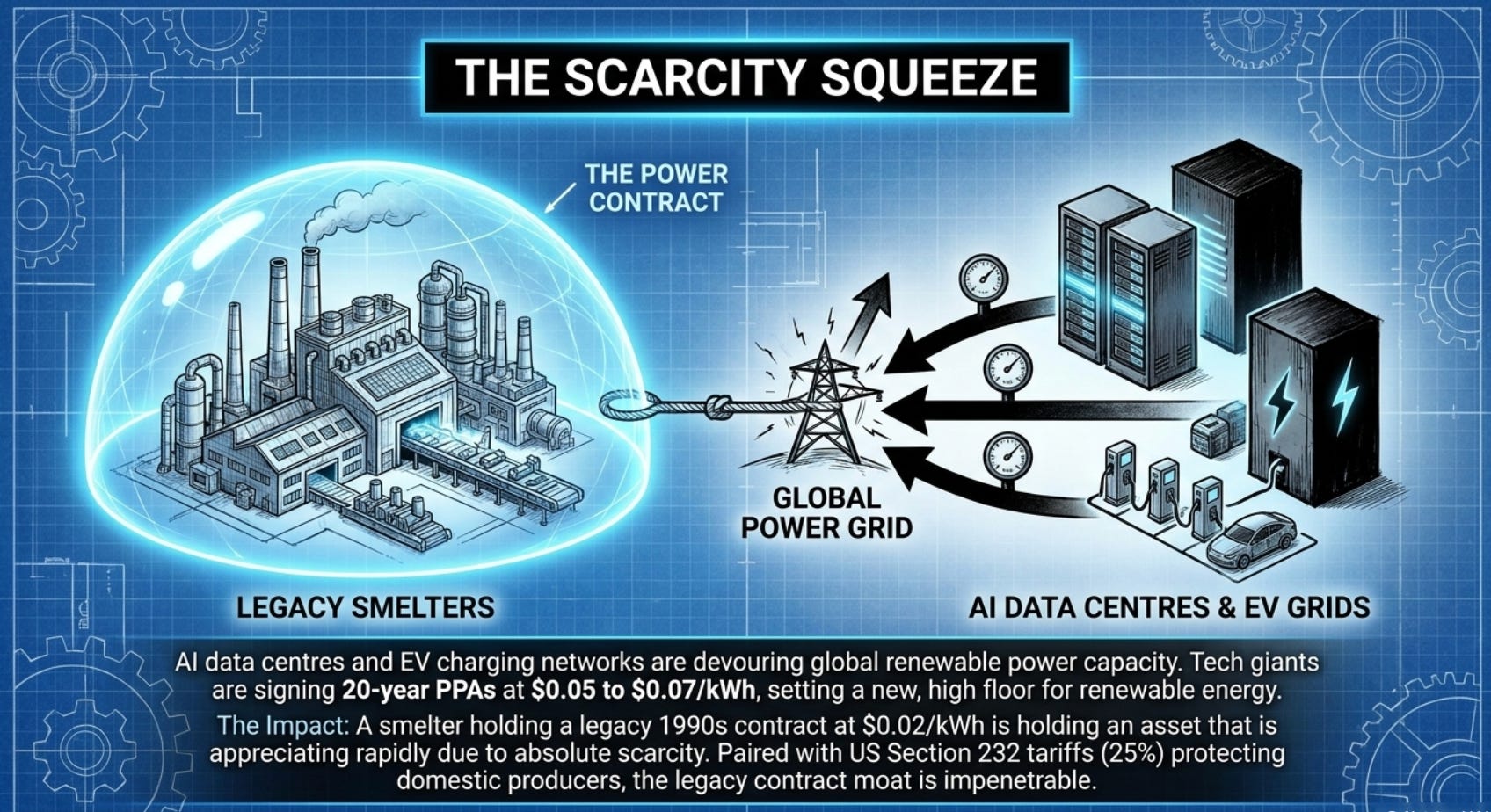
A counterintuitive consequence of the AI data centre boom and EV charging infrastructure build-out is that they are consuming massive quantities of electricity — at market rates — that is tightening electricity availability for new industrial users across the US and Europe. Data centres are signing long-term power purchase agreements, locking in renewable electricity supply for 10 to 20 years at prices competitive with what new aluminium smelters would need. This is directly reducing the availability of cheap renewable power for hypothetical new smelter construction.
The effect is to make existing legacy power contracts — signed before the data centre boom when renewable electricity was available at lower prices — even more valuable relative to what a new entrant would face. The moat around existing power-advantaged smelters is widening, not narrowing, as data centres and EV infrastructure compete for the same renewable electricity supply. A power contract signed in 1998 or 2003 at $0.02 to $0.03/kWh, with 10 to 15 years remaining, is more precious today than it was five years ago — because the renewable electricity it locks in is now being bid for by data centre operators willing to pay $0.05 to $0.07/kWh. The existing contract holder owns something that cannot be replicated at anything close to the contracted price.
CONCLUSION: THE WOMAN WHO SAW THE PHYSICS FIRST
The executive who quietly made her money in aluminium and then moved on to biopharma is not particularly famous. She did not write a book about it. She does not appear on conference panels discussing energy transition investment. She saw something simple and acted on it — which, in the history of industrial investing, is usually the entire story.
What she saw was that aluminium is an energy business masquerading as a metal business. The kilowatt-hours that flow into the potrooms are transformed into metal ingots through a process that has not fundamentally changed since 1886. The margin on each ingot is determined almost entirely by the price paid for those kilowatt-hours. And the price paid for those kilowatt-hours is determined by contracts and geography — locked-in agreements with power generators, located near hydroelectric dams or geothermal fields or wind farms — that the balance sheet does not record, that the earnings model does not isolate, and that the sector P/E multiple treats as no different from any other cost input.
The company she identified — the one that went to the moon because it pivoted to wind power for its aluminium production — did not go to the moon because of its management team or its customer relationships or its revenue growth. It went to the moon because it secured an electricity cost structure that made it one of the most profitable smelters per tonne on earth, from assets that its balance sheet valued at depreciated historical cost.
The owner who asks the right question — what do you pay per kilowatt-hour, for how many years, and how much aluminium does that produce at today’s price? — bypasses the earnings model entirely. They are calculating the value of the power contract embedded in the smelter, and comparing it to the enterprise value the market is assigning. When those two numbers diverge significantly — which they do, cyclically and structurally, at every point in the aluminium price cycle when the earnings model generates pessimism — the owner has an opportunity that the earnings model’s user cannot see.
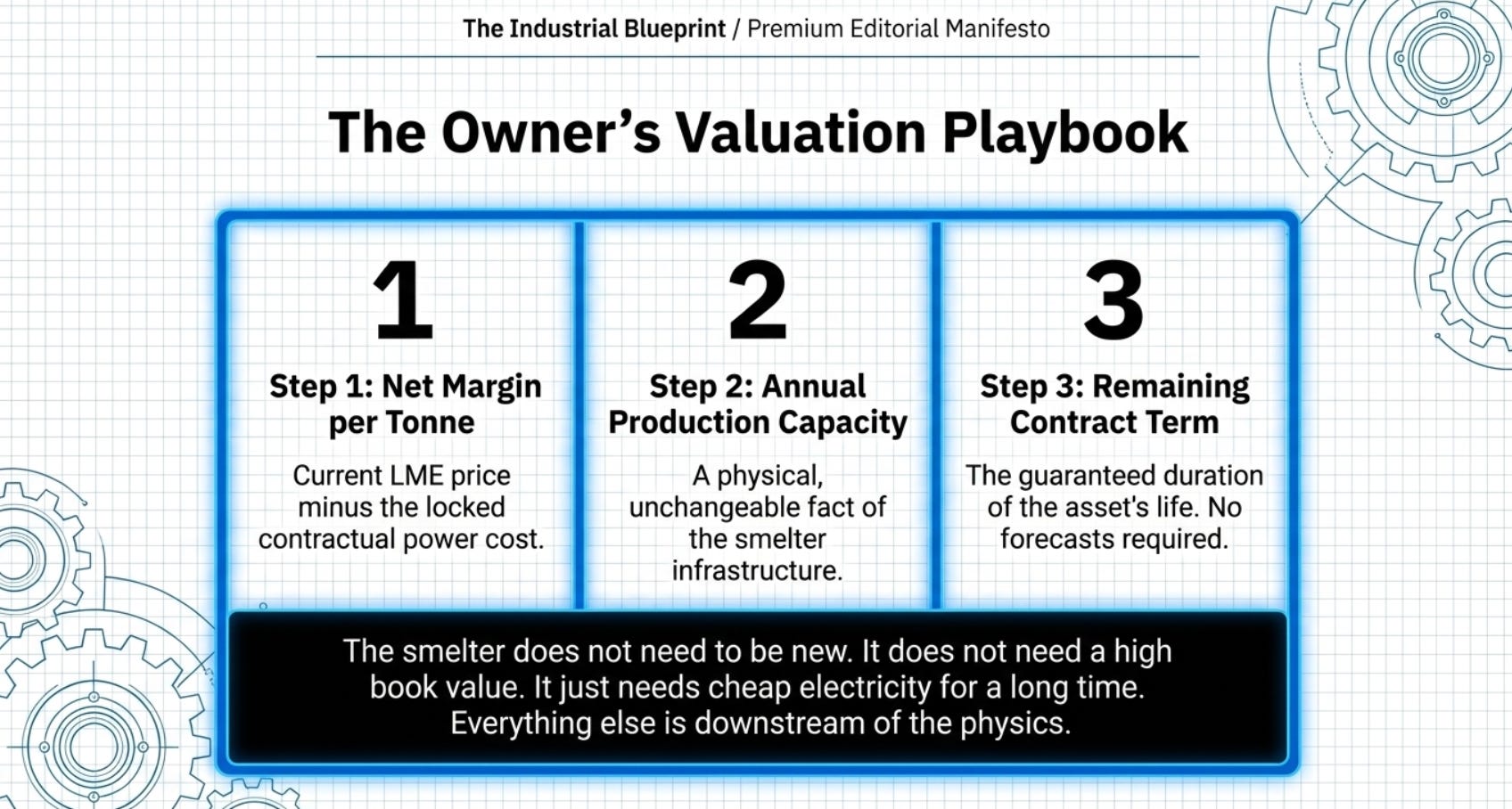
The smelter does not need to be new to be valuable. It does not need a high book value. It does not need to show high earnings this quarter. It needs one thing: cheap electricity for a long time. Everything else follows from the physics.
This white paper is for educational and informational purposes only. All financial figures cited are drawn from publicly available sources including Century Aluminum’s Form 10-K filings as filed with the SEC, RUSAL’s Hong Kong Stock Exchange disclosures and corporate history materials, Landsvirkjun and Askja Energy reporting on Iceland’s aluminium power contracts, and industry publications as cited throughout. Nothing herein constitutes investment advice.
If you like this read, check out my other writings 👇
Rust, Rigs, and the Recurring Revenue Hidden in Plain Sight: A Deep Dive into Beng Kuang Marine (SGX: BEZ)

The Old Steel and the Sea: Why You Should Care About a Ship Maintenance Company
Investment Reflection #2 — The Grand Play: 100 Years of the World’s Nations as Characters in the Greatest Story Ever Told

“The world is not a chessboard. It is a living organism, where every cell — every nation — eats, competes, cooperates, and occasionally tries to eat the others. Understanding it requires not just memorizing moves, but understanding hunger.”

The Tide Is Going Out: Commodity Houses, Private Credit, and the AI Debt Bomb

Start Here: What This Article Is About
Why I Passed on Graftech (EAF): Riding The Battery Hype, Or Perhaps Not...

There is a kind of company that is the most dangerous thing in investing. It is not the fraudulent company. It is not the obviously bad company with terrible products and incompetent management. Those are easy — you just avoid them. The truly dangerous company is the one with a
The Beautiful Trap: Why I'm Passing on The Hour Glass (SGX: AGS)

There’s a peculiar kind of investment that keeps you up at night — not because it’s bad, but because it’s genuinely good. Good enough to admire. Not good enough to buy.
The Diamond in the Rough That Isn't Quite Yours: Why I Passed on Boustead (SGX: F9D)

There is an old saying that investors have borrowed, bent, and quoted so many times it has nearly lost its sharpness: a bird in the hand is worth two in the bush. Warren Buffett, characteristically, gave it a precise mathematical form. The value of any investment, he wrote, is determined by three questions:
The Schoolteacher's Secret Insurer: Why Horace Mann (NYSE:HMN) Is Sitting on My Watchlist

“The stock market is a device for transferring money from the impatient to the patient.” — Warren Buffett

The Dormitory King That Couldn't Leave Home: Why I Passed on Centurion (SGX: OU8)

There is a deceptively simple question that Warren Buffett borrowed from Aesop’s ancient fable, and has repeated across decades of shareholder letters: “How many birds are in the bush? How sure are you they’re there? And how long until you get them out?”
The Children's Place: A $90 Million Bet on a Company That Used to Be Worth $2 Billion (NYSE: PLCE)

There is a classic scene in every heist movie. The detective walks into a room, sees the chalk outline, the scattered evidence, the broken window, and immediately knows something went terribly wrong long before anyone called the police. You do not need the full autopsy report to read the body.
World War 3 In Iran and Why Oil Price Will Continue Increasing — It Arrived Sooner Than Anyone Expected

This is Part 2 of a continuing analysis of California Resources Corp (CRC). Part 1 built the foundational investment case: a company trading at $44 per share against a conservative intrinsic value of $108–$156, built on 567 million barrels of proved developed oil reserves in California, and a management team spending hundreds of millions buying back its…
The Most Overlooked Oil Company in America — And Why That Might Be the Opportunity of the Decade

Date of analysis: 28 December 2025
The Art Of Saying No - MYPS: Playstudios Inc

PLAYSTUDIOS (MYPS) is a Las Vegas-based mobile gaming company that operates free-to-play social casino games and a loyalty platform called playAWARDS, which lets players redeem points for real-world rewards at places like MGM Resorts, Norwegian Cruise Line, and Wolfgang Puck restaurants. On the surface, this sounds like a clever moat. A loyalty program.…
The Art Of Saying No - UGP: Ultrapar Participacoes S.A (Part 2 of 2)

Question 2: How Certain Are You?
The Art Of Saying No - GLIBK: GCI Liberty Inc

Picture this: a single telecommunications company — the dominant one — serves over 200 communities scattered across the largest state in the United States. Alaska. A state with just over one person per square mile. A state where 39% of residents are underserved by broadband. A state where, until recently, some villages received internet via satellite li…

The Art Of Saying No - UGP: Ultrapar Participacoes S.A (Part 1 of 2)

The Setup: A Value Investor Dream?


The Art of Saying No - RIG: Transocean LTD

“The difference between successful people and really successful people is that really successful people say no to almost everything.” — Warren Buffett
The Art of Saying No - KPRX: Kiora Pharmaceuticals Inc

“The difference between successful people and really successful people is that really successful people say no to almost everything.” — Warren Buffett
The Art of Saying No - DNUT: Krispy Kreme Inc

“The difference between successful people and really successful people is that really successful people say no to almost everything.” — Warren Buffett

🎓 A Business Strategy Primer Part 7 - Learning From Great Companies

The Billion-Dollar Playbook: How Market-Based Management Powered Koch Industries’ Unstoppable Rise
The Art of Saying No - MRX: Marex Group PLC

“The difference between successful people and really successful people is that really successful people say no to almost everything.” — Warren Buffett


The Art of Saying No - SFIX: Stitch Fix Inc

“The difference between successful people and really successful people is that really successful people say no to almost everything.” — Warren Buffett
🎓 A Business Strategy Primer Part 2 - Brainstorming Solutions With Value At The Core

Creating An Irresistible Offer
The Art of Saying No - TDOC: Teladoc Health Inc

“The difference between successful people and really successful people is that really successful people say no to almost everything.” — Warren Buffett

The Art of Saying No - MDU: Mdu Resources Group Inc

“The difference between successful people and really successful people is that really successful people say no to almost everything.” — Warren Buffett


The Art of Saying No - AFCG: Advanced Flower Capital Inc

“The difference between successful people and really successful people is that really successful people say no to almost everything.” — Warren Buffett
The Art Of Saying No - VYX: NCR Voyix Corp

“The difference between successful people and really successful people is that really successful people say no to almost everything.” — Warren Buffett
The Art of Saying No - VSTS: Vestis Corp

“The difference between successful people and really successful people is that really successful people say no to almost everything.” — Warren Buffett

🛢️Basic Energy Primer Part 2 - Business and Competitive Landscape

The Man Who Bet Everything on Being Wrong
The Art of Saying No - CISS: C3is Inc

“The difference between successful people and really successful people is that really successful people say no to almost everything.” — Warren Buffett
The Art of Saying No - PSHG: Performance Shipping Inc

“The difference between successful people and really successful people is that really successful people say no to almost everything.” — Warren Buffett

The Art Of Saying No - MAGN: Magnera Corp

The Magnera Corporation Analysis Nobody Asked For (But Everyone Needs)
The Art of Saying No - CHR: Cheer Holding Inc

“The difference between successful people and really successful people is that really successful people say no to almost everything.” — Warren Buffett
The Art of Saying No - WIMI: WiMi Hologram Cloud Inc.

“The difference between successful people and really successful people is that really successful people say no to almost everything.” — Warren Buffett
⚡️Alternative Energy Primer Part 3 - Industry and Sector Technicals

The €2.2 Billion Mistake That Revealed Everything
⚡️Alternative Energy Primer Part 2 - Business & Competitive Landscape

The Shipwreck That Changed Everything

🏥 A U.S. Health Insurance (Managed Care Organizations) Sector Primer

1️⃣ Industry Fundamentals & Macro View

