
Date of analysis: 28 December 2025
There is a peculiar kind of investing opportunity that almost nobody talks about, because almost nobody is looking. It does not show up on CNBC. No hedge fund manager is pounding the table on it. In fact, the very forces that make it attractive are the same forces that guarantee most investors will never see it — until it is far too late.
It starts with a simple, boring screening exercise: find companies trading below their intrinsic worth. And tucked inside that screen, almost by accident, was a company called Berry Petroleum (BRY) — a mid-size California oil producer that looked suspiciously cheap. Cheap enough to make you stop scrolling. But then something more interesting happened: Berry was being acquired by an even more interesting company.
California Resources Corporation (NYSE: CRC).
And that company — the one doing the acquiring — turned out to be the real story.
Part I: The Thread You Follow
Charlie Munger once said that great opportunities are rarely found by looking directly for them. You stumble onto them by following threads. You pull one string, and it leads to another, and then another, until suddenly you are standing in front of something remarkable that the crowd has completely missed.
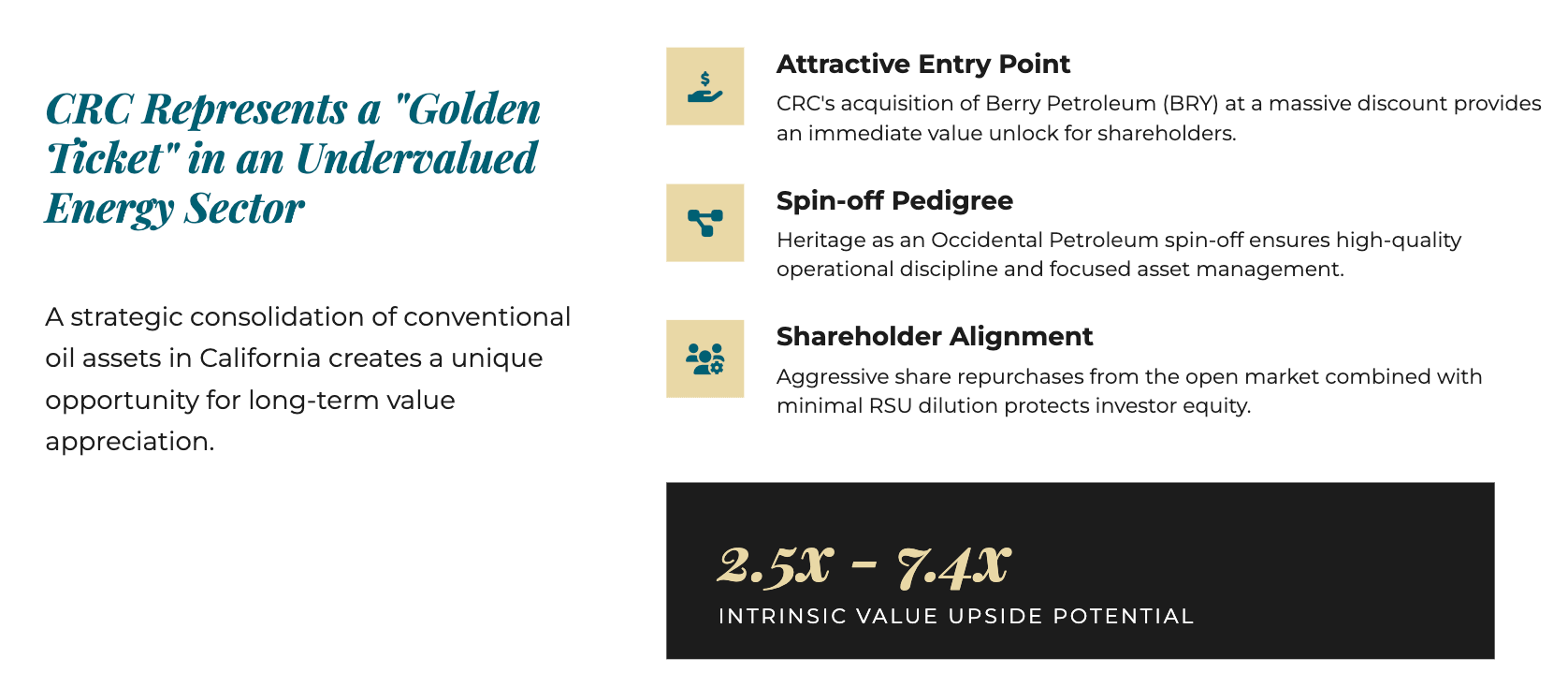
The thread here goes like this: Berry Petroleum shows up cheap on a screen. But the entity acquiring Berry — California Resources Corp — is purchasing it at what appears to be a massive discount to net book value. CRC is paying roughly $253 million in stock for a company whose shareholders’ equity stood near $730 million. That is buying dollars for less than thirty-five cents. In any business, when a company voluntarily acquires an asset at a fraction of its stated book value, you want to understand the entity doing the buying.
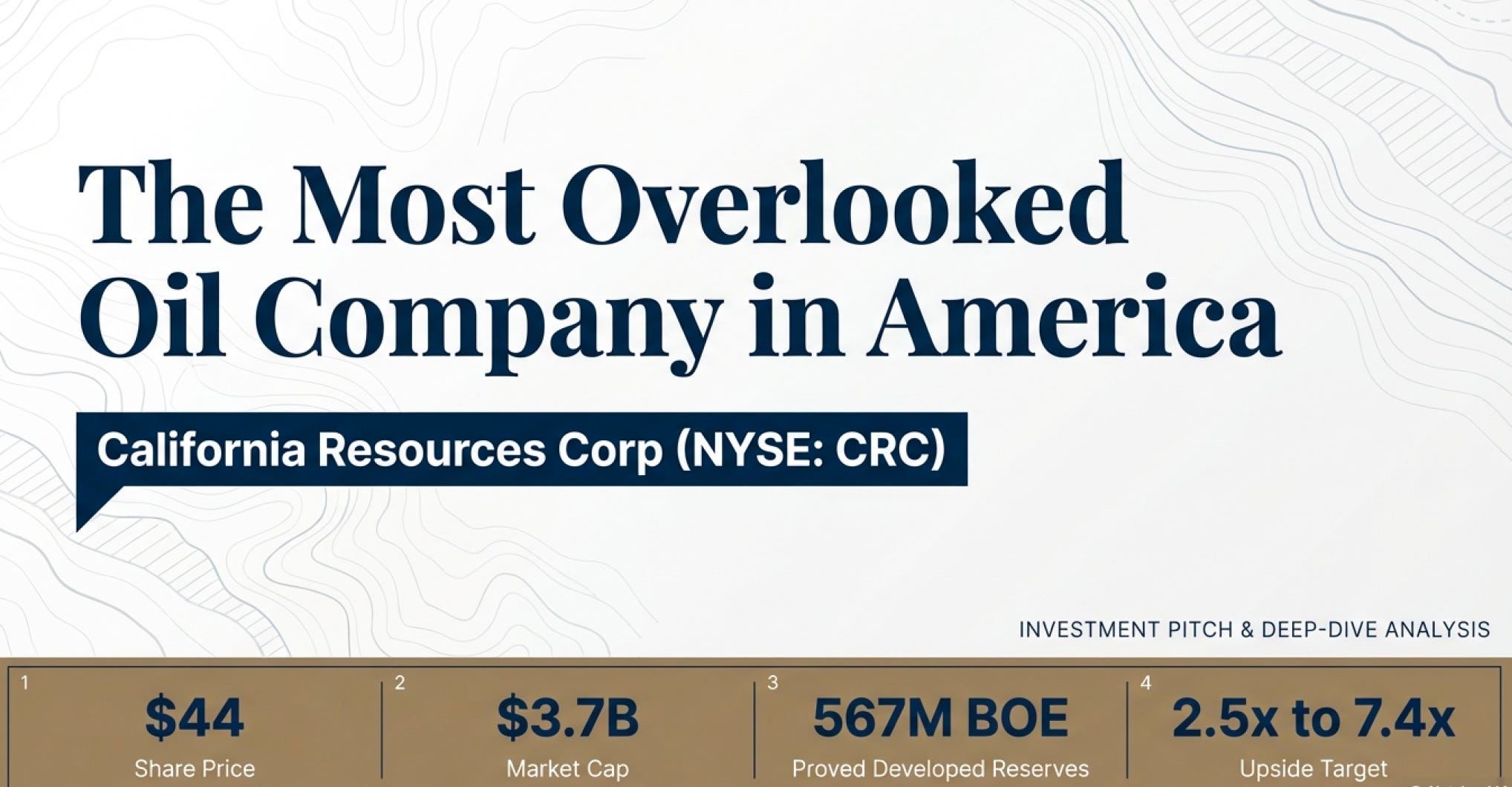
So you look at CRC itself. And what you find is a company that, at its recent price of roughly $44 per share, is priced as if its best days are permanently behind it.
They are not. In fact, the thesis here is that CRC’s best days have not even begun yet.
Part II: What CRC Actually Is — Stripping Away the Noise
California Resources Corporation is a spinoff from Occidental Petroleum, separated in 2014. That provenance matters more than it might seem. Occidental is one of the most operationally rigorous oil companies in the world, and CRC inherited its DNA: a focus on conventional, mature California oil fields with long-lived, low-decline production. These are not the flashy shale wells of the Permian Basin that require constant drilling just to stay flat. These are old-school, gravity-fed conventional reservoirs that produce steadily for decades.
The geography is critical. CRC operates primarily in three California basins — the San Joaquin Valley, the Los Angeles Basin, and the Ventura Basin. As of their most recent filings, CRC is now the largest oil operator in California, a title they cemented first through the acquisition of Aera Energy in 2024, and then through the closing of the Berry merger in December 2025.
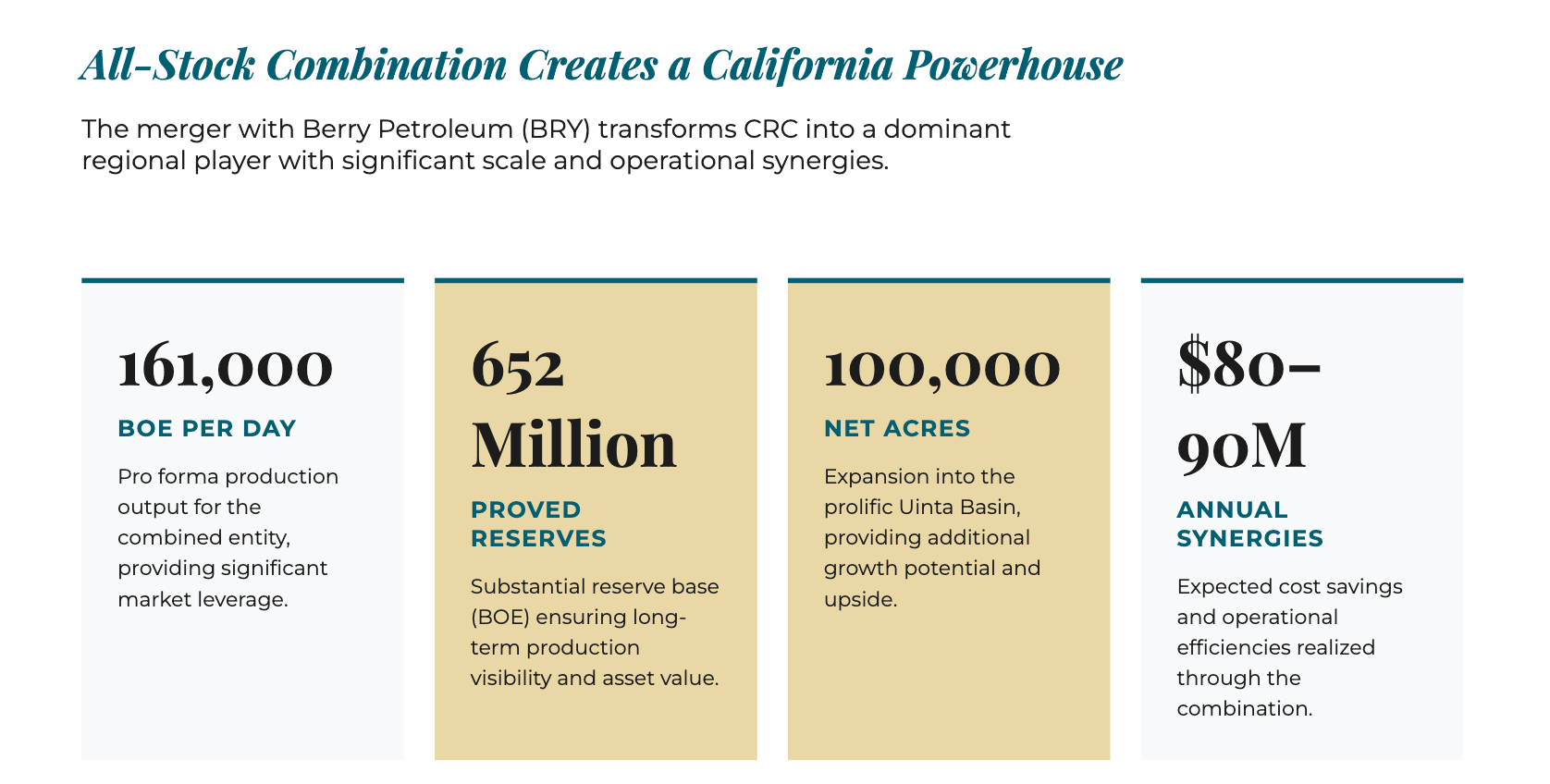
Here is the picture of CRC today, post-Berry merger: the combined company holds approximately 654 million barrels of oil equivalent (BOE) in proved reserves, produces around 138,000 barrels of oil equivalent per day, and is targeting roughly 152,000-157,000 BOE per day for full-year 2026 — representing approximately 12% year-over-year production growth, averaging 152–157 MBoe/d, with approximately 81% oil.
The revenue picture is equally concentrated and clean: in 2024, oil, natural gas, and NGL sales totalled $2.537 billion, with oil making up roughly 79-81% of total production. This is, at its core, an oil business. So let us understand the oil business it is actually in.
Part III: The Peculiar Advantage of Being the Ugly Duckling
To understand why CRC is misunderstood, you need to understand the mental model most investors apply to oil companies. When you say “oil producer,” most people immediately think of horizontal fracking — the shale revolution that transformed American energy. The Permian Basin. The Bakken. The Eagle Ford. Fast wells, high production rates, quick decline curves, requiring constant reinvestment just to maintain output. These are the darlings of the energy analyst community.
California Resources is none of that.
CRC’s fields are conventional, meaning the oil flows through natural pressure or gravity rather than being fractured out of rock. This distinction, while seemingly technical, has enormous financial consequences.
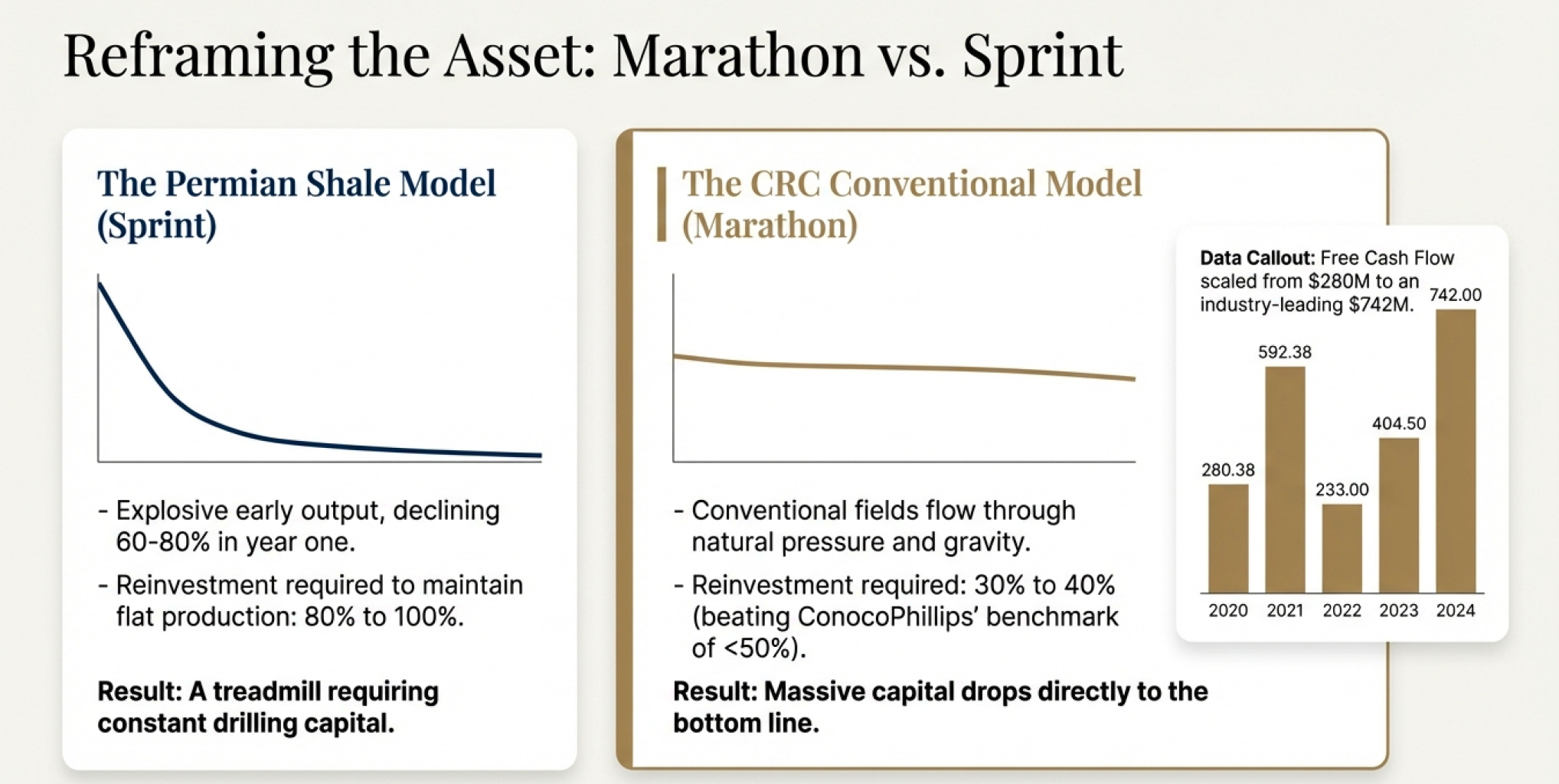
Think of it this way. A shale well in the Permian is like a sprinter — explosive output early, then it declines 60-80% in the first year alone. You need to keep running just to stand still. An operator like Pioneer Natural Resources or Devon Energy is essentially on a treadmill: drill aggressively or production collapses. The reinvestment rate — the percentage of cash flow that must go back into the ground just to maintain current output — runs anywhere from 80% to 100% for shale producers.
A conventional field is more like a marathon runner — slower, steadier, and extraordinarily efficient. For conventional producers like CRC, the reinvestment rate to maintain production sits at roughly 30-40%. This means more free cash flow drops through to shareholders from every barrel produced. ConocoPhillips, the best-in-class operator globally, has managed to achieve a reinvestment rate below 50% — and CRC’s conventional model structurally beats that benchmark.
The numbers bear this out. CRC’s annual free cash flow has been consistently growing: $280 million in 2020, rising to $592 million in 2021, and then reaching a peak of $742 million in 2024 — the highest in four years. This is not a company consuming its reserves; it is a company efficiently extracting cash from assets it has already paid to acquire.
Part IV: The Competitor Matrix — Where CRC Stands
Context is everything in investing. A company’s value only becomes clear when placed against its peers. So let us do exactly that.
Here is how CRC compares against five comparable American oil producers across the metrics that actually matter:
Chord Energy (CHRD) — Williston Basin shale in North Dakota — produces at a total cost of $15.8-$18.4 per barrel, trades at 0.72x book value, and holds 352 million BOE in proved developed reserves. The Bakken is efficient shale country, but it is still shale: high decline rates, high reinvestment demands.
SM Energy (SM) — Permian/Eagle Ford/Uinta — costs about $12.2 per barrel all-in, trades at 0.5x book, and holds 135.7 million BOE. Excellent cost structure, but relatively small reserve base.
Magnolia Oil & Gas (MGY) — Eagle Ford — runs at $14 per barrel, trades at 2.5x book, holding 63 million BOE. Expensive on a book basis for the reserve size.
Matador Resources (MTDR) — Delaware Basin, best-cost shale in the U.S. — runs at about $15.7 per barrel, trades at 1.08x book, 210 million BOE. Strong operator with midstream upside, but carries heavier shale reinvestment requirements.
Murphy Oil (MUR) — U.S. and international — runs at $17.2 per barrel, trades at 0.9x book, 184.7 million BOE.
And then there is California Resources Corp: production cost of $23-26 per barrel (yes, higher), trading at 1.3x book... but holding 567 million BOE in proved developed reserves — the highest of any company on this list, by a substantial margin.
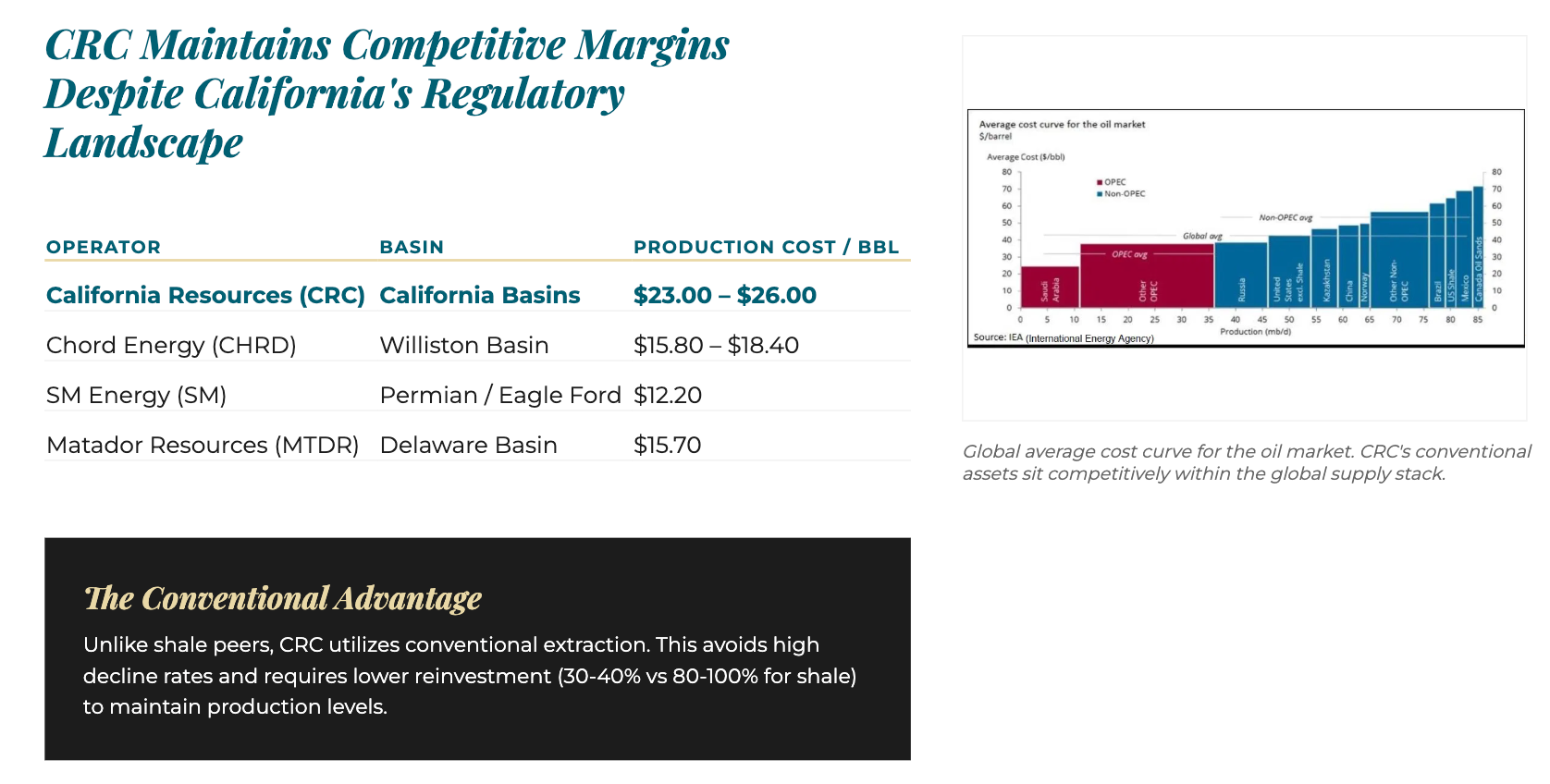
The production cost differential is real and deserves honest engagement. CRC’s California fields are mature. They use older, more expensive extraction methods — in some cases thermal recovery — and face significantly higher California environmental compliance costs than operators in Texas or North Dakota. Fracking, which radically lowers cost in shale plays, is now effectively banned for new permits in California as of October 2024. California is not an oil-friendly regulatory environment.
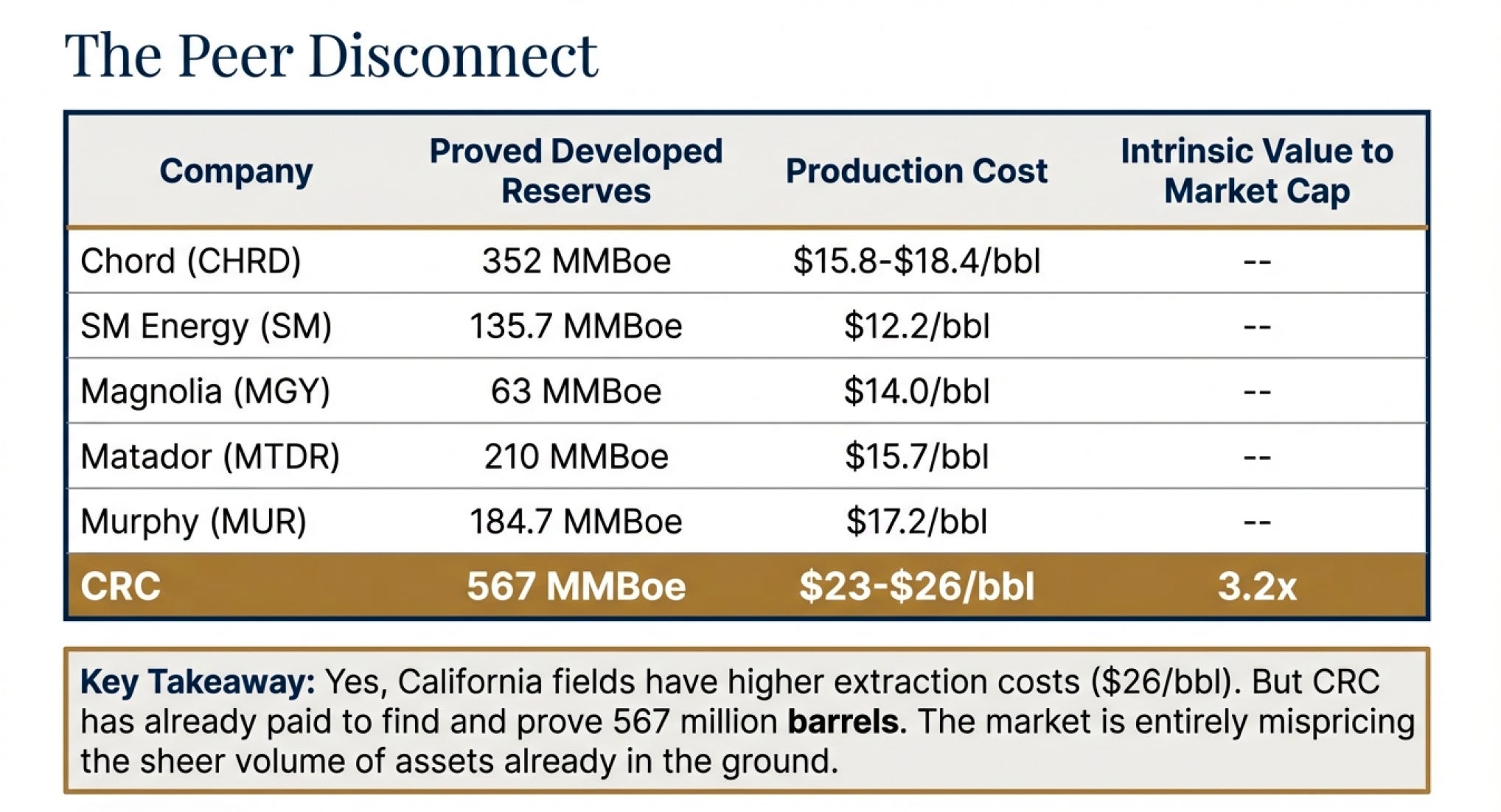
But here is the thing that matters: CRC has already paid to find and prove those 567 million barrels. The hard work — the exploration, the drilling, the proving up of the resource — is done. What remains is the orderly, methodical extraction of value from assets that will produce for decades. And on a net value per barrel basis at a $55 oil price, even after subtracting CRC’s higher production cost of $26 per barrel, you are left with $29 of net value sitting in the ground.
$29 per barrel × 567 million barrels = $16.4 billion in gross reserve value.
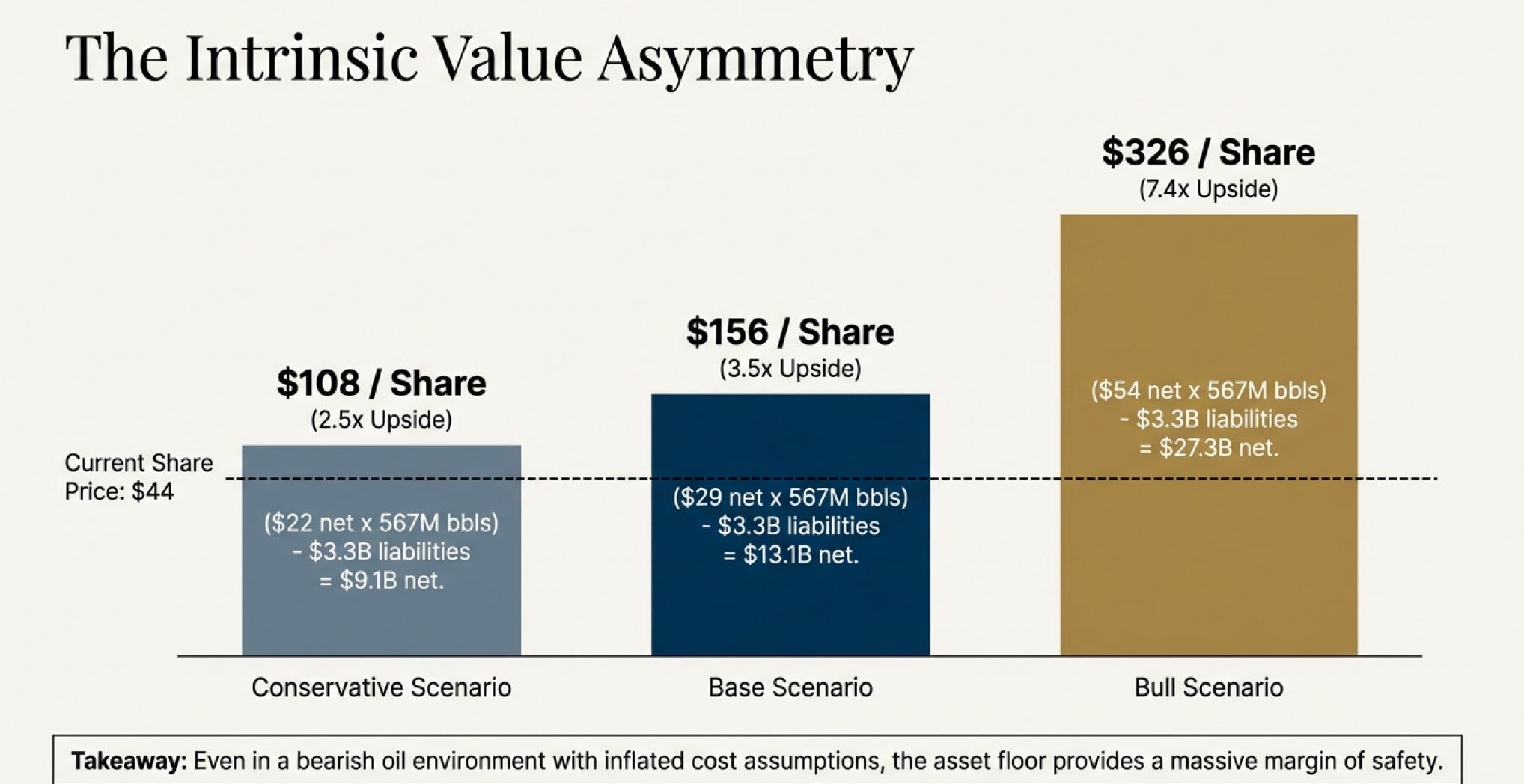
Subtract $3.3 billion in total liabilities. You get $13.1 billion in net intrinsic value, or roughly $156 per share on 83.7 million shares outstanding — against a current price of $44.
This is the birds in the bush.
Part V: The Three Questions Every Honest Investor Must Answer
Charlie Munger and Warren Buffett built their framework around a deceptively simple set of tests for any investment. I have distilled them into three questions that, if any one of them fails, the idea dies. It is not negotiable.
Question One: How many birds are in the bush?
Question Two: How sure are you the birds are actually there?
Question Three: How long until you get them out?
Let us take each in turn with brutal honesty.
Question One: How Many Birds Are in the Bush?
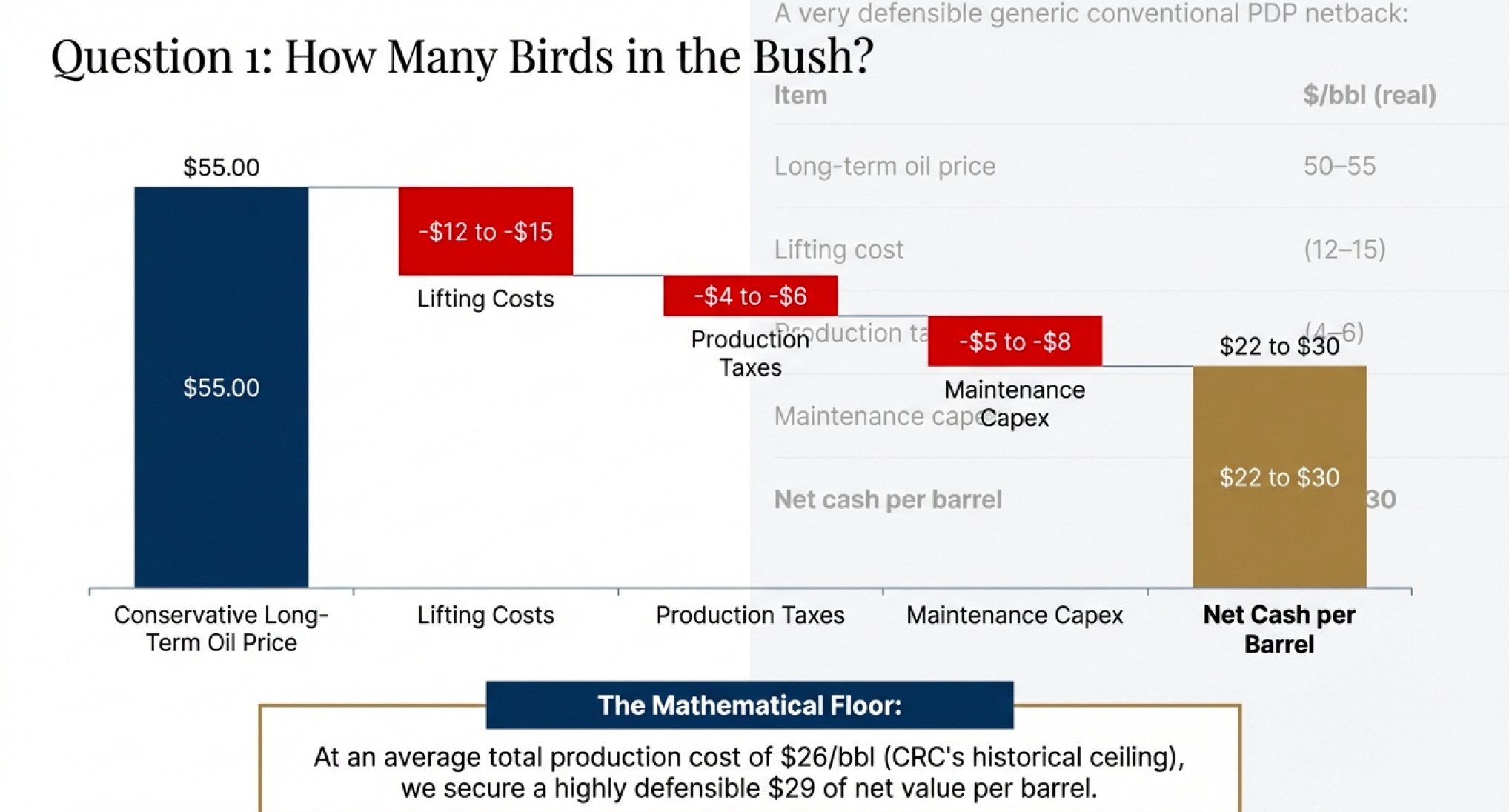
We already built the base case above: $156 per share at $55/barrel oil, representing roughly 3.5x upside from the current price of $44.
But let us stress-test this rather than just celebrate it.
The conservative case: If we assume net value per barrel of only $22 — reflecting higher-than-expected operating costs or a sustained low oil price environment — then: $22 × 567 million barrels = $12.4 billion, minus $3.3 billion in liabilities = $9.1 billion net, or $108.7 per share. That is still 2.5x the current price.
The base case: At $55 oil and $26 cost per barrel, net value of $29/bbl: $156 per share, or 3.5x upside.
The bull case: If oil reverts to its historical average high near $80/barrel — not unprecedented given geopolitical volatility — net value becomes $54/barrel: $54 × 567 million barrels = $30.6 billion, minus $3.3 billion = $27.3 billion, or $326 per share. That is 7.4x from here.
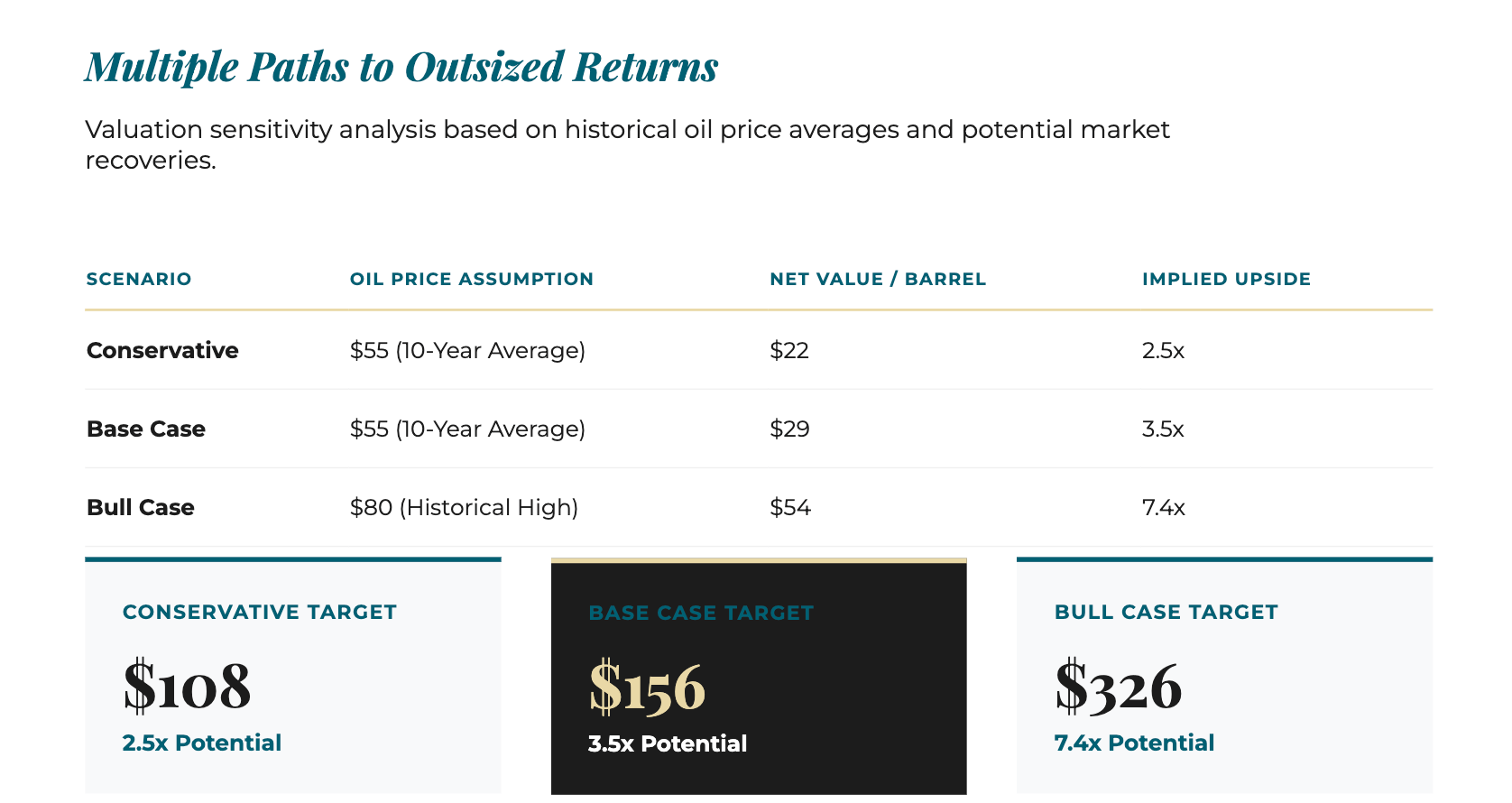
The range of outcomes is $108 to $326, with the conservative floor still representing a more than doubling of the investment.
Now, where does the $22-26 net per barrel come from? This is not a number pulled from thin air. CRC’s own 10-K filing states operating costs after hedges ranging from $23.75 to $25.30 per barrel from 2022 to 2024. A generic conventional PDP netback model — using a long-term oil price of $50-55, subtracting lifting costs of $12-15, production taxes of $4-6, and maintenance capex of $5-8 — yields a net cash per barrel of $22-30. CRC’s proven track record of operating costs further validates this floor.
But we need to go deeper on the proved reserves figure, because this is where the argument either stands or falls.
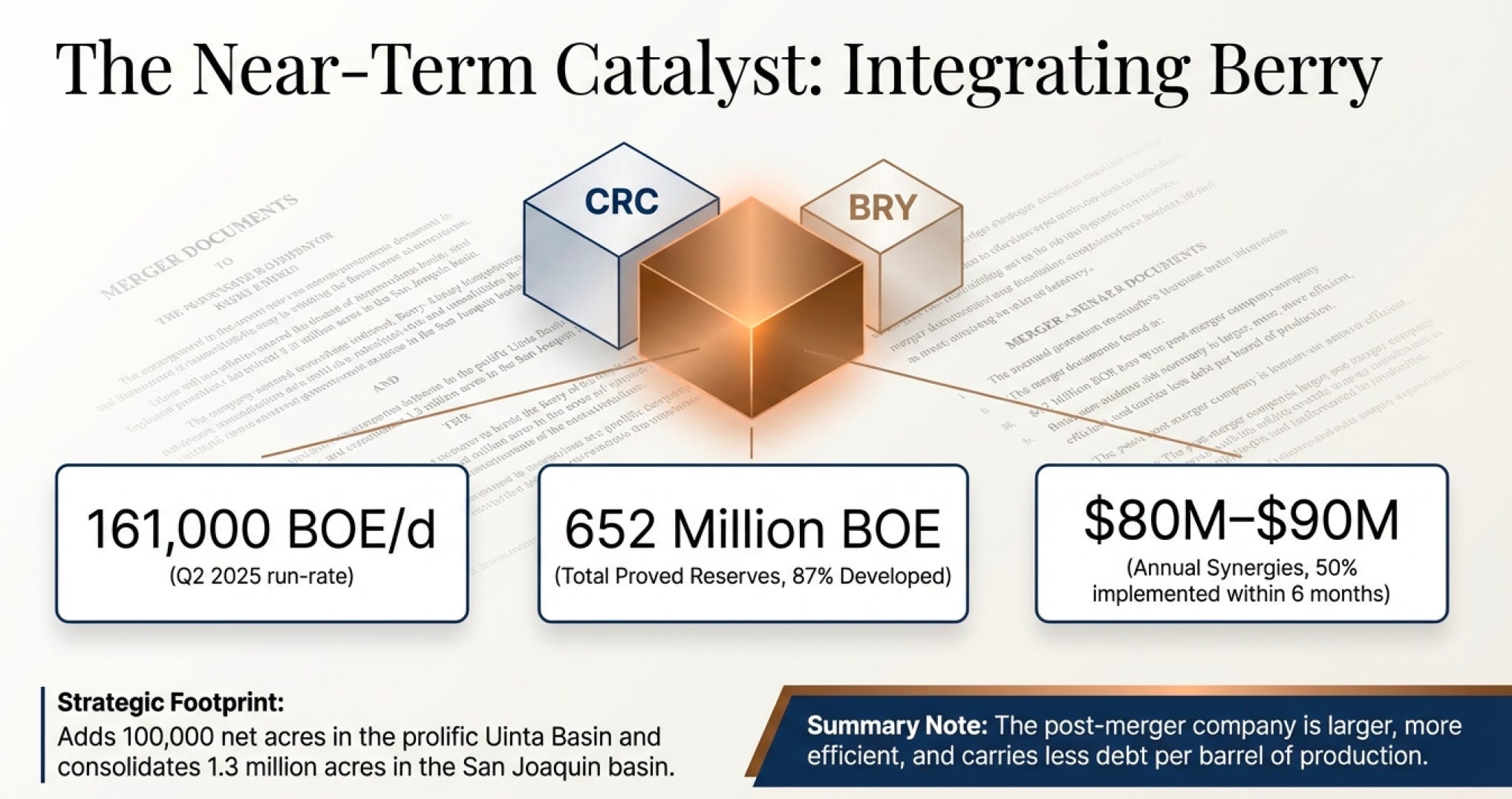
As of year-end 2025, CRC ended 2025 with 654 MMBoe of proved reserves and average production of 138 MBoe/d, generating $80–$90 million annually from the Berry integration. Of those 654 million BOE, approximately 87% is classified as proved developed — meaning already drilled and producing, requiring no new capital to begin recovery. That gives us roughly 567 million barrels of proved developed reserves — assets already in the ground, with the infrastructure already in place to extract them.
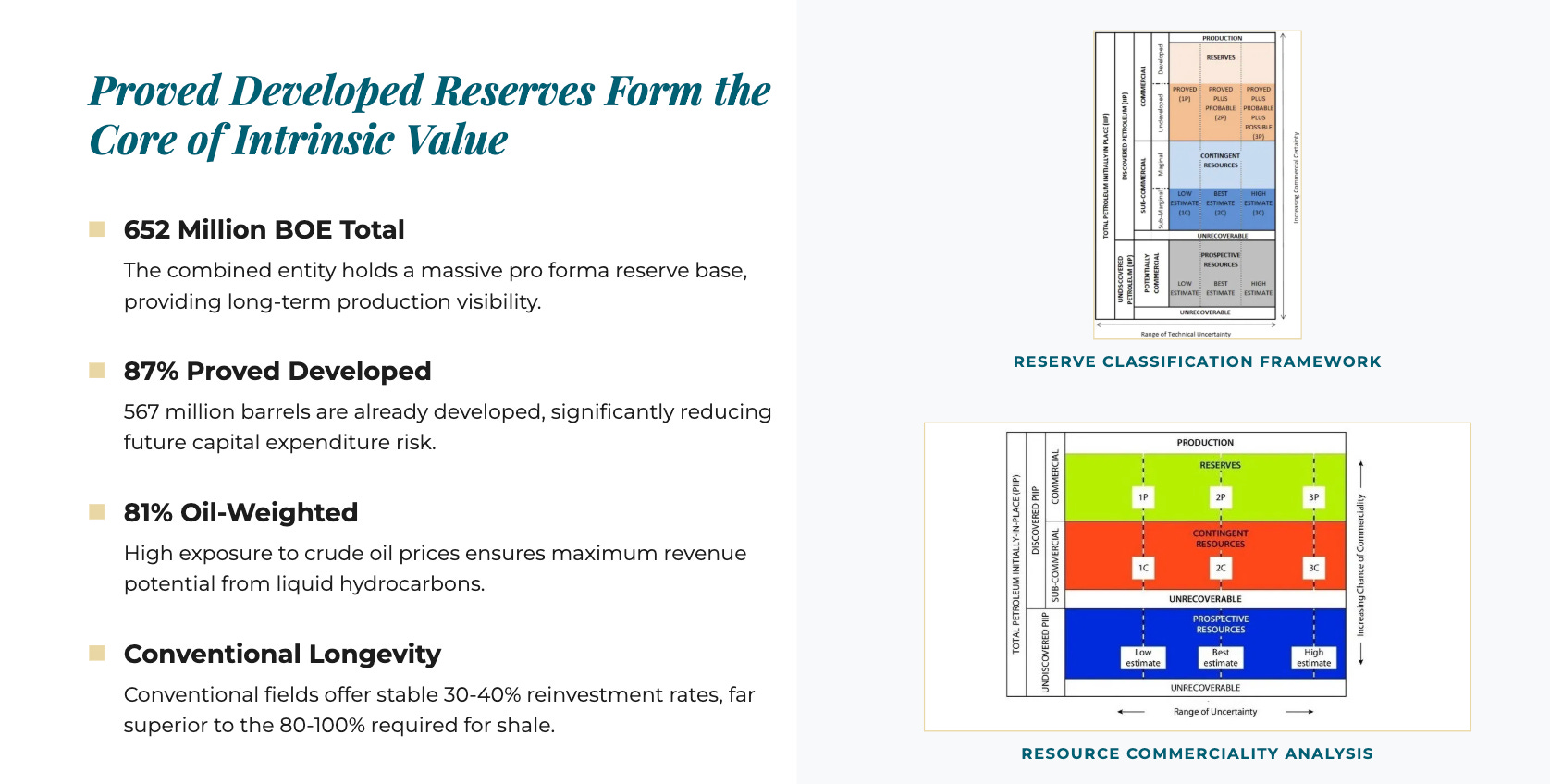
Compare this to the world’s total estimated 1.73 trillion barrels of proven developed oil reserves. CRC holds roughly 0.033% of the world’s entire proved developed reserve base — in a single state, in a company with an $3.7 billion market cap. The reserve base is genuine, verified, and independently audited under SEC standards.
The birds are in the bush. There are a lot of them.
Question Two: How Sure Are You?
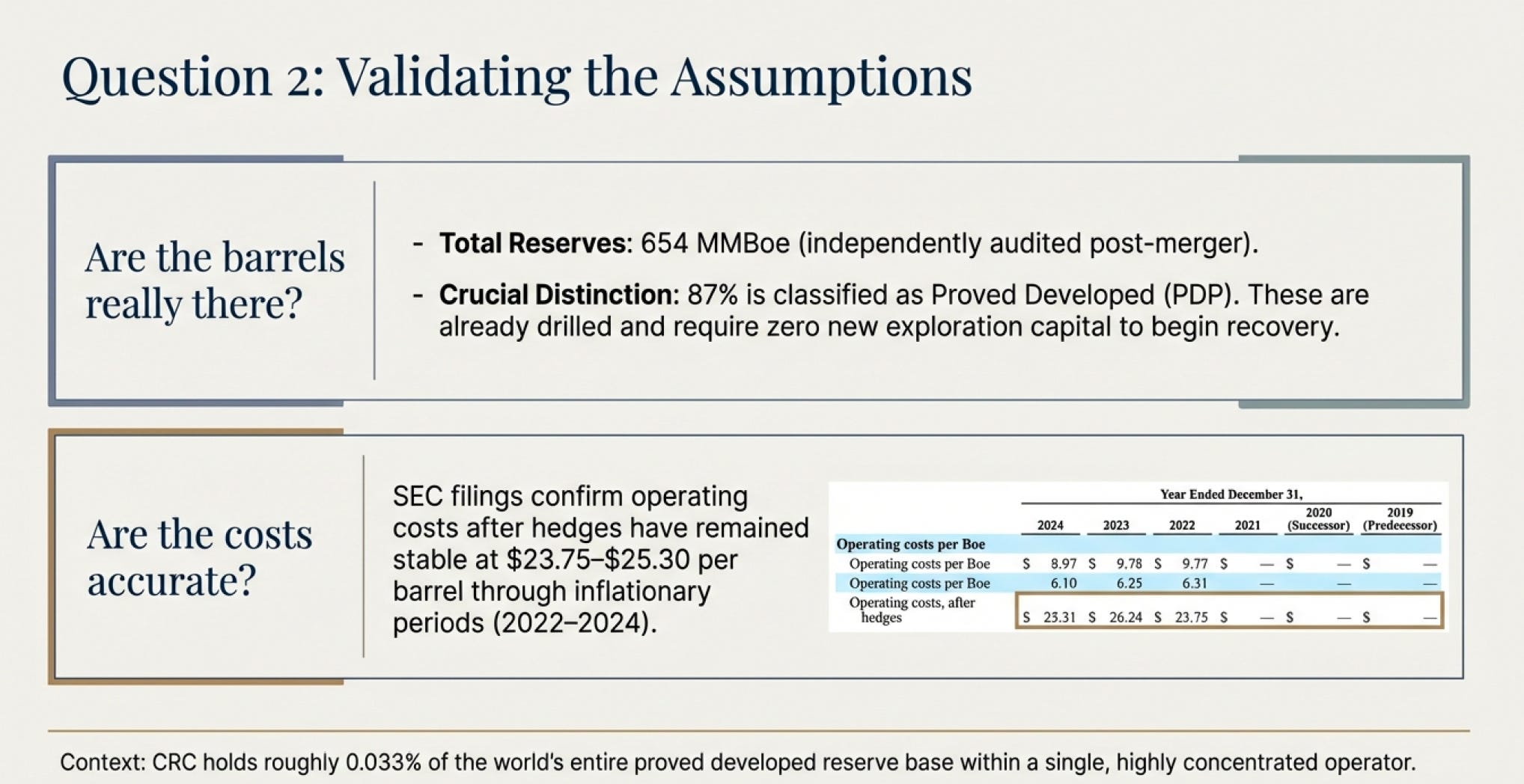
This is where an investor must be most ruthless with themselves. The temptation when building a bull case is to notice only the evidence that confirms the thesis. Let us instead enumerate the serious risks to this investment.
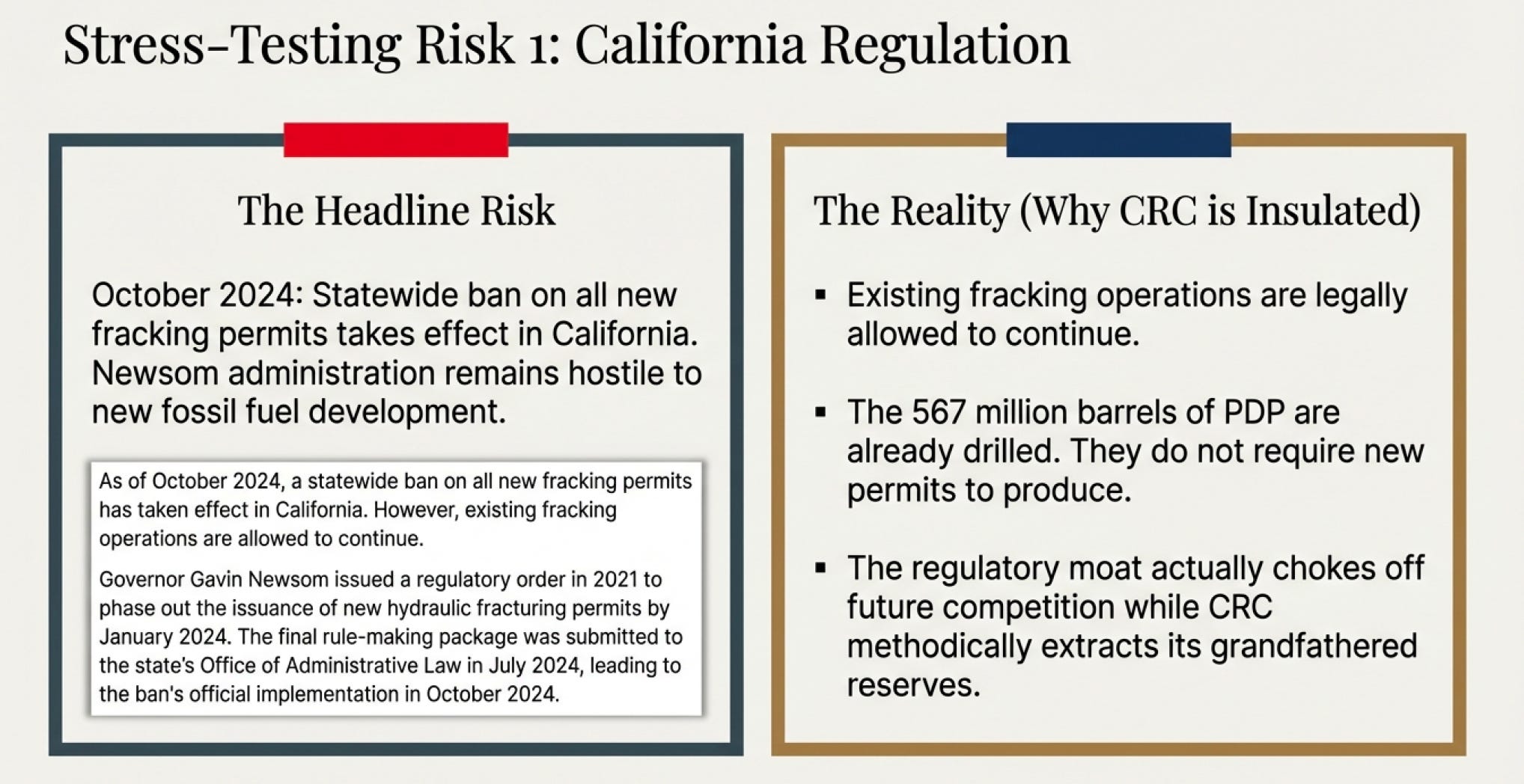
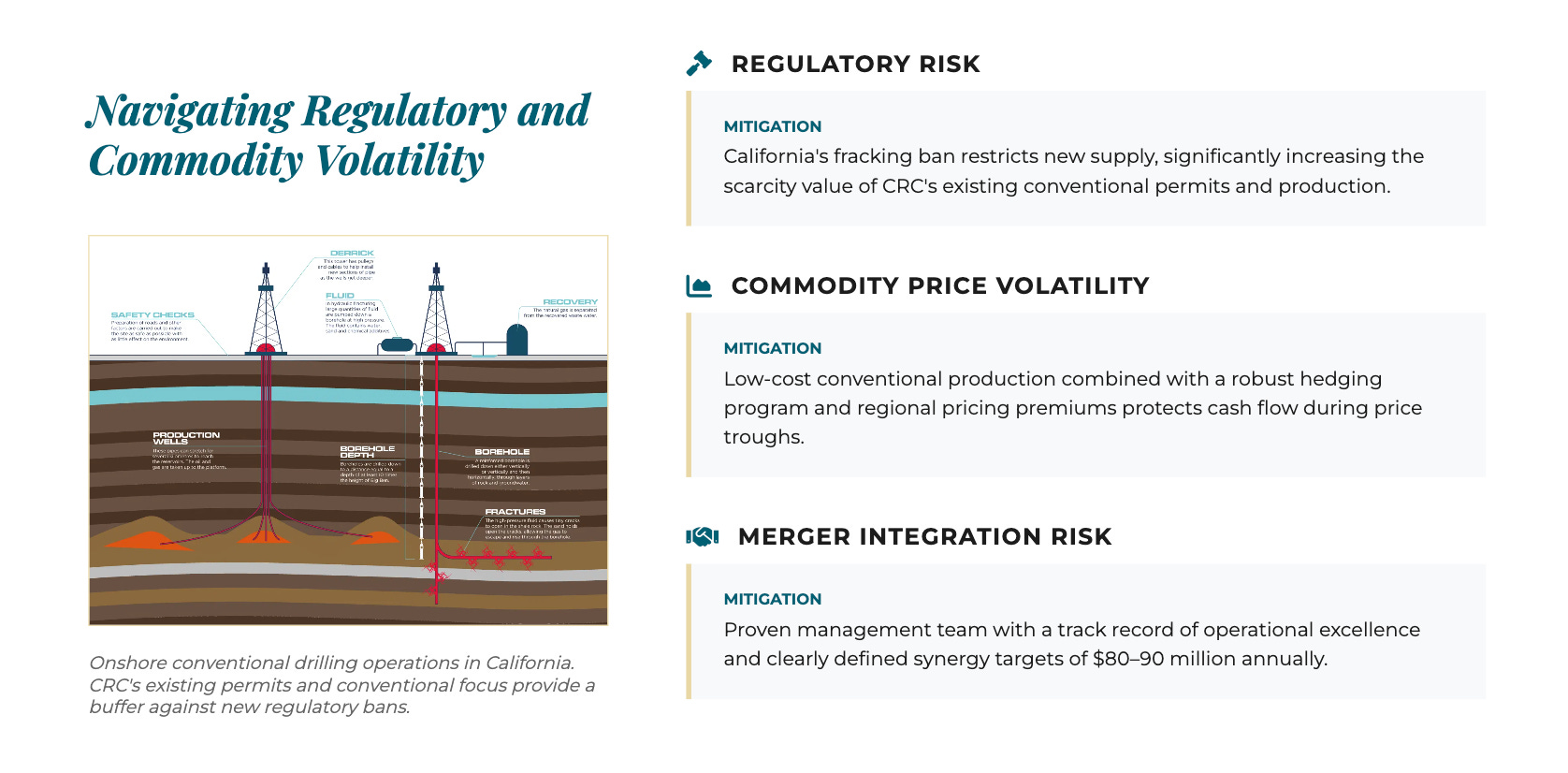
Risk One: California’s regulatory environment. This is real. California has implemented a statewide ban on all new fracking permits, effective October 2024. Governor Newsom’s administration has been consistently hostile to fossil fuel development. This introduces genuine permitting risk for future drilling. However, CRC’s existing fields and existing fracking operations are grandfathered in and allowed to continue. The proved developed reserves — the 567 million barrels we are valuing — are already drilled. They do not require new permits to produce. CRC itself has noted that it expects the resumption of new well permitting in early 2026 to enhance its ability to develop its core Kern County assets.
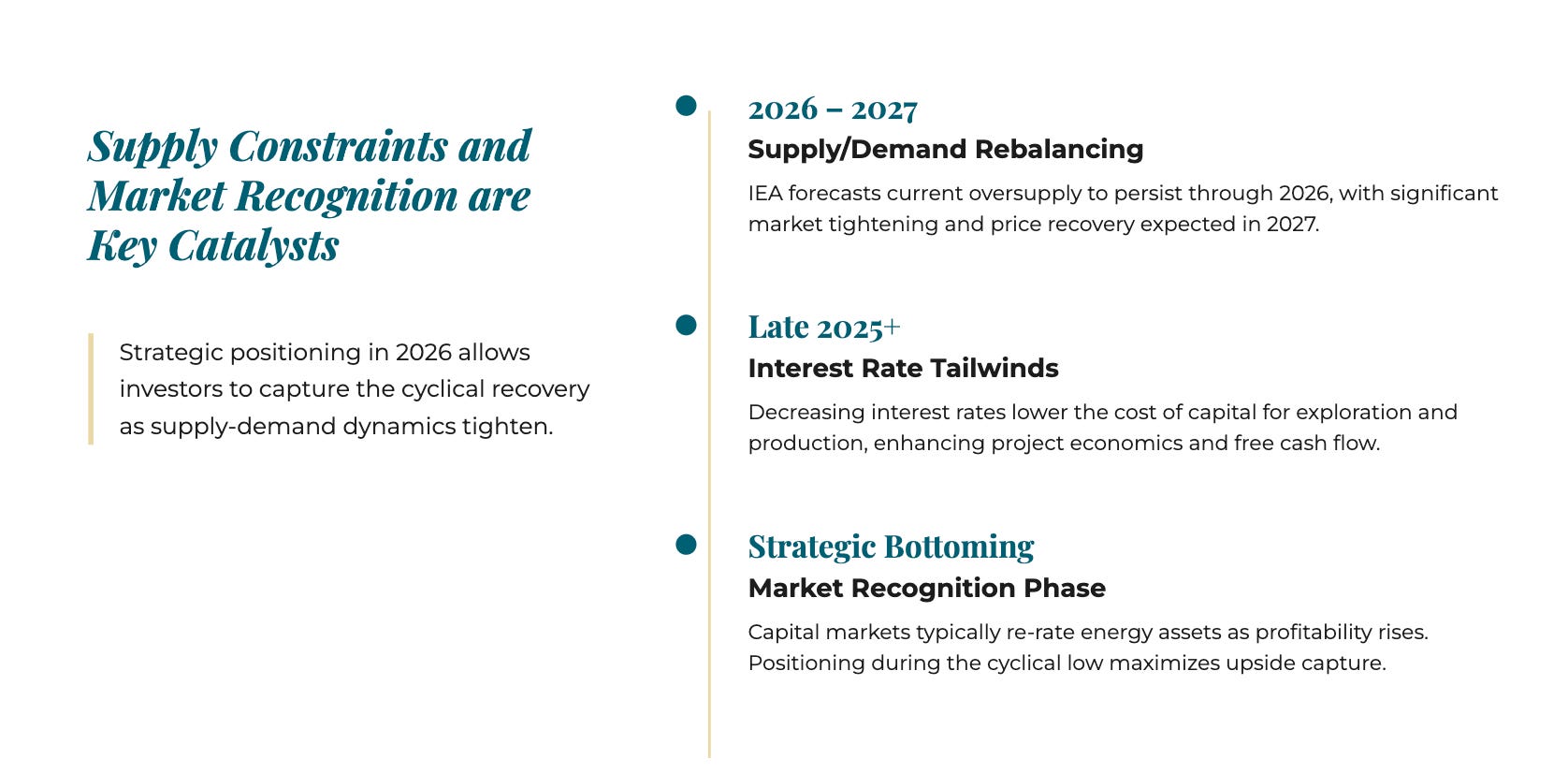
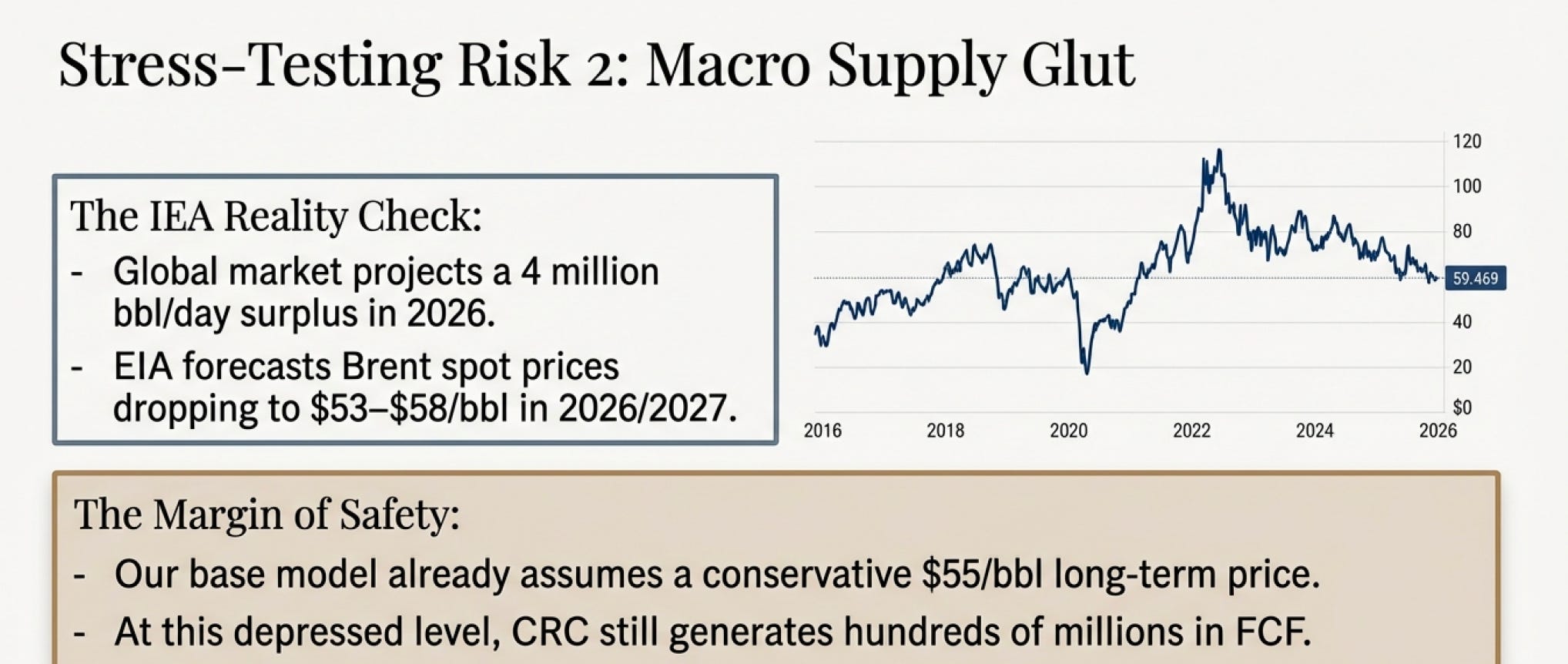
Risk Two: The oil price. This is the dominant variable in the entire thesis, and it is currently working against CRC. The IEA has been unambiguous about what is coming. The global oil market averaged a surplus of 1.9 million barrels per day from January through September 2025, with surging supplies from the Middle East and the Americas pointing to a nearly 4 million barrel-per-day surplus in 2026. The EIA is forecasting Brent spot prices averaging $58 per barrel in 2026 and $53 per barrel in 2027, down from an average of $69 per barrel in 2025. This is not a tailwind. This is a headwind, and it is blowing directly at the thesis.
But step back and look at this through a Buffett lens. The time to buy an oil company is not when oil is at $100 and everyone is euphoric. It is when the surplus is enormous, the headlines are bearish, and the price reflects maximum pessimism. Low oil prices do two things simultaneously: they depress the current earnings (making the stock look cheap on trailing metrics) while also suppressing capital investment industry-wide, sowing the seeds of the next price recovery. You are being paid to wait by a company that, even at $55 oil, generates hundreds of millions in free cash flow annually. That being said, given current supply context in the market, I personally do forsee that oil prices will come collapsing first before a major oil run (in the long-term).
Risk Three: The conventional field decline. CRC’s California basins are mature. Production will decline naturally over time without new drilling. This is why the proved developed reserves calculation — rather than a simple flowing production multiple — is the correct way to value this company. We are buying a finite but enormous reservoir of value, not a perpetual cash machine. The question is whether we are paying the right price for that finite resource. At $44 per share against $108+ in conservative intrinsic value, we are paying well under half a dollar for every dollar of conservative value.
Risk Four: Leverage and integration. Post-closing of the Berry merger, CRC retains a strong balance sheet with an estimated pro forma leverage ratio of less than 1.0x. The debt load is modest. The $80-90 million in annual synergies expected from the Berry integration provide a meaningful buffer. The integration risk is real but manageable for a company with CRC’s operational history.
The conviction check: yes, there are genuine risks here. Oil prices are depressed and trending lower. California is a difficult operating environment. The reserves will eventually deplete. But the margin of safety — buying at $44 against a conservative intrinsic value of $108+ — is large enough to absorb substantial error in the assumptions. As Benjamin Graham taught: the purpose of a margin of safety is precisely to protect you from the mistakes you do not yet know you are making.
Question Three: How Long Until You Get Them Out?
This is the question where patience becomes not just a virtue but a requirement. The honest answer here is: not immediately.
The mechanism by which CRC’s intrinsic value gets recognized by the market is straightforward: oil prices must rise enough that the company’s earnings become obviously attractive relative to its price. That is the signal that brings institutional capital back into the sector. And that signal has not yet sounded.
Falling output saw the global oil market briefly return to equilibrium in December 2025, but bloated inventories and new supply injections continue to steer the world toward a major supply glut in the coming months, with the IEA projecting some 2.5 million barrels per day in global supply growth for 2026. This supply pressure is real. Benchmark Brent crude monthly averages fell from around $79 per barrel early in 2025 to approximately $63 per barrel by December 2025 — the lowest average since early 2021.
The supply glut, however, carries within it the mechanism of its own resolution. When oil prices fall far enough for long enough, several things happen almost inevitably: E&P companies cut capital expenditure, reducing future supply; marginal producers go bankrupt; OPEC+ accelerates production discipline; and demand quietly keeps growing, especially from India and non-OECD Asia. Global liquid fuels production growth is expected to slow from an average of 3.0 million barrels per day in 2025 to just 1.6 million barrels per day in 2026 and 0.9 million barrels per day in 2027. The supply surge is already decelerating.
The precise timing of the oil price recovery is unknowable — and anyone who tells you otherwise is selling something. But the direction of travel, over a 3-5 year horizon, is far more predictable. Oil demand continues to grow in absolute terms, with the IEA itself projecting that oil demand will continue to rise until 2050. The world consumes over 100 million barrels of oil every single day, and that number inches upward with every new power plant in India, every new middle-class consumer in Southeast Asia.
What this means practically for CRC is that the investment demands a specific temperament. You must be willing to own a cheap asset through a period when it gets cheaper, and hold it long enough for the underlying value to be recognized. This is not a week’s work. It is probably a 2-4 year holding period. The Benjamin Graham metaphor that applies here: the market is a voting machine in the short run and a weighing machine in the long run. The weight of 567 million barrels of proved oil is not going anywhere.
Part VI: The Berry Acquisition — The Gift That Made the Gift Obvious
There is an additional layer to the CRC story that deserves its own section, because it is what first made the whole thing visible.
California Resources, which last year bought Aera Energy to become the state’s largest oil producer, is now poised to become even bigger with the pending acquisition of Dallas-based Berry Corp, which was announced as an all-stock transaction valuing Berry at $717 million.
But here is the part that made the eyes widen. Berry Corporation’s book value per share was approximately $9.40 (net book value of $730 million on 77.6 million shares). CRC acquired Berry shareholders’ equity for stock valued at roughly $253 million — purchasing approximately $730 million worth of book value for one-third the price. Why would a rational company with a competent board do this?
Because they believe their own stock is also undervalued. They are using an undervalued currency (CRC shares) to buy an even more undervalued asset (Berry). It is a leveraged bet on the combined entity’s intrinsic value — a signal management sends when they believe they are acting as stewards of long-term shareholder value rather than short-term earnings managers.
The combined company is expected to achieve annual synergies of $80-90 million within 12 months of closing, representing approximately 12% of the transaction value, with approximately 50% of run-rate synergies implemented within six months. Those synergies come from three places: lower operating costs, reduced G&A (two management teams become one), and financing cost savings from refinancing Berry’s more expensive debt onto CRC’s balance sheet.
CRC is entering 2026 stronger than ever, ready to build on our operational momentum and deliver meaningful synergies for our shareholders, said Francisco Leon, CRC’s CEO, upon the closing of the deal in December 2025. The post-merger company is larger, more efficient, carries less debt per barrel of production, and controls a reserve base that — at current prices — the market is pricing as if it barely exists.
Part VII: The Hidden Optionality — Carbon, Not Just Carbon
There is a final element to the CRC thesis that most oil investors skip over entirely, but which could prove to be the most transformative value driver of all.
California Resources is not just an oil company. It is sitting on an asset that only becomes more valuable as the world decarbonizes: geological storage capacity for carbon dioxide.
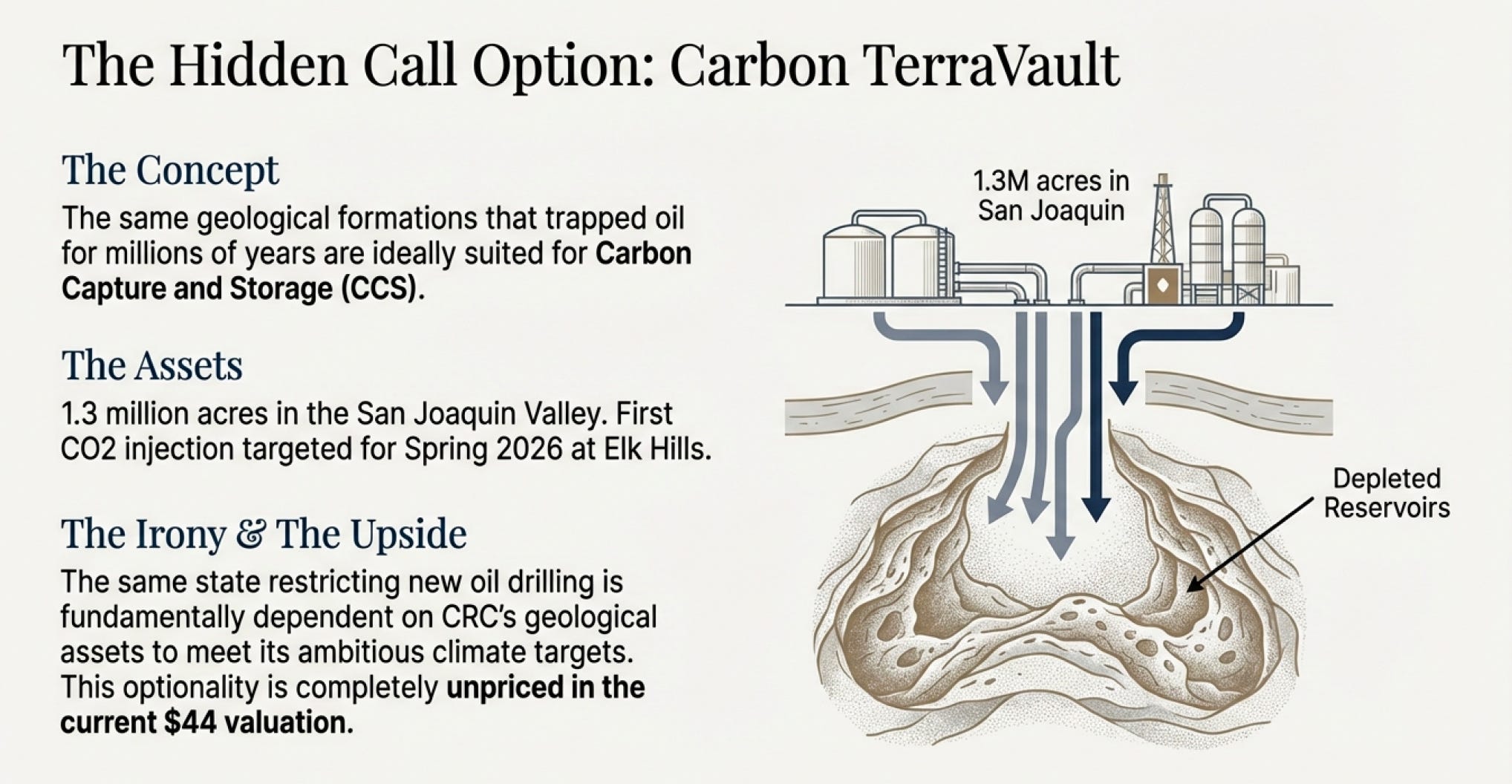
CRC’s vast acreage across California’s basins — over 1.3 million acres in the San Joaquin Valley alone — is ideally suited for carbon capture and storage (CCS). The same geological formations that trap oil underground are equally capable of trapping CO₂. CRC has been developing its Carbon TerraVault platform, a joint venture that aims to commercialize subsurface CO₂ storage for industrial emitters across California who face regulatory pressure to reduce emissions.
CRC announced a new memorandum of understanding with a leading California power producer to provide CO₂ transportation and storage and explore decarbonized power solutions near Silicon Valley, and is targeting first CO₂ injection at its CCS project at the Elk Hills cryogenic gas plant in spring 2026.
Think about what this means. The same state that is trying to eliminate CRC’s ability to drill for new oil is simultaneously dependent on CRC’s geological assets to meet its climate targets. CRC is the rare energy company that is both exposed to the risk of energy transition regulation and positioned to benefit from it. The carbon management segment is early-stage and does not contribute meaningful revenue today. But the optionality is real and costs you nothing at the current price.
Part VIII: The Management Signal — Actions Speak Louder
Before we arrive at a conclusion, there is one more element worth examining: what the insiders are doing with their own money. Because you can read all the analyst reports you want, but nothing concentrates the mind like watching executives bet their personal wealth.
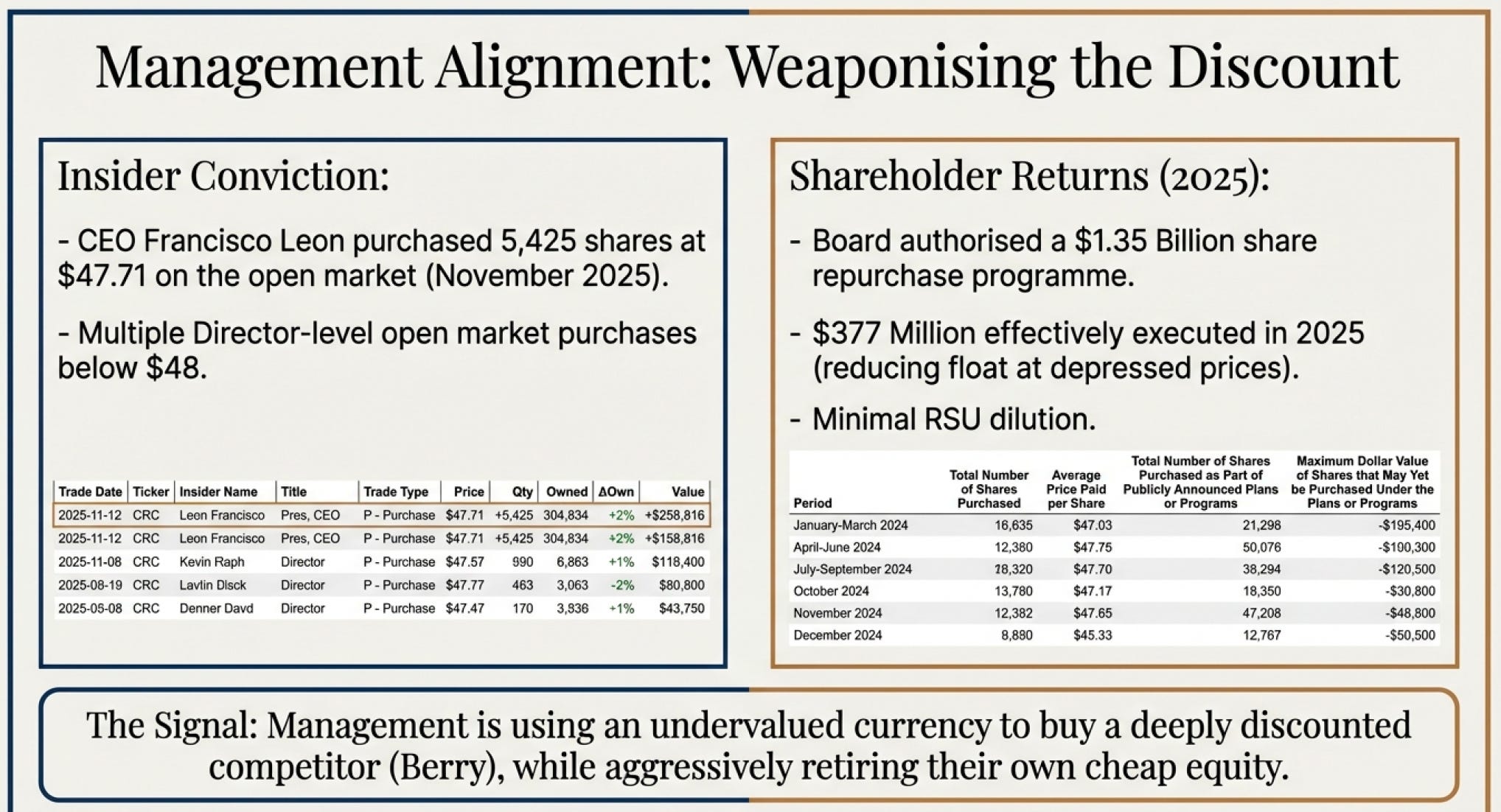
The insider transaction table tells a compelling story. While there are some executives who sold shares in late 2024 — which is normal behavior from a tax-planning and portfolio-diversification standpoint — the more recent data shows the CEO Francisco Leon purchasing 5,425 shares at $47.71 in November 2025 for over $258,000, and directors acquiring shares in March 2025 at prices below $45. More strikingly, the company’s Board authorized a share repurchase program of up to $1.35 billion of common stock through December 2025. In 2024 alone, the company repurchased approximately 3.65 million shares at an average price of $52.12. In 2025, CRC returned $513 million to shareholders including $377 million in share repurchases and $136 million in dividends.
This is the capital allocation behavior of a management team that looks at their own stock and sees exactly what this analysis sees: a significant discount to intrinsic value. They are not just saying it. They are spending $377 million of the company’s cash to act on it. Dilution — the silent thief that destroys value in mediocre companies — is absent here. RSU issuance is minimal. The share count has been declining, not rising.
When management acts this decisively to reduce float while the stock is cheap, it is one of the clearest signals available to an outside investor. You are, in a very literal sense, buying shares alongside the people who know the company best.
The Conclusion: A Company Worth Waiting For
Let us bring the three questions back together for a final verdict.
How many birds are in the bush? At a conservative $55/barrel oil price and $26/barrel production cost, CRC’s 567 million barrels of proved developed reserves — now growing toward 654 million total BOE post-Berry merger — represent approximately $108 to $156 per share in intrinsic value against a current price of $44. The gap between price and value is extraordinary. The birds are there. There are many of them.
How sure are you? The reserve base is independently audited. The production cost is documented in SEC filings. The management team is demonstrating its conviction through hundreds of millions in buybacks. The risks — California regulation, oil price depression, field maturity — are real but well-understood, and the margin of safety at the current price absorbs most of them. The certainty is not absolute, but the range of outcomes is skewed dramatically in the investor’s favor.
How long until you get them out? This is the honest constraint. Oil is in a structural oversupply period that may persist through 2026 and into 2027. The catalyst for market recognition is a recovery in oil prices, which requires the natural exhaustion of the current supply glut. This is not a trade. It is an investment with a 2-4 year horizon, requiring the patience to sit with an unloved, under-owned, ignored asset while the market catches up.
But here is the thing about “sit-on-your-ass investing” — the phrase coined by Charlie Munger to describe his favorite kind of position. You are not just passively waiting. You are collecting free cash flow (CRC generated $543 million in free cash flow in 2025). You are benefiting from buybacks that increase your per-share value with every quarter that passes. You are watching the Berry integration steadily unlock $80-90 million in annual synergies. And you are holding a call option on both higher oil prices and the emerging carbon storage economy, both of which are included in the current price for free.
The market is pricing California Resources Corporation as if the oil in the ground barely matters. As if the 567+ million proved barrels of oil, the largest conventional operator in California, the best-in-class reinvestment rate, the $742 million in peak free cash flow, the disciplined management team, and the carbon management optionality are worth precisely $44 per share.
The market is wrong.
It has been wrong before about beaten-down commodity producers trading at fractions of their proved reserve value. It will be wrong again here. The only question is whether you will be sitting in the seat when it corrects.
That being said, given current supply context in the market, I personally do forsee that oil prices will come collapsing first before a major oil run (in the long-term).
This article represents a personal investment analysis and does not constitute financial advice. All intrinsic value calculations are based on reported SEC filings, independently published reserve audits, and publicly available cost data. Oil price assumptions use a 10-year average of approximately $55/barrel as a conservative baseline. Investors should conduct their own due diligence and consult a qualified financial advisor before making investment decisions.
For industry fundamentals, read this 👇

Sources consulted: California Resources Corporation 10-K (2024, 2025), CRC 10-Q Q3 2025, IEA Oil Market Reports (2025-2026), EIA Short-Term Energy Outlook (February 2026), S&P Global Energy, Los Angeles Business Journal, CRC investor relations press releases, SEC insider transaction filings, Exxon 2024 Annual Report, U.S. Energy Information Administration production cost data, Rystad Energy breakeven analysis.
For latest update as of 3rd March 2026: https://compoundingzero.substack.com/p/the-thesis-just-got-its-catalyst