
There Is a Mountain of Copper Sitting Quietly in British Columbia, and Wall Street Has Priced It at a 52-Cent Discount (and possibly more)
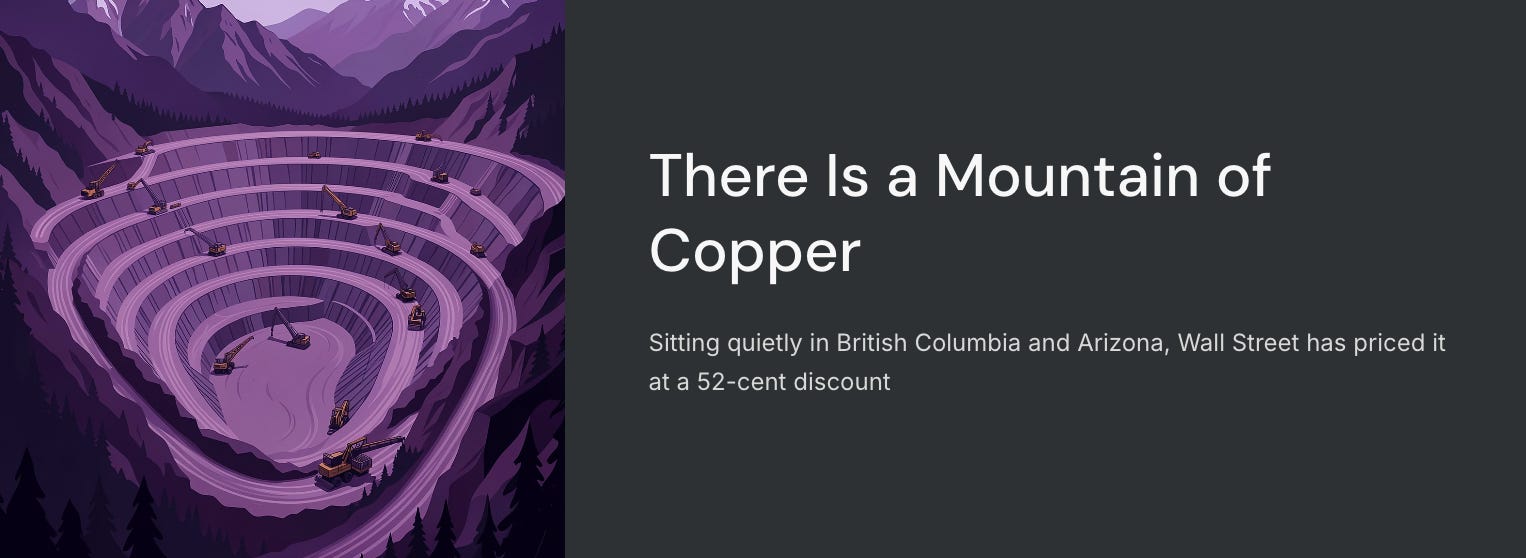
Most great investments don’t announce themselves. They don’t come wrapped in a press release from Goldman Sachs. They don’t appear on the “most active” tab of your brokerage. They sit there, quietly, like a pile of wood at the edge of your property that you keep walking past — until one morning the temperature drops, and suddenly you realize what you’ve been ignoring.
This is a story about one of those piles of wood.
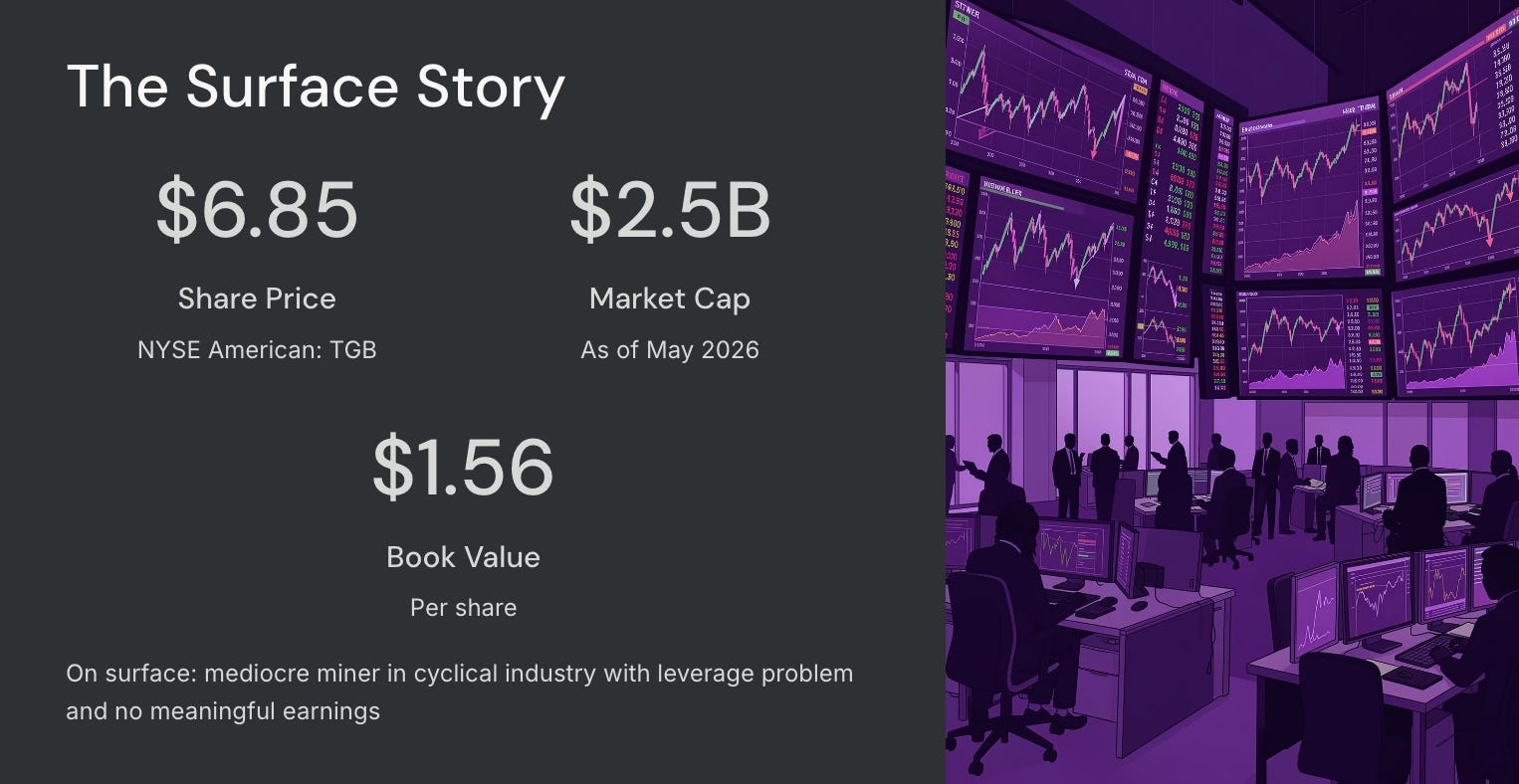
The company is Taseko Mines Limited, listed on the NYSE American under the ticker TGB. As of May 5, 2026, the stock trades at $6.85 a share with a market capitalization of approximately $2.5 billion. Book value per share is $1.56. Its ROE has been inconsistent — 10.8% in 2021, negative in 2022, a strong 21% in 2023, and back to slightly negative in 2024 and 2025. On the surface, this looks like a mediocre miner in a cyclical industry with a leverage problem and no earnings to speak of. The P/E ratio is undefined because there are no meaningful earnings — only the suggestion of them.
And yet.
When you open the annual report and read past the headline numbers — when you stop looking at what the accountants say and start looking at what a business owner would see — something strange happens. The picture inverts. Completely.
This is the story of how that inversion works, why the market is missing it, and — crucially — why I am not yet buying it.
The Problem With Accountants
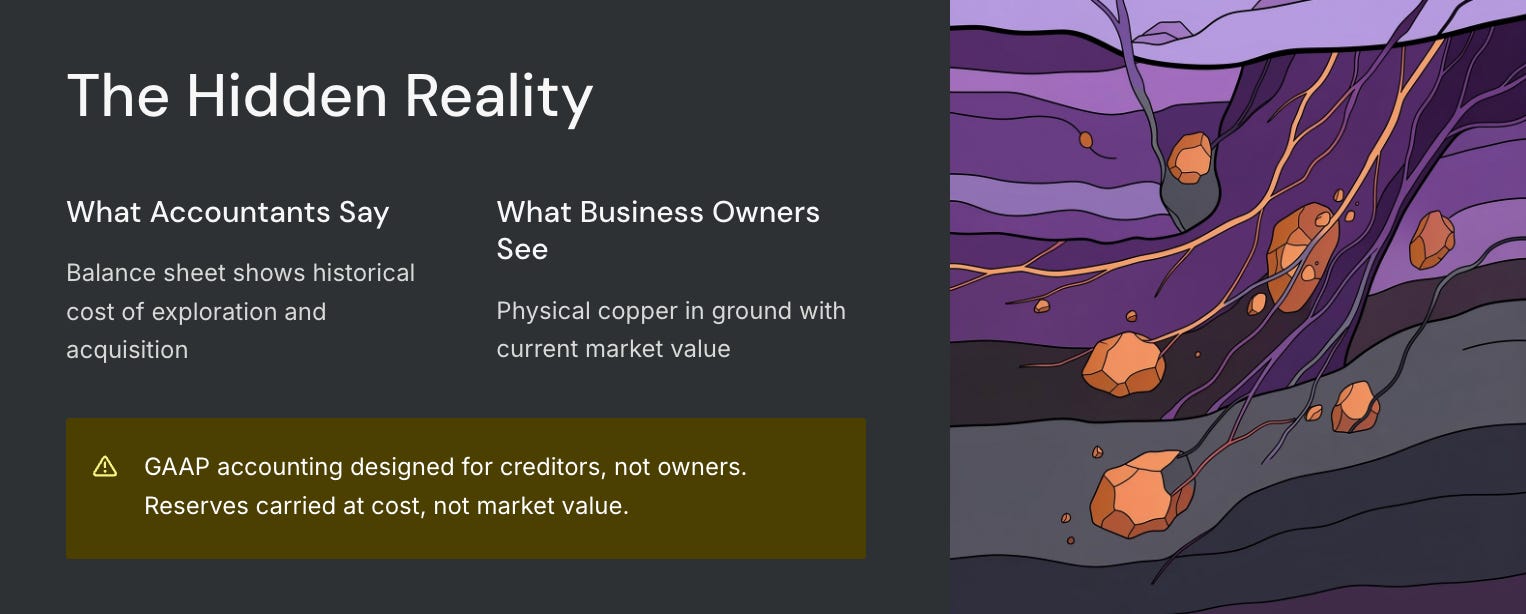
Here is a truth that took me a long time to fully internalize: accounting was not designed to tell you what a business is worth. It was designed to tell you what happened, historically, in a conservative way, to protect creditors. GAAP is a retrospective system built for debt contracts, not for owners.
Charlie Munger put it simply: the most dangerous thing in investing is a man with a set of financial statements and no understanding of what they represent. The numbers themselves are not the reality — they are a shadow of the reality, cast by a very particular light source pointing in a very particular direction.
In the mining industry, this distortion is almost comically severe. The reason is geological.
When a mining company identifies a copper reserve — after drilling hundreds of wells, assaying samples, running geological models, applying metallurgical recovery factors, and filing a formal technical report under NI 43-101 or SEC guidelines — it is essentially describing a physical asset that exists in the ground right now. The copper is there. It has been verified by qualified persons. It has a grade, a mass, and a location. You can calculate how many pounds of copper sit inside that rock with the same confidence that you can calculate how many gallons of milk are in a dairy farm’s tank.
But here is where it gets strange. Under GAAP, that reserve is not carried at the value of the copper it contains. It is carried at cost — the historical cost of exploration and acquisition. The copper grade climbs, commodity prices rise, and inflation makes the replacement cost of the mine exponentially more expensive. None of that shows up on the balance sheet. The asset just sits there, at its original price tag, aging quietly into irrelevance as a number, while appreciating furiously as a physical reality.
This is what we are dealing with at Taseko. The balance sheet says one thing. The earth says something very different.
The Inventory: What Is Actually in the Ground
Let me build this up the way a business owner would — not a hedge fund manager running a DCF, not an accountant filing a 10-K, but someone who just bought the company outright and is walking through the warehouse with a clipboard.
The Gibraltar Mine, British Columbia. This is Taseko’s operating core and has been for decades. It is one of the largest open-pit copper mines in Canada. The ore grade is about 0.25% copper — genuinely low-grade by global standards, which is relevant for costs and we will come back to it. Within the Gibraltar system there are four sub-pits: Pollyanna, Connector, Gibraltar, and Extension. The proven copper reserves, doing the math directly from the technical reserve tables:
Pollyanna carries 91 million tonnes at 0.24% copper = 436.8 million pounds. Connector carries 118 million tonnes at 0.25% = 590 million pounds. The Gibraltar pit itself holds 121 million tonnes at 0.24% = 580.8 million pounds. Extension carries 84 million tonnes at a richer 0.31% = 520.8 million pounds. The Gibraltar mine complex in total: 2,128.4 million pounds of proven copper.
That number alone — 2.1 billion pounds — is staggering when you hold it against the $2.5 billion market cap. But we are not finished.
The Florence Copper Project, Arizona. This is not just another mining project. This is something genuinely new, and it changes the whole character of Taseko’s cost structure and the timeline to cash. More on this shortly. The proven reserves at Florence: 258 million tonnes at 0.35% copper, which works out to 1,812 million pounds (the technical report rounds it to 1,806 million).
The Yellowhead Copper Project, British Columbia. This is a development-stage project — Taseko does not operate it yet, and it would require enormous capital to bring into production. The proven reserves stand at 458 million tonnes at 0.29% copper = 2,928 million pounds.
Combined total across all three asset bases: 6,862.5 million pounds of proven copper.
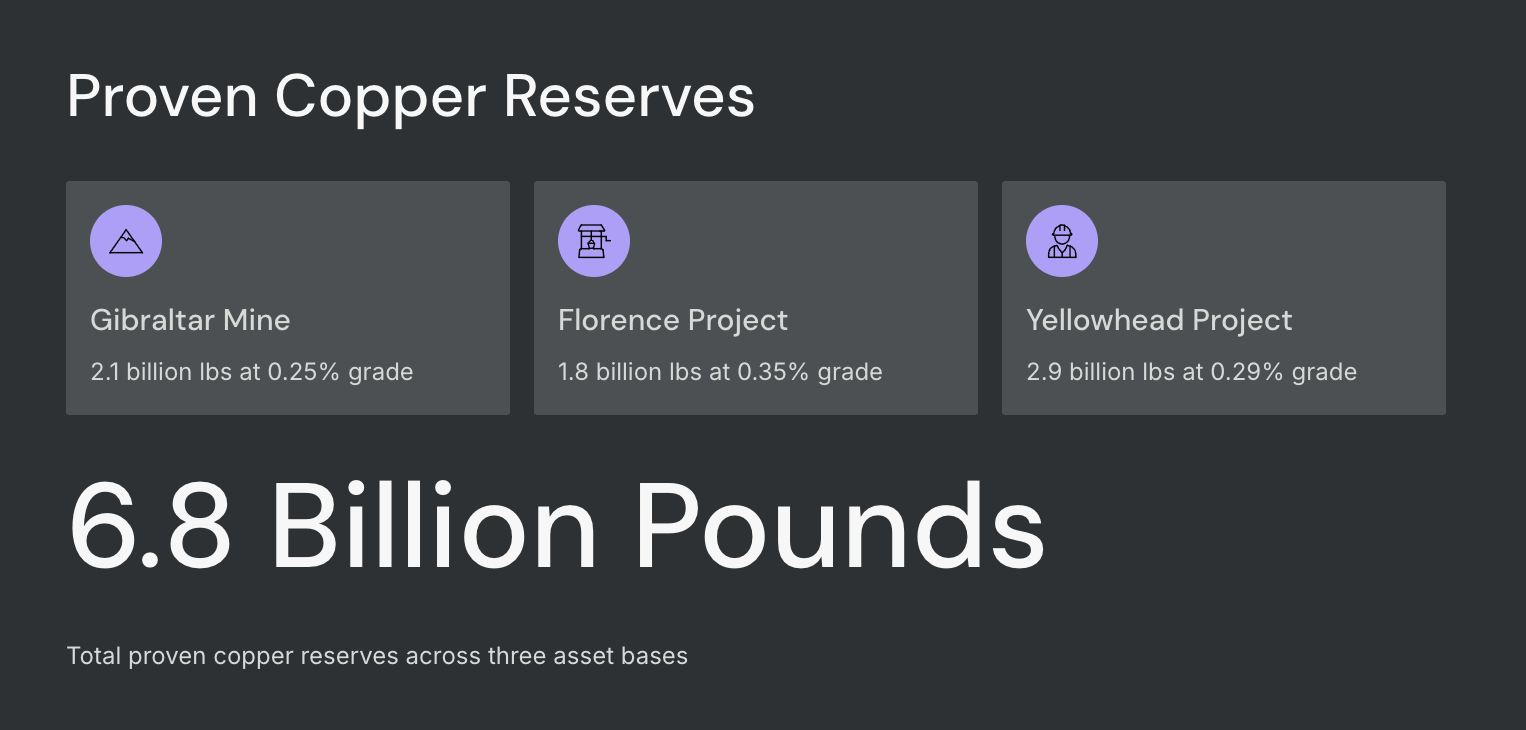
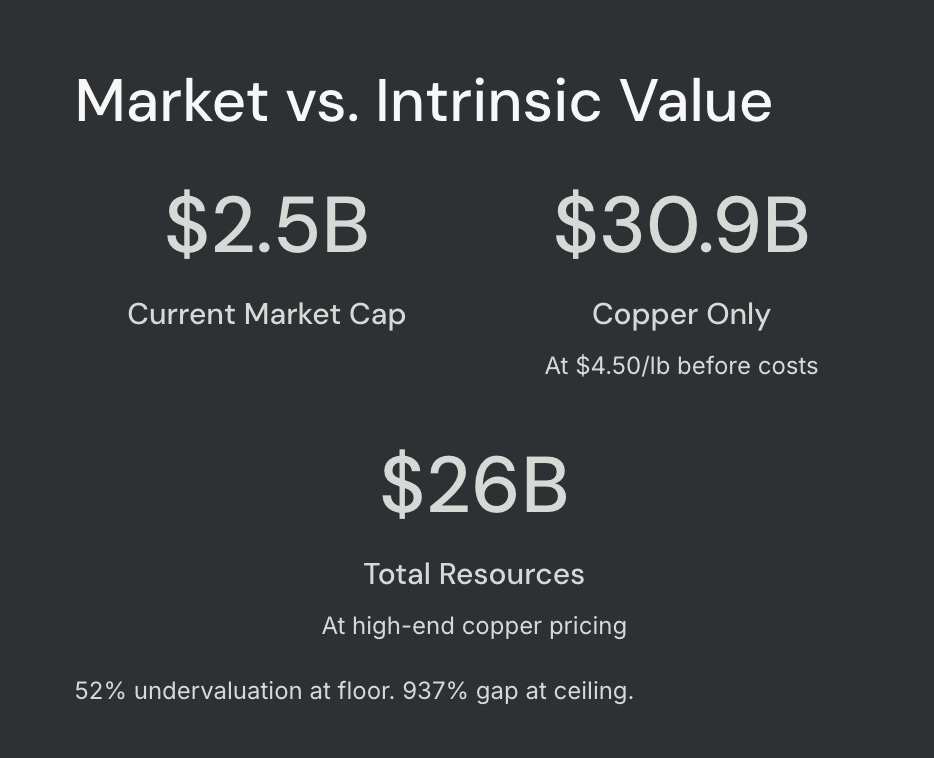
That is six point eight billion pounds. At a low base average LME copper price of approximately $4.50 per pound, the gross in-ground value of just the copper — before any costs, before any discounting — is roughly $30.9 billion.
The market cap is $2.5 billion.
Now, the immediate and entirely correct objection is: “You can’t just multiply reserves by the price it’ll sell for. You have to account for operating costs, capital requirements, time value of money, and execution risk.” Absolutely right. Let us do exactly that.
What a Business Owner Actually Pays Attention To: The Cost Structure
This is where the story gets interesting, because the cost side of this equation is not uniform across Taseko’s assets. It bifurcates sharply. And that bifurcation is the entire thesis.
The Gibraltar mine runs at what the industry calls C1 cash costs — the full operating cost to produce a pound of copper, net of by-product credits. Historical data from Taseko’s own filings is clear: Full year 2023 averaged $2.37 per pound, among the most efficient years. Full year 2024 averaged $2.66 per pound, pressured by labor strikes and lower grades. Full year 2025 came in at $2.66 per pound as well. Q4 2025, after operational improvements and a return to higher grades, dropped to $2.47 per pound. Q4 2023 at peak efficiency hit $1.91 per pound.
At today’s LME copper price of roughly $4.50 to $5.00 per pound, the margin on Gibraltar copper looks like this: at $2.66 all-in, Gibraltar earns between $1.84 and $2.34 per pound of copper produced. In 2025, the company produced roughly 93 million pounds of copper, translating to operating economics somewhere between $171 million and $218 million in gross cash margin from Gibraltar alone, before corporate overhead and finance costs.
But Florence Copper is a different animal entirely.
The Technology That Changes Everything: ISCR and Why It Matters
Here is where I need to slow down and explain something that most people, even in the mining industry, don’t fully appreciate.
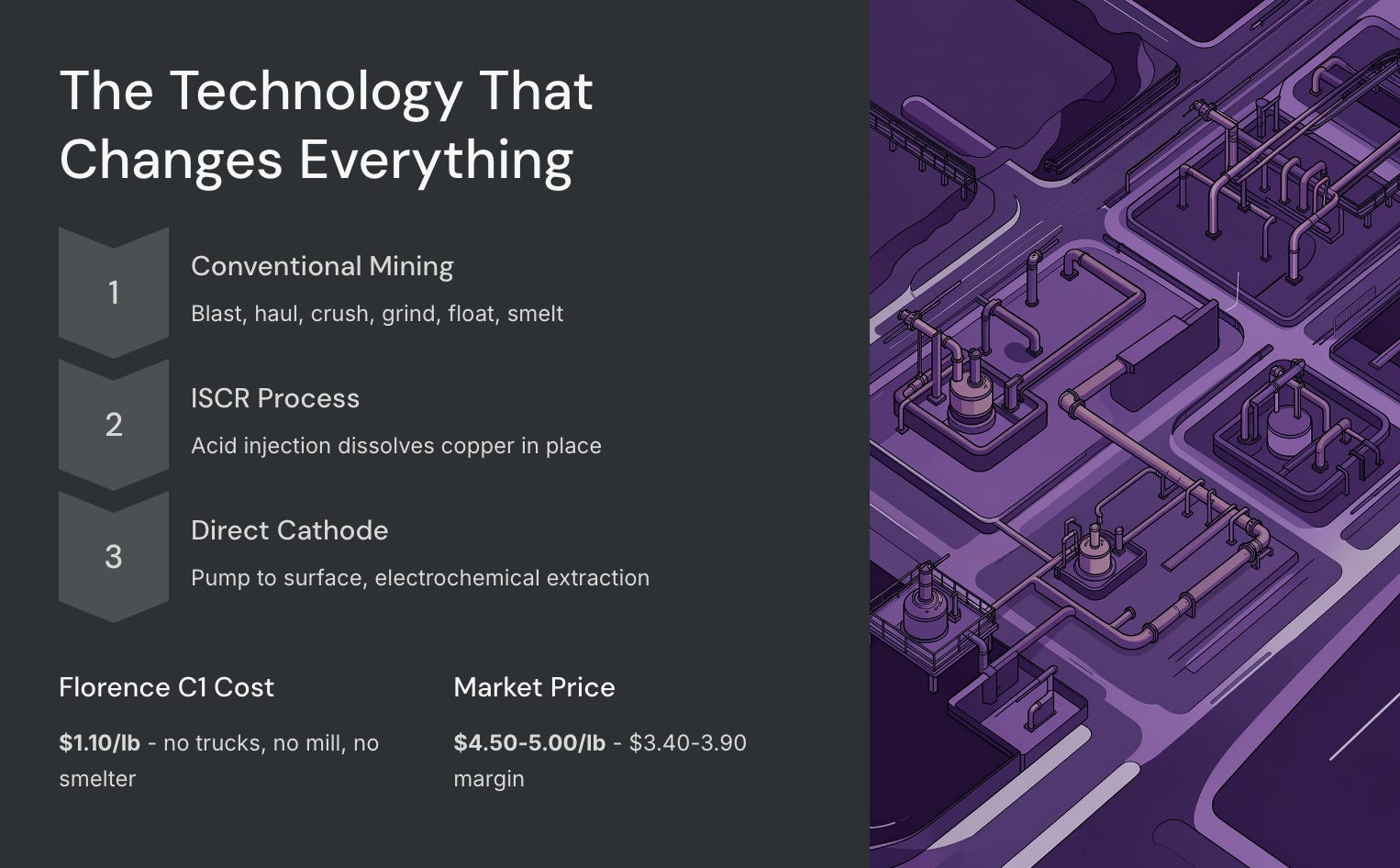
Conventional copper mining — what Gibraltar does — is a grinding, energy-intensive, expensive business. You blast open rock, haul it with 400-ton trucks burning diesel, crush it in a primary jaw crusher, grind it in rotating SAG mills filled with steel balls (the most electricity-intensive step in all of mining), then run the powdered slurry through a flotation circuit using chemical reagents — almost all of which are petroleum-derived — to produce a concentrate that is 20-30% copper. Then you ship that concentrate, pay treatment and refining charges (TC/RCs) to a smelter in China or Japan, and receive back cash net of those deductions. The payable percentage (by clients) is roughly 96% of contained copper. The TC/RC deductions add $0.20 to $0.35 per pound to the effective cost.
The whole process is thermally and energetically violent. It is a war against physics, run at industrial scale, every day of the year.
Florence Copper uses none of this. The process requires no blasting, no loading, no hauling, no crushing, no conveying of mineralized material, resulting in 75% fewer carbon emissions, 65% less energy, and 78% less water consumed per pound of copper produced than conventional open-pit copper mines in Arizona.
Instead, Florence injects a weakly acidic solution — roughly the same pH as household vinegar — into a naturally fractured copper orebody via a series of injection wells in the copper oxide zone, 400 to 1,200 feet below surface, causing copper minerals to dissolve into solution prior to being pumped to surface through recovery wells, and processing it into LME grade A copper cathode sheets using an electrochemical solvent extraction and electrowinning process.
No trucks. No mill. No smelter. No TC/RC deductions. No flotation reagents. No tailings pond.
Florence Copper is the first greenfield site globally to employ ISCR at commercial scale, establishing operational precedent for this technology.
The economics of this process are almost offensive in their simplicity. Taseko’s technical team has guided to a C1 cash cost for Florence of approximately $1.10 per pound of cathode. At a $4.50-5.00 copper price, that is a margin of $3.40 to $3.90 per pound.
To put that in perspective with the “$2.5 billion market cap” line at the top: Florence alone, at full capacity, could theoretically pay for the entire current market cap of Taseko in less than nine years of operations, before accounting for Gibraltar’s own cash flows.
Once Florence Copper achieves its nameplate capacity of 85 million pounds of LME Grade A copper metal per year, Taseko will become the third largest copper cathode producer in America.
The Hidden Value: What the Balance Sheet Refuses to Show You
Now let us apply the framework from the first document on hidden asset values — specifically the “Depreciated PP&E” concept — to Taseko’s situation, because it maps almost perfectly.
The Gibraltar mine has been running since the early 1970s. Much of the physical infrastructure — the mill buildings, the conveying systems, the tailings dam, the power connections, the road networks — has been depreciated for decades. On the balance sheet, Property, Plant and Equipment stands at roughly $2 billion Canadian. But the replacement cost of a comparable operation — a fully permitted, operating copper mine in Canada with over 2 billion pounds of proven reserves, an active mill processing 130,000+ tonnes of ore per day, with all environmental permits in place — is not $2 billion. It is multiples of that.
This is the insight that is almost never discussed about mining companies: the permit itself is worth more than the building. Environmental permits for large open-pit copper mines in British Columbia are effectively impossible to obtain today. The regulatory timeline, the First Nations consultation requirements, the environmental assessment process — all of these have lengthened dramatically since Gibraltar was first permitted. The mine that Gibraltar represents could not be permitted from scratch in under 20 years today, and perhaps not at all. What Taseko owns, therefore, is not just a mine. It is a grandfathered regulatory position — a Certificate of Need, if you want to borrow the healthcare analogy — that has no market value on the balance sheet but commands a significant premium in any rational acquisition scenario.
This is also true, even more dramatically, for Florence. The ISCR process in Arizona required permits from both the Arizona Department of Environmental Quality and the EPA. The combination of the unique geological conditions required for ISCR to work, the permitting process, and the multi-year Production Test Facility phase means that the demonstration of technical viability and operational economics may encourage mining companies to reassess suitable resources using in-situ recovery methodologies — but nobody else can just go build a second Florence. The site-specific hydrogeology, the prior community relationships, the standing permits, and the already-amortized PTF costs are all embedded in Taseko’s asset at zero marginal book value.
The By-Products No One Is Talking About
Every good mine has a secret second story. At Gibraltar, the second story is molybdenum.
Molybdenum is a silvery metal used primarily as an alloying agent in high-strength steel — infrastructure, aerospace, defense, oil and gas pipelines. It trades in a relatively thin market, and prices can be volatile. But the point is that Gibraltar produces it as a by-product of copper mining. The molybdenum comes up in the same ore, goes through the same mill, and requires only modest incremental processing to separate. The marginal cost of the molybdenum Taseko produces is essentially zero — or rather, it is already embedded in the C1 cost calculation as a negative number, because the molybdenum revenue offsets copper costs.
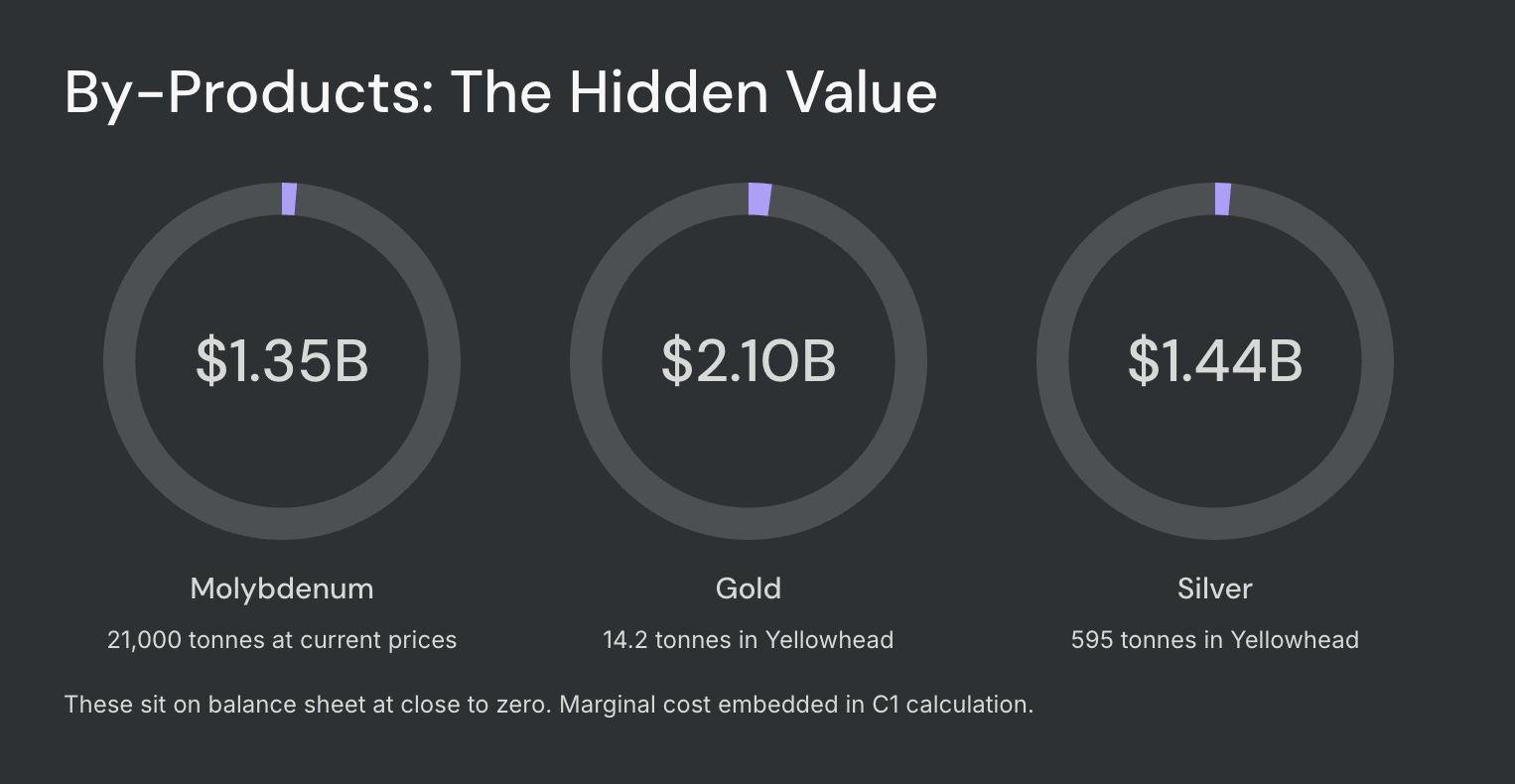
The sulphide ore at Gibraltar carries approximately 21,000 metric tonnes of proven molybdenum. At current market prices of roughly $63,900 to $64,486 per metric tonne (based on March-May 2026 LME trends), the total intrinsic value of the molybdenum in the ground is approximately $1.34 to $1.35 billion.
That molybdenum sits on the balance sheet at close to zero. It will be produced over the remaining life of the mine. It will offset a portion of copper operating costs year after year. And it represents roughly 54% of the entire current market cap of Taseko, in by-product minerals alone.
Then there is the Yellowhead project’s by-products. The 458 million proved tonnes carry gold at 0.031 gpt and silver at 1.3 gpt. At spot prices of approximately $4,600 per troy ounce for gold and $75 per ounce for silver:
14.2 tonnes of gold = 456,540 troy ounces × $4,600 = $2.10 billion. 595.4 tonnes of silver = 19,142,527 troy ounces × $75 = $1.44 billion.
Total precious metal value within the proved resource base: $3.54 billion. Against a market cap of $2.5 billion.
This is the base case. The “recession scenario.” The floor where copper is at lows, oil is expensive, and the world has forgotten why it wanted copper in the first place. Even in that scenario, the gold and silver in the ground — not the copper, not the molybdenum, just the precious metals — exceed the current enterprise price you pay for the entire company.
In aggregate — $3.54 billion in gold and silver, $1.35 billion in molybdenum, and $3.8 to $21.2 billion in copper (using the $0.56 to $3.10 net-back spread across 6,862.5 million pounds) — the total intrinsic resource base ranges from $3.8 billion at the most conservative estimate to approximately $26 billion at the high end, against a market cap of $2.5 billion.
A 52% undervaluation at the floor. A 937% gap at the ceiling.
The Copper Market: The Wind at Its Back
The question is not whether copper is important. The question is how important and how soon.
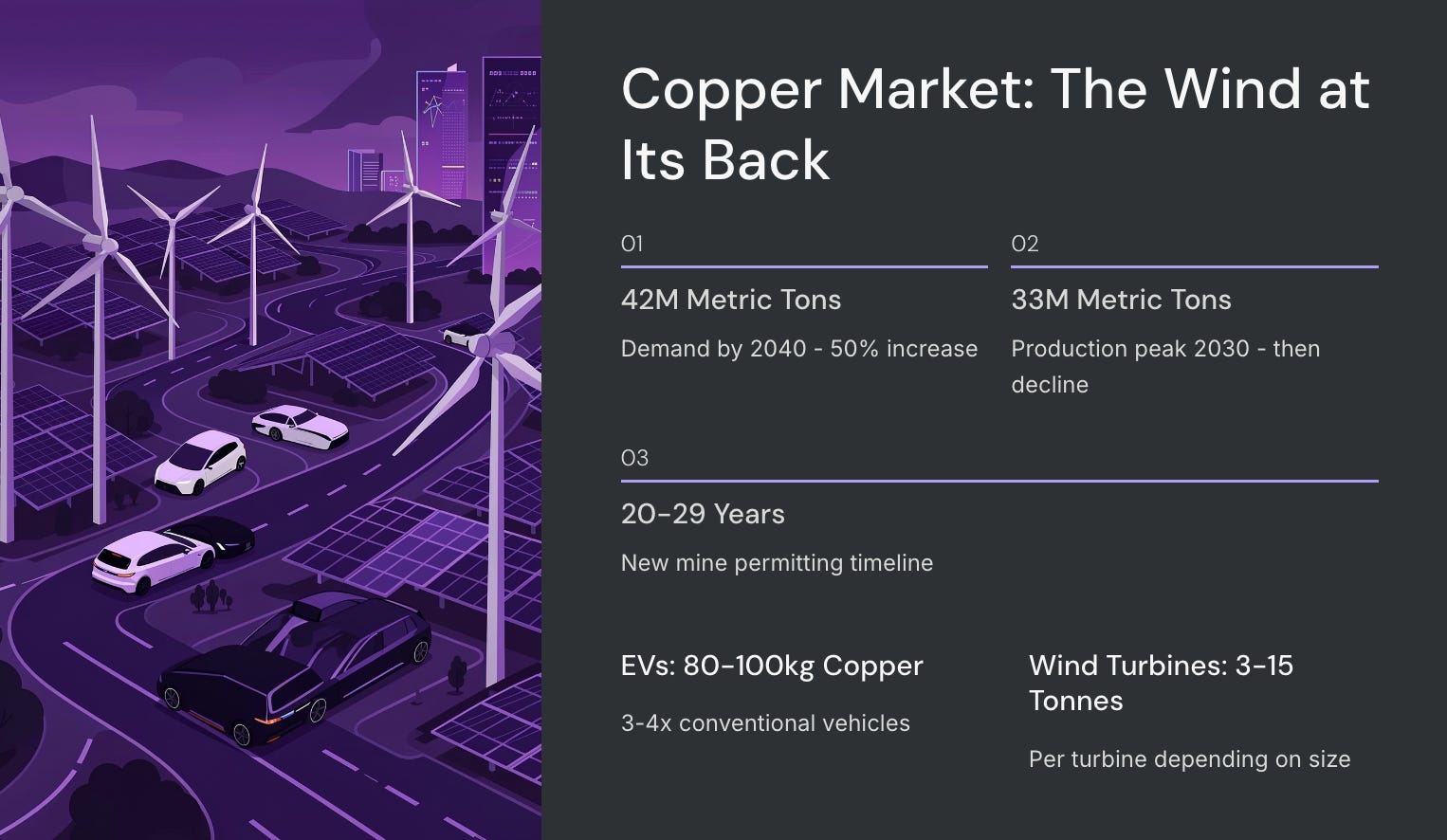
According to S&P Global’s January 2026 study “Copper in the Age of AI: The Challenges of Electrification,” the accelerating pace of electrification is projected to swell copper demand to 42 million metric tons by 2040, a 50% increase from current levels, yet existing supply is currently poised to decrease as the mining sector faces challenges across the copper value chain.
The supply gap threatens to constrain technological advancement and economic growth as copper becomes increasingly essential for AI data centers, electric vehicles, renewable energy infrastructure, and defense systems. Without significant changes to supply, global copper production is projected to peak at 33 million metric tons in 2030 before declining.
BloombergNEF’s Transition Metals Outlook warns copper demand for the energy transition could triple by 2045 and that the metal may enter structural deficit as early as 2026.
An electric vehicle contains roughly 80-100 kilograms of copper, three to four times as much as a conventional internal combustion car. A single offshore wind turbine uses approximately 3 to 15 tonnes of copper depending on size. Data center construction — driven by the AI buildout — consumes copper in the wiring, cooling infrastructure, and power distribution systems. Defence spending is increasing globally. The arithmetic of demand is not a prediction. It is a function of decisions that have already been made, announced, and begun.
On the supply side, the structural problem is even cleaner. In developed regions, opening new mines takes 20 to 30 years, with the U.S. averaging close to 29 years. Six countries are responsible for roughly two-thirds of mining production, and China commands roughly 40% of total smelting capacity and 66% of copper concentrate imports, making the global supply chain vulnerable to policy shocks and trade barriers.
This last point is specifically relevant for Florence. Taseko’s Arizona cathode bypasses China entirely. It goes from the wellfield to the SX/EW plant to an American manufacturer — no concentrate, no Chinese smelter, no geopolitical exposure. In a world where supply chain sovereignty has become a first-order policy concern, the value of domestically produced, LME-grade copper cathode with zero refining intermediaries is not adequately captured by the LME spot price alone. There is a premium — qualitative, and perhaps increasingly quantitative — embedded in Florence’s product that does not show up in Taseko’s revenue line yet.
The Contrarian’s Pause: Why I Am Not Buying Today
I have spent several pages building a case for why Taseko’s assets are extraordinary. Now let me do something more useful and spend equal time tearing it apart.
The first principle of thinking about any investment is simple: invert. Don’t ask “why will this work?” Ask “how could this destroy me?” The bear case on Taseko is not vague or philosophical. It is concrete and it is serious.
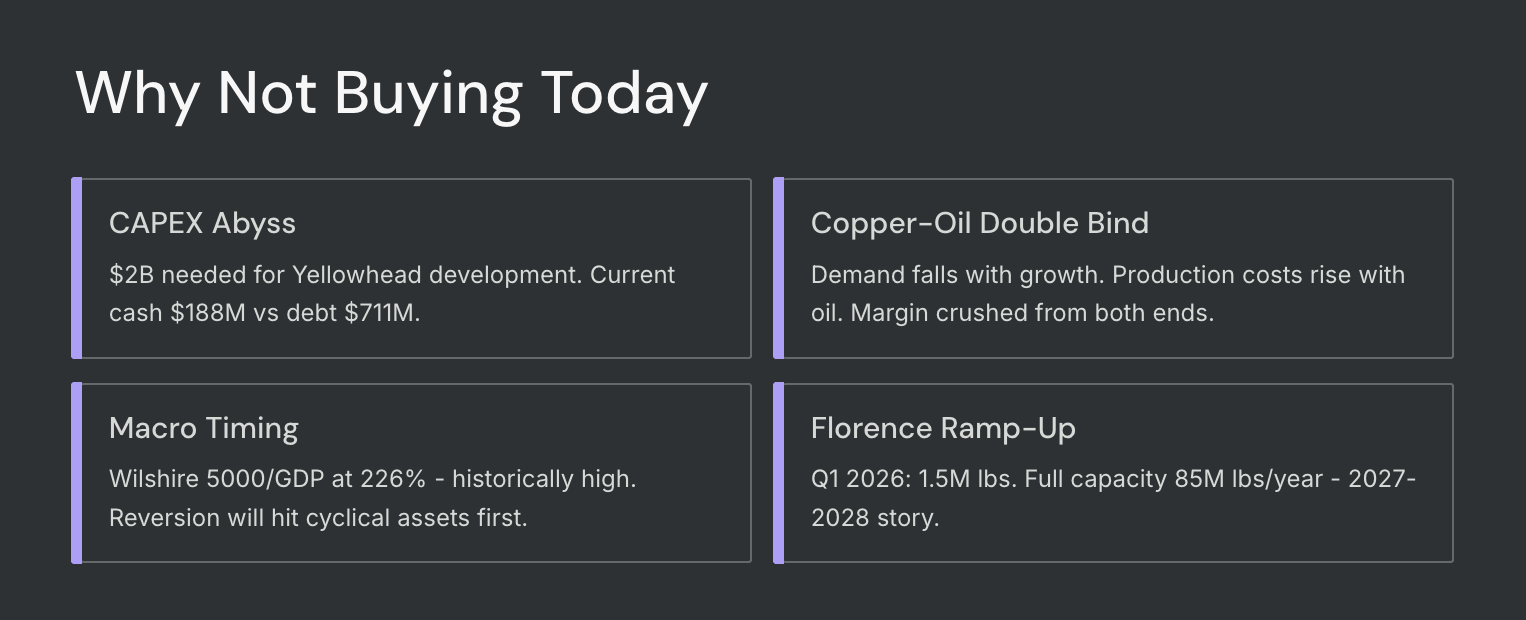
The CAPEX abyss. Of the 6,862.5 million pounds of proven copper, only a fraction is immediately monetizable without massive capital investment. Florence is producing, and its reserves of 1,812 million pounds are progressively extractable without large incremental capital — the $230 million has been spent and the wells are flowing. Gibraltar is operating (most of it at least), and its 2,128 million pounds will be produced over the remaining mine life at current throughput rates. But Yellowhead — the 2,928 million pounds that makes up 43% of the total reserve base and the engine of the “937% upside” calculation — needs approximately $2 billion in initial capital expenditure and has no current infrastructure of any kind. It is, in the parlance of the field, a development-stage project. You cannot sell it today at intrinsic copper value.
You own an option, not the copper. And this option is not cheap (at PS of approx 4, + a small cash balance relative to the CAPEX that is required to unlock the company’s full intrinsic value)
And even Gibraltar and Florence require ongoing maintenance capital. The balance sheet as of December 31, 2025 shows cash of approximately $188 million Canadian against long-term debt of approximately $711 million. The company is not in a position to self-fund major expansion. That means (very likely) equity dilution, given the fact that debt is quite high — at about 95% of equity.
The copper-oil double bind. Here is an insight that rarely appears in the bullish mining literature: copper and oil have a complex, unhealthy relationship. Copper demand is highly correlated with economic growth. When growth slows — especially industrial growth, which is what eventually always follows a period of over-investment in a capital markets bubble — copper demand falls first and hardest. It is the most economically sensitive of all base metals, precisely because it is used in everything productive.
At the same time, copper production is deeply dependent on oil. Gibraltar’s cost structure is materially affected by diesel — 400-ton haul trucks, the primary energy input for blasting (ANFO explosive), off-grid power generation for remote operations, and the thermal input to reagent manufacturing. Taseko’s own Q1 2026 guidance acknowledged this explicitly, noting that diesel prices at current levels would add $0.10 to $0.15 per pound to Gibraltar’s annual operating costs. When oil rises because the economy is strong, copper demand is high, margins hold. But if oil rises in a stagflationary environment — rising input costs with declining product prices — the margin gets crushed from both ends simultaneously.
This is not an abstract concern. The froth flotation circuit that turns raw ore into concentrate is essentially impossible without petroleum-based flotation reagents. Every pound of concentrate that comes out of Gibraltar has hydrocarbon molecules embedded in its production cost. This dual pressure — to oil prices and from economic contraction — means Taseko’s earnings profile is riskier than the copper price alone would suggest.
The Wilshire 5000 signal. I want to be careful here not to be too clever, but the macro backdrop matters for the timing of an investment even when the fundamental value is clear. As of May 2026, the Wilshire 5000 to GDP ratio — the Buffett Indicator — stands at approximately 226%. This is not a trivial data point. The historical average for this ratio, going back decades, is somewhere between 80% and 100%. At 226%, it reflects either a permanently higher plateau of corporate earnings power relative to the economy, or a significant mispricing of risk across asset classes. If the latter, the unwinding (economic contraction) — whenever it happens — will depress copper prices through demand destruction before it resolves. Taseko’s copper reserves do not disappear in a recession. But the price at which they are monetized over the next five to ten years does compress, and the cash flows that allow the company to develop Yellowhead shrink with them.
Copper is cyclical. Intrinsic resource value is permanent. The distance between those two truths is exactly the gap between a good idea and a good investment.
The Florence ramp-up question. Florence is producing. Q1 2026 saw 1.5 million pounds of copper cathode produced, with solutions flowing in the wellfield since late 2025 and initial copper leaching production in line with expectations based on internal modeling. But 1.5 million pounds in a quarter is a long way from 85 million pounds per year. Full annualized production in Q1 works out to 6 million pounds — about 7% of nameplate. The ramp from 7% to 100% involves wellfield expansion, increasing acid injection rates, managing solution chemistry, and resolving the operational learning curves inherent in the world’s first commercial-scale ISCR project. Total Florence production for 2026 is expected to be in the range of 30 to 35 million pounds of copper cathode. At 35 million pounds, Florence is 20-30% of nameplate. Full capacity is not a 2026 story. It is a 2027-2028 story at the earliest.
This matters because the $3.75 billion lifetime gross profit I calculated earlier is a 22-year number. In the near term, Florence is contributing partial cash flows against a fully loaded interest expense. The company’s ability to grow into its intrinsic value is a function of time, operational execution, and the copper price environment during the ramp period — none of which is in the investor’s control.
The PDP Insight: What Florence Is Versus What Gibraltar and Yellowhead Are
There is a concept in oil and gas valuation called PDP — Proved Developed Producing reserves. These are reserves in wells that are already drilled, already completed, already flowing. You do not need to spend another dollar to produce them. The next molecule of oil that comes up that wellbore is essentially free capital, subject only to operating costs. PDP is the highest quality reserve category in the entire oil and gas taxonomy, and it is priced accordingly — often at the highest multiples per BOE because the execution risk has already been paid for.
Florence’s in-situ reserves are the copper equivalent of PDP. The wellfield exists. The acid is flowing. The solution is being pumped. The SX/EW plant is running. Copper cathodes are being harvested. No new drilling. No new permitting. No new capital. Every pound that comes up is a pound you capture at $1.10 of cost against $4.50 of price.
Gibraltar is more like PUD — Proved Undeveloped, or in this case, Proved Developed but requiring ongoing maintenance capital. You know the ore is there, you know the equipment works, but the mine will eventually exhaust the current pit and need to expand, and the expansion costs real money.
Yellowhead is a wild card — resource certainty without production reality. It exists as an asset only in a financial model, not in the physical world.
The implication is that the valuation spread on Taseko’s asset base is wider than it looks from the outside. The high-quality, immediately-value-generating assets (Florence plus the running portions of Gibraltar) are genuinely compelling. The development-stage assets are contingent value that requires capital, time, and benign market conditions to realize.
A sophisticated buyer of Taseko equity today is not buying the whole $26 billion intrinsic number. They are buying the high-quality near-term assets at a reasonable price, and getting the long-dated optionality on Yellowhead and expanded Gibraltar essentially for free. That is a very different and more defensible proposition.
The Molybdenum Wildcard: The By-Product That Could Be a Business
The molybdenum story at Gibraltar deserves its own brief chapter because it illustrates exactly the kind of hidden value that GAAP obscures.
Molybdenum prices have been extraordinarily volatile over the past decade, as the Taseko analysis document shows. The 10-year chart is arresting: prices ranged from roughly 100 CNY/kg through 2018-2019, then exploded to nearly 900-1,000 CNY/kg in the 2022-2023 period before settling back to around 244 CNY/kg at the time of writing. The 21,000 metric tonnes of molybdenum in the Gibraltar sulphide ore is, at 244 CNY/kg (approximately $33,600/tonne), worth approximately $706 million at today’s price. At the 2022-2023 peak pricing near 400 CNY/kg, the same reserves were worth $1.2 billion.
This by-product is not a projection. It is contained in ore that is already being mined. It comes out of the same plant, in the same process. Taseko does not have to build anything to capture it. It just comes up with the copper, is separated in the molybdenum circuit, and is sold.
The by-product credit — roughly $0.20 to $0.35 per pound of copper, depending on molybdenum prices — is the primary reason Gibraltar can maintain C1 costs in the $2.40-2.66 range despite being a low-grade mine. Without the molybdenum credit, C1 costs would be approximately $0.30 per pound higher.
Capital Structure and Dilution: The Last Fortress
One of the quiet ways good investments get ruined is through share issuance. You buy a company at a discount to intrinsic value, and then management issues so many new shares at cheap prices that your per-share value erodes even as the company grows. This is the dilution trap, and mining companies are particularly prone to it because they are perpetually capital-hungry.
Taseko’s dilution profile, at this moment, is actually quite clean. As of February 18, 2026, there are 364,557,150 common shares outstanding and 8,091,464 stock options. All 8 million options carry strike prices well below 50% of the current market price — meaning they are deeply in-the-money and likely to be exercised, adding approximately 8 million shares or a 2.2% dilution in the worst case. In a company of this size, with this asset base, a 2% dilution from a fixed option pool is essentially noise.
There are no outstanding warrants, no convertible debentures at punitive conversion rates, no history of toxic equity financing — the kind of structure that kills junior miners.
Why This Is On My Watchlist, Not In My Portfolio
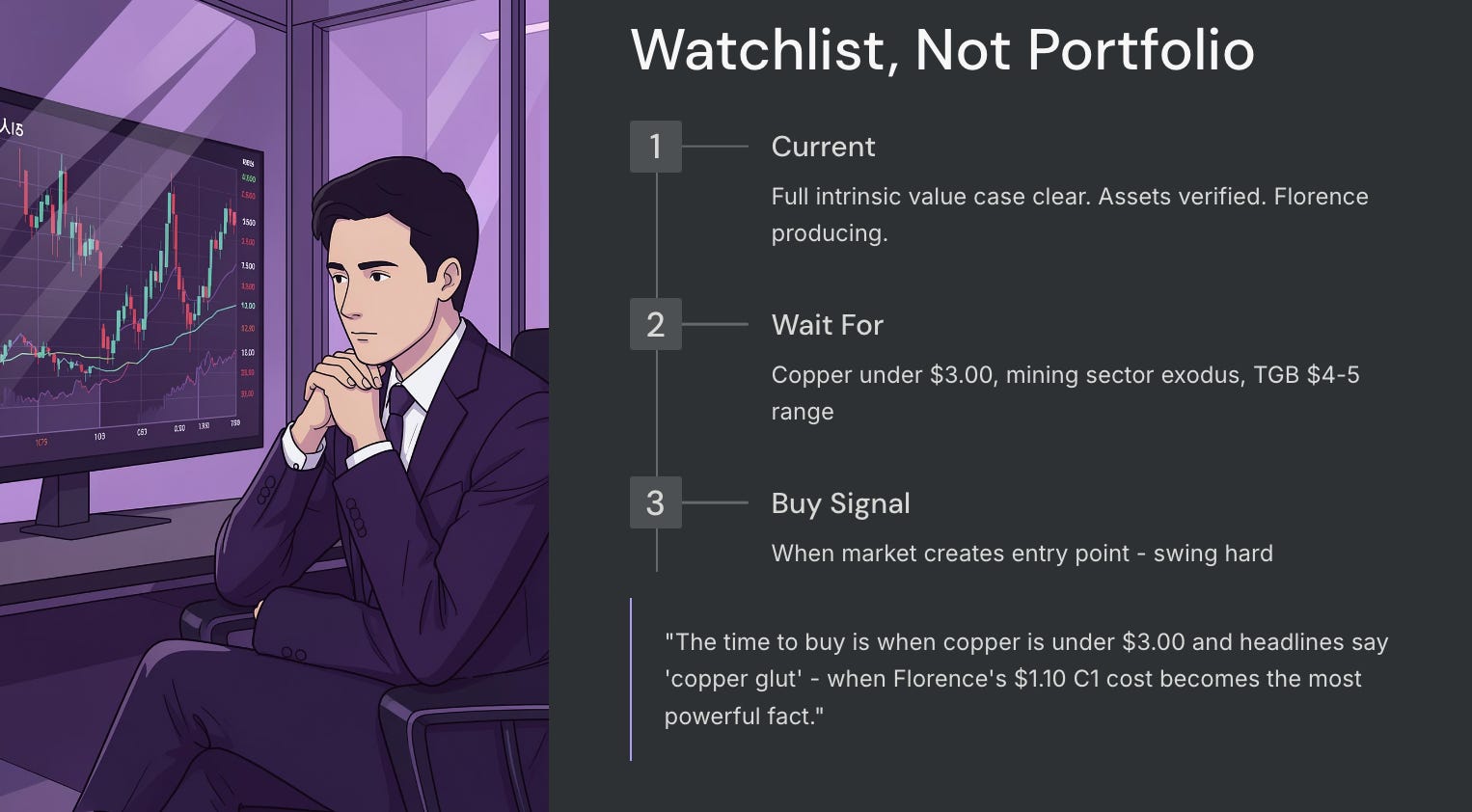
The conclusion of this analysis is not “buy immediately.” It is “watch very closely.” The distinction matters.
The intrinsic value case is clear and compelling. The assets are real, verified, and priced by the market at a substantial discount to their in-ground economic value. Florence is producing. Gibraltar is performing. The macro tailwinds for copper are as strong as any I have seen for a commodity in recent memory. The dilution risk is low. The management has executed the Florence construction on time and on budget — a genuinely difficult achievement for a first-of-kind greenfield mining project.
But timing is the variable that determines whether a right idea becomes a profitable investment.
The Wilshire 5000 to GDP ratio at 226% is not just a chart curiosity. It represents trillions of dollars of capital sitting in equity positions at valuations that presuppose a level of economic growth and corporate earnings expansion that, historically, has never been delivered. When that valuation reversion begins — and it will, because it always does — the first assets to sell are the cyclical ones. Copper is cyclical. Mining companies are cyclical. The market will sell Taseko before it sells Microsoft, because Taseko’s earnings are volatile and its narrative is difficult to tell at a cocktail party. That selling will create the entry point. And although we have significant proven reserves of Gold and Silver, they would still have to be unlocked by a capital catalyst.
The time to buy Taseko is when copper is under $3.00 per pound and the headlines say “copper glut” and the mining stocks have been abandoned. That is when the $1.10 C1 cost at Florence becomes the most powerful fact in the entire investment universe — because Florence is cash-flow positive even at $2.00 copper, while every conventional mine in the world is bleeding.
Alternatively, the time to buy is when Yellowhead reaches a final investment decision with committed financing, because at that point the market can begin to price it as a producing asset rather than a development option.
Until then, the thesis sits here on the watchlist, fully formed, waiting for the price to come to the idea rather than the idea chasing the price.
There is something almost Buffett-like in that discipline. He once described investing as waiting at the plate until the pitcher throws exactly the ball you want, with no called strikes. The pitcher for Taseko is still warming up. The ball I want — a copper-bearish macro selloff, a mining sector exodus, a temporary decline in TGB toward the $4-5 range, and a capital catalyst — has not yet been thrown.
When it is, I intend to swing hard.
The Full Picture, Summarized Without Mercy
What we have in Taseko Mines is a company that owns:
6.8 billion pounds of proven copper reserves, of which roughly 4 billion (Gibraltar plus Florence) are immediately or near-term actionable without large new CAPEX. It owns the first commercial-scale ISCR copper operation in the world, producing at $1.10 per pound against a $4.50-5.00 copper market. It owns 21,000 metric tonnes of molybdenum by-product worth over $700 million at current prices. It owns 14.2 tonnes of gold and 595 tonnes of silver worth a combined $3.54 billion.
The market cap is $2.5 billion.
The refined copper market is projected to shift from a surplus in 2025 to a deficit of 150,000 tonnes or more by 2026, against a backdrop where new mines take 20-29 years to permit in developed countries.
The bears will say: leverage, cyclicality, unproven ISCR ramp-up, $13-18 billion in eventual CAPEX needed to monetize all reserves, and a macro backdrop that has historically preceded commodity demand destruction.
All of those are fair. None of them are fatal to the thesis over a five to ten year horizon.
The mountain of copper in British Columbia and Arizona is not going anywhere. The acid in the Florence wellfield is dissolving it right now, bringing it to the surface at a cost structure that would have seemed like science fiction to a conventional miner fifteen years ago. And the world — with its EVs and its data centers and its wind turbines and its defense infrastructure — needs every pound of it.
The only question is the price at which you choose to acquire your share of what the earth has already made.
I know my price. I am waiting.
Disclosure: This is a personal investment analysis document, written for educational and watchlist purposes. It does not constitute financial advice. All figures sourced from Taseko Mines public filings, Taseko Q1 2026 operational update, S&P Global, BloombergNEF, Wood Mackenzie, Florence Copper project documentation, and International Copper Study Group public reports. The author does not currently hold a position in TGB.
If you like this read, check out my other writings 👇
Rust, Rigs, and the Recurring Revenue Hidden in Plain Sight: A Deep Dive into Beng Kuang Marine (SGX: BEZ)

The Old Steel and the Sea: Why You Should Care About a Ship Maintenance Company
Investment Reflection #2 — The Grand Play: 100 Years of the World’s Nations as Characters in the Greatest Story Ever Told

“The world is not a chessboard. It is a living organism, where every cell — every nation — eats, competes, cooperates, and occasionally tries to eat the others. Understanding it requires not just memorizing moves, but understanding hunger.”

The Tide Is Going Out: Commodity Houses, Private Credit, and the AI Debt Bomb

Start Here: What This Article Is About
Why I Passed on Graftech (EAF): Riding The Battery Hype, Or Perhaps Not...

There is a kind of company that is the most dangerous thing in investing. It is not the fraudulent company. It is not the obviously bad company with terrible products and incompetent management. Those are easy — you just avoid them. The truly dangerous company is the one with a
The Beautiful Trap: Why I'm Passing on The Hour Glass (SGX: AGS)

There’s a peculiar kind of investment that keeps you up at night — not because it’s bad, but because it’s genuinely good. Good enough to admire. Not good enough to buy.
The Diamond in the Rough That Isn't Quite Yours: Why I Passed on Boustead (SGX: F9D)

There is an old saying that investors have borrowed, bent, and quoted so many times it has nearly lost its sharpness: a bird in the hand is worth two in the bush. Warren Buffett, characteristically, gave it a precise mathematical form. The value of any investment, he wrote, is determined by three questions:
The Schoolteacher's Secret Insurer: Why Horace Mann (NYSE:HMN) Is Sitting on My Watchlist

“The stock market is a device for transferring money from the impatient to the patient.” — Warren Buffett

The Dormitory King That Couldn't Leave Home: Why I Passed on Centurion (SGX: OU8)

There is a deceptively simple question that Warren Buffett borrowed from Aesop’s ancient fable, and has repeated across decades of shareholder letters: “How many birds are in the bush? How sure are you they’re there? And how long until you get them out?”
The Children's Place: A $90 Million Bet on a Company That Used to Be Worth $2 Billion (NYSE: PLCE)

There is a classic scene in every heist movie. The detective walks into a room, sees the chalk outline, the scattered evidence, the broken window, and immediately knows something went terribly wrong long before anyone called the police. You do not need the full autopsy report to read the body.
World War 3 In Iran and Why Oil Price Will Continue Increasing — It Arrived Sooner Than Anyone Expected

This is Part 2 of a continuing analysis of California Resources Corp (CRC). Part 1 built the foundational investment case: a company trading at $44 per share against a conservative intrinsic value of $108–$156, built on 567 million barrels of proved developed oil reserves in California, and a management team spending hundreds of millions buying back its…
The Most Overlooked Oil Company in America — And Why That Might Be the Opportunity of the Decade

Date of analysis: 28 December 2025
The Art Of Saying No - MYPS: Playstudios Inc

PLAYSTUDIOS (MYPS) is a Las Vegas-based mobile gaming company that operates free-to-play social casino games and a loyalty platform called playAWARDS, which lets players redeem points for real-world rewards at places like MGM Resorts, Norwegian Cruise Line, and Wolfgang Puck restaurants. On the surface, this sounds like a clever moat. A loyalty program.…
The Art Of Saying No - UGP: Ultrapar Participacoes S.A (Part 2 of 2)

Question 2: How Certain Are You?
The Art Of Saying No - GLIBK: GCI Liberty Inc

Picture this: a single telecommunications company — the dominant one — serves over 200 communities scattered across the largest state in the United States. Alaska. A state with just over one person per square mile. A state where 39% of residents are underserved by broadband. A state where, until recently, some villages received internet via satellite li…

The Art Of Saying No - UGP: Ultrapar Participacoes S.A (Part 1 of 2)

The Setup: A Value Investor Dream?


The Art of Saying No - RIG: Transocean LTD

“The difference between successful people and really successful people is that really successful people say no to almost everything.” — Warren Buffett
The Art of Saying No - KPRX: Kiora Pharmaceuticals Inc

“The difference between successful people and really successful people is that really successful people say no to almost everything.” — Warren Buffett
The Art of Saying No - DNUT: Krispy Kreme Inc

“The difference between successful people and really successful people is that really successful people say no to almost everything.” — Warren Buffett

🎓 A Business Strategy Primer Part 7 - Learning From Great Companies

The Billion-Dollar Playbook: How Market-Based Management Powered Koch Industries’ Unstoppable Rise
The Art of Saying No - MRX: Marex Group PLC

“The difference between successful people and really successful people is that really successful people say no to almost everything.” — Warren Buffett


The Art of Saying No - SFIX: Stitch Fix Inc

“The difference between successful people and really successful people is that really successful people say no to almost everything.” — Warren Buffett
🎓 A Business Strategy Primer Part 2 - Brainstorming Solutions With Value At The Core

Creating An Irresistible Offer
The Art of Saying No - TDOC: Teladoc Health Inc

“The difference between successful people and really successful people is that really successful people say no to almost everything.” — Warren Buffett

The Art of Saying No - MDU: Mdu Resources Group Inc

“The difference between successful people and really successful people is that really successful people say no to almost everything.” — Warren Buffett


The Art of Saying No - AFCG: Advanced Flower Capital Inc

“The difference between successful people and really successful people is that really successful people say no to almost everything.” — Warren Buffett
The Art Of Saying No - VYX: NCR Voyix Corp

“The difference between successful people and really successful people is that really successful people say no to almost everything.” — Warren Buffett
The Art of Saying No - VSTS: Vestis Corp

“The difference between successful people and really successful people is that really successful people say no to almost everything.” — Warren Buffett

🛢️Basic Energy Primer Part 2 - Business and Competitive Landscape

The Man Who Bet Everything on Being Wrong
The Art of Saying No - CISS: C3is Inc

“The difference between successful people and really successful people is that really successful people say no to almost everything.” — Warren Buffett
The Art of Saying No - PSHG: Performance Shipping Inc

“The difference between successful people and really successful people is that really successful people say no to almost everything.” — Warren Buffett

The Art Of Saying No - MAGN: Magnera Corp

The Magnera Corporation Analysis Nobody Asked For (But Everyone Needs)
The Art of Saying No - CHR: Cheer Holding Inc

“The difference between successful people and really successful people is that really successful people say no to almost everything.” — Warren Buffett
The Art of Saying No - WIMI: WiMi Hologram Cloud Inc.

“The difference between successful people and really successful people is that really successful people say no to almost everything.” — Warren Buffett
⚡️Alternative Energy Primer Part 3 - Industry and Sector Technicals

The €2.2 Billion Mistake That Revealed Everything
⚡️Alternative Energy Primer Part 2 - Business & Competitive Landscape

The Shipwreck That Changed Everything

🏥 A U.S. Health Insurance (Managed Care Organizations) Sector Primer

1️⃣ Industry Fundamentals & Macro View

