

Before We Begin: A Story About the Same Asset Being Valued at Two Different Numbers on the Same Day
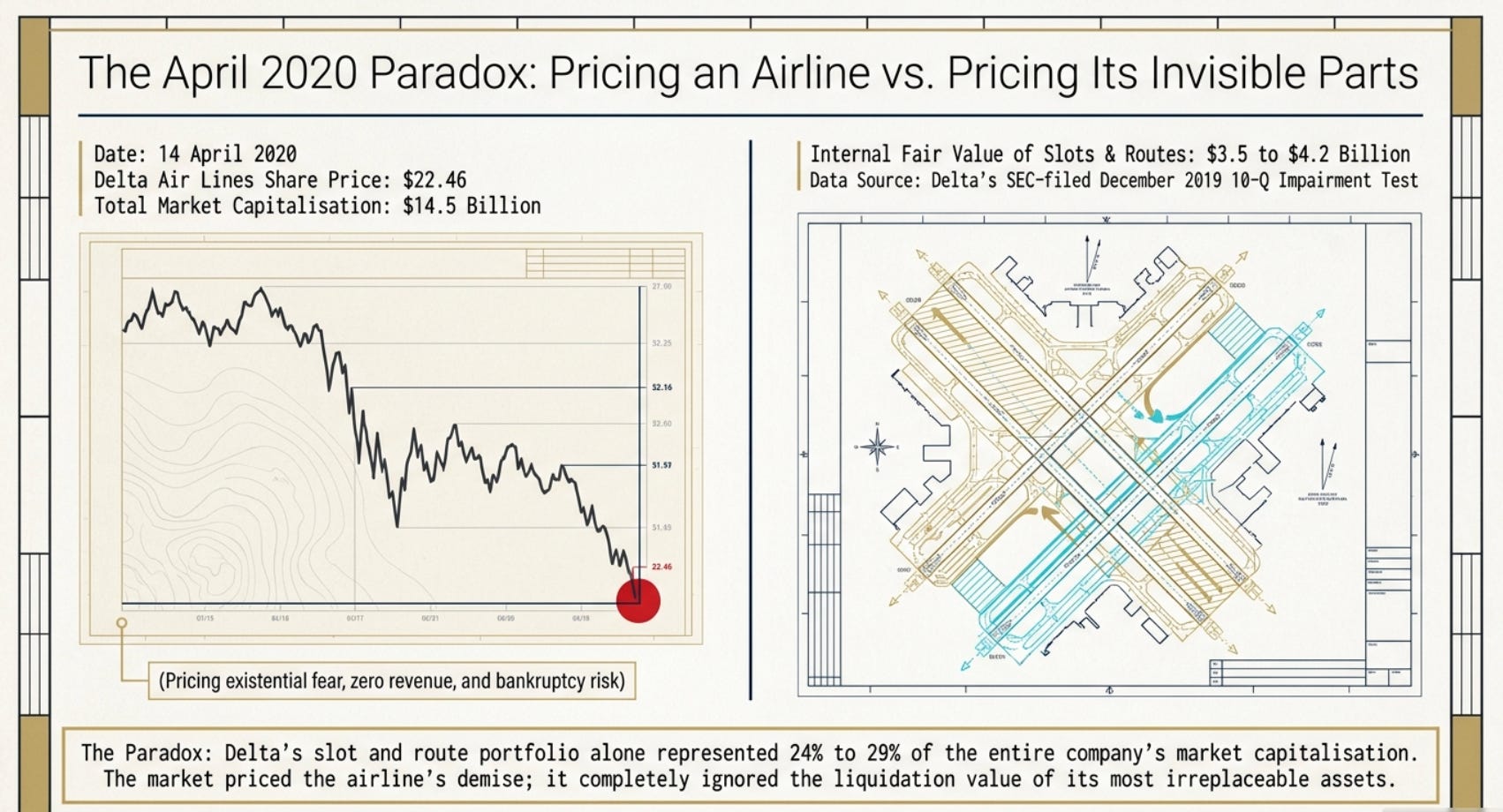
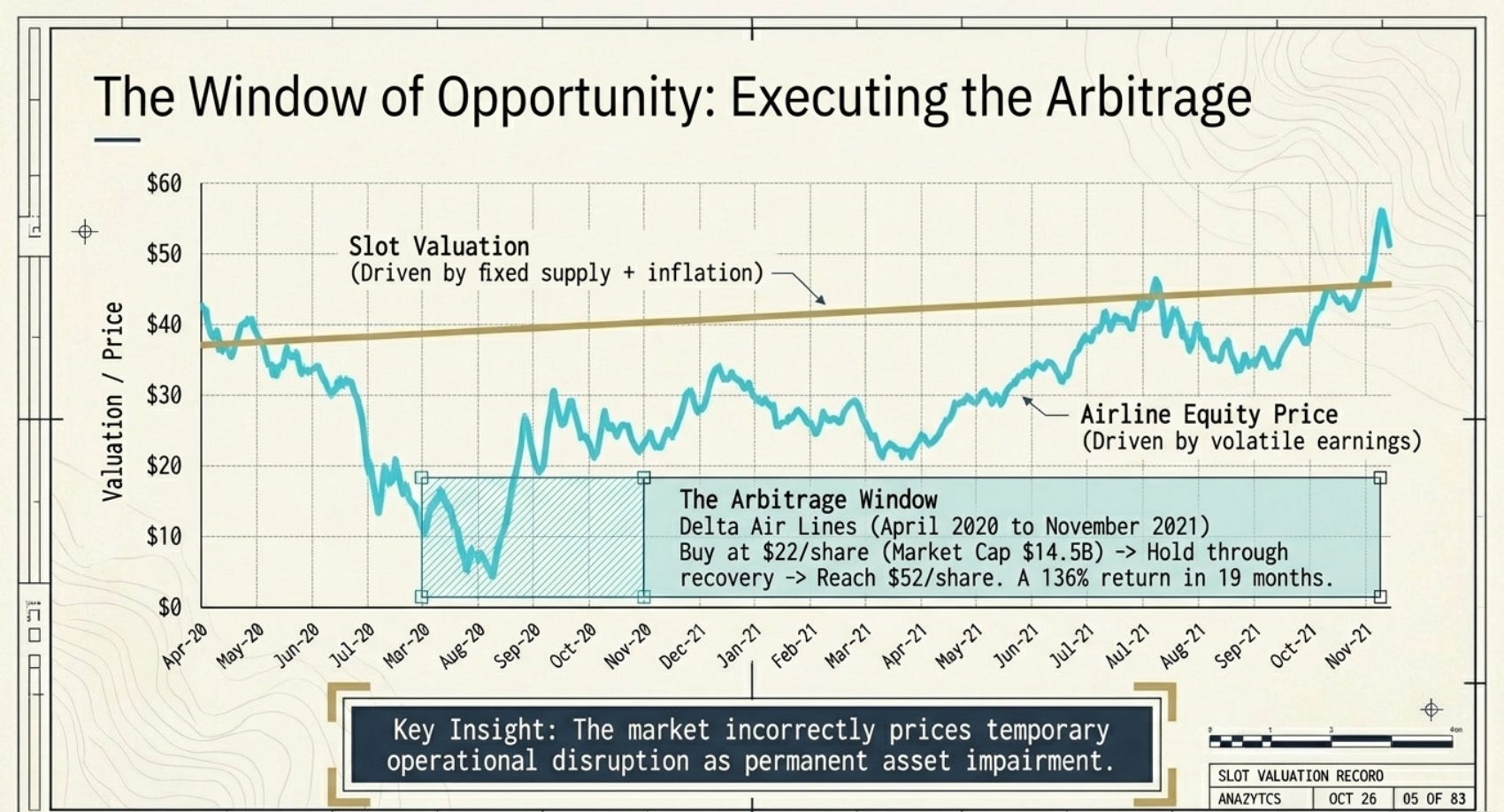
On April 14, 2020, Delta Air Lines’ stock closed at $22.46 per share. With approximately 645 million shares outstanding, the market capitalisation was roughly $14.5 billion. The market had decided, in the crucible of a global pandemic that had grounded 95% of commercial aviation, that the entire Delta Air Lines enterprise — aircraft, gates, routes, brand, customer relationships, loyalty programme, and everything else — was worth $14.5 billion.
On that same day, the slot portfolio that Delta held at New York’s LaGuardia Airport, Ronald Reagan Washington National Airport, and John F. Kennedy International Airport — the legal rights to take off and land at specific times at three of the busiest and most constrained airports in the United States — was sitting on Delta’s balance sheet. The disclosed carrying value for Delta’s domestic slots, as reported in its December 2019 10-Q impairment test, was $622 million. Delta’s own fair value assessment at that same December 2019 test showed that the fair value of those domestic slots exceeded the carrying value by 61% to 181%.
Apply even the low end of Delta’s own fair value disclosure — 61% above the $622 million carrying value — and the domestic slots alone were worth approximately $1 billion in Delta’s own reckoning at pre-pandemic testing. Add the international routes and slots, which Delta disclosed at a carrying value of $2,583 million with a fair value 15% to 29% above that, and the total slot and route intangible portfolio had a Delta-disclosed fair value of approximately $3.5 to $4.2 billion — based on the company’s own impairment testing numbers, filed with the SEC.
In April 2020, the market capitalization of the entire airline was $14.5 billion. The slot portfolio alone, at values Delta’s own accountants were comfortable defending to auditors just four months earlier, represented roughly 24% to 29% of the entire market cap of the company. The question the stock market was not asking — because the stock market was busy pricing in bankruptcy, zero revenue, and existential fear — is what is the slot portfolio worth on a standalone basis, and how much of the company’s total value does that represent at the current market price?
The answer, if you had asked it, was: more than the market thought. Much more. This paper is about why.
PART I: WHAT AN AIRPORT SLOT ACTUALLY IS — BEFORE ANY FINANCE
The Physics of Congested Airspace
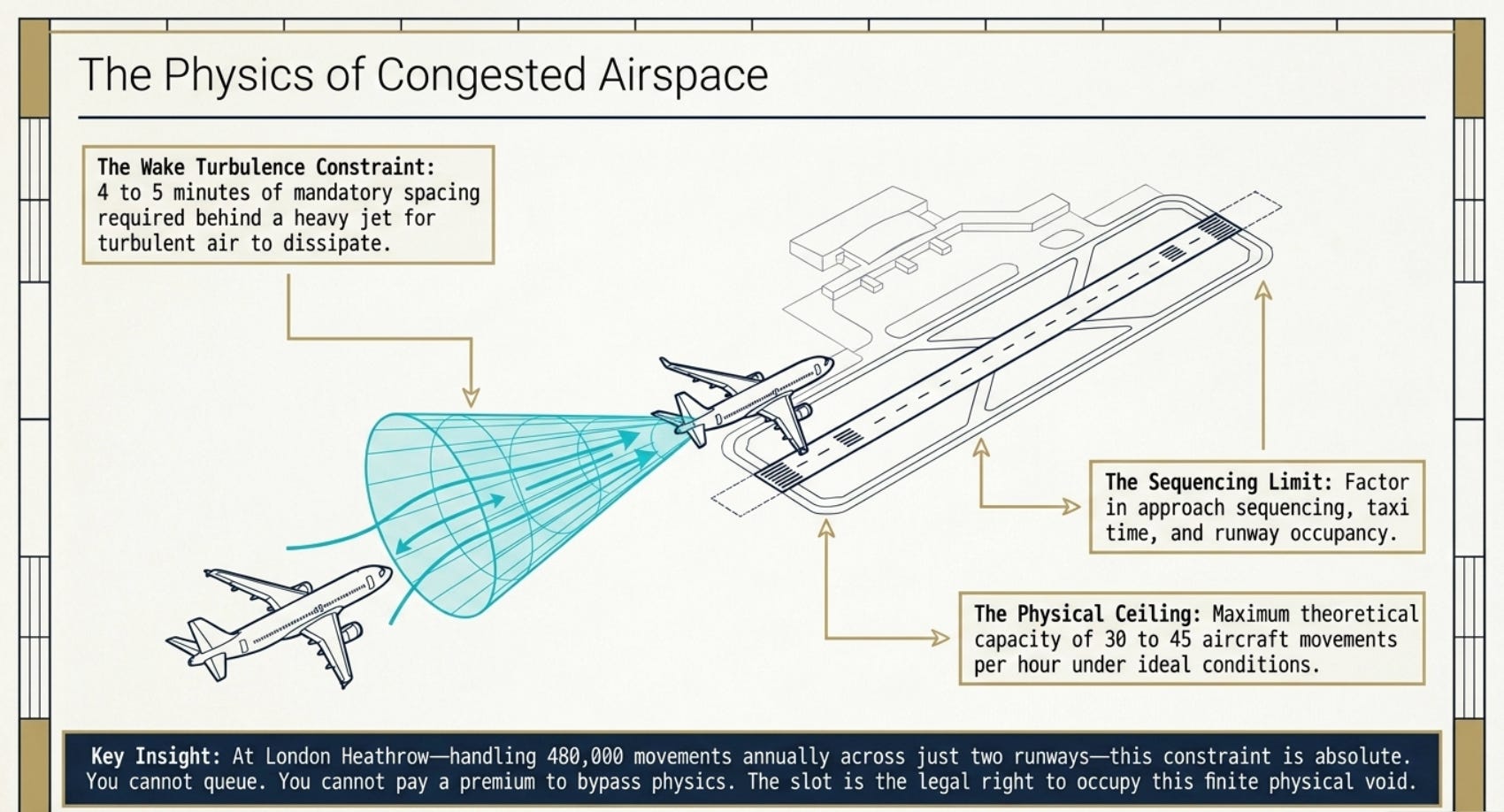
An airport runway can only handle a certain number of aircraft movements per hour. This is not a policy choice. It is physics, aerodynamics, and safety regulation combined. A runway requires a certain minimum spacing between successive aircraft to allow the preceding aircraft’s wake turbulence to dissipate. For a large aircraft like a Boeing 777 taking off ahead of a smaller regional jet, that spacing might be four to five minutes. For two large jets in sequence, perhaps two to three minutes. Factor in the approach sequencing, the taxi time, the runway occupancy time, and the departure roll, and you arrive at a maximum theoretical capacity for a single runway of roughly 30 to 45 aircraft movements per hour under ideal conditions.
At London Heathrow — two runways, four terminals, handling roughly 480,000 aircraft movements per year — this constraint is not theoretical. It is the fundamental reality around which the entire airport operates. Every take-off and landing at Heathrow has been planned, allocated, coordinated, and slotted into a precise window. If you arrive at a Heathrow runway without a slot, you do not take off. There is no queue you can join by simply showing up. The slot — the government-allocated authorisation to use the runway at a specified time — is the legal right to occupy a piece of the airport’s most finite and most irreplaceable resource: the runway itself.
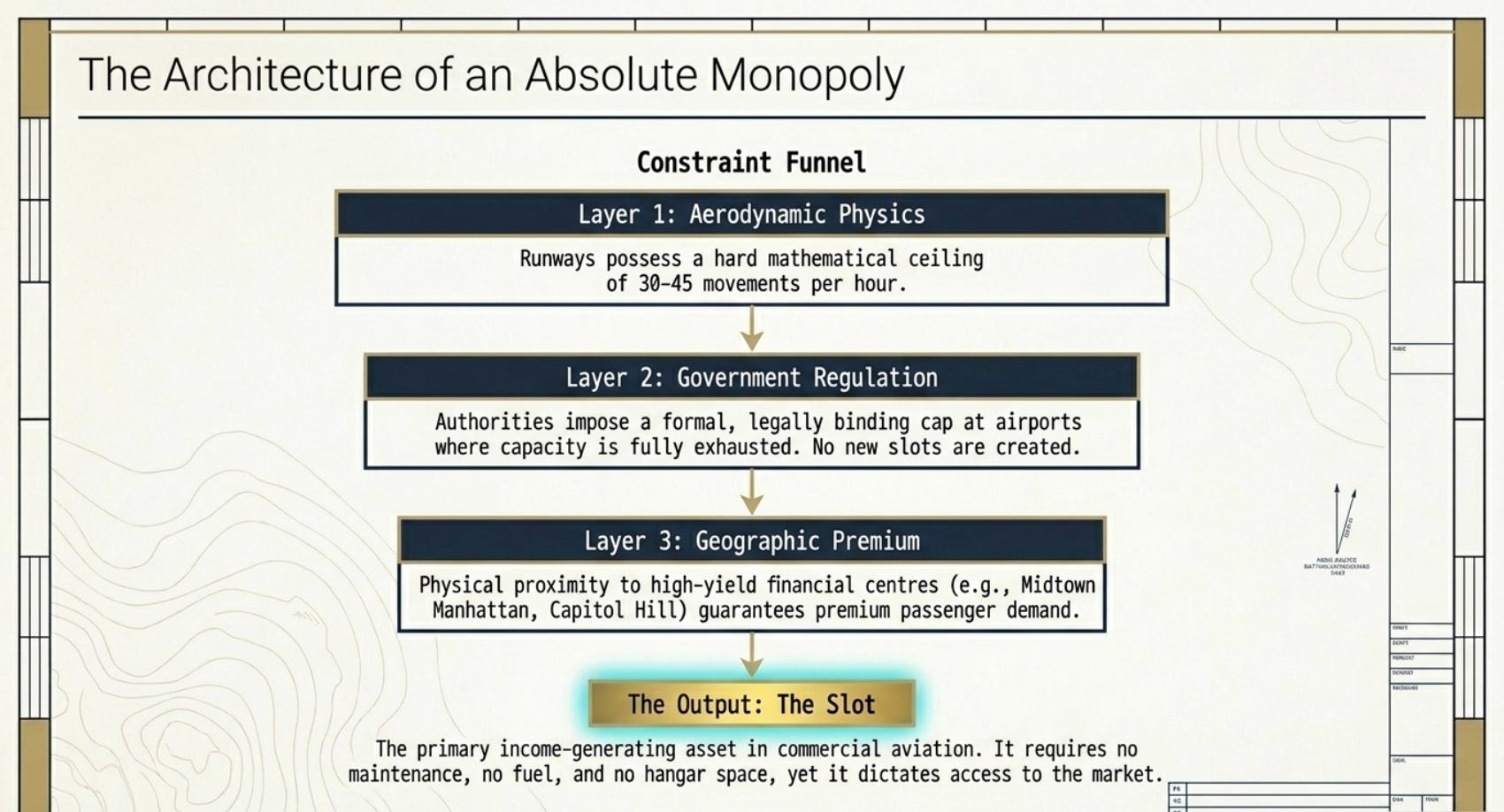
At the six truly slot-controlled airports in the world — Heathrow, LaGuardia, Reagan National, Tokyo’s Haneda, Sydney Kingsford Smith, and a handful of others — the government has made a formal, permanent, legally binding determination that the runway capacity is fully allocated. There is no more. No new entrant can simply pay to use these runways during peak hours because there are no slots available for sale by the airport. The only way to obtain a slot at a slot-controlled airport is to buy one from a carrier that already holds one, negotiate an exchange, or wait for the essentially nonexistent event of an existing carrier surrendering a slot voluntarily.
This is the asset. Not the airline. Not the aircraft. Not the brand. The slot — the piece of government authorisation to use a runway at a specific time — is the primary income-generating asset at these airports, and its scarcity is absolute.
Why Some Airports Are More Equal Than Others
Not every airport is slot-controlled, and not every slot-controlled airport is equally valuable. The economics of a slot are determined by two factors: the pricing power of the routes that can only be served from that airport, and the regulatory permanence of the constraint that makes the slot scarce.
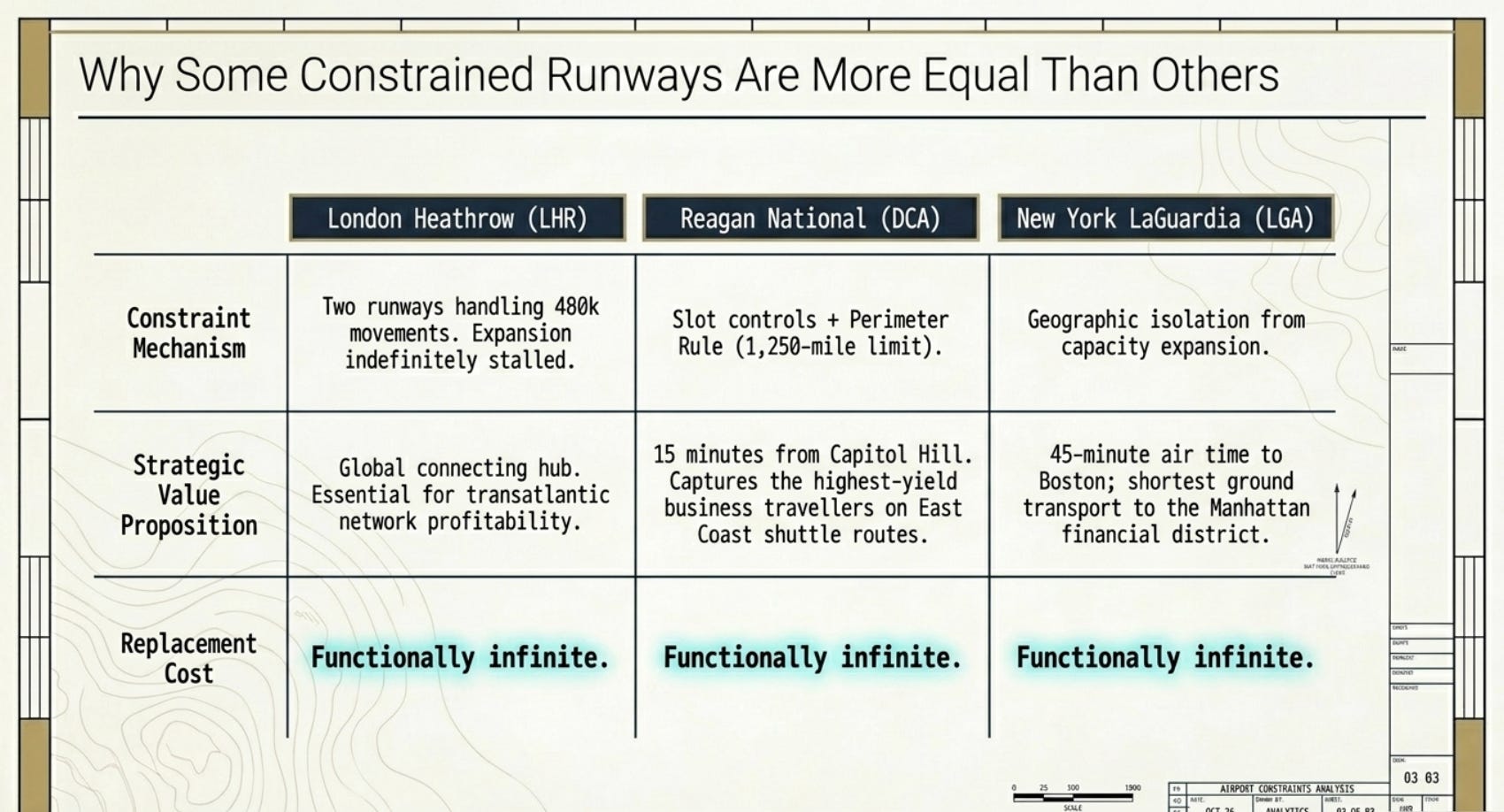
Reagan National Airport in Washington, DC operates under both slot controls and a perimeter rule — airlines can only fly non-stop to destinations within 1,250 miles of the airport, with a small number of exceptions for limited beyond-perimeter destinations. The perimeter rule concentrates demand at DCA from exactly the markets where frequency and schedule convenience matter most: the business travellers on the Washington-New York, Washington-Boston, Washington-Chicago, and Washington-Atlanta corridors who will pay premium fares for the ability to fly into an airport 15-minutes from Capitol Hill rather than making the 45-minute journey from Dulles. A slot pair at Reagan National is not merely the right to take off and land. It is the right to offer the most convenient service to some of the highest-yield business travellers in the United States.
LaGuardia, similarly, serves New York’s business community with proximity that JFK and Newark cannot match for travellers heading to Midtown Manhattan. A shuttle from LaGuardia to Boston takes 45 minutes in the air and drops passengers within a reasonable taxi or subway ride of the financial district. The same journey from JFK adds 30 to 40 minutes of ground transportation. For the financial executive who makes this trip multiple times per week, the LaGuardia slot is worth paying a premium for — and that premium feeds directly into the economic value of the slot.
Heathrow’s value proposition is different but equally structural. It is the primary connecting hub for transatlantic traffic between Europe and North America. A carrier without Heathrow access cannot offer the connectivity — the ability to connect from dozens of European cities to dozens of North American cities through a single hub — that Heathrow provides. This is not merely a matter of passenger preference. It is a matter of commercial impossibility: the connecting traffic that makes a transatlantic network profitable requires the hub infrastructure that only Heathrow provides at the scale and geography that airlines need. A carrier without Heathrow slots cannot compete meaningfully for premium transatlantic connecting traffic. A carrier with Heathrow slots has access to a market that is genuinely closed to carriers without them.
PART II: THE ACCOUNTING TREATMENT — HOW ZERO BECAME THE MOST IMPORTANT NUMBER IN AIRLINE FINANCE
The Origin Story of the Grandfather Slot
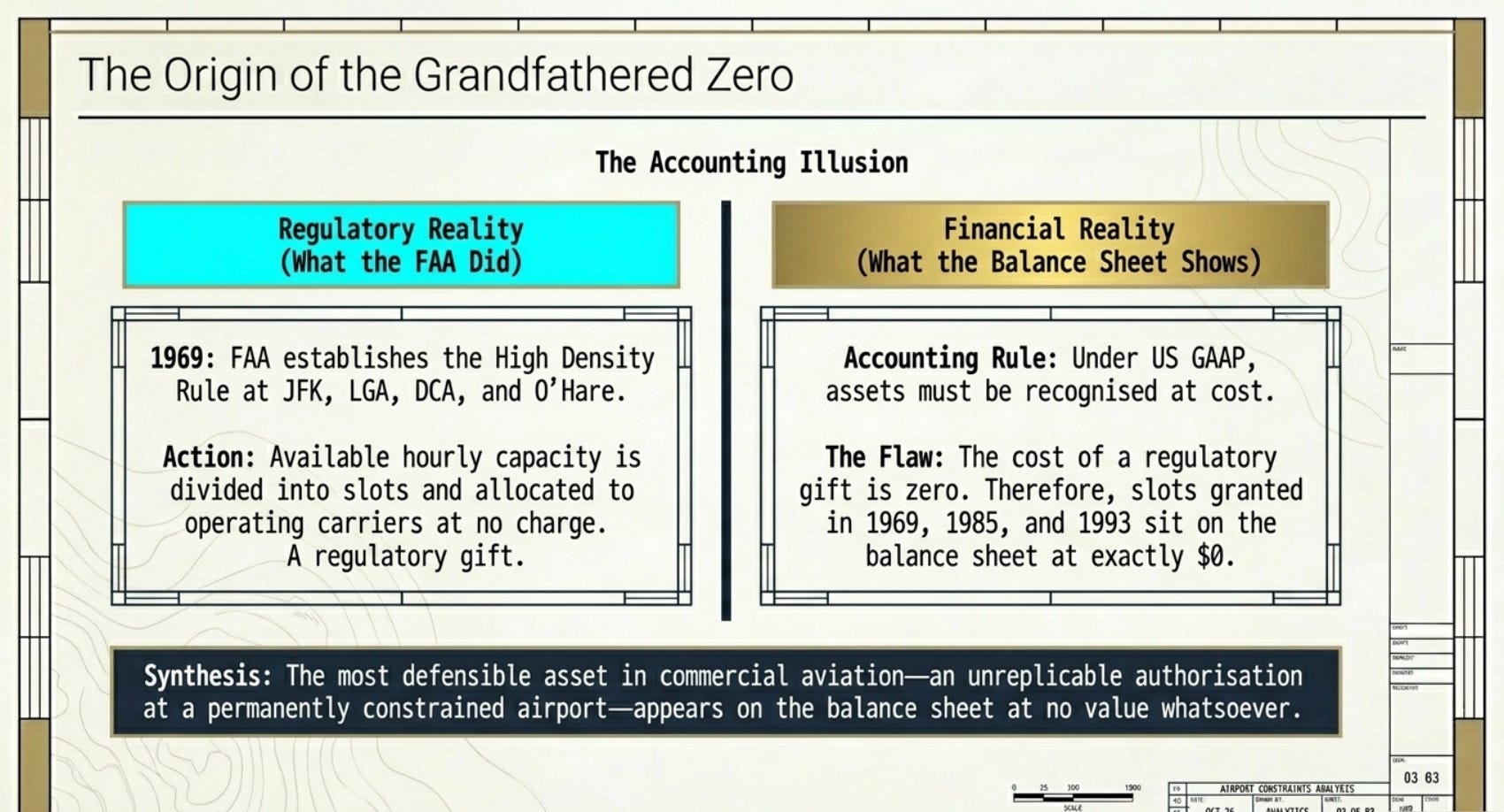
The slot system at US airports was established under the FAA’s High Density Rule, initially implemented in 1969 at four airports: JFK, LaGuardia, Reagan National, and O’Hare. The rule divided the available hourly capacity of each airport into a fixed number of slots and allocated those slots to the carriers then operating at each airport — at no charge. Airlines that were flying from LaGuardia in 1969 received their slots for free, as a regulatory gift from the federal government in the form of authorised operating rights.
These original slot allocations — and subsequent allocations made as part of the 1985 and 1993 slot control reforms — are carried on airline balance sheets at exactly what the airlines paid for them: zero. Nothing was purchased. No consideration changed hands. The FAA granted the rights administratively, and the accounting standards in place at the time (and since) require assets to be recognised at cost. The cost of a regulatory gift is zero. Therefore, the balance sheet value of these grandfathered slots is zero.
This creates the foundational absurdity at the heart of this paper: the asset that is most definitively not replicable by any competitor — an authorisation to use a runway at a permanently constrained airport, allocated by a government agency that has not created a new runway-capacity slot in decades — appears on the balance sheet of its owner at no value whatsoever.
Slots purchased in the secondary market since the post-1993 liberalisation of slot trading are treated differently. Under US GAAP, these slots are recognised as indefinite-lived intangible assets at their purchase cost, not amortised (because their useful life is indefinite), and tested annually for impairment — therefore resulting in a higher absolute value in the future, due to inflation. Delta’s domestic slot portfolio — which includes a mix of originally grandfathered slots and subsequently purchased slots — carried a net value of $622 million on its balance sheet. American Airlines’ intangible asset footnote in its 2023 10-K groups its airport slots within a broader intangibles disclosure totalling approximately $2 billion in net intangibles, which includes both slots and routes.
The critical point is that neither the carrying value of $622 million for Delta’s domestic slots nor the approximately $2 billion in total net intangibles for American’s portfolio bears any relationship to the transaction prices that these assets command in the secondary market. The carrying values reflect a combination of historical zeros (for grandfathered slots) and historical purchase prices from transactions that may be 20 or 30 years old. The market value of the assets as of any given day reflects current demand from airlines willing to pay today’s prices for access to today’s most congested airports.
PART III: THE OWNER’S VALUATION — WHAT THE SECONDARY MARKET ACTUALLY PAYS
The Transaction Record That Wall Street Ignores
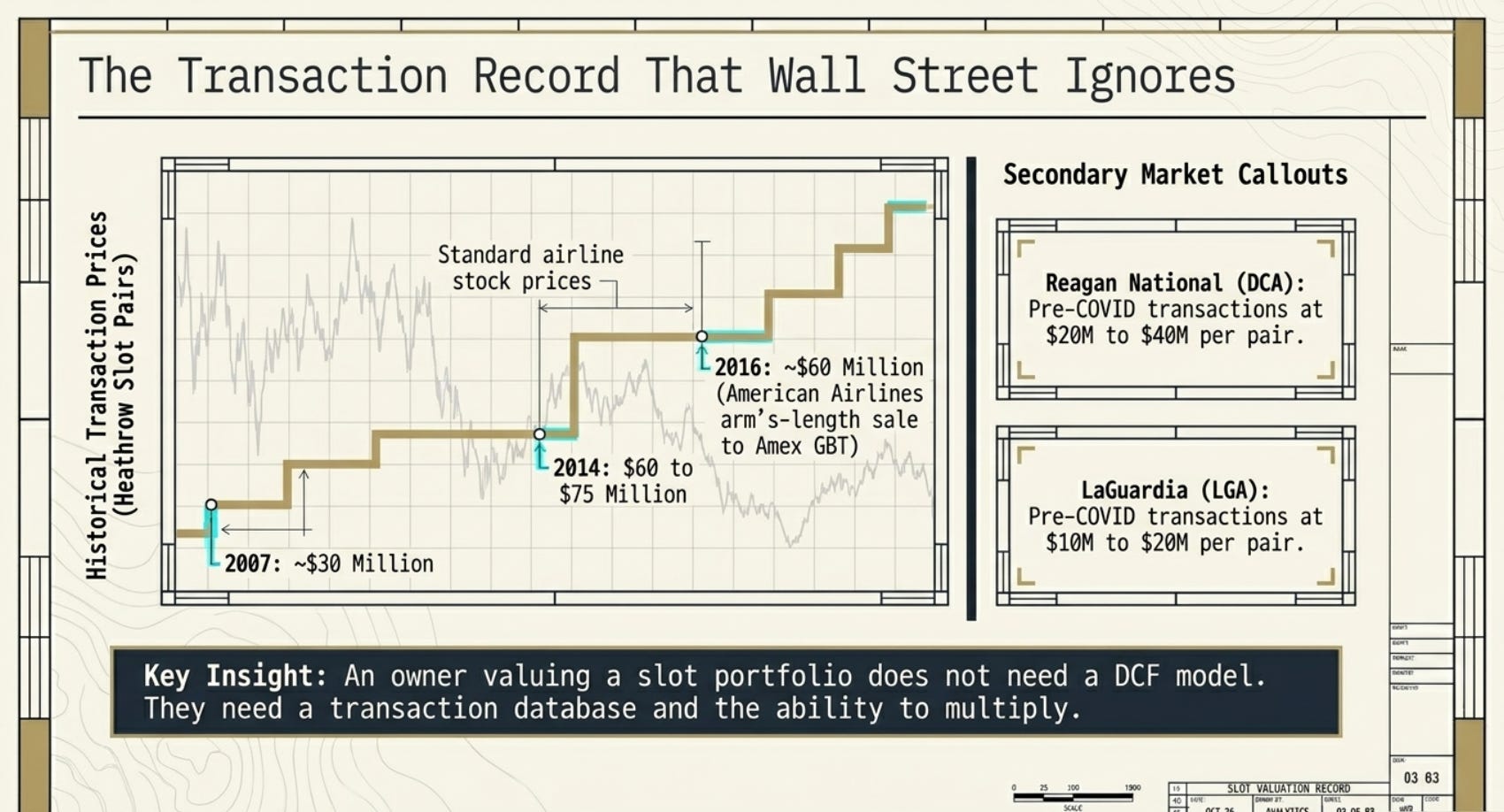
An owner valuing an airline’s slot portfolio does not need a financial model. They need a transaction database and the ability to multiply. The secondary market for airport slots has produced documented, arm’s-length transactions at prices that are publicly available from SEC filings, regulatory disclosures, and industry reporting. These prices are as objective as the current copper spot price or the LIFO reserve disclosed in a steel distributor’s footnote. They represent what a willing buyer and a willing seller agreed on in a competitive process, with full information about the asset.
At London Heathrow, the most liquid and most expensive slot market in the world, the transaction record shows consistent escalation. In 2007, a pair of Heathrow slots sold for approximately $30 million. By 2014, comparable slot pairs were transacting at $60 to $75 million. In 2016, American Airlines sold a pair of Heathrow slots to American Express Global Business Travel for approximately $60 million — a disclosed arm’s-length transaction. Virgin Atlantic, in December 2015, used its Heathrow slot portfolio as collateral for a £225 million private placement bond — effectively obtaining a market-based valuation of the slots from professional debt investors who needed to be confident in the collateral value before lending against it.
At Reagan National, the transaction record shows slot pairs at $20 to $40 million in the years preceding COVID. At LaGuardia, slot pairs have transacted at $10 to $20 million. These are not estimates or opinion. They are the prices at which airlines have actually transferred slots to each other, often disclosed in SEC filings because the transactions were material enough to require regulatory reporting.
Applying the Transaction Database to a Specific Airline
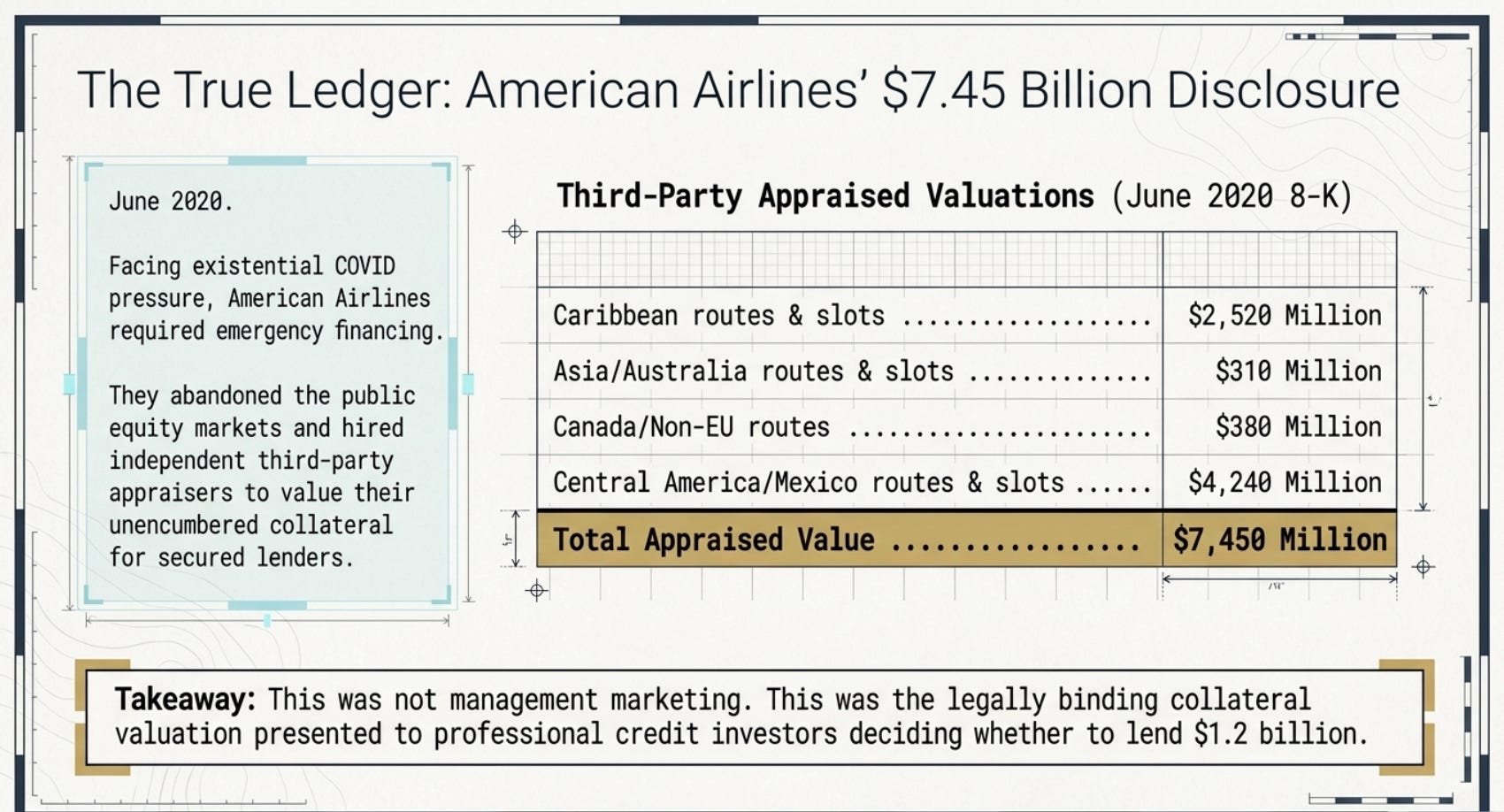
Consider American Airlines’ disclosure in its June 2020 8-K filing with the SEC. Facing the existential financial pressure of COVID, American’s management produced a detailed asset-by-asset breakdown of the company’s unencumbered assets for the purpose of securing emergency financing. The filing disclosed the following third-party appraised values for its Slots, Gates, and Routes portfolio:
Caribbean routes and associated slots: $2,520 million
Asia and Australia routes and associated slots: $310 million
Canada and Non-EU routes: $380 million
Central America and Mexico routes and slots: $4,240 million
Total Slots, Gates, and Routes (disclosed): $7,450 million
These values were not produced by American Airlines’ management for marketing purposes. They were produced by independent third-party appraisers — the same appraisers that lenders and investors use when deciding whether to lend money against an asset. They represent the professional opinion of people whose livelihoods depend on producing accurate valuations that can withstand scrutiny, because the alternative — overvaluing collateral — is what gets appraisers sued and lenders bankrupted.
This is not a theoretical argument about what the assets might be worth under optimistic assumptions. It is the comparison between independently appraised values that American itself was presenting to professional lenders — people who were deciding whether to extend $1.2 billion in emergency financing secured by the LGA/DCA slots — and the market price of the equity at the same moment.
PART IV: STORIES FROM THE TARMAC — THREE CASE STUDIES IN SLOT VALUE ARBITRAGE
American Airlines’ COVID Financing: When the Company Itself Proved the Asset’s Worth
The most authoritative evidence that airline slots have substantial standalone value independent of the airline’s operating condition came not from an investor thesis or an analyst report. It came from American Airlines’ own crisis financing in 2020.
In July 2020, with global air travel at approximately 5% of normal levels, no meaningful revenue, and a deeply uncertain future, American Airlines needed to raise emergency capital to survive. The company had two choices: sell equity at deeply diluted prices, reflecting the crisis-level market capitalisation, or find assets to pledge as collateral to secured lenders. Management chose the latter.
On July 23, 2020, American filed an 8-K disclosing that Goldman Sachs had committed to purchase $1.0 billion in IP Notes and $200 million in LGA/DCA Notes — the latter secured by a first-lien interest in American’s slots at LaGuardia and Reagan National. The LGA/DCA slots, which on the balance sheet were carried at historical cost values reflecting a mix of zero (for grandfathered slots) and old acquisition prices, were being used as collateral for $200 million in emergency financing at a moment when the entire airline was under existential financial stress.
The lenders extending $200 million against these slots were professional credit investors who were not motivated by sentiment or narrative. They were motivated by the recovery value of the collateral if American Airlines defaulted. Their willingness to lend $200 million against the LGA/DCA slots — at the darkest moment of the airline industry’s history in generations — confirmed that independent, financially-sophisticated market participants believed the slots had a standalone value substantially in excess of $200 million. Lenders do not extend credit against collateral at 100% of their assessed value; they extend it at a loan-to-value ratio that protects them from downside. A $200 million loan against collateral appraised conservatively might require $300 to $400 million in slot value to support the lending decision. The slots delivered that, and they delivered it in April 2020, when zero aircraft were flying from those airports.
JetBlue, simultaneously, raised $750 million using airport slots at JFK and LaGuardia — along with other collateral — as security for a secured term loan. The lenders to JetBlue and American were making the same bet in parallel: that the regulatory right to use these specific runways at these specific times was worth real money regardless of what was currently happening to airline revenues, because that right would return to full productive use when the pandemic ended, and at that point, the slot’s value would reflect the same secondary market prices that had prevailed in 2019.
They were correct. Both loans were repaid. The slots retained their value. The airlines that survived — which most major US carriers did, albeit with significant government assistance — emerged from COVID with their slot portfolios intact.
The Heathrow Premium: When Slots Are Worth More Than the Planes
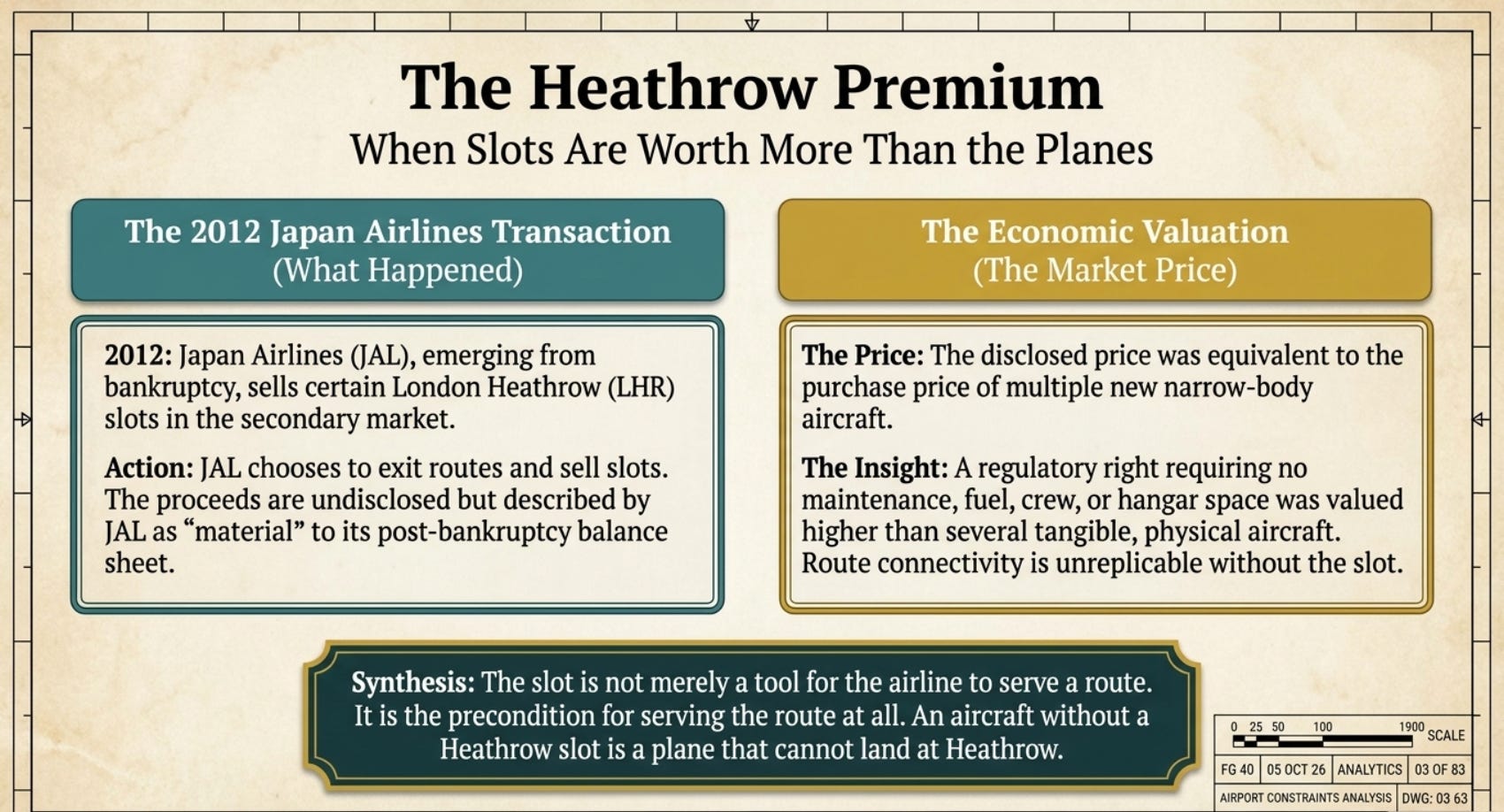
In 2012, Japan Airlines (JAL), emerging from a 2010 bankruptcy and restructuring, made a decision that attracted relatively little attention in the Western financial press but that illustrated the economics of slot ownership with extraordinary clarity. JAL, as part of its operational restructuring, chose to exit certain of its London Heathrow slots rather than maintain the routes those slots enabled. The slots were sold in the secondary market. The proceeds were, by JAL’s own accounting, material to its post-bankruptcy balance sheet.
The price paid for those JAL Heathrow slots — disclosed in filings with Japanese regulators — was equivalent to the purchase price of multiple new narrow-body aircraft. The slot rights, which took up no hangar space and required no maintenance, no fuel, no crew, and no insurance, were worth as much as several tangible, physical aircraft. A buyer trying to replicate the route connectivity that those Heathrow slots enabled could not have done so by buying the equivalent aircraft at any price, because without the Heathrow slots, the aircraft had nowhere to land during the peak hours required to make the transatlantic route commercially viable.
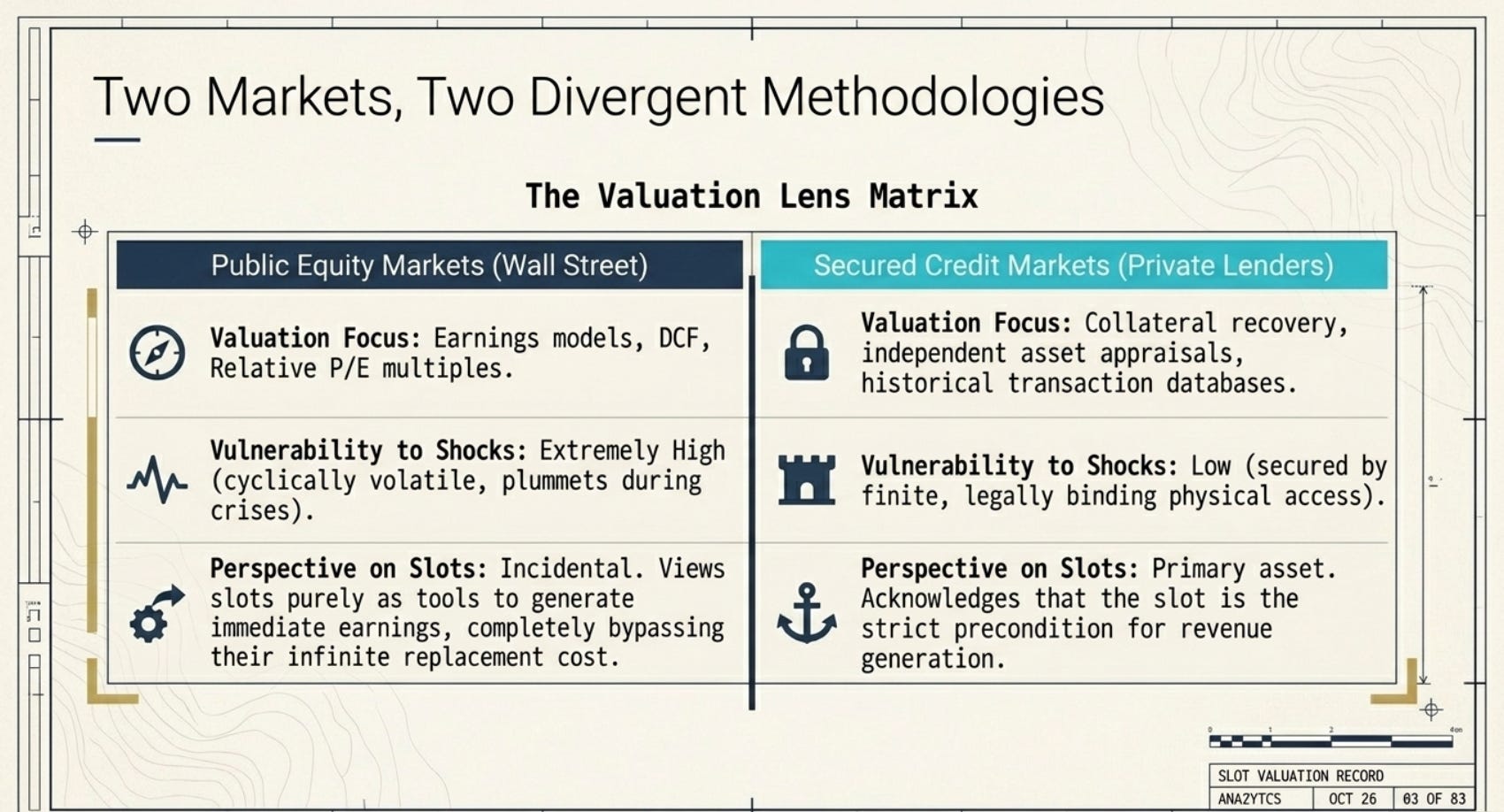
This transaction illustrates what the earnings model perpetually obscures: the slot is not merely a tool for the airline to serve a route. It is the precondition for serving the route at all. An aircraft without a Heathrow slot is a plane that cannot land at Heathrow. A carrier without Heathrow slots is a carrier that cannot compete for premium transatlantic traffic through London. The slots come first. The routes, the revenue, and the earnings follow. But an earnings model (e.g. DCF, Relative PE.etc) counts the revenue and prices it with a multiple, completely bypassing the question of whether the precondition for generating that revenue — the slot — is cheap or expensive relative to its replacement cost, which is functionally infinite.
Delta’s COVID Trough and What a Patient Investor Saw
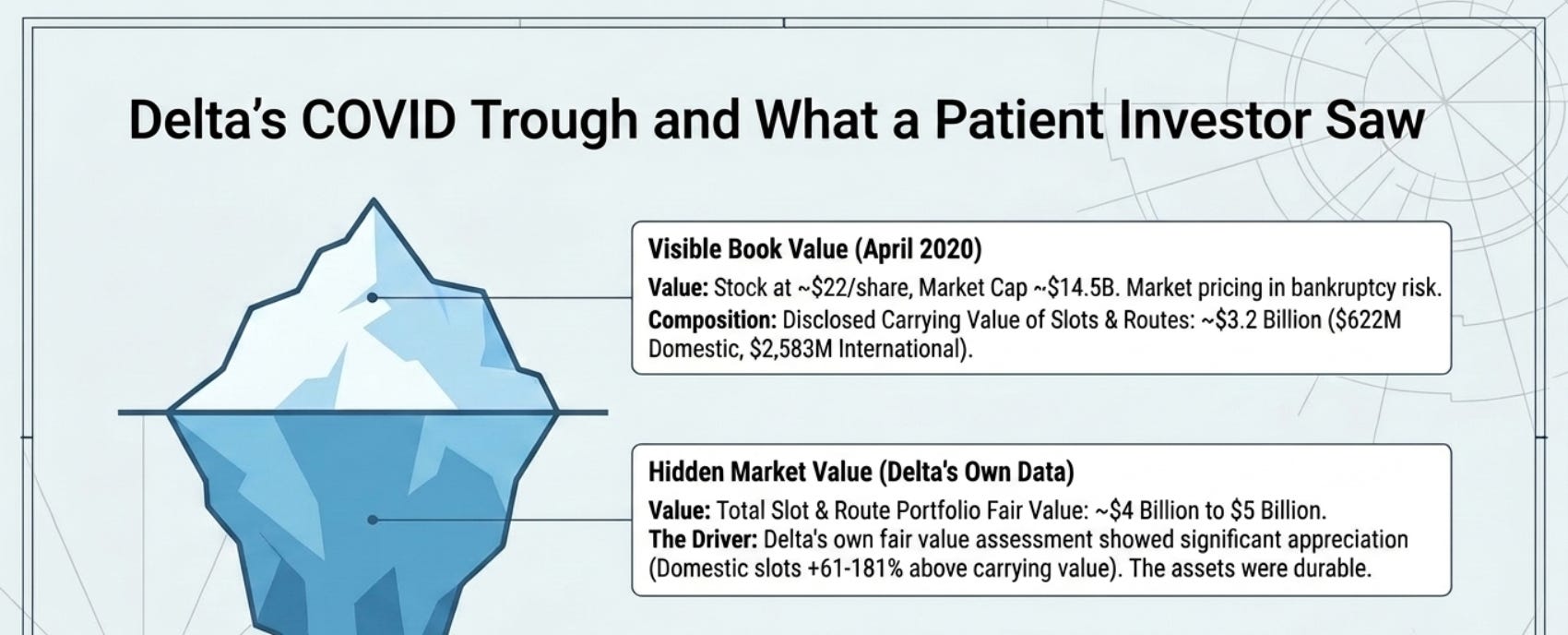
Return to April 14, 2020. Delta Air Lines trades at $22.46 per share, $14.5 billion total market cap. The company’s December 2019 10-Q impairment test has disclosed:
Domestic slots: $622 million carrying value, fair value 61% to 181% above that. International routes and slots: $2,583 million carrying value, fair value 15% to 29% above that.
The picture that emerges for an investor who is reading the asset footnotes rather than the earnings model is strikingly different from the narrative the market was pricing. The market was pricing: airline industry in crisis, revenues near zero, bankruptcy risk elevated, sell. The asset analysis was pricing: a slot and route portfolio worth $4 to $5 billion by the company’s own fair value testing worth many multiples of the current equity price, in a company that the US government was explicitly supporting through the CARES Act specifically to prevent from failing. The CARES Act Payroll Support Programme provided Delta with $5.4 billion in grants and loans. The government had effectively already decided that Delta would not be permitted to fail.
An investor who had bought Delta at $22 per share in April 2020 and held through the recovery watched the stock reach $52 per share by November 2021 — a 136% return in 19 months. The slot portfolio had not changed. The route network had not changed. What changed was the market’s willingness to price temporary disruption as permanent impairment, and then to reverse that mistake as the disruption proved temporary and the assets proved durable.
PART V: THE ACCOUNTING GAP — WHY CARRYING VALUE IS ALMOST MEANINGLESS FOR SLOTS
Why Zero Plus Old Acquisition Cost Is Not a Useful Number
The balance sheet representation of an airline’s slot portfolio is, by any honest assessment, nearly useless for determining economic value. It is the sum of two fundamentally different numbers with no common basis of comparison:
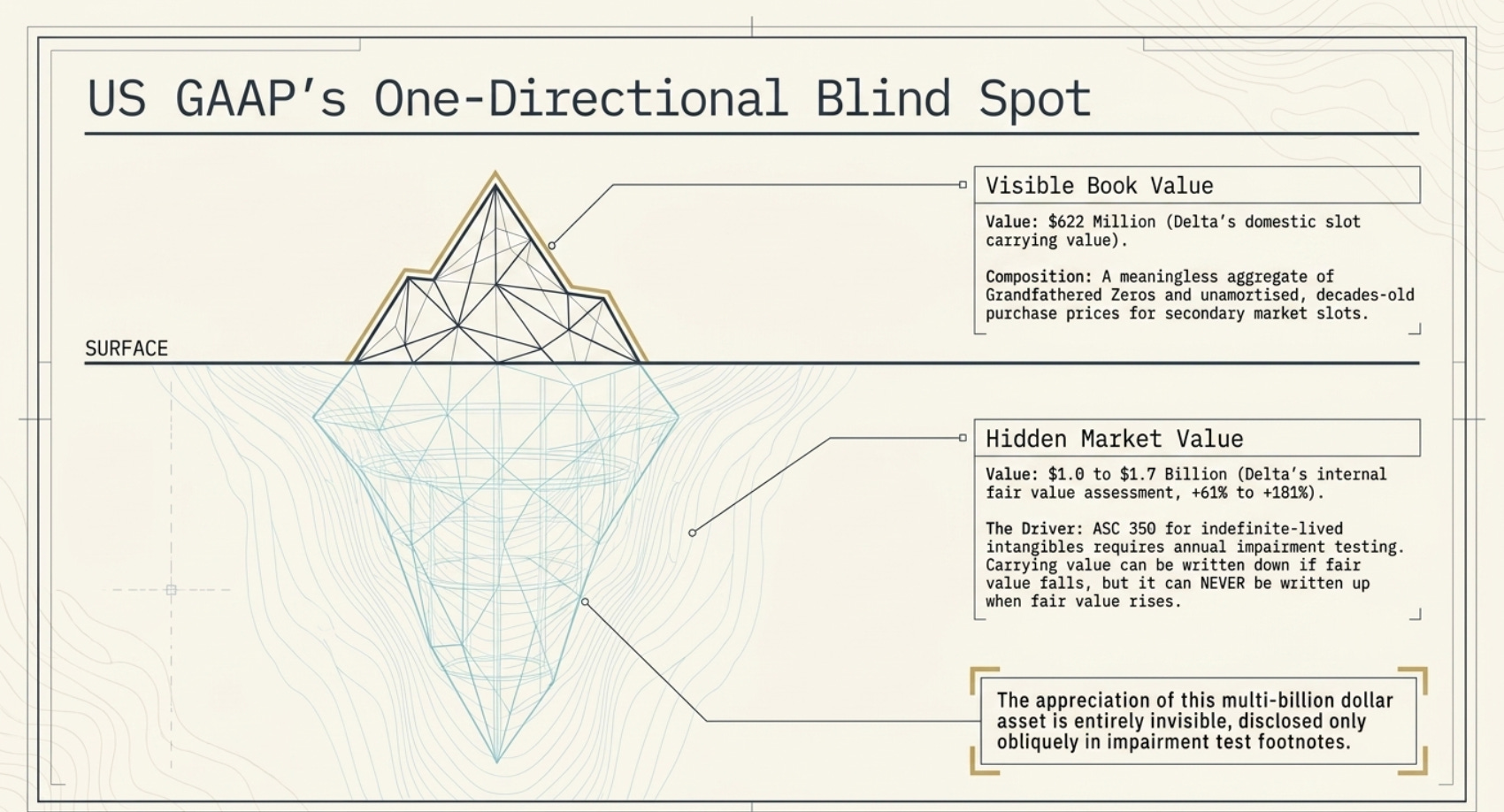
The first component is the grandfathered slots — allocated by the FAA at zero cost in 1969, 1985, or 1993, carried at zero on the balance sheet, never revalued regardless of what secondary market prices have done in the intervening decades. A Reagan National slot pair that the FAA allocated for free in 1985 is carried at zero in 2026, despite the fact that comparable slot pairs have transacted at $20 to $40 million in recent secondary market transactions.
The second component is purchased slots — acquired in the secondary market at historical transaction prices, carried at those historical prices as indefinite-lived intangibles and not amortised. A LaGuardia slot pair purchased for $8 million in 2001 is carried at $8 million in 2026, despite the fact that comparable slot pairs have transacted at $15 to $20 million recently. The acquisition cost is fixed in time; the market value has continued to move.
The result is a carrying value that is neither the current market value nor a consistent methodology. It is a historical accident — a combination of regulatory history (which slots were granted for free) and acquisition history (when purchased slots were bought and at what prices) that has no predictive relationship to the portfolio’s current economic value.
Under GAAP (ASC 350 for intangibles), indefinite-lived intangible assets are not amortised but must be tested annually for impairment. The impairment test asks: is the carrying value above the asset’s fair value? If not, no adjustment is made. This is a one-directional test. The carrying value can be written down to fair value if fair value falls below cost, but it cannot be written up if fair value rises above cost. This means that a grandfathered slot carried at zero — whose fair value has risen to $20 million per pair — remains at zero on the balance sheet permanently. The appreciation is invisible, disclosed only obliquely in the impairment test footnote when the company notes that fair value exceeds carrying value by a specified percentage.
PART VI: CONFIRMED CATALYSTS — WHAT MAKES THE VALUATION GAP IRREVERSIBLE
Catalyst 1: Heathrow Expansion Is Off the Table — Confirmed by Multiple Governments, Multiple Times
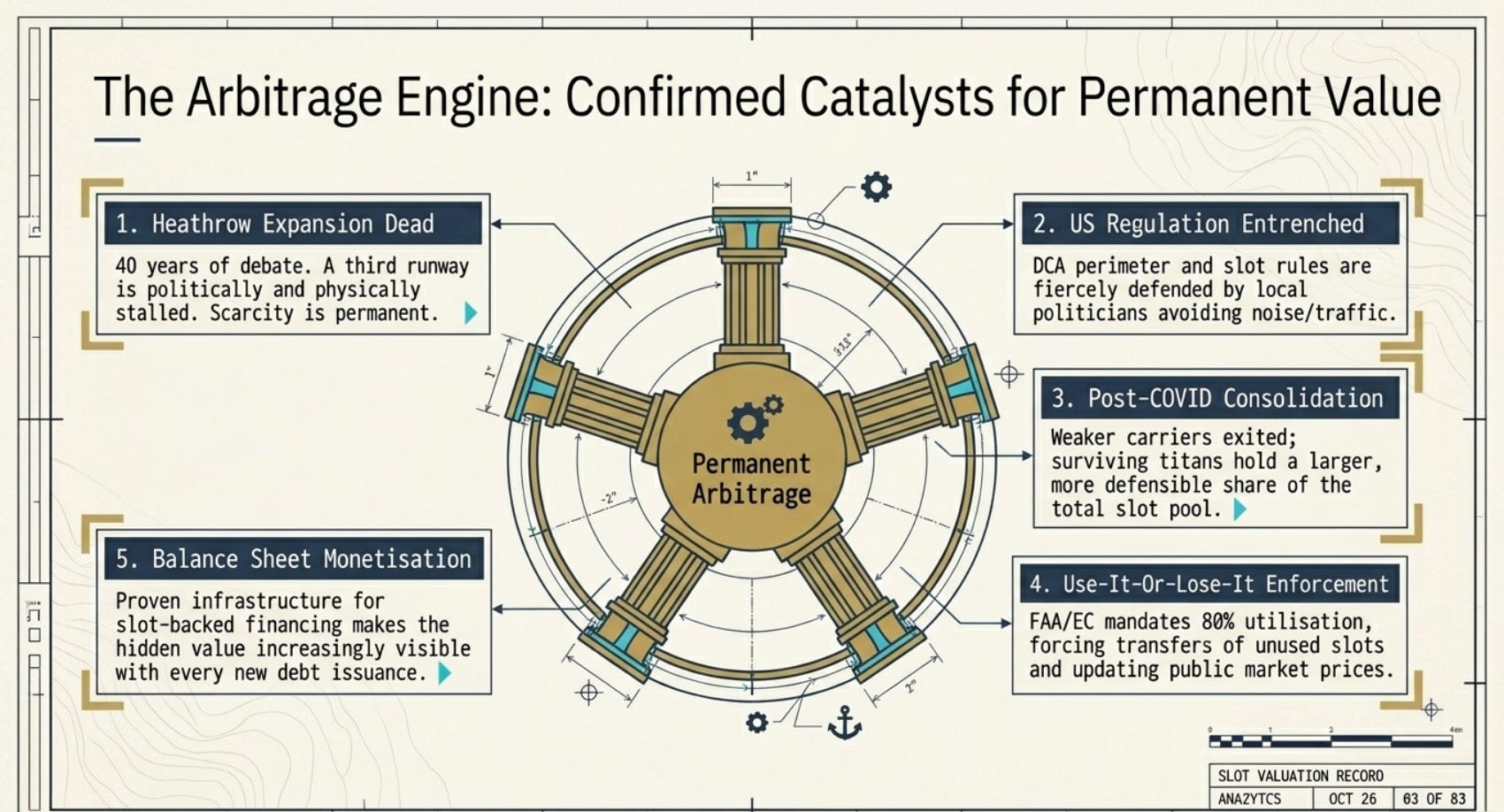
The Heathrow expansion debate in the United Kingdom has persisted for decades. A third runway at Heathrow — the single addition that would meaningfully increase slot capacity and potentially reduce slot scarcity — has been proposed, studied, approved, rejected, appealed, and reapproved at various points across forty years of aviation policy. As of 2025, the third runway remains unbuilt and its timeline, if any, extends well beyond a decade.
In the meantime, every year that passes without a new Heathrow runway is a year in which existing Heathrow slots appreciate. The demand for slots — from airlines wanting to serve the world’s most-visited city and Europe’s most important hub — grows with global aviation traffic. The supply of slots is fixed. The price follows the relationship between fixed supply and growing demand.
This is confirmed as a catalyst in the most concrete sense: the physical and regulatory constraints on Heathrow expansion are not speculative future risks. They are documented, litigated, and politically settled realities. There will not be a third Heathrow runway operational in any timeframe that is commercially relevant for current slot holders. The scarcity is permanent within any reasonable investment horizon.
Catalyst 2: US Airport Slot Controls Are Entrenched by a History of Opposition to Expansion
At Reagan National, the perimeter rule and slot controls have been in place for decades, survived multiple legislative challenges, and are actively defended by the political representatives of the District of Columbia and Northern Virginia — jurisdictions that have no interest in increasing noise, traffic, or disruption around their airport and every interest in maintaining the premium business-travel environment that slot control creates. Every time Congress has considered relaxing slot controls at Reagan National, the opposition from local representatives and the airline incumbents who benefit from existing slots has been sufficient to prevent any substantive change.
The DOT’s process for slot allocation and trading is well-established and creates a liquid secondary market without creating new slot supply. New slots at Reagan National are simply not available. The FAA does not have a mechanism for creating new runway capacity without building new runways, and new runways at Reagan National would require expanding into the Potomac River — which is not on any currently contemplated infrastructure agenda.
It is however, interesting to note, that in the future, new engine technology (which reduces the sound of flights dramatically) may result in an increase in slot supply
Catalyst 3: The Post-COVID Consolidation Has Reduced the Number of Slot Holders
The COVID pandemic, despite its devastation to airline revenues, produced one structural consequence that benefits remaining slot holders: it accelerated the exit of weaker carriers from slot-controlled airports. Airlines that could not survive the revenue shock surrendered slots or sold them to larger carriers at distressed prices. The concentration of slots at the largest US and European carriers increased. Each surviving carrier emerged with a larger proportional share of the total slot pool than it had before — without paying market prices for the incremental slots in every case.
Delta’s slot position at LaGuardia and Reagan National, and American Airlines’ position at the same airports plus Heathrow, is larger and more defensible post-COVID than it was pre-COVID. The secondary market for slot trading has resumed, and prices have recovered to or above pre-COVID levels for prime peak-hour slots at Heathrow and the key US slot-controlled airports.
Catalyst 4: Regulatory Action Against Slot Hoarding Creates Forced Transfers at Market Prices
Both the FAA and the European Commission enforce “use it or lose it” rules for airport slots: carriers must use their slots a specified minimum percentage of the time (typically 80% under the IATA Worldwide Slot Guidelines) or risk forfeiture. These rules periodically create forced transfers of slots when carriers cannot maintain minimum utilisation — as happened during COVID when regulators temporarily suspended use-it-or-lose-it requirements to prevent mass forfeiture. The resumption of normal use-it-or-lose-it enforcement creates a predictable channel for slot transactions to occur at market prices, documenting and updating the transaction database on which the owner’s valuation is based.
When a slot pair transacts — whether voluntarily between two carriers or as a result of regulatory enforcement — the transaction price enters the public record and updates the market’s understanding of current slot values. Each documented transaction confirms or updates the secondary market price and reduces the uncertainty about what an entire slot portfolio would be worth in a monetisation event.
Catalyst 5: The Airline Industry’s Continuing Need to Monetise Non-Operational Assets
Major US carriers have repeatedly demonstrated willingness to sell or securitise slot portfolios when capital needs arise. American’s 2020 use of LGA/DCA slots as collateral, JetBlue’s $750 million slot-backed financing, and historical outright slot sales at Heathrow all confirm that the secondary market for slot transactions is liquid, functional, and capable of processing material volumes in short timeframes. The infrastructure for slot monetisation exists. The appetite from buyers — both operating airlines and financial investors — is documented.
As airlines manage their balance sheets in the post-COVID era, with high debt levels from pandemic financing and capital requirements from fleet renewal, the economics of selling non-core slot positions or using peak slot pairs as collateral for lower-cost financing are attractive and proven. Each such transaction at current market prices documents the gap between the carrying value and the economic value — making the arbitrage increasingly visible with each disclosed transaction.
CONCLUSION: THE ASSET THAT GETS MORE VALUABLE AS THE BALANCE SHEET IGNORES IT
The airport slot story is, in one sense, the simplest value arbitrage in this series of papers. You do not need to understand geological engineering or electrolytic chemistry or regulatory rate-of-return frameworks. You need to understand one physical reality — runways have finite capacity and some airports will never add capacity — and one accounting consequence — the slots allocated free by the government in 1969 will forever be carried at zero, regardless of what they trade for in the secondary market.
Between those two realities lives the arbitrage. The slots appreciate in value as global aviation traffic grows and slot supply remains fixed. The balance sheet shows the same zero it has always shown. The earnings model applies a multiple to current airline earnings, which are cyclically volatile and temporarily terrible during crises, and produces a price target that has no systematic relationship to the standalone value of the most non-replicable asset in the portfolio. And periodically — every seven to twelve years in the history of commercial aviation — a crisis arrives that makes airline earnings terrible, drives the stock price toward the floor, and creates a window in which an investor can buy a slot portfolio worth $3 to $5 billion at the fair values the company’s own accountants were comfortable defending just months earlier, embedded in a company priced at $14 to $15 billion in total equity value.
That window closed in 2021 as COVID receded and airline stocks recovered. It will open again — because it always does, in every sufficiently severe aviation cycle. When it does, the question that will separate investors who earn extraordinary returns from investors who earn ordinary ones is the same question that separated them in April 2020: are you looking at the earnings model, or are you looking at the asset?
The slot is the asset. The earnings are its temporary, cyclically-impaired output. The gap between what the slot is worth in the secondary market and what the balance sheet records is not a mistake or an oversight. It is a mechanical consequence of accounting standards designed for a world in which assets have purchase prices. When the government gives you a slot for free, the accounting records a zero, and the zero persists forever, while the world changes around it.
Delta’s domestic slots: $622 million on the balance sheet, $1.0 to $1.7 billion in Delta’s own fair value testing. American’s LGA/DCA slots: pledged as collateral for $200 million in emergency financing when no one was flying. Virgin’s Heathrow slots: £225 million of debt raised against them in a private bond market. The market kept being told the same thing by the same transactions. It kept looking at the earnings model instead.
This white paper is for educational and informational purposes only. Delta Air Lines impairment test data is drawn from Delta’s Form 10-Q filed with the SEC for the period ended September 30, 2020, Note 4 (Goodwill, Identifiable Intangibles, and Other Assets). American Airlines appraised asset values are drawn from American Airlines Group Inc. Form 8-Ks filed June 12, 2020 and July 23, 2020 with the SEC. Virgin Atlantic’s slot-backed financing is documented in contemporaneous press reports of the December 2015 transaction. JetBlue’s slot-backed financing is documented in ACC Aviation’s published analysis of COVID-era airline capital markets activity. Heathrow slot transaction prices are drawn from publicly disclosed SEC filings and mba Aviation’s published industry analysis. Nothing herein constitutes investment advice.
If you like this read, check out my other writings 👇
Rust, Rigs, and the Recurring Revenue Hidden in Plain Sight: A Deep Dive into Beng Kuang Marine (SGX: BEZ)

The Old Steel and the Sea: Why You Should Care About a Ship Maintenance Company
Investment Reflection #2 — The Grand Play: 100 Years of the World’s Nations as Characters in the Greatest Story Ever Told

“The world is not a chessboard. It is a living organism, where every cell — every nation — eats, competes, cooperates, and occasionally tries to eat the others. Understanding it requires not just memorizing moves, but understanding hunger.”

The Tide Is Going Out: Commodity Houses, Private Credit, and the AI Debt Bomb

Start Here: What This Article Is About
Why I Passed on Graftech (EAF): Riding The Battery Hype, Or Perhaps Not...

There is a kind of company that is the most dangerous thing in investing. It is not the fraudulent company. It is not the obviously bad company with terrible products and incompetent management. Those are easy — you just avoid them. The truly dangerous company is the one with a
The Beautiful Trap: Why I'm Passing on The Hour Glass (SGX: AGS)

There’s a peculiar kind of investment that keeps you up at night — not because it’s bad, but because it’s genuinely good. Good enough to admire. Not good enough to buy.
The Diamond in the Rough That Isn't Quite Yours: Why I Passed on Boustead (SGX: F9D)

There is an old saying that investors have borrowed, bent, and quoted so many times it has nearly lost its sharpness: a bird in the hand is worth two in the bush. Warren Buffett, characteristically, gave it a precise mathematical form. The value of any investment, he wrote, is determined by three questions:
The Schoolteacher's Secret Insurer: Why Horace Mann (NYSE:HMN) Is Sitting on My Watchlist

“The stock market is a device for transferring money from the impatient to the patient.” — Warren Buffett

The Dormitory King That Couldn't Leave Home: Why I Passed on Centurion (SGX: OU8)

There is a deceptively simple question that Warren Buffett borrowed from Aesop’s ancient fable, and has repeated across decades of shareholder letters: “How many birds are in the bush? How sure are you they’re there? And how long until you get them out?”
The Children's Place: A $90 Million Bet on a Company That Used to Be Worth $2 Billion (NYSE: PLCE)

There is a classic scene in every heist movie. The detective walks into a room, sees the chalk outline, the scattered evidence, the broken window, and immediately knows something went terribly wrong long before anyone called the police. You do not need the full autopsy report to read the body.
World War 3 In Iran and Why Oil Price Will Continue Increasing — It Arrived Sooner Than Anyone Expected

This is Part 2 of a continuing analysis of California Resources Corp (CRC). Part 1 built the foundational investment case: a company trading at $44 per share against a conservative intrinsic value of $108–$156, built on 567 million barrels of proved developed oil reserves in California, and a management team spending hundreds of millions buying back its…
The Most Overlooked Oil Company in America — And Why That Might Be the Opportunity of the Decade

Date of analysis: 28 December 2025
The Art Of Saying No - MYPS: Playstudios Inc

PLAYSTUDIOS (MYPS) is a Las Vegas-based mobile gaming company that operates free-to-play social casino games and a loyalty platform called playAWARDS, which lets players redeem points for real-world rewards at places like MGM Resorts, Norwegian Cruise Line, and Wolfgang Puck restaurants. On the surface, this sounds like a clever moat. A loyalty program.…
The Art Of Saying No - UGP: Ultrapar Participacoes S.A (Part 2 of 2)

Question 2: How Certain Are You?
The Art Of Saying No - GLIBK: GCI Liberty Inc

Picture this: a single telecommunications company — the dominant one — serves over 200 communities scattered across the largest state in the United States. Alaska. A state with just over one person per square mile. A state where 39% of residents are underserved by broadband. A state where, until recently, some villages received internet via satellite li…

The Art Of Saying No - UGP: Ultrapar Participacoes S.A (Part 1 of 2)

The Setup: A Value Investor Dream?


The Art of Saying No - RIG: Transocean LTD

“The difference between successful people and really successful people is that really successful people say no to almost everything.” — Warren Buffett
The Art of Saying No - KPRX: Kiora Pharmaceuticals Inc

“The difference between successful people and really successful people is that really successful people say no to almost everything.” — Warren Buffett
The Art of Saying No - DNUT: Krispy Kreme Inc

“The difference between successful people and really successful people is that really successful people say no to almost everything.” — Warren Buffett

🎓 A Business Strategy Primer Part 7 - Learning From Great Companies

The Billion-Dollar Playbook: How Market-Based Management Powered Koch Industries’ Unstoppable Rise
The Art of Saying No - MRX: Marex Group PLC

“The difference between successful people and really successful people is that really successful people say no to almost everything.” — Warren Buffett


The Art of Saying No - SFIX: Stitch Fix Inc

“The difference between successful people and really successful people is that really successful people say no to almost everything.” — Warren Buffett
🎓 A Business Strategy Primer Part 2 - Brainstorming Solutions With Value At The Core

Creating An Irresistible Offer
The Art of Saying No - TDOC: Teladoc Health Inc

“The difference between successful people and really successful people is that really successful people say no to almost everything.” — Warren Buffett

The Art of Saying No - MDU: Mdu Resources Group Inc

“The difference between successful people and really successful people is that really successful people say no to almost everything.” — Warren Buffett


The Art of Saying No - AFCG: Advanced Flower Capital Inc

“The difference between successful people and really successful people is that really successful people say no to almost everything.” — Warren Buffett
The Art Of Saying No - VYX: NCR Voyix Corp

“The difference between successful people and really successful people is that really successful people say no to almost everything.” — Warren Buffett
The Art of Saying No - VSTS: Vestis Corp

“The difference between successful people and really successful people is that really successful people say no to almost everything.” — Warren Buffett

🛢️Basic Energy Primer Part 2 - Business and Competitive Landscape

The Man Who Bet Everything on Being Wrong
The Art of Saying No - CISS: C3is Inc

“The difference between successful people and really successful people is that really successful people say no to almost everything.” — Warren Buffett
The Art of Saying No - PSHG: Performance Shipping Inc

“The difference between successful people and really successful people is that really successful people say no to almost everything.” — Warren Buffett

The Art Of Saying No - MAGN: Magnera Corp

The Magnera Corporation Analysis Nobody Asked For (But Everyone Needs)
The Art of Saying No - CHR: Cheer Holding Inc

“The difference between successful people and really successful people is that really successful people say no to almost everything.” — Warren Buffett
The Art of Saying No - WIMI: WiMi Hologram Cloud Inc.

“The difference between successful people and really successful people is that really successful people say no to almost everything.” — Warren Buffett
⚡️Alternative Energy Primer Part 3 - Industry and Sector Technicals

The €2.2 Billion Mistake That Revealed Everything
⚡️Alternative Energy Primer Part 2 - Business & Competitive Landscape

The Shipwreck That Changed Everything

🏥 A U.S. Health Insurance (Managed Care Organizations) Sector Primer

1️⃣ Industry Fundamentals & Macro View


While no one has written about it.... this is why there is a bidding war for easyjet. They have a very valuable SGR franchise at LGW. Unfortunately only an air carrier can own a SGR portfolio so in distress times, an SGR portfolio is only worth what another airline will pay for it. Yes, it can be collateral for a loan - but generally the SGR are already encumbered with first and second lien debt. Sure, it isnt on the balance sheet, but the debt is already there (RCF/Miles). I would argue that that the most important number is not the SGR portfolio but the credit car affinity program. Another reason the bidders are circling easyjet - they dont even have a loyalty program - easy money for PE to spin one up and then extract money from the various alliance partners - ahem Delta - who will want them to be part of SkyTeam. I can pretty much promise you that Delta and AF-KLM are part of the Castlelake consortium. Last thing is that not all slots are created equal and you need a slot pair - if you even wonder why the low cost carriers have flights that leave at like 2am this is why.