
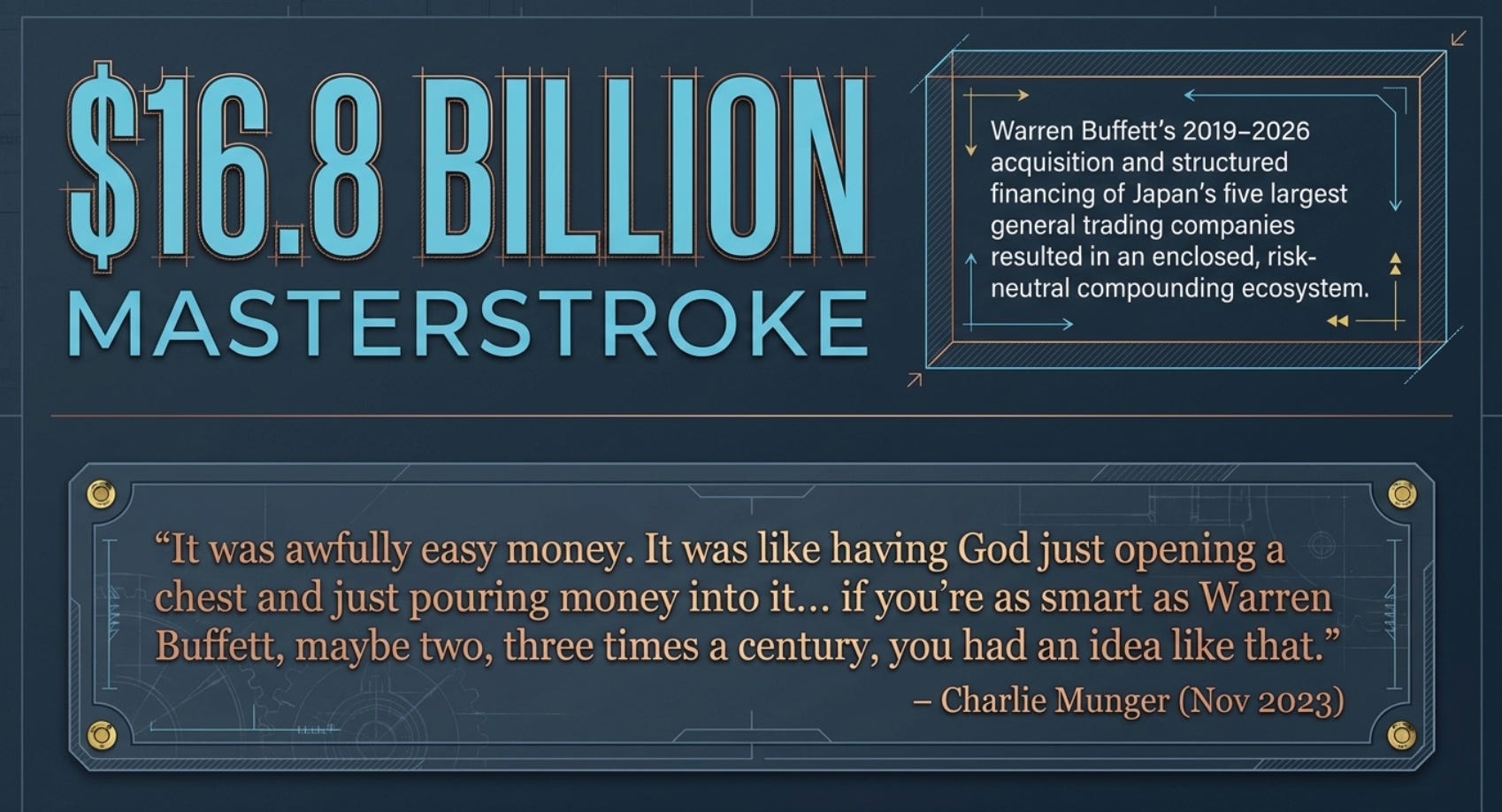
“It was awfully easy money. It was like having God just opening a chest and just pouring money into it.” — Charlie Munger, Acquired Podcast, November 2023
Preface: On the Nature of This Paper
This paper does not forecast earnings. It does not build discounted cash flow models or assign price targets. It does not speculate about what these businesses will be worth in ten years. What it does instead is something both simpler and harder: it reconstructs, from primary sources — SEC-filed bond prospectuses, annual reports, and the words of the men who made the trade — the exact mechanical architecture of what may be the most structurally elegant large-scale investment of the last fifty years. The goal is understanding of the thought process of a genius, not the prediction of a business’ potential.
Part One: The Book
In the summer of 2019, Warren Buffett — then 88 years old, running a company with a market capitalisation approaching half a trillion dollars, and supposedly incapable of finding anything worth buying at scale — sat down with a copy of the Japanese Company Handbook, a semi-annual directory published by Toyo Keizai. The handbook is not elegant. It contains no narrative, no analysis, no recommendation. It is a reference book in the truest sense: roughly 3,000 companies compressed into a single volume, one page per company, each page containing revenue, earnings, net assets, dividends, and a recent price range. It is the kind of document that most professional investors in 2019 had never heard of, because most professional investors in 2019 had dismantled their Japan desks and redirected their attention to China.
Buffett has described his fundamental research methodology as “turning every page.” He meant it as a young man combing through Moody’s manuals in the 1950s, and he meant it literally in 2019 with the Japanese handbook. At the 2025 Berkshire Hathaway annual meeting, his last as CEO, he recalled the discovery plainly: “I was just going through a little handbook that probably had two or three thousand Japanese companies in it. There were these five trading companies selling at ridiculously low prices. So I spent about a year acquiring them. Turning every page is one important ingredient to bring to the investment field. And very few people who turn every page are going to tell you what they find, so you’ve got to do a little of it yourself.”
The five companies he found — Mitsubishi Corporation, Mitsui & Co., Itochu Corporation, Sumitomo Corporation, and Marubeni Corporation — are collectively known in Japan as sogo shosha, or general trading companies. They are among the oldest and most globally extensive commercial enterprises on earth. Itochu traces its roots to 1858. Mitsubishi was founded in 1870. Sumitomo’s origins in copper trading extend to the seventeenth century. By 2019, each was generating tens of billions of dollars in annual revenue, operating in more than 60 countries, holding equity stakes in hundreds of businesses across every major sector of the global economy. And each was trading at between 0.5 and 0.8 times the stated accounting value of its net assets, on earnings multiples in the single digits, with dividend yields between 4 and 7 percent.
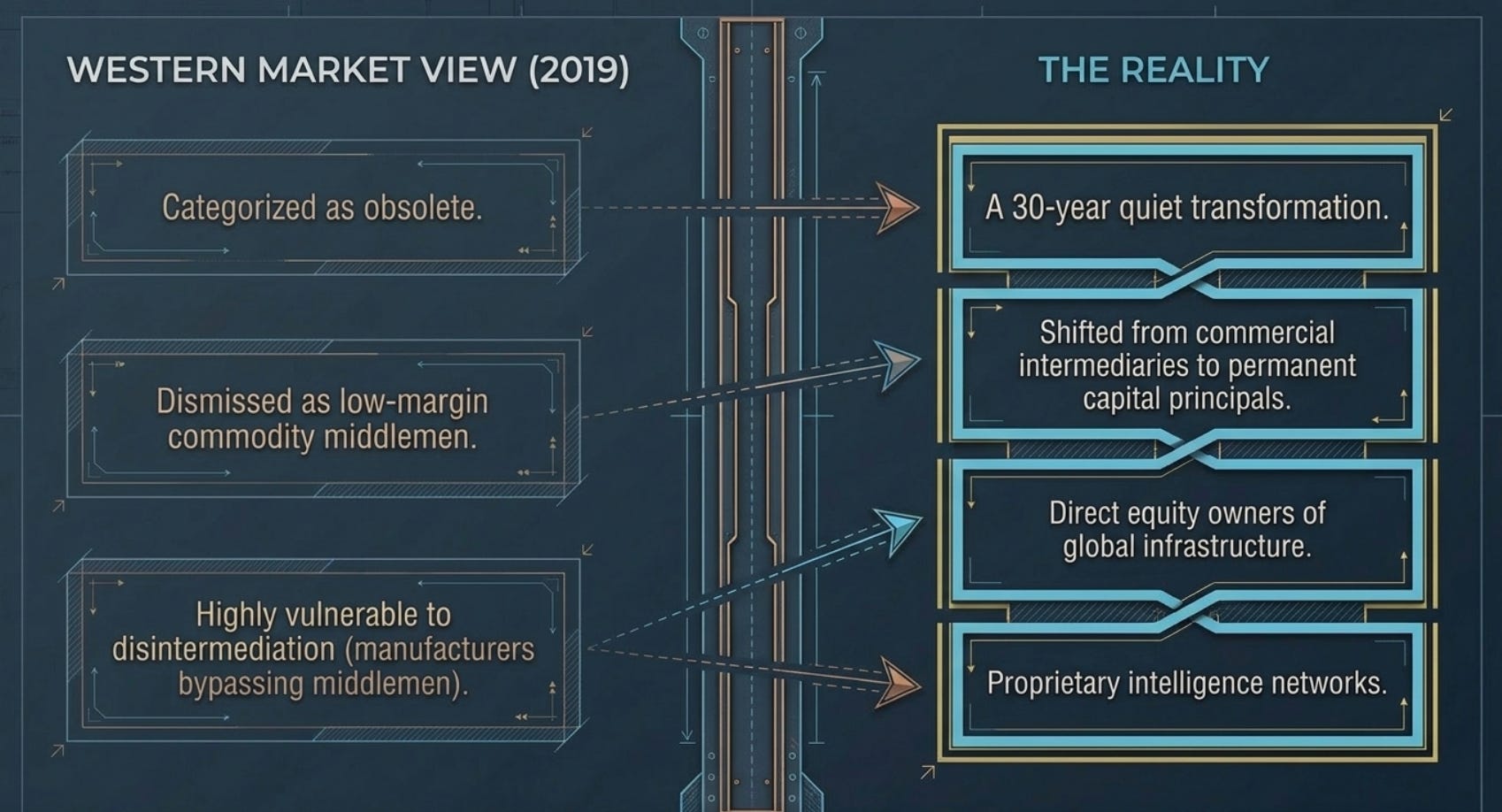
The Western investment community had collectively decided these companies were not worth understanding. They were labelled “trading companies” — a description that conjured images of commodity middlemen operating on thin margins — and filed away under the category of things that sophisticated modern capital allocators did not need to think about. This misclassification was not an accident. It was the product of genuine analytical difficulty: the sogo shosha are, as Moody’s formally recognises, a category unto themselves with no Western comparable. They are simultaneously trading houses, private equity firms, infrastructure operators, food distributors, retail operators, energy developers, and financial intermediaries, all in one entity, operating across every industry and continent at once. Most analysts, confronted with something they cannot categorise, simply move on. Buffett, confronted with something he cannot categorise, reads more carefully.
Part Two: What He Was Actually Looking At
Before we can understand the capital structure that Buffett built around these companies, we have to understand what the sogo shosha actually are — because this is where the intellectual foundation of the trade lives.
The common description — “general trading company” — is misleading in a specific and important way. In the 1980s and early 1990s, the sogo shosha did earn a significant portion of their income from acting as commercial intermediaries: buying from producers, selling to buyers, and earning a thin spread on the transaction. That model was always capital-light but scale-dependent, and it generated enormous volumes with modest margins. The criticism that accompanied it was fair: why would any large manufacturer continue paying a middleman when it could sell directly? Disintermediation, the logic went, would eventually hollow these businesses out.
What the analysts who wrote that narrative missed — and what Buffett saw when he read the handbook numbers carefully — is that the sogo shosha had been quietly transforming themselves for thirty years. Beginning in the 1990s, they began deploying their balance sheets not as intermediaries but as principals. Instead of earning a commission on a copper trade, Mitsubishi took an equity stake in the copper mine itself. Instead of financing a grain shipment for a fee, Marubeni bought grain farming operations outright. Instead of distributing food products to convenience stores for a margin, Itochu acquired FamilyMart, Japan’s second-largest convenience store chain, outright — via a takeover bid in 2020 — while simultaneously owning Nippon Access, the wholesaler that delivered inventory to FamilyMart’s stores three times a day.
This is the shift that matters. The trading commission revenue is high-volume and thin. The equity investment income — dividends, retained earnings, capital appreciation from hundreds of owned businesses — is the engine that has driven these companies’ actual earnings for the past two decades. When Buffett read the handbook and saw single-digit earnings multiples on businesses with 150-year operating histories, what he was actually observing was the market pricing a transformation it had not yet recognised. The companies were still being valued as commodity middlemen. The earnings being generated were from a permanent, diversified portfolio of owned businesses spanning every sector of the global economy.
Mitsui & Co.’s 2019 annual report — the document that would have corresponded to the numbers Buffett was reading in the handbook that year — lists ownership stakes in IHH Healthcare (33%), the largest hospital group in Asia; Penske Automotive (17%), one of North America’s largest automotive retailers; Roy Hill iron ore operations in Australia; LNG terminals across Asia-Pacific; and food businesses spanning grain trading, animal feed, protein production, and retail distribution. These are not the assets of a trading company. They are the assets of a diversified permanent capital vehicle — something that looks, in structure and philosophy, almost exactly like Berkshire Hathaway itself. Buffett noted this directly in his 2022 shareholder letter, writing that these companies “very successfully operate in a manner somewhat similar to Berkshire itself.”
Part Three: The Architecture of the Moat
To appreciate why the carry trade Buffett was about to construct was not speculative but structural, you first have to understand why the cash flows underpinning it are not fragile. That requires understanding the barriers that protect them — and these barriers are unlike anything taught in a standard framework of competitive advantage.
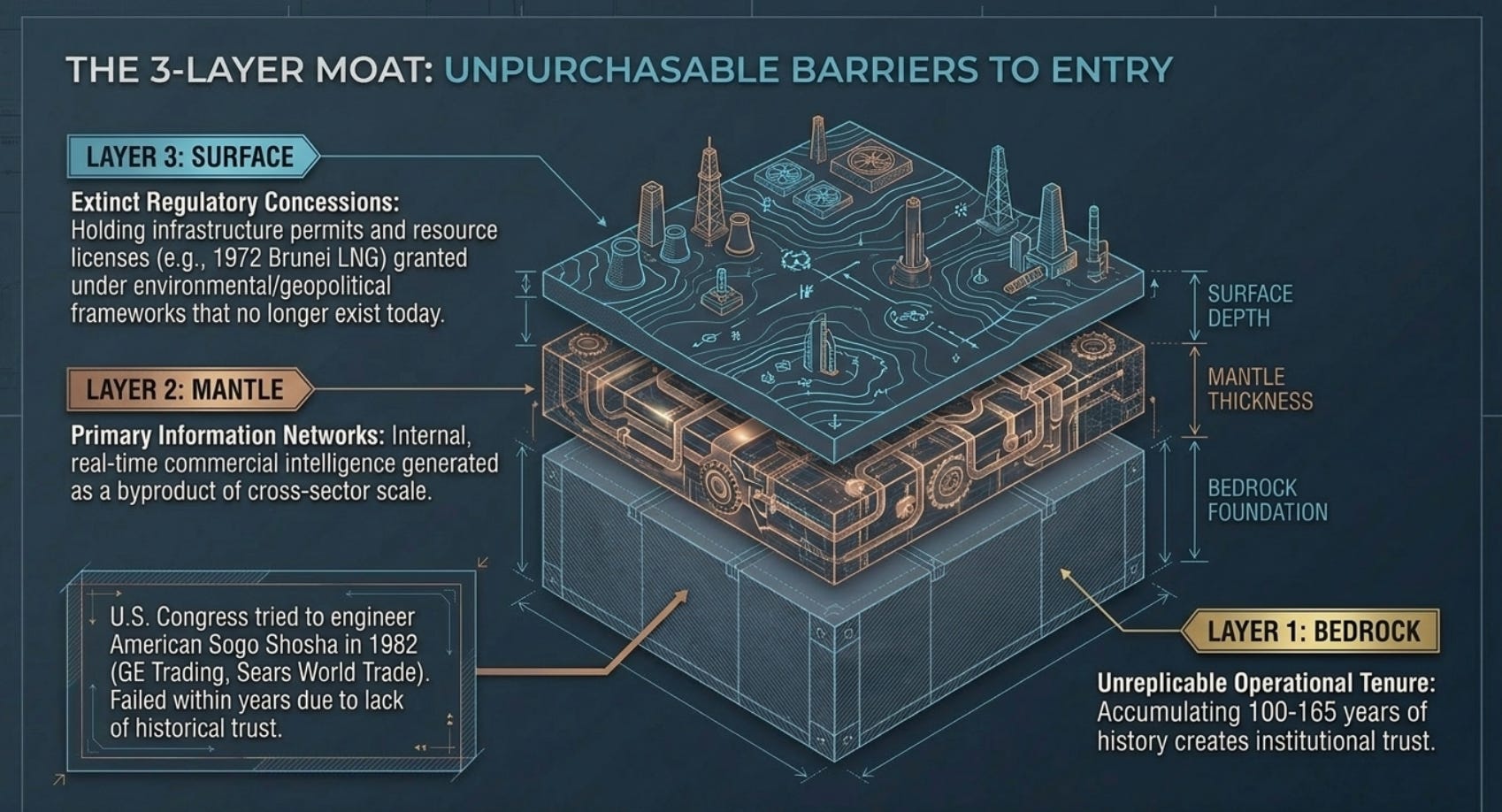
The First Wall: One Hundred and Fifty Years Cannot Be Purchased
There is a category of competitive advantage that capital cannot replicate, and it is the one that most investors systematically underweight: the advantage of accumulated operational tenure. The sogo shosha have been physically present in their core markets — not as salespeople, not as financial investors, but as operators — for between 100 and 165 years. That tenure has produced something that has no balance sheet entry and no market price: the trust of governments, communities, and commercial counterparts who have watched these organisations show up, deliver, and stay across multiple generations.
When Mitsui first signed iron ore offtake agreements with Australian miners in the early 1960s, it was not executing a financial transaction. It was beginning a relationship that now spans six decades of joint venture operations, shared infrastructure development, and government-level engagement in Canberra. The Pilbara iron ore operations that Mitsui participates in today were not built by writing a cheque. They were built by being there for sixty years, through commodity cycles, through political transitions, through the conversion of a remote Western Australian wilderness into the world’s largest iron ore province. No amount of capital can compress that history into a shorter timeline.
The United States government understood this problem when it attempted to engineer American equivalents of the sogo shosha. Congress passed the Export Trading Company Act of 1982 specifically to enable US companies to build Japanese-style general trading organisations. General Electric formed GE Trading Company. Sears formed Sears World Trade Organization. Both were defunct by the mid-1980s — not because they lacked capital, but because they could not purchase the one input the model requires most: time. You cannot buy a 150-year relationship. You have to show up every day for 150 years.
The Second Wall: A Network That Gets Stronger as It Gets Larger
The second layer of the moat is structurally different from the first, and it is the one that makes the competitive position genuinely compound over time rather than merely persist. The sogo shosha generate what can be called primary information — intelligence that flows from operating simultaneously across twenty sectors and sixty countries, in real time, at commercial scale. This is categorically different from the secondary information that most market participants rely on: analyst reports, news wires, commodity indices, and consultant assessments.
When Mitsui’s grain desk in Iowa observes an unusual drought pattern forming across the US Midwest, that information does not stay on the grain desk. It flows — through internal systems, through regular communication between business units, through the natural conversations that happen when 45,000 employees work inside a single integrated organisation — to Mitsui’s LNG trading operations in Tokyo, to its protein businesses in Southeast Asia, and to its food retail operations in Japan. The grain desk is not charging the LNG desk for this intelligence. There is no internal transfer price. The information is a free byproduct of scale, and it creates immediate, actionable competitive advantage across apparently unrelated businesses.
Sumitomo Corporation described this dynamic directly in its own investor materials: “What makes this possible is our combination of diversity and scale. Since our companies operate in such a broad range of fields, we can diversify our exposure. And the scale of our business strengthens our ability to cope with even substantial risks. To manage these risks, we rely heavily on our worldwide network of offices, which provide a rich supply of primary information. This is a business model that obviously cannot be built overnight, and so it can be said that the barriers to new entrants into our industry is very high.”
The phrase “cannot be built overnight” understates the case considerably. It cannot be built in a decade. The information advantage is not a function of having offices in sixty countries — it is a function of those offices having operated in their markets for long enough that they have become embedded nodes in local commercial networks. The Mitsui office in Lagos is not merely an outpost. It is a known entity with established relationships with Nigerian government ministries, local businesses, logistics operators, and banking institutions, accumulated across decades of continuous presence. A new entrant opening an office in Lagos today would spend years building what Mitsui already has. By the time they had built it, Mitsui would have deepened it further. The gap does not close — it widens.
This is the property of network effects applied to physical, relationship-based commercial intelligence, and it is one of the most durable forms of competitive advantage in existence. Unlike a technology platform, it cannot be copied by writing code. Unlike a brand, it cannot be built by advertising spend. Unlike a patent, it does not expire. It accumulates silently, year after year, as a byproduct of simply continuing to operate.
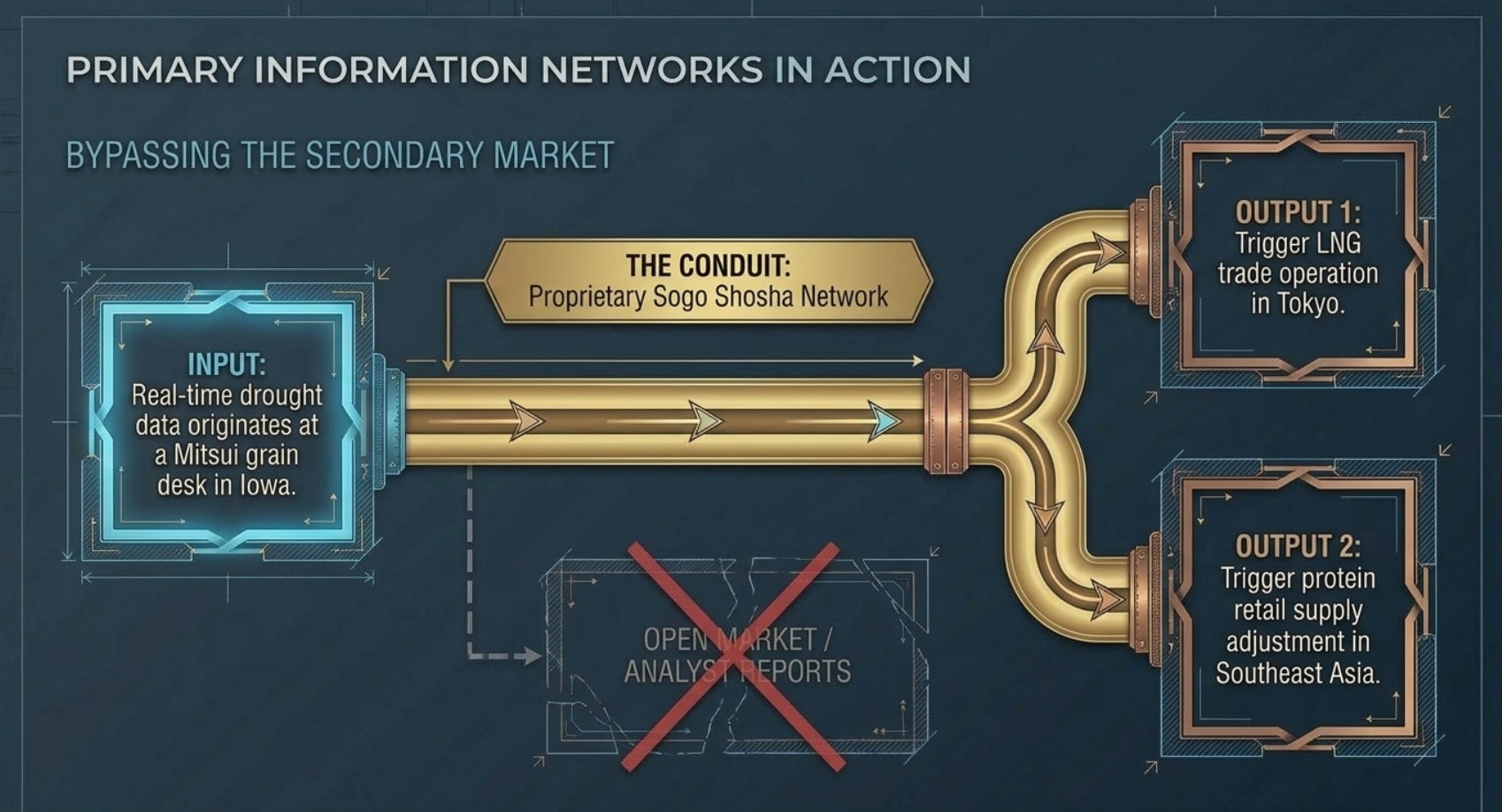
The Third Wall: Regulatory Positions That Were Granted Under Regimes That No Longer Exist
The third layer is the most permanent of all, and it is the one that modern markets are most systematically bad at pricing. The sogo shosha hold resource concessions, trading licences, and operating permits across dozens of jurisdictions — many of which were awarded under regulatory frameworks that no longer exist in the same form and that cannot be replicated under current conditions.
A liquefied natural gas concession awarded to Mitsui in Brunei in 1972 was granted under the regulatory expectations of 1972: different environmental standards, different community consultation requirements, different government priorities, and a geopolitical environment in which Japan’s need for energy security made it a particularly welcome partner for resource-rich Southeast Asian nations. Applying for an equivalent concession today would require navigating environmental impact assessment processes, community approval mechanisms, government procurement rules, and international partnership requirements that bear no resemblance to the conditions of 1972. In practice, for the most valuable resources in the most sensitive geographies, the regulatory path to a new concession is not merely difficult — it is functionally closed.
The sogo shosha’s position in these markets is therefore not just competitive. It is structurally exclusive. The assets they hold cannot be replicated by new entrants because the conditions under which those assets were obtained no longer exist. This is the commercial equivalent of a building permit issued before a historic preservation district was established: the holder has rights that the regulatory system will never issue again.
When you add all three walls together — the unreplicable operational tenure, the self-reinforcing information network, and the regulatory positions granted under extinct frameworks — the resulting structure is a moat that does not merely protect existing cash flows. It actively deepens over time, becoming more durable with every passing year of continued operation. This is what Buffett was holding in his mind when he told Nikkei Asia in 2023 that he expected Berkshire to hold these stakes “for the next 50 years.” He was not expressing sentiment. He was describing the logical conclusion of a structural analysis: barriers this deep and this compounding do not erode.
Part Four: The Capital Structure — Where the Genius Lives
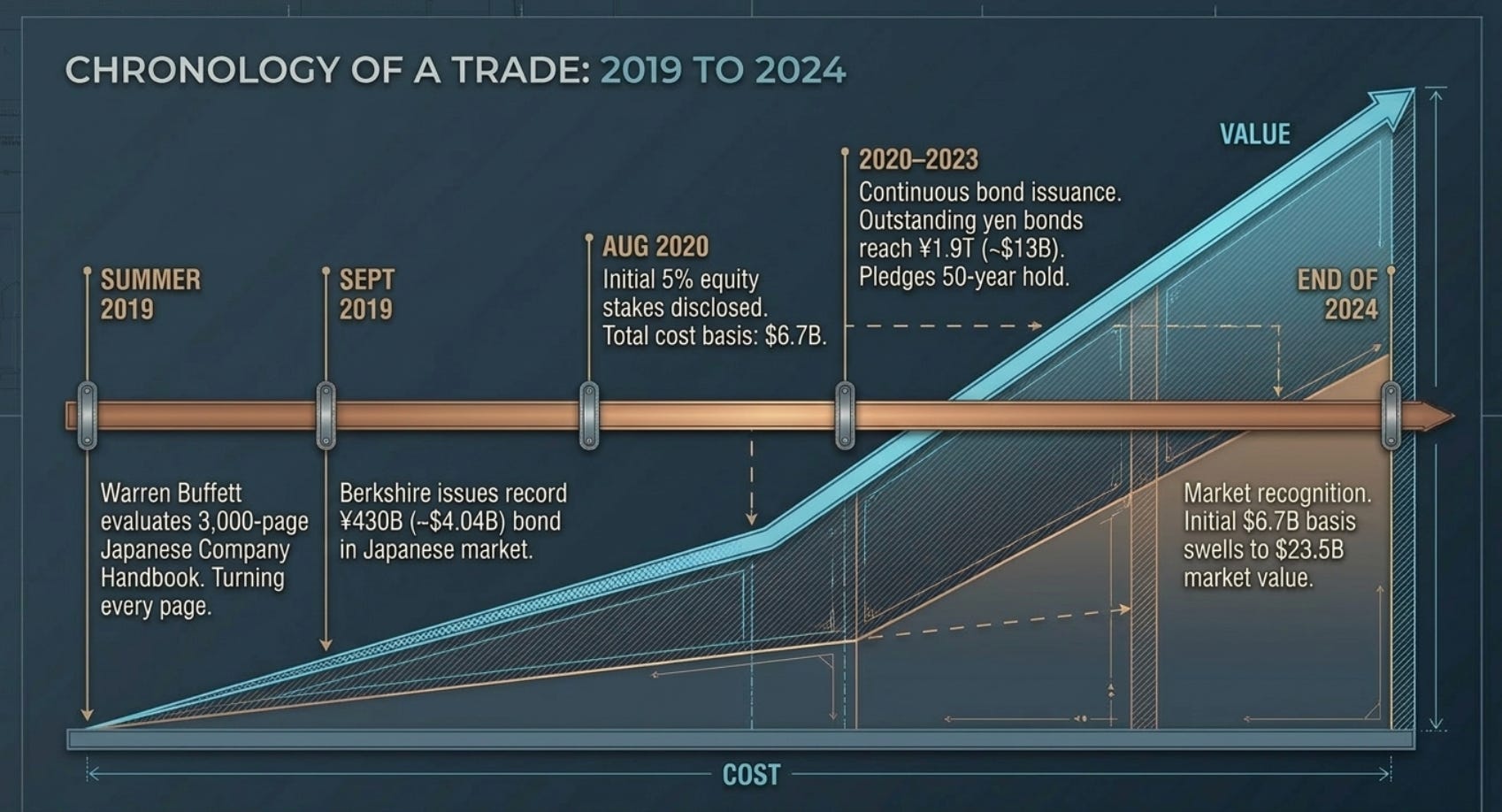
In September 2019, one month before Berkshire began quietly accumulating shares in the five trading houses, Berkshire Hathaway’s treasury team executed a bond issuance in the Japanese domestic market that would become the financing instrument for the most elegant capital structure Buffett had ever assembled.
The issuance, documented in SEC filings, was ¥430 billion — approximately $4.04 billion at prevailing exchange rates — structured across six tranches with maturities of 5, 7, 10, 15, 20, and 30 years. The coupons, as filed with the SEC, ranged from 0.17% on the 5-year tranche to 1.10% on the 30-year tranche. This was, at the time, a record-sized yen bond issuance by any foreign company. It was also, in retrospect, the opening move of a trade whose architecture would not be fully understood by the market for several years.
S&P Global’s capital markets commentary noted the precise reason why Japanese institutional investors devoured these bonds: Berkshire’s 10-year tranche offered a yield of approximately +0.44%, compared to roughly -0.25% on Japanese Government Bonds of the same maturity. Japanese insurance companies and pension funds, trapped in a negative yield environment by the Bank of Japan’s extraordinary monetary policy, needed positive yield from names they trusted. Berkshire, with its AA credit rating and global recognition, was exactly that name. The supply and demand aligned so cleanly that the deal was oversubscribed many times over.
Berkshire’s yen bond programme continued through subsequent years, with documented issuances of ¥196 billion in April 2020 — the 5-year tranche at 0.674%, the 10-year at 1.002% — and ¥160 billion in April 2021, with the 5-year tranche at a remarkable 0.173% and the 10-year at 0.437%. By 2023, Berkshire had accumulated approximately ¥1.9 trillion in yen-denominated bonds outstanding, representing roughly $13 billion at prevailing exchange rates, at a blended average coupon that can be conservatively estimated at approximately 0.5% per annum.
Now set that number beside the starting point of the equity investment.
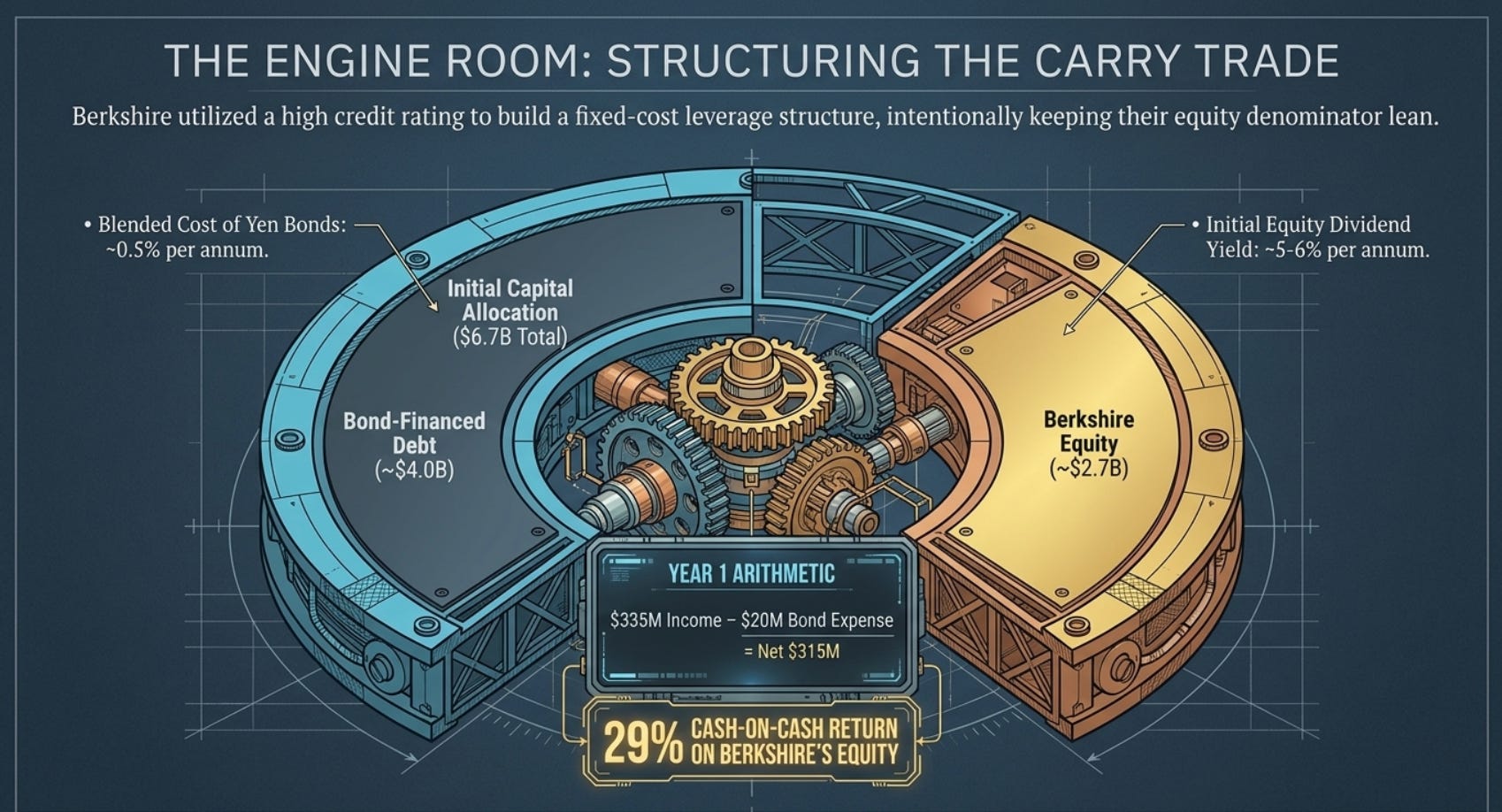
By the time Berkshire disclosed its positions in August 2020, it had accumulated approximately 5% stakes in each of the five trading houses for a total cost of approximately $6.7 billion. The yen bond proceeds covered approximately $4.0 to $4.5 billion of that initial cost. Berkshire’s own equity capital deployed — the residual between the total position and the bond financing — was approximately $2.7 billion.
The capital structure at the moment of initial disclosure was therefore:
Bond-financed portion: approximately $4.0 billion, or 60% of total investment
Berkshire’s own equity: approximately $2.7 billion, or 40% of total investment
Blended cost of the bond financing: approximately 0.5% per annum
Dividend yield on the equity position at purchase price: approximately 5–6% per annum
From this structure, a specific and calculable arithmetic follows. Annual dividend income from the $6.7 billion position at a 5% yield: approximately $335 million. Annual interest cost on $4.0 billion of bonds at 0.5%: approximately $20 million. Net annual cash income to Berkshire after debt service: approximately $315 million. Return on Berkshire’s own $2.7 billion of equity, from the income stream alone, in Year 1: approximately 29% per annum.
This number requires no assumptions about future growth, no forecast of commodity prices, no view on the macroeconomy. It is the arithmetic product of the capital structure as it existed on the day the position was disclosed. The bonds were outstanding. The dividends were being paid. The spread was locked. The 29% was already there.
Part Five: The Compounding Engine — When a Fixed Cost Meets a Growing Income
Twenty-nine percent in Year 1 is not the end of this analysis. It is the beginning of a separate and more powerful phenomenon — one that Buffett had seen operate over thirty years in a different context and recognised instantly when he saw the conditions for it reappearing in Japan.
The sogo shosha, between fiscal years 2021 and 2025, grew their dividends per share at an average annual rate of 19.2%. This rate is partially elevated by the post-COVID commodity supercycle, and a long-run sustainable rate is more conservatively estimated at 8 to 12 percent. But it establishes the direction and magnitude of the underlying compounding dynamic.
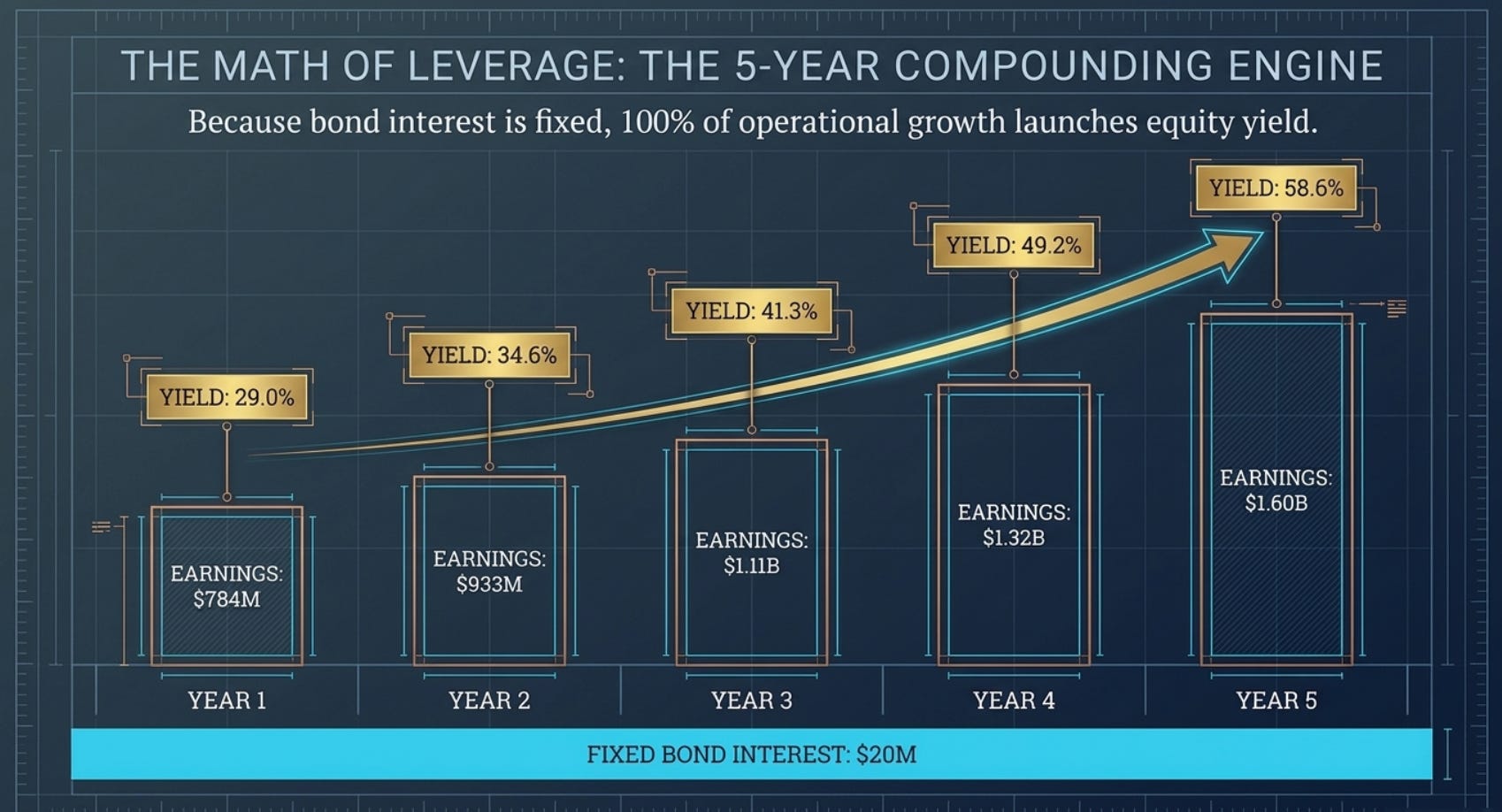
Now apply that dividend growth to the capital structure described above, holding the bond cost constant — because the bond coupons, fixed at issuance, do not participate in any growth. They are permanent liabilities with permanent, fixed costs. The equity income above them grows freely:
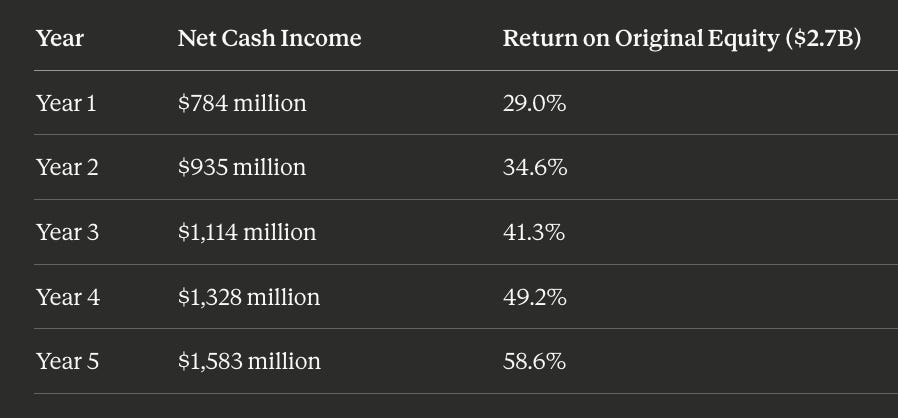
(Net cash income uses the earnings yield on the full position, not dividend yield alone, to reflect the full economic return Berkshire’s ownership stake generates. Bond interest at 0.5% on $4.0B bond principal held constant.)
Note that 58.6% is on 1 year, without including previous year dividend payouts along with the capital growth of the equity stake. This investment case is a rare one where the compounding economics is created by financial engineering instead of through a compounding machine (business) which Berkshire have traditionally done so.
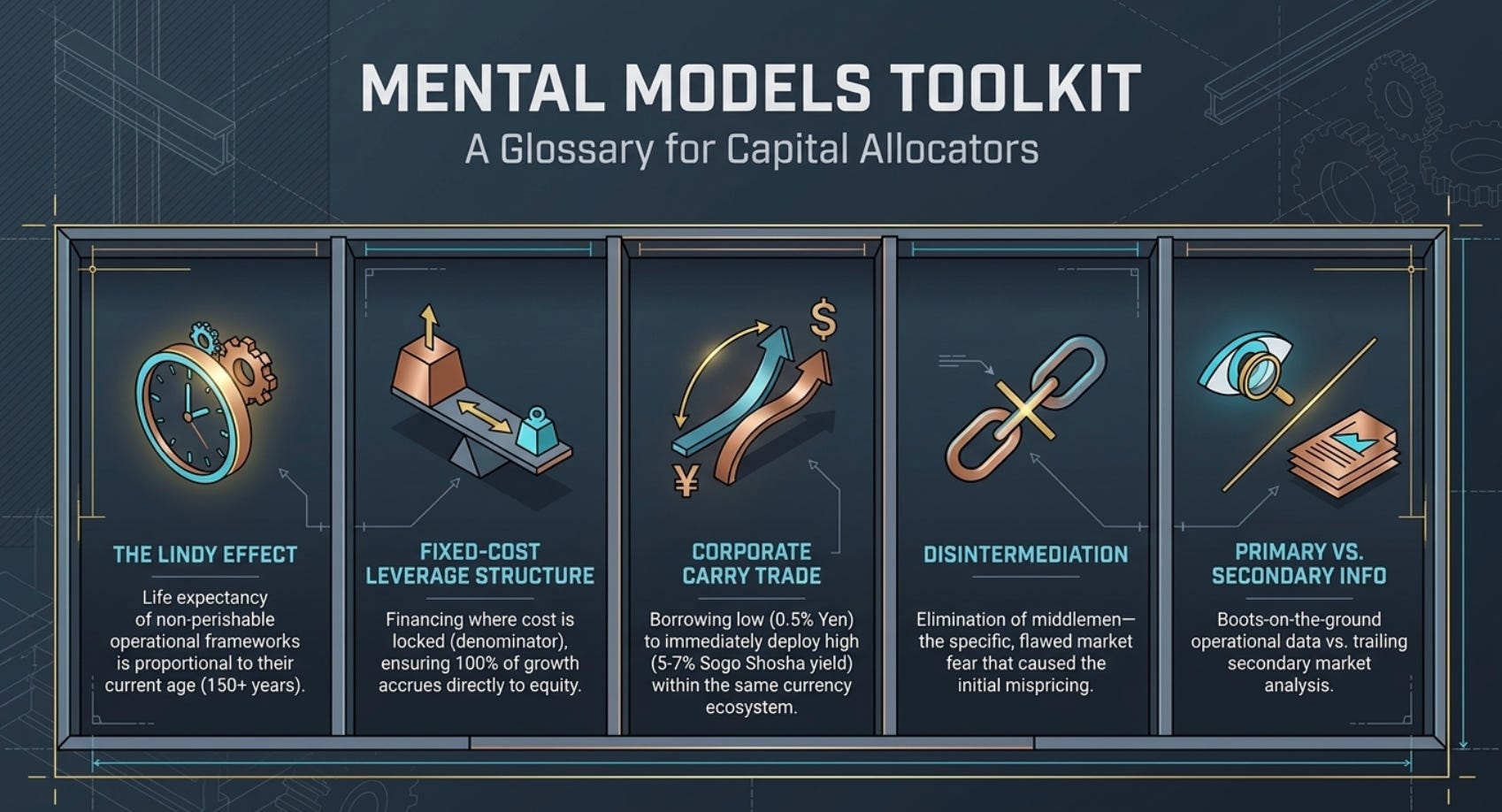
The mechanism at work here is what engineers call a fixed-cost leverage structure. The bond interest is a fixed denominator. The earnings flowing from the equity position — growing at 19% annually — have no obligation to share any of their growth with the bondholders. Every dollar of dividend growth above the fixed bond cost flows directly to Berkshire’s equity holders, compounding the return on Berkshire’s own $2.7 billion at an accelerating rate. By Year 5, Berkshire is earning $1.58 billion annually from a $2.7 billion equity investment — a yield on original cost of 58.6%.
Buffett had seen exactly this dynamic before. In his 2022 shareholder letter, he described the arithmetic of Berkshire’s Coca-Cola investment with characteristic plainness. Berkshire completed its purchase of Coke shares in 1994 for a total cost of $1.3 billion. In that first year, Coke paid Berkshire $75 million in cash dividends — a yield of approximately 5.8% on cost. Coke grew its dividend every year thereafter. By 2022, the annual cash dividend check had grown to $704 million — a yield of 54% on Berkshire’s original $1.3 billion investment, received annually, in perpetuity.
The structural parallel is precise. In both cases, Buffett identified a durable cash flow stream attached to a business with deep competitive protection, acquired at a price that gave him an attractive initial yield, and then simply waited while the yield on his original cost grew toward something that bears no relationship to any standard measure of investment return.
The difference between the two trades is the timeline. Berkshire held Coca-Cola for nearly thirty years before the yield on original cost crossed 50%. In Japan, because Buffett introduced fixed-rate yen bond leverage into the capital structure, the mathematics of yield-on-original-cost acceleration are compressed dramatically. The 58% yield on equity materialises in five years rather than thirty — not because the underlying business is growing faster than Coke did, but because Berkshire’s own equity denominator is smaller relative to the total position, so each dollar of income growth translates into a larger percentage return on that smaller equity base.
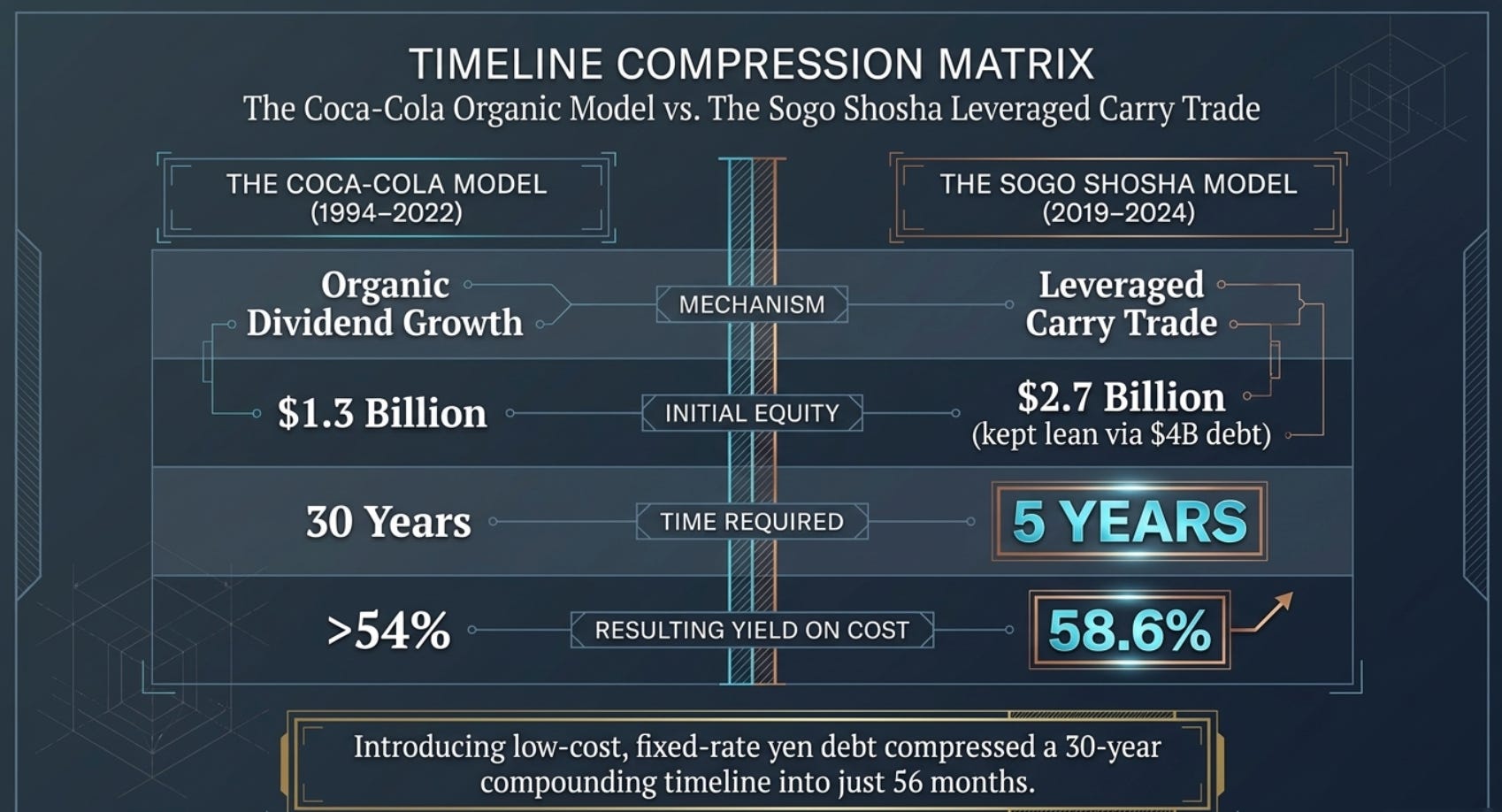
Charlie Munger understood this compression immediately. In his November 2023 interview with the Acquired podcast, seven weeks before his death at age 99, he described the trade with characteristic directness: “Something like that — if you’re as smart as Warren Buffett, maybe two, three times a century, you had an idea like that. It was awfully easy money. It was like having God just opening a chest and just pouring money into it.” He then identified the precise source of the advantage: “These trading companies were really entrenched, old companies, and they had all these cheap copper mines and rubber plantations, and so you could borrow easily. But Berkshire, with its credit, could. The only way you could get it was to be very patient and just pick away at little pieces at a time. It took forever.”
The phrase “took forever” matters. The position required approximately a year of quiet accumulation — buying in small amounts, in the open market, in yen, without causing visible price movements that would alert the market and push prices higher before Berkshire had built the full position. This patience is not a personality trait. It is a structural requirement of the trade: the returns are only available to someone capable of accumulating billions of dollars of shares over twelve months without advertising what they are doing.
Part Six: The Yen — The Dimension the Market Ignored
There is a third layer to this trade that is almost never discussed in Western financial commentary, and it is the layer that makes the entire structure genuinely elegant rather than merely clever.
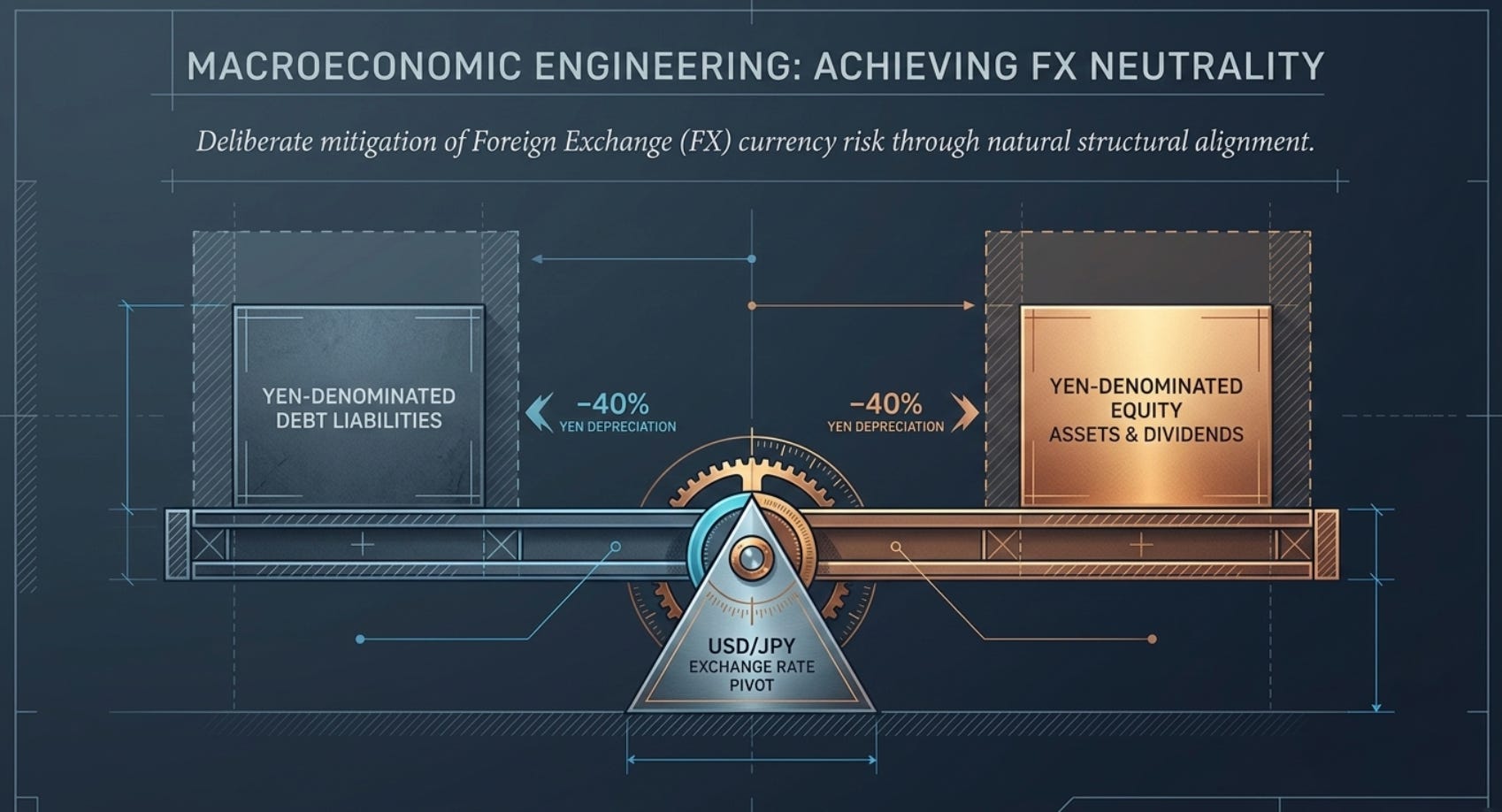
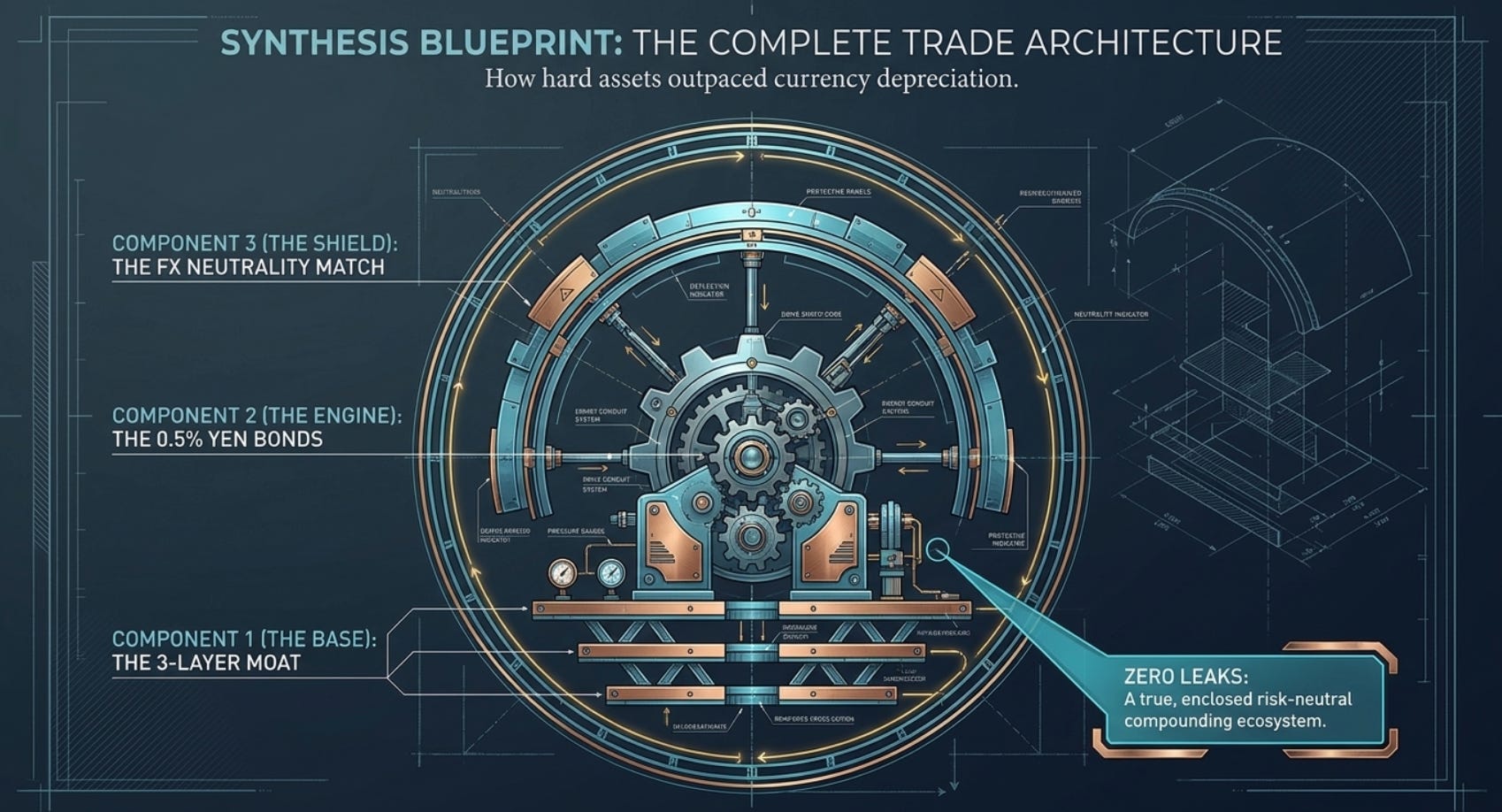
Berkshire borrowed in yen. Berkshire received dividends in yen. Berkshire’s liabilities and its income are denominated in the same currency. This is not a hedging strategy. It is a structural fact that eliminates foreign exchange risk from the spread — the gap between the dividend yield and the bond cost — entirely. Whatever happens to the yen relative to the dollar has equal and opposite effects on the income side and the liability side of the trade. They cancel.
The yen depreciated significantly from approximately ¥107 per dollar in 2019 to approximately ¥150 per dollar by 2023 — a weakening of roughly 40 percent. In dollar terms, a yen-denominated income stream that stayed flat in yen would have lost 40% of its dollar value over that period. But the yen-denominated bond liability declined by exactly the same proportion. Berkshire owed yen to its Japanese bondholders, and those yen were worth less in dollars. The liability shrank in dollar terms at exactly the same rate as the income shrank. The net dollar spread — income minus debt service — remained stable.
More than stable, in fact. Berkshire’s 2024 annual letter disclosed that by the end of that year, Berkshire had accumulated $850 million in after-tax gains from the dollar’s appreciation against the yen. This is the accounting recognition of the net effect: Berkshire’s yen liabilities, translated back to dollars for reporting purposes, had declined in value by more than Berkshire’s yen-denominated equity investments had declined, because the equity investments had simultaneously been appreciating in yen terms as the sogo shosha’s earnings and book values grew. The currency movement, instead of hurting the trade, added to it.
Inflation = Asset value increases whilst currency value decreases — that is what happened to Japan, whereby in 2019-2024, currency depreciated 40%. It makes much more sense to compound that capital in a Yen-denominated business than hold cash (Yen)
This outcome was not guaranteed when Buffett entered in 2019. He has said explicitly that he does not take views on foreign exchange. What he did instead was construct a structure in which he did not need a view: by matching the currency of his liabilities to the currency of his income, he removed the foreign exchange question from the equation entirely and let the fundamental economics of the trade — the spread between a sub-one-percent borrowing cost and a compounding five-to-seven percent equity yield — drive the outcome. The currency became neutral by design, not by luck.
Part Seven: The Complete Picture — Three Layers Stacked
The income arithmetic — $784 million in net annual cash in Year 1, growing toward $1.58 billion by Year 5, against $2.7 billion of Berkshire’s own equity — captures the operating engine of the trade. But it is only one of three layers that constitute the total return.
The second layer is capital appreciation. Berkshire’s initial $6.7 billion position, accumulated at prices averaging 0.6 to 0.8 times book value, was worth approximately $23.5 billion by the end of 2024. The $16.8 billion in unrealised capital gains represents the market’s slow recognition of what Buffett observed in the handbook in 2019: that these businesses were being priced as commodity middlemen when they were, in fact, permanent capital vehicles with global reach and 150-year operating histories. The Tokyo Stock Exchange’s governance reform — which began pressuring companies trading below book value to improve their returns or return capital — provided the mechanism through which this recognition was forced. Buybacks accelerated. Dividends grew. The P/B multiple expanded from below one to above one as the market processed what was always there.
The Lindey effect: the future life expectancy of non-perishable things (like ideas, technologies, or books) is proportional to their current age. Simply put — the longer something has already survived, the longer it is expected to endure in the future.
The third layer has no dollar value yet, and may be the most valuable of all: the strategic option embedded in the relationship itself. Buffett told Nikkei Asia in 2023 that Berkshire wanted to be “the first port of call” for any of the five companies thinking of making a large acquisition or seeking a co-investment partner. This is not a casual expression of goodwill. It is a description of Berkshire’s position as the preferred permanent-capital co-investor for five of the most globally connected commercial organisations on earth — organisations that collectively operate in more than 60 countries, see primary deal flow across every sector of the global economy, and have established the kind of trust with governments, resource owners, and local businesses that takes 150 years to accumulate.
Every co-investment opportunity that flows from those relationships in the next fifty years comes to Berkshire first, with no competitive process, at terms negotiated between parties who have already demonstrated mutual trust. The option has no cost basis. It was acquired as a consequence of buying equity at prices that were already attractive on their own terms. This is what Buffett meant when he wrote, in his 2024 shareholder letter, that “Berkshire will find other ways to work productively with the five companies in the future” — and why he specified that Greg Abel and his eventual successors would be holding these positions for “many decades.”
Part Eight: Why Only Berkshire
Every element of this trade was, in theory, visible to every institutional investor in the world in 2019. The handbook was publicly available. The financial statements were filed. The yen bond market was open. The arbitrage between near-zero Japanese interest rates and 5-7% dividend yields from century-old conglomerates trading below book value required no proprietary information to identify. And yet no one executed it. Understanding why illuminates something important about what this trade actually was.
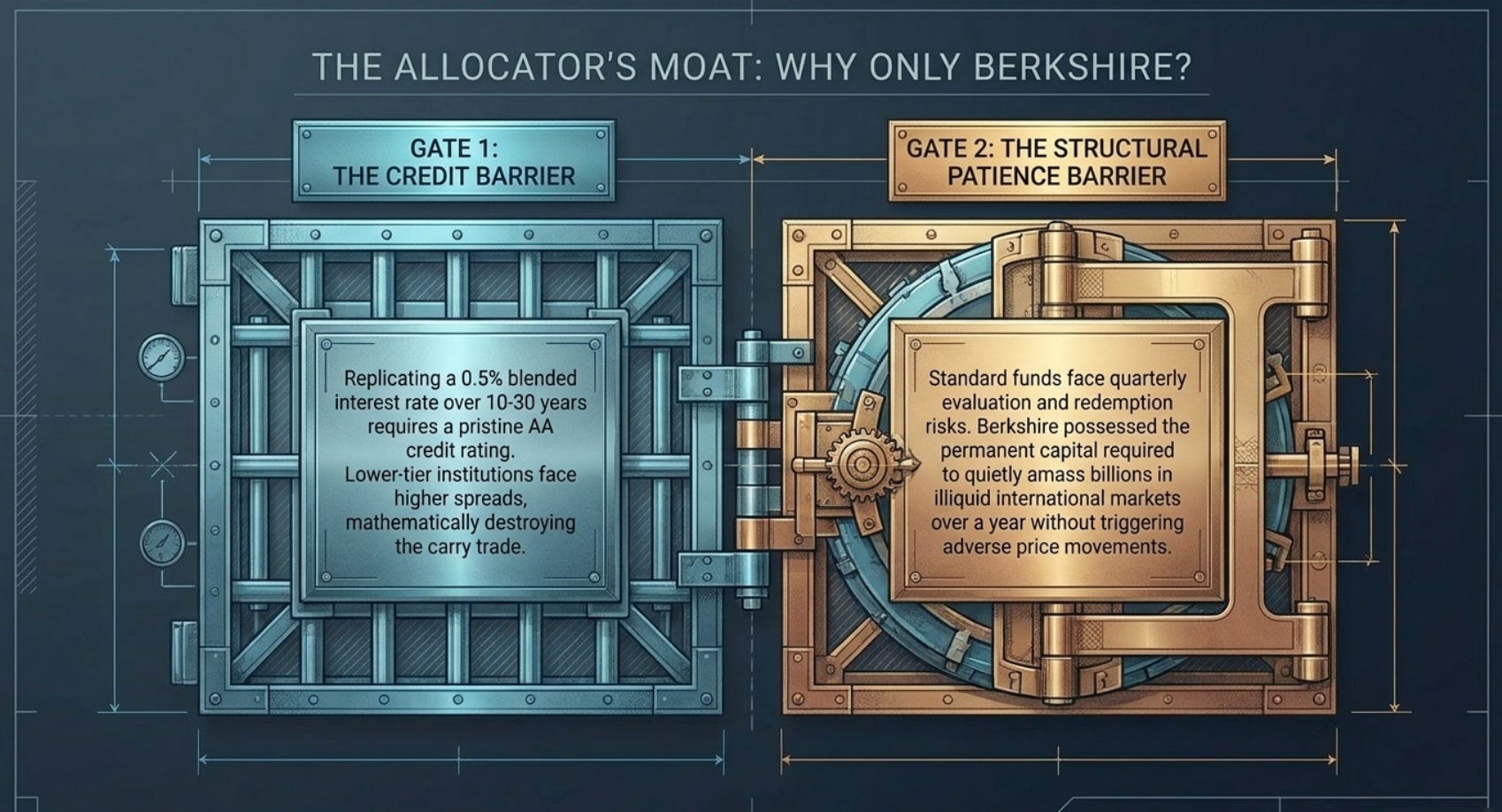
To execute the yen bond component of this arbitrage at the interest rates Berkshire obtained, you needed Berkshire’s AA credit rating. A lower-rated issuer in the Japanese market would have paid 200 to 300 basis points more — collapsing the spread from 4.5% to something between 1.5% and 2.5%, which is respectable but not the once-in-a-century opportunity Munger described. The AA rating is itself the product of sixty years of Berkshire’s capital discipline, its permanent equity capital base, its reputation for honouring obligations, and its insurance float — none of which can be manufactured quickly by an institution that wants to replicate the trade.
To accumulate $13 billion in illiquid Japanese equities over multiple years without announcing your position or moving prices materially against yourself, you needed Berkshire’s patience and its ability to deploy capital slowly without quarterly performance pressure. A hedge fund building the same position would face redemption pressure, performance benchmarking, and the structural incentive to concentrate quickly rather than accumulate gradually. By the time a hedge fund had deployed enough capital for the position to matter to its returns, it would have already moved the market against itself.
And to sit for five, ten, or fifty years without selling — which is what makes the yield-on-original-cost mathematics compound to its most extraordinary values — you needed Berkshire’s institutional commitment to permanent capital. Berkshire does not manage money for clients who can withdraw it. It does not answer to a limited partner advisory board that reviews the portfolio annually. It answers to shareholders who understand, because Buffett has explained it in every annual letter for sixty years, that Berkshire’s preferred holding period is forever. This institutional structure is itself a competitive advantage in the execution of long-duration, compounding trades.
Munger put the constraint precisely: “Other companies couldn’t get it. But Berkshire, with its credit, could.” The trade was available only to an institution that was simultaneously trusted by Japanese institutional investors as a bond issuer, trusted by markets as a long-term holder of equity, and willing to spend a year accumulating a position quietly before revealing it. That is a very short list. It may be a list of one.
Part Nine: The Lesson
There is a tendency, when studying great investment trades, to focus on the outcome — the return figures, the capital appreciation, the validation by subsequent events — and to extract from that outcome a lesson that sounds profound but is practically useless: find cheap assets. Be patient. Think long-term.
The lesson from this particular trade is more specific, and more useful.
What Buffett identified in 2019 was not merely a cheap asset or an overlooked market. He identified a convergence of three conditions that independently were interesting and jointly were extraordinary: a structural moat so deep that the cash flows it protected could be treated as near-certain; a financing opportunity available only to an institution with his specific combination of credit rating, capital base, and patience; and an accounting regime that was systematically understating the value of the assets behind that moat. Any one of these conditions is worth investigating. All three simultaneously — in a market that Western professional investors had collectively abandoned — is what produces the outcome that Munger described as a gift from God.
The sogo shosha’s competitive position had been building for 150 years. The yen bond arbitrage had been available, in principle, since the Bank of Japan adopted its near-zero rate policy in the 1990s. The accounting understatement of these companies’ assets — their fully depreciated resource concessions, their cross-holdings carried at historical cost, their relationship networks priced at zero — had been sitting in plain sight in annual reports for decades. None of these conditions was secret. All of them required the same thing to be acted upon: someone willing to read carefully, think patiently, and understand that the most powerful investment structures are usually not discovered through sophisticated modelling but through the simple, disciplined act of turning every page.
At 88 years old, with $700 billion under management and the resources to hire any analyst in the world, Warren Buffett found a $23 billion idea in a handbook. He found it because he was the only person of his scale who was still willing to read the handbook.
This paper was prepared as an analytical study of a completed investment structure. All data cited refers to historical figures. Nothing in this paper constitutes investment advice or a recommendation regarding any security. The bond coupon and tranche data cited in this paper is drawn from SEC-filed Form 424B5 prospectuses for Berkshire Hathaway’s yen bond issuances in September 2019, April 2020, April 2021, and January 2022, all filed under CIK 0001067983. The September 2019 inaugural issuance of ¥430 billion is confirmed by S&P Global Capital Markets Weekly commentary dated September 2019. The $23.5 billion valuation of Berkshire’s sogo shosha stakes is from Berkshire’s 2024 annual report. The 19.2% average annual dividend per share growth rate for 2021–2025 is sourced from public dividend disclosures across all five companies. The $850 million after-tax foreign exchange gain is from Berkshire’s 2024 shareholder letter. ROE data for each company is drawn from their respective IFRS annual reports, with Mitsui’s five-year average ROE of 14.4% confirmed by Investing.com data citing fiscal years ending March 2021–2025. Charlie Munger’s quotations are from the Acquired podcast interview, November 2023. Warren Buffett’s quotations are from the 2025 Berkshire annual meeting, the 2024 Berkshire shareholder letter, and the April 2023 Nikkei Asia interview conducted during his Tokyo visit.
If you like what you read, check out my other writings 👇
Rust, Rigs, and the Recurring Revenue Hidden in Plain Sight: A Deep Dive into Beng Kuang Marine (SGX: BEZ)

The Old Steel and the Sea: Why You Should Care About a Ship Maintenance Company
Investment Reflection #2 — The Grand Play: 100 Years of the World’s Nations as Characters in the Greatest Story Ever Told

“The world is not a chessboard. It is a living organism, where every cell — every nation — eats, competes, cooperates, and occasionally tries to eat the others. Understanding it requires not just memorizing moves, but understanding hunger.”

The Tide Is Going Out: Commodity Houses, Private Credit, and the AI Debt Bomb

Start Here: What This Article Is About
Why I Passed on Graftech (EAF): Riding The Battery Hype, Or Perhaps Not...

There is a kind of company that is the most dangerous thing in investing. It is not the fraudulent company. It is not the obviously bad company with terrible products and incompetent management. Those are easy — you just avoid them. The truly dangerous company is the one with a
The Beautiful Trap: Why I'm Passing on The Hour Glass (SGX: AGS)

There’s a peculiar kind of investment that keeps you up at night — not because it’s bad, but because it’s genuinely good. Good enough to admire. Not good enough to buy.
The Diamond in the Rough That Isn't Quite Yours: Why I Passed on Boustead (SGX: F9D)

There is an old saying that investors have borrowed, bent, and quoted so many times it has nearly lost its sharpness: a bird in the hand is worth two in the bush. Warren Buffett, characteristically, gave it a precise mathematical form. The value of any investment, he wrote, is determined by three questions:
The Schoolteacher's Secret Insurer: Why Horace Mann (NYSE:HMN) Is Sitting on My Watchlist

“The stock market is a device for transferring money from the impatient to the patient.” — Warren Buffett

The Dormitory King That Couldn't Leave Home: Why I Passed on Centurion (SGX: OU8)

There is a deceptively simple question that Warren Buffett borrowed from Aesop’s ancient fable, and has repeated across decades of shareholder letters: “How many birds are in the bush? How sure are you they’re there? And how long until you get them out?”
The Children's Place: A $90 Million Bet on a Company That Used to Be Worth $2 Billion (NYSE: PLCE)

There is a classic scene in every heist movie. The detective walks into a room, sees the chalk outline, the scattered evidence, the broken window, and immediately knows something went terribly wrong long before anyone called the police. You do not need the full autopsy report to read the body.
World War 3 In Iran and Why Oil Price Will Continue Increasing — It Arrived Sooner Than Anyone Expected

This is Part 2 of a continuing analysis of California Resources Corp (CRC). Part 1 built the foundational investment case: a company trading at $44 per share against a conservative intrinsic value of $108–$156, built on 567 million barrels of proved developed oil reserves in California, and a management team spending hundreds of millions buying back its…
The Most Overlooked Oil Company in America — And Why That Might Be the Opportunity of the Decade

Date of analysis: 28 December 2025
The Art Of Saying No - MYPS: Playstudios Inc

PLAYSTUDIOS (MYPS) is a Las Vegas-based mobile gaming company that operates free-to-play social casino games and a loyalty platform called playAWARDS, which lets players redeem points for real-world rewards at places like MGM Resorts, Norwegian Cruise Line, and Wolfgang Puck restaurants. On the surface, this sounds like a clever moat. A loyalty program.…
The Art Of Saying No - UGP: Ultrapar Participacoes S.A (Part 2 of 2)

Question 2: How Certain Are You?
The Art Of Saying No - GLIBK: GCI Liberty Inc

Picture this: a single telecommunications company — the dominant one — serves over 200 communities scattered across the largest state in the United States. Alaska. A state with just over one person per square mile. A state where 39% of residents are underserved by broadband. A state where, until recently, some villages received internet via satellite li…

The Art Of Saying No - UGP: Ultrapar Participacoes S.A (Part 1 of 2)

The Setup: A Value Investor Dream?


The Art of Saying No - RIG: Transocean LTD

“The difference between successful people and really successful people is that really successful people say no to almost everything.” — Warren Buffett
The Art of Saying No - KPRX: Kiora Pharmaceuticals Inc

“The difference between successful people and really successful people is that really successful people say no to almost everything.” — Warren Buffett
The Art of Saying No - DNUT: Krispy Kreme Inc

“The difference between successful people and really successful people is that really successful people say no to almost everything.” — Warren Buffett

🎓 A Business Strategy Primer Part 7 - Learning From Great Companies

The Billion-Dollar Playbook: How Market-Based Management Powered Koch Industries’ Unstoppable Rise
The Art of Saying No - MRX: Marex Group PLC

“The difference between successful people and really successful people is that really successful people say no to almost everything.” — Warren Buffett


The Art of Saying No - SFIX: Stitch Fix Inc

“The difference between successful people and really successful people is that really successful people say no to almost everything.” — Warren Buffett
🎓 A Business Strategy Primer Part 2 - Brainstorming Solutions With Value At The Core

Creating An Irresistible Offer
The Art of Saying No - TDOC: Teladoc Health Inc

“The difference between successful people and really successful people is that really successful people say no to almost everything.” — Warren Buffett

The Art of Saying No - MDU: Mdu Resources Group Inc

“The difference between successful people and really successful people is that really successful people say no to almost everything.” — Warren Buffett


The Art of Saying No - AFCG: Advanced Flower Capital Inc

“The difference between successful people and really successful people is that really successful people say no to almost everything.” — Warren Buffett
The Art Of Saying No - VYX: NCR Voyix Corp

“The difference between successful people and really successful people is that really successful people say no to almost everything.” — Warren Buffett
The Art of Saying No - VSTS: Vestis Corp

“The difference between successful people and really successful people is that really successful people say no to almost everything.” — Warren Buffett

🛢️Basic Energy Primer Part 2 - Business and Competitive Landscape

The Man Who Bet Everything on Being Wrong
The Art of Saying No - CISS: C3is Inc

“The difference between successful people and really successful people is that really successful people say no to almost everything.” — Warren Buffett
The Art of Saying No - PSHG: Performance Shipping Inc

“The difference between successful people and really successful people is that really successful people say no to almost everything.” — Warren Buffett

The Art Of Saying No - MAGN: Magnera Corp

The Magnera Corporation Analysis Nobody Asked For (But Everyone Needs)
The Art of Saying No - CHR: Cheer Holding Inc

“The difference between successful people and really successful people is that really successful people say no to almost everything.” — Warren Buffett
The Art of Saying No - WIMI: WiMi Hologram Cloud Inc.

“The difference between successful people and really successful people is that really successful people say no to almost everything.” — Warren Buffett
⚡️Alternative Energy Primer Part 3 - Industry and Sector Technicals

The €2.2 Billion Mistake That Revealed Everything
⚡️Alternative Energy Primer Part 2 - Business & Competitive Landscape

The Shipwreck That Changed Everything

🏥 A U.S. Health Insurance (Managed Care Organizations) Sector Primer

1️⃣ Industry Fundamentals & Macro View

