
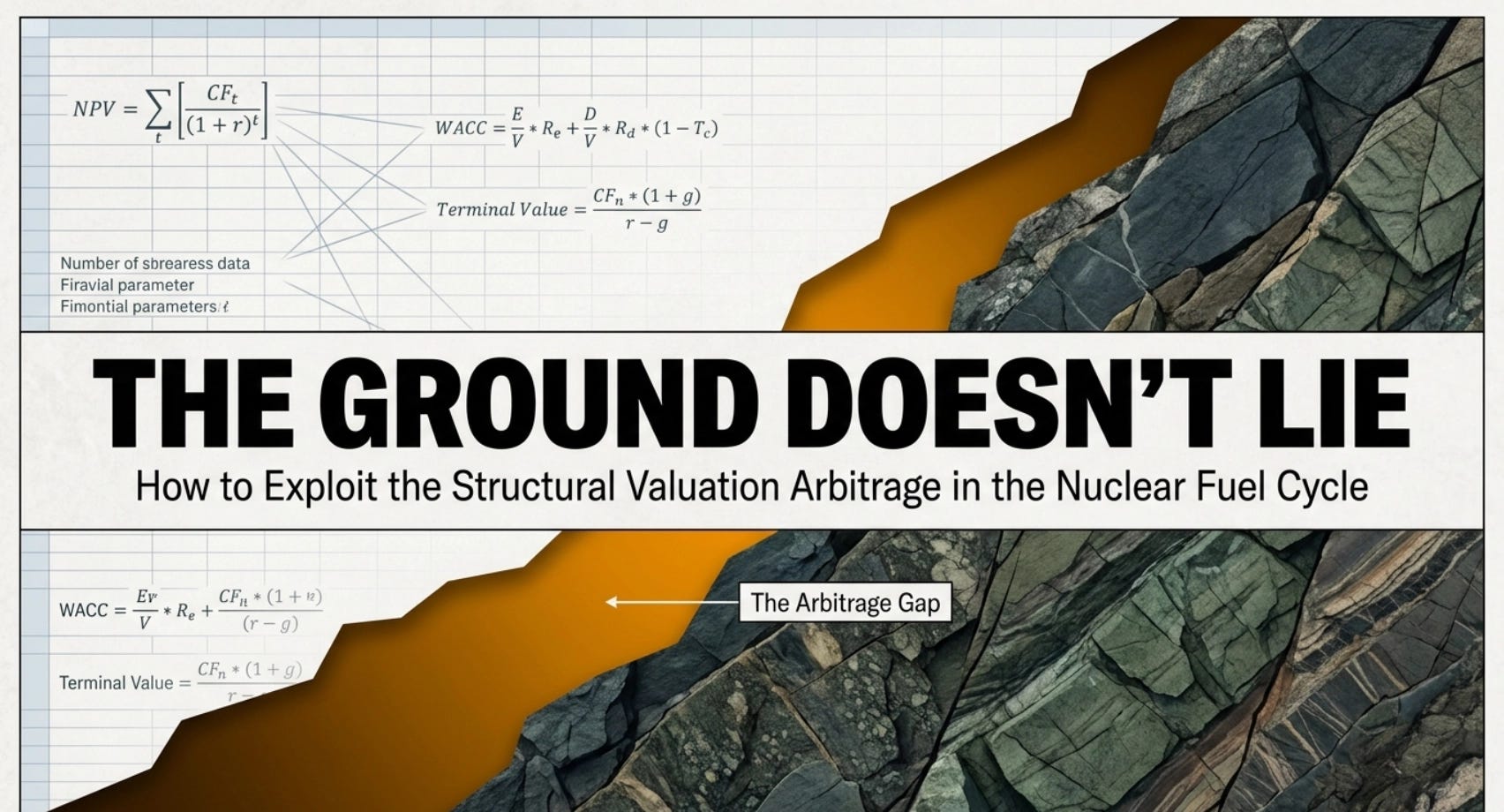
A Note on Method Before We Begin
Every analyst who has ever covered Cameco, NexGen, or Kazatomprom has opened a financial model and begun discounting future cash flows. They have built tables of uranium price assumptions, escalating production schedules, operating cost projections, EBITDA multiples, and present value calculations using discount rates they cannot justify with anything more rigorous than gut feeling and precedent.
None of that appears in this paper.
Instead, this paper asks a simpler question — the question a mine owner asks, not a financial modeler. That question is: how many pounds of uranium are in the ground, what does it cost to get them out, and what can I sell them for right now?
The answer to that question — a business owner’s answer, derived from certified reserve reports and current spot prices, not from spreadsheets built on assumptions — is systematically and repeatedly higher than what public markets price these companies at. Understanding why that gap exists, how large it is, why it has persisted for decades, and why specific, already-confirmed catalysts are now closing it — that is what this paper is about.
Part One: The Asset
What a Uranium Company Actually Owns
Start with a physical fact that no financial model can alter: uranium is a finite, non-renewable substance embedded in specific rock formations at specific grades in specific places on earth. It cannot be manufactured, substituted for fuel purposes, or meaningfully extracted from seawater at any economic cost. The 439 operating nuclear reactors in the world as of 2025 need approximately 180 million pounds of uranium oxide (U₃O₈) per year to generate the electricity they were built to produce. Those reactors do not need uranium that might be in the ground somewhere. They need uranium that has already been found, certified by qualified geologists under internationally audited standards, and measured to within a narrow margin of error.
That certified, measured, verified quantity of uranium in the ground is called a Proven and Probable Mineral Reserve. Under National Instrument 43-101 (Canada) and JORC Code (Australia) — the two primary reserve certification standards for uranium companies — a reserve can only be declared when it has been drilled at sufficient density to confirm the grade and continuity of the ore body, and when the economics have been demonstrated viable at a stated commodity price. This is not a guess. It is an engineering statement about what is physically extractable from a specific hole in the ground.
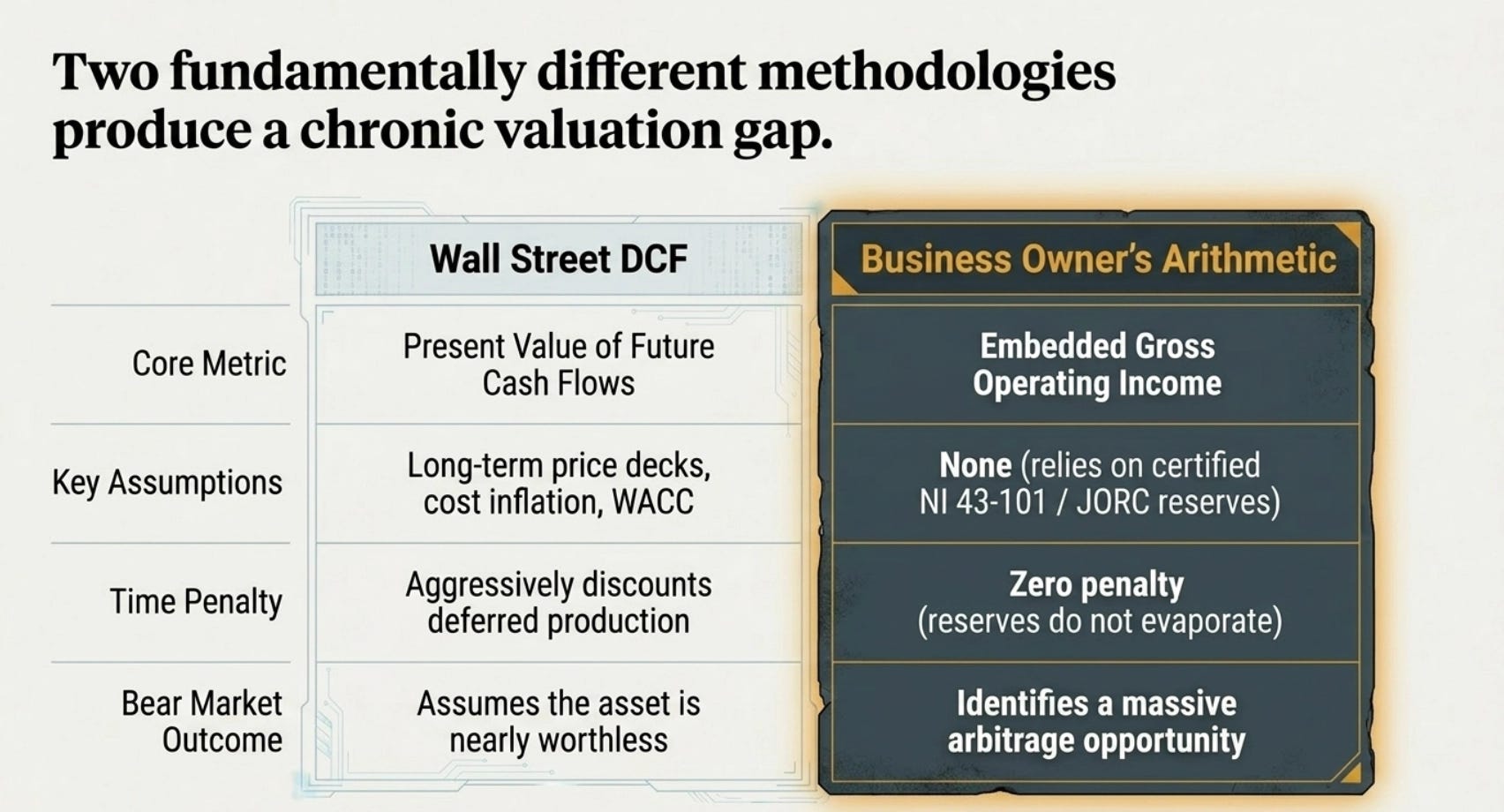
The business owner’s arithmetic begins here. Take the reserve in pounds. Subtract the cash operating cost per pound to get it out of the ground and into a drum of yellowcake (uranium concentrate). What remains is the net operating income embedded in the ground — before a single future assumption is required.
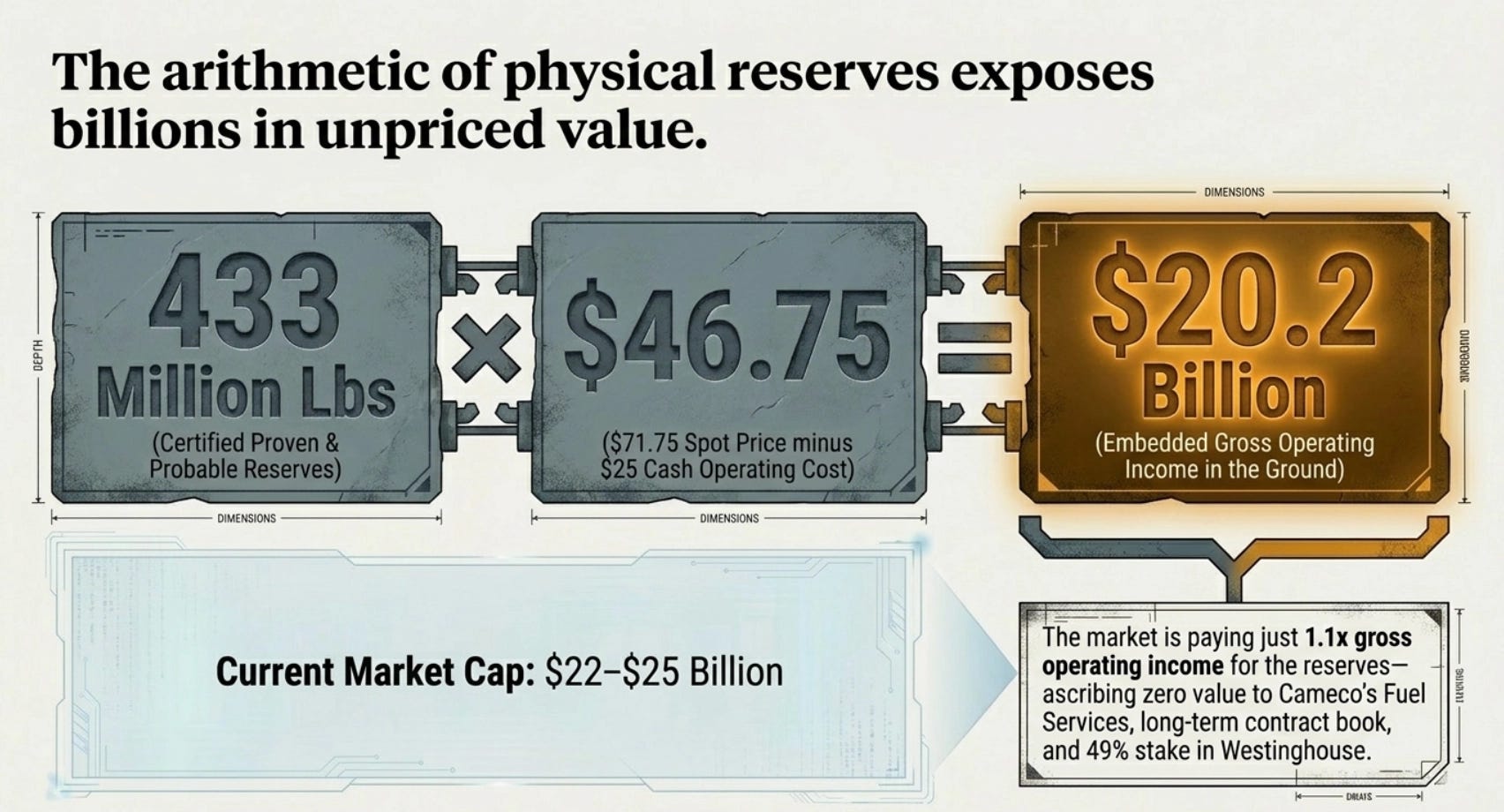
For Cameco Corporation, the world’s second-largest uranium producer, the arithmetic is direct. The company’s annual reports disclose that it has access to approximately 433 million pounds of proven and probable mineral reserves (its attributable share across McArthur River, Cigar Lake, and its other operations). As of mid-2025, the uranium spot price was approximately $71.75 per pound. Cameco’s reported cash operating costs for its underground Canadian operations run approximately $20–$30 per pound, with the midpoint at $25. Net operating margin per pound: $71.75 minus $25 = $46.75. Applied to 433 million pounds of certified reserves: approximately $20.2 billion in gross operating income embedded in existing, certified, drilled-out reserves.
Cameco’s market capitalization in early 2026 was approximately $22–$25 billion. That means the market is paying roughly 1.1 to 1.2 times the gross operating income of the company’s proven reserves — and ascribing essentially zero value to Cameco’s Fuel Services segment (uranium conversion and refining), its 49% ownership stake in Westinghouse Electric (the world’s leading nuclear reactor technology company, which alone was valued at approximately $7.9 billion in its 2023 acquisition by Brookfield and Cameco), and its long-term contract book that locks in multi-year sales at prices above the current spot market.
This is the gap. Not a speculative gap, not a forecasted gap, but a gap between a number you can calculate today — pounds times net margin per pound — and the price the market is charging for the whole enterprise.
Why the Balance Sheet Is Useless for This Asset
Under both US GAAP (ASC 932) and IFRS (IFRS 6), mineral reserves are not recognized as assets at fair value on the balance sheet. Full stop. The accounting treatment is to capitalize the cost of exploration and development drilling as Property, Plant, and Equipment, and then deplete those capitalized costs against production using the Units of Production method.
What this produces is absurd from an economic perspective. Cameco has been drilling and developing McArthur River since the 1980s. The capitalized development costs that remain on the balance sheet after decades of accumulated depletion represent what was spent to find and develop the reserves, not what those reserves are worth. A deposit that cost $400 million to develop and has been 60% depleted shows a net book value of $160 million — completely independent of whether the remaining pounds are worth $1 billion or $5 billion at current prices.
The balance sheet is therefore not merely unhelpful for uranium analysis. It is actively misleading. A naive analyst who screened for uranium companies trading at low Price-to-Book ratios would find nothing, because all major uranium producers trade at significant premiums to their accounting book value. The book value bears no relationship to the economic value of the pounds in the ground. A sophisticated analyst ignores the balance sheet entirely and does the reserve math directly.
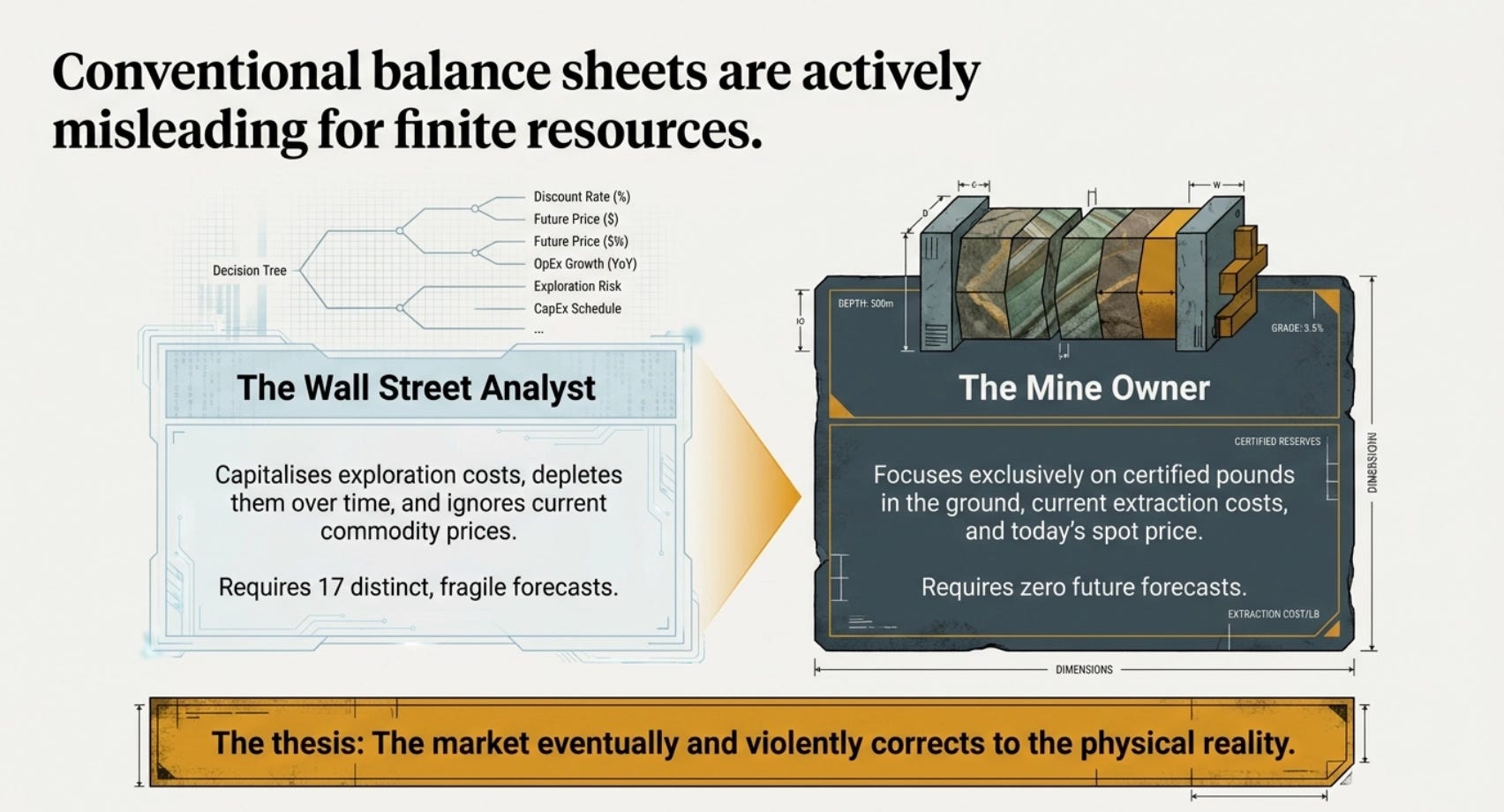
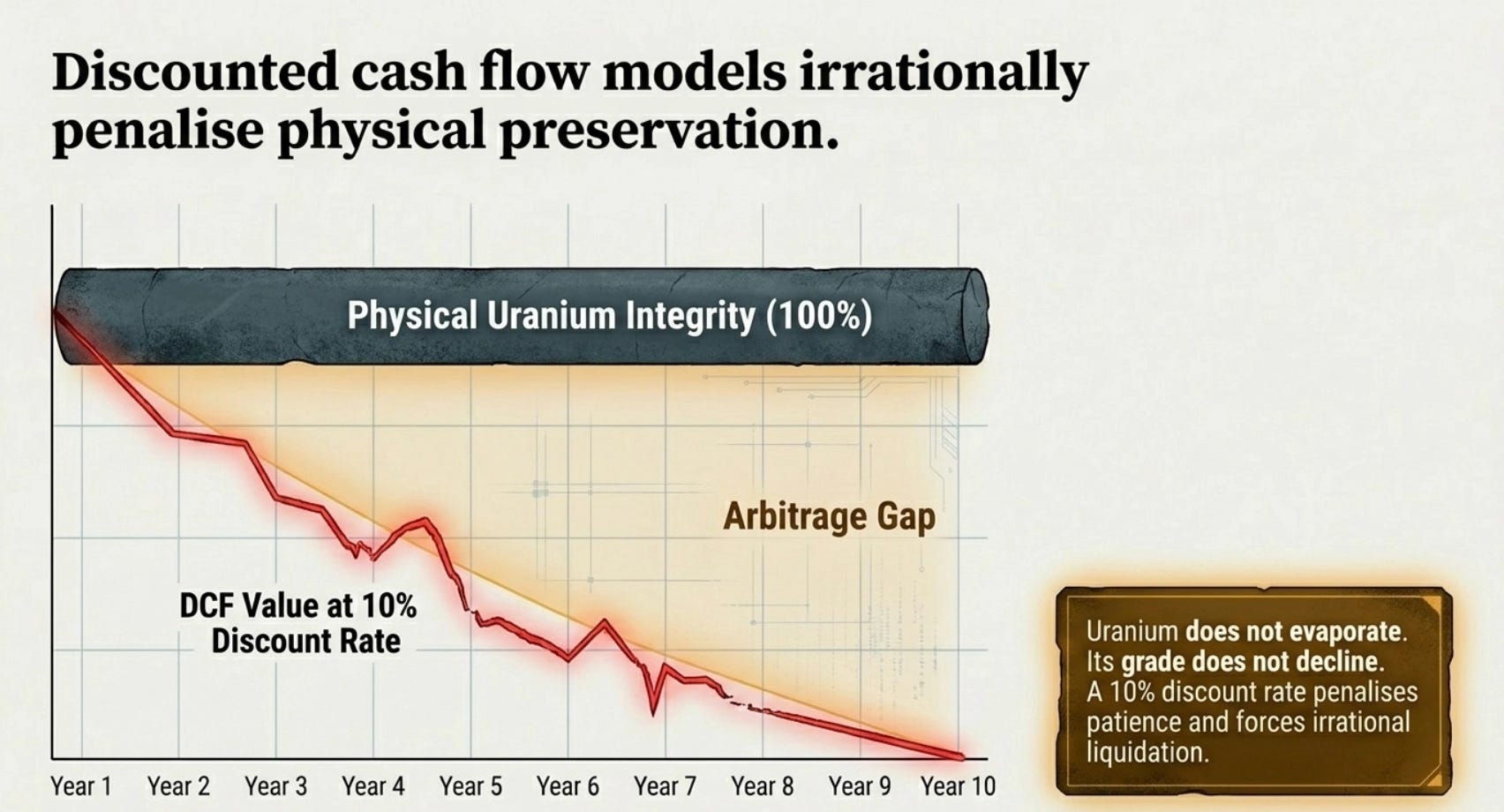
Wall Street does neither of these things cleanly. Instead, it builds discounted cash flow models that require uranium price assumptions three, five, and ten years into the future — assumptions that carry enormous uncertainty — and discount everything back at arbitrary rates. The result is a valuation that looks precise but is built entirely on forecasts that could be wrong by 50% in either direction. The business owner’s method — pounds in the ground times net margin per pound at today’s price — requires no forecast at all. It is an arithmetic calculation about what already exists.
Part Two: The Story of How This Market Works — And Why the Gap Persists
To understand why uranium reserves are chronically mispriced, you need to understand the specific structure of the uranium market. It is unlike any other commodity market, and those structural features create the mispricing that this paper is documenting.
The Long-Term Contract System: Why Spot Prices Understate Realized Revenue
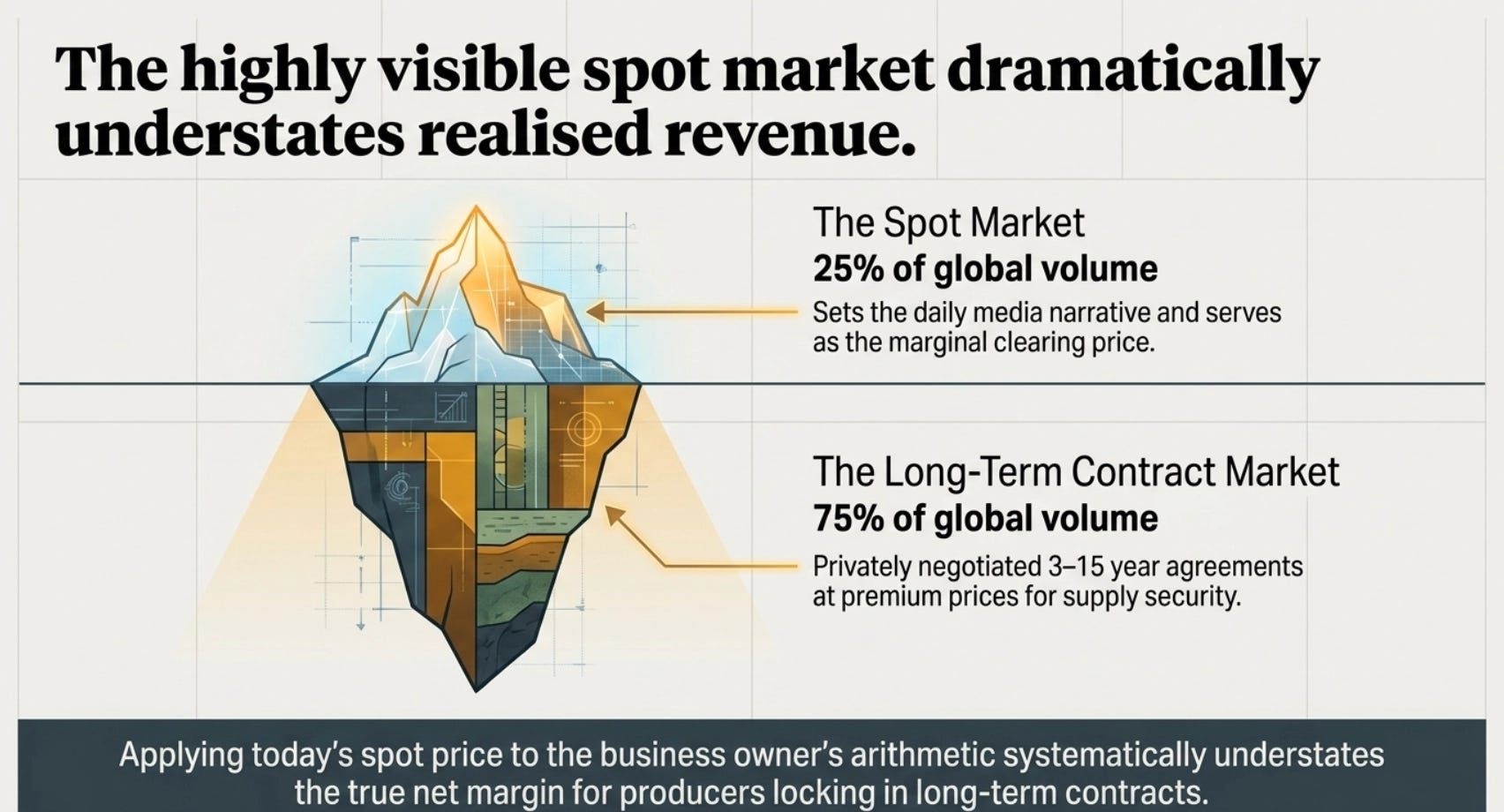
Uranium does not trade on an open exchange like copper or oil. There is no London Metals Exchange for uranium, no futures market that sets a continuous public price, no real-time bid-ask spread visible to anyone with a Bloomberg terminal. Instead, nuclear utilities buy uranium primarily under long-term supply contracts — privately negotiated agreements that run for 3 to 15 years between the utility and the mining company. The contracted price is typically higher than spot, because utilities pay a premium for supply security.
The World Nuclear Association has documented this structure consistently: as of the most recent available data, approximately 75% of global uranium supply is sold under long-term contracts, with only 25% traded on the spot market. This means the spot price — the number reporters and analysts quote — represents only the marginal clearing price for 25% of the market. The other 75% is contracted at prices that can be meaningfully higher. Cameco’s average realized price in 2023 was approximately $57.78 per pound, against a spot market that averaged approximately $55–$60 per pound during the year — but in 2024, as contracts signed in 2021–2023 at escalating term prices began to deliver, Cameco was realizing significantly above spot.
This means the business owner’s arithmetic using today’s spot price actually understates the net margin per pound for a company like Cameco that has locked in long-term contracts above spot. The embedded value of the reserve is higher than the spot-based calculation suggests.
The Inventory Liquidation that Suppressed Prices for a Decade — and Why It Is Over
The single most important structural fact about uranium pricing from 2011 to 2021 is one that most financial analysts never examine. For the decade following the March 2011 Fukushima Daiichi nuclear accident in Japan, uranium prices collapsed from approximately $70/lb to as low as $18/lb by 2016 and spent years in the $20–$30 range. Every financial model built during this period — models that Wall Street analysts used to “value” uranium companies — was implicitly or explicitly forecasting that these depressed prices would persist or recover only slowly.
The actual cause of the price collapse was the liquidation of a specific, finite, and non-recurring inventory: Soviet-era weapons-grade uranium. From 1993 to 2013, a program known as “Megatons to Megawatts” converted 500 metric tonnes of Russian highly-enriched uranium (originally built for nuclear warheads) into low-enriched uranium suitable for reactor fuel. This created approximately 500 million pounds of equivalent reactor-grade uranium over 20 years — or about 25 million pounds per year of secondary supply that required zero mining to produce. Combined with Japanese reactor shutdowns (Japan had operated 54 reactors; all were eventually idled after Fukushima), the market was simultaneously losing 10–15% of global demand while gaining a persistent secondary supply source. The significant increase in supply relative to demand resulted in the massive drop in prices.
The critical point: both of these suppression factors had a defined end date. The Megatons to Megawatts program concluded in December 2013. Japanese reactor restarts were a regulatory question, not a physics question. The secondary supply overhang would eventually be consumed, and the reactors would eventually restart or be permanently decommissioned. In either case, the structural suppression was temporary.
Uranium producers who understood this stayed in the business, reduced output to preserve reserves, and waited. Uranium producers who valued their companies using the discounted cash flow models of 2015 — which mechanically extrapolated a $28/lb uranium price into the future — concluded their assets were nearly worthless. The ones who calculated pounds times net margin at a normalized price, and found that number to be many times the market cap, understood what they owned.
Part Three: Three Case Studies in the Gap Between Book and Reserve
Case Study 1 — Cameco at the Trough (2016)
By the end of 2015, Cameco Corporation — the premier uranium mining company in the Western world, operator of the McArthur River mine (the world’s highest-grade uranium mine, at approximately 17% U₃O₈ average grade versus a global average of less than 0.1%), and owner of certified reserves totaling hundreds of millions of pounds — was trading on the Toronto Stock Exchange at approximately CAD $15 per share. Analysts were uniformly bearish. Price targets clustered around CAD $12–$18. The consensus DCF model, fed with $30/lb long-term uranium price assumptions, produced valuations that in several cases were below the cash on Cameco’s balance sheet plus the depreciated book value of its Canadian mining assets.
What the analysts were doing, specifically, was this: they took the prevailing spot price of approximately $28–$35/lb, escalated it at a modest rate in their models, applied it to future production schedules, discounted at 8–10%, and arrived at a net present value. From that NPV they subtracted net debt, divided by shares outstanding, and called it a price target. Every step of this process was theoretically defensible. Every step also systematically undervalued what was in the ground.
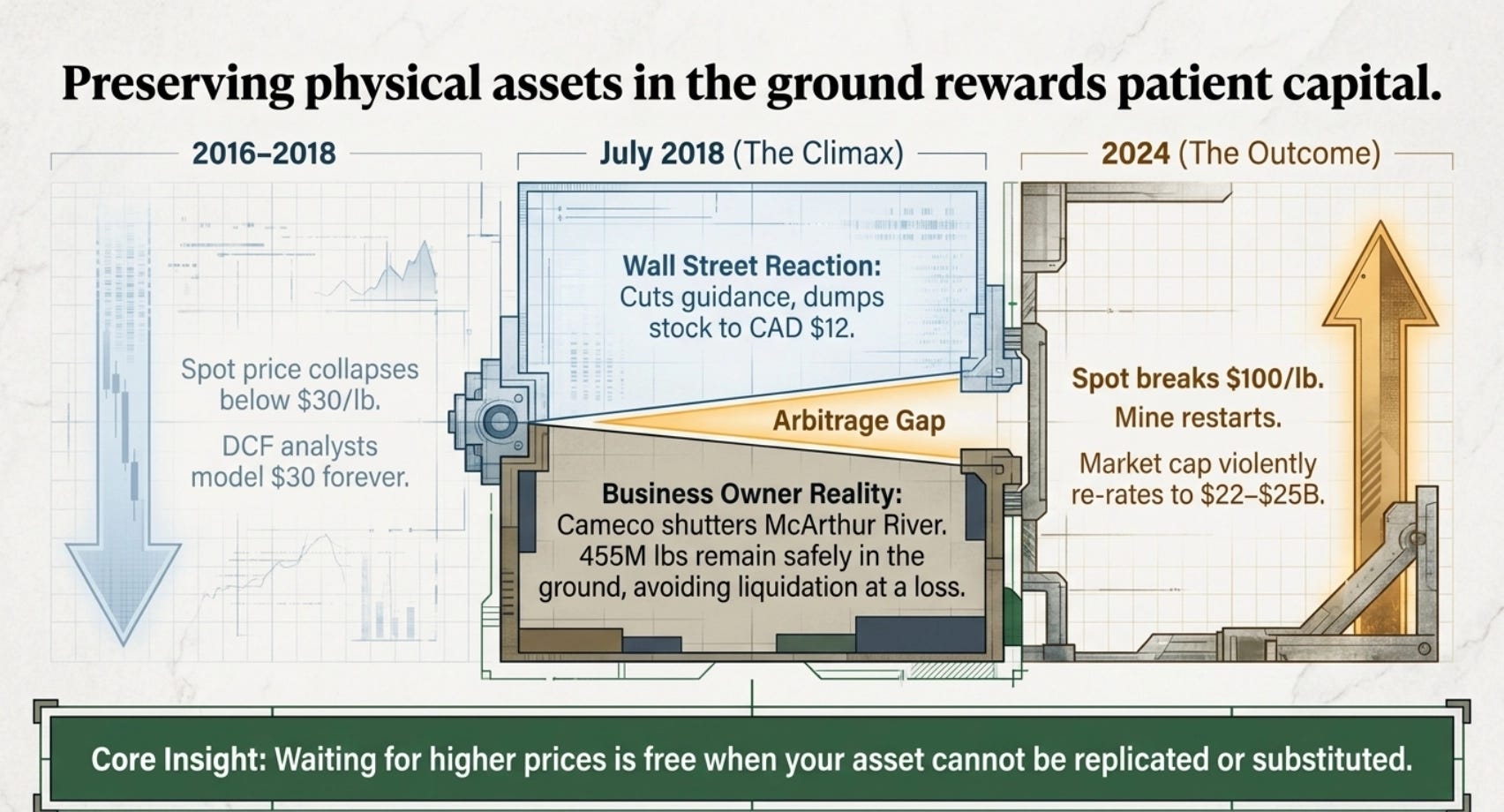
In July 2018, after years of losses from operating McArthur River and Cigar Lake at cash costs above the prevailing spot price, Cameco did something that financial models did not predict: it shut both mines down entirely. McArthur River, the world’s highest-grade uranium operation, was placed on care and maintenance. Cigar Lake continued at reduced capacity. Cameco’s management stated publicly that it preferred to buy uranium in the spot market to fulfill existing contracts rather than mine it at a loss. This was not a statement of despair. It was the statement of a business owner who understood the value of what was in the ground and refused to liquidate it at prices below its worth.
The financial community interpreted the mine closures as a negative signal. Production guidance cuts drove further analyst downgrades. The stock declined further, reaching approximately CAD $12–$14 per share in late 2018. By this point, the business owner’s arithmetic was stark: Cameco held approximately 455 million pounds of proven and probable reserves. At $28/lb spot with $25/lb operating costs, the net margin was $3/lb — barely positive and not sufficient to justify operating the mines. But the reserves had not disappeared. They were still in the ground. A buyer who purchased the entire company at the 2018 market cap of approximately CAD $5–$6 billion ($3.8–$4.5 billion USD) was purchasing the right to produce hundreds of millions of pounds of uranium from the world’s highest-grade mines — at the option to produce them when prices made it economic. At any uranium price above $40/lb (well within the historical range), the net margin per pound was $10–$15+, and across 455 million pounds, the embedded operating income was $4.5–$6.8 billion. The market, guided by DCF models assuming $30/lb uranium forever, was selling this for $3.8 billion.
Uranium spot prices began their recovery in late 2021 and accelerated dramatically through 2022, 2023, and early 2024. In January 2024, the uranium spot price broke above $100/lb for the first time in 17 years. Cameco restarted McArthur River in November 2022 and resumed full operations at Cigar Lake. By early 2026, Cameco’s market capitalization had recovered to approximately $22–$25 billion USD. Investors who purchased at the 2018 trough near $12–$14 CAD per share had earned returns of approximately 4–5x their investment over six years — not from a business transformation or a competitive reinvention, but from the market finally pricing what had been in the ground all along.
The business owner who looked at Cameco in 2018 and calculated “455 million pounds times $15/lb net margin at a $40/lb price scenario = $6.8 billion embedded operating income, versus a $4 billion market cap” was not making a forecast. He was reading a reserve report and multiplying by a number. The analyst who built a DCF at $30/lb was making seventeen specific forecasts about uranium prices, production ramp schedules, operating cost inflation, exchange rates, discount rates, and capital spending — every single one of which could be wrong. The business owner’s method was more certain, more grounded, and in this case, more correct.
Case Study 2 — NexGen Energy and the Arrow Deposit: A Reserve So Large It Bent the Market
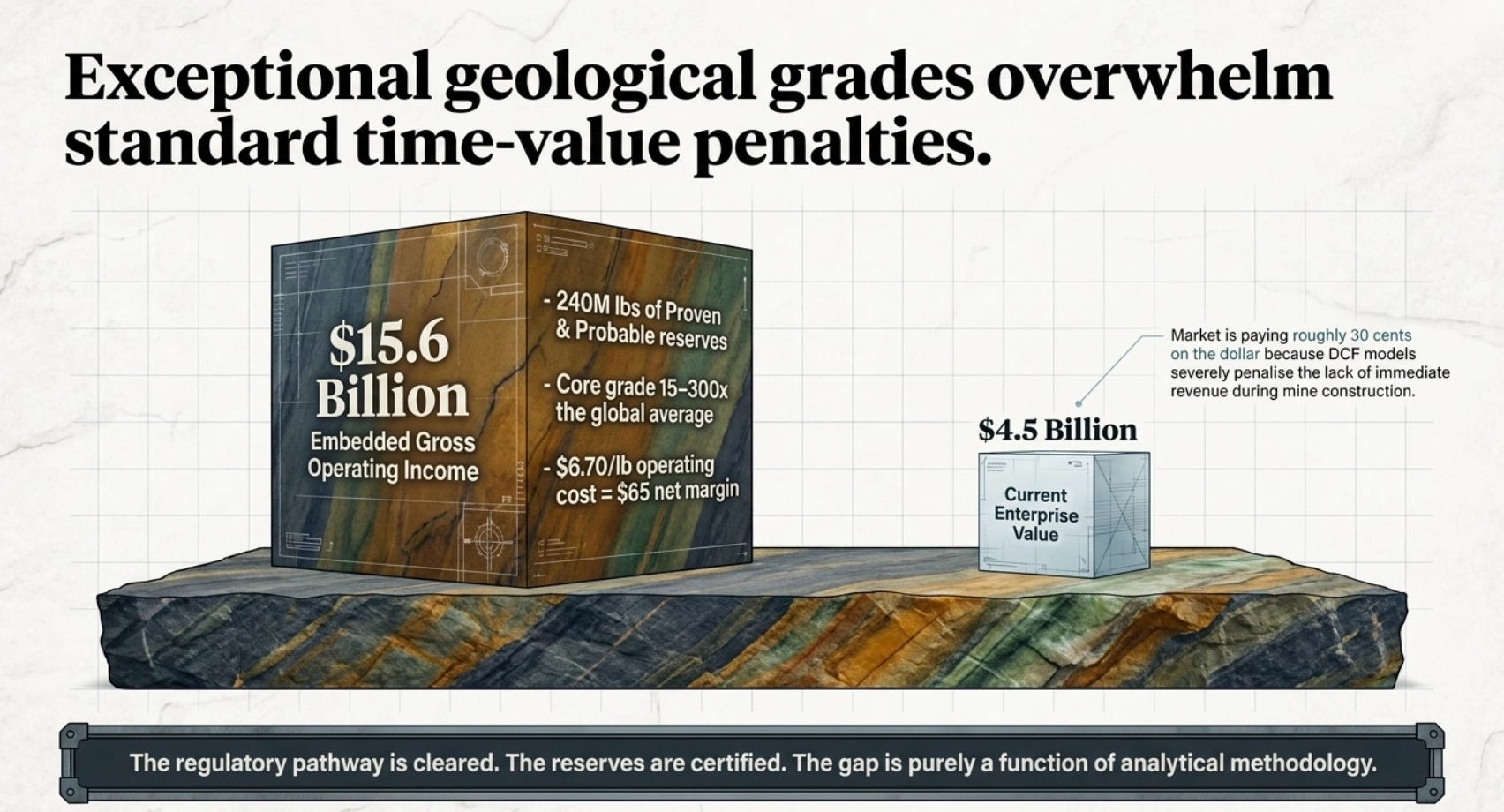
NexGen Energy is a Canadian uranium developer with a single asset that has become one of the most debated topics in the uranium investment world. Its Rook I project, centered on the Arrow deposit in Saskatchewan’s Athabasca Basin, hosts proven and probable mineral reserves of 240 million pounds of U₃O₈ at an average grade of 2.37% — with a high-grade core zone (the A2 sub-zone) averaging approximately 15–17% U₃O₈, grades that are extraordinary by any global standard. For context, the global average uranium mine grade is approximately 0.05–0.10%. Arrow’s high-grade core is 150–300 times richer than the average uranium mine in the world.
The economics disclosed in NexGen’s 2021 NI 43-101 feasibility study are specific and remarkable: average cash operating costs of approximately US $4.36–$6.70 per pound over the mine life. At a $71.75/lb spot price, the net operating margin per pound ranges from $65 to $67 on the high-grade core material. Applied to 240 million pounds of probable reserves: embedded gross operating income of approximately $15.4–$16.1 billion from a single mine. The company’s entire market capitalization as of early 2026 was approximately $4–$5 billion USD — less than a third of the operating income embedded in its certified reserves.
The financial community’s persistent difficulty with NexGen is that it has no revenue. The mine is not yet in production. A DCF analyst looks at NexGen and sees years of negative cash flow ahead (construction costs, development capital) before any production begins. They discount those future cash flows at 8%, 10%, or 12% depending on their risk adjustment, layer in uranium price assumptions for 2028 and beyond, and arrive at a valuation. Because the mine is not producing, the numerator of any income-based calculation is zero or negative for several years. Most financial models for NexGen have therefore either (a) severely undervalued the company during periods of uranium market pessimism, or (b) struggled to justify the company’s market capitalization against any conventional metric when uranium prices are low.
The business owner’s approach cuts through this entirely. Arrow’s 240 million pounds of probable reserves are in the ground right now. They have been drilled, certified, and published in a publicly available NI 43-101 report. The operating cost — derived from a feasibility study conducted by independent engineering firms — is approximately $6.70/lb at the life-of-mine average. At $71.75/lb spot price, net operating margin is $65.05/lb. The entire reserve base is worth $15.6 billion in embedded operating income at today’s price, today’s cost. The question is not “will this be worth something in the future” — it already is worth $15.6 billion. The question is only whether the market is paying full price for it now.
As of early 2026, with a market cap of approximately $4–$5 billion, the answer is clearly no. The market is paying roughly 30 cents on the dollar for the embedded reserve value. The construction risk is real — Arrow has not yet been built — but the ore body is certified. The economic framework is established. The regulatory approval process advanced materially in March 2026 when NexGen received construction approval from the provincial government of Saskatchewan. The environmental assessment is complete. The mine will be built.
NexGen received its construction go-ahead in early 2026. The company is targeting a production start in the late 2020s. By the time Arrow reaches full production — approximately 30 million pounds of U₃O₈ per year in the first half of its mine life — it will represent approximately 16% of current global uranium mine supply from a single deposit. At any uranium price above $30/lb, the mine is extremely profitable. At the $71.75/lb spot price in mid-2025, it would be generating approximately $1.9 billion per year in gross operating income from a single operation. The market cap of $4–$5 billion, measured against these numbers, reflects a discount that can be explained only by the systematic failure of conventional valuation to account for what is in the ground.
The Arrow deposit has contained the same 240 million pounds since it was drilled out between 2014 and 2019. The grade has been confirmed repeatedly by independent engineers. The operating cost estimate has been refined by a rigorous feasibility study. None of these facts require a forecast. A business owner looking at Arrow says: “240 million pounds at $65/lb net margin = $15.6 billion in embedded operating income. I am being asked to pay $4.5 billion for the entire company.” An analyst running a DCF says: “The mine is not yet in production, the uranium price in 2030 is uncertain, and my discount rate adjusts for political risk in Saskatchewan.” The analyst’s model produces a number that looks precise but is built on a scaffold of assumptions. The business owner’s calculation is based on what already exists.
Case Study 3 — The 2021 Sprott Intervention: When a Physical Trust Exposed the Market Structure
By mid-2021, the uranium spot market was a ghost town. The price had languished near $30/lb for three years. Kazatomprom had cut production. Cameco had shuttered its flagship mines. The Megatons to Megawatts program had been over for eight years, and its secondary supply contribution was gone. Yet prices remained stubbornly depressed, and uranium mining companies traded at fractions of their in-ground reserve values, because financial analysts continued to model forward prices at $35–$45/lb and discount everything back at rates that made even Cameco look only modestly undervalued.
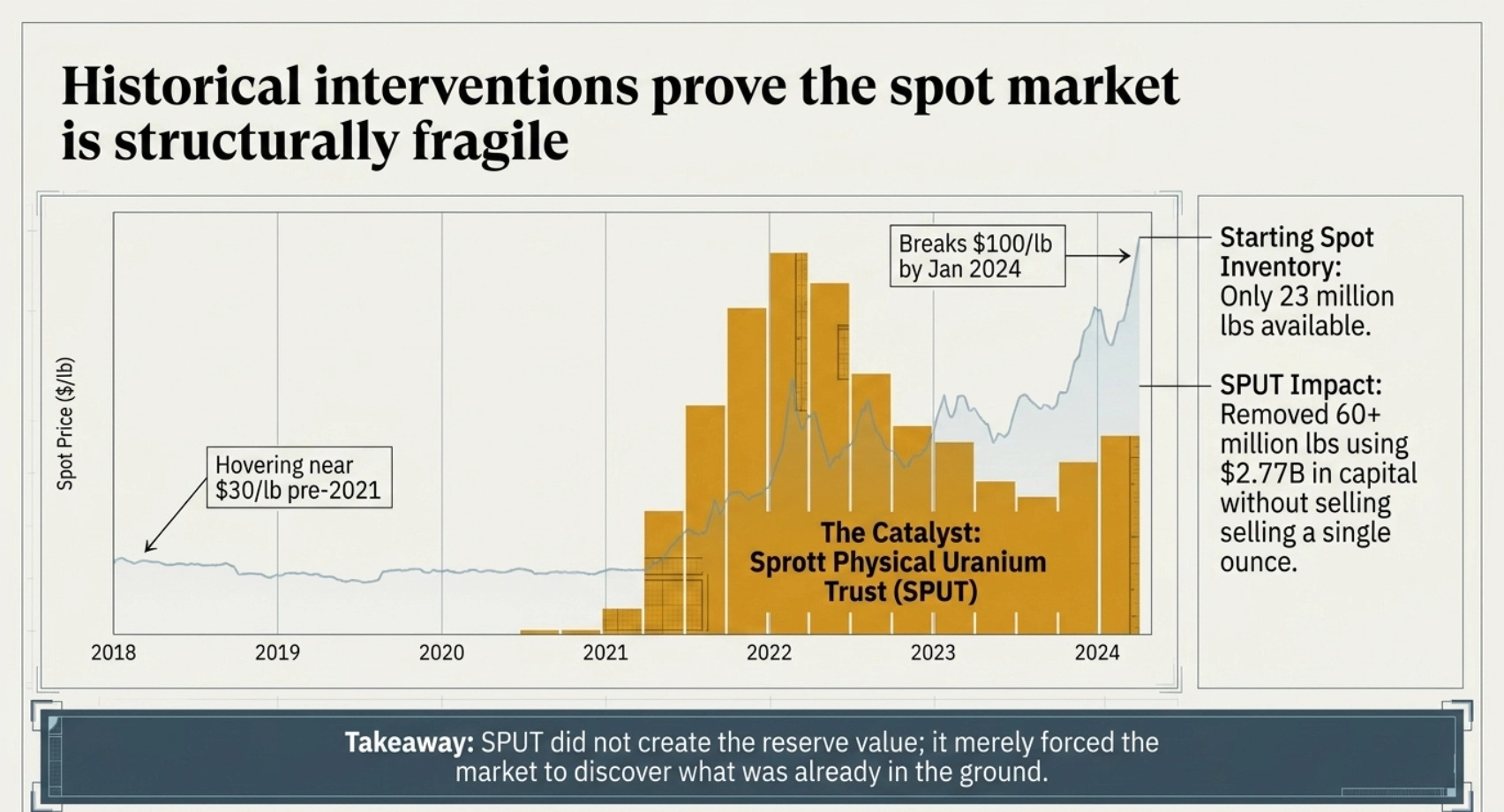
The spot market’s available inventory — the pounds of physical uranium oxide available for purchase in the spot market at any given time — was estimated at approximately 23 million pounds in August 2021. This is a remarkably small number. The global reactor fleet consumes 180 million pounds per year, meaning the spot market held roughly six weeks of global consumption. The market was structurally tight but nobody was forcing the price discovery.
In July 2021, Sprott Asset Management acquired the Uranium Participation Corporation (a pre-existing Canadian physical uranium vehicle) and reorganized it into the Sprott Physical Uranium Trust (SPUT), listed on the Toronto Stock Exchange. SPUT’s mechanism was simple: issue trust units to investors, use the proceeds to purchase physical uranium in the spot market, and store it indefinitely. Unlike a futures contract or a mining stock, SPUT actually took physical delivery of the uranium — removing it from available spot inventory and holding it in licensed storage facilities.
The effect was immediate and substantial. Within weeks of its launch, SPUT had begun purchasing uranium at a rate that shocked the small spot market. By August 2022, SPUT had purchased approximately 57 million pounds of U₃O₈ — more than twice the spot market’s entire available inventory at the trust’s launch, purchased over roughly twelve months. Total capital deployed: approximately $2.77 billion, representing approximately 250 individual purchases from 28 different counterparties. By mid-2025, SPUT’s total holdings had grown to more than 60 million pounds — without selling or lending a single pound.
The spot price response was direct: from approximately $28–$30/lb at the trust’s July 2021 launch, uranium prices had risen to $50/lb by late 2021, $63/lb by mid-2022, and eventually broke above $100/lb in January 2024 for the first time in 17 years, briefly touching $106/lb in February 2024 — a level last seen in 2007 when the Cigar Lake mine flood triggered the previous bull market.
Uranium mining stocks moved with prices. Cameco shares went from approximately CAD $20 in mid-2021 to approximately CAD $65 by late 2024 — a 225% return. Uranium Energy Corp, an ISR-focused US producer, went from approximately $3 per share to peaks above $8 during the same period. NexGen Energy went from approximately $4 to peaks above $10. The entire sector rerated, not because earnings estimates were revised upward by financial models (the companies were not yet producing at full capacity), but because the physical market demonstrated, with actual purchases at documented prices, that the uranium in the ground was worth more than the models said.
The Sprott intervention reveals something fundamental about the uranium market that every DCF-based valuation misses: the spot market is structurally thin, and it only takes one large actor buying physical material to move prices dramatically. The reserve value embedded in Cameco’s 433 million pounds, or NexGen’s 240 million pounds, or Kazatomprom’s billions of pounds, existed before Sprott existed. Sprott did not create value — it revealed it. The business owner calculating pounds times net margin per pound in 2019 or 2020 was sitting on the same answer that the market eventually reached in 2023 and 2024. The gap between the two was patience, not analysis.
Part Four: The Structural Supply Deficit — Why the Business Owner’s Math Gets Better Over Time
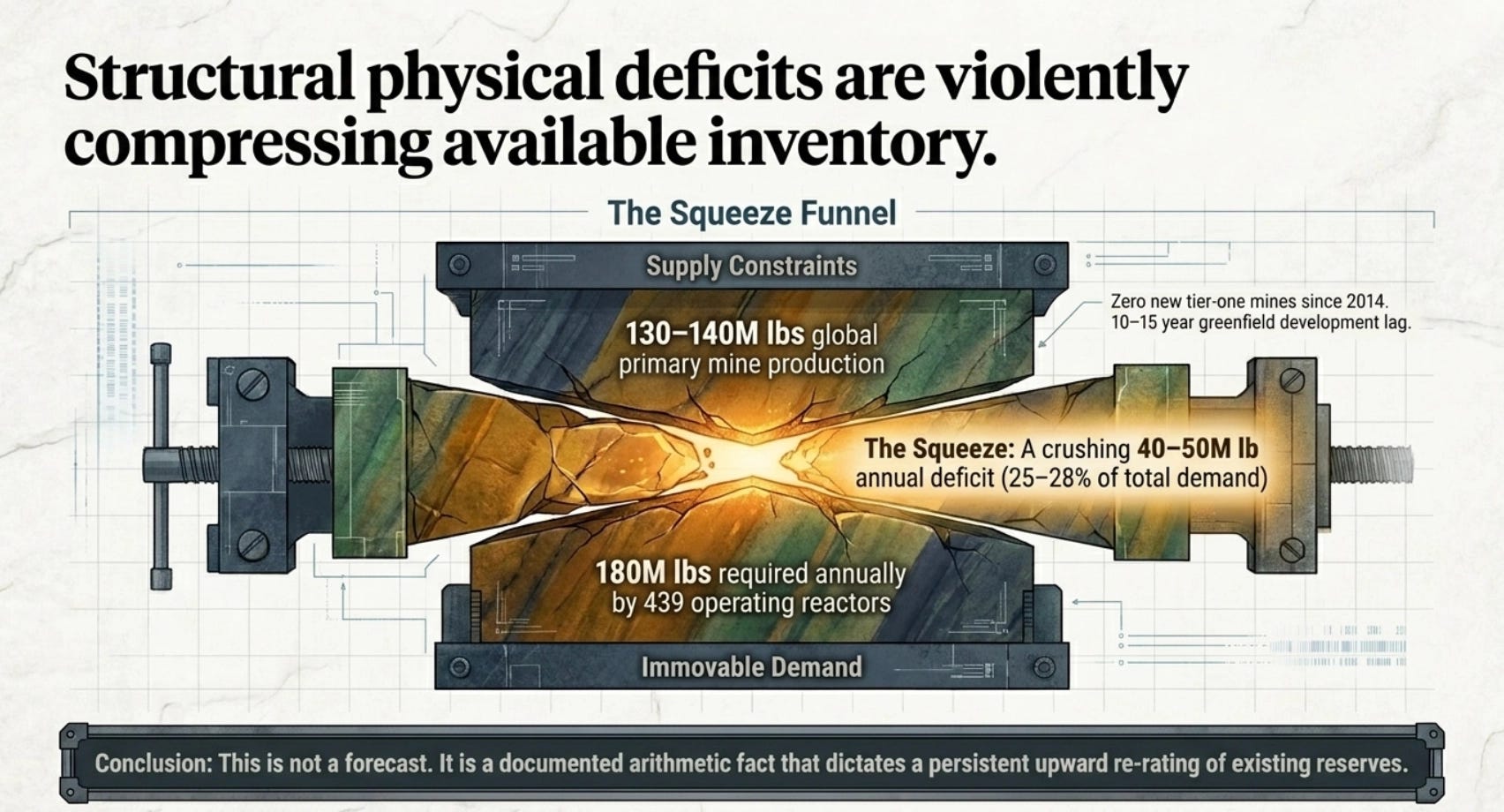
The critical quantitative fact about the uranium market as of 2025 is this: the world’s 439 operating nuclear reactors require approximately 180 million pounds of U₃O₈ per year to operate. Global primary mine production — uranium actually coming out of the ground — was approximately 130–140 million pounds in 2023, the most recent year with complete data. The deficit between demand and primary supply is therefore approximately 40–50 million pounds per year, or roughly 25–28% of demand.
This deficit is currently bridged by secondary sources: utility inventories accumulated during the post-Fukushima low-price era, enrichment tails (reprocessed from old enrichment waste), and Russian state inventories — none of which are infinite and all of which are declining in availability. The US Energy Information Administration’s 2024 report stated explicitly that American nuclear utilities face a growing uranium supply gap over the next decade, with the shortfall expected to reach 184 million pounds — more than three years of US reactor consumption — without new domestic supply.
No new tier-one uranium mine has entered production since Cigar Lake came online in 2014. Lead times for new mine development, including exploration, feasibility studies, permitting, and construction, are typically 10–15 years for greenfield projects in even favorable jurisdictions. This means the supply that will be available to the world’s reactors in 2030 is largely already determined: it will come from mines that are either already operating, already in advanced development, or — for a small fraction — being fast-tracked from advanced exploration. There is no scenario in which the supply deficit resolves quickly.
For the business owner who owns certified reserves in a producing or near-producing mine, this structural supply deficit is not a forecast — it is a documented arithmetic fact. The reserves are more valuable precisely because supply cannot easily expand to meet demand.
Part Five: Confirmed Catalysts — What Is Already Happening That the Market Has Not Fully Priced
Catalyst 1: The Russian Uranium Import Ban — Legislation Enacted, Not Proposed
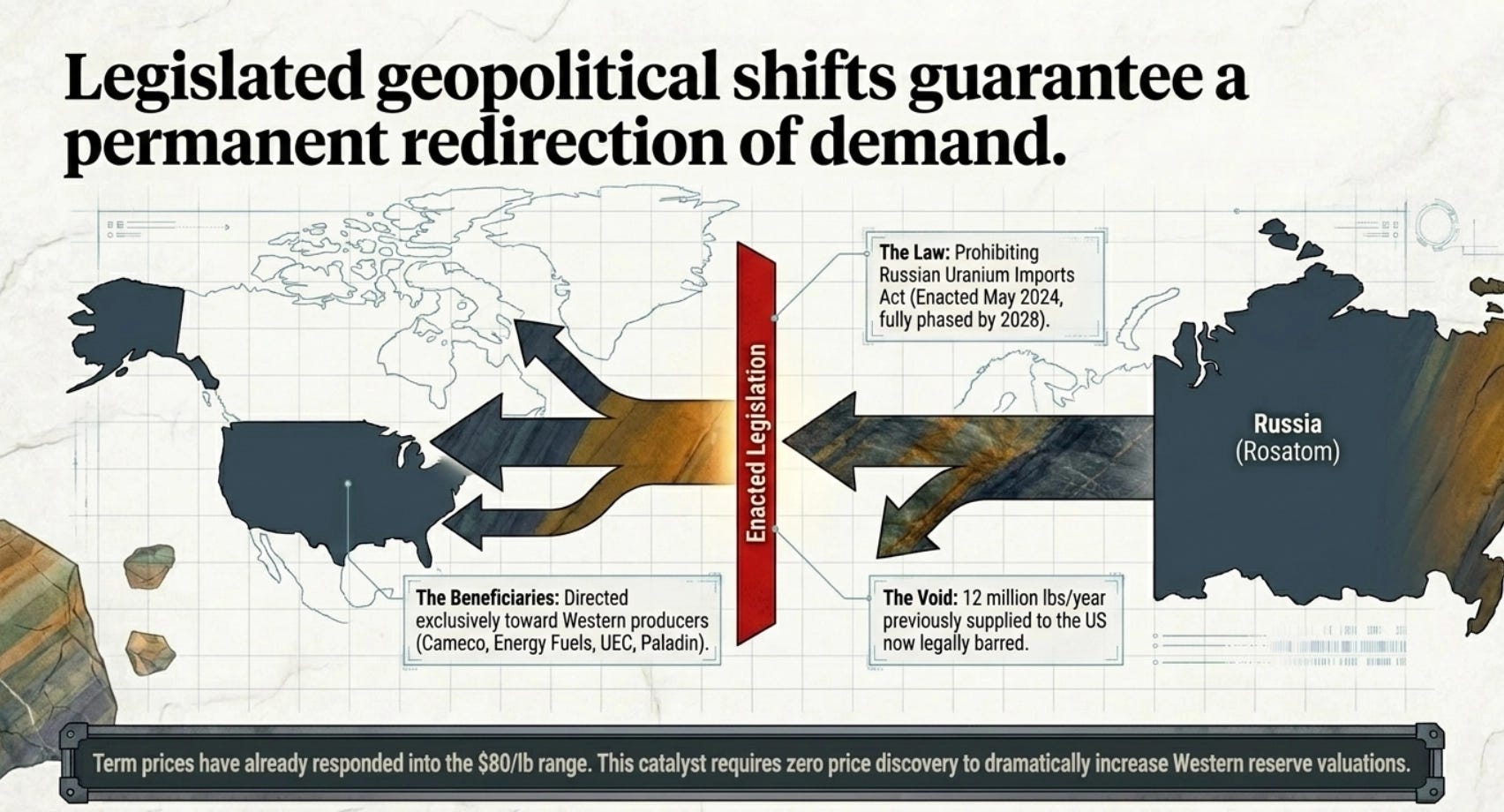
On May 13, 2024, President Biden signed into law the Prohibiting Russian Uranium Imports Act. This legislation bans the import of Russian uranium into the United States with limited exception waivers for utilities that have no alternative supply, phased out completely by 2028. This is not a proposal. It is not a policy recommendation. It is enacted law.
The significance for reserve valuation is direct and quantifiable. The United States currently operates approximately 93 nuclear reactors, requiring approximately 40–45 million pounds of uranium annually. Russia and Russian-controlled entities (Rosatom and its subsidiaries) supplied approximately 12 million pounds of uranium equivalent annually to US utilities as recently as 2022, plus additional conversion and enrichment services. That supply must now be replaced from non-Russian sources.
The Western producers with proven reserves in geopolitically stable jurisdictions — Cameco in Canada, Energy Fuels and Uranium Energy Corp in the US, Paladin Energy and Boss Energy in Australia — are the direct beneficiaries. Each pound of demand redirected away from Rosatom is a pound that must be contracted from Western producers. The term price — the multi-year contract price above spot — has responded: as of late 2024, long-term uranium contract prices were approximately $70–$80/lb, meaningfully above spot. Cameco’s disclosed contracted position in 2024 included deliveries at prices “in the $70s” per pound for a substantial portion of its output.
This catalyst does not require uranium prices to go higher to increase reserve value. It requires only that existing Western reserves become the exclusive or primary source of supply for a market that was previously served by Russian supply. The Western reserve base is finite. The demand redirected from Russia is 12 million pounds per year minimum — permanent, legislated, and growing as the 2028 sunset on any waivers approaches.
Catalyst 2: Small Modular Reactors — The First US Design Certification and the Analog to Shale Technology
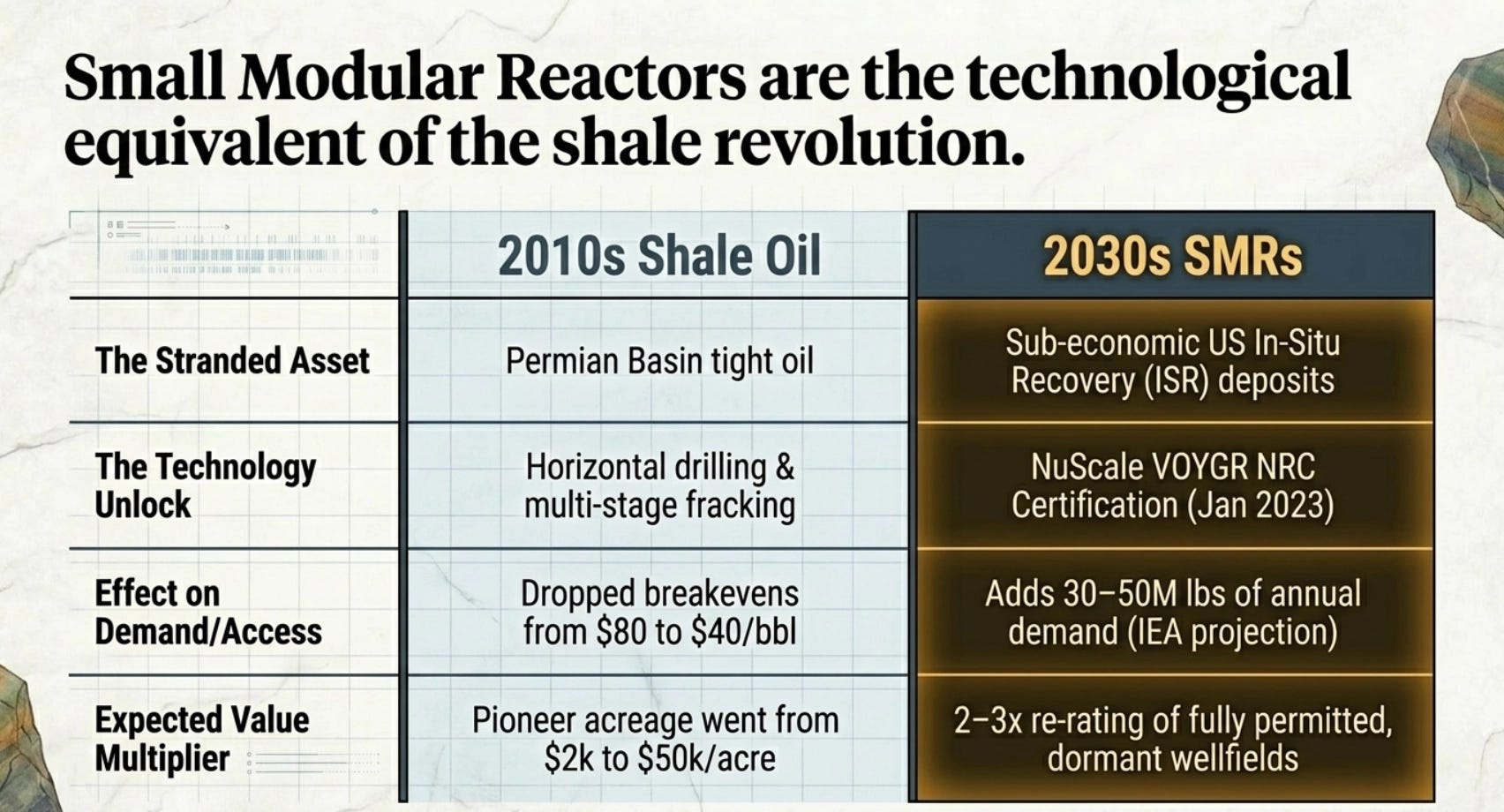
The US Nuclear Regulatory Commission issued its first design certification for a Small Modular Reactor in January 2023, approving the NuScale VOYGR design. This is a regulatory milestone that took more than a decade to reach. A design certification means the NRC has formally determined that the reactor design meets all US safety standards — the most important regulatory gate in the SMR development process.
The technology parallel to hydraulic fracturing in the Permian Basin is precise. Before commercial shale technology was deployed around 2008–2012, the Permian Basin contained the same oil it contains today. The hydrocarbons were there. They were just economically inaccessible. Horizontal drilling and multi-stage hydraulic fracturing reduced breakeven production costs from $80+/bbl to $35–$45/bbl, fundamentally changing the economics of accessing the existing resource. Pioneer Natural Resources’ Midland Basin acreage, acquired at $2,000–$5,000 per acre in the 2010–2015 period, was valued at $30,000–$50,000 per acre following the technology’s commercial deployment. The acreage existed the whole time. The technology made it worth 10–25x more.
SMRs create a directly analogous situation for specific categories of uranium reserves that are currently sub-economic. In-situ recovery (ISR) uranium deposits in the United States — concentrated in Wyoming and South Dakota — are amenable to production at cash costs of approximately $15–$25/lb. At current spot prices of $71.75/lb, these operations are already economic. But the impact of SMRs is felt on the demand side: the IEA has projected that 100–200 GW of new nuclear capacity could be brought online by 2040 through SMR deployment, which would increase annual uranium demand by 30–50 million pounds — a 17–28% increase on a market already running at a 25% supply deficit.
For companies like Uranium Energy Corp, which holds licensed ISR wellfields and processing facilities in Wyoming that can restart production within 6–12 months of a sustained price signal, the SMR catalyst unlocks reserve value without any incremental capital investment. The wellfields are drilled. The processing plant exists. The permits are valid. The uranium is in the ground. A $90–$120/lb uranium environment — which the IEA’s demand projections would likely produce — would make these assets worth 2–3x their current balance sheet value, which is carried at historical development cost far below economic value.
Catalyst 3: Data Center Power Demand and the Re-Rating of Nuclear as Baseload Technology
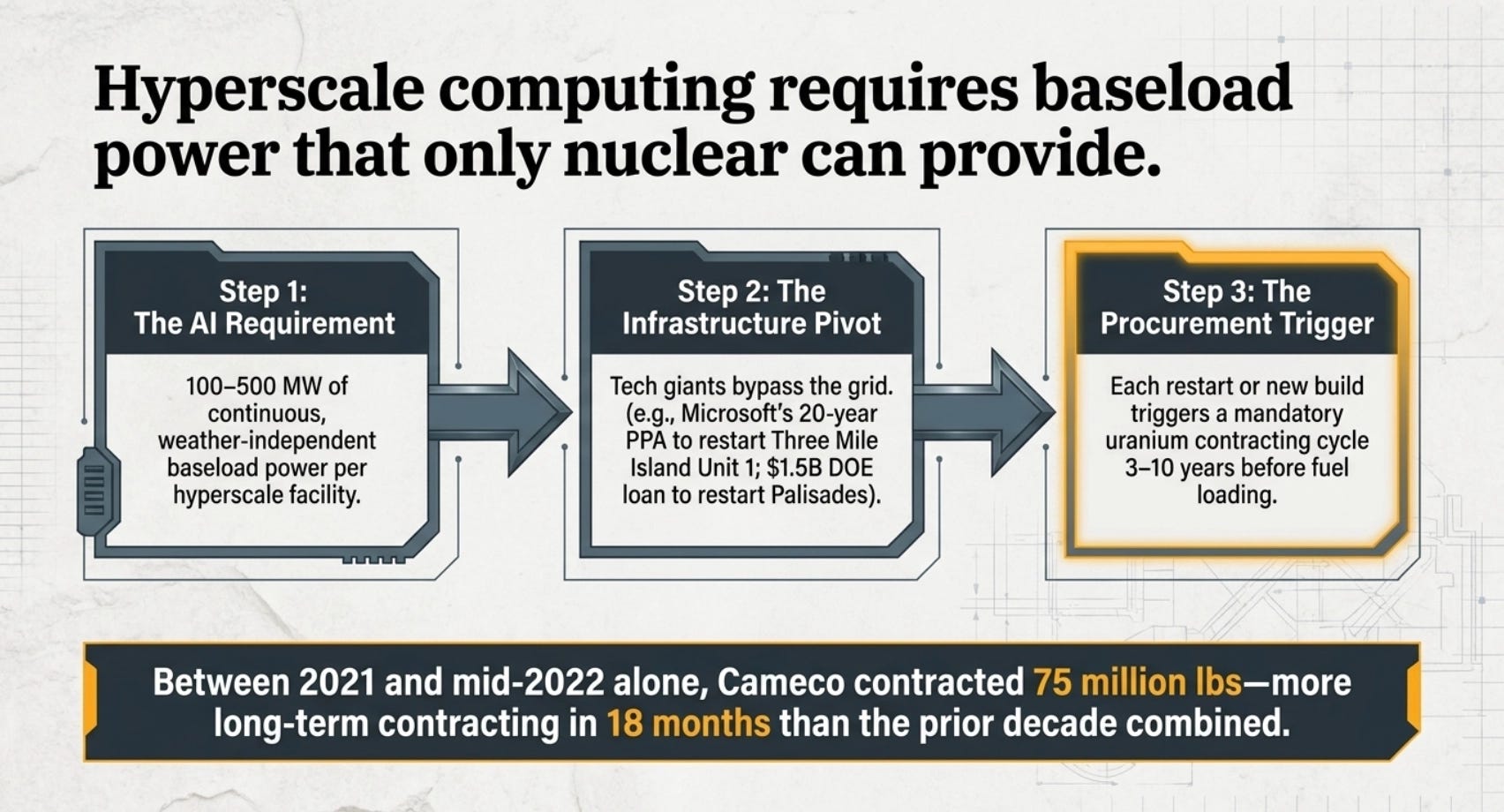
The emergence of large-scale AI data centers has created a power demand problem that the existing electric grid cannot solve cleanly. A single hyperscale data center requires 100–500 MW of continuous, reliable power — not intermittent power from wind or solar, but baseload power that runs 24 hours a day regardless of weather. Nuclear power is the only zero-carbon technology that meets this requirement at scale.
Three Mile Island Unit 1, shut down in September 2019 after becoming uneconomic during the years of cheap natural gas, was contracted to restart specifically to power Microsoft’s data centers in the region, with a 20-year power purchase agreement announced in September 2023. The Palisades nuclear plant in Michigan — shut down in May 2022 — received a $1.5 billion federal Department of Energy loan in 2024 to facilitate the first reactor restart in US history. The Department of Energy under multiple administrations has explicitly included nuclear power in its clean energy strategy.
These are not exploratory discussions. They are operational decisions backed by committed capital. Each additional operating reactor hour consumes uranium. Each reactor restart or new reactor construction triggers a procurement cycle in which the utility must contract for uranium supply — typically 3–10 years in advance of fuel loading. The procurement cycle for nuclear fuel means that demand from reactors entering service in 2028–2032 must be contracted from roughly 2025–2027. That contracting wave is already underway. Cameco disclosed in its 2022 Sprott investor presentation that it had contracted 75 million pounds of uranium from the beginning of 2021 through mid-2022 alone — more new long-term contracting in 18 months than the prior decade combined.
Part Six: What Wall Street Gets Wrong and Why It Keeps Getting It Wrong
To understand the persistent mispricing of uranium reserves, it helps to understand specifically how financial analysts approach the sector and where their methodology systematically fails.
The standard framework is a discounted cash flow model. The analyst forecasts uranium prices for 5, 10, and 20 years. They apply those prices to a production schedule. They subtract operating costs, capital expenditures, royalties, and taxes. They discount the residual cash flows at a weighted average cost of capital. The result is a net present value per share that becomes the price target.
Every step in this process introduces error in a direction that systematically undervalues the asset:
On price forecasting: Uranium analysts who produced price decks in 2014, 2015, 2016, and 2017 universally forecast long-term prices in the $40–$55/lb range. The actual price in January 2024 was $106/lb. No model built in 2015 with a $45/lb long-term price assumption would have produced a Cameco price target higher than CAD $20. The actual price in early 2025 was CAD $60+. The forecast was wrong not because the analysts were incompetent but because uranium price prediction requires knowing when utilities will enter a contracting cycle, when governments will build reactors, when secondary supply will be exhausted, and when producers will reduce output — all of which are unknowable with precision.
On discount rates: An analyst who applies a 10% discount rate to a uranium reserve in the Athabasca Basin is making an implicit claim that the uranium will be worth 10% less in present value terms for every year it remains in the ground rather than being sold. This is an arbitrary assumption. The uranium does not disappear. Its value does not naturally erode. The grade does not decline. The discount rate is a device for handling uncertainty, but when the uncertainty itself has a directional bias (structural supply deficit, legislated demand from non-Russian sources, SMR deployment), applying a symmetric discount rate as if the future is equally likely to be better or worse than today is itself an error.
On earnings-based metrics: P/E ratios are essentially useless for uranium miners. During a price trough, earnings are negative or minimal — not because the company’s assets have diminished in value, but because extracting uranium at $25/lb cost and selling it at $28/lb is unprofitable. Applying a P/E screen to uranium companies during a price trough produces the perverse result that the companies with the best assets (Cameco, which shut mines rather than sell at a loss) look the worst on earnings-based metrics.
On the DCF’s fundamental assumption: A DCF model assumes the correct valuation of a resource company is the present value of future cash flows from extracting the resource over its mine life. But the business owner knows something the model does not: if you have pounds in the ground that cannot be replicated at any cost by any competitor, waiting for a higher price is free. The reserves do not expire. The uranium does not evaporate. A company that holds 433 million pounds of the world’s highest-grade uranium can afford to wait for $80/lb, $90/lb, or $100/lb — because the resource will still be there when those prices arrive. The DCF penalizes waiting. The business owner rewards it.
The 2018 Cameco decision to shutter McArthur River and buy uranium on the spot market rather than mine at a loss is the purest possible demonstration of this principle. Management was explicitly declining to sell at the prevailing price because they judged the reserves to be worth more than the market offered. They were correct. The financial community punished the stock for the production guidance cut. The business owner recognized it as a rational decision to preserve the value of an irreplaceable asset.
Part Seven: A Note on Thorium
Thorium deserves mention in the context of uranium reserve valuation — not as an imminent substitute, but as a context for understanding the supply scarcity argument in uranium.
Thorium (Th-232) is approximately three to four times more abundant in the earth’s crust than uranium and is distributed more widely across a broader range of geological formations. India has very large thorium reserves (approximately 300,000 tonnes, among the world’s largest) and has pursued thorium reactor development as a deliberate energy security strategy since the 1970s. Advanced reactor designs — including the Molten Salt Reactor and the Liquid Fluoride Thorium Reactor — can use thorium as a fuel source through a conversion cycle that produces uranium-233 as an intermediate fission fuel.
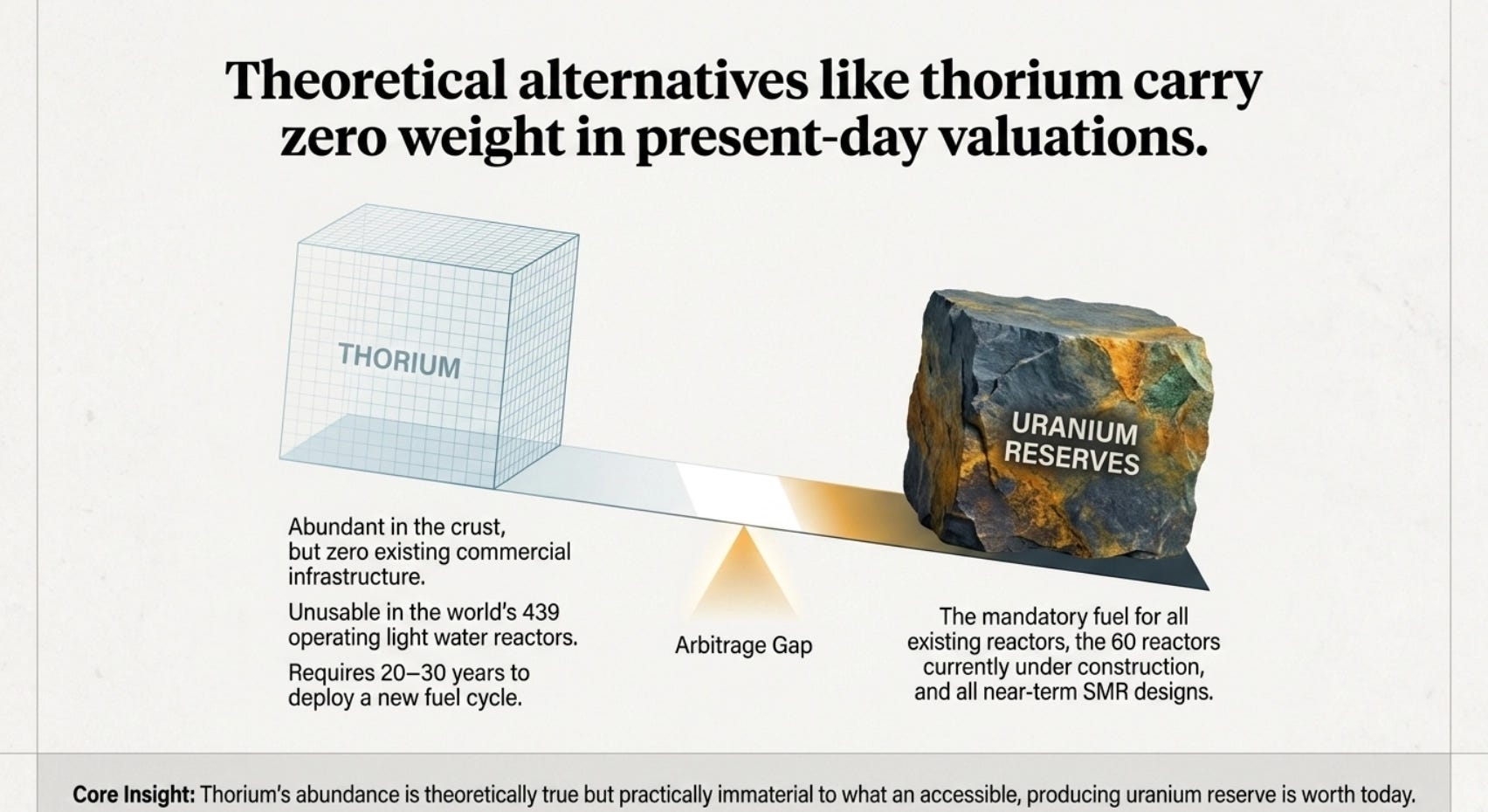
The relevance to uranium reserve valuation is this: thorium cannot currently be used directly in any of the world’s 439 operating nuclear reactors. Every light water reactor (the dominant global reactor design) uses enriched uranium fuel. There is no existing commercial infrastructure for thorium fuel fabrication, processing, or reprocessing. A thorium-capable reactor fleet would require massive new investment in a fuel cycle that does not yet commercially exist.
In the next 10–15 years, thorium poses no threat to uranium demand. The existing reactor fleet will consume uranium. The reactors currently under construction (approximately 60 globally) are uranium-fueled light water reactors. The SMR designs currently in advanced regulatory review are uranium-fueled. Any world in which thorium meaningfully displaces uranium demand is a world in which entirely new reactor designs have been commercialized, built, and deployed at sufficient scale to matter — a process requiring at minimum two to three decades under the most optimistic assumptions.
For the purpose of valuing uranium reserves today, thorium’s abundance is theoretically relevant but practically irrelevant. It is like observing that there is oil in Venezuela to undermine the reserve value of Permian Basin production — theoretically true and practically immaterial to what the existing, accessible, certifiably-producing reserve is worth right now.
Part Eight: The Business Owner’s Checklist
After this analysis, a business owner evaluating uranium reserves would look for four things — none of which require a financial model:
One: Pounds in the ground, certified to NI 43-101 or JORC standard. Not resources — reserves. Resources are geological estimates; reserves have been demonstrated economically viable at a stated price. Probable reserves (the lower of the two reserve categories) are still subject to a feasibility-level economic analysis. A company with 200 million pounds of measured and indicated resources may have 100 million pounds of probable reserves. Use the reserves.
Two: Cash operating cost per pound, as disclosed in the most recent feasibility study or annual report. For operating mines, this is the C1 cash cost or equivalent, disclosed regularly in financial statements and supplementary data. For development projects, this is the life-of-mine operating cost from the feasibility study. Compare this to the current spot price and the current long-term contract price. The margin between the two is the embedded operating income per pound.
Three: Multiply pounds by the net margin. Reserves times net margin per pound equals the embedded operating income in the reserve base. Compare this to the Enterprise Value of the company (market cap plus net debt). Any company where the Enterprise Value is below the embedded operating income of its proved reserve base is selling below reserve value — a state that has historically resolved through price recovery.
Four: Check the jurisdictional and political risk. Saskatchewan (Cameco, NexGen) is perhaps the world’s most stable mining jurisdiction. Kazakhstan (Kazatomprom) carries some geopolitical risk. Australia (Paladin, Boss Energy) has strong rule of law and established mining codes. The United States (Energy Fuels, Uranium Energy Corp) has domestic security legislation actively incentivizing domestic uranium production. Jurisdictional risk adjusts the value — but it does not change the pounds.
Conclusion: The Ground Doesn’t Lie
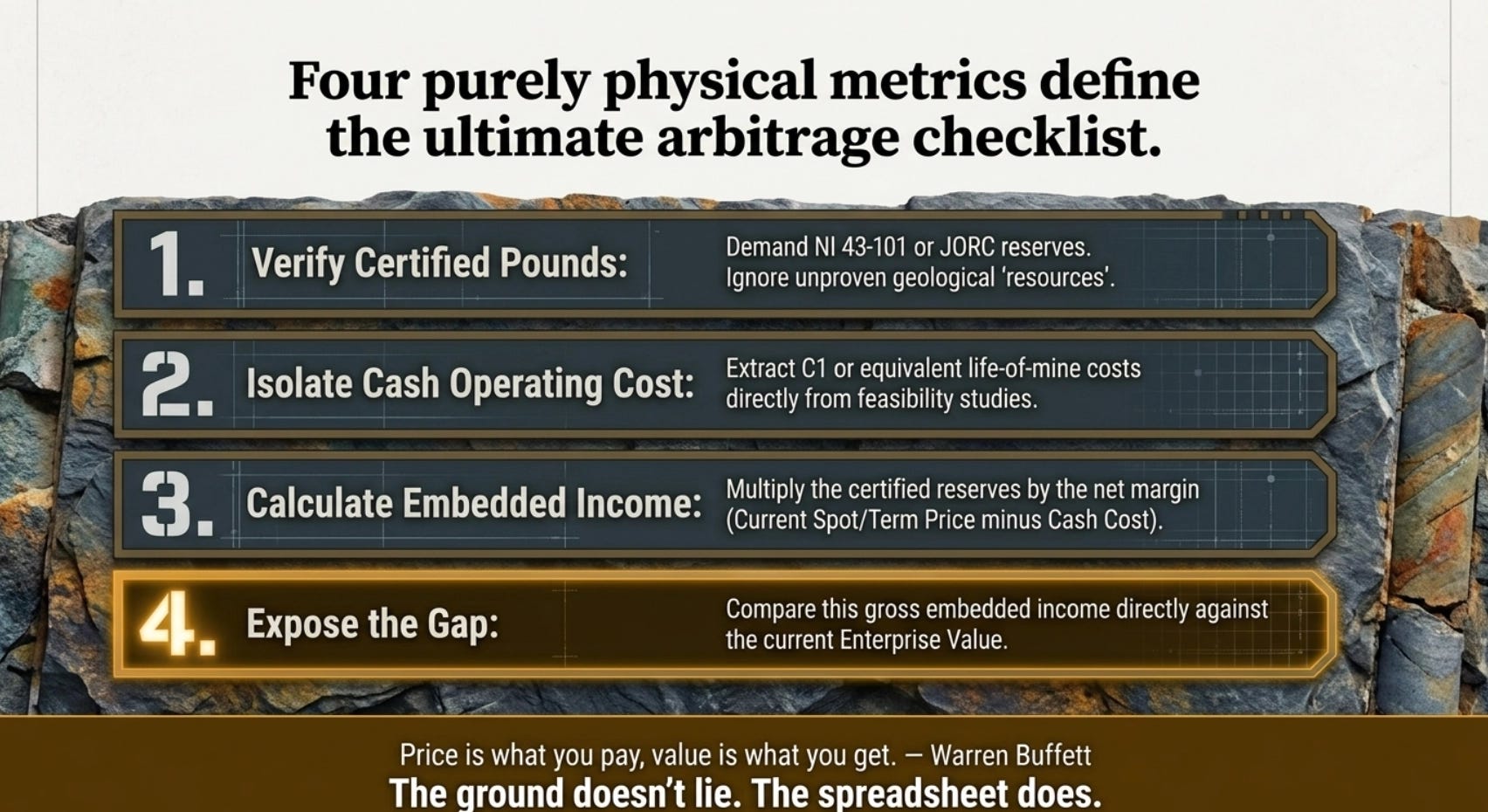
There is a sentence in Warren Buffett’s 2009 shareholder letter that captures the essence of what this paper is arguing. He wrote: “Price is what you pay, value is what you get.” In uranium, what you get — when you buy a company — is a specific, certified, engineered quantity of a material that the world’s nuclear reactors will consume indefinitely, produced at a specific, documented cost, in a specific, geologically unique deposit that cannot be moved, replicated, or substituted.
Financial models can discount that. Wall Street can ignore it during bear markets. Analysts can apply arbitrary price assumptions and arrive at price targets that suggest these companies are fairly valued or even expensive relative to current earnings. None of that changes how many pounds are in the ground.
The 2016–2021 trough in uranium produced companies trading below what a straightforward multiplication of pounds times net margin per pound justified. Cameco traded below the embedded value of its McArthur River reserves alone. The gap was closed — slowly, then all at once — as the structural supply deficit became undeniable, as Kazatomprom and Cameco cut production, as SPUT removed physical inventory from the market, as the Russian import ban legislated a demand shift toward Western producers, as data centers created new baseload power demand that only nuclear could reliably meet, and as the first SMR design certification signaled the technology pathway to meaningfully higher uranium demand in the 2030s.
The lessons from this cycle compound: the right answer in 2016 was not a discounted cash flow model. It was a reserve report, a cost disclosure, and a multiplication. The pounds were in the ground. The costs were documented. The price would recover — because it always has, because the reactors have no alternative fuel, and because supply cannot expand quickly enough to meet even existing demand, let alone the demand being created by energy transition, data centers, and military procurement priorities.
The ground doesn’t lie. The spreadsheet does.
All data referenced reflects publicly available information from company annual reports, NI 43-101 feasibility studies, SEC filings, World Nuclear Association publications, Sprott Asset Management disclosures, and documented market transactions as cited throughout. No investment advice is implied or intended.
If you like this read, check out my other writings 👇
Rust, Rigs, and the Recurring Revenue Hidden in Plain Sight: A Deep Dive into Beng Kuang Marine (SGX: BEZ)

The Old Steel and the Sea: Why You Should Care About a Ship Maintenance Company
Investment Reflection #2 — The Grand Play: 100 Years of the World’s Nations as Characters in the Greatest Story Ever Told

“The world is not a chessboard. It is a living organism, where every cell — every nation — eats, competes, cooperates, and occasionally tries to eat the others. Understanding it requires not just memorizing moves, but understanding hunger.”

The Tide Is Going Out: Commodity Houses, Private Credit, and the AI Debt Bomb

Start Here: What This Article Is About
Why I Passed on Graftech (EAF): Riding The Battery Hype, Or Perhaps Not...

There is a kind of company that is the most dangerous thing in investing. It is not the fraudulent company. It is not the obviously bad company with terrible products and incompetent management. Those are easy — you just avoid them. The truly dangerous company is the one with a
The Beautiful Trap: Why I'm Passing on The Hour Glass (SGX: AGS)

There’s a peculiar kind of investment that keeps you up at night — not because it’s bad, but because it’s genuinely good. Good enough to admire. Not good enough to buy.
The Diamond in the Rough That Isn't Quite Yours: Why I Passed on Boustead (SGX: F9D)

There is an old saying that investors have borrowed, bent, and quoted so many times it has nearly lost its sharpness: a bird in the hand is worth two in the bush. Warren Buffett, characteristically, gave it a precise mathematical form. The value of any investment, he wrote, is determined by three questions:
The Schoolteacher's Secret Insurer: Why Horace Mann (NYSE:HMN) Is Sitting on My Watchlist

“The stock market is a device for transferring money from the impatient to the patient.” — Warren Buffett

The Dormitory King That Couldn't Leave Home: Why I Passed on Centurion (SGX: OU8)

There is a deceptively simple question that Warren Buffett borrowed from Aesop’s ancient fable, and has repeated across decades of shareholder letters: “How many birds are in the bush? How sure are you they’re there? And how long until you get them out?”
The Children's Place: A $90 Million Bet on a Company That Used to Be Worth $2 Billion (NYSE: PLCE)

There is a classic scene in every heist movie. The detective walks into a room, sees the chalk outline, the scattered evidence, the broken window, and immediately knows something went terribly wrong long before anyone called the police. You do not need the full autopsy report to read the body.
World War 3 In Iran and Why Oil Price Will Continue Increasing — It Arrived Sooner Than Anyone Expected

This is Part 2 of a continuing analysis of California Resources Corp (CRC). Part 1 built the foundational investment case: a company trading at $44 per share against a conservative intrinsic value of $108–$156, built on 567 million barrels of proved developed oil reserves in California, and a management team spending hundreds of millions buying back its…
The Most Overlooked Oil Company in America — And Why That Might Be the Opportunity of the Decade

Date of analysis: 28 December 2025
The Art Of Saying No - MYPS: Playstudios Inc

PLAYSTUDIOS (MYPS) is a Las Vegas-based mobile gaming company that operates free-to-play social casino games and a loyalty platform called playAWARDS, which lets players redeem points for real-world rewards at places like MGM Resorts, Norwegian Cruise Line, and Wolfgang Puck restaurants. On the surface, this sounds like a clever moat. A loyalty program.…
The Art Of Saying No - UGP: Ultrapar Participacoes S.A (Part 2 of 2)

Question 2: How Certain Are You?
The Art Of Saying No - GLIBK: GCI Liberty Inc

Picture this: a single telecommunications company — the dominant one — serves over 200 communities scattered across the largest state in the United States. Alaska. A state with just over one person per square mile. A state where 39% of residents are underserved by broadband. A state where, until recently, some villages received internet via satellite li…

The Art Of Saying No - UGP: Ultrapar Participacoes S.A (Part 1 of 2)

The Setup: A Value Investor Dream?


The Art of Saying No - RIG: Transocean LTD

“The difference between successful people and really successful people is that really successful people say no to almost everything.” — Warren Buffett
The Art of Saying No - KPRX: Kiora Pharmaceuticals Inc

“The difference between successful people and really successful people is that really successful people say no to almost everything.” — Warren Buffett
The Art of Saying No - DNUT: Krispy Kreme Inc

“The difference between successful people and really successful people is that really successful people say no to almost everything.” — Warren Buffett

🎓 A Business Strategy Primer Part 7 - Learning From Great Companies

The Billion-Dollar Playbook: How Market-Based Management Powered Koch Industries’ Unstoppable Rise
The Art of Saying No - MRX: Marex Group PLC

“The difference between successful people and really successful people is that really successful people say no to almost everything.” — Warren Buffett


The Art of Saying No - SFIX: Stitch Fix Inc

“The difference between successful people and really successful people is that really successful people say no to almost everything.” — Warren Buffett
🎓 A Business Strategy Primer Part 2 - Brainstorming Solutions With Value At The Core

Creating An Irresistible Offer
The Art of Saying No - TDOC: Teladoc Health Inc

“The difference between successful people and really successful people is that really successful people say no to almost everything.” — Warren Buffett

The Art of Saying No - MDU: Mdu Resources Group Inc

“The difference between successful people and really successful people is that really successful people say no to almost everything.” — Warren Buffett


The Art of Saying No - AFCG: Advanced Flower Capital Inc

“The difference between successful people and really successful people is that really successful people say no to almost everything.” — Warren Buffett
The Art Of Saying No - VYX: NCR Voyix Corp

“The difference between successful people and really successful people is that really successful people say no to almost everything.” — Warren Buffett
The Art of Saying No - VSTS: Vestis Corp

“The difference between successful people and really successful people is that really successful people say no to almost everything.” — Warren Buffett

🛢️Basic Energy Primer Part 2 - Business and Competitive Landscape

The Man Who Bet Everything on Being Wrong
The Art of Saying No - CISS: C3is Inc

“The difference between successful people and really successful people is that really successful people say no to almost everything.” — Warren Buffett
The Art of Saying No - PSHG: Performance Shipping Inc

“The difference between successful people and really successful people is that really successful people say no to almost everything.” — Warren Buffett

The Art Of Saying No - MAGN: Magnera Corp

The Magnera Corporation Analysis Nobody Asked For (But Everyone Needs)
The Art of Saying No - CHR: Cheer Holding Inc

“The difference between successful people and really successful people is that really successful people say no to almost everything.” — Warren Buffett
The Art of Saying No - WIMI: WiMi Hologram Cloud Inc.

“The difference between successful people and really successful people is that really successful people say no to almost everything.” — Warren Buffett
⚡️Alternative Energy Primer Part 3 - Industry and Sector Technicals

The €2.2 Billion Mistake That Revealed Everything
⚡️Alternative Energy Primer Part 2 - Business & Competitive Landscape

The Shipwreck That Changed Everything

🏥 A U.S. Health Insurance (Managed Care Organizations) Sector Primer

1️⃣ Industry Fundamentals & Macro View

