
“The world is not a chessboard. It is a living organism, where every cell — every nation — eats, competes, cooperates, and occasionally tries to eat the others. Understanding it requires not just memorizing moves, but understanding hunger.”
PROLOGUE: The Rules of the Game
Before the story begins, you need to understand the rules. Because the entire 100-year saga you are about to read is governed by a small set of eternal principles that never change — only the players change, and the masks they wear.
Rule 1: Every nation is a business. It has revenues (taxes, exports, resources), expenses (military, social welfare, debt interest), assets (land, infrastructure, talent), and liabilities (debt, dependency, geography). Nations that forget this go bankrupt. Nations that master this become empires.
Rule 2: Money is political. Who prints it, who lends it, who accepts it — these are not economic questions. They are power questions. The nation that controls the world’s preferred currency is, in a very real sense, the landlord of the global economy. Everyone pays rent to it, even if they don’t realize it.
Rule 3: Trade is war by other means. When a nation sells you something, it is making you dependent. When it buys from you, it is keeping you alive. The strategic manipulation of this dependency — who needs whom more — is the core game of geopolitics.
Rule 4: Debt is a leash. Nations that lend are nations that own. Nations that borrow are nations that obey. This has never, not once in 100 years, failed to be true.
Rule 5: Ideology is a costume. Capitalism, communism, fascism, liberalism — these are not religions. They are tools. Nations adopt ideologies the way salespeople adopt pitches: whatever closes the deal of internal control and external influence.
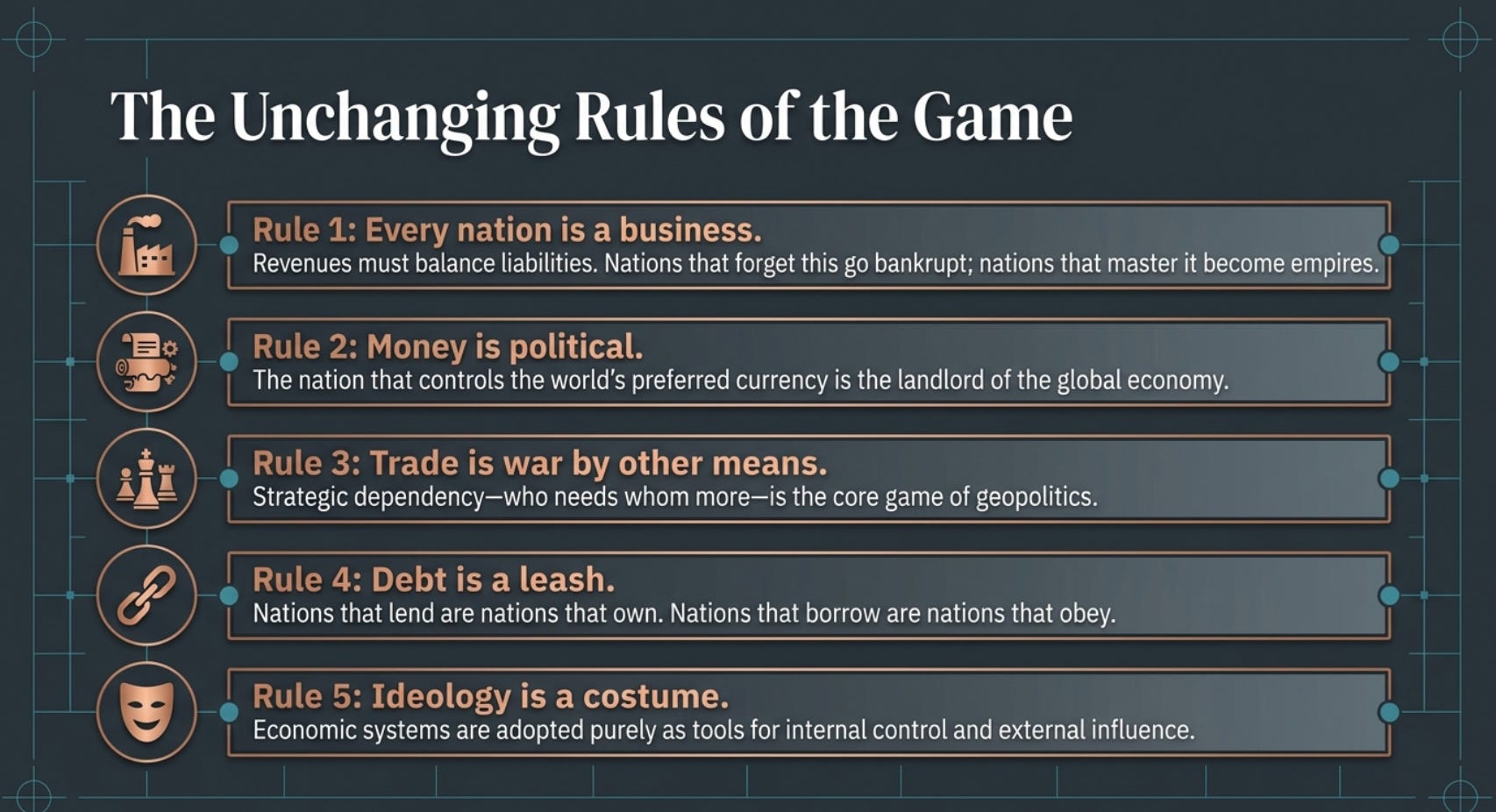
With these five rules in your pocket, the entire last century becomes not a confusing blur of wars and crises, but a coherent, logical, almost predictable story.
Now. Let the play begin.
ACT I: THE WORLD AFTER THE FIRE (1920–1929)
In Which a Wounded Europe Tries to Rebuild, America Discovers Its Own Power, and Everyone Ignores the Warning Signs
The Stage After the First Great War
Imagine you are watching a poker table after a massive brawl. The table is broken. Chips are scattered everywhere. Some players are bleeding. And one player — who sat out most of the fight — is sitting quietly in the corner, holding nearly all the chips.
That player is the United States of America.
The First World War (1914–1918) did not just kill people. It killed an entire world order. Before 1914, the world was run essentially by Britain, with its vast empire, its navy, its pound sterling, and its London banks. Britain was the central node of global trade and finance. If the world economy were a solar system, the pound sterling was the sun.
But the war cost Britain everything. Not just the 700,000 dead soldiers, but the financial architecture. To fight Germany, Britain had borrowed massively — from its own citizens, from its colonies, and critically, from the United States. By the war’s end, Britain had gone from being the world’s largest creditor to one of its largest debtors.
France was in an even worse position. Its northern industrial heartland — the most productive region in the country — had literally been used as a battlefield for four years. The factories were rubble. The fields were craters. The young men were graves. France needed money to rebuild, but it had spent everything on the war. Its solution was to bleed Germany dry through war reparations — the financial punishment imposed on the losing nation by the Treaty of Versailles.
Germany, meanwhile, was the economic patient zero of the decade. It had lost the war. It had lost territory. It had been assigned reparations of 132 billion gold marks — a sum so astronomical it was essentially designed to keep Germany economically crippled for a generation. Germany could not pay. So it started doing something that seems insane but makes a horrifying kind of logic: it printed money.
When you can’t pay your debts, you can do two things. You can default — say “I refuse to pay” — which is politically explosive. Or you can inflate — print so much money that the currency becomes worthless, and your debt becomes worthless with it. Germany chose inflation.
By 1923, German inflation had reached levels that human language struggles to describe. A loaf of bread that cost 160 marks in 1922 cost 200 billion marks in November 1923. Workers were paid twice a day because by lunchtime, the morning’s wages had already lost half their value. People burned currency as fuel because it was cheaper than wood. This is called hyperinflation, and it is economic collapse wearing a clown costume — terrifying because it reveals that money is, ultimately, a shared hallucination. The moment people stop believing in it, it is worthless.
Meanwhile, across the Atlantic, the United States was doing something remarkable. It was discovering capitalism at industrial scale, and it was glorious.
America’s Roaring Twenties: The First Great Consumer Economy
America had emerged from the war almost untouched physically, vastly enriched financially, and newly confident in its industrial might. It had the factories, the resources, the capital, and — this is crucial — the consumer.
The 1920s were the decade America invented the modern economy. Not just production, but the idea that ordinary working people should buy things. Lots of things. New things. This sounds obvious today, but before the 1920s, most people in the world bought only what they needed. The concept of buying what you want — goods beyond subsistence — was new and revolutionary.
America made it happen through three inventions that would reshape capitalism permanently:
First: Mass production. The assembly line allowed goods to be produced at quantities and speeds that collapsed prices. A car — once the exclusive toy of the wealthy — became something a factory worker could aspire to own. This wasn’t charity. This was genius capitalism: the factory workers were also the customers.
Second: Consumer credit. Why wait until you can afford something when you can borrow money and buy it now? The 1920s saw the explosion of installment plans — pay a little each month. This unlocked enormous purchasing power. People bought cars, radios, refrigerators, washing machines — the whole new vocabulary of modern life — on credit.
Third: Advertising. If mass production creates supply and credit enables demand, advertising manufactures desire. The 1920s saw advertising become a sophisticated psychological industry, understanding that humans don’t just buy things — they buy identities, status, and dreams.
The result was a spectacular economic boom. Stock prices soared. Employment was high. The middle class was expanding. America felt like it had cracked the code.
But here is the thing about booms — and this is one of the most important lessons of the entire century: a boom built on credit and speculation is not wealth. It is borrowed time.
The Hidden Architecture of Disaster
While America partied, the international financial system was quietly constructing a trap.
The world in the 1920s tried to return to the Gold Standard — a system where every currency is backed by a fixed amount of gold, and countries can exchange currencies for gold at a fixed rate. This sounds safe and orderly. In reality, by the 1920s, it was a straitjacket.
Here’s why. Britain returned to the gold standard in 1925 at the pre-war exchange rate — meaning the pound was priced as if the war had never happened, as if Britain were still the economic titan it was in 1900. It was not. The pound was now overvalued relative to Britain’s actual economic strength. This made British exports expensive and uncompetitive. British industry — coal, steel, textiles — began dying quietly.
France eventually stabilized its currency at a more realistic rate, which made French goods cheap and competitive. France began accumulating gold. Fine for France, but gold accumulating in France meant gold draining from everywhere else, particularly Britain.
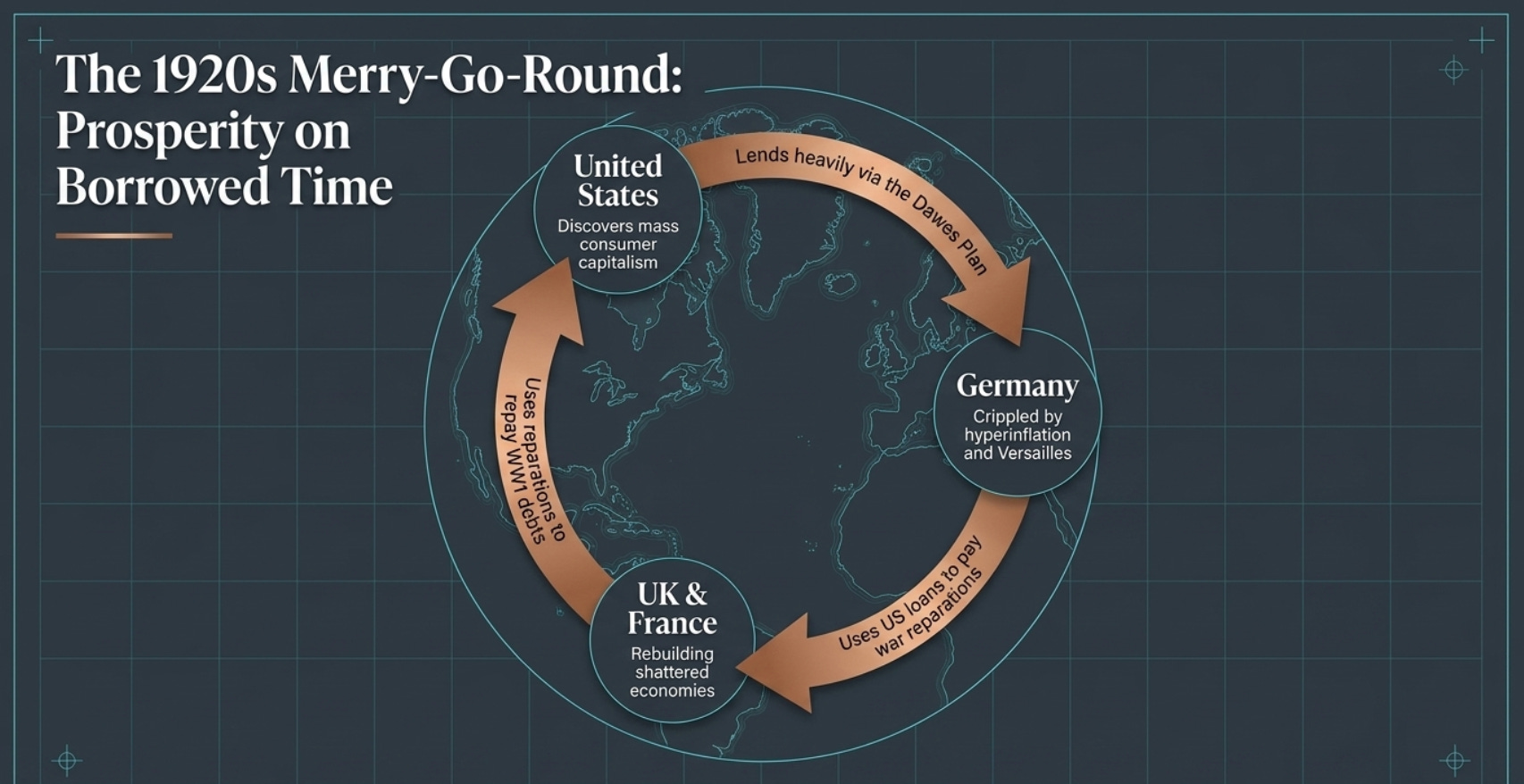
Germany, after the hyperinflation disaster, was stabilized with American loans through the Dawes Plan (1924) — a clever financial arrangement where American banks lent money to Germany, Germany used it to pay reparations to France and Britain, and France and Britain used that money to repay their war debts to America. It sounds circular because it was circular. The entire European financial recovery of the late 1920s was essentially running on American credit.
The structure looked like this:
American Banks → lend to → Germany
Germany → pays reparations to → France & Britain
France & Britain → repay war debts to → America
America → uses that money to → lend more to Germany
This was not a recovery. This was a merry-go-round. The moment American lending stopped, the whole chain would collapse.
And on Wall Street, something even more dangerous was happening. Stock prices were rising not because companies were actually worth more, but because everyone expected prices to continue rising. People were buying stocks on credit — borrowing money from brokers to buy shares, with the shares themselves as collateral. As long as prices rose, this worked. The moment prices fell, everyone would have to sell at once to repay their loans — which would make prices fall faster — which would trigger more selling.
This is called a speculative bubble. It had happened before. It would happen many times after. But never quite like what was about to come.
ACT II: THE GREAT UNRAVELLING (1929–1939)
In Which the World Discovers That Prosperity Was an Illusion, and Desperation Gives Birth to Monsters
The Crash
On October 29, 1929 — a date history would call Black Tuesday — the New York Stock Exchange collapsed.
In the span of a few days, billions of dollars in paper wealth evaporated. But paper wealth disappearing is just the opening act. What followed was the real catastrophe: the banking crisis.
Here is how the dominoes fell, and pay close attention, because this exact mechanism would replay in 2008.
When stock prices collapsed, people who had borrowed to buy stocks could not repay their loans. Banks that had made those loans were now owed money that didn’t exist. Simultaneously, ordinary people — terrified about the future — rushed to withdraw their savings from banks. Banks, which had been lending out most of their deposits (as banks always do), did not have enough cash to pay everyone. Banks started failing.
When a bank fails, the businesses that kept their money there can’t pay their workers. Workers who aren’t paid can’t buy goods. Businesses that sell no goods fire their workers and close. More banks fail. More businesses close. More workers are unemployed. Unemployed workers spend nothing. More businesses fail.
This spiral — called a deflationary depression — is economics’ version of a nuclear reaction gone wrong. Each failure triggers more failures. By 1933, the United States had lost a third of its economic output. One in four American workers was unemployed. Thousands of banks had closed.
But this was an American crisis, right? Why did it destroy the rest of the world?
Because of the circular loan structure. American banks, now desperate for cash, stopped lending to Germany. Overnight. Germany, which had been running on American loans, suddenly had no money. Germany defaulted on its debts. The reparation payments to France and Britain stopped. France and Britain, no longer receiving reparations, stopped repaying their war debts to America. American banks, now owed money from everywhere that wasn’t coming, failed in greater numbers.
And because the gold standard linked all currencies together in a fixed exchange rate system, the deflationary pressure spread like a virus. Country after country tried to protect itself by erecting tariff walls — taxes on imports designed to keep foreign goods out and protect domestic industries. In 1930, the United States passed the Smoot-Hawley Tariff, raising import taxes to record levels. Other countries retaliated with their own tariffs. Global trade collapsed by 65%.
When trade collapses, everybody loses. The world economy contracted by roughly a third between 1929 and 1933. This is not a recession. This is not a downturn. This is civilizational trauma.
The Nations Respond — And the Responses Shape the Next Century
What a country does in a crisis reveals its character — and creates its future. The Great Depression forced every major nation to make a fundamental choice about what kind of economy and society it wanted to be. The choices made in the 1930s literally determined the shape of the world for the next 80 years.
The United States chose reform over revolution. Faced with mass unemployment and economic collapse, it chose to expand the government’s role in the economy dramatically — building public works, creating social safety nets, regulating banks, and stimulating demand through government spending. This approach — spending your way out of a depression — was a radical idea at the time. The dominant economic thinking said governments should balance budgets and let the free market correct itself. The new idea said: in a crisis, when everyone is too scared to spend, the government must spend in their place. This would later be called Keynesian economics, and it became the dominant economic philosophy of the next four decades.
Britain tried to preserve the empire and the pound, with mixed results. It abandoned the gold standard in 1931 — a humiliating admission that the old system was dead — and focused on trading within its empire, a strategy called “Imperial Preference.” This worked well enough to avoid complete collapse but did nothing to restore Britain’s pre-war economic dynamism.
Germany’s choice was the most consequential and the most terrifying. Germany in the early 1930s was not just economically broken — it was psychologically shattered. The hyperinflation of 1923 had wiped out the savings of the middle class. The Depression then wiped out their jobs. The war reparations were a daily humiliation. The Weimar Republic’s democracy, which had never been loved, was associated in German minds with nothing but failure and suffering.
Into this vacuum stepped extremism. A political movement promising to restore Germany’s greatness, cancel the humiliating treaties, put people back to work, and identify a clear enemy to blame — offered the simplest, most intoxicating solution to a people in despair. Germany chose this path. And the economic model it adopted — state-directed industrial production, massive military spending funded by debt, total control of the economy by the government — actually worked in the short term. German unemployment fell dramatically through the 1930s. The factories hummed. The roads were built. People had jobs.
This created a lesson that would haunt the 20th century: authoritarian state control of the economy can produce rapid results. The question — always the question — is: at what cost, and for how long?
Japan had a parallel story. Japan was a late industrializer that had, in the late 19th and early 20th century, transformed itself from a feudal society into an industrial power with remarkable speed. But Japan had a fundamental problem: it was a resource-poor island nation that needed raw materials — oil, rubber, iron ore — to feed its industries. These resources existed in Asia, particularly in European colonies: British Malaya (rubber and tin), Dutch East Indies (oil), French Indochina (rice and rubber).
The Depression hit Japan’s export economy hard. Japan’s answer was military expansion. If you can’t buy resources, conquer the territories that have them. Japan invaded China’s Manchuria in 1931, then escalated into full-scale war with China in 1937. Japan was explicitly building what it called a “Co-Prosperity Sphere” in Asia — a polite name for a Japanese economic empire where Asian resources would flow to Japanese industry and Japanese goods would be sold to Asian markets at prices Japan set.
The Soviet Union watched the Depression with barely concealed glee and profound strategic conclusion. Here, they said, is what capitalism does — it devours itself. The Soviet Union, which had been pursuing its own experiment in state-controlled economics since 1917, doubled down. Under its new five-year plans, the Soviet state directed all investment into heavy industry — steel mills, power plants, machinery factories. The results were brutal (millions died in famines caused by the forced collectivization of agriculture) but industrially dramatic. The Soviet Union went from a largely agrarian economy to a major industrial power in a single decade.
The colonial world — Africa, most of Asia, much of the Middle East — had no choice at all. They were owned. The Depression crashed the prices of the commodities they produced — cotton, coffee, copper, rubber — while the prices of the manufactured goods they imported from Europe stayed high. Colonial economies bled. But the seeds of something were planted: the educated elites of colonial nations began to see, with crystalline clarity, that the economic relationship between empire and colony was designed entirely for the empire’s benefit. The independence movements that would explode after World War II were fertilized in the misery of the 1930s.
ACT III: THE WORLD ON FIRE (1939–1945)
In Which Economics Becomes Warfare and the Post-War Order Is Designed Before the Shooting Stops
War as Economics
World War II is usually taught as a moral story — good versus evil, democracy versus fascism. And that framing is not wrong. But underneath the morality is an economics story that explains why the war happened, how it was fought, and why it ended the way it did.
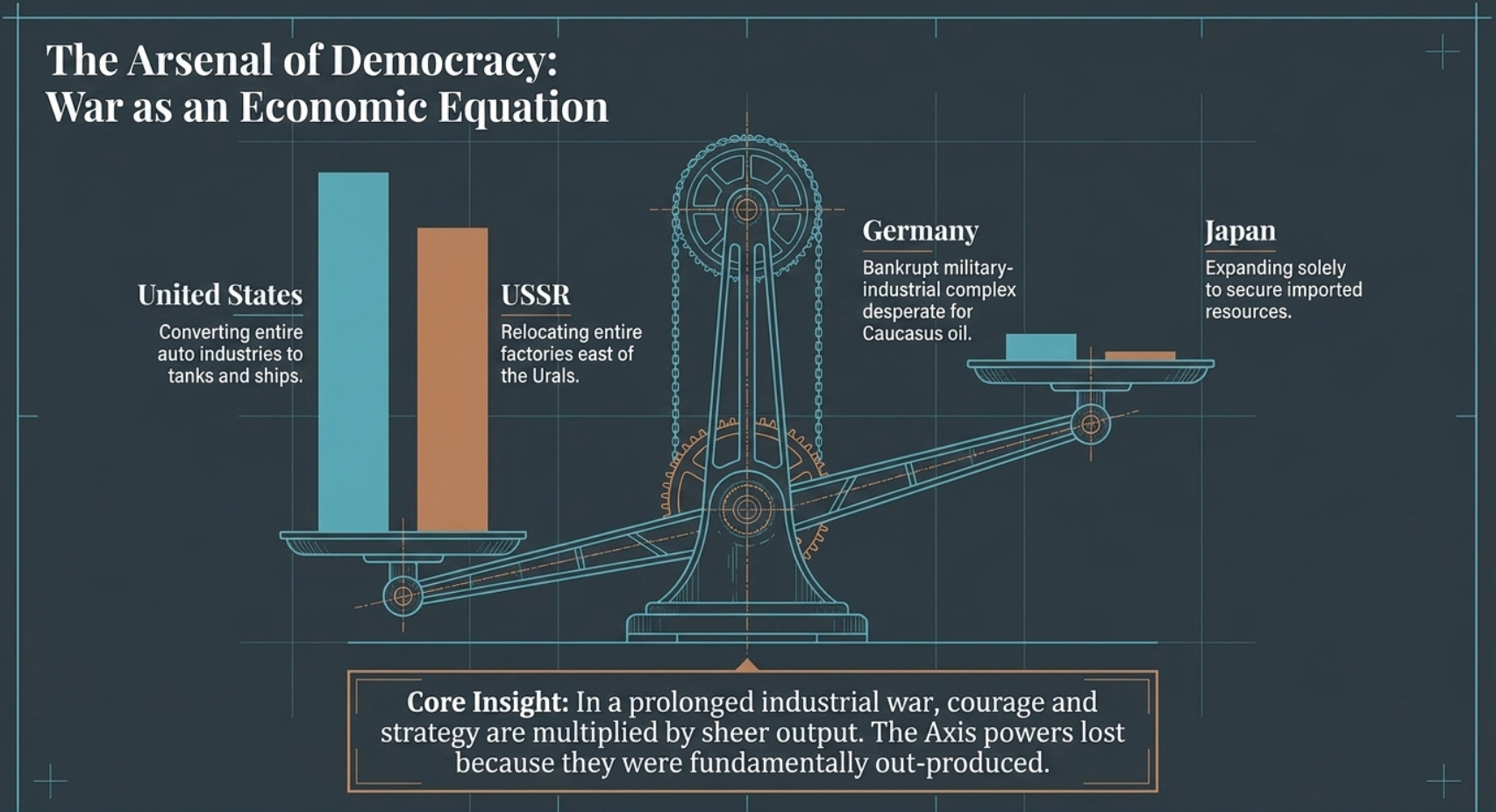
Germany’s war was fundamentally a resource war. Germany had built a massive military-industrial complex on debt. By the late 1930s, Germany was essentially bankrupt — it had borrowed so much to fund rearmament that it could not service its debts. The economic logic of the regime pointed in one direction: expansion. Conquer new territory, seize its resources and productive capacity, and use those to sustain the machine. This is why Germany moved so relentlessly eastward. The vast agricultural lands of Ukraine, the oil of the Caucasus — these were not just strategic military objectives. They were economic oxygen. Germany needed them to survive.
This is a crucial insight: the Nazi war machine was not just morally evil — it was economically unsustainable from its inception. It was built on a pyramid scheme where each new conquest had to fund the next one. The moment the conquests slowed or stopped, the whole structure would collapse.
Japan’s war followed an identical logic in the Pacific. Japan’s invasion of China had brought American economic sanctions — particularly an oil embargo. Japan imported 80% of its oil from the United States. Without oil, Japan’s entire industrial and military machine would stop in months. Japan’s attack on Pearl Harbor was not irrationality. It was cold economic calculation: destroy the American Pacific fleet, seize the oil-rich Dutch East Indies, and build a self-sufficient economic sphere before America could respond.
The fatal flaw in this calculation: Japan dramatically underestimated American industrial capacity.
The Arsenal of Democracy: Economics as Weapon
Here is perhaps the most important economic lesson of the 20th century: in a prolonged industrial war, the side with greater productive capacity wins. Courage, strategy, and technology matter. But they are multiplied or divided by the sheer volume of stuff you can produce.
The United States, upon entering the war, did something unprecedented. It converted its entire economy to war production with breathtaking speed. Automobile factories began making tanks and jeeps. Appliance manufacturers made weapons and equipment. Shipyards launched vessels faster than the enemy could sink them. Women entered the workforce in massive numbers, becoming the productive backbone of the home front.
By 1944, the United States alone was outproducing all the Axis powers combined. It was building more ships every month than Japan could destroy. It was making more aircraft than Germany could shoot down. This is not poetic exaggeration — it is arithmetic. The war became, in its industrial phase, a math problem. And America had better numbers.
The Soviet Union, on the eastern front, performed an industrial miracle of its own. When Germany invaded in 1941, the Soviets physically dismantled thousands of factories from western Russia and Ukraine — unbolting machinery from floors, loading it on trains — and reassembled them east of the Ural Mountains, out of German reach. In the middle of the worst military catastrophe in Russian history, the Soviet Union was simultaneously building a new industrial base. By 1943, Soviet production was outpacing German production on nearly every metric.
The combined productive might of the United States and Soviet Union — plus the resources of the British Empire — was simply too much for Germany and Japan to overcome. The Axis lost not because they were outfought (though they were), but because they were outproduced.
Designing the Post-War World — Before the War Ends
Here is something remarkable: while the war was still being fought, while millions were still dying, the United States was already designing the post-war economic order.
In July 1944, representatives of 44 Allied nations gathered at a hotel in Bretton Woods, New Hampshire. The war in Europe was not yet over. The war in the Pacific had more than a year to run. But at this conference, the framework for the entire global economic system that would govern the next 80 years was laid out.
The genius of Bretton Woods was that it was simultaneously idealistic and ruthlessly self-interested — from America’s perspective.
The idealistic part: create a stable international monetary system, prevent the competitive devaluations and trade wars that had made the Depression so catastrophic, and build institutions that would provide economic stability to member nations. The International Monetary Fund (IMF) would provide emergency loans to countries in balance-of-payment crises. The World Bank would finance reconstruction and development.
The self-interested part: the entire system would be anchored to the US dollar. Every other currency would be fixed to the dollar at a set exchange rate. The dollar would be fixed to gold at $35 per ounce. This meant every currency was, indirectly, backed by gold — but more immediately, every currency was backed by the dollar.
The implications were staggering and profound. The United States would become the world’s central banker. Every country in the world would need dollars to conduct international trade. America’s currency would become the world’s reserve currency — the one every other country needed to hold.
This is the single most important economic fact of the last 80 years, and its implications run through every crisis, every war, every economic negotiation you will read about in this entire story. America discovered a superpower that no empire in history had possessed at such scale: the ability to pay for things by simply printing money, because everyone in the world wanted that money.
Economists call this seigniorage — the profit that comes from issuing currency. When the whole world uses your currency, you collect seigniorage from the entire world. You can import more than you export. You can run budget deficits. You can finance wars and welfare states. Because no matter how many dollars you print, there is always more global demand for them.
The Bretton Woods conference was, in the nicest possible way, America writing the rules of a game it had already won.
ACT IV: THE GOLDEN AGE (1945–1970)
In Which America Runs the World, Europe Rebuilds Magnificently, and the East Struggles to Be Born
The Marshall Plan: Generosity as Grand Strategy
The war ended in 1945 with Europe in ruins and the United States in unprecedented dominance. America had roughly half of the world’s economic output. Its factories were intact, its infrastructure undamaged, its population employed. It had the bomb. It had the dollar. It had the navy. It was, by any measure, the most powerful nation in the history of the world to that point.
What it did next was either the greatest act of geopolitical generosity in history or the smartest investment ever made — or, most likely, both simultaneously.
The Marshall Plan (1948–1952) pumped $13 billion into Western Europe’s reconstruction (equivalent to roughly $150 billion today). America helped rebuild the factories, infrastructure, and agricultural systems of the very countries it had just helped defeat and liberate.
Why? Several reasons, and they stack perfectly on top of each other:
The economic reason: A rebuilt Europe is a customer. America’s factories needed markets. Impoverished Europe couldn’t buy American goods. Prosperous Europe could. The Marshall Plan was partly America creating its own export market.
The political reason: The Soviet Union now occupied Eastern Europe and was the ideological rival to American-style capitalism. Western Europe, exhausted and impoverished, was genuinely tempted by communist parties (which were electorally strong in France and Italy). The Marshall Plan was a demonstration that capitalism could deliver prosperity — a refutation of the communist argument delivered in the language of factory output and rising living standards.
The systemic reason: A stable, prosperous, democratic Western Europe would be a pillar of the American-designed international order. It would participate in the Bretton Woods system, use dollars, trade freely, and provide markets and allies. The alternative — a fragmented, unstable, potentially authoritarian Europe — would be a constant source of crises.
The Marshall Plan worked beyond anyone’s expectation. Western Europe’s reconstruction was so rapid and so complete that it became known as the “economic miracle” — in Germany they called it Wirtschaftswunder, in France Les Trente Glorieuses (the thirty glorious years), in Italy il miracolo economico.
Germany — the nation that had been bomb-shattered, economically wrecked, and morally devastated — was within 20 years one of the most prosperous and dynamic economies on earth. This is astonishing. And the lesson is important: institutions and culture matter more than starting conditions. Germany rebuilt not just because of American money, but because it had human capital — engineers, managers, skilled workers — and it built democratic institutions and a social market economy (capitalism with a strong welfare state) that channeled that human capital productively.
The Cold War Economy: Capitalism vs. Communism as a Business Competition
The Cold War is typically framed as a military and political competition. But at its heart, it was a competition between two economic models, each trying to prove that it was the superior system for organizing human productive activity.
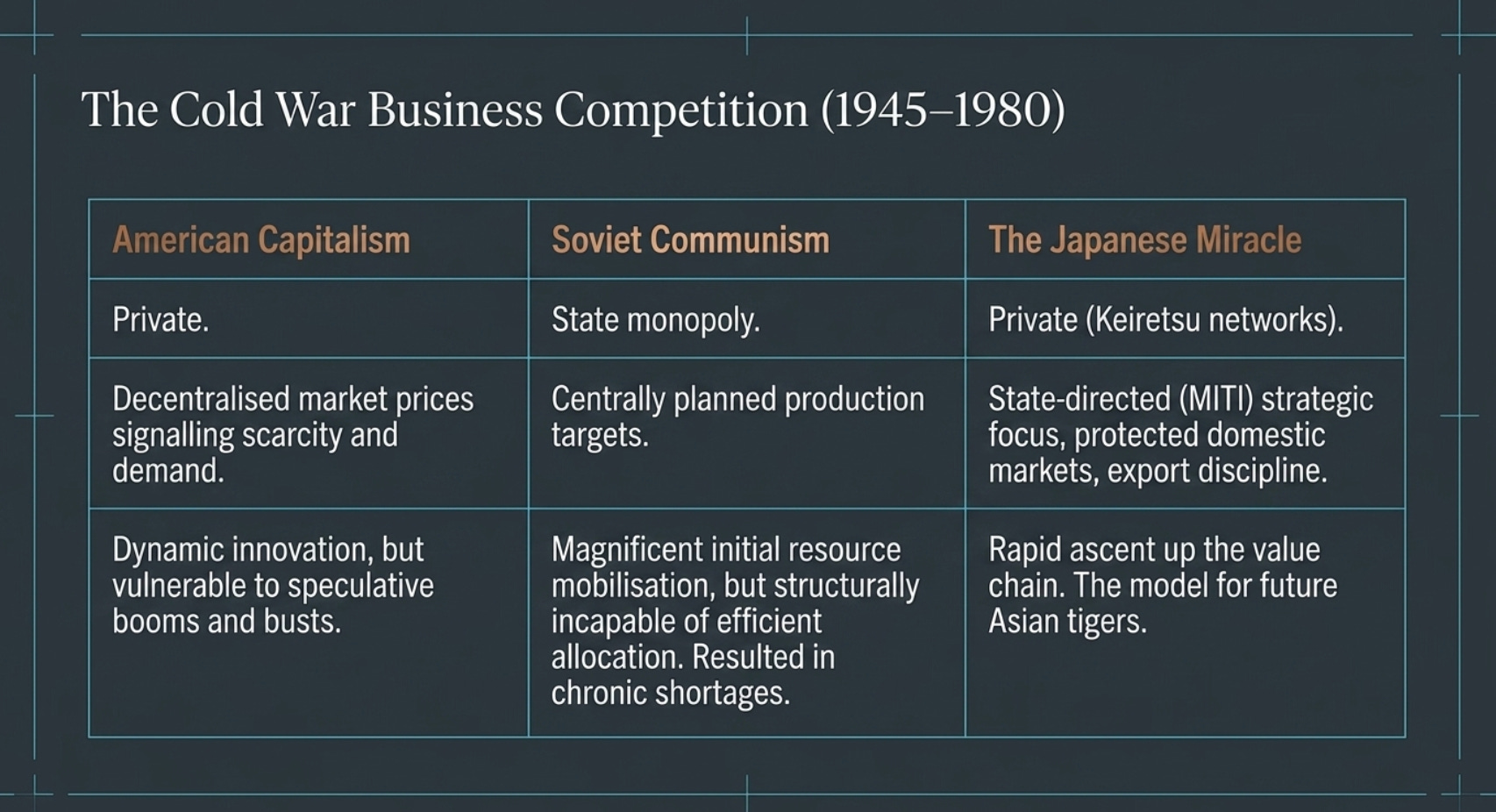
The American model: private ownership of the means of production, market-determined prices, profit incentive for innovation, political democracy (in theory), and international free trade anchored to the dollar.
The Soviet model: state ownership of all major productive assets, centrally planned production targets, no profit motive, single-party political control, and a separate trading bloc (COMECON) for the Eastern bloc countries.
The Cold War was, in a very real sense, the world’s most consequential management consulting competition. Two teams, two systems, competing for the loyalty of developing nations by demonstrating which approach produced better economic results.
In the 1950s and early 1960s, the competition was genuinely close. The Soviet Union’s GDP was growing at rates that impressed Western economists. Its space program demonstrated technological capability. Its heavy industries produced steel, machinery, and weapons at impressive volumes.
But the Soviet model had a structural flaw that became increasingly apparent over time: it could mobilize resources magnificently, but it could not allocate them efficiently.
Here’s the core problem. In a market economy, prices are signals. When something is scarce, its price rises, telling producers to make more of it and telling consumers to use it more carefully. When something is abundant, its price falls, telling producers to redirect their efforts. This decentralized, real-time signaling system processes billions of pieces of information simultaneously and routes resources to where they are needed.
A central planner — even an extraordinarily intelligent one with the best computers available — cannot replicate this. There are simply too many decisions to be made. By the 1970s, the Soviet Union was producing enormous quantities of things nobody wanted and chronic shortages of things people desperately needed. The jokes about Soviet planning — “they pretend to pay us, we pretend to work” — were not just gallows humor. They were economic diagnosis.
Meanwhile, in East Asia, something fascinating was happening that would eventually upend everyone’s assumptions.
Japan’s Resurrection: The First Asian Economic Miracle
Japan, devastated by the war, occupied by America, stripped of its empire, and saddled with a pacifist constitution that prohibited a military force — was supposed to be a diminished power for a generation.
Instead, by the 1970s, it was the world’s second-largest economy. How?
Japan’s reconstruction demonstrated a model of economic development that was neither American capitalism nor Soviet planning. It was something in between, and it was devastatingly effective.
The Japanese government, particularly through a ministry called MITI (Ministry of International Trade and Industry), directed the private economy toward strategic industries without owning it. The government identified which industries Japan should dominate — steel, shipbuilding, automobiles, electronics — and then coordinated private companies, provided cheap capital through directed bank lending, protected domestic industries from foreign competition while exports were encouraged, and guided technology acquisition from abroad.
Japanese companies formed keiretsu — interconnected groups of companies with cross-shareholdings and long-term relationships with their banks — that allowed them to think in decades rather than quarters. Where American companies faced pressure from shareholders to maximize this year’s profits, Japanese companies could absorb years of losses while building market position.
The result: in industry after industry, Japan entered as a low-quality, cheap producer and systematically moved up the value chain until it was producing the world’s best products. The trajectory of “Made in Japan” — from postwar joke about cheap imitations to a 1970s symbol of precision engineering — is one of the great economic stories of the century.
Japan’s model would be studied, copied, and adapted by South Korea, Taiwan, Singapore, and eventually China with enormous consequences.
The Decolonization Dividend — and Its Tragic Complexity
Between 1945 and 1970, the entire European colonial system was dismantled. Dozens of nations in Asia, Africa, and the Middle East gained independence. This was one of the most significant political events in human history.
But — and this is absolutely critical to understand — political independence did not equal economic independence.
Here’s why. Colonial economies had been structured by the imperial powers for the imperial powers’ benefit. The colonies produced raw materials (cotton, coffee, cocoa, copper, rubber, oil) and imported manufactured goods. The prices of these commodities were determined by markets in London, New York, and Paris. The shipping, insurance, and banking that moved these goods were controlled by European and American companies.
When the colonies became independent nations, they inherited this economic structure intact. The flag changed. The economic relationship didn’t.
A newly independent African nation growing coffee still sold that coffee at prices set by commodity markets in New York. It still shipped it on European ships. It still financed the trade through European banks. It still imported manufactured goods at prices set by European and American companies. The terms of trade — how many bags of coffee it took to buy one tractor — were still determined by the rich world.
This structural trap had a name: dependency theory. The idea that the global economic system was not a level playing field but a hierarchy in which commodity-producing peripheral nations were systematically disadvantaged relative to manufacturing core nations.
Some newly independent nations tried to break this trap by industrializing — building their own factories, processing their own raw materials, producing their own manufactured goods. To protect infant industries from being killed by cheap imports, they erected high tariff walls. This policy was called Import Substitution Industrialization (ISI).
ISI worked partly and failed ultimately. The protected industries were often inefficient because they faced no competitive pressure. The foreign exchange to buy capital equipment had to come from commodity exports — so the nations were still trapped in commodity dependence while also trying to build industry. And the governments that managed these programs were often corrupt, inefficient, or captured by the very industries they were supposed to develop.
The result: many newly independent nations failed to escape the commodity trap. They grew, but slowly. They built some industry, but never enough. And they accumulated debt trying to do it.
The Middle East had a different story, because it sat on something that the entire industrial world needed: oil.
By the late 1940s and 1950s, it was becoming clear that the Middle East held perhaps the greatest concentration of oil reserves on earth. And those reserves were owned — through concession agreements made in the colonial era — primarily by Western oil companies. Agreements that paid the producing countries a modest royalty while the oil companies made vast profits and Western industrial economies ran on cheap energy.
The tension between national sovereignty over natural resources and foreign corporate control of those resources would reach a boiling point in the 1970s. But through the 1950s and 1960s, the cheap oil flowed and the Western economies boomed.
ACT V: THE CRACKS APPEAR (1970–1979)
In Which the Post-War Order Begins to Fracture, Oil Becomes a Weapon, and Inflation Becomes the Enemy
Nixon’s Bombshell: The End of Bretton Woods
On August 15, 1971, the United States did something that would permanently reshape the global financial system. It told the world: we are no longer redeeming dollars for gold.
The Bretton Woods system — where the dollar was fixed to gold at $35 an ounce and all other currencies were fixed to the dollar — had worked magnificently for 25 years. But it contained a fatal contradiction identified by a Belgian economist named Robert Triffin, and it became known as the Triffin Dilemma.
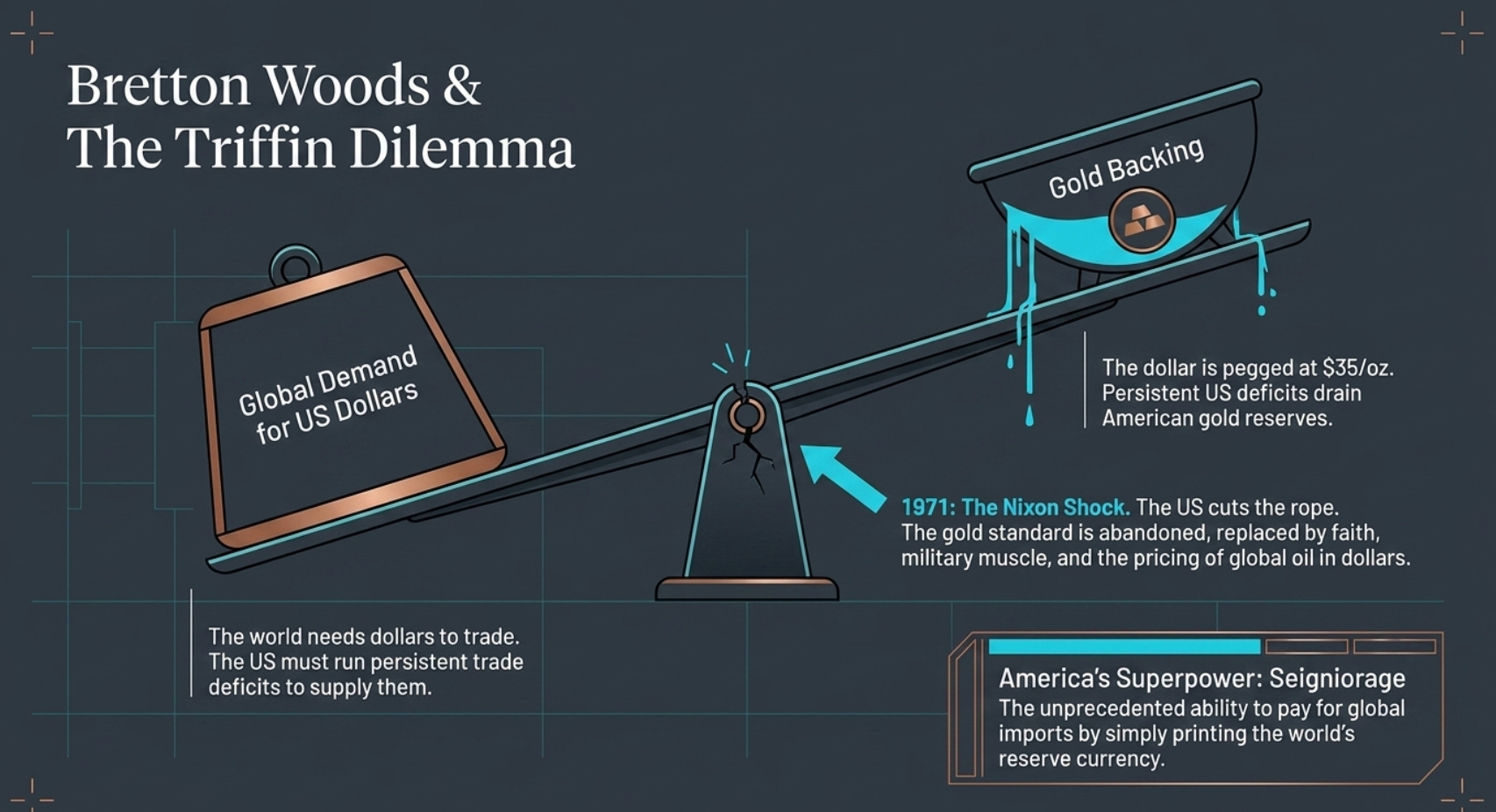
Here it is: For the global economy to grow, it needs more dollars (since the dollar is the reserve currency that lubricates all international trade). For more dollars to exist, America must run trade deficits — spend more abroad than it earns. But if America runs persistent trade deficits, doubts will grow about whether there is enough gold to back all those dollars. And if those doubts grow, countries will rush to redeem dollars for gold before the gold runs out, which will collapse the system.
By the late 1960s, this is exactly what was happening. The United States had been spending lavishly: on the Vietnam War, on the Great Society welfare programs, on the Space Race. Dollars had flooded the world. Foreign central banks, particularly France (which was deeply suspicious of American financial dominance), had been accumulating dollars and trading them in for gold. US gold reserves were draining.
Rather than discipline America’s spending to protect the gold peg, the Nixon administration simply... cut the rope. Dollars were no longer convertible to gold. The Bretton Woods fixed exchange rate system ended. Currencies would now float against each other, their relative values determined by market forces.
This moment — often called the Nixon Shock — changed everything, and its consequences are still unfolding today.
The dollar no longer needed to be backed by gold. It was backed by... faith. And the muscle of the American economy. And crucially, by the fact that oil — the world’s most essential commodity — was priced in dollars.
This last point requires elaboration. When oil began to be traded internationally in large quantities, the price was denominated in US dollars. To buy oil, every country in the world needed dollars. This created a permanent global demand for dollars that made the dollar indispensable as a reserve currency without the gold backing. America had converted its reserve currency status from a gold-backed claim to a petroleum-backed reality. This arrangement — sometimes called Petrodollar system — became one of the most strategically important financial facts of the next 50 years.
OPEC’s Revolution: When the Resources Fight Back
In 1973, the Arab oil-producing nations did something that had never been done successfully before: they used their control of a critical resource as a geopolitical weapon against the world’s industrial powers.
In the context of the Arab-Israeli War of October 1973, the Arab members of OPEC (Organization of Petroleum Exporting Countries) declared an oil embargo against nations that had supported Israel — primarily the United States and Western Europe. They also cut production to drive up prices.
The effect was electrifying. The price of oil quadrupled in months. Long lines appeared at American gas stations. Factories that ran on cheap oil faced skyrocketing input costs. The entire economic model of the post-war boom — built on the assumption of cheap, abundant oil — was suddenly invalid.
But the 1973 embargo was more than a political gesture. It represented a fundamental shift in the power relationship between commodity producers and commodity consumers. The oil nations were declaring: we are not just passive suppliers. We are players.
OPEC’s price hikes were not just about the embargo. In 1974, the embargo ended — but the high prices stayed. Saudi Arabia and the other Gulf states had discovered something crucial: their oil was worth far more than the Western companies had been paying for it. The concession agreements, negotiated in the colonial era, had been systematically underpricing their resource.
The petrodollars that now flowed into the Gulf states were staggering — Saudi Arabia’s oil revenues went from $2.7 billion in 1972 to $22.6 billion in 1974. These revenues needed to go somewhere. They were deposited in Western banks — primarily in London and New York — which then lent them to developing countries hungry for capital.
This created the petrodollar recycling loop: oil money from the Gulf → into Western banks → lent to developing nations → used to buy Western goods → some of that money pays for more oil. A circular financial system with Western banks in the middle, collecting fees at every turn.
For developing nations, cheap petrodollar loans seemed like a gift. They borrowed enthusiastically to finance industrialization, infrastructure, and sometimes simply to keep their governments running. This debt would become a catastrophe in the 1980s.
Stagflation: When Economics Broke Its Own Model
The oil shocks did something that economics textbooks said was impossible: they created stagflation — high inflation and high unemployment simultaneously.
The prevailing economic model of the 1960s — called Keynesianism in its applied form — said there was a stable trade-off between inflation and unemployment. More inflation meant less unemployment (because spending was high, demand was strong, businesses were hiring). More unemployment meant less inflation (because demand was weak, wages weren’t rising, prices were stable). Governments could tune the economy by adjusting this dial.
Stagflation broke this model. When oil prices quadrupled, the cost of producing everything — every good, every service — rose. Businesses had to charge more (inflation). But also, those same high costs meant businesses were hiring less, laying people off (unemployment). You got both, simultaneously.
The United States and Britain struggled desperately with stagflation through the 1970s. They tried stimulating the economy with government spending (which made inflation worse). They tried cutting spending to fight inflation (which made unemployment worse). Nothing worked.
The intellectual edifice of post-war Keynesian consensus was cracking. Into that crack, a new set of ideas was about to rush.
ACT VI: THE GREAT REVERSAL (1980–1991)
In Which the World Pivots to Markets, the Debt Crisis Swallows the Developing World, and Communism Collapses
The Monetarist Revolution
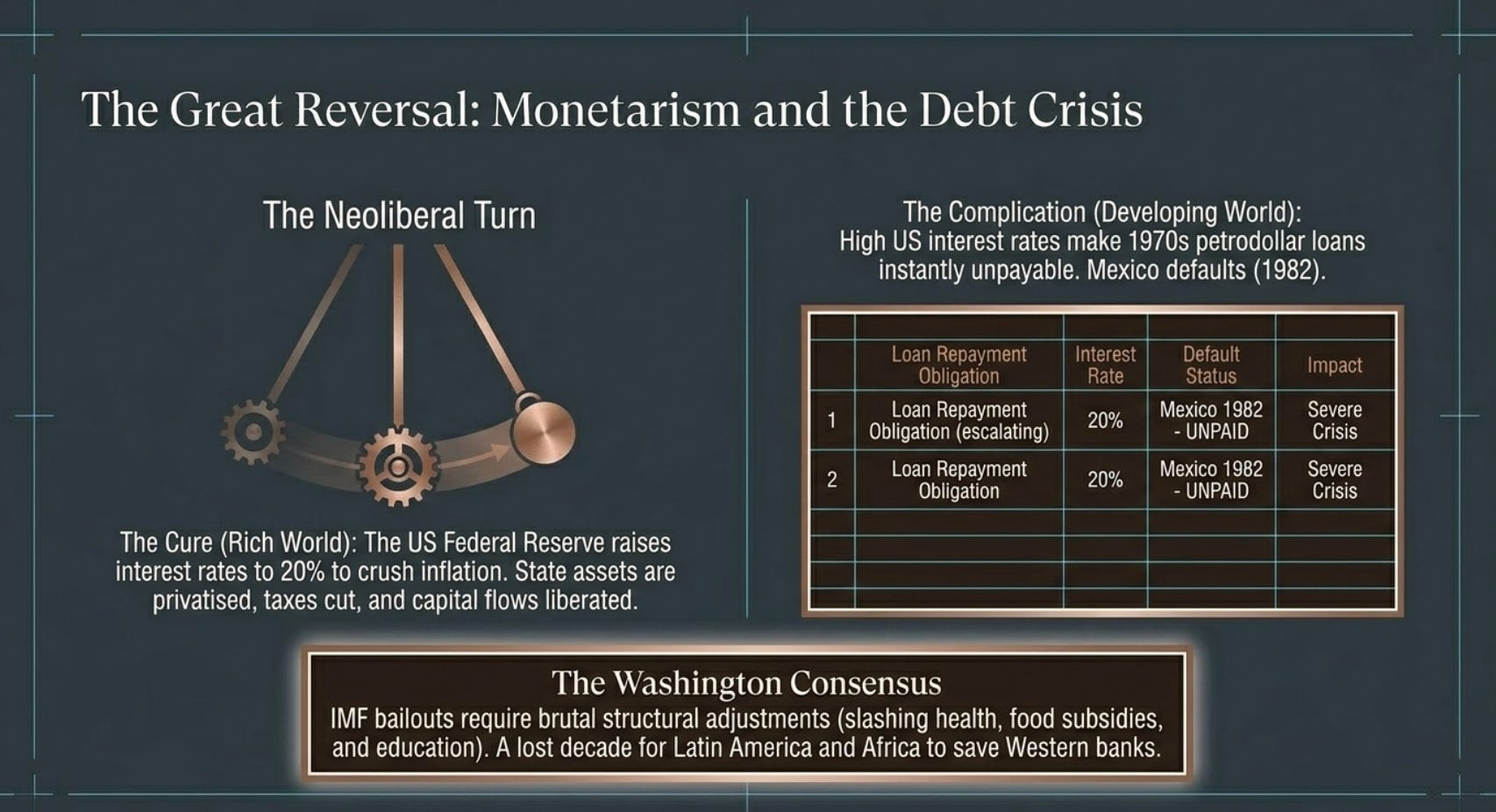
In 1979, the newly appointed head of the US Federal Reserve made a decision that would inflict tremendous short-term pain and fundamentally reshape the global economy. He would raise interest rates to whatever level was necessary to crush inflation.
The Federal Reserve raised its benchmark interest rate to nearly 20%. Think about what that means. If you borrowed money at 20% interest, your debt would double in less than four years even if you paid nothing back. Mortgages became unaffordable. Business loans became prohibitively expensive. The United States went into a severe recession.
But inflation was crushed. Completely, brutally crushed. By 1983, US inflation had fallen from 13% to 3%.
This deliberate use of high interest rates to kill inflation — regardless of the unemployment cost — was called Monetarism, and its political implementation in the United States and Britain (where a similar approach was adopted) is called neoliberalism or the Reagan-Thatcher Revolution.
The philosophy had several components that together constituted a near-total rejection of the post-war Keynesian consensus:
1. Markets over governments. The economy should be organized by private market decisions, not government planning. State-owned enterprises should be privatized. Regulations that restricted market freedom should be removed.
2. Inflation is the primary enemy. The government’s primary economic job is maintaining price stability (low inflation). Full employment — the Keynesian priority — is secondary. Let the market determine employment.
3. Tax cuts stimulate growth. By reducing taxes, particularly on the wealthy and corporations, you increase the incentive to invest and work, generating economic growth that benefits everyone. This was called supply-side economics or, by its critics, trickle-down economics.
4. Free trade and free capital flows. Remove barriers to the movement of goods, services, and money across borders. Liberalize financial markets. Let capital flow to wherever it earns the best return.
Britain under its government (1979–1990) implemented this with extraordinary ideological conviction. State-owned industries — coal, steel, telecommunications, water, gas, electricity, railways — were privatized. Powerful trade unions were broken. Financial markets were deregulated. The result was a modern service and financial economy, but also the decimation of industrial communities in the north of England and Wales that has never fully healed.
The United States cut taxes dramatically, deregulated industries, and began running unprecedented peacetime budget deficits (cut taxes + spend more on military = big deficits). The economy boomed in the mid-1980s. The stock market soared. But income inequality began widening — for the first time in decades, the gap between rich and poor in America started growing rather than shrinking.
The Debt Crisis: The Developing World’s Nightmare
Remember those petrodollar loans from the 1970s? The moment the United States raised interest rates to 20%, those loans — which had variable interest rates — became catastrophically expensive.
In August 1982, Mexico announced it could not repay its foreign debt. Mexico owed roughly $80 billion to international banks and couldn’t service it. This triggered panic in financial markets. Would other developing nations follow? Within months, dozens of countries in Latin America, Africa, and Asia announced they too were in debt difficulties.
The debt crisis of the 1980s was perhaps the greatest economic catastrophe to hit the developing world since the Great Depression. And it was followed by something arguably worse: the cure.
The IMF stepped in as the lender of last resort — providing emergency loans to prevent outright default. But IMF loans came with conditions. Brutal conditions. The standard package — called structural adjustment programs — required debtor nations to:
Cut government spending dramatically (no more subsidies on food, fuel, healthcare, education)
Privatize state-owned enterprises
Liberalize trade (remove protective tariffs)
Devalue the currency to boost exports
Raise domestic interest rates
Open capital markets to foreign investors
In economic theory, these measures were supposed to restore competitiveness and fiscal balance, enabling growth. In practice, they were devastating. Government spending cuts meant school fees were introduced, health clinics closed, food subsidies ended. The poorest people — who depended most on government services — were hit hardest. Economic growth collapsed. Poverty increased. In many African nations, per capita income in 1990 was lower than in 1960.
Latin America’s 1980s are called the “Lost Decade.” Africa’s 1980s were arguably a “Lost Generation.” The neoliberal medicine, administered by institutions controlled by the wealthy nations, was prescribed to the bodies of the poorest ones.
The bitter irony: the debt crisis was not caused by developing world profligacy alone. It was caused by the interaction of:
Low commodity prices (the rich world’s industrial decline reduced demand for raw materials)
High interest rates (set by the US Federal Reserve for domestic reasons)
Overconfident lending by Western banks (which had recycled petrodollars irresponsibly)
But the adjustment cost was paid entirely by the debtor nations. The banks were bailed out. The workers in Lagos, Buenos Aires, and Manila paid the price.
Japan’s Bubble and the First Warning
While Western ideology celebrated markets and deregulation, Japan was demonstrating both the heights and the dangers of financially driven expansion.
Through the 1980s, Japan’s economy was producing extraordinary export surpluses. Its car companies were defeating American car companies in their own market. Its electronics companies were winning globally. The resulting trade surpluses accumulated as Japanese capital that then flowed back into financial markets.
Japanese asset prices — particularly real estate and stocks — entered a speculative spiral. Japanese land prices became so elevated that the land under the Imperial Palace in Tokyo was theoretically worth more than all the real estate in California. The Nikkei stock index more than tripled between 1985 and 1989.
This was a bubble. Asset prices had completely disconnected from the underlying productive value of the assets. When the Bank of Japan raised interest rates to cool the speculation, the bubble popped spectacularly in 1990. Japanese stocks fell 40% in a year. Real estate collapsed. Banks that had lent against inflated asset values were suddenly holding mountains of bad loans.
Japan entered what it would call the “Lost Decade” — a period of economic stagnation, zombie companies kept alive by indulgent banks, and persistent deflation that neoliberal theory had no good answers for. Japan tried government stimulus — building roads and bridges — and got debt without growth. It tried keeping interest rates near zero and got zombie banks rather than recovery.
Japan’s lost decade was a warning that would go largely unheeded until 2008 delivered a global version of the same lesson.
The Soviet Collapse: Communism’s Last Chapter
By the mid-1980s, the Soviet economic model was visibly failing. The problem was not military — the Soviet Union still had thousands of nuclear warheads. The problem was productivity.
Soviet industry could produce tanks but not computers. It could build blast furnaces but not microchips. The third industrial revolution — computing, information technology, advanced telecommunications — was happening, and centrally planned economies were structurally incapable of participating in it. Innovation requires experimentation, and experimentation requires the freedom to fail, and a centrally planned system cannot afford to plan for failure.
Soviet leadership recognized the crisis. The reform program known as glasnost (openness) and perestroika (restructuring) tried to introduce elements of market mechanism and democratic accountability into the Soviet system. But the Soviet system was not reformable. It was held together by its own internal logic. Introduce market mechanisms, and the inefficiencies of the plan become glaringly visible. Introduce political openness, and people begin to question the legitimacy of the whole arrangement.
The combination of failed economic model, political liberalization, and the demonstration effect of Western prosperity proved fatal. Between 1989 and 1991, the Soviet empire simply dissolved. Eastern European satellites peacefully broke free. The Soviet Union itself fragmented into 15 independent republics.
The Cold War was over. The American model — democratic capitalism — had won. Or so it seemed.
ACT VII: THE UNIPOLAR MOMENT (1991–2001)
In Which America Runs the World Alone, Globalization Remakes Everything, and the Seeds of Future Crises Are Planted
The End of History — Or So It Seemed
The collapse of communism produced an extraordinary intellectual atmosphere in the early 1990s. One famous essay argued that history — understood as the evolution of human political and economic organization — had essentially ended, because liberal democratic capitalism had comprehensively defeated all rival models. The only question remaining was the technical implementation of the winning system.
This was hubris of a spectacular order. But it was understandable hubris, because the facts seemed to support it.
The United States was the world’s sole superpower. Its military had no rival. Its economy was the world’s largest by a vast margin. Its cultural products — films, music, fast food, blue jeans — had penetrated every corner of the earth. Its language was the global language of business, science, and the internet (a technology America had invented). Its currency was the global reserve currency. Its universities attracted the world’s brightest students. Its model was being copied everywhere.
For most of the 1990s, American-style capitalism seemed simply to be the correct answer to the question of how to organize a modern economy.
Globalization: The World Becomes a Factory
The end of the Cold War unlocked the full potential of something that had been building since the 1970s: economic globalization.
Globalization is not a natural force. It is a policy choice — specifically, the choice to lower barriers to the movement of goods, services, capital, and (to a lesser extent) people across national borders. These barriers — tariffs, capital controls, regulations — were systematically dismantled from the 1980s onward, accelerating dramatically in the 1990s.
The mechanism that made globalization transformative was the global supply chain.
Before globalization, a car was built in one country: raw materials came from nearby, parts were made locally, assembly was local, and the car was sold domestically or exported as a finished product. After globalization, a car’s components might be sourced from 20 different countries: steel from Brazil, electronics from Taiwan, leather from Argentina, design from Germany, assembly in Mexico. Each component is made wherever in the world it can be produced most cheaply.
This system had several powerful effects:
For consumers in rich countries: Prices fell dramatically. Goods that would have been expensive when made domestically became cheap when made in low-wage countries. The real wages of poor and middle-class consumers stretched further in terms of what they could buy.
For corporations in rich countries: Profit margins expanded enormously. Instead of paying American or European wages for manufacturing, companies could pay Vietnamese or Chinese wages. Shareholders grew wealthy. Executive compensation tied to stock prices soared.
For workers in rich countries: Manufacturing jobs — the high-paying, unionized backbone of the 20th century middle class — began to disappear. The factory that moved to Mexico or China did not take its workers with it. The American or European worker was left to compete in a service economy where wages were lower and job security was less.
For developing countries: Jobs! The factories that left the rich world went somewhere. China, Vietnam, Bangladesh, Mexico, Indonesia — these countries were now integrated into global production as low-cost manufacturers. This created enormous economic growth, lifted hundreds of millions out of poverty, and built industrial capability.
The political consequences of this distribution of gains and losses would detonate 20-30 years later. But in the 1990s, the economists were focused on the aggregate gains — total global wealth was growing, so globalization was, in their models, a net positive.
The Washington Consensus: Exporting the American Model
Emboldened by the apparent victory of market capitalism, the international institutions headquartered in Washington — the IMF and World Bank — developed what became known as the Washington Consensus: a standard recipe for economic development that every developing nation was encouraged (or required) to follow.
The recipe: privatize state assets, deregulate markets, liberalize trade, maintain fiscal discipline (balanced budgets), ensure central bank independence, protect property rights, and welcome foreign investment.
This model was applied across the former Soviet world — countries like Russia, Poland, Ukraine, the Czech Republic — as well as in Latin America, Africa, and Asia.
The results were wildly uneven. Poland and the Czech Republic, with strong institutions, educated populations, cultural and geographic proximity to Western Europe, and EU membership prospect, did well. Russia was a catastrophe.
Russia’s transition from communism to capitalism was handled through a policy called “shock therapy” — rapid, comprehensive privatization of state assets, price liberalization, and trade opening, all at once.
The theory: if you rip off the Band-Aid quickly, the pain is intense but brief, and markets will rapidly emerge to allocate resources efficiently.
The practice: state assets — factories, natural resources, entire industries — were sold at absurd discounts in rigged privatizations that transferred them to politically connected insiders. These new owners — called oligarchs — stripped the assets for cash rather than investing in them. Capital fled Russia at rates that made the economy bleed. Life expectancy in Russia fell during the 1990s. GDP collapsed by 40% — a peacetime contraction comparable to the Great Depression.
Russia’s traumatic 1990s experience created a political psychology that persists to this day: a deep suspicion of Western-designed economic “reforms,” a nostalgia for state control, and a resentment of the international institutions that had supervised the disaster.
The Asian Financial Crisis: When Capital Markets Attack
In 1997, a crisis erupted in Thailand that rapidly spread across East Asia with terrifying speed. It contained lessons that should have been learned and weren’t — until 2008 forced the global system to pay attention.
Through the 1990s, Southeast Asian economies — Thailand, Indonesia, Malaysia, South Korea, the Philippines — had received enormous inflows of foreign capital. These inflows were largely enabled by financial liberalization: the removal of capital controls that had previously limited how much foreign money could flow in and out.
The money flowed in because these economies were growing rapidly (6-9% annually), interest rates were relatively high, and currencies were pegged to the US dollar (so foreign investors faced no exchange rate risk on their returns). Banks and corporations in these countries borrowed enthusiastically in dollars (cheap) and lent or invested in local assets (profitable).
This created a vulnerability: if foreign investors decided to withdraw their money simultaneously — a “sudden stop” — the exchange rate peg would break, the local currency would collapse, and the dollar-denominated debts (now suddenly worth much more in local currency terms) would become unpayable.
That is precisely what happened. In July 1997, confidence cracked in Thailand. Foreign capital fled. The Thai baht collapsed. The contagion spread immediately to Indonesia, Malaysia, South Korea — everywhere that had the same structural vulnerability.
Indonesia’s crisis was the most devastating. The rupiah lost 80% of its value against the dollar. Companies and banks with dollar debts were instantly insolvent. The economy contracted by 13% in a year. Unemployment soared. Civil unrest erupted.
The IMF rode in with bailout packages — but attached, again, the structural adjustment conditions that had been so painful in the 1980s. Raise interest rates (to defend the currency, which made borrowing more expensive and crushed domestic businesses). Cut government spending (in the middle of a collapsing economy). Open markets further to foreign competition.
Malaysia took a different path. Rather than accepting the IMF package, Malaysia imposed capital controls — preventing foreign money from leaving — and cut interest rates to stimulate the domestic economy. The IMF said this was reckless. In practice, Malaysia recovered faster than its neighbors who followed the IMF prescription.
The Asian financial crisis produced several long-lasting consequences:
First: Every Asian nation resolved to accumulate enormous foreign exchange reserves — stockpiles of dollars — so that they would never again be vulnerable to a sudden capital outflow. The way to build these reserves was to export more than you import, maintaining large trade surpluses. China, learning from its neighbors’ crisis, made this a strategic priority.
Second: Confidence in the Washington Consensus was damaged. If financial liberalization could produce crises this severe, maybe the recipe was wrong — or at least, the sequencing was wrong.
Third: The crisis produced political consequences that reverberated for decades. Indonesia’s long-ruling government fell. The political systems of several Asian nations were fundamentally altered. Populations that had been told market liberalization would bring prosperity instead experienced sudden catastrophe.
ACT VIII: THE CHINESE CENTURY BEGINS (1978–2010)
In Which the Sleeping Giant Awakens, and Its Awakening Changes Everything
(Note: China’s story deserves special treatment because it runs alongside and increasingly dominates the main narrative)
The Greatest Economic Development Story in Human History
In 1978, China was among the world’s poorest large countries. Four hundred million people lived in absolute poverty. Industry was rudimentary. Agriculture was collectivized and inefficient. The economy was hermetically sealed from the outside world.
By 2010, China was the world’s second-largest economy. By 2021, in purchasing power terms, the largest. In a single generation, China had industrialized at a speed and scale that makes every other development story in history look modest.
How? And why does it matter so much for understanding the world?
China’s development model was not the Washington Consensus. It was something entirely its own — pragmatic, iterative, and brilliantly adapted to China’s specific circumstances.
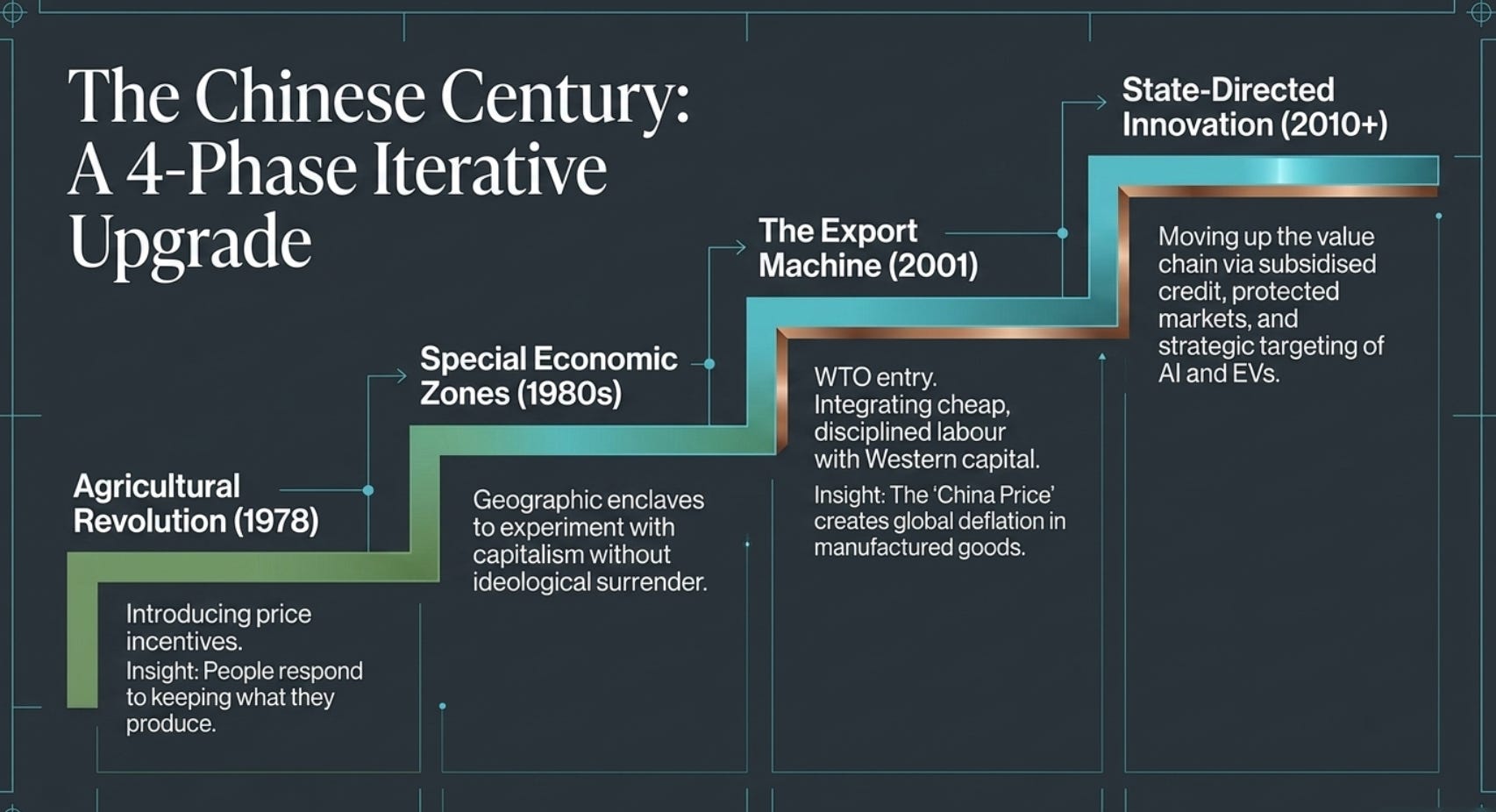
Phase 1: The Agricultural Revolution (1978–1984)
China’s first reform was to allow farmers to sell surplus grain on the open market after meeting state quotas. This tiny change — introducing price incentives into agriculture — immediately increased food production dramatically. Farmers worked harder because they now kept the profits of their additional effort.
This seems obvious. But it was revolutionary in a communist system where the whole ideological point was that profit incentives were unnecessary and even harmful. What China’s leadership had figured out — an insight that sounds simple but is deeply profound — is that incentives work. People respond to the ability to keep what they produce.
Phase 2: The Special Economic Zones (1980–1990)
China created geographic enclaves — Shenzhen, Zhuhai, Xiamen — where the rules of the national economy didn’t apply. In these zones, foreign companies could invest, hire workers at market wages, and keep profits. Joint ventures between foreign companies and Chinese state enterprises could operate with market flexibility.
The genius of this approach was that it allowed China to experiment with capitalism without officially abandoning communism. If it worked, the zones could be expanded. If it failed, they could be closed. China was treating economic reform as a scientific experiment — test, observe, iterate.
It worked spectacularly. Foreign companies — particularly from Taiwan, Hong Kong, and then the broader world — flocked to the special economic zones, bringing capital, technology, and access to global markets. Shenzhen, a fishing village in 1980, was a city of millions with gleaming factories within a decade.
Phase 3: WTO Entry and the Great Export Machine (2001–2015)
When China joined the World Trade Organization in 2001, it fully plugged into the global economy. The effect was like connecting a high-capacity generator to the global power grid. China’s combination of enormous, disciplined, cheap labor; improving infrastructure; political stability; and improving technical skills made it the world’s most competitive manufacturer across almost every industry.
The mechanism was direct: Western multinationals moved production to China, where labor costs were a fraction of home-country costs. Chinese factories produced goods at prices that undercut every competitor. Chinese exports flooded world markets.
The scale of what happened is almost impossible to comprehend. Between 2000 and 2020, China’s share of world manufacturing output went from roughly 7% to over 25%. In many specific categories — electronics, textiles, furniture, toys, chemicals, steel — China’s share is 50-70% of global production.
This had profound consequences for the global economy:
For consumers worldwide: Deflation in manufactured goods. Every year, the real price of manufactured things fell. This was the great “China price” — the benchmark that every manufacturer in the world had to beat.
For Western workers: The most severe dislocation since the Industrial Revolution. Millions of manufacturing jobs in the United States, Europe, and elsewhere disappeared — not gradually, but in sudden waves as entire industries relocated. Academic research suggests the “China shock” from 1999-2011 eliminated roughly 2 million American manufacturing jobs. Communities built around those industries were devastated.
For global inflation: The massive deflationary impact of Chinese manufacturing helped keep inflation extremely low in the rich world throughout the 2000s, allowing central banks to keep interest rates low — which fueled the credit bubble that caused the 2008 crisis.
For the geopolitical balance: China accumulated incomprehensible trade surpluses. Those surpluses were invested in US Treasury bonds — meaning China was lending money to the United States. By the 2000s, China held over a trillion dollars of American government debt. The world’s largest communist country was financing the world’s dominant capitalist empire. The two economies were so intertwined that strategists invented a word for it: Chimerica.
Phase 4: The State-Directed Innovation Push (2010–present)
As China’s wage costs rose and its market share in simple manufacturing peaked, China faced the classic development challenge: how to move up the value chain from low-cost assembly to high-value-added production?
China’s answer combined market incentives and state direction in a way that has no clean parallel in economic history. The government identified strategic industries — semiconductors, electric vehicles, artificial intelligence, renewable energy, aerospace, biotechnology — and provided them with an unprecedented combination of:
Subsidized credit from state-owned banks
Protected domestic markets (limiting foreign competition)
Technology transfer requirements for market access
Direct government procurement support
Research university partnerships
The results have been stunning in some sectors (electric vehicles, solar panels, high-speed rail, 5G telecommunications) and more mixed in others (semiconductors, advanced aircraft engines, premium brands). But the trajectory is clear: China is moving from being the world’s cheapest factory to the world’s most formidable technological competitor.
ACT IX: THE GREAT CRASH AND ITS AFTERMATH (2001–2014)
In Which the World Discovers That Finance Has Eaten the Economy, and the Bill Comes Due
9/11 and the War Economy
On September 11, 2001, the United States experienced an attack on its homeland that triggered a military and geopolitical response with profound economic consequences.
The American response was to launch two major wars: in Afghanistan (to remove the Taliban government that had harbored the attackers) and in Iraq (presented as a pre-emptive strike against weapons of mass destruction that didn’t exist). These wars were funded entirely on credit — the first wars in American history to be accompanied simultaneously by tax cuts rather than tax increases.
The cost of these wars — ultimately totaling several trillion dollars — was charged to the national debt. America’s military spending ballooned from $300 billion in 2001 to $700 billion by the late 2000s. The wars stimulated the defense industry, intelligence apparatus, and security sector massively. But they did not produce the kind of broad economic stimulus that wartime spending historically did — because modern military spending is highly capital-intensive rather than labor-intensive, and a large portion of the spending was on private contractors rather than public employment.
More importantly for the economic story, the period after 9/11 saw the Federal Reserve cut interest rates aggressively to prevent a recession — and keep them low for an extended period. This cheap money needed somewhere to go. It went into housing.
The Housing Bubble: The Most Expensive Lesson in Financial History
The 2000s housing bubble in the United States was not simply a case of too many people buying houses they couldn’t afford. It was a systemic failure of the entire financial architecture — a failure enabled by deregulation, enabled by perverse incentives, and accelerated by financial innovation that nobody fully understood, including the people selling it.
Here is how it worked, and it is important to understand this clearly because versions of this mechanism appear in many financial crises.
Step 1: The origination machine. Banks and mortgage companies lent money to homebuyers. This is normal. But in the early 2000s, the standards for who could borrow changed dramatically. People with low incomes, poor credit history, and no down payment were lent money to buy houses. These were called subprime mortgages. Why did lenders do this? Because they didn’t plan to keep the loans — they planned to sell them.
Step 2: Securitization. Thousands of individual mortgages were bundled together and turned into securities — financial instruments that could be bought and sold. These mortgage-backed securities paid regular interest derived from the mortgage payments. Wall Street banks bought these mortgages from the originators, bundled them, and sold slices to investors worldwide.
Step 3: The rating problem. Investors needed to know how risky these securities were. They relied on credit rating agencies. But the rating agencies were paid by the banks creating the securities — a conflict of interest that led to almost all these securities being rated as safe, low-risk investments. AAA-rated, like US government bonds, even when they contained nothing but subprime mortgages.
Step 4: The derivatives amplification. On top of the mortgage securities, a further layer of derivatives was constructed — instruments called CDOs (Collateralized Debt Obligations) and credit default swaps that allowed investors to bet on or insure against defaults. These instruments were so complex that even the people selling them couldn’t fully explain their risk profiles. Trillions of dollars of these instruments were traded between major financial institutions worldwide.
Step 5: Housing prices stop rising. The entire structure rested on one assumption: US house prices would keep rising. As long as prices rose, even borrowers who couldn’t afford their mortgages could sell their house for a profit and pay off the loan. When US house prices stopped rising in 2006 and began falling in 2007, the assumption failed.
Step 6: Cascade. Subprime borrowers defaulted. Mortgage-backed securities lost value. Banks holding these securities took losses. But because of the web of derivatives — banks had insured each other against these losses — nobody knew which banks were really exposed. Trust between banks evaporated. Banks stopped lending to each other. Credit markets froze. The modern economy runs on credit the way a car runs on oil. When credit froze, the engine seized.
The Lehman Brothers bankruptcy in September 2008 was the moment the engine seized visibly. A major Wall Street investment bank, with tentacles into every financial market on earth, failed. Within weeks, the global financial system was in freefall. Stock markets crashed worldwide. Trade finance — the credit that enables international trade — froze. Businesses couldn’t borrow to meet payrolls.
The 2008 financial crisis was not a uniquely American event. It was the failure of the global financial system that American deregulation and Wall Street financial engineering had constructed. Germany saw its exports collapse as global trade froze. Japan entered recession. Iceland — which had built a banking system seven times larger than its own GDP — completely collapsed and had to be bailed out by the IMF. Ireland, Spain, and Portugal, which had their own housing bubbles, faced sovereign debt crises.
The Rescue and Its Discontents
The response to the 2008 crisis involved government interventions on a scale that would have been unthinkable a decade earlier. Central banks slashed interest rates to near zero. Governments bailed out major banks with public funds. Fiscal stimulus packages injected money into economies.
The United States passed a $700 billion bank bailout and an $800 billion fiscal stimulus. The Federal Reserve created trillions of dollars of new money — through a process called Quantitative Easing — to purchase bonds and support financial markets.
The bailouts worked in the narrow sense that they prevented a second Great Depression. The banking system survived. The stock market recovered. GDP returned to growth relatively quickly in America.
But the distribution of the recovery was deeply troubling. Banks were rescued with public money but their executives faced few consequences. Homeowners who had taken out mortgages they couldn’t afford were foreclosed on in their millions. Workers who lost jobs in the recession discovered that new jobs paid less and offered fewer benefits. The wealthy — who owned stocks — benefited enormously from quantitative easing, which inflated asset prices. The middle class — whose wealth was primarily in their homes and their jobs — recovered far more slowly.
This asymmetric recovery — Wall Street bouncing back while Main Street struggled — created a political resentment that would fuel populist movements on both left and right for the next decade.
The Eurozone Crisis: Europe’s Design Flaw Revealed
The 2008 crisis exposed a structural problem in the European Union that its designers had known about but hoped to manage: the Euro — the single currency — was a monetary union without a fiscal union.
Here’s the problem. When you join a currency union, you give up your exchange rate as an economic adjustment tool. If your economy becomes uncompetitive (because wages rise too fast, or you accumulate too much debt), you can no longer devalue your currency to restore competitiveness. The only alternative is internal devaluation — cutting wages, cutting government spending, reducing prices. This is extremely painful and politically explosive.
Greece had been running large budget deficits and accumulating debt since its Euro entry in 2001, facilitated by the fact that financial markets treated Greek government debt as almost as safe as German debt (because they were both in Euros). When the 2008 crisis hit and Greek finances were exposed as even more precarious than acknowledged, markets suddenly demanded much higher interest rates on Greek bonds.
Greece could not afford those higher rates. Greece needed a bailout. The bailout came from the IMF and the European Union — and again, it came with brutal austerity conditions. Greece cut government spending by 25%. The Greek economy contracted by 25% — a depression-level contraction. Unemployment reached 27%. Youth unemployment reached 60%.
Ireland, Portugal, and Spain faced similar, if less extreme, crises. The entire southern European periphery of the Eurozone went through years of austerity that dramatically lowered living standards and left psychological and political scars.
The fundamental lesson of the Eurozone crisis: monetary union without political union is inherently unstable. When you share a currency, you share economic fates. You cannot have a “Germany doing fine” and “Greece in catastrophe” coexist within the same currency system for long without the system breaking — or without Germany subsidizing Greece. Germany was deeply reluctant to subsidize Greece. The crisis was eventually contained, but the fundamental tension was papered over rather than resolved.
ACT X: THE WORLD FRAGMENTS (2010–2020)
In Which Globalization Backlashes, Nationalism Resurges, and the Old Order Shows Its Age
The Inequality Engine
Here is the great paradox of the 30 years from 1990 to 2020: global inequality fell significantly while national inequality rose significantly in rich countries.
Across the world as a whole, the gap between the richest and poorest countries narrowed — primarily because China, India, and other large developing nations grew rapidly, bringing hundreds of millions out of poverty. From a bird’s eye view, this is the greatest reduction in human poverty in history.
But within the rich world — within the United States, Britain, France, Germany — inequality rose sharply. The gains from globalization and technological progress concentrated at the top. The top 1% of Americans captured roughly 90% of income gains in the years after the 2008 recovery.
The economic mechanism was straightforward but politically explosive. Globalization and automation both reduced the bargaining power of workers relative to capital:
Globalization: a factory can move to Vietnam; a worker cannot.
Automation: a machine can replace a worker; the worker cannot become a machine.
Deunionization: organized labor, which had historically given workers countervailing power, was weakened by decades of policy and structural change.
The result: capital’s share of income rose; labor’s share fell. Profits rose; wages stagnated. The people who owned things got richer; the people who worked for others stagnated or declined in real terms.
By the 2010s, median wages in the United States, adjusted for inflation, had barely risen in 30 years. The American Dream — the idea that each generation would be materially better off than the last — was increasingly a promise the economy was failing to keep.
The Populist Explosion
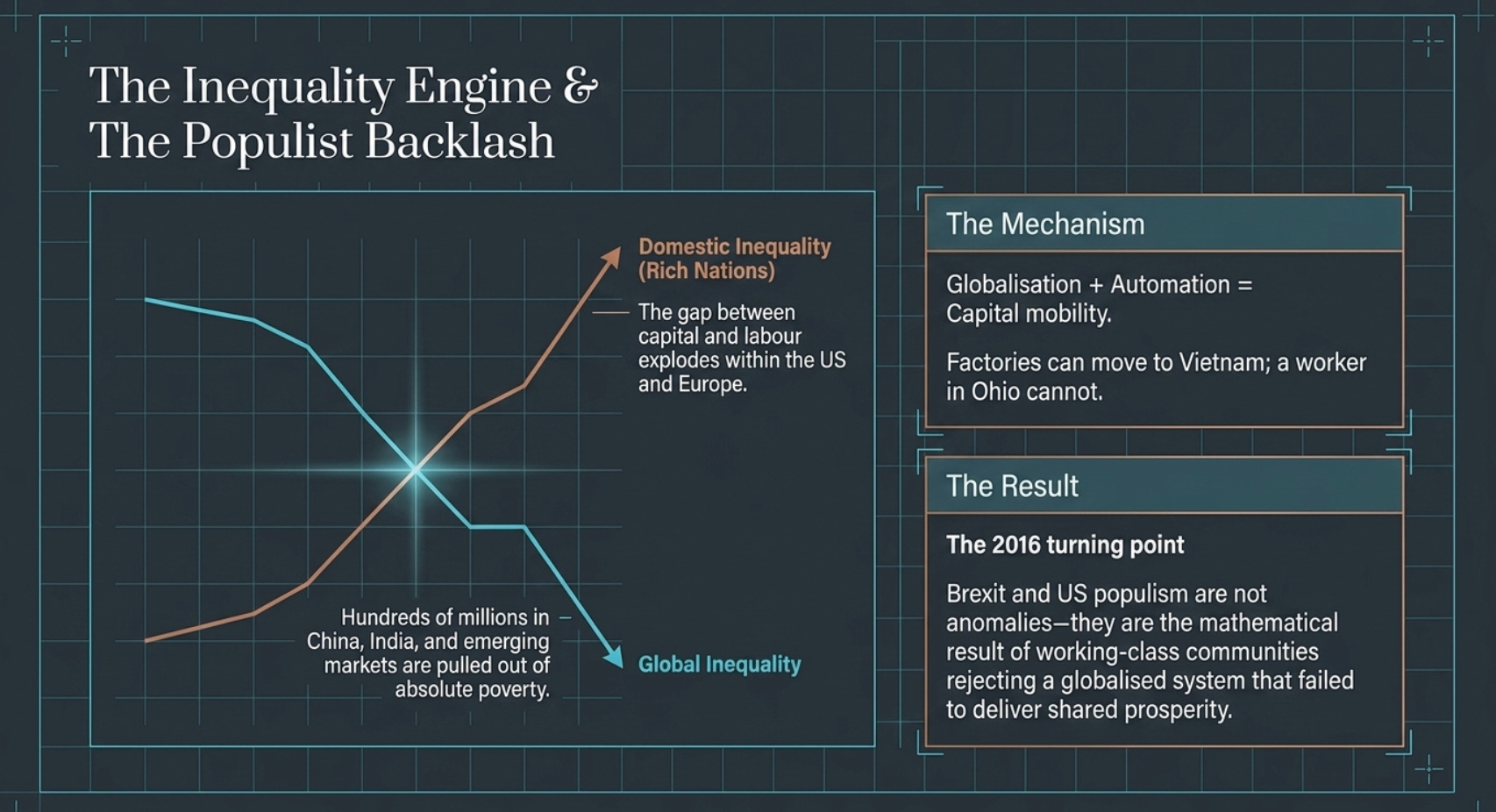
When economic systems fail to deliver broadly shared prosperity, political systems get disrupted. This is a law as reliable as gravity.
In 2016, the United States elected a president who had run explicitly against free trade, globalization, and the political establishment of both parties. His core message — that the working class had been sold out by elites who moved their factories to China and imported cheap labor — resonated powerfully with exactly the communities that had been most damaged by the processes described above.
In the same year, Britain voted to leave the European Union. The Brexit vote was, at its core, a vote against the globalization consensus — against free movement of people (which held down wages), against EU regulations (which were perceived as corporate-friendly), against an international order that felt unaccountable and remote.
These were not isolated events. Similar populist insurgencies swept Italy, France, Hungary, Poland, Brazil, and others. The specific ideological content varied enormously — some were right-nationalist, some left-populist — but the common thread was a rejection of the globalization consensus and the political class that had managed it.
The economic dimension is crucial. The communities that voted most strongly for Brexit and for the populist insurgents were often former industrial areas — places where the factory had closed in the 1980s or 1990s, the replacement jobs never came (or came at much lower wages), and the promised benefits of the global economy were entirely invisible. These communities had been told for 30 years that free trade was good for everyone. They had not experienced it as good for them.
The US-China Trade War: The End of Chimerica
The comfortable narrative of Chimerica — America consuming, China producing, each enabling the other’s prosperity — began cracking in the 2010s as China’s economic weight became too large to ignore.
Several specific tensions had been building for years:
The trade deficit. America bought far more from China than China bought from America. By the mid-2010s, the US trade deficit with China was approaching $400 billion annually. From a pure accounting perspective, this meant American consumers and companies were sending $400 billion a year to China beyond what they received back. From America’s perspective, this represented lost production and lost jobs. From China’s perspective, it represented earned income — payment for legitimate production.
Intellectual property. Western companies operating in China had long complained about forced technology transfer — the informal requirement to share proprietary technology with Chinese partners as the price of market access — and outright theft of intellectual property. China had been using the innovation of others to accelerate its own technological development in ways that violated the spirit (and sometimes the letter) of international trade rules.
State subsidies. Chinese state enterprises and private companies with political connections received subsidized credit, land, and government procurement that gave them advantages over Western competitors. These subsidies violated WTO rules on paper, but China’s political system made enforcement impossible.
Technology competition. By the late 2010s, it was clear that Chinese companies in critical technology sectors — telecommunications equipment, artificial intelligence, semiconductors — were becoming genuine world leaders, not just assemblers of others’ designs. Chinese 5G leader Huawei was building telecommunications infrastructure in dozens of countries, raising questions about data security and technological dependence.
The US response — tariffs on Chinese goods, export controls on semiconductor technology, restrictions on Chinese investment in strategic sectors — represented a conscious attempt to decouple the two economies in critical areas. China retaliated symmetrically.
By 2020, the world was experiencing the early stages of what strategists called “decoupling” — the gradual separation of the US and Chinese economic systems into separate technological and financial spheres. This was potentially the most significant geopolitical development since the end of the Cold War.
The Middle East’s Perpetual Complexity
The Middle East requires its own paragraph in the chapter of economic complexity, because it sits at the intersection of oil, religion, colonialism, and great power competition in a way that makes clean analysis almost impossible.
The post-Ottoman, post-colonial borders of the Middle East were drawn by Britain and France in the 1916 Sykes-Picot Agreement — with little regard for ethnic, religious, or tribal realities. The resulting nations — Iraq, Syria, Lebanon, Jordan — were artificial constructs containing deeply divided populations.
The vast oil wealth of the region was an additional complication. Countries like Saudi Arabia and the Gulf states accumulated oil revenues far beyond their capacity to invest productively domestically, creating rentier states where the government distributed oil wealth as social subsidy in exchange for political quiescence.
The Arab Spring of 2011 — a wave of popular uprisings across the Arab world — demonstrated the limits of this bargain. Populations that had been kept politically passive by oil money demanded voice, dignity, and accountability. In some countries (Tunisia), this produced genuine democratic transition. In most (Syria, Libya, Yemen, Egypt), it produced civil war, military coup, or chaotic instability.
The Syrian civil war in particular became a laboratory for great power competition: the United States, Russia, Iran, Turkey, Saudi Arabia, and others all intervening directly or by proxy, each pursuing its own strategic interests in the wreckage of a collapsed state.
The economic consequence of this instability: refugee flows that destabilized European politics, energy price volatility that rippled through the global economy, and trillions of dollars of wealth destroyed in wars that produced no productive outcome.
ACT XI: THE PANDEMIC ECONOMY AND THE NEW DISORDER (2020–2025)
In Which a Virus Rewrites the Rulebook, Every Assumption Is Tested, and the Shape of the New World Begins to Emerge
COVID-19: The Stress Test of Everything
In early 2020, a novel coronavirus began spreading from China to the rest of the world. By March 2020, it had triggered the largest simultaneous economic shutdown in history.
The immediate economic impact was without modern precedent. Global GDP fell by roughly 3.3% in 2020 — the deepest single-year contraction since World War II. But unlike a financial crisis or a war, the damage was not concentrated in financial markets or specific industries. It was everywhere at once: restaurants, hotels, airlines, retail, entertainment, education, construction. Entire sectors of the economy were legally prohibited from operating.
The policy response was equally unprecedented. Governments that had spent the previous decade agonizing over debt levels suddenly agreed, almost overnight, to spend whatever was necessary. The United States authorized stimulus packages totaling roughly $5 trillion — a sum larger than any wartime spending in real terms. European nations provided direct income support to workers in furlough schemes. Central banks expanded their balance sheets by trillions more. Interest rates fell to zero — or below zero — in much of the world.
The scale of this monetary and fiscal response — necessary to prevent total economic collapse — planted seeds that would grow into the next crisis.
Supply Chain Breakdown: The Hidden Complexity Made Visible
The pandemic revealed something that economists and policy-makers had known in theory but not felt viscerally: the global supply chain was extraordinarily fragile.
Just-in-time manufacturing — the system where companies hold minimal inventory and rely on parts arriving precisely when needed from global suppliers — is maximally efficient in normal times and maximally catastrophic in disrupted times. When Chinese factories closed, American car plants discovered they had zero inventory of essential components and could not produce. When demand patterns shifted suddenly (everyone buying furniture and computers while nobody was buying airplane tickets), supply chains built for the previous demand pattern could not adapt quickly enough.
Semiconductor shortages in 2021 took car manufacturers by surprise — they had underordered chips before the pandemic and couldn’t restart the supply quickly because semiconductor fabrication requires specialized, expensive, time-consuming production ramps. A shortage of sophisticated chips — worth perhaps $50 per car — meant that $40,000 cars couldn’t be completed. Dealerships were empty. Car prices soared.
This experience triggered a comprehensive rethink of global supply chain strategy. “Just-in-time” gave way to “just-in-case.” Nations and companies alike began asking: what if we cannot rely on global supply chains? What do we need to produce domestically?
This line of questioning — which overlapped with the strategic concerns about decoupling from China — produced a significant shift in industrial policy, particularly in the United States. The CHIPS and Science Act (2022) provided $52 billion to rebuild American semiconductor manufacturing capacity. The Inflation Reduction Act provided hundreds of billions in subsidies for American-made clean energy technology.
This was a remarkable ideological reversal. America — the country that for 40 years had insisted markets should decide industrial structure without government interference — was now explicitly picking strategic industries and subsidizing their development. It was, in effect, adopting elements of the industrial policy that Japan, South Korea, and China had used successfully.
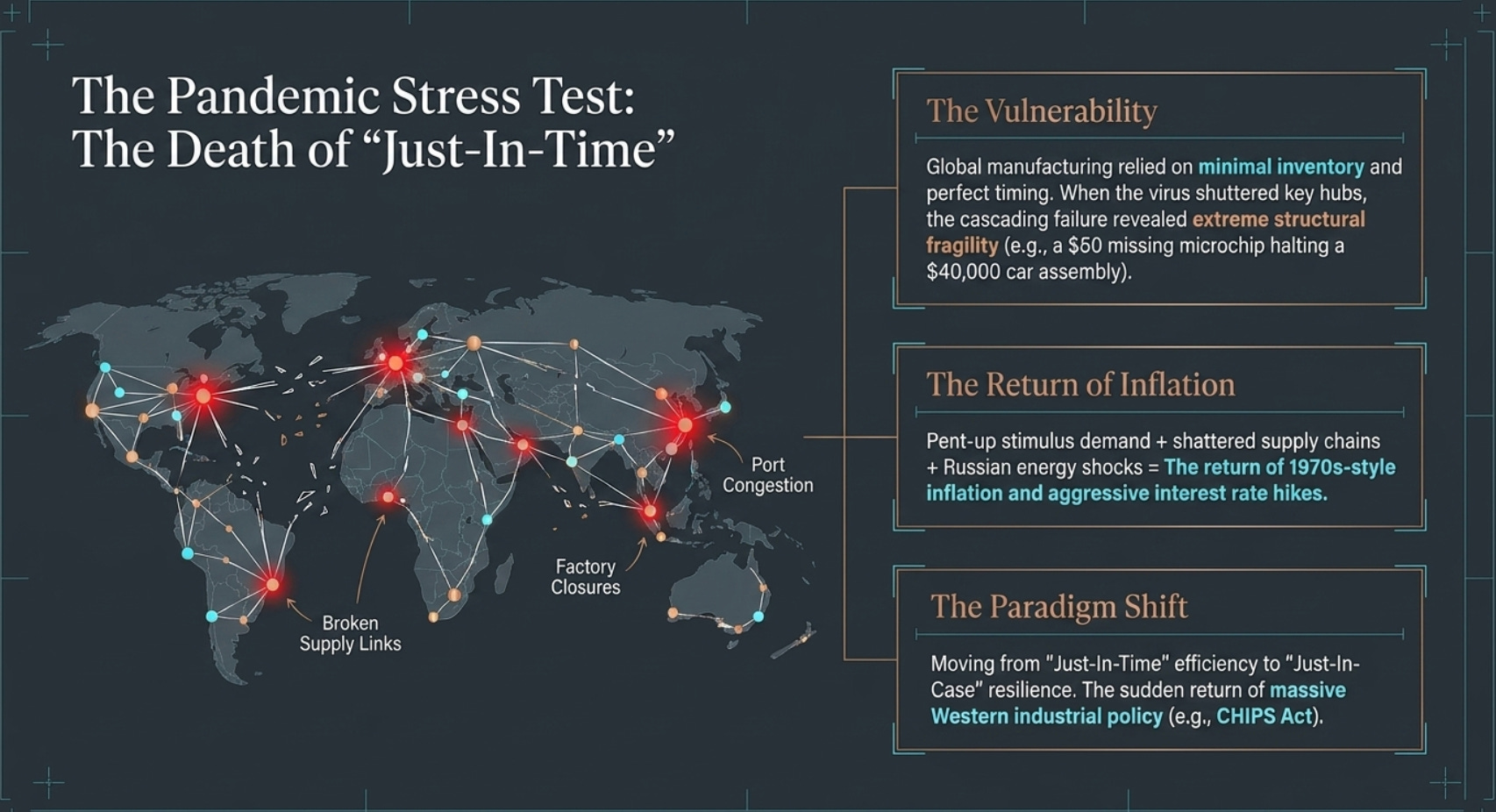
Inflation Returns: The Reckoning for Decades of Easy Money
In 2021, for the first time in 30 years, inflation returned to the rich world with force. By 2022, American inflation reached 9% — the highest since the early 1980s. European inflation hit similar peaks. Britain experienced double-digit inflation.
The causes were several and overlapping:
Demand surge: All those stimulus checks and furlough payments had given consumers money. Pent-up demand for goods and services exploded when restrictions lifted.
Supply constraint: Supply chains hadn’t recovered. Ports were congested. Shipping costs had increased ten-fold. Inventory was low. More money chasing constrained supply = inflation.
Energy shock: Russia’s invasion of Ukraine in February 2022 removed Russian energy — a massive share of European supply — from the market. European gas prices went to ten times their pre-crisis level. Oil spiked. Energy feeds into the cost of everything.
Labor shortage: The pandemic had prompted early retirements, career changes, and in some countries, immigration restrictions. Workers who left the labor market during the pandemic did not fully return. Employers bid up wages to attract scarce workers, which both reflected and further fed inflation.
The Federal Reserve and other central banks responded as they had in 1980: sharp, rapid interest rate increases. In 18 months, the US Federal Reserve raised rates from near-zero to over 5% — the fastest rate of increase in 40 years. The intent: squeeze demand, cool the economy, break inflation.
This worked, eventually — inflation fell from 9% to below 4% by 2023. But the cure had costs:
The housing freeze: With mortgage rates jumping from 3% to 7-8%, the housing market froze. Existing homeowners refused to sell (they’d lose their low-rate mortgage). First-time buyers couldn’t afford the new rates. Housing affordability — already terrible — became catastrophic.
Banking stress: Some smaller regional banks in the United States had loaded up on long-term government bonds when rates were near zero. When rates rose sharply, the market value of those bonds fell. Banks were sitting on unrealized losses. Several bank runs occurred in 2023, requiring federal intervention.
Debt service crisis (developing world): The same mechanism that caused the 1980s debt crisis — US rate hikes strengthening the dollar and making dollar-denominated debts more expensive — played out again. Dozens of developing countries faced crippling debt service costs. Sri Lanka went bankrupt. Zambia, Ghana, Ecuador, and others restructured their debts or sought IMF bailouts.
Russia’s War and the Energy Weapon
In February 2022, Russia invaded Ukraine in the most significant European land war since World War II.
The immediate economic consequences were dramatic. Russia had been the dominant energy supplier to Europe: roughly 40% of European natural gas and significant shares of oil came from Russia. Ukraine was among the world’s largest grain exporters. The war disrupted both.
Europe faced an energy emergency unlike anything since the 1970s oil shocks. It responded with a compressed energy transition — rapidly building LNG (liquefied natural gas) import terminals, accelerating renewable energy installation, and cutting consumption through both price signals and government mandates. What experts had said would take a decade happened in two years.
The Western economic sanctions on Russia constituted the most comprehensive attempt to weaponize the global financial system since World War II. Russia was cut off from the SWIFT international payments network. Nearly $300 billion of Russian central bank assets held in Western financial institutions were frozen. Major multinationals exited Russia. Technology exports to Russia were banned.
Russia was not destroyed by these sanctions — it had been preparing for economic isolation for years, and China continued trading with Russia extensively. But its economy was significantly damaged, and its technology sector was set back years by the export controls.
More significantly, the weaponization of the dollar-based financial system sent a message to every nation that had been watching: if you hold your reserves in dollars and Western financial institutions, you are potentially hostage to Western foreign policy decisions. This accelerated a trend that had been slowly building — a deliberate effort by China, Russia, and others to reduce dependence on the dollar-based financial system and develop alternative payment mechanisms.
ACT XII: THE WORLD IN 2025 AND BEYOND
In Which the Old Order Fragments and a New One Has Not Yet Been Born
The Shape of the New World
As of 2025, the world is at a genuine inflection point — one of those rare historical moments when the basic rules of international economic and political organization are in flux.
The post-World War II order — Bretton Woods institutions, American military supremacy, dollar hegemony, rules-based international trade — is not dead. But it is under serious stress from several directions simultaneously.
The Challenge to Dollar Hegemony
The dollar’s role as the world’s reserve currency rests on several foundations: the depth and liquidity of US financial markets, the credibility of US institutions, the indispensability of the dollar for commodity pricing (especially oil), and the lack of a viable alternative.
All of these foundations are being tested. The weaponization of dollar access through sanctions has motivated nations to develop alternatives. China has been building its own cross-border payment system (CIPS). Trade between China and Russia is increasingly settled in yuan or rubles. The BRICS group (Brazil, Russia, India, China, South Africa — with recent additions) has discussed reserve currency alternatives.
It is important to be precise here: the dollar is not in imminent danger of losing reserve status. No alternative is remotely ready to replace it. The euro lacks the backing of a unified political authority. The yuan lacks open capital markets. Gold cannot support modern trade volumes. Bitcoin is far too volatile.
But the marginal erosion of dollar dominance — more trade settled in non-dollar currencies, more nations holding diversified reserves — could have significant implications over decades. The seigniorage America collects from dollar hegemony is worth hundreds of billions of dollars a year. Even a 20% reduction would be economically significant.
The Technology Race
The 21st century’s defining competition is technological — specifically in artificial intelligence, semiconductors, quantum computing, biotechnology, and clean energy. These technologies will determine which nations are wealthy and which are not in 2050 in the same way that industrial technology determined national power in 1950.
The United States maintains significant leads in AI software, chip design, and biotech. Its universities, companies, and immigrant talent pool remain incomparable. But its advantages in manufacturing capability — the ability to actually build the hardware — have eroded and are only now being rebuilt through industrial policy.
China has become a genuine peer competitor in many technology categories — not the imitator it was 20 years ago. In clean energy manufacturing (solar panels, wind turbines, electric vehicle batteries), China is already the world leader. In AI, it is a close competitor. In semiconductors, the most advanced chips still elude it (due partly to US export controls on key equipment), but the gap is narrowing faster than American policy-makers would prefer.
The European Union has world-class research capability and strong companies in specific sectors, but lacks the integrated industrial base and the single market depth to compete with the US or China in platform technologies. Europe’s role in the technology competition may be more as a regulatory power — setting standards and rules that other large markets adopt — than as a production power.
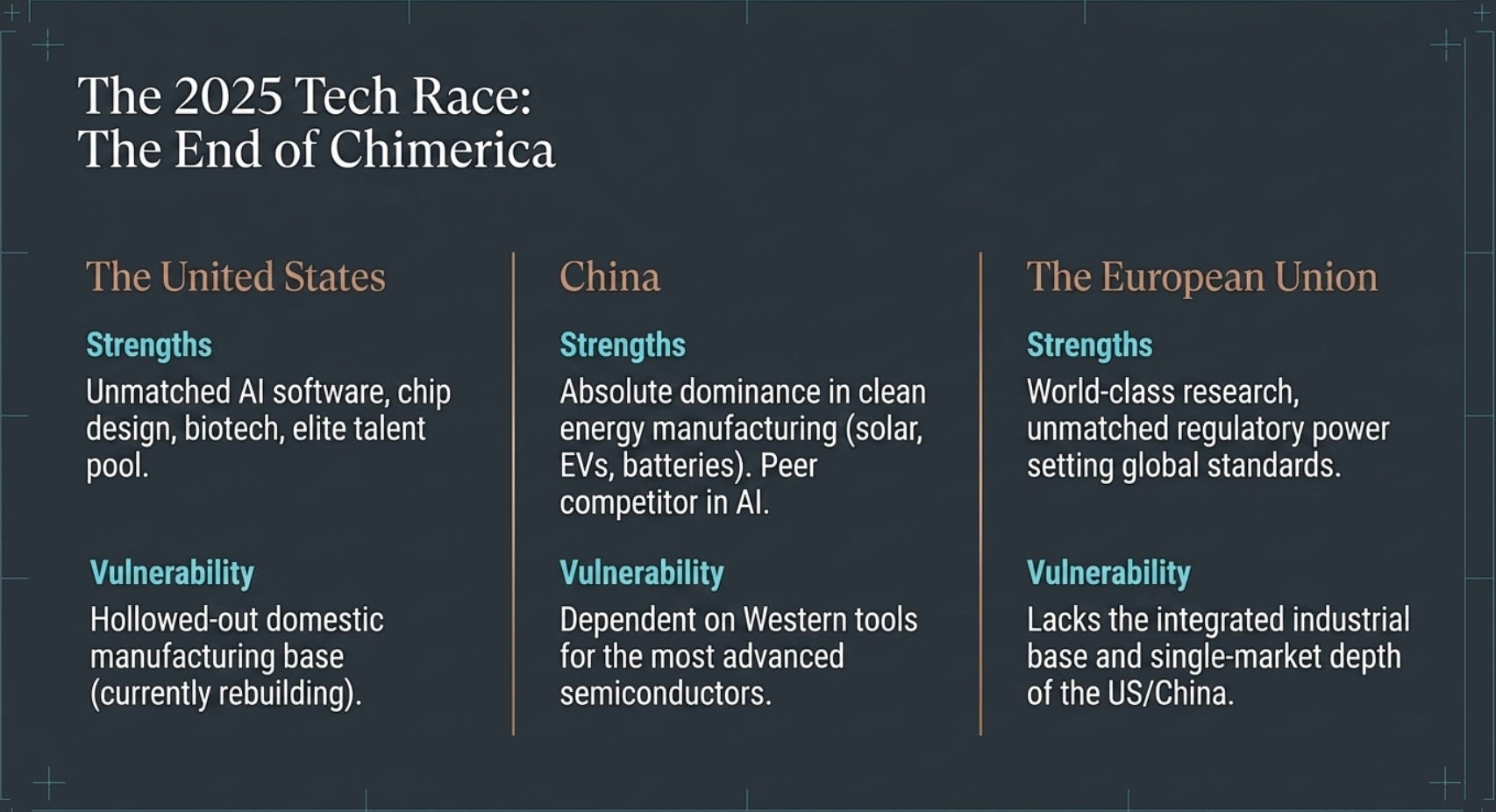
The Great Decarbonization
Perhaps the most consequential economic transition in human history is underway: the replacement of fossil fuels with renewable energy.
This transition has profound economic implications that are only beginning to be understood:
The fossil fuel-producing nations — Saudi Arabia, Russia, the Gulf states, Iraq, Iran, Venezuela, Nigeria — face the potential loss of their primary economic foundation over the next 20-40 years. Some, like Saudi Arabia and the UAE, are racing to diversify. Others, like Venezuela and Nigeria, are poorly positioned for the transition and face genuine developmental peril.
The manufacturing competition in clean energy technology is intense. Solar panels, wind turbines, and electric vehicle batteries are manufactured goods — which means their production can be dominated by the nation with the best manufacturing ecosystem. That nation, currently, is China. The United States and Europe are aggressively subsidizing domestic clean energy manufacturing, but China’s head start is substantial.
The energy security map is being redrawn. A world running on renewable electricity is a world where a nation’s energy security depends on its access to manufacturing capability (to make solar panels and wind turbines), rare earth minerals (needed for batteries and motors), and electricity grid infrastructure — not on proximity to oil and gas. Countries that currently have no oil but abundant sunshine, wind, or manufacturing capacity will be energy winners in 2050. Countries whose entire national identity and budget depends on oil must transform or decline.
EPILOGUE: THE PERMANENT LESSONS
The century you have just traversed — from the ruins of 1919 to the uncertainties of 2025 — teaches a set of lessons that are not specific to their historical moment. They are the physics of political economy, as constant as gravity.
Lesson 1: Prosperity Is Not Self-Sustaining
The greatest delusion in economics is the belief that once prosperity is achieved, it will maintain itself. It will not. Prosperity requires constant institutional maintenance — rules that prevent monopoly, systems that distribute gains broadly enough to sustain political legitimacy, investment in public goods that markets underperform. The moments in this story when nations forgot this — Weimar Germany, pre-crash America in 1929, pre-crisis America in 2008 — ended in catastrophe.
Lesson 2: The Global System Is a Network, and Networks Fail in Cascades
The interconnectedness of the global economy is its greatest strength — it allows specialization, efficiency, and the concentration of talent and capital at global scale. But networks fail in cascades. When one node fails, the failure can propagate instantly across all connected nodes. The 1929 crash, the 2008 crisis, and the COVID supply chain breakdown all demonstrate this. The price of global integration is global vulnerability.
Lesson 3: Finance Must Serve the Economy, Not the Other Way Around
Finance — banking, investment, insurance — exists to channel savings into productive investment. It is a service industry, as essential as logistics or electricity. But through the 20th century’s deregulation and the 21st century’s sophistication, finance has increasingly become an end in itself — a sector that generates profits by trading with itself, creating increasingly complex instruments that distribute rather than reduce risk, and capturing an ever-larger share of national income.
When finance grows faster than the underlying economy, you eventually get a crisis — because the financial claims (debts, derivatives) exceed the real economic capacity to service them. Every major financial crisis in this story confirms this.
Lesson 4: Political Legitimacy Requires Shared Prosperity
The most politically stable periods in this century were those of broadly shared prosperity — when economic growth genuinely improved living standards across the income distribution. The most politically turbulent periods were those of economic concentration — where growth benefited the few while the many stagnated. This pattern — stagnation → resentment → populism → political disruption — has repeated with remarkable consistency. The nations and periods that avoided it did so by building institutions that distributed economic gains — progressive taxation, labor protections, public investment in education and health. These were not charities. They were the price of political stability.
Lesson 5: Every Nation Is Its Own Author
The most important insight of this century of economic history is that there is no universal script. The countries that succeeded economically were those that adapted general principles to their specific circumstances — geography, history, institutions, culture. Japan, South Korea, China, and Germany all industrialized and grew wealthy, but through different models. The countries that failed most often did so by adopting models designed for other circumstances — by following ideological prescriptions (from either Washington or Moscow) without asking whether those prescriptions fit their actual reality.
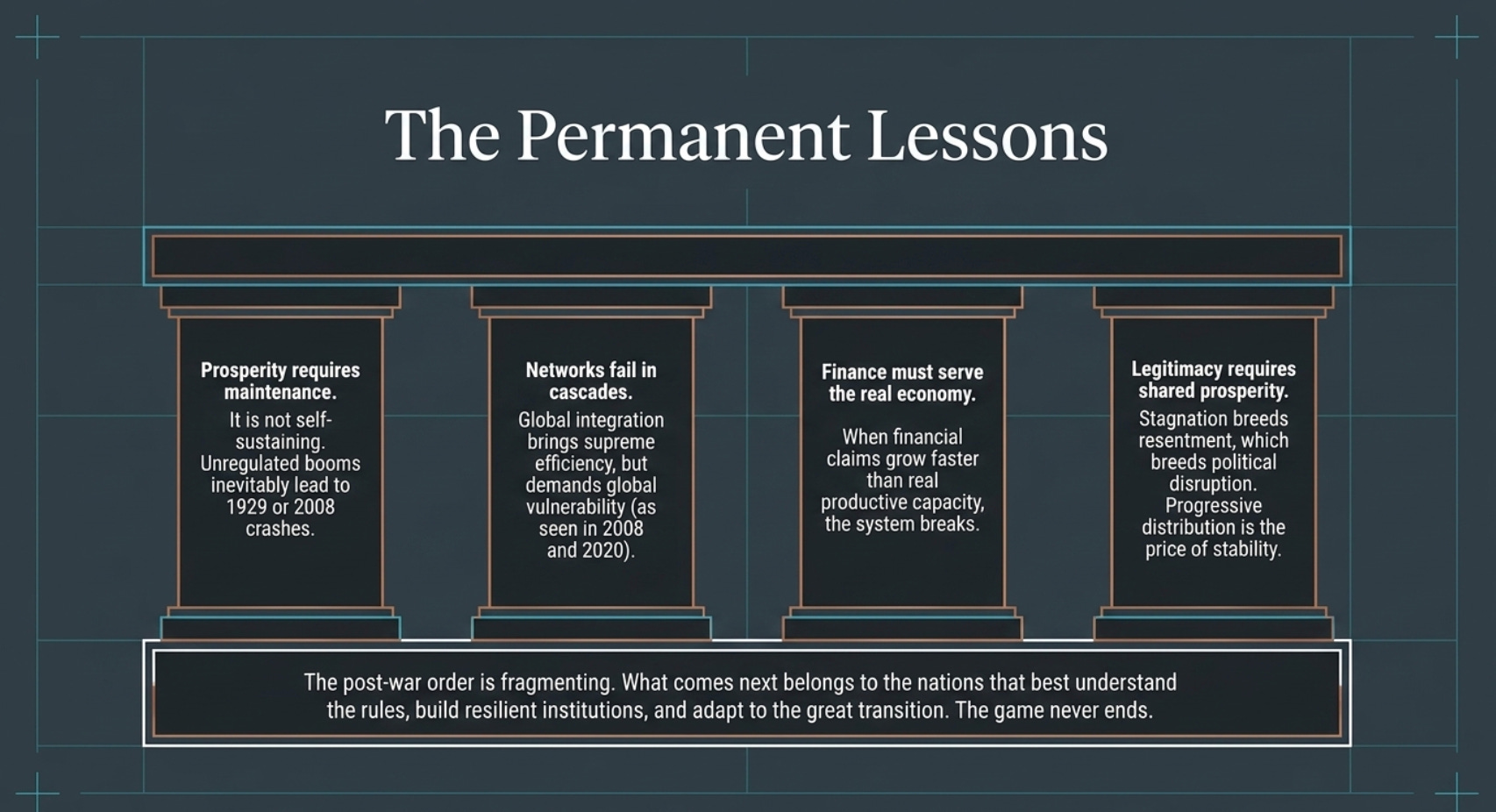
The world has never been more economically interconnected — and more politically fragmented. It has never been wealthier in aggregate — and never more unequally distributed within nations. It has never had more productive capacity — and never faced a greater structural challenge in the climate transition.
What comes next will be determined, as it has always been, by which nations best understand the rules of the game, best build institutions that channel human energy productively, and best adapt when the world changes.
The game has never ended. It has only gotten more interesting.
A Note on Further Study
If this story has sparked your curiosity, the following are the intellectual pillars behind it: Keynes’ General Theory (macroeconomics), Kindleberger’s Manias, Panics and Crashes (financial crises), Daron Acemoglu’s Why Nations Fail (institutions), Barry Eichengreen’s Globalizing Capital (monetary history), Ha-Joon Chang’s Bad Samaritans (development economics critique), and Adam Tooze’s Crashed (2008 crisis and aftermath). Together, they are the library behind this century.