
There is a deceptively simple question that Warren Buffett borrowed from Aesop’s ancient fable, and has repeated across decades of shareholder letters: “How many birds are in the bush? How sure are you they’re there? And how long until you get them out?”
The riddle sounds almost childish. And yet the overwhelming majority of investment mistakes — the ones that bleed capital quietly for years — are made by people who answered just one of those three questions well and treated the other two as formalities. The business looked cheap. Or it looked high quality. Or the catalyst seemed close. Rarely all three at once. Rarely with rigour applied to each.
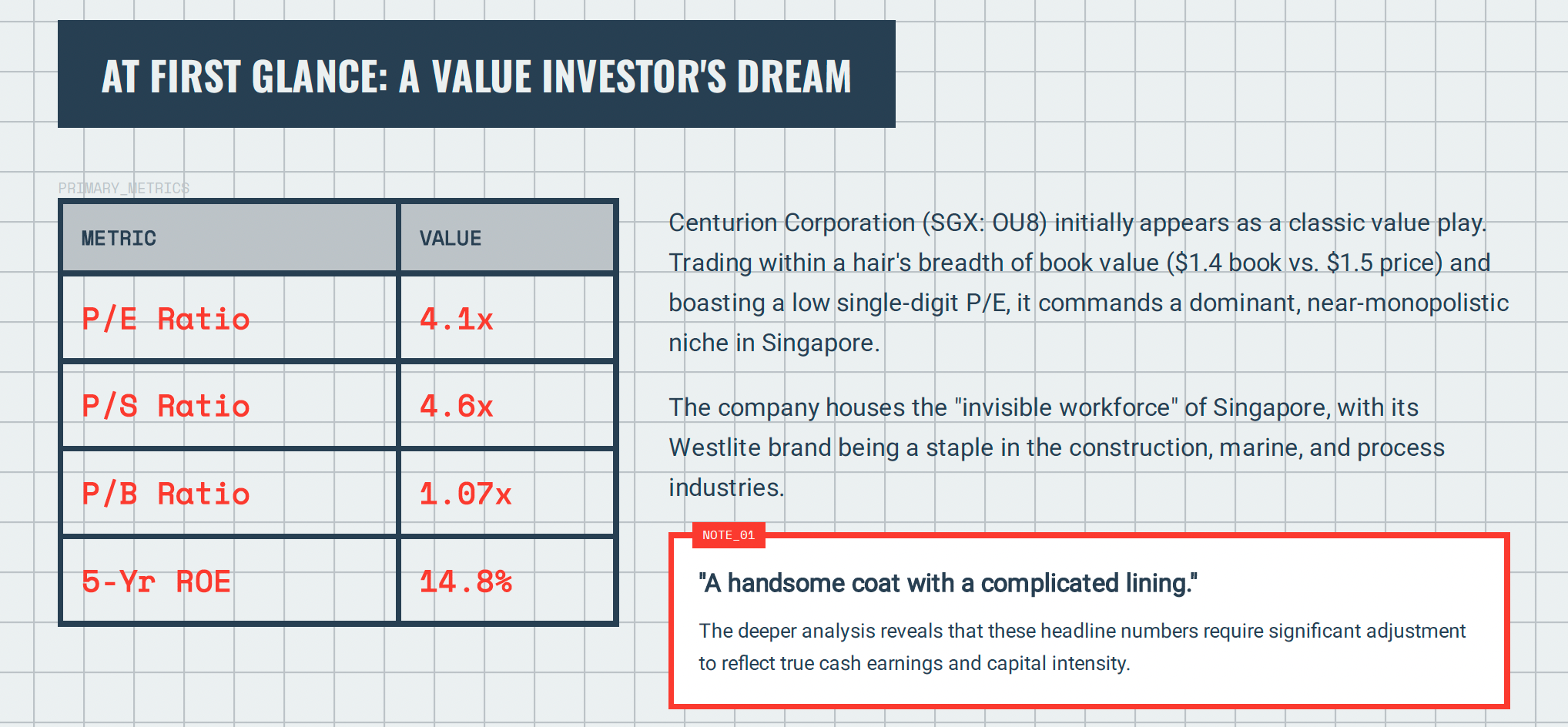
Centurion Corporation (SGX: OU8) landed on my radar in February 2026. At first glance, it looked like the kind of thing that makes a value investor’s heartbeat quietly accelerate — a P/E of 4.1x, trading within a whisker of book value ($1.4 book, $1.5 price), a 14.8% five-year average ROE, and an apparently dominant position in a niche market with genuine regulatory barriers to entry. In Singapore, where the company makes most of its money, it looked almost monopolistic.
But the further I went, the more I encountered that peculiar phenomenon that recurs across investing: a company that is genuinely excellent at one thing, surrounded by a collection of other activities that dilute, confuse, and ultimately compromise what the excellent thing is worth. This article is the story of what I found — and the thinking behind how I found it.
The Business: Housing the People Who Build the City
Before we count any birds, we need to understand the bush.
Centurion is not a tech company. It does not sell software subscriptions or exploit a data flywheel. What it does is considerably more fundamental: it houses the invisible workforce that physically builds the cities the rest of us inhabit. Singapore, for all its gleaming towers and seamless infrastructure, runs on the labour of approximately 1.4 million foreign workers. As of June 2024, there were over 442,900 work permit holders in the construction, marine shipyard, and process (CMP) industries — a figure that represents a 24.5% increase since December 2018. These workers are legally required to live in licensed dormitories, and Centurion — operating under its “Westlite” brand — is one of the largest providers of such housing in the country.
The business model, stripped to its essence, works like this: Centurion builds or acquires a large, purpose-built dormitory, often on government-allocated land, and then signs multi-year master leases with the employers of foreign workers, collecting predictable recurring rental income at very high occupancy rates. Think of it as a toll road — once the dormitory is built and the regulatory licence obtained, a competitor cannot simply appear next door. The barriers are immense. Land in Singapore is finite. Licences from the Ministry of Manpower (MOM) are not easily issued. And the New Dormitory Standards (NDS), introduced in October 2023, have significantly raised the minimum requirement for what a compliant dormitory must look like: a maximum of 12 workers per room, en-suite toilets for every six workers, more living space per head. Existing dormitories must be refurbished to meet DTS guidelines by 2030 and the full NDS requirements by 2040, a process which is reducing available bed supply in the short term and pushing rents upward as operators pass on their capital expenditure.
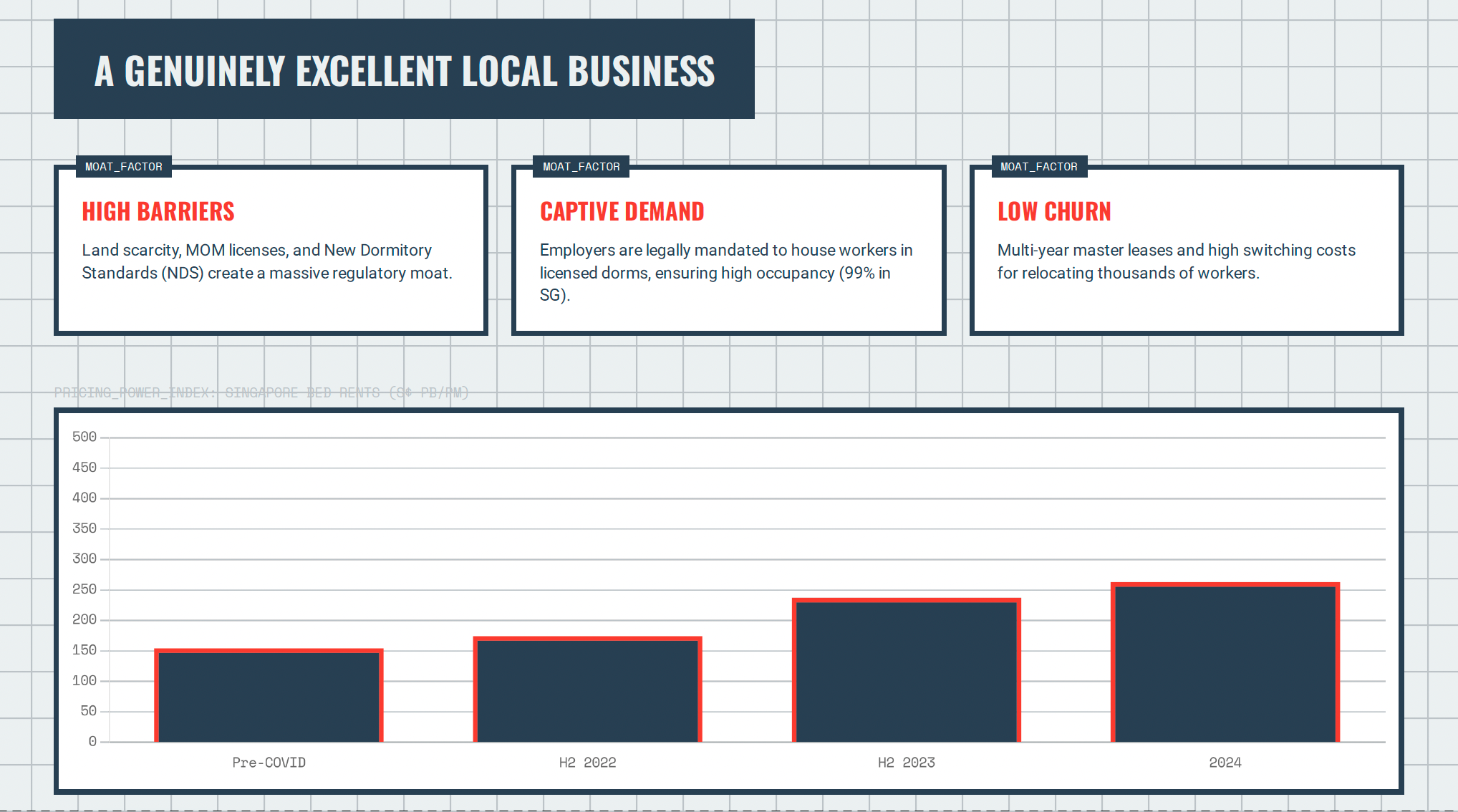
The market dynamics inside Singapore right now are, in a word, exceptional. Average islandwide bed rents rose from S$270 per bed per month before the pandemic, to S$305 in H2 2022, then spiked 36% to S$415 in H2 2023, before reaching S$460 per bed per month in 2024. That is a 70% rent increase in roughly four years, and the trajectory has not softened. In H1 2025, centrally located dormitories were commanding S$530 per bed per month, with eastern facilities at S$515 and western at S$445. Knight Frank and DASL forecast bed rents to rise by approximately 10% for the remainder of 2025, consistent with the 10.8% growth recorded in 2024.
This pricing power is not accidental. It flows from a customer dynamic that is structurally different from almost any other business you might encounter. The customer — the employer of the foreign worker — does not need to be convinced that they require a dormitory bed. Singapore law compels them to provide licensed accommodation for every Work Permit holder on their payroll. The employer’s cost of not using a Westlite dormitory is not a slightly worse option; it is a violation of the Employment of Foreign Manpower Act. This makes Centurion’s customer acquisition cost (CAC) structurally, almost unfairly, low. The company does not need a sales team hunting for clients. It needs proximity — a dormitory positioned near the worksites its target employers are building on.
And once an employer signs a master lease, they rarely leave. A construction company erecting a decade-long infrastructure project does not casually relocate five thousand workers to a different dormitory across the island. The logistics are prohibitive, the disruption enormous, and the employee relationships built inside a dormitory community genuinely hard to replicate. The lifetime gross profit of each employer customer is long, the churn structurally low, and the switching costs meaningfully real. Centurion’s Singapore Purpose-Built Workers Accommodation (PBWA) segment achieved financial occupancy of 99% in FY2024, a number that speaks for itself.
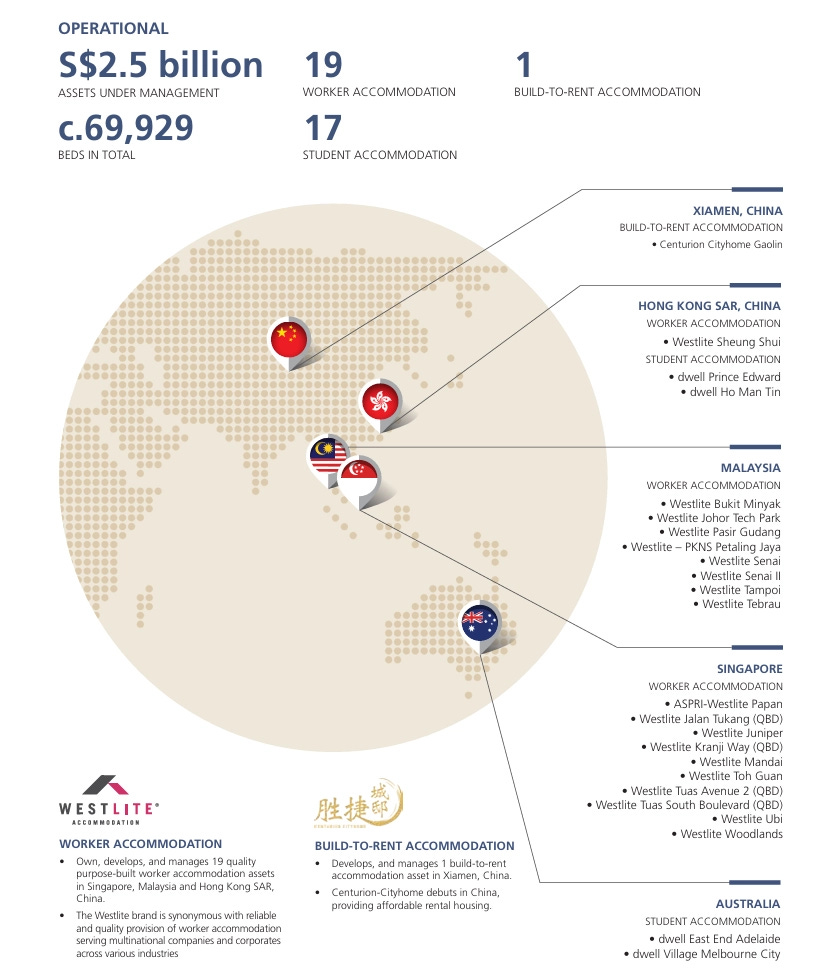
Operating across Singapore, Malaysia, Australia, the UK, the US, and China, the company manages approximately 69,929 beds across 37 properties, with S$2.5 billion in assets under management. On paper, it is a formidable company. In FY2024, group revenue grew 22% year-on-year to S$253.6 million, driven by the Singapore dormitory segment’s performance.
So far, so compelling. This is the part of the story where most screens would stop — a cheap stock with strong fundamentals, pricing power, and a government-enforced customer base. A rare combination. But good investing is not screening. It is what comes after the screen.
Part One: How Many Birds Are in the Bush?
The Seduction of Surface-Level Numbers
The first thing that caught my attention — and should catch yours — is the Capital Reinvestment Rate, or CRR. This metric answers a deceptively important question: how much operational earnings does the business generate per cycle of activity, relative to the total asset base it employs to generate them? The reason this matters is direct: if operational earnings reinvested back into the business are small relative to the asset base, the business simply cannot grow very fast. The asset base — in Centurion’s case, billions of dollars worth of physical property — is the engine of future earnings, and the CRR tells you how fast that engine can grow from its own fuel.
Centurion first appeared on my radar with a CRR of -365%. Negative. Which sounds alarming until you understand what it actually means in this context. The negative figure emerged because Centurion’s net working capital — the difference between current assets (S$149m) and current liabilities (S$191m) — is itself negative. That negative net working capital is, counterintuitively, a good operational sign: it means the business collects cash from its customers before it has to pay its own bills, a cash conversion dynamic more commonly associated with supermarkets and subscription businesses than property companies. In Centurion’s case, it reflects advance rental collections that sit inside the business before obligations come due. A negative CRR that arises from negative net working capital is not a warning; it’s worth examining beneath the surface.
The real issue emerged when I correctly included what had initially been missed in the denominator: S$2,069 million in long-term assets, almost entirely comprising physical investment properties. When you run the CRR correctly — S$190 million five-year average EBIT divided by (S$149m current assets minus S$191m current liabilities plus S$12.6m PP&E plus S$2,069m long-term assets) — the number lands at 9.3%.
What that 9.3% actually means is this: for every dollar of assets Centurion holds, the business generates just over nine cents of operational earnings per year. If the company retains all of those operational earnings and reinvests them into the asset base, the asset base can grow by roughly 9.3% annually from internal operations. That is the organic growth ceiling. It is not a terrible number for a property company — but it is far from the 20-30% reinvestment rates that define the compounders I am looking for. And it tells you something important about Centurion’s fundamental business character: it is a high-quality income generator sitting atop a massive capital base, not an asset-light compounding machine.
The reason the CRR is this modest is worth spelling out. A true compounder — think of a business like a dominant software platform or a ratings agency — earns high returns from assets that are largely intangible. The “assets” in those businesses are brand, monopoly position, customer relationships, intellectual property. These don’t show up on the balance sheet at anywhere near their economic value, so the denominator in any return calculation is small relative to the earnings. Centurion, by contrast, owns the physical buildings. The assets are on the balance sheet, in full, at fair value. The denominator is enormous, and no amount of pricing power fully overwhelms it.
The Earnings Quality Problem
The second issue with the “how many birds” question is harder to see and more consequential.
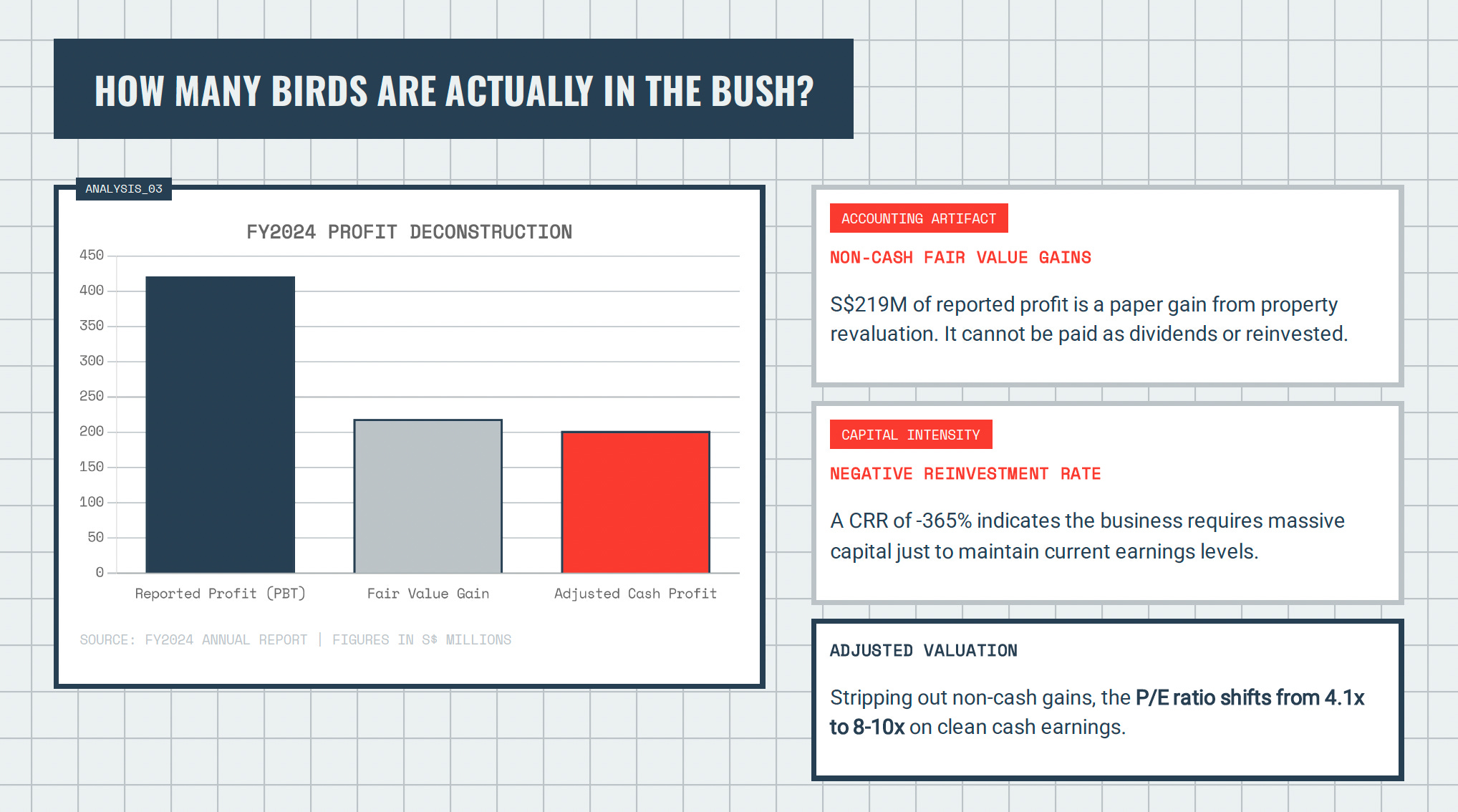
When Centurion reported FY2024 earnings, the headline looked extraordinary — profit before tax of S$421 million on revenue of S$253 million. That implied a profit margin north of 160% of revenue, which is physically impossible for an operating business without something unusual happening. The unusual thing was a line item called “Net fair value gain on investment properties” — S$219 million in 2024, compared to S$84 million in 2023. Under international accounting standards, Centurion marks its investment property portfolio to market each year, and when valuations rise — as Singapore property has relentlessly done — that upward revaluation flows straight into the income statement as “profit.”
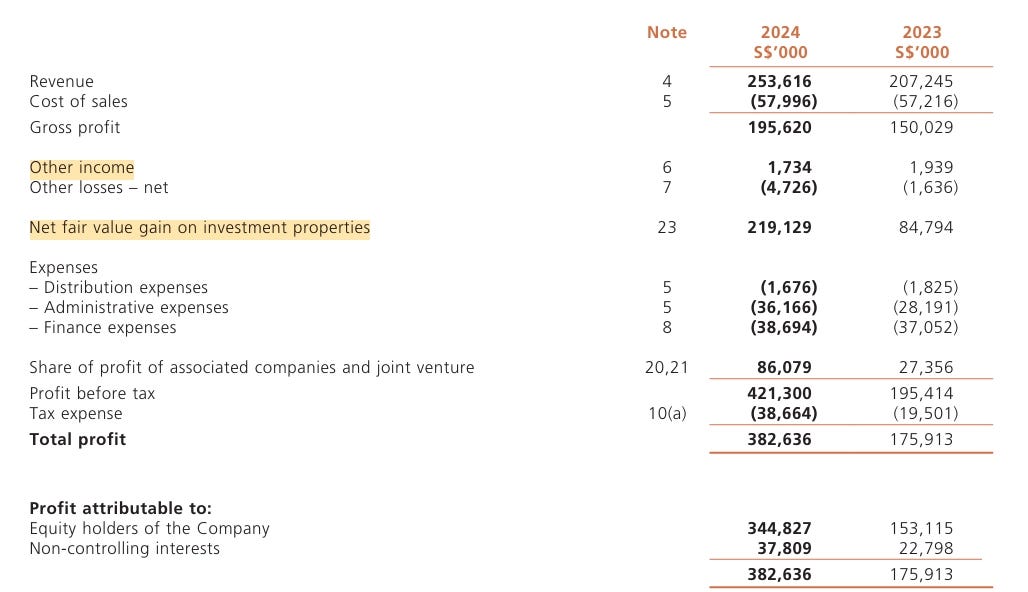
This is not fraud. It is not even unusual for a property company. But it is the kind of accounting artifact that cleanly separates the careful analysis from the careless one. That S$219 million never hits a bank account. It cannot be paid as a dividend, deployed into a new dormitory, or returned to shareholders. And critically: it can reverse. If Singapore property values fall — say, as new government-built dormitories enter the market, or as demand from CMP workers softens after the current infrastructure wave completes — that S$219 million tailwind becomes a headwind. The reported earnings that look “cheap” at a P/E of 4.1x are substantially a reflection of paper property gains, not cash generated from running dormitories.
Strip the fair value gain from the calculation, and operational profit before tax drops to approximately S$202 million. On that basis, the effective P/E is closer to 8-10x — not expensive for a stable, growing business, but also not the screaming statistical anomaly the headline multiple implied. The valuation is reasonable. It is not compelling.
Part Two: How Sure Are You?
The Geography of Excellence — and Its Limits
If the first question narrowed the upside, the second question — how confident can you be in the thesis? — is where the investment case begins to unravel properly.
The confidence problem with Centurion is geographical. Its Singapore worker dormitory business is, as described above, genuinely excellent: near-full occupancy, rising rents, low CAC, long customer lifetime value, regulatory moats. But Singapore is only one part of what Centurion owns. And the data on the rest is considerably less encouraging.
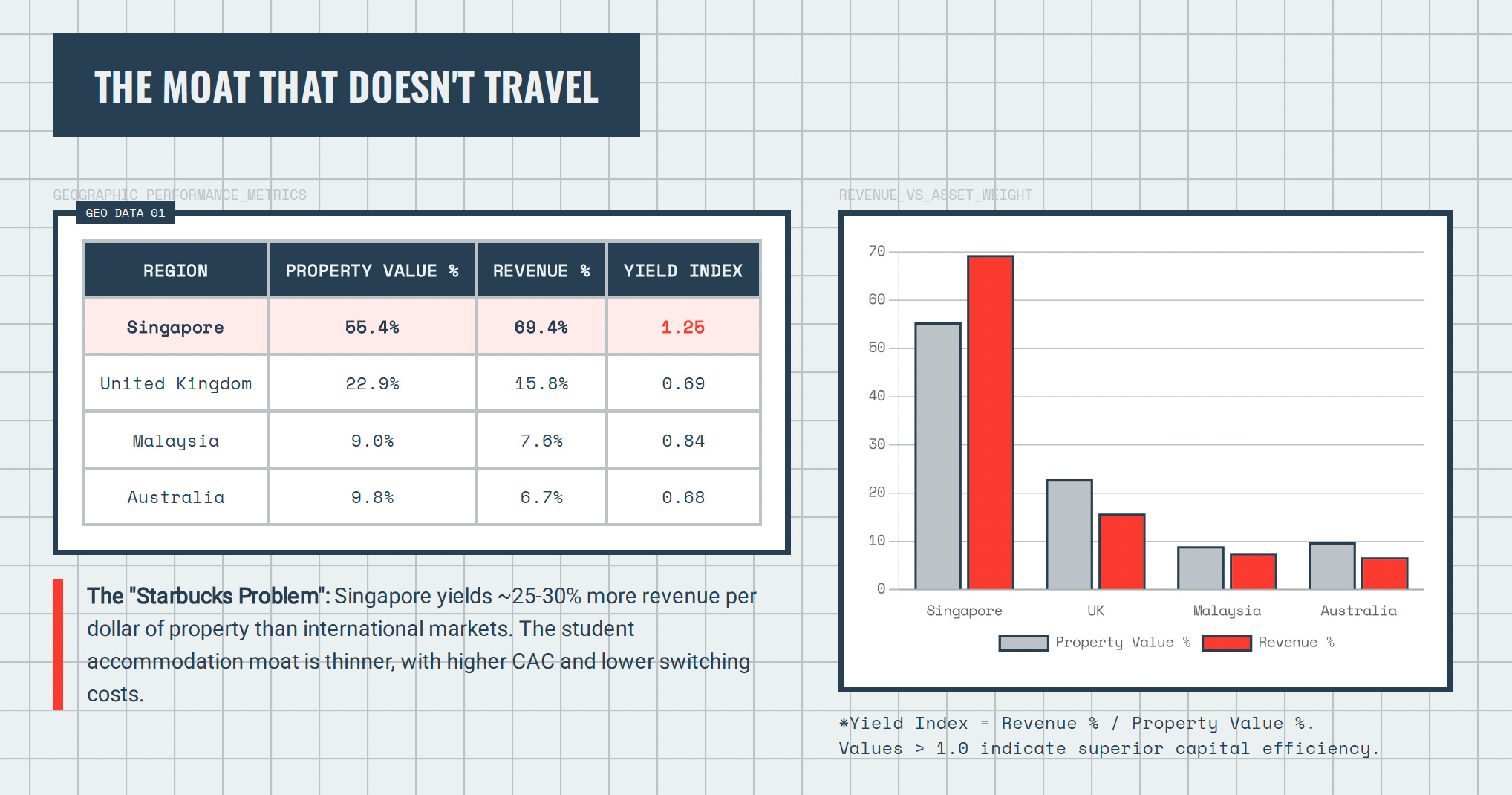
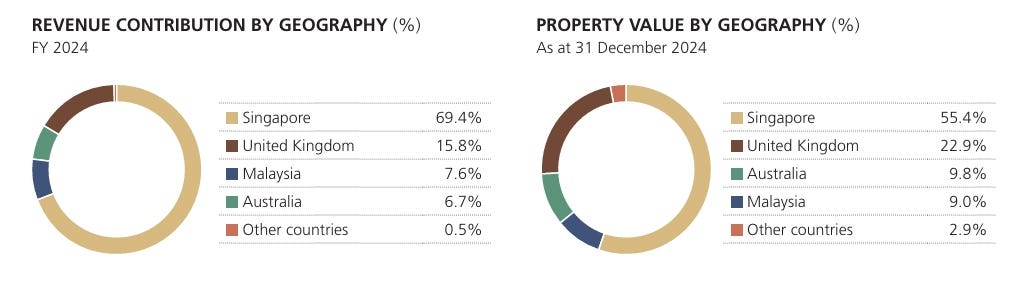
Singapore contributes 69.4% of Centurion’s revenue while representing only 55.4% of its property value by geography. Read that ratio in reverse: the non-Singapore assets comprise 44.6% of the property portfolio but produce only 30.6% of revenue. The international assets are earning at a meaningfully lower revenue yield per dollar of property than Singapore. The UK holds 22.9% of property value for 15.8% of revenue. Australia holds 9.8% of property value for 6.7% of revenue. Malaysia holds 9% for 7.6%. Every single non-Singapore geography is earning below the Singapore revenue-to-asset ratio, and in most cases significantly so.
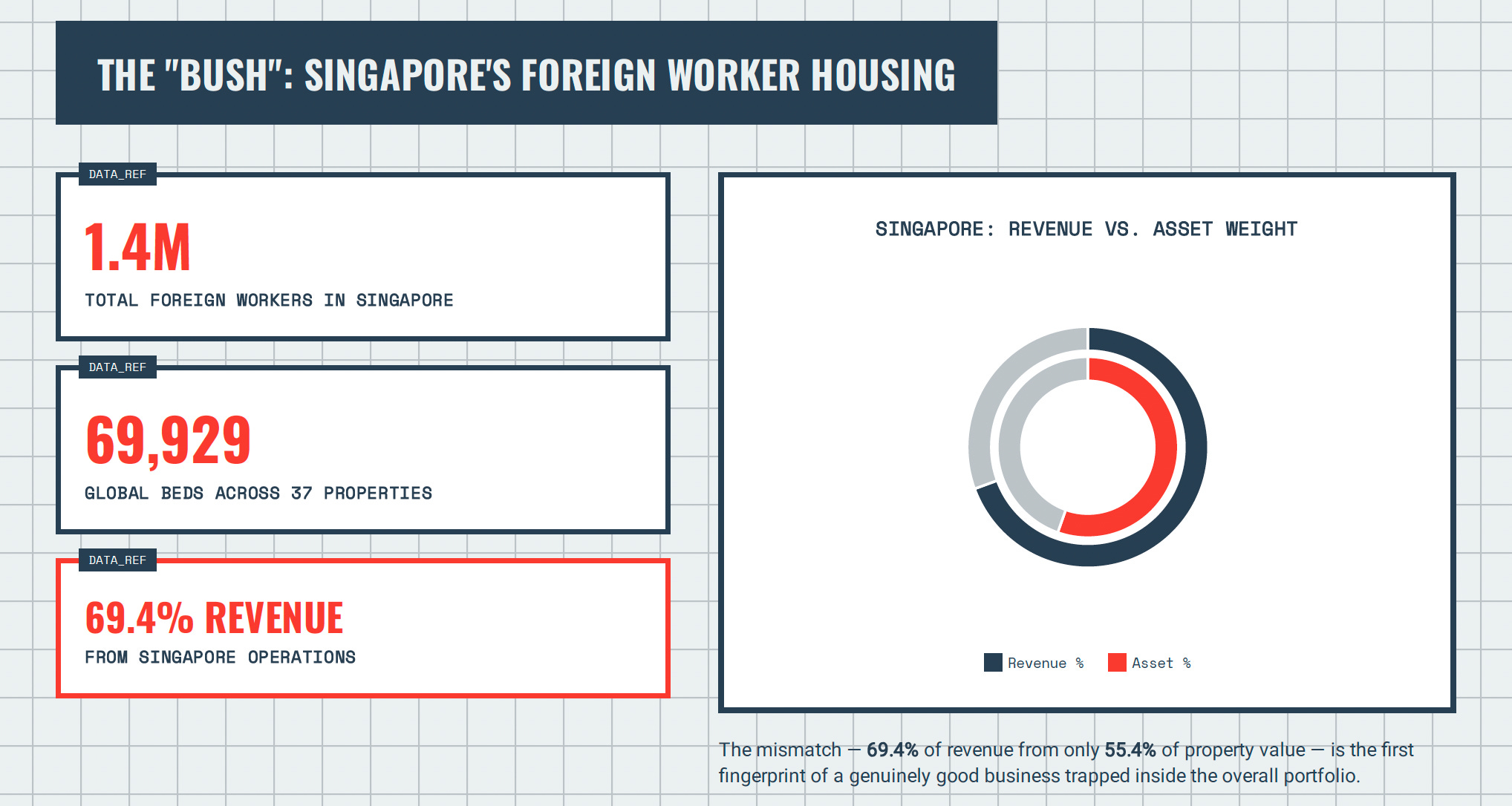
This is the central tension in evaluating Centurion. You are not buying the Singapore worker dormitory business. You are buying Centurion — which includes the Singapore worker dormitory business plus a student accommodation business operating in the UK, Australia, the US, and China, plus a Malaysian worker dormitory business, plus early-stage developments in Xiamen. The question is not whether Singapore is good. The question is whether the entire enterprise, taken together, can sustain and grow the returns the Singapore business alone would suggest.
The student accommodation segment — operating under the “dwell” brand — is a fundamentally different animal than the Singapore dormitory business. In Australia, visa pressures continue to dampen interest from international students, even as enrollment rates remain healthy and occupancy rose to 96%. The student accommodation customer is a 20-year-old making a one-year housing decision based on price, social atmosphere, and proximity to campus. The CAC is higher — Centurion competes with private landlords, university halls, and shared housing. Customer lifetime value is short (typically one to two academic years). Switching costs are low. The moat is thinner.
There is also a telling data point hidden in the related party transactions. Centurion extended a shareholder loan of S$8 million to Lachlan Avenue Development Pty Ltd — an Australian entity — at an interest rate of 15% per annum. When a company loans money to one of its own subsidiaries at 15% annually, it is almost always because that entity cannot attract conventional bank financing at competitive rates — meaning the external market has assessed that particular project or geography as carrying meaningfully more risk than the headline suggests. A 15% internal loan rate is the financial equivalent of a quiet admission.
On ownership structure: the controlling directors — Loh Kim Kang David, Han Seng Juan, and their related entities — hold approximately 70-80% of the company, with only 26.32% of shares freely held by the public. High insider ownership is often a positive signal — management has enormous skin in the game. But with a float that thin, liquidity is constrained, price discovery is imperfect, and minority shareholders have limited practical recourse if management’s capital allocation priorities and theirs ever diverge.
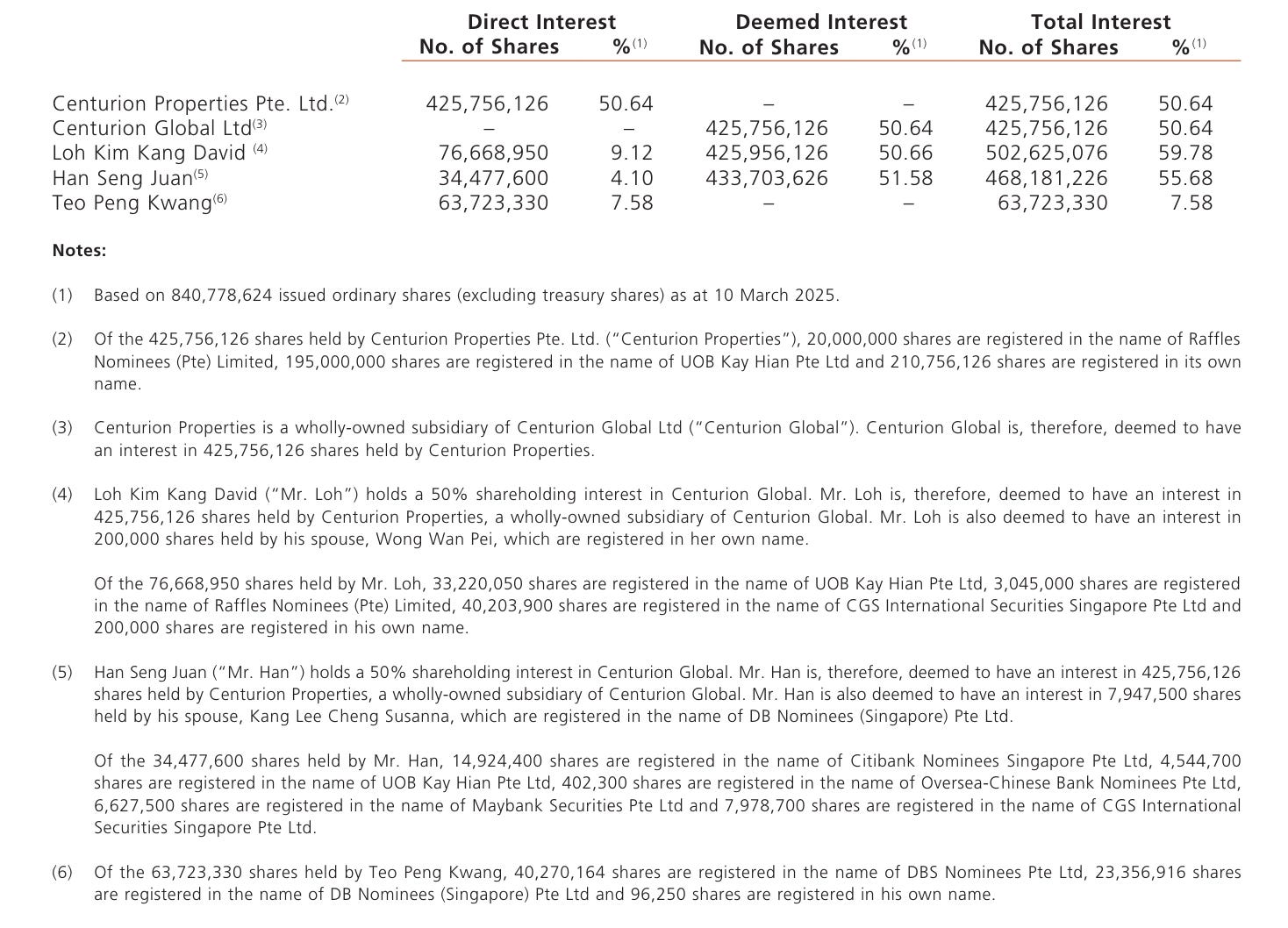
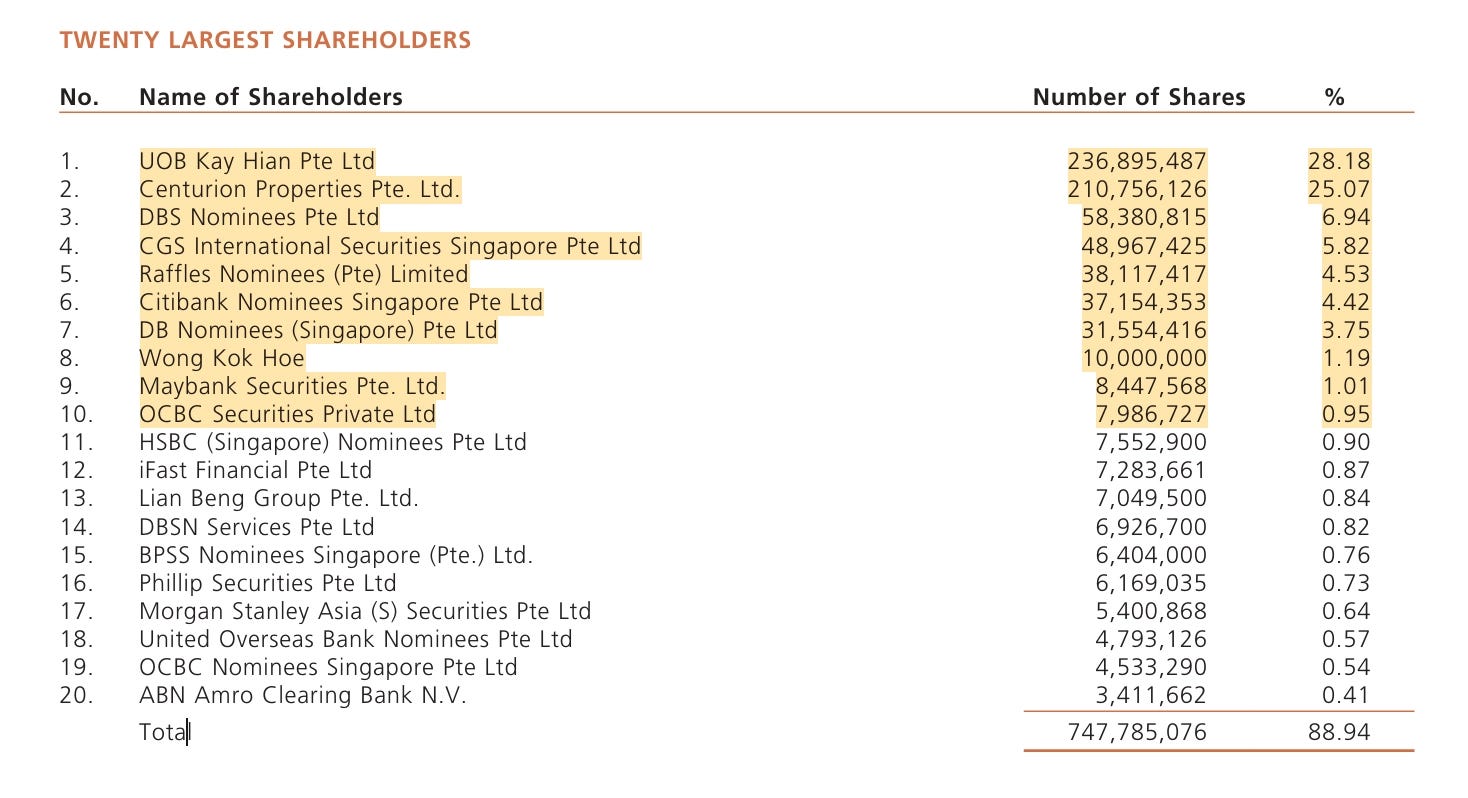
The confidence question ultimately resolves like this: I am highly confident in the Singapore worker dormitory business. I am moderately skeptical about whether Centurion can replicate those economics anywhere else. The data, so far, suggests it has not been able to. The gap between Singapore’s revenue yield and every other geography’s revenue yield is wide, persistent, and visible in multiple years of financial data. There is a well-worn pattern in business history of a company that is genuinely dominant in its home market — protected by regulatory moats, cultural familiarity, and years of relationship-building — discovering, expensively, that those same advantages do not travel easily across borders.
Part Three: How Long Until You Get Them Out?

The Catalyst Problem — and the Time Tax
Even granting a degree of confidence in the Singapore business, the third question introduces a different kind of friction: when and how does the value you believe exists actually crystallize into something a shareholder can hold?
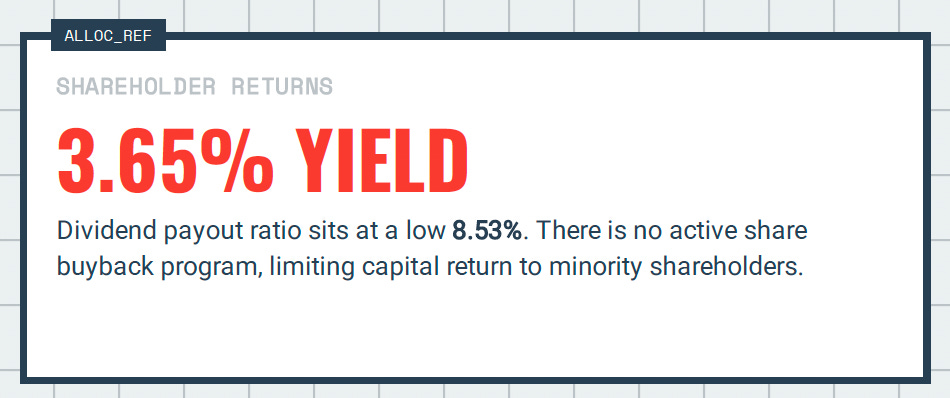
Centurion has no buyback program. Shares outstanding have been essentially flat at 840.78 million for at least five consecutive years, which is reassuring — there is no dilution quietly eroding your ownership stake. But equally, no capital is being actively returned to shareholders. The dividend yield sits at approximately 3.65% with a payout ratio of only 8.53%, meaning the overwhelming majority of earnings are being retained inside the business. That retention would be entirely justified — even desirable — if the capital being reinvested were compounding at high rates. Buffett’s great insight, after all, is that a business earning 20% returns on equity should never pay a dividend; every retained dollar becomes $1.20 the following year. But Centurion’s CRR of 9.3% tells us the reinvestment rate is not 20%. At 9.3%, retaining earnings is only marginally better than returning them — and a patient shareholder has to sit for a long time to see the compounding benefit.
The potential value unlock frequently discussed by management and analysts is a REIT listing — spinning off Centurion’s dormitory property assets into a Singapore-listed REIT structure, which would allow the market to reprice those assets at the lower cap rates typically applied to Singapore REITs, potentially unlocking significant value. It is a credible idea. Singapore has a deep and liquid REIT market, and Centurion’s Singapore assets — stable, government-mandated, inflation-linked — would be attractive REIT assets. But the REIT listing idea has circulated for years without materializing. Investing on the hope of a future corporate action that management controls and has not yet executed is not the same as investing in a business whose value compounds by its own natural operation. It is a reasonable catalyst, but it remains speculative until the announcement is made.
There is also a macro timing risk that deserves respect. The current boom in Singapore dormitory rents is real and data-supported — bed rents have surged 81.5% since the pre-pandemic trough, and near-full occupancy continues across all zones in H1 2025. Mega infrastructure projects — Tuas Port, Changi Airport Terminal 5, Marina Bay Sands expansion, Resorts World Sentosa 2.0 — are expected to sustain demand for foreign construction labour. But construction pipelines are finite. The government is simultaneously adding new supply: five new purpose-built dormitories are expected to come online in coming years, adding approximately 35,000 beds. And the New Dormitory Standards upgrades, while currently suppressing supply and supporting rents, will eventually resolve — meaning the supply-demand tension that has powered rent growth since 2022 will normalize over the medium term. The tailwind is strong today. It is not permanent.
The Inverse: In What World Does This Fail?
The best analysis is not just optimistic scenario-building. It is actively looking for the scenario where the investment fails — the bear case not as a formality, but as a genuine test of conviction.
The central failure scenario for Centurion is straightforward: the business continues to be unable to replicate its Singapore economics outside Singapore, while simultaneously deploying capital at below-average rates into the international expansion. The international operations are not destroying value today. But they are not creating it at the rate the Singapore business does, and each dollar allocated to a student dormitory in Adelaide or a worker facility in Johor Bahru is a dollar not deployed into the regulated, near-monopolistic Singapore market.
The second failure scenario is accounting-driven: if Singapore property values flatten or decline — not an implausible scenario in a global interest rate cycle turn — the fair value gains that have inflated reported earnings in 2023 and 2024 reverse. Reported profits fall sharply. The stock reprices. Investors who bought on a 4.1x P/E discover they were actually paying 8-10x for the operating business, at a time when the narrative has shifted negative.
The third failure scenario is more subtle: the REIT listing never happens, the dividend remains thin, and investors are left holding a business that earns 9.3% on its capital, grows slowly, and returns little. That is not a disaster — Centurion would still be earning decent money in a strong market. But it is the slow decay of an investment that never had a defined exit, held too long against better opportunities elsewhere.
The Verdict: A Good Business, Not the Investment I’m Looking For
Aesop’s three questions, applied honestly:
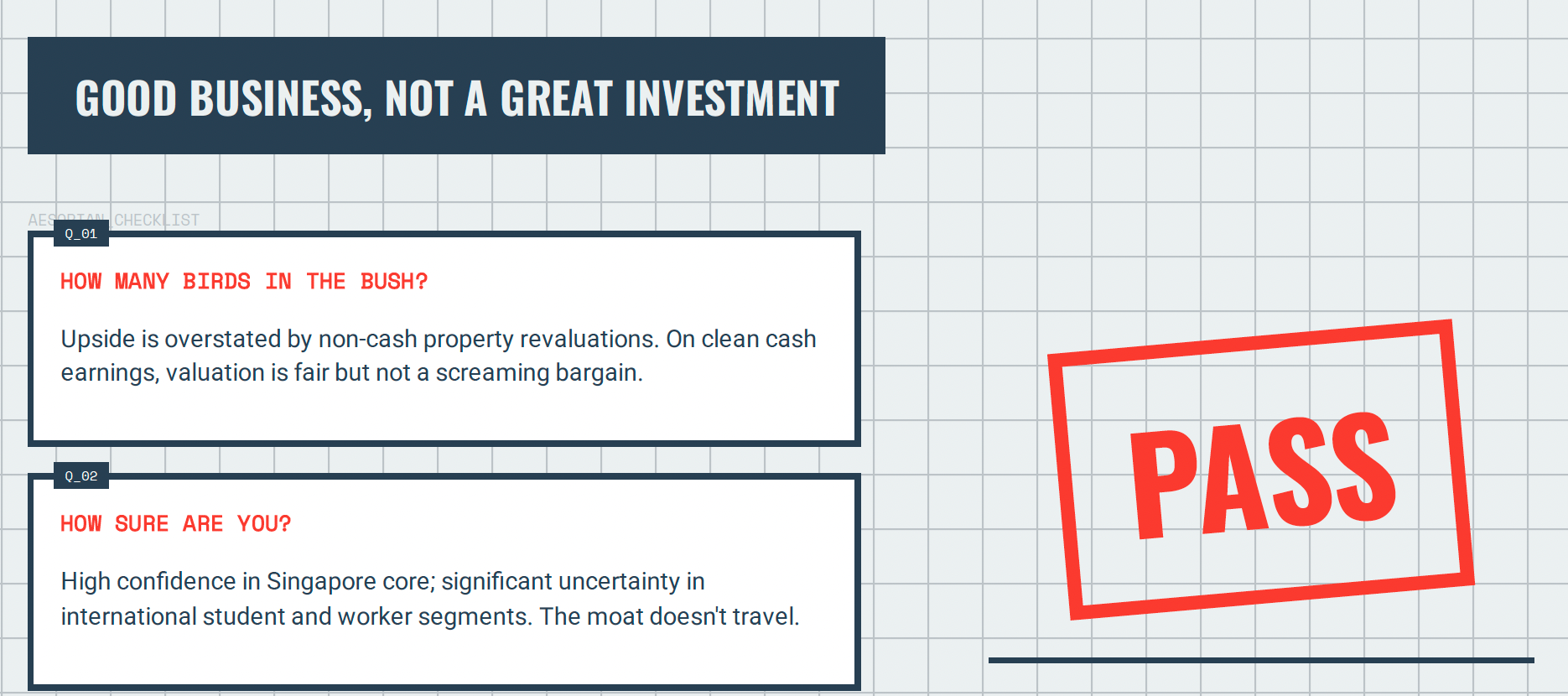
How many birds are in the bush? The headline numbers are overstated by non-cash property revaluations that have nothing to do with operating the dormitory business. On clean operational earnings, the stock is fairly priced — not a bargain. The CRR of 9.3% tells us the business grows from reinvestment at a moderate, not exceptional, rate. The birds are there, but fewer than the initial count suggested.
How sure are you? High confidence in the Singapore business. Much lower confidence in the international operations, where the data persistently shows below-Singapore performance. The scalability of Centurion’s competitive advantages beyond its home market is the key unanswered question, and the current evidence does not answer it favorably.
How long until you get them out? No clear catalyst. No buyback. A thin dividend on a 9.3% CRR reinvestment base. A REIT listing that remains theoretical. The natural compounding rate of the business, operating internationally, is not fast enough to justify the wait when better-compounding alternatives exist elsewhere in the market.
Any one of these failing would be enough to pass. All three are imperfect here.
This is not a condemnation of Centurion. The Singapore dormitory business is a genuinely attractive one — regulatory-moated, inflation-protected, demand-inelastic, and operating in a city-state that is structurally unable to build its infrastructure without a large migrant workforce. If this were a pure-play Singapore dormitory company, the conversation would be meaningfully different.
But investing is not about finding good businesses. It is about finding good investments. The two are not the same thing. A wonderful business wrapped inside a collection of mediocre ones, without a clear catalyst for value realization, at a valuation that only looks cheap before you strip the accounting gains, is not what I am looking for. There are better compounders and better deep value situations in the market today. I am giving Centurion a miss.
The bird in hand is always worth two in the bush. The catch is knowing exactly what’s in there, how sure you are, and whether you can actually get them out.
This analysis is based on Centurion Corporation’s FY2024 annual report and financial disclosures, the Knight Frank / Dormitory Association of Singapore (DASL) H2 2024 and H1 2025 Worker Dormitories in Singapore reports, Ministry of Manpower (MOM) published data, and The Edge Singapore. It does not constitute financial advice. All figures in Singapore dollars unless otherwise stated.