
Two companies receive $1.2 million from customers today. One has already delivered everything it sold. The other has promised to serve those customers for the next twelve months. The bank balance changes by the same amount. The investment conclusion should not.
The second business may be well run. Annual prepayment can reduce collection risk and give a company cash before it pays the costs of delivery. But the cash arrives with an obligation attached. If an investor treats the whole receipt as proof of stronger current earnings, or as cash that can safely be distributed, the analysis has skipped the work the business still owes.
The useful question is not simply, “How much cash came in?” It is, “How much of that cash is already earned, and what must still be spent to deliver what customers bought?”
A fictional subscription model
Consider a fictional learning service. At the start of the year, 10,000 customers each pay $120 for twelve months of access. Service is provided evenly, revenue is recognized as delivered, and direct delivery cost is $72 per customer for the year, also incurred evenly. Ignore taxes, marketing, support overhead, refunds, financing, and capital expenditure for now.
The simple arithmetic:
• Cash collected upfront: 10,000 × $120 = $1.2 million.
• Annual direct service cost: 10,000 × $72 = $720,000.
• Gross profit for a completed year before other costs: $1.2 million − $720,000 = $480,000.
When customers pay, no twelve-month service has yet been delivered. Under IFRS 15, paragraphs 105–106, consideration paid or unconditionally due before the promised service is transferred is presented as a contract liability. Depending on the contract, the obligation is to transfer service later or refund consideration. In this fictional example, the opening liability is $1.2 million. It is not a bank loan, and successful performance does not mean the full amount must be refunded. The business still consumes labor, hosting, content, or other resources to serve customers.
After three months, the model has delivered one quarter of the year. The graphic below shows cash, revenue earned, the remaining service obligation, and direct delivery cost.
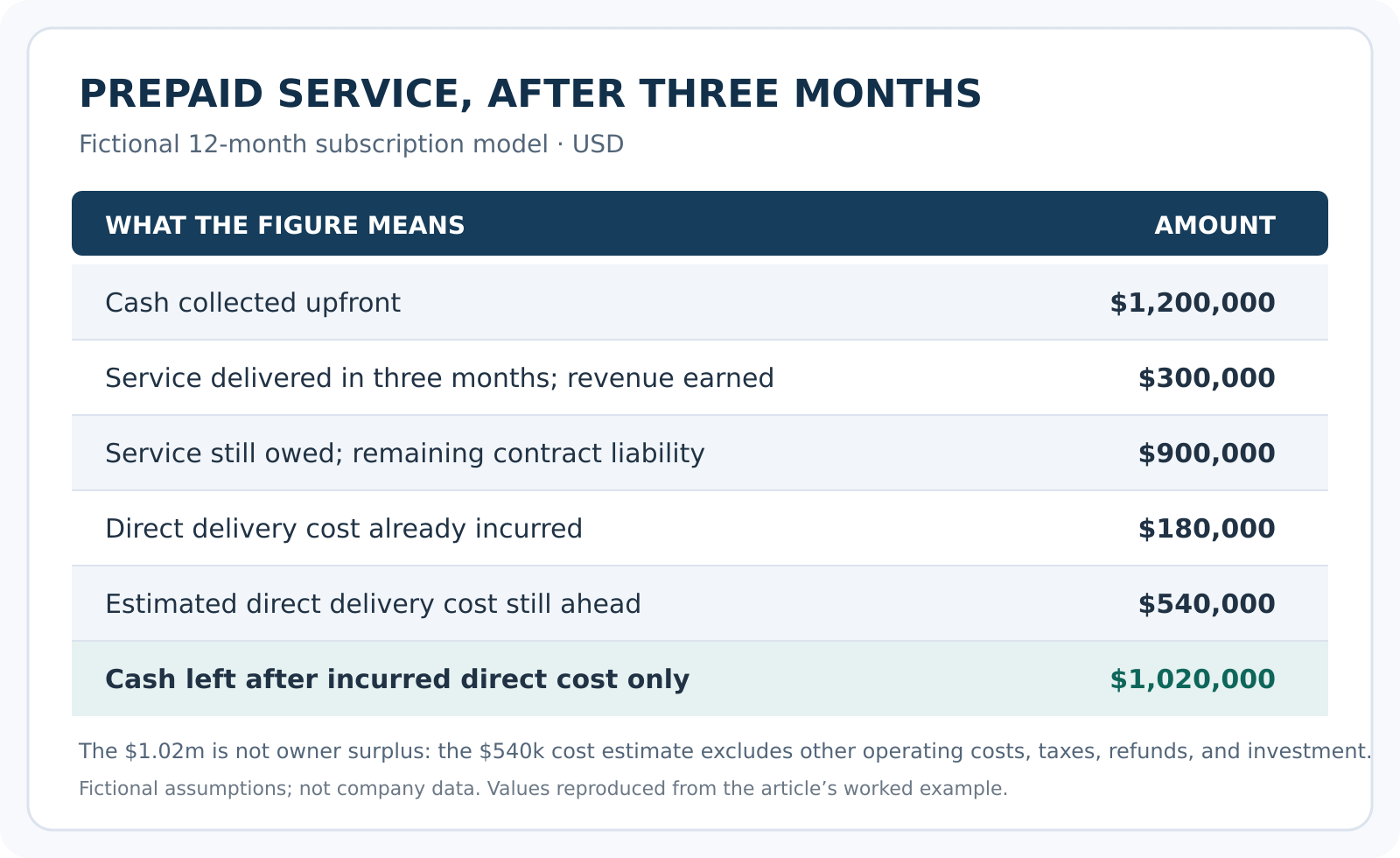
It is also wrong to subtract the entire $900,000 contract liability from cash as if it were debt due tomorrow. The liability measures unearned consideration; the cost to fulfill the remaining service is a separate estimate. Both matter, and they answer different questions.
Cash received is a fact, revenue earned is an accounting measure, and the cost and risk of future delivery require an economic estimate. Do not collapse them into one number.
Why the cash-flow statement can look unusually strong
When customers pay before service is provided, cash receipts can exceed revenue recognized in the same period. In a simplified cash-flow bridge, an increase in contract liabilities can therefore support operating cash flow. That can be a genuine advantage: customers finance part of the operating cycle rather than waiting to pay after delivery.
But the timing of a receipt can make one period look stronger than the rate at which the company earns revenue. A growing contract-liability balance may reflect new sign-ups, annual renewals, a shift from monthly to annual billing, or seasonal timing. Those explanations have different implications, and the balance alone cannot tell you which occurred.
The accounting liability and the cash-flow adjustment are not interchangeable. Receivables, taxes collected for others, refunds, acquisitions, currency movements, and other changes may affect the reconciliation. The difference between two balance-sheet balances is not automatically the cash-flow-statement movement. Read the company’s reconciliation and stated definitions rather than forcing a one-line bridge.
The ticket analogy, and where it stops
Imagine a concert venue that sells a ticket months before the show. The venue has the cash, but it still owes the performance. If it spends the ticket money and cannot pay the crew or secure the venue, the early sale has not solved the operating problem.
An annual subscription resembles that ticket because money arrives before the promised experience is complete. The analogy helps distinguish receipt from performance. It stops fitting in an important way: a concert is usually a dated event, while a subscription can require repeated service, support, and ongoing capacity. The subscription may also be delivered successfully without refunding the original payment. The face amount of deferred revenue is therefore not the same as a cash repayment obligation or the cost of fulfillment.
When prepayment is a real strength
Do not turn this lesson into a rule that deferred revenue is bad. A customer who pays annually may be less likely to miss a monthly bill. The company may avoid collection work, reduce credit losses, and receive working capital before it incurs some costs. If customers renew, the service is inexpensive to maintain, and the company can keep its promises without heavy new investment, prepayment can improve the economics of the business.
The investor still needs to separate a durable benefit from a timing effect. Suppose the first year has 10,000 subscribers. In the next year, only 6,000 renew and no new customers replace the others. At the same $120 price, renewal cash falls to $720,000, 40% below the first-year receipt. Direct delivery cost for those 6,000 customers is $432,000 at the model’s $72 assumption. This does not prove the business is failing: it could add new customers, change prices, or reduce costs. It shows that the first year’s $1.2 million receipt is not a perpetual annual cash stream by itself.
If 4,000 new customers replace the non-renewers, billings could return to $1.2 million. But the investor should ask what it cost to acquire those new customers. Stable cash receipts can conceal a shift from low-cost renewals to expensive replacement sales. Read renewal percentage alongside acquisition spending, cohort retention, service usage, and the margin earned on each cohort.
The strongest alternative explanation
A rising contract liability can be good news. It may indicate customers value the service, accept annual billing, and commit cash before delivery. It may also be a calendar effect: comparing a quarter just after annual renewal season with one before renewal season can create a misleading trend.
To distinguish these explanations, compare like periods and inspect the components. Look for new-customer billings versus renewals, monthly versus annual plans, churn, refunds, usage, and any disclosed contract-liability roll-forward. Ask whether cash came from more customers, a larger prepayment per customer, or a different billing date. Then compare that evidence with recognized revenue and the costs of serving customers already contracted.
The interpretation would weaken if customers routinely renew, delivery costs are low and stable, cancellations are rare, and prices can rise without harming retention. It would become more concerning if renewals fell, fulfillment costs rose, refunds increased, or growth depended on discounts that make new cohorts less profitable. The same receipt can sit inside very different businesses.
A practical filing check
When operating cash flow rises while contract liabilities grow, use this sequence:
1. Find the revenue policy and contract-liability note. Identify when revenue is recognized, how much of the balance is expected to be recognized within the next year if disclosed, and what performance obligations remain. Do not assume every advance is earned on the same schedule.
2. Reconcile the timing. Compare beginning and ending balances with disclosed additions, revenue recognized from prior advances, refunds, and other adjustments. Read the cash-flow reconciliation separately; a balance-sheet change does not automatically equal cash received.
3. Estimate remaining delivery work. Use disclosed margins, service costs, staffing or capacity commitments, and refund terms. If disclosure is insufficient, preserve the uncertainty instead of assigning false precision to cash available.
4. Test repeatability by cohort. Review renewals, churn, acquisition costs, plan mix, and usage. Ask whether next year’s cash depends on retaining customers, replacing them, or increasing prepayments.
5. Run a no-new-sales case. If sign-ups stopped today, how much cash would remain after serving existing customers and paying unavoidable costs? This is a stress test, not a forecast; it reveals how much current cash supports future promises.
The decision improved by this check is narrow but important: it prevents the investor from treating customer financing as already-earned owner earnings. A company can have excellent economics and benefit from advance payment. It can also show a temporary cash-flow surge while future delivery obligations grow. The contract-liability balance, renewal evidence, and cost to fulfill tell you which interpretation deserves more weight.
The takeaway
Cash received before the work is done can finance operations, but it is not proof of earned profit or owner surplus. When cash arrives before the work, count the cash, but count the work too. Ask: if sales stopped growing tomorrow, what portion of this period’s customer cash would still be needed to serve customers who have already paid?
The company, customer counts, prices, costs, and calculations are fictional teaching assumptions. No company data or investment recommendation is presented.