
The $90B Silicon Valley Left Behind
Fewer than a handful of photographs of Mark Leonard exist. For over three decades in Constellation Software, Mark has done almost no interviews. His “legend” untold: a $25 million stake grew into roughly $90 billion, generating more than 30% in compounded returns annually. The most interesting part of Mark’s success isn’t the return itself, but rather, refusing the behavior he’d spent a decade learning — as they say “what got you here, won’t get you there”.
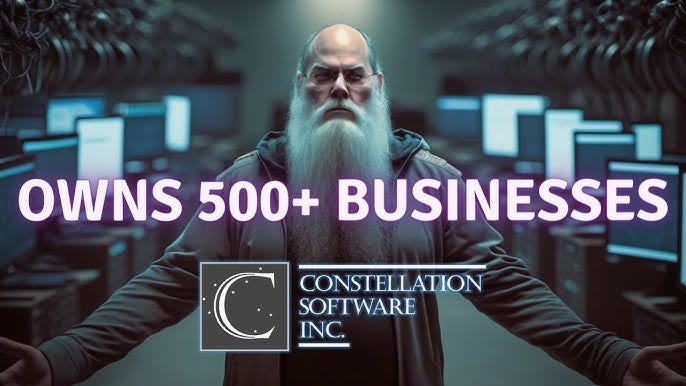
Mark Leonard is also known as the most low-key, reclusive billionaire who also looks like Gandalf from Lord of the Rings
Before Constellation, Mark worked in a Canadian venture capital firm called Ventures West. In that (venture) world, nine out of ten bets go to zero, meaning the tenth bet has to return the entire fund. The economics of such investments has resulted in investment professionals (in venture capita) being trained to walk past good, steady businesses — companies capable of growing 20% a year forever. In other words, steady growth doesn’t produce the massive payouts VCs require. This was the key insight that Mark took with him when he left Ventures West. But building Constellation wasn’t easy, the devil was in the details.
Building The Beast
Mark left Ventures West in 1995 with $25 million to do exactly the opposite of what he’s been doing for 11 years. He started buying hundreds of small but specialized mission-critical software businesses. His unbreakable rule: every acquisition had to clear a strict internal rate of return (IRR). Think of IRR as the annualized yield a deal must hit e.g. the yearly return on a rental property, discounted annually based on inflation (but we shall not go into that). The requirements for small deals had a VERY STRICT minimum target of 30% in IRR. This was loosened up to 20% as competition thickened.
However, because Mark was initially the only one doing the due dilligence, he faced a hurdle. How do you buy a thousand companies like this? The solution was to give the IRR rule away. Mark created decentralized Operating Groups to source, price, and close deals (of up to $20 million) on their own. A bad call would costs only one deal, and not the company. Although this allowed him to solve the speed problem, it unleashed a terrifying financial question: how do you fund a thousand acquisitions without taking on the kind of debt that destroys small businesses?
i.e. The Wall-Street LBO sagas that crashed the market in 1989, all the way into 1990
Financing The Growth
Wall Street’s standard play is the leveraged buyout (LBO): whereby all the acquirer have to do is to put a tiny portion of cash down, and borrow the rest to purchase a business. The borrowed money would then be written as massive debts onto the acquired company. Although this allowed Private Equity and the look alikes to inflate their returns, it is a reckless move for a niche business (the ones that Constellation has to deal with).
A massive corporation has thousands of customers to help absorb the hit if the economy dips. But, a software company serving significant lesser customers, would have its huge chunk of cash flow affected i.e. a niche business that has only 100 clients would have cash flow significantly affected if 10 clients cancel. If that cash is utilized to pay off debt, the company defaults and goes bankrupt.
When a founder has already built a lean niche, perfectly optimized business, cutting costs further would destroy it. Mark Leonard realized that the value wasn’t in squeezing these steady companies dry, but in letting them run autonomously while reinvesting their consistent cash flows into new acquisitions.
However, post acquisition, Mark soon realize that there was another issue that was pretty problematic — without corporate headquarters micromanaging operations, ground managers would eventually make decisions that prioritized quick but destructive “wins”. Mark’s radical answer eliminated this.
Everyone Is An “Owner”
“Show me the incentive, and I will show you the outcome.” — Charlie Munger
The solution wasn’t stock options. Constellation’s stock-based compensation was zero. Instead, a the Operating Group’s bonus are heavily reliant on the unit’s return on capital against that strict (20-30%) IRR hurdle rate. Overpay for a deal, and that return plummets (taking their bonus down together).
To tie their wealth to the company’s longevity, up to 75% of any bonus over $50,000 must be used to buy Constellation stock on the open market. The company never issues new shares, meaning existing shareholders aren’t diluted. That stock then locks up for four years at minimum (the employee doesn’t get rich until it has compounded for a decade). On the other hand, an investment banker gets paid the day a deal closes. Such an incentive structure aligns the Constellation employee with the company’s goals.
This reflected almost exactly how Garantia Partners did their Anheuser-Busch InBev (AB InBev) deal.
The strategy worked flawlessly for small, cash-funded deals. But eventually, Constellation would run out of small targets and have to buy giant divisions. What happens when you face competitors who can outspend you?
To win corporate carve-outs (divisions a larger company sells whole) against private equity firms willing to load up on debt, Mark finally allowed borrowing. But he didn’t take on standard corporate debt. He used “non-recourse” debt, meaning he ring-fenced it — the bank could only seize the assets of that specific acquired company if the loan defaulted. If the bet went bad, the bank took the loss, and the Constellation group walked away. The rest of the company was untouchable. “We use it as a competitive tool,” he told shareholders in 2020.
The Magic of Never Having to Sell
Looking back, none of these were separate decisions. Refusing to issue stock, ring-fencing debt, killing a dividend without sentiment, and refusing to force founders out—these are mechanisms designed for a single purpose: ensuring Constellation was never forced to sell. That is why Constellation’s returns don’t decay as they scale.
Insights You Might Have Missed
Felix highlights how true wealth compounding happens when you reject traditional venture capital hype in favor of acquiring unglamorous, steady, cash-generative businesses with strict rate-of-return discipline.
That long-term capital efficiency spotlights Mark Leonard’s extraordinary playbook and Constellation Software’s unique acquisition strategy in Edition Take 14 of Random Investing Notes.

Constellation Software is a masterclass in capital allocation, decentralization, and building a culture around long-term ownership. But at ELYRION, we don't invest simply because a business is exceptional. We look for the right combination of business quality, risk/reward, and timing. CSU is a fascinating example of why that distinction matters: even an extraordinary compounder can become a poor investment when expectations and price get ahead of fundamentals. Sometimes the best opportunity is not when the story looks perfect, but when patience creates asymmetric risk/reward.

As a contrarian, I loved this. Everyone wants to find the next 10x company; Leonard built a fortune by repeatedly buying businesses that looked too small and boring to matter. The real contrarian insight was realizing that you don’t need spectacular businesses if you can acquire decent ones at the right price and never have to sell them.
Great insights here, Felix! Folks are still trying to repeat this playbook today - the ring-necked debt and focus on smaller, boring businesses is the core philosophy in the "search fund" space.
Another outstanding breakdown, Felix. Mark Leonard’s anti-Silicon Valley ethos is a masterclass in alignment. What stands out most is how Constellation treats capital allocation as an organization-wide culture rather than a C-suite exercise. Forcing employees to buy stock on the open market with zero share dilution creates true long-term owner alignment, and ring-fencing non-recourse debt proves you can scale aggressively without taking catastrophic downside risk. Brilliant deep dive!