
There’s a peculiar kind of investment that keeps you up at night — not because it’s bad, but because it’s genuinely good. Good enough to admire. Not good enough to buy.
The Hour Glass (SGX: AGS) is that investment.
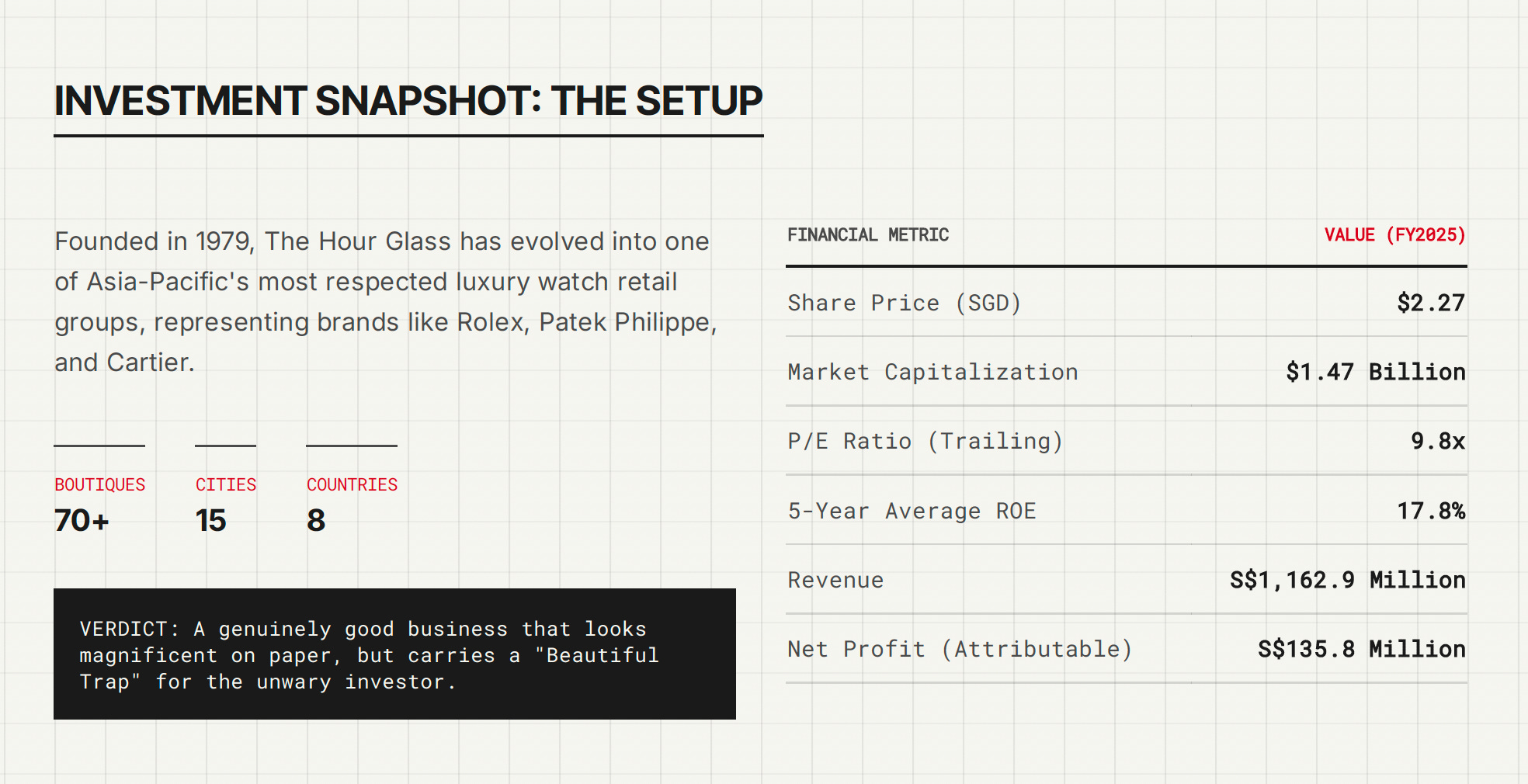
It trades at $2.27 a share. Market cap: $1.47 billion. P/E of 9.8. A 5-year average ROE of 17.8%. On paper, it looks like the kind of boring, profitable, well-run business that value investors dream about in the quiet hours. And in many ways, it is that business.
But here’s the thing about investing — the most dangerous ideas are the ones that are almost right. A perfect business with flawed capital allocation is like a Ferrari with the wrong engine oil. It still looks magnificent in the driveway. It just won’t take you where you want to go.
This is the story of why I passed on The Hour Glass — and more importantly, what it taught me about the nature of luxury, the economics of status, and the three questions that I believe every investor must answer before committing a single dollar.
The Setup: A Business Worth Falling In Love With
Before the verdict, you owe the defendant a fair hearing.
The Hour Glass was founded in 1979 by Dr. Henry Tay Yun Chwan and Dato’ Dr. Jannie Tay — a husband-and-wife team who built from a single Singapore boutique into what is today one of Asia-Pacific’s most respected luxury watch retail groups. Over 70 boutiques. Fifteen cities. Eight countries spanning Singapore, Malaysia, Thailand, Vietnam, Hong Kong, Japan, Australia, and New Zealand. Brands like Rolex, Patek Philippe, Cartier, Hublot, Omega, and Bvlgari adorn their shelves — and more importantly, their relationships.
For the fiscal year ending March 31, 2025, revenue increased 3% year-over-year to S$1,162.9 million, while net profit attributable to owners declined 13% to S$135.8 million, amid inflationary pressures and a consolidating luxury watch market. But in the first half of FY2026, the recovery began: revenue rose 14% to S$615.4 million, and net profit increased 23% to S$75.7 million, reflecting rebounding demand and improved gross margins.
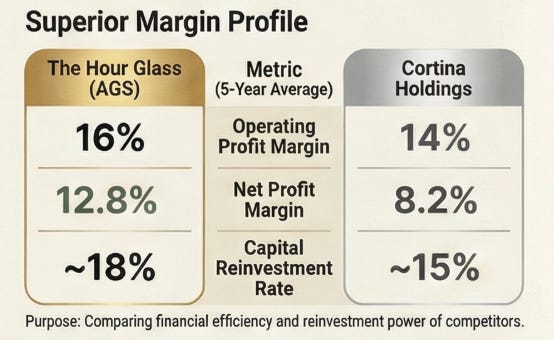
The company beats its largest rival Cortina Watch on almost every margin metric. Five-year average operating profit: 16% for THG vs 14% for Cortina. Net profit margins: 12.8% vs 8.2%. Capital reinvestment rate: ~18% for THG vs ~15% for Cortina. By industry standards, this is a lean, mean, margin-defending machine.
So what’s the problem?
To understand that, we first have to understand what The Hour Glass actually sells. And this is where the story gets truly interesting.
The Deeper Game: What Luxury Actually Sells
Most people think luxury watch retailers sell watches. They don’t. Not really.
Think about it this way. When you walk into a Rolex AD with $20,000 in your pocket, you cannot simply buy a steel Daytona. Even with the money. Even with polite persistence. Most ADs don’t operate on a first-come, first-served basis. Instead, they maintain a soft hierarchy of preferred clients based on spend history, longevity, and perceived loyalty. Some clients wait five years and never get the call. Others are offered a Daytona within six months — not because they’re lucky, but because they’ve already spent $100,000 or more with that dealer.
That is not a watch business. That is a status brokerage.
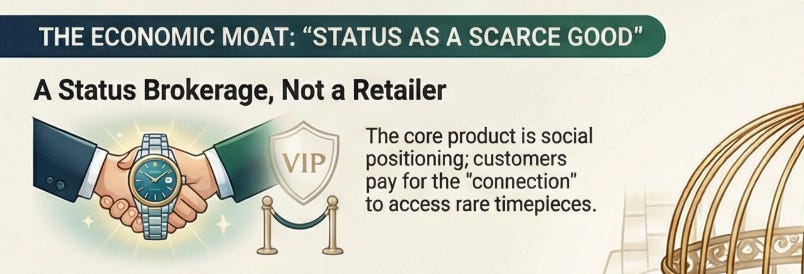
The Hour Glass understood this profoundly. The real product they sell is recognized social positioning. The customer isn’t paying for the gears and springs inside a Patek Philippe Nautilus. They’re paying to be publicly categorized as someone who belongs — someone who has the connections, the history, the credibility to get the call.
And this classification only works because of exclusion. The moment anyone with enough cash can walk in and walk out with the watch, the signal collapses. So luxury retailers do something economically sophisticated: they engineer scarcity that goes beyond supply constraints. They create what I’d call relational scarcity — a system where access is earned through relationship, history, and social proof.
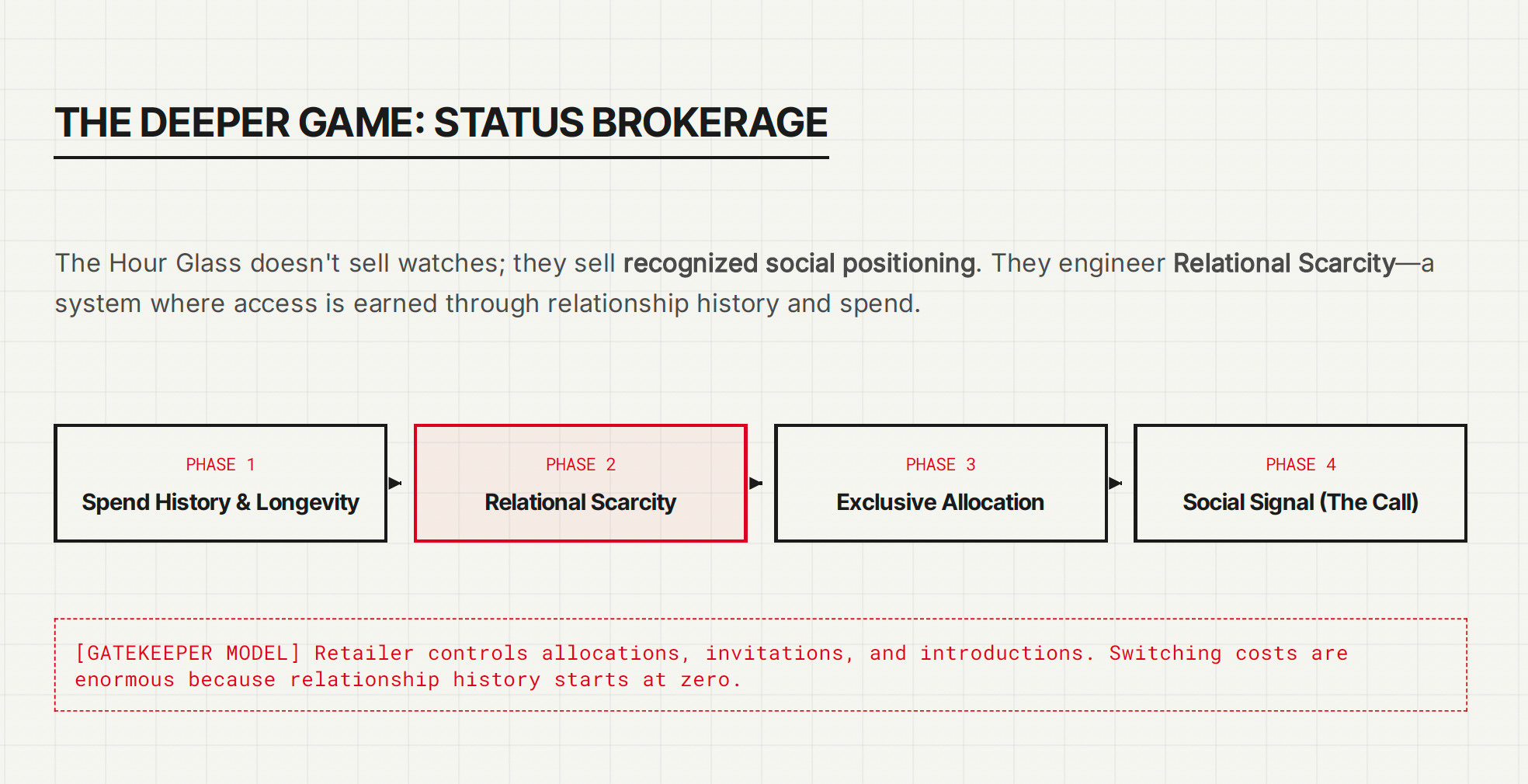
This transforms the retailer from a seller into a gatekeeper. And gatekeepers have enormous economic power. They control allocations, invitations, events, and introductions. Switching to a competitor means starting your relationship history from zero — an enormous cost in a world where your waitlist position at one boutique took years to build.
The Hour Glass has leaned into this brilliantly. In 2004, they pioneered “Tempus — The Great Watchscapade,” a landmark event reshaping contemporary watch collecting culture. They’ve built IAMWATCH, a social platform designed to deepen human connections within artisanal watchmaking. Certain sections of their events are listed as “by invitation only” — the barrier of entry being status or money. A business owner I know personally connected with Thailand’s CP Group through a THG event. That’s not retail. That’s social capital infrastructure.
Singapore is the sixth-largest global market for Swiss watches, importing US$1.84 billion worth in 2024 despite its small population. THG is perfectly positioned at the center of this ecosystem. And the economics of their customer relationships reflect it.
Part One: How Many Birds Are In The Bush?
The first question every investor must answer is the simplest and hardest: what is this business actually worth?
There’s an old parable: a bird in the hand is worth two in the bush. But in investing, the real question is how many birds are actually in that bush — and whether they’ll fly out before you can catch them.
The CAC:LTGP Engine
The Hour Glass runs an unusual economics model. Customer Acquisition Cost (CAC) is genuinely high. To attract the kind of client who will spend $100,000+ over a lifetime, you must maintain prime real estate in Marina Bay Sands and Takashimaya. You must host watchmaker talks, private dinners, and collector events. You must invest in high-touch, knowledgeable staff who build relationships over years, not transactions.
You are not running Facebook ads to the masses. You are hand-crafting relationships, one relationship at a time. That’s expensive by definition.
But the Lifetime Gross Profit (LTGP) is equally formidable. Once a client enters the inner circle, the calculus flips. They want to maintain status — which means continued purchasing. They want access to future allocations of rare pieces. They want continued event invitations. They may want to upgrade or add to their collection over years. A single relationship can produce multiple high-ticket purchases, referrals of similarly wealthy friends (who arrive pre-qualified), and decades of loyalty. So while purchase frequency is low, relationship depth is high. The ratio of LTGP to CAC is genuinely solid — it just doesn’t look like a SaaS company’s metrics because it operates on an entirely different timescale.
What the Numbers Actually Say
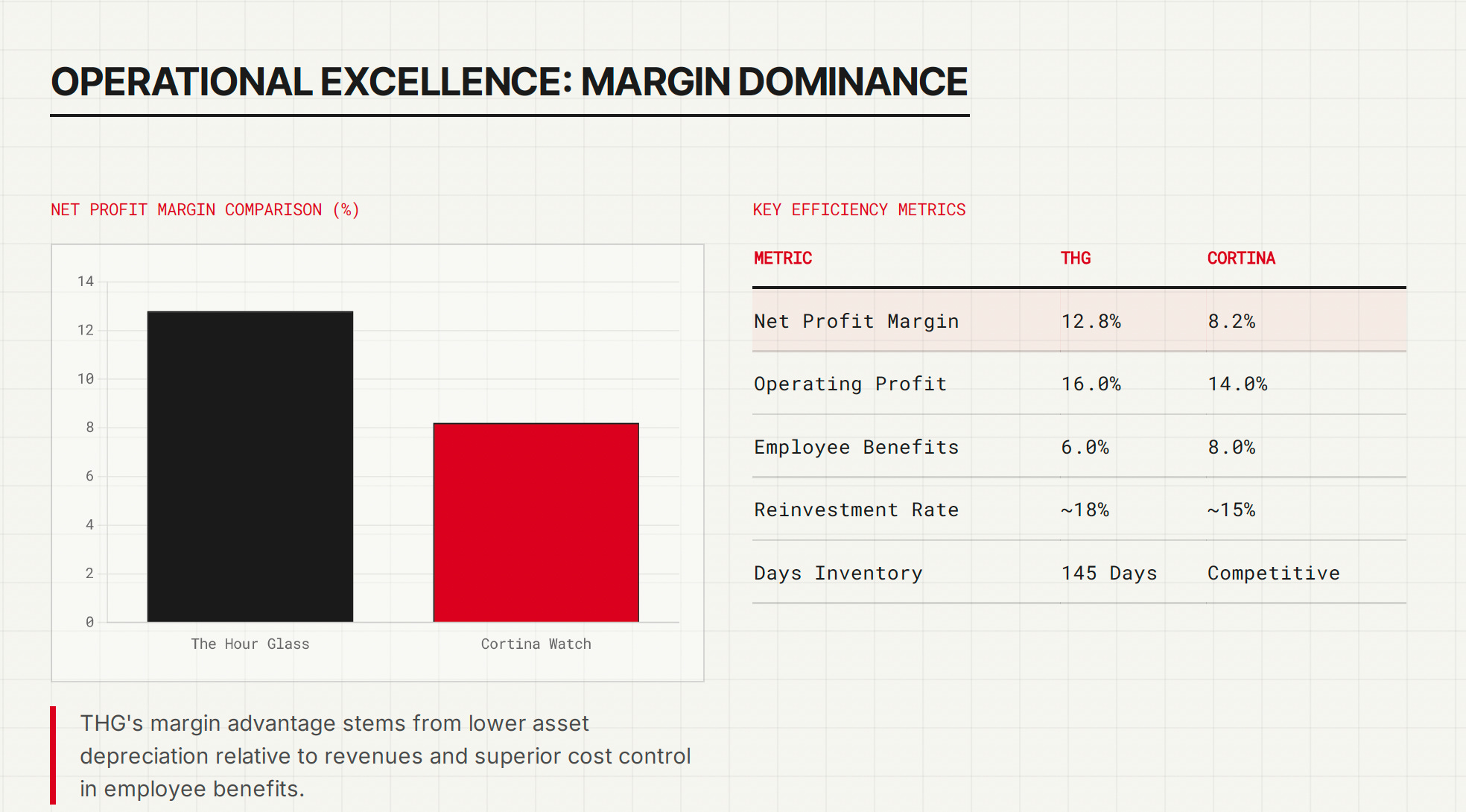
At a P/E of 9.8 and a P/S of 1.2, the market is pricing THG as a modest, slow-growth retailer. That’s arguably fair, but it ignores the balance sheet’s hidden strength. Book value per share of $1.50 against a share price of $2.27 means you’re paying only about 1.5x book for a business generating 17.8% return on equity consistently. The cash conversion rate (CRR) is 27%, which for a luxury watch retailer carrying significant inventory (Days Inventory: 145 days) is respectable.
Compare against Cortina: both carry ~18% debt-to-asset ratios and ~25% debt-to-equity. Both generate similar ROEs. But THG’s net margin is 12.8% versus Cortina’s 8.2% — a gap that, sustained over years, compounds into meaningfully different shareholder outcomes. The source of this margin advantage lies in THG’s lower “percentage of asset depreciation relative to revenues” than Cortina, and employee benefits at about 6% of revenue versus Cortina’s 8%. Over a billion-dollar revenue base, that gap is tens of millions of dollars per year falling straight to the bottom line.
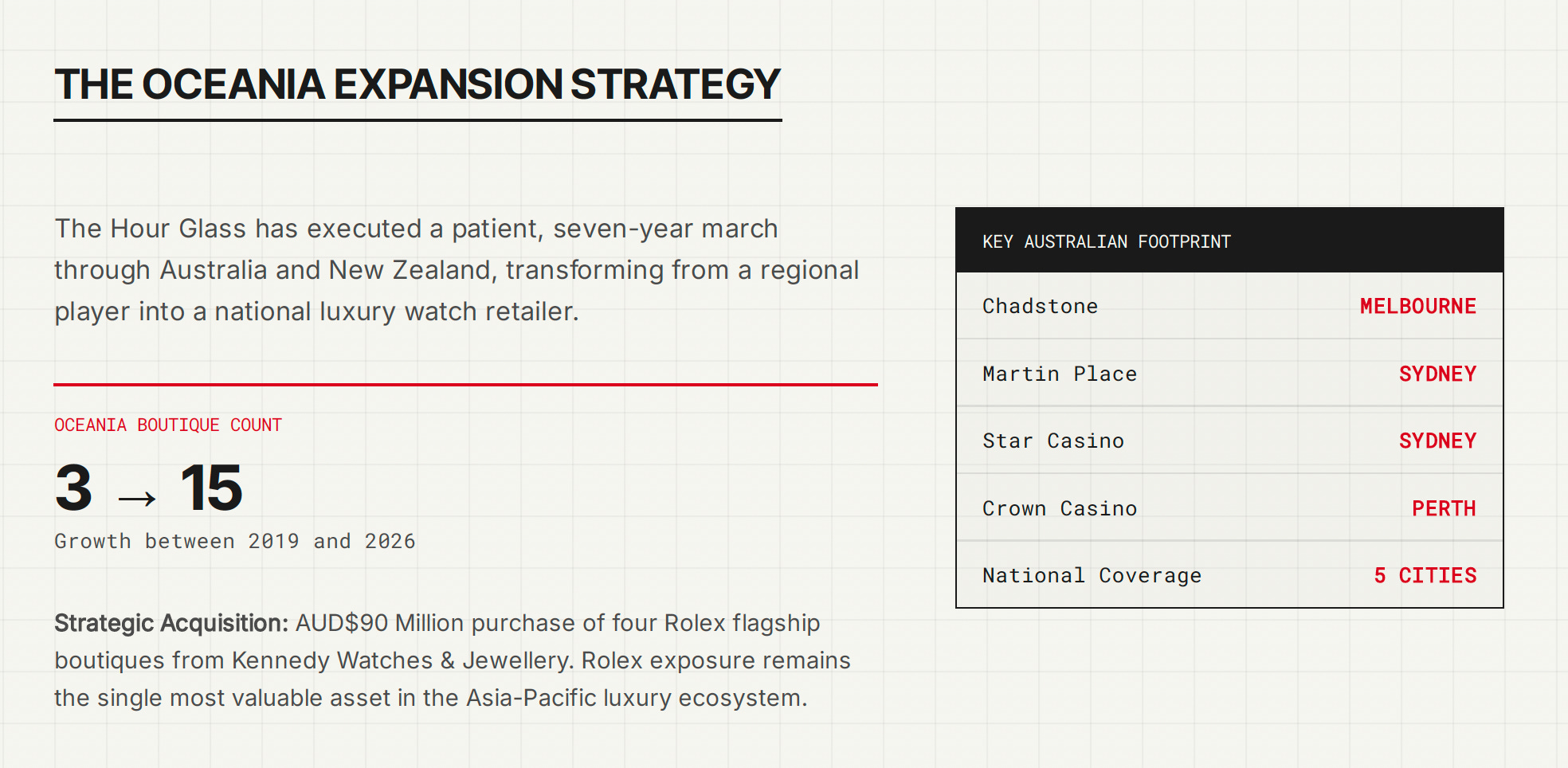
The Oceania expansion tells a story of deliberate, geographic value-building. THG quintupled their Oceania boutique count from 3 to 15 between 2019 and 2026 — a seven-year patient march through Australia and New Zealand. The most recent move was an AUD$90 million acquisition of four Rolex flagship boutiques from Kennedy Watches & Jewellery, including stores at Chadstone in Melbourne, Star Casino and Martin Place in Sydney, and Crown Casino in Perth. With a presence now established in all five main Australian cities, THG can now be considered a national luxury watch retailer.
This matters because Rolex exposure is the single most valuable card a luxury watch retailer can hold in Asia-Pacific. Rolex’s revenue was CHF 10.58 billion in 2024, up from CHF 10.1 billion in 2023, driven by strategic price increases and deliberate supply discipline. Rolex has become the world’s largest watch brand by revenue, commanding roughly 32% of the primary luxury watch market — and its allocation to authorized dealers is the most coveted prize in the industry.
The Structural Ceiling
Here is where the bird count gets complicated.
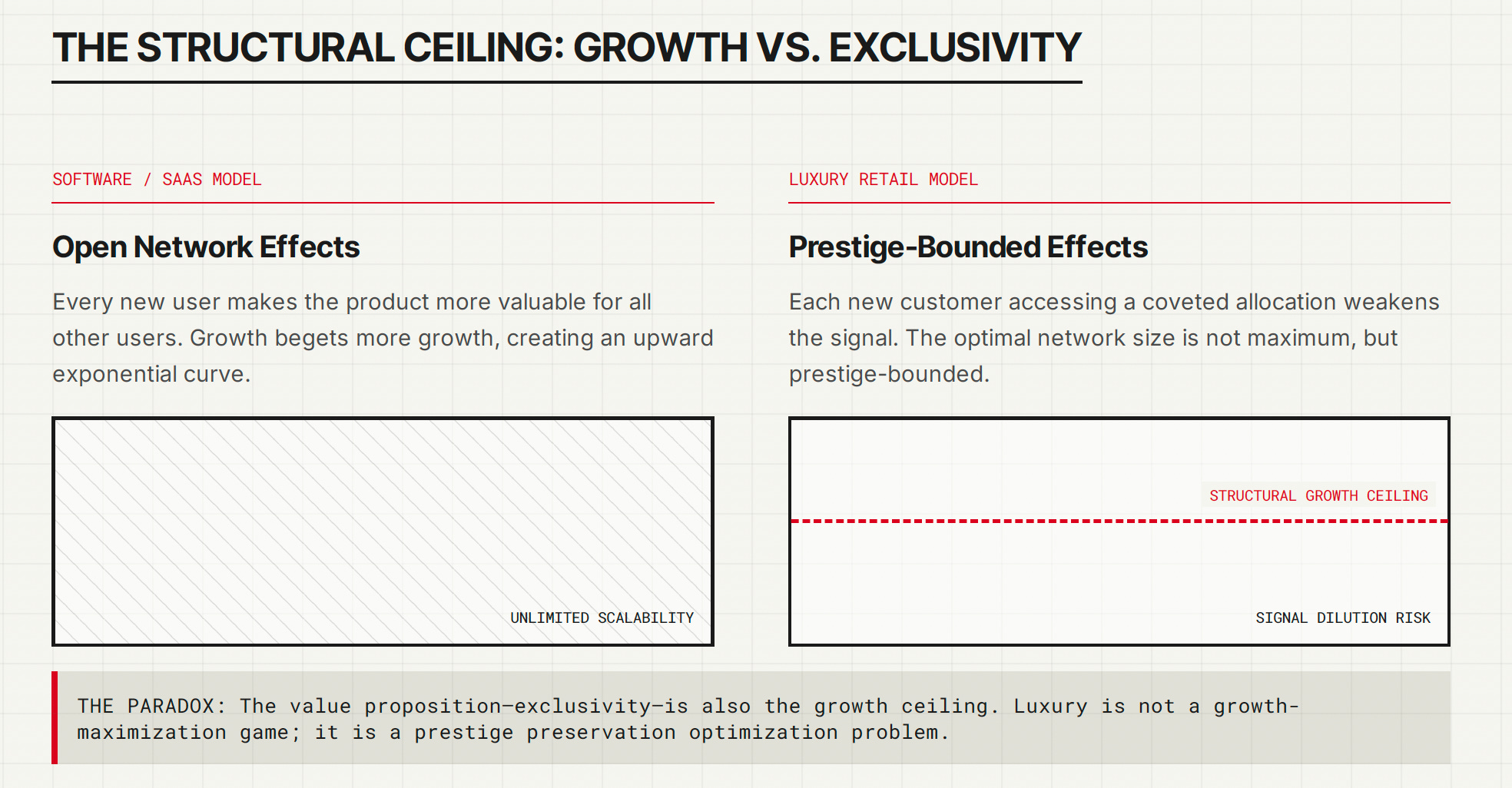
The same economics that make luxury watch retail profitable are the ones that make it structurally incapable of compounding like a great business should. There’s a beautiful paradox at the heart of it: the value proposition — exclusivity — is also the growth ceiling.
Think about it like this. In a software business, every new user makes the product more valuable for all other users. That’s a positive feedback loop — what economists call an “open network effect.” Growth begets more growth, and the curve bends upward exponentially.
Luxury works the opposite way. Each new customer accessing a coveted allocation doesn’t strengthen the signal — it weakens it. If everyone at the club party has the same watch, the watch stops signaling anything. The network effect in luxury is closed and prestige-bounded: the optimal network size is not the maximum possible size, it’s the optimal prestige size. The moment THG grows beyond that boundary, the product they’re really selling — social positioning — begins to depreciate.
This means growth must be intentionally managed, market size is structurally constrained by the number of people who can afford and care about these signals, and purchase frequency is inherently low since watches are not bought monthly and the social signal saturates after a few key pieces. Even with Rolex’s global reach, the waitlist for the most coveted models is cooling — availability for core steel models has widened considerably by end-2025, suggesting that the speculative premium of the 2021-2022 peak is normalizing.
The answer to “how many birds are in the bush” is: a decent flock. Solid, predictable, generating real cash. But the flock isn’t growing fast enough to justify the chase at this point in the cycle, particularly given what we discover when we examine the capital allocation decisions of the people in charge.
Part Two: How Sure Are You?
The second question is about conviction. Even a great idea, held without conviction, will be abandoned at exactly the wrong moment.
The Hour Glass is, at its foundation, a family business built on relationship capital. Dr. Henry Tay, now in his later years, is the Executive Chairman. His son Michael Tay Wee Jin serves as Group Managing Director. During November 2025, there were significant insider share purchases by both Dr. Henry and Michael — and notably, both transactions were of nearly identical size, suggesting one may be transferring shares to the other as part of succession planning. This is not nefarious; it is simply the natural rhythm of a family enterprise preparing for generational transition.
What does matter is what this tells you about the culture of capital allocation.
The Property Problem
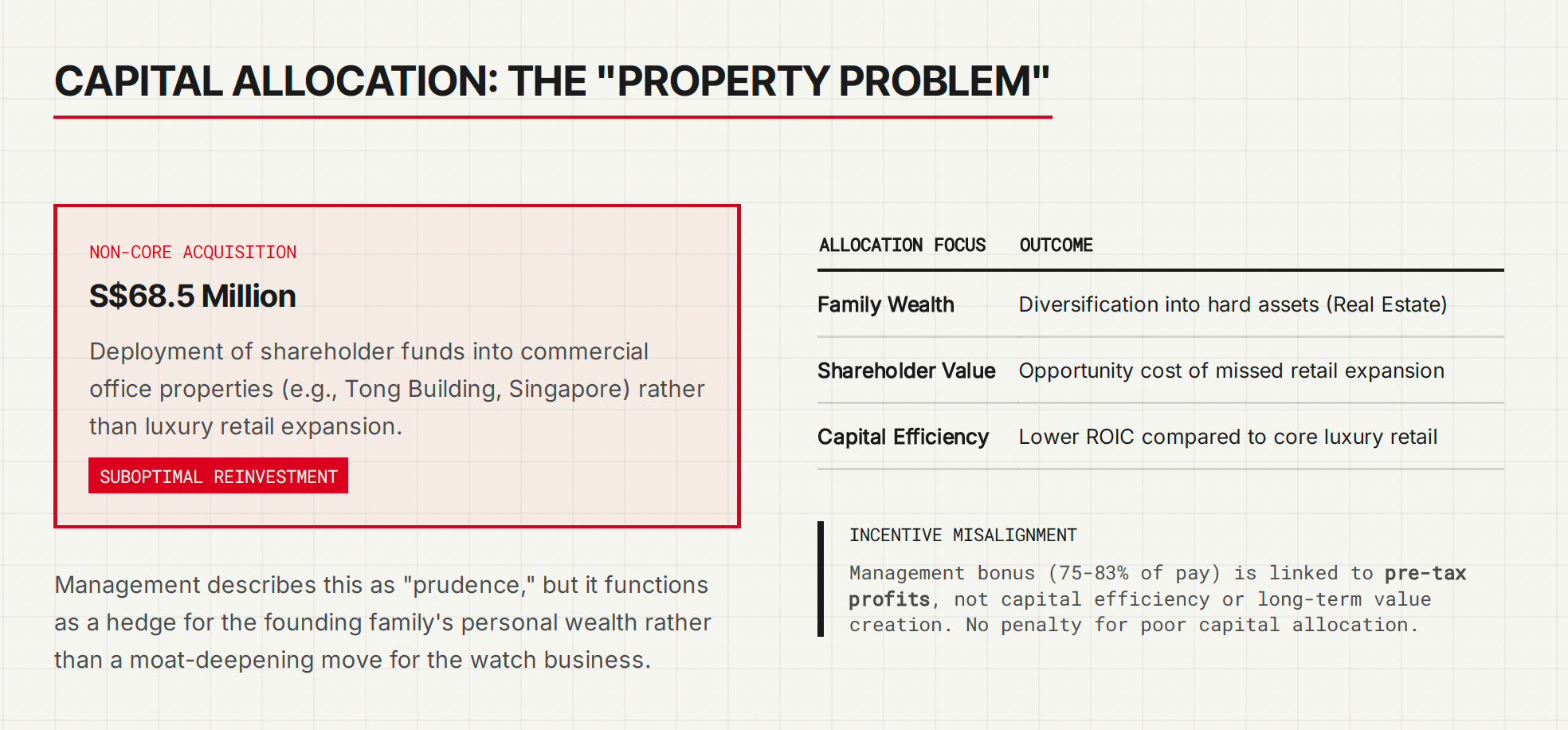
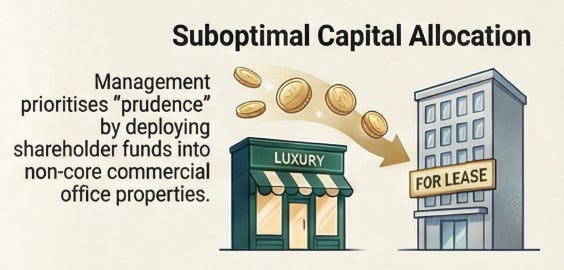
Here is the most concrete exhibit of that culture: THG has been acquiring commercial office properties in prime Singapore and Hong Kong locations, describing it in their annual report as “deploying resources towards secure assets where our equity heavy financing for these properties reflects our prudence.”
Let’s be precise about what that sentence is doing. It is taking a capital allocation decision that deploys shareholder funds into non-core real estate and describing it as prudence. But prudence for whom? The building on Tong Building in Singapore (acquired for S$68.5 million in September 2024) does not make THG’s watch retail business more profitable. It does not deepen their relationship with Rolex. It does not accelerate their Oceania expansion. It does not fund their IAMWATCH platform or their collector events.
It hedges the founding family’s personal wealth by parking equity in hard assets — a completely rational thing for a family to do, but a suboptimal thing for shareholders seeking to benefit from the luxury watch retail opportunity.
The difference between a great luxury watch business and a family conglomerate that happens to retail watches is exactly this: one deploys every dollar of capital into deepening the moat, and the other diversifies away from the moat to protect the family’s balance sheet.
Rolex CEO Jean-Frédéric Dufour reaffirmed that authorized dealers will remain the primary sales channel — which is excellent news for THG’s core business thesis. But that means the real constraint on THG’s value isn’t brand access. It’s the discipline — or lack thereof — to reinvest every available dollar into that business rather than office buildings.
The Structural Risk Nobody Talks About Enough
There is a creeping existential risk that the Kennedy Watches CEO identified when he sold his Rolex license to THG: the Swiss watchmaker may sell directly to shoppers in the future.
Rolex has already opened directly operated boutiques in China. Rolex’s plan to open its largest store in the Western world on Old Bond Street in London — a four-story flagship boutique — signals a broader ambition to control more of its retail experience. While Rolex’s CEO has stated the brand will not expand its own retail network beyond Bucherer and Tourneau for now, the trajectory is clear: the brand is thinking about what it looks like to own the client relationship more directly.

For THG, whose core value proposition depends on being the trusted intermediary between Rolex/Patek Philippe and the end consumer, this is a slow-burning structural question. Imagine if tomorrow, Rolex decided to go fully direct-to-consumer in Southeast Asia. THG’s revenue would not collapse overnight — relationships and trust take years to transfer. But the moat would begin to drain, quietly and irreversibly.
It is also difficult to evaluate THG’s actual bargaining position with the luxury brands, because the company discloses almost nothing about the economics of these arrangements. Do they take ownership of inventory and bear price risk? (It appears so, which means this is an asset-heavy, capital-intensive model rather than an asset-light margin-rich one.) What are the renewal terms of their distribution agreements? The opacity here is a genuine risk, and the lack of disclosure makes it nearly impossible to fully model the business.
The Compensation Signal
The bonus portion of management remuneration — comprising 75% to 83% of total pay — is linked to pre-tax profits. This is directionally correct: management is motivated to generate profit. But the structure says nothing about capital efficiency. There is no mention of return on invested capital targets, no equity-based incentives tied to long-term value creation, and no disclosed mechanism that would penalize management for deploying capital into property rather than back into the luxury retail business. When incentives don’t distinguish between good capital allocation and bad capital allocation, you tend to get more of the latter.
My conviction on the business is high. My conviction on the management’s stewardship of shareholder capital is low. And in investing, those two things are not separable.
Part Three: How Long Till You Get Them Out?
The third question is about time. Even the right business at the right price can destroy wealth if you hold it too long — or not long enough.
This is the question where The Hour Glass fails most clearly, and also the question that illuminates why.
The Compounding Trap
Charlie Munger used to say that the key to compounding is never interrupting it unnecessarily. The question you want to answer is: if I buy this business today, will it be worth meaningfully more in ten years through the power of its own reinvestment?
For THG, the answer is: probably somewhat more, but not in the way that justifies the opportunity cost.
At 17.8% average ROE and a 27% cash reinvestment rate (CRR) — the rate at which earnings being retained compound inside the business. It’s not bad. But it’s not particularly exciting either, especially when management is simultaneously allocating a meaningful chunk of excess capital into office real estate rather than the luxury watch business.
The share buyback program — up to 10% of shares outstanding — is the most shareholder-friendly capital allocation decision on the table right now. And it is genuinely accretive at current prices given the discount to intrinsic value. But as the analysis notes, buyback accretion is capped: they can only buy back so much before the mandate runs out, and you cannot build a long-term compounding thesis on buybacks alone.
The Bird in the Bush Doesn’t Fly Fast Enough
Here is the brutal synthesis. For the investment to work, I need to see that the management changes its capital allocation approach and deploys free cash flow into the watch retail business, strengthening their business economics, instead of property.
Otherwise, the business won’t grow like a compounding machine nor deteriorate dramatically. The Tay family will continue to run it conservatively. The Rolex relationship will likely remain intact. The stores will remain beautiful and well-curated. Revenue will probably grow modestly.
But modest is the problem. In a world where every dollar of capital has an opportunity cost — where I could be allocating to a business that genuinely compounds free cash flow at 15-20% annually by reinvesting back into a scalable moat — “modest and stable” is not sufficient justification.
The Final Synthesis: A Beautiful Business in the Wrong Container
Here is what I believe, stated plainly.
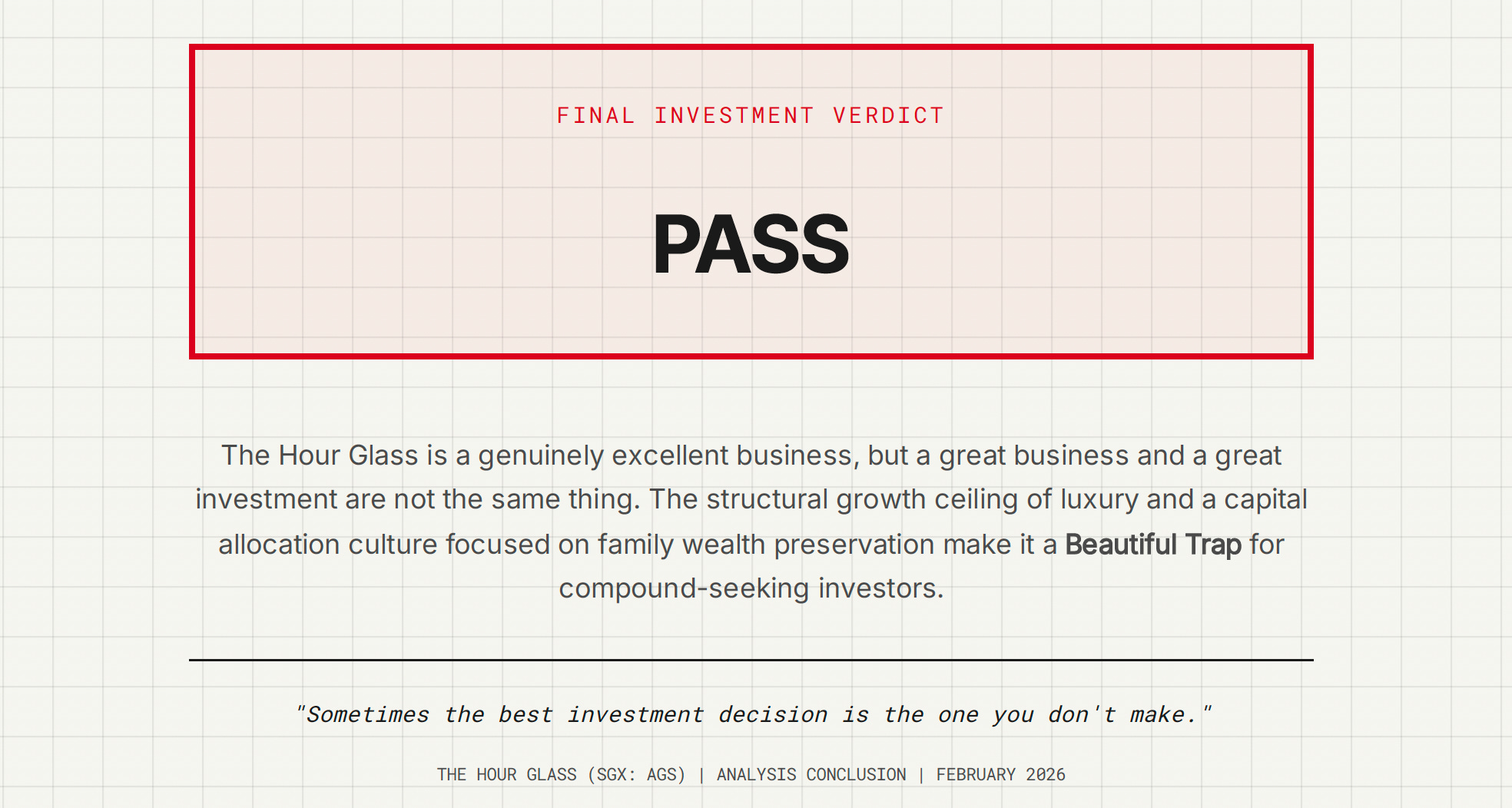
The Hour Glass has built something genuinely rare — a business that has elevated a commoditized retail function into a status brokerage and social capital network for the ultra-wealthy. Their understanding of the economics of luxury (selling access, not products) puts them a generation ahead of most retailers. Their margin advantage over Cortina is real and sustainable. Their Rolex and Patek Philippe relationships are deeply embedded and hard to replicate.
But a great business and a great investment are not the same thing.
The luxury economics themselves impose structural limits: exclusivity caps growth, the addressable market is finite, frequency is low, and network effects are closed rather than open. Luxury is not a growth-maximization game — as the analysis puts it, it is a prestige preservation optimization problem. And a prestige preservation business, however high-quality, does not compound wealth the way a true growth compounder does.
Layered on top of this is a capital allocation culture that prioritizes the founding family’s wealth preservation over shareholders’ return maximization. Every dollar deployed into the Tong Building is a dollar not deployed into another Rolex boutique in a growing Asian city, another collector event deepening the relationship network, or another acquisition like the Kennedy Watches deal that expands distribution reach.
Singapore consistently ranks among the top ten export markets for Swiss watches, and Singapore topped the Julius Baer Global Wealth and Lifestyle Report 2024 as the most expensive city in the world for high-net-worth individuals. The luxury watch tailwind in Asia-Pacific is real. THG is positioned beautifully to ride it. But positioning and capital discipline are different things.
The answer to all three questions:
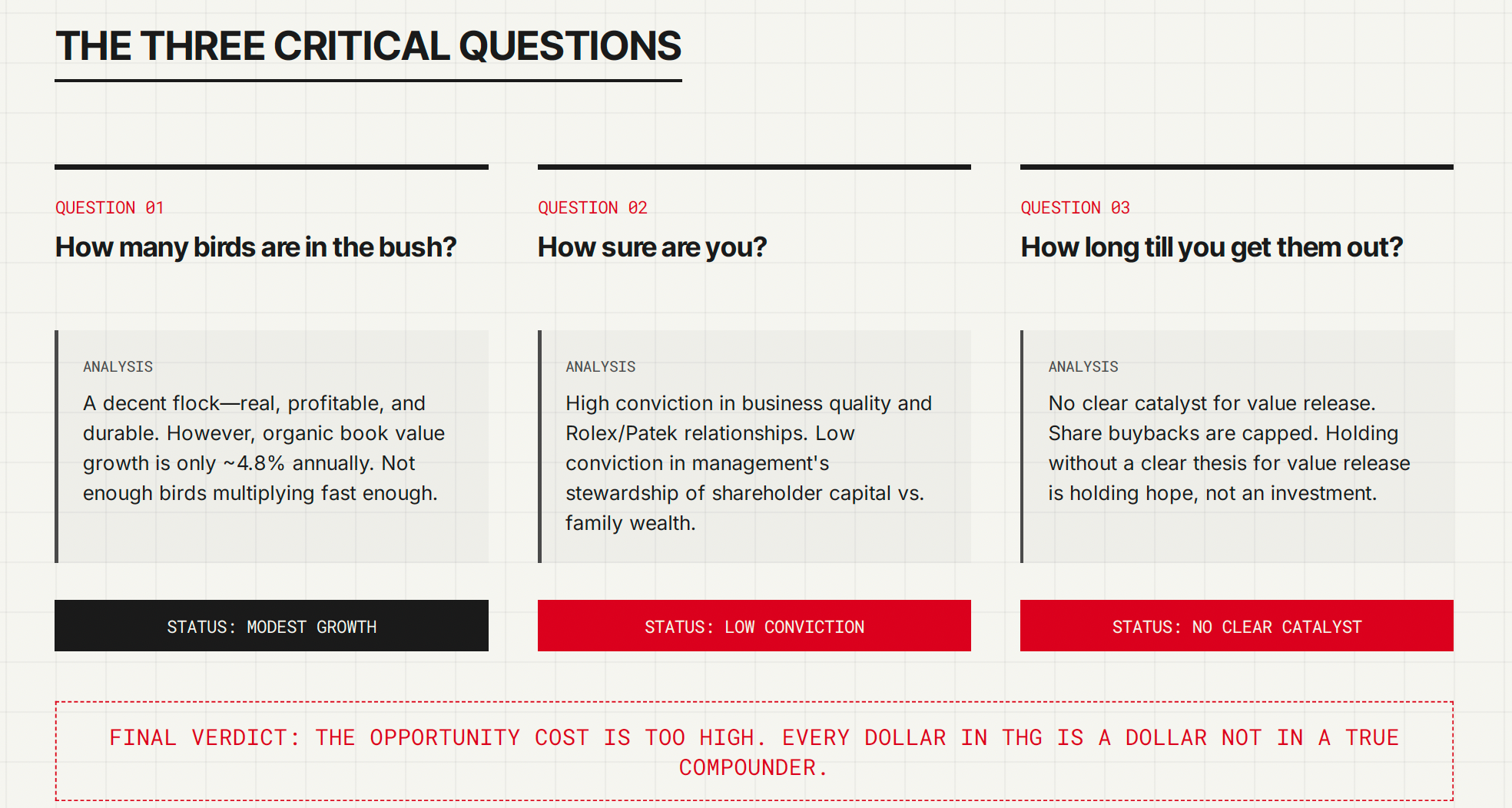
How many birds are in the bush? A decent flock — real, profitable, durable. But not enough birds growing fast enough to justify the opportunity cost over a 5-10 year horizon, particularly given the structural ceiling on luxury compounding.
How sure are you? Very sure about the business quality. Not sure at all about the management’s willingness to allocate capital in ways that maximise shareholder returns rather than family wealth preservation. In a family-controlled business, those two things can diverge indefinitely.
How long till you get them out? This is the killer. I don’t see a clear catalyst within a foreseeable investment horizon. The share buyback is accretive but capped. The business will grow, but slowly. The valuation is already fair. Without a capital allocation shift from management, the value sits in the business but doesn’t fully flow to shareholders. Holding a stock without a clear thesis for value release is holding hope, not an investment.
Conclusion: No.
This is not a condemnation. The Hour Glass is a genuinely excellent business run by people who understand luxury at a deep level. If you’re a patient, income-oriented investor who loves the elegance of the business model and can live with modest capital appreciation plus a ~2.6% dividend yield, there are worse places to park money.
But for investors seeking compounders — businesses where every retained dollar earns more than a dollar of market value — THG doesn’t clear the bar. The birds in the bush are real. There just aren’t enough of them, they don’t multiply fast enough, and the person holding the cage seems more interested in building a property portfolio than setting them free.
Sometimes the best investment decision is the one you don’t make.
All data sourced from The Hour Glass annual reports, SGX filings, and public market data as of February 2026. This is not financial advice.