
“The difference between successful people and really successful people is that really successful people say no to almost everything.” — Warren Buffett
Introduction: The Power of Subtraction
In the autumn of 1995, Steve Jobs returned to Apple and did something counterintuitive: he killed 70% of Apple’s products. Not because they were bad, but because they distracted from what mattered. This is the central paradox of value creation—the power lies not in what you do, but in what you refuse to do.
Warren Buffett keeps a list of companies he’s studied and rejected. Charlie Munger famously said his success came from “knowing the edge of my circle of competence.” Peter Lynch turned down hundreds of stocks for every one he bought. These aren’t stories about missing opportunities; they’re stories about the disciplined pursuit of only the best opportunities.
Sometimes, the companies we look at are perfectly fine companies at the wrong time or wrong price. A few are fascinating turnarounds that need more time. But all of them failed to answer three brutally simple questions satisfactorily:
1. How many birds are in the bush? (What’s the magnitude of return if the thesis works?)
2. How sure are you? (What’s the probability the thesis actualizes?)
3. How fast till you get them out? (What’s the realistic time horizon?)
For a LEAPs strategy—buying long-dated call options 12-24 months out—I need high conviction on all three. If any answer is unsatisfactory, the idea gets rejected. Period.
What follows is a detailed forensic examination of each rejection, complete with financial analysis, probability assessments, and the specific mechanical failures that killed each thesis. Think of it as a masterclass in what Charlie Munger calls “the psychology of misjudgment”—except here, we catch ourselves before the mistake.
Let’s begin.
VYX: The Technology Company That Makes Analysis Impossible
Date Analyzed: September 27, 2025
Current Price: ~$11 | Market Cap: ~$1.4B
When Red Flags Come in Crimson
NCR Voyix provides point-of-sale and restaurant technology systems. Post-spin-off of NCR Atleos (the ATM business), Voyix was supposed to be the higher-growth, asset-light software play.
Instead, it became a case study in why clear financial reporting matters.
The Litany of Problems
Problem #1: The $34 Million Fraud
In February 2024, the company discovered fraudulent ACH disbursements from a company bank account totaling $34 million. As of June 30, 2025, they’d recovered about $16 million from banks and were pursuing insurance recoveries.
Translation: Someone stole $34 million, and management noticed months later. That’s not a red flag—that’s a red banner visible from orbit.
Problem #2: The Environmental Liability Time Bomb
The company has ongoing environmental remediation obligations for the Kalamazoo River and Fox River sites. In November 2023, the EPA conditionally approved a remediation plan, prompting the company to increase reserves for cleanup costs.
Then disputes arose over Phase 2 work. The company argued costs exceeded their obligations. After filing a Notice of Dispute in March 2024, they reached a “tentative agreement” in June and submitted a revised work plan in October.
The Smoking Gun: Management acknowledges that “under other assumptions, actual costs could potentially more than double the current reserve.”
Current reserve: Unknown (they don’t clearly disclose it)
Potential cost: 2x current reserve
Translation: Massive contingent liability of uncertain magnitude
Problem #3: The Debt Situation
Interest Coverage Ratio (TTM September 2025):
Using EBIT: $13M ÷ $83M = 0.15x (catastrophically bad)
Using EBITDA: $232M ÷ $134M = 1.7x (barely acceptable)
When your EBIT interest coverage is 0.15x, you’re not covering interest from operations—you’re burning cash or relying on asset sales to stay alive.
What Happened to the Cash?
December 31, 2024: $724 million cash
September 2025: $276 million cash
Change: -$448 million
Where did it go?
Debt repayment: Majority
Taxes from Digital Banking sale: $284 million payment in Q2 2025
Operations: Negative cash flow

Problem #4: The Sale of Digital Banking
In September 2024, VYX sold its Digital Banking business for $2.45 billion in cash. Proceeds were used to:
Tender for $1.2 billion of senior unsecured notes
Repay all loans under Senior Secured Credit Facilities
Pay off the T/R Facility
Pay taxes ($284 million!)
This creates a massive optical illusion in 2024 financials. The company appears profitable due to the asset sale, but ongoing operations were actually struggling.

As a result of the Digital banking sale, it resulted in a “really good” ROE (which btw, is not recurring). This was used to repay debt instead.
Problem #5: The Encrypted Annual Report
Here’s the detail that killed any remaining interest: VYX’s 2024 annual report was encrypted, disabling the search function.
Why would a company make their annual report unsearchable? Three possibilities:
Incompetence (unlikely for a technology company)
They’re hiding something
They’re making analysis deliberately difficult
None of these are bullish.
The Business Segments
VYX operates two main segments:
1. Retail Solutions
Software-led POS systems
Payment processing and merchant acquiring
Self-service kiosks (self-checkout)
Barcode scanners and terminals
2. Restaurant Solutions
POS hardware and software for table-service, QSR, fast casual
Payment processing
Installation and maintenance services
The Goodwill Problem

The company carries massive goodwill on the balance sheet (typical for tech companies post-merger). But amortization expense decreased significantly despite still having huge goodwill balances.


This raised questions: Did they change amortization methodologies? Are they avoiding impairment charges they should be taking?
The Remaining Performance Obligations Mystery
From the financials:
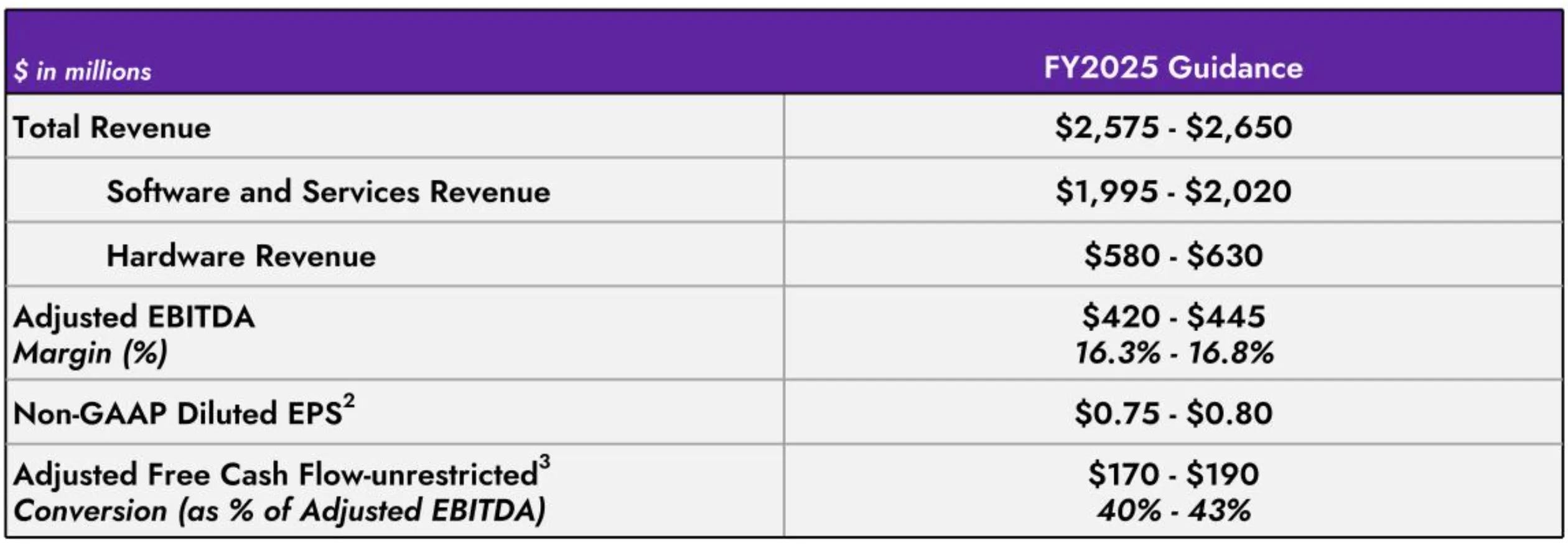
“As of June 30, 2025, the aggregate amount of the transaction price allocated to remaining performance obligations was approximately $1.1 billion.”
This represents contracted revenue not yet recognized. Management expects to recognize “over approximately three-quarters” in the next 12 months.
That’s $825 million of contracted revenue coming—sounds great! Except:
The Catch: “The Company has made three elections that affect the value of remaining performance obligations described above. We do not disclose remaining performance obligations for contracts where variable consideration is directly allocated based on usage or when the original expected duration is one year or less.”
Translation: They’re not showing you the full picture. Actual revenue might be higher or lower than the $1.1 billion figure suggests.
Why Analysis Was Impossible
To value this company, I needed to answer:
What are normalized earnings? (Sale of Digital Banking distorts everything)
What’s the real environmental liability? (Could be 2x current reserves)
What’s the actual debt service capacity? (EBIT coverage of 0.15x says bankrupt soon)
What are real cash flows? (Operating cash flow went negative in 2024)
Are there more frauds or irregularities? ($34M ACH theft suggests weak controls)
I couldn’t answer any of these questions confidently.
The encrypted annual report was the final straw. When management makes analysis difficult, they’re protecting themselves from scrutiny, not trade secrets.
Birds in the Bush: Unknown—financials too opaque
Probability of Success: Zero—can’t trust the numbers
Time Horizon: Irrelevant
The Lesson: Trust but Verify (Mostly Verify)
Charlie Munger’s advice: “A lot of people with high IQs are terrible investors because they’ve got terrible temperaments. You need to keep raw irrational emotion under control.”
But there’s a corollary: Don’t outsmart yourself into trusting untrustworthy management.
When you see:
Fraudulent disbursements
Encrypted financial reports
Massive contingent liabilities
Debt coverage ratios below 1x
Asset sales masking operational struggles
You don’t need to solve the puzzle. You just walk away. As Buffett would say: “I could improve your ultimate financial welfare by giving you a ticket with only 20 slots in it so that you had 20 punches—representing all the investments that you got to make in a lifetime.”
Don’t waste a punch on a company that makes you work this hard to understand if they’re solvent.
Verdict: Hard pass. Life’s too short and markets too large to invest in companies that deliberately obscure their financial condition.
Learnings To Stick To
1. Dilution is Value Destruction
It doesn’t matter if a company has $200 million in cash if they’re issuing $300 million in equity at pennies on the dollar. Per-share value is what matters, not absolute value.
2. Debt is Fragility
Interest coverage below 3x means one bad year could trigger covenant breaches. Below 2x is playing with fire. Below 1.5x is suicidal.
3. Insiders Always Know First
When CEOs, CFOs, and directors sell 60-80% of vested RSUs immediately, they’re voting with their wallets. Listen.
4. Business Models Matter More Than Operations
You can’t cost-cut your way to success if the fundamental value proposition is obsolete.
5. Timing Is Everything (For Options)
e.g. MDU Resources and Krispy Kreme might be great investments... in 2027. But for LEAPs expiring in 2026, the timeline doesn’t work.
6. Regulatory Red Flags Are Never False Alarms
When annual reports are encrypted, when revenue collapses without explanation, when short sellers publish specific fraud allegations—walk away. The risk isn’t worth the reward.
7. Pandemic Winners Are Usually Losers
Mean reversion is brutal. Companies that benefited from temporary behavioral shifts rarely maintain those gains.
The Philosophy of “No”
Charlie Munger said: “The art of being wise is the art of knowing what to overlook.”
In investing, success comes from:
Saying yes to the right opportunities (important)
Saying no to the wrong opportunities (more important)
Saying no to marginal opportunities (most important)
This article is about #3. None of these companies were obviously terrible (well, maybe CHR and WIMI). Most had legitimate businesses, real assets, and plausible turnaround stories.
But “plausible” isn’t “probable.”
And “interesting” isn’t “investable.”
The Buffett-Munger Standard
Before investing, ask:
Do I understand this business? (Circle of competence)
Does it have a sustainable competitive advantage (Moat)/ does it have a legitimate working business model (for LEAPs)?
Is management trustworthy and aligned? (Stewardship)
Is the price attractive relative to intrinsic value? (Margin of safety)
What could go wrong? (Risk analysis)
For LEAPs specifically, add: 6. Will value be realized in 12-24 months? (Timing) 7. Is the expected return 2x+ to compensate for time decay? (Return threshold)
If the answer to ANY of these is “no” or “uncertain,” walk away.
The Opportunity Cost Mindset
Every dollar invested in these marginal opportunities is a dollar not available for exceptional opportunities.
Your capital is finite. Your attention is finite. Your time is finite.
Protect all three zealously.
When I reject companies, I’m not losing opportunities—I was preserving capital and attention for better opportunities yet to come.
In investing, a 0% success rate at finding investments can be a 100% success rate at avoiding disasters.