
“The difference between successful people and really successful people is that really successful people say no to almost everything.” — Warren Buffett
Introduction: The Power of Subtraction
In the autumn of 1995, Steve Jobs returned to Apple and did something counterintuitive: he killed 70% of Apple’s products. Not because they were bad, but because they distracted from what mattered. This is the central paradox of value creation—the power lies not in what you do, but in what you refuse to do.
Warren Buffett keeps a list of companies he’s studied and rejected. Charlie Munger famously said his success came from “knowing the edge of my circle of competence.” Peter Lynch turned down hundreds of stocks for every one he bought. These aren’t stories about missing opportunities; they’re stories about the disciplined pursuit of only the best opportunities.
Sometimes, the companies we look at are perfectly fine companies at the wrong time or wrong price. A few are fascinating turnarounds that need more time. But all of them failed to answer three brutally simple questions satisfactorily:
1. How many birds are in the bush? (What’s the magnitude of return if the thesis works?)
2. How sure are you? (What’s the probability the thesis actualizes?)
3. How fast till you get them out? (What’s the realistic time horizon?)
For a LEAPs strategy—buying long-dated call options 12-24 months out—I need high conviction on all three. If any answer is unsatisfactory, the idea gets rejected. Period.
What follows is a detailed forensic examination of each rejection, complete with financial analysis, probability assessments, and the specific mechanical failures that killed each thesis. Think of it as a masterclass in what Charlie Munger calls “the psychology of misjudgment”—except here, we catch ourselves before the mistake.
Let’s begin.
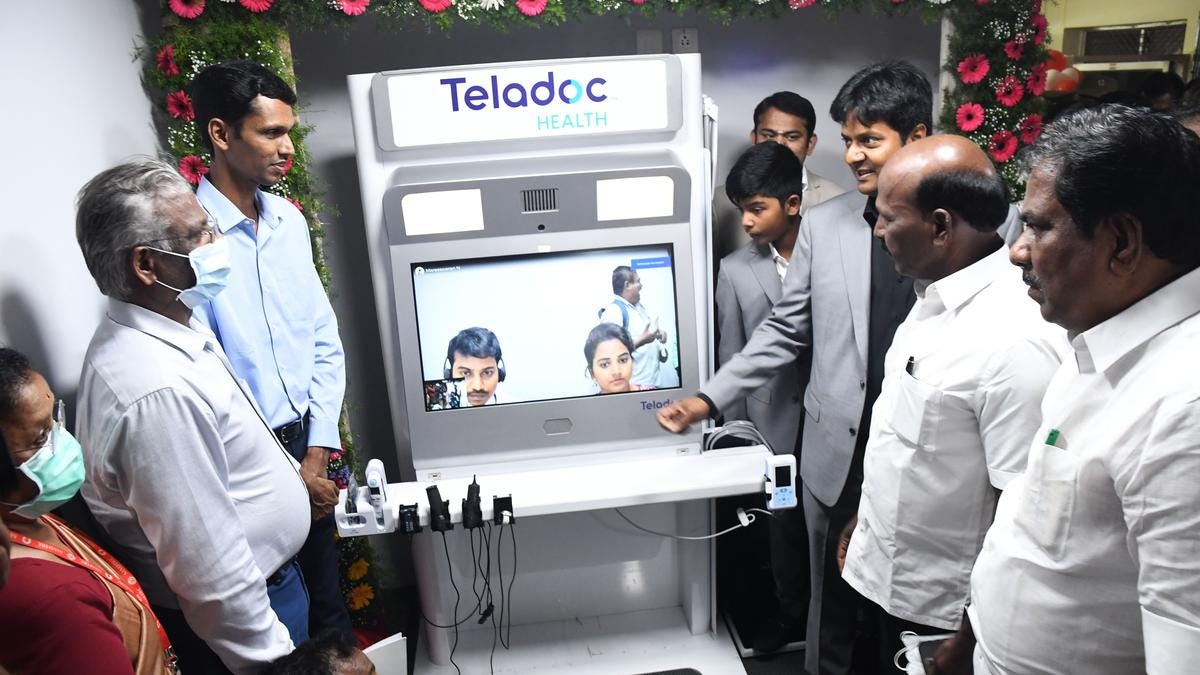
TDOC: The Telemedicine Giant Losing Its Way
Date Analyzed: December 2, 2025
Current Price: ~$7.23 | Market Cap: ~$1.29B
The Pandemic Winner That Couldn’t Sustain
Teladoc Health was the poster child for pandemic-era investing. Stuck at home? Don’t want to visit a doctor’s office? Video call your physician! The stock went from $75 (pre-pandemic) to $308 (February 2021)—a 4x gain in under a year.
Today it trades at $7.23. That’s a 98% decline from the peak.
The Business Segments
1. Integrated Care (~60% of revenue)
Virtual primary care
Chronic condition management (acquired Livongo for diabetes/hypertension)
Specialist consultations
Preventative care (acquired Catapult Health)
2. BetterHelp (~40% of revenue)
Direct-to-consumer mental health
Therapy via video/phone/text
Psychiatry services
The Financial Performance Deterioration
Q4 2024 (February 26, 2025):
Revenue: $640.5M (vs. $660.5M year-ago, -3% decline)
Loss Per Share: -$0.28 (vs. -$0.24 expected)
Adjusted EBITDA: $74.8M (-35% year-over-year)
Integrated Care Segment:
Adjusted EBITDA: $53.2M (-5% YoY)
BetterHelp Segment:
Adjusted EBITDA: $21.7M (-63% YoY!)
The BetterHelp Collapse
BetterHelp, which drove much of Teladoc’s pandemic growth, is imploding:
Revenue declining
Margins compressing
User churn increasing
Why?
Insurance Competition: Consumers shifting from cash-pay therapy (BetterHelp’s model) to insurance-covered therapy (traditional providers)
Advertising Costs: BetterHelp spends heavily on marketing. As customer acquisition costs rise and lifetime value falls, unit economics break down.
Quality Concerns: BetterHelp has faced criticism over therapist vetting and session quality. When you’re competing on convenience, quality concerns are fatal.
Goodwill Impairments: The market is telling you something when a company takes:
$790 million goodwill write-down (Q2 2024)
$59 million impairment (Q1 2025)
Those are non-cash charges, but they represent management admitting “we overpaid for acquisitions and they’re not worth what we thought.”
The Guidance Withdrawal
October 29, 2025: Teladoc narrowed guidance ranges
Previous Guidance:
Net loss per share: ($1.35) to ($1.00)
Revenue: $2.501B to $2.548B
Revised Guidance:
Net loss per share: ($1.25) to ($1.10)
Revenue: $2.51B to $2.53B
This looks like a narrowing, not a withdrawal. But the market viewed the lower end of revenue guidance as confirmation of demand problems.
Q1 2026 Guidance (May 2025):
Revenue: $608M to $629M (vs. $632.9M expected)
Adjusted EBITDA: $47M to $59M
Missing expectations and guiding down is never bullish.
The Insider Selling Bonanza
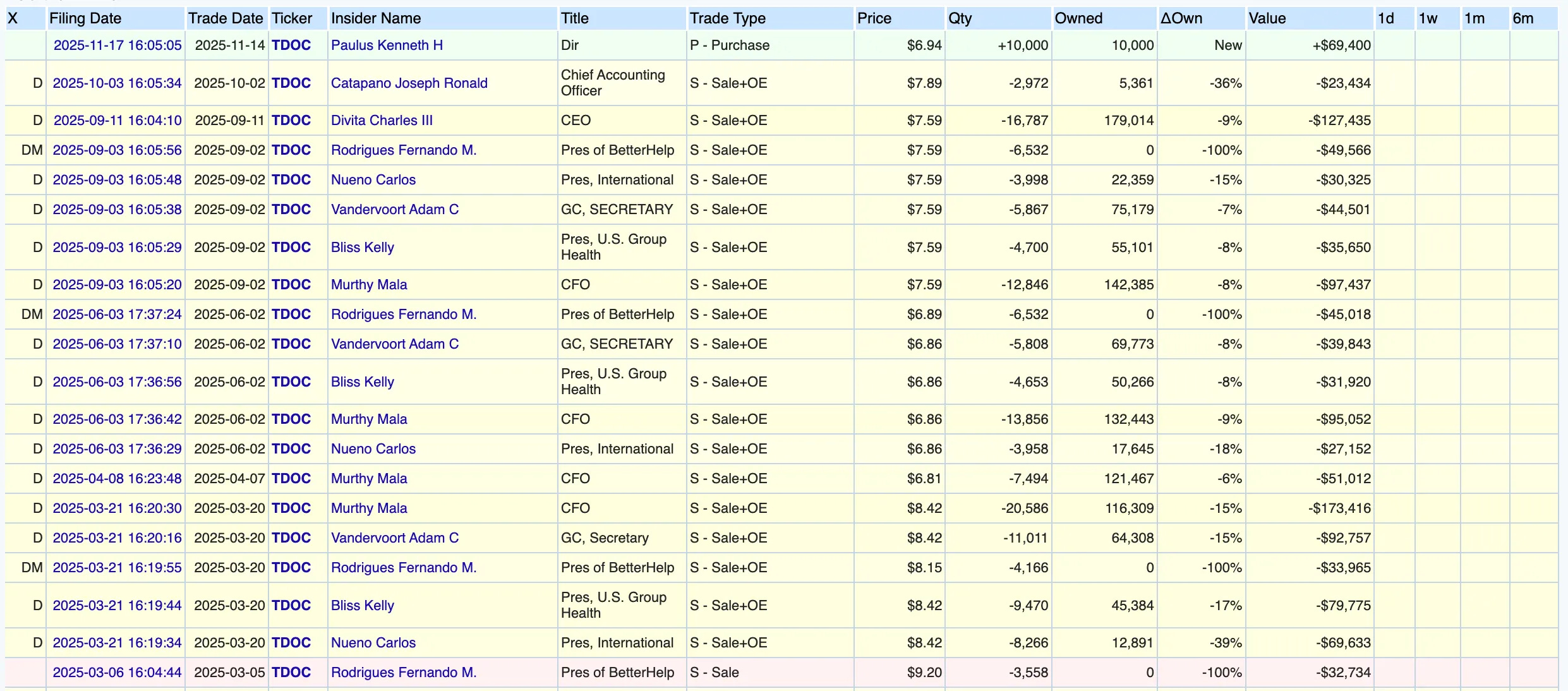
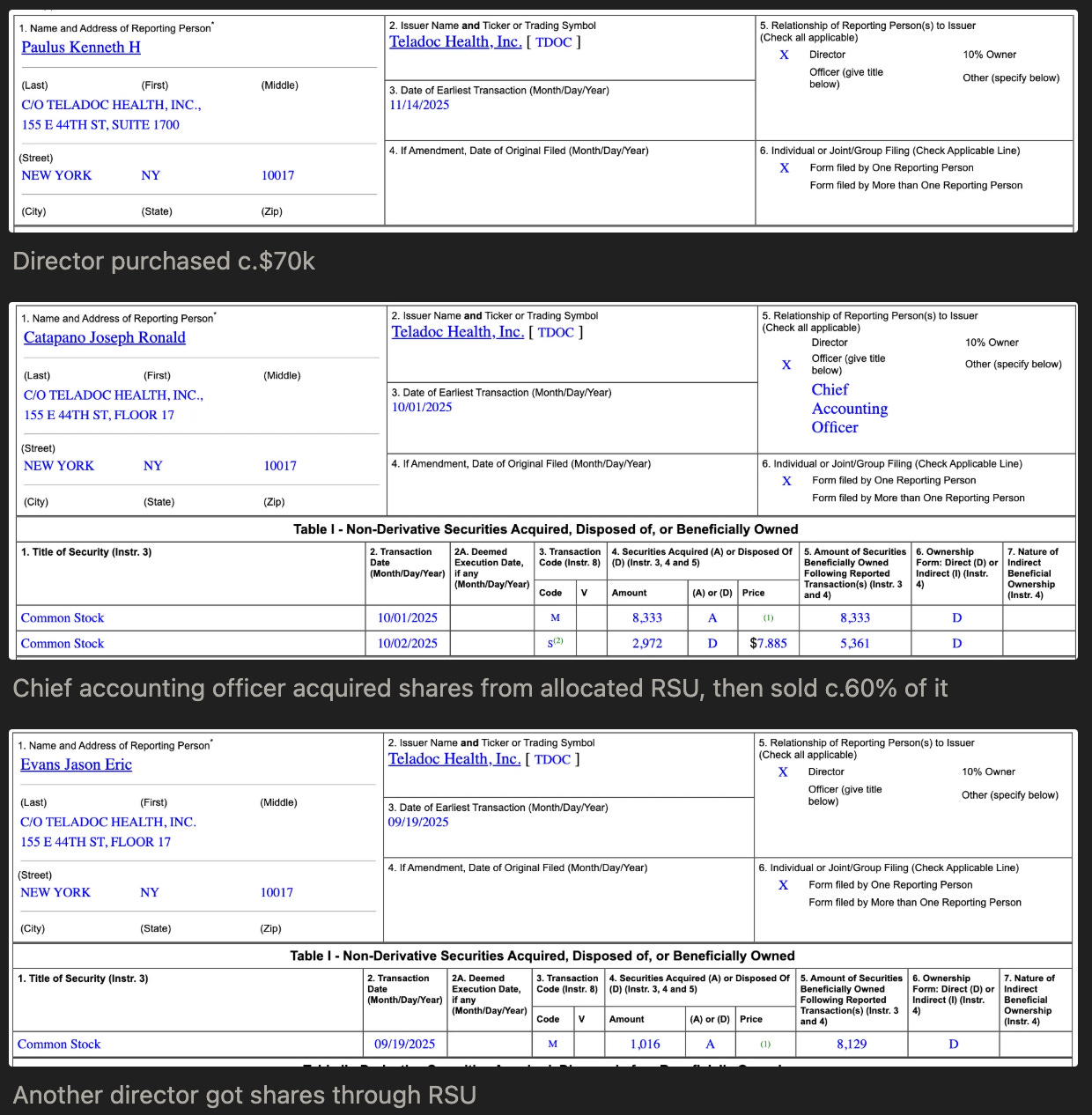
This is where my analysis got damning:
Chief Accounting Officer:
Acquired shares via RSU allocation
Sold ~60% immediately
Multiple Directors:
Received RSU shares
Sold significant portions immediately upon vesting
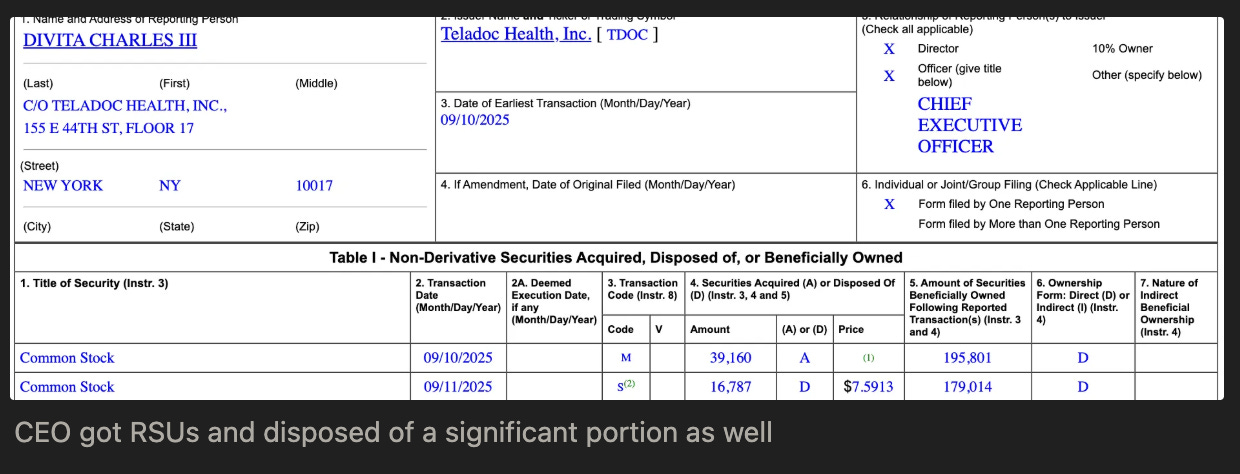
CEO:
Received RSUs
Disposed of significant portion
Pattern Recognition:
When insiders receive stock as compensation and immediately sell most of it, they’re telling you:
They don’t believe in the current valuation (or)
They need liquidity (unlikely for high-paid executives) (or)
They know something you don’t (most likely)
My Analysis: “Massive insider sales of RSUs, with executives disposing of 60-80% of allocated shares immediately upon vesting.”
This isn’t “normal tax planning.” Executives typically hold 50-70% of RSU grants as a vote of confidence. Selling 60-80% immediately is a vote of no confidence.
The Competitive Moat Erosion
Original Teladoc Moat (2010-2020):
First-mover advantage in telehealth
Network effects (more doctors → more patients → more doctors)
Employer/insurance contracts (B2B2C distribution)
Technology platform (proprietary)
Moat Erosion (2020-2025):
Competition Exploded:
Amazon Health: Deep pockets, existing Prime membership, logistics advantage
CVS/Aetna: Integrated insurance + pharmacy + telehealth
Walgreens/VillageMD: Physical + virtual hybrid
Mayo Clinic/Cleveland Clinic: Premium brand telehealth
Hundreds of startups: Better UX, better pricing
Regulatory Changes: Pandemic-era telehealth waivers expired, reducing reimbursement and convenience
Patient Preferences: Post-pandemic, people returned to in-person care
Technology Commoditization: Video calling is trivial now. Zoom, Teams, Google Meet all have healthcare-compliant versions. The technology moat evaporated.
The Valuation Question
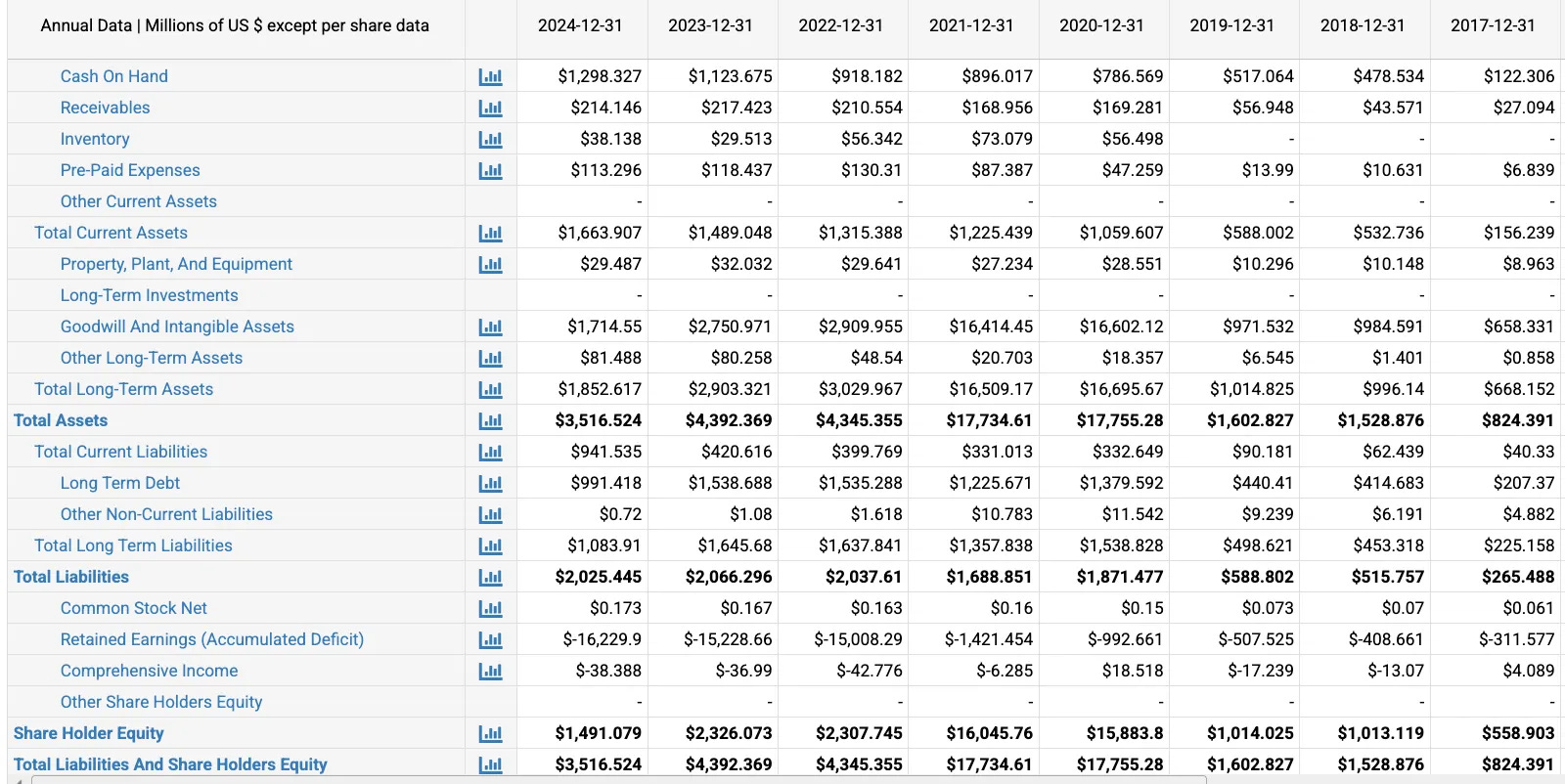
Liquidation Value:
Current Assets: $1.6 billion
Total Liabilities: $2.0 billion
Net: -$400 million (negative!)
So liquidation value is zero. Equity holders get nothing if they shut down.
Market Cap: $1.29 billion
So the market is pricing in $1.29B of going-concern value above liquidation.
Is That Justified?
Only if you believe:
BetterHelp can stabilize (currently declining)
Integrated Care can grow (currently flat)
Profitability can be achieved (currently losing money)
Competition won’t intensify (it’s intensifying)
I’m not confident in any of these.
The Expected Value Calculation
Bull Case (20% probability):
BetterHelp stabilizes at lower but sustainable level
Integrated Care grows mid-single-digits
Company achieves breakeven, then profitability
Stock reaches $12-15
Return: 1.8x
Base Case (50% probability):
Slow decline continues
Cash burn persists
Market cap erodes to $700-900M
Stock falls to $4-5
Return: 0.65x
Bear Case (30% probability):
BetterHelp continues collapsing
Integrated Care growth stalls
Company forced to raise capital dilutively or sell assets
Stock falls to $2-3
Return: 0.30x
Expected Value: (0.20 × 1.8) + (0.50 × 0.65) + (0.30 × 0.30) = 0.80x
Expected loss of 20%.
Birds in the Bush: 1.8x absolute best case
Probability of Success: 20%
Time Horizon: 3-4 years minimum
The Lesson: Pandemic Winners Rarely Stay Winners
The pandemic created artificial demand for:
Telemedicine (Teladoc)
Home fitness (Peloton)
Video conferencing (Zoom)
Food delivery (DoorDash, Uber Eats at inflated prices)
Remote work tools (Asana, Monday.com)
E-commerce (Shopify)
When the world reopened, mean reversion happened violently.
The Pattern:
2020-2021: Massive growth as behavior shifts temporarily
2021-2022: Peak optimism, stocks hit all-time highs
2022-2023: Reality sets in, growth slows, stocks crater
2024-2025: New normal emerges, much lower than pandemic peak
Teladoc Timeline:
2019: $9.30 stock price
Feb 2021: $308 (33x gain!)
Dec 2025: $7.23 (98% decline from peak, 22% below pre-pandemic)
The Question: If Teladoc is trading below its pre-pandemic price, doesn’t that mean it’s cheap?
The Answer: No. Because:
Debt increased: Balance sheet worse than pre-pandemic
Competitive intensity higher: More competitors than 2019
Growth rate lower: Pandemic pulled forward years of demand
Profitability worse: Still losing money despite $2.5B revenue scale
The company is structurally worse than pre-pandemic, despite being larger.
Verdict: Rejection. The competitive moat has eroded, insider selling signals low confidence, and the path to profitability is unclear. At $7.23, the stock prices in ~20% probability of success—and I think that’s optimistic. Fair value is probably $4-5, implying perhaps 30-45% further downside.
Learnings To Stick To
1. Dilution is Value Destruction
It doesn’t matter if a company has $200 million in cash if they’re issuing $300 million in equity at pennies on the dollar. Per-share value is what matters, not absolute value.
2. Debt is Fragility
Interest coverage below 3x means one bad year could trigger covenant breaches. Below 2x is playing with fire. Below 1.5x is suicidal.
3. Insiders Always Know First
When CEOs, CFOs, and directors sell 60-80% of vested RSUs immediately, they’re voting with their wallets. Listen.
4. Business Models Matter More Than Operations
You can’t cost-cut your way to success if the fundamental value proposition is obsolete.
5. Timing Is Everything (For Options)
e.g. MDU Resources and Krispy Kreme might be great investments... in 2027. But for LEAPs expiring in 2026, the timeline doesn’t work.
6. Regulatory Red Flags Are Never False Alarms
When annual reports are encrypted, when revenue collapses without explanation, when short sellers publish specific fraud allegations—walk away. The risk isn’t worth the reward.
7. Pandemic Winners Are Usually Losers
Mean reversion is brutal. Companies that benefited from temporary behavioral shifts rarely maintain those gains.
The Philosophy of “No”
Charlie Munger said: “The art of being wise is the art of knowing what to overlook.”
In investing, success comes from:
Saying yes to the right opportunities (important)
Saying no to the wrong opportunities (more important)
Saying no to marginal opportunities (most important)
This article is about #3. None of these companies were obviously terrible (well, maybe CHR and WIMI). Most had legitimate businesses, real assets, and plausible turnaround stories.
But “plausible” isn’t “probable.”
And “interesting” isn’t “investable.”
The Buffett-Munger Standard
Before investing, ask:
Do I understand this business? (Circle of competence)
Does it have a sustainable competitive advantage (Moat)/ does it have a legitimate working business model (for LEAPs)?
Is management trustworthy and aligned? (Stewardship)
Is the price attractive relative to intrinsic value? (Margin of safety)
What could go wrong? (Risk analysis)
For LEAPs specifically, add: 6. Will value be realized in 12-24 months? (Timing) 7. Is the expected return 2x+ to compensate for time decay? (Return threshold)
If the answer to ANY of these is “no” or “uncertain,” walk away.
The Opportunity Cost Mindset
Every dollar invested in these marginal opportunities is a dollar not available for exceptional opportunities.
Your capital is finite. Your attention is finite. Your time is finite.
Protect all three zealously.
When I reject companies, I’m not losing opportunities—I was preserving capital and attention for better opportunities yet to come.
In investing, a 0% success rate at finding investments can be a 100% success rate at avoiding disasters.