
“The difference between successful people and really successful people is that really successful people say no to almost everything.” — Warren Buffett
Introduction: The Power of Subtraction
In the autumn of 1995, Steve Jobs returned to Apple and did something counterintuitive: he killed 70% of Apple’s products. Not because they were bad, but because they distracted from what mattered. This is the central paradox of value creation—the power lies not in what you do, but in what you refuse to do.
Warren Buffett keeps a list of companies he’s studied and rejected. Charlie Munger famously said his success came from “knowing the edge of my circle of competence.” Peter Lynch turned down hundreds of stocks for every one he bought. These aren’t stories about missing opportunities; they’re stories about the disciplined pursuit of only the best opportunities.
Sometimes, the companies we look at are perfectly fine companies at the wrong time or wrong price. A few are fascinating turnarounds that need more time. But all of them failed to answer three brutally simple questions satisfactorily:
1. How many birds are in the bush? (What’s the magnitude of return if the thesis works?)
2. How sure are you? (What’s the probability the thesis actualizes?)
3. How fast till you get them out? (What’s the realistic time horizon?)
For a LEAPs strategy—buying long-dated call options 12-24 months out—I need high conviction on all three. If any answer is unsatisfactory, the idea gets rejected. Period.
What follows is a detailed forensic examination of each rejection, complete with financial analysis, probability assessments, and the specific mechanical failures that killed each thesis. Think of it as a masterclass in what Charlie Munger calls “the psychology of misjudgment”—except here, we catch ourselves before the mistake.
Let’s begin.
SFIX: When the Business Model Breaks

Date Analyzed: December 1, 2025
Current Price: ~$4.25 | Market Cap: ~$560M
The Styling Service Nobody Wants Anymore
Stitch Fix pioneered online personal styling—send information about your preferences, receive curated clothing selections, keep what you like, return the rest. It’s Spotify for fashion: algorithmic recommendations plus human curation.
The idea was brilliant. The execution is failing.
The Numbers Tell a Story
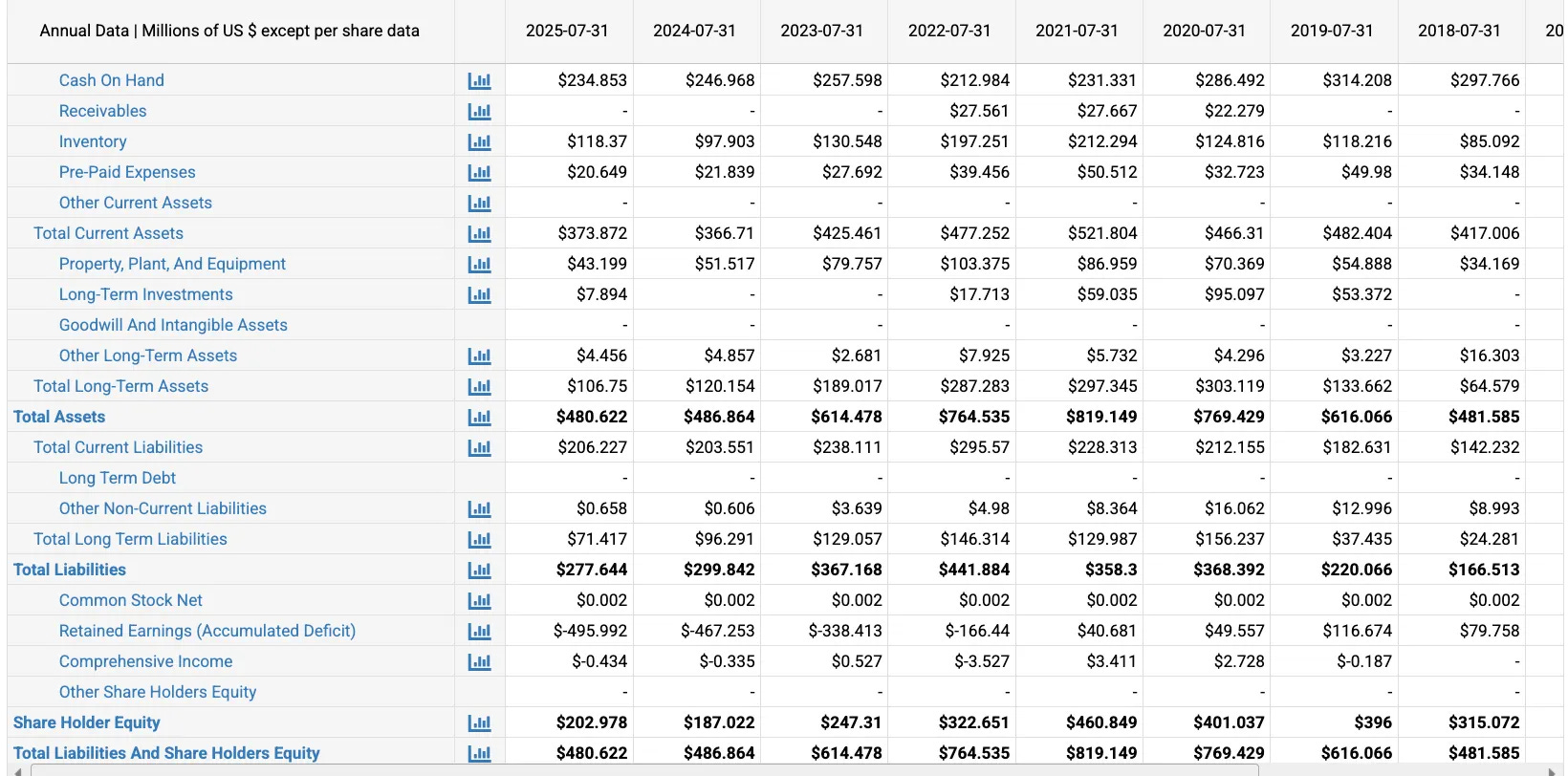

Liquidation Value:
Current Assets: $374 million
Total Liabilities: $278 million
Net Asset Value: $96 million
Per-Share Liquidation Value:
$96M ÷ 132M shares = $0.73/share
Current Price: $4.25
Premium to Liquidation: 5.8x
So you’re paying six times what you’d get if they shut down tomorrow. That premium implies the business is worth something as a going concern.
The question: Is it?
The Customer Retention Crisis
The Core Problem: Massive customer acquisition and retention challenges.
Evidence from Management: “Massive problem in acquiring and retaining clients. I personally do not think the market is wrong, the question is, will they have enough time and resources to fix this without dilution?”

When even the investor analyzing the stock thinks “the market is right,” that’s a bad sign.
What’s Happening:
CAC (Customer Acquisition Cost) Rising: More expensive to acquire new customers
Churn Increasing: Existing customers leaving faster
Engagement Declining: Customers ordering less frequently
The Restructuring That Doesn’t Fix The Problem

Management’s Plan:
Reduce fixed operating costs ✓
Reduce variable operating costs ✓
Optimize organizational structure ✓
Reduce CAC: ✗ (Not addressed!)
My Analysis: “Restructuring is only focusing on reducing fixed and variable operating cost, not on reducing CAC”
This is like treating a gunshot wound with band-aids. Cost-cutting helps profitability IF you have a viable business. But if the core business model is broken (customers don’t want the service), efficiency improvements just mean going bankrupt more efficiently.
The Business Model Breakdown
Why Did Stitch Fix Work (2011-2020)?
Novelty Factor: First-mover advantage in online styling
Pandemic Boost: People couldn’t shop in stores, so online styling thrived
Algorithm Hype: “AI-powered styling” sounded futuristic
Lockdown Convenience: Clothing delivered to your door mattered more
Why Is It Failing Now (2022-2025)?
Competition: Every retailer now offers personalization
Amazon has “recommended for you”
Nordstrom has styling services
Even Walmart has personal shopping features
Return to In-Person: People want to try clothes on in stores again
Economic Pressure: In cost-of-living crisis, $20 styling fee + keeping clothes you’re not sure about = too expensive
Saturation: Early adopters tried it; mainstream never adopted at scale
Retention Economics: The business model REQUIRES high retention (keep customers for years). But actual retention is low.
The Cash Conversion Cycle Improvement

There’s one bright spot:
Cash Conversion Cycle: Improving year-over-year
What This Means:
Inventory turning faster
Receivables collected quicker
Payables extended longer
Why It Matters: This shows operational efficiency is improving. They’re getting better at managing working capital.
Why It Doesn’t Save Them: Better cash management with declining revenues is like rearranging deck chairs on the Titanic. It’s good to have tidy deck chairs, but the ship is still sinking.
The Dilution Watch
Historical Shares Outstanding: 22.01 million
I didn’t note significant dilution concerns in my analysis, suggesting:
Management is managing cap structure responsibly (good!)
But they may NEED to dilute if cash burns through current assets (bad)
The Dilution Risk:
If revenue declines continue, they’ll face a choice:
Cut costs faster (more layoffs, service degradation)
Raise capital through equity (dilute shareholders)
Shut down (liquidate)
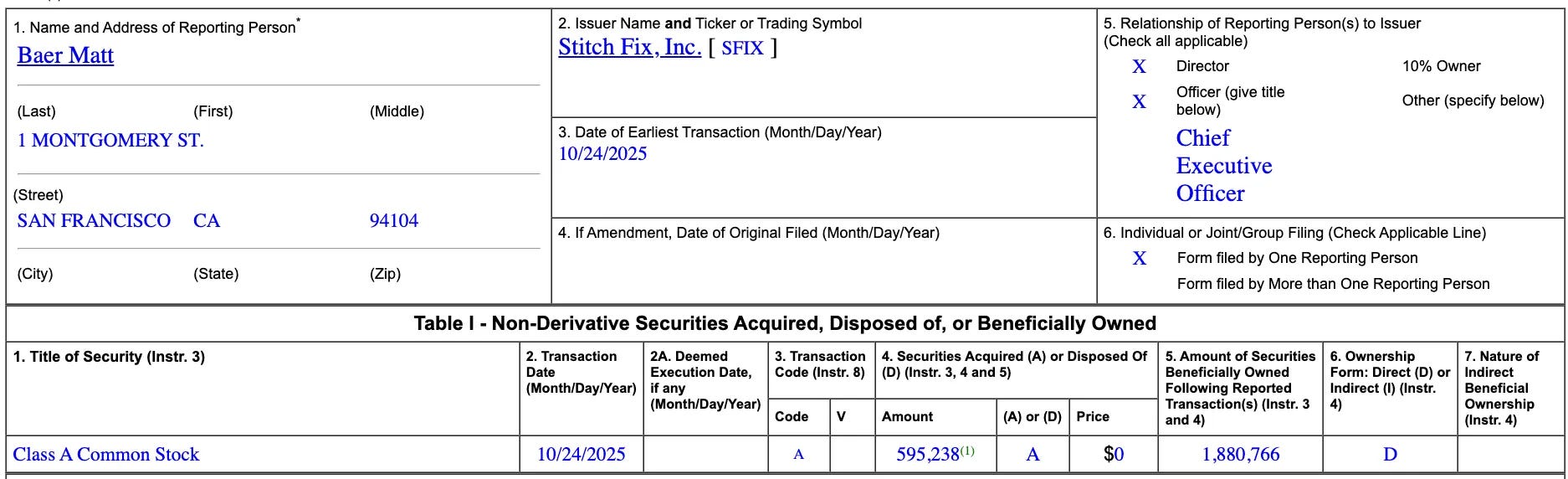
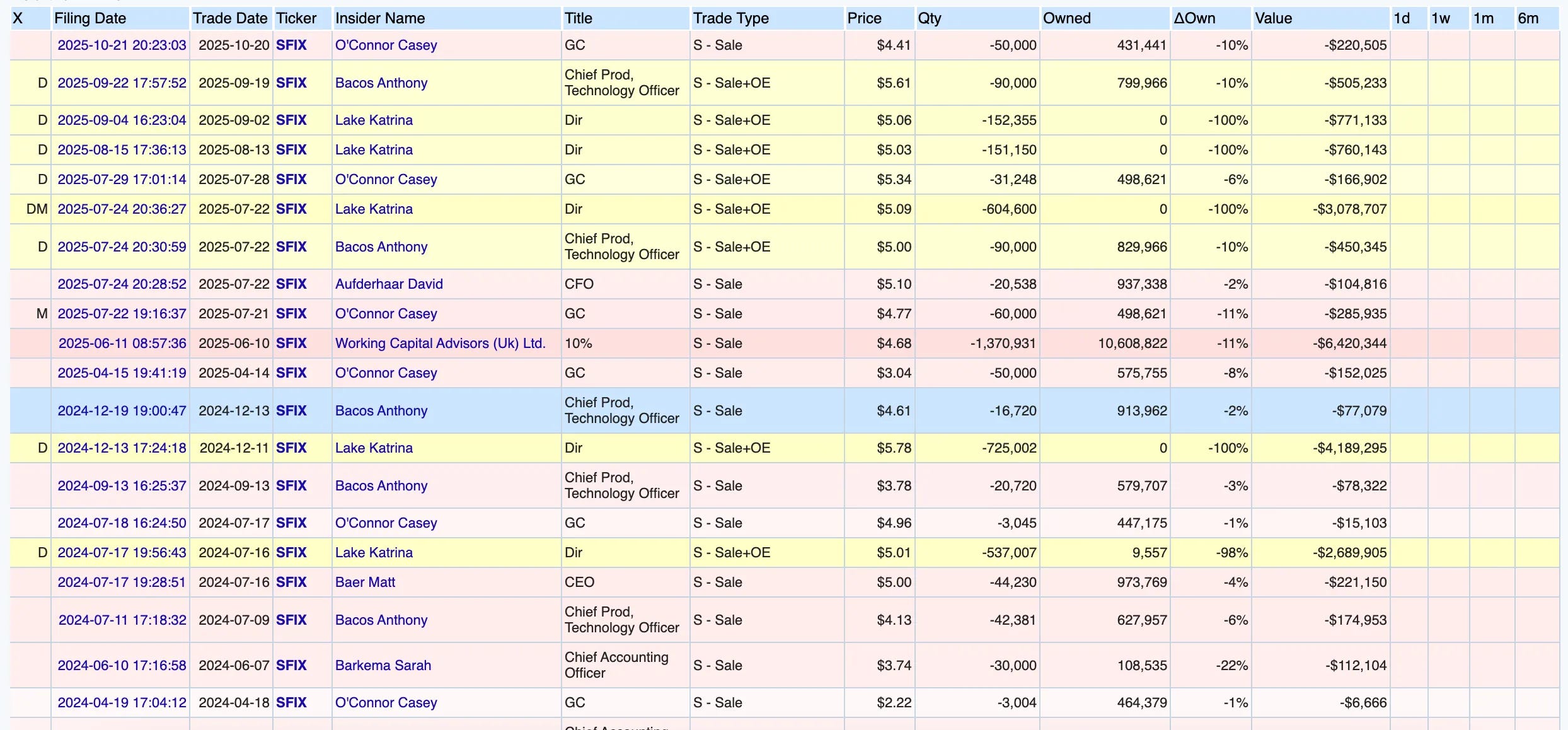
None of these are bullish. And not to forget, massive RSU dilution and sale of stock..
The Comparable Company Analysis
Nordstrom Styling Services: Free for loyalty members, drives store traffic
Walmart Personal Shopping: Free
Amazon Personal Shopper: $4.99/month (way cheaper than Stitch Fix)
Stitch Fix charges a $20 styling fee per box (credited toward purchases, but still psychologically expensive).
When competitors offer similar services for free or near-free, your price premium only works if your service is substantially better. The data suggests it’s not.
The Expected Value Calculation
Bull Case (15% probability):
Restructuring succeeds in cutting costs
Some new product offering revitalizes customer acquisition
Stock reaches $6-7
Return: 1.5x
Base Case (50% probability):
Slow decline continues
Cash burns down over 2-3 years
Stock falls to $2-3
Return: 0.6x
Bear Case (35% probability):
Rapid decline, potential bankruptcy
Stock falls to $0.50-1.00 (near liquidation value)
Return: 0.15x
Expected Value: (0.15 × 1.5) + (0.50 × 0.6) + (0.35 × 0.15) = 0.58x
Expected value below 1.0x means expected loss, not gain.
Birds in the Bush: 1.5x maximum (and that’s generous)
Probability of Success: 15%
Time Horizon: 2-3 years (if they survive that long)
The Lesson: When The Business Model Breaks, Run
There’s a hierarchy of business problems:
Tier 1 (Fixable): Execution issues
Poor management → Replace management
High costs → Cut costs
Operational inefficiency → Improve operations
Tier 2 (Hard but Possible): Competitive problems
Losing market share → Differentiate product, improve marketing
Price pressure → Lower costs, improve efficiency
Tier 3 (Usually Unfixable): Business model obsolescence
Customers don’t want the product anymore
Competitors offer better/cheaper alternatives
Structural shift in market
Stitch Fix is Tier 3. The market has moved past “mail-order styling services” the same way it moved past Blockbuster, Borders, and BlackBerry.
Can Business Models Come Back?
Rarely. Some examples:
Polaroid: Instant photography died with digital cameras (business model obsolete)
Blackberry: Physical keyboards obsolete once iPhone launched
Blockbuster: Physical rentals obsolete once streaming emerged
Notice the pattern: When technology or consumer behavior shifts fundamentally, the old business model doesn’t “come back.” It’s just done.
Verdict: Hard rejection. Restructuring can’t save a business model that customers no longer want. The 5.8x premium to liquidation value is unjustified. Fair value is probably $1.50-2.00 per share (roughly 2x liquidation value to account for brand value and some optionality). At $4.25, this is a value trap, not a value opportunity.
Learnings To Stick To
1. Dilution is Value Destruction
It doesn’t matter if a company has $200 million in cash if they’re issuing $300 million in equity at pennies on the dollar. Per-share value is what matters, not absolute value.
2. Debt is Fragility
Interest coverage below 3x means one bad year could trigger covenant breaches. Below 2x is playing with fire. Below 1.5x is suicidal.
3. Insiders Always Know First
When CEOs, CFOs, and directors sell 60-80% of vested RSUs immediately, they’re voting with their wallets. Listen.
4. Business Models Matter More Than Operations
You can’t cost-cut your way to success if the fundamental value proposition is obsolete.
5. Timing Is Everything (For Options)
e.g. MDU Resources and Krispy Kreme might be great investments... in 2027. But for LEAPs expiring in 2026, the timeline doesn’t work.
6. Regulatory Red Flags Are Never False Alarms
When annual reports are encrypted, when revenue collapses without explanation, when short sellers publish specific fraud allegations—walk away. The risk isn’t worth the reward.
7. Pandemic Winners Are Usually Losers
Mean reversion is brutal. Companies that benefited from temporary behavioral shifts rarely maintain those gains.
The Philosophy of “No”
Charlie Munger said: “The art of being wise is the art of knowing what to overlook.”
In investing, success comes from:
Saying yes to the right opportunities (important)
Saying no to the wrong opportunities (more important)
Saying no to marginal opportunities (most important)
This article is about #3. None of these companies were obviously terrible (well, maybe CHR and WIMI). Most had legitimate businesses, real assets, and plausible turnaround stories.
But “plausible” isn’t “probable.”
And “interesting” isn’t “investable.”
The Buffett-Munger Standard
Before investing, ask:
Do I understand this business? (Circle of competence)
Does it have a sustainable competitive advantage (Moat)/ does it have a legitimate working business model (for LEAPs)?
Is management trustworthy and aligned? (Stewardship)
Is the price attractive relative to intrinsic value? (Margin of safety)
What could go wrong? (Risk analysis)
For LEAPs specifically, add: 6. Will value be realized in 12-24 months? (Timing) 7. Is the expected return 2x+ to compensate for time decay? (Return threshold)
If the answer to ANY of these is “no” or “uncertain,” walk away.
The Opportunity Cost Mindset
Every dollar invested in these marginal opportunities is a dollar not available for exceptional opportunities.
Your capital is finite. Your attention is finite. Your time is finite.
Protect all three zealously.
When I reject companies, I’m not losing opportunities—I was preserving capital and attention for better opportunities yet to come.
In investing, a 0% success rate at finding investments can be a 100% success rate at avoiding disasters.