
PLAYSTUDIOS (MYPS) is a Las Vegas-based mobile gaming company that operates free-to-play social casino games and a loyalty platform called playAWARDS, which lets players redeem points for real-world rewards at places like MGM Resorts, Norwegian Cruise Line, and Wolfgang Puck restaurants. On the surface, this sounds like a clever moat. A loyalty program. Brand partnerships. A unique product category. So why am I passing? Because in investing, the question is never whether a company is interesting. The question is whether the price you pay gives you enough cushion — enough margin of safety — before you’d ever consider writing a cheque.
The Framework: Three Questions Every Investment Must Answer
Charlie Munger once said that the art of investing is largely the art of asking the right questions. Over the years, I have found that nearly every investment decision I make — whether I end up buying or walking away — can be filtered through three deceptively simple questions. The first: how many birds are in the bush? That is, how much value does this company actually hold? The second: how sure am I? That is, how confident can I be that this value is real and reachable? The third: how long until I get them out? That is, how quickly can that value translate into returns for me as a shareholder? If any one of these three fails — if the birds are too few, or the certainty is too low, or the timeline is too long — the idea gets rejected. Not because the company is bad, but because my capital has better things to do elsewhere.
This is not a takedown of PLAYSTUDIOS. It is an exercise in disciplined thinking. The company has genuine assets, real cash flow, and a creative business model. But discipline means that “interesting” and “investable” are not the same word. Let us walk through each of the three questions, one at a time.
Part One: How Many Birds Are in the Bush?
This is the valuation question. Warren Buffett borrowed the metaphor from Benjamin Graham: a bird in the hand is worth two in the bush. The investor’s job is to figure out how many birds are actually in that bush — how much intrinsic value exists inside this company — and then decide whether the current share price is paying a fair price or an extravagant one.
The Balance Sheet: What Does the Company Own?
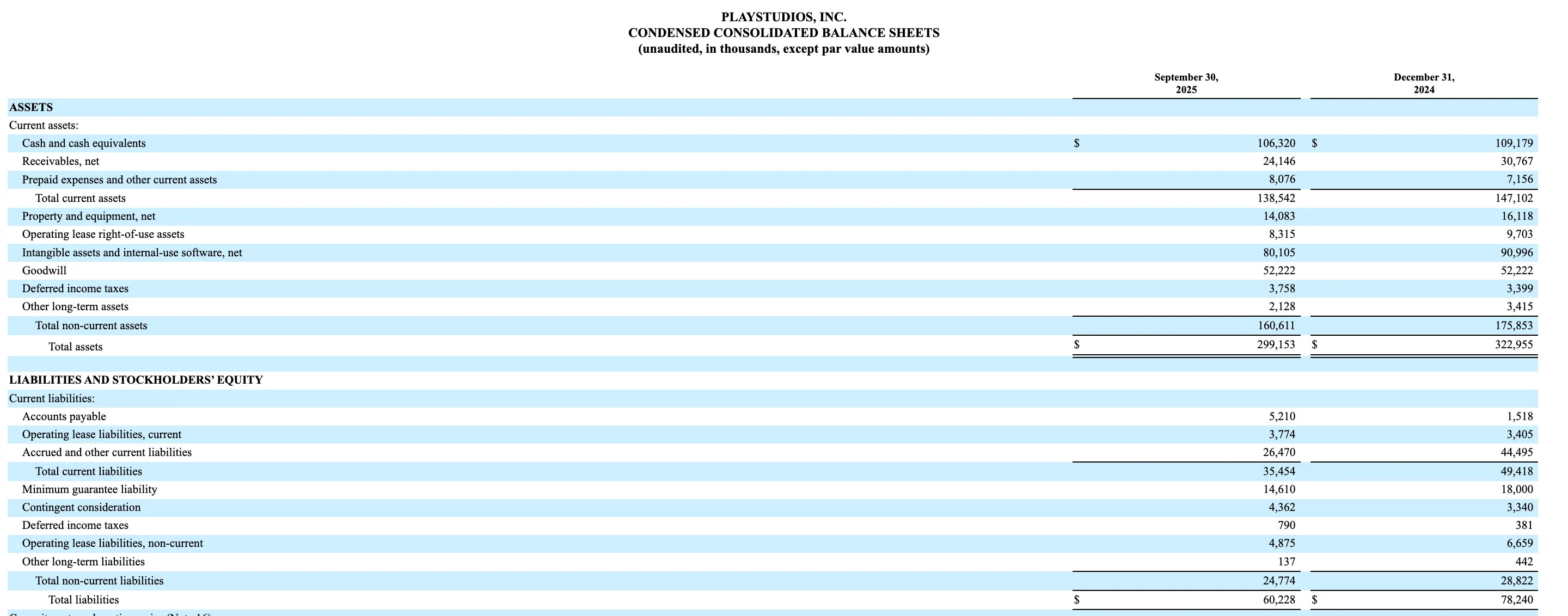
As of September 30, 2025, PLAYSTUDIOS reported a book value of approximately $239 million across its total assets, against total liabilities of roughly $61 million. At the time of my analysis, the company’s market capitalisation sat at around $79 million. On first glance, this appears to be a bargain — the market is pricing the company at roughly one-third of its book value.
But here is where we must slow down and ask an uncomfortable question: is that book value real? Not in the accounting sense — it is real on paper. But in the economic sense, can this company actually convert those assets into cash? The answer requires us to look beneath the headline number.
Table 1: Asset Composition vs. Market Value (Sep 30, 2025)
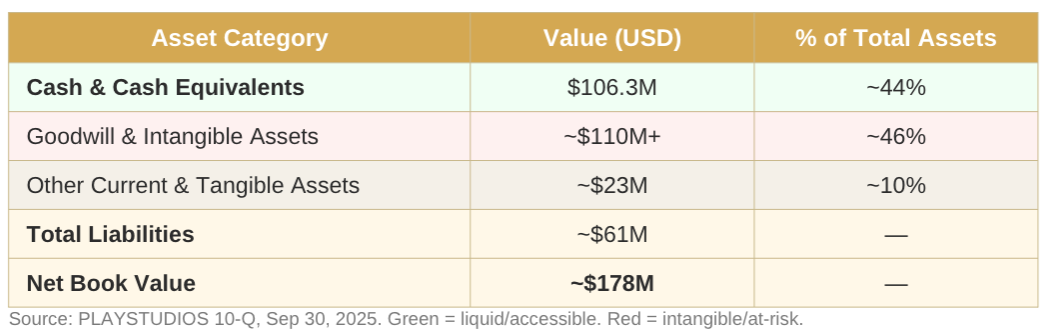
Nearly half of the company’s asset base is made up of goodwill and intangible assets — the accounting residue of past acquisitions. These are not cash. They are not easily liquidated. And critically, the company’s own income statement tells us these intangibles are depreciating rapidly, reflected in elevated depreciation and amortisation charges each quarter. Goodwill is a promise that past acquisitions will generate future earnings. But if those acquisitions are losing their relevance — if the games they represent are losing players — then goodwill is just a number on a spreadsheet that has not yet been written down.

The Liquidation Floor: What’s Left When You Strip Away the Promises?
When we remove goodwill and intangibles and focus only on what could realistically be converted to cash — current assets minus total liabilities — we arrive at a much more sobering number: approximately $77 million. That is almost exactly where the market cap sits today. In other words, the market is already pricing MYPS at its liquidation value. There are essentially no additional birds in the bush beyond what you could get by simply shutting the company down and selling off what’s left.
The Revenue Decline: Are the Birds Flying Away?
A static valuation is only half the story. We also need to understand whether this company is growing or shrinking. And the trajectory here is unmistakable.
Table 2: Quarterly Revenue Trajectory (2024 vs. 2025)
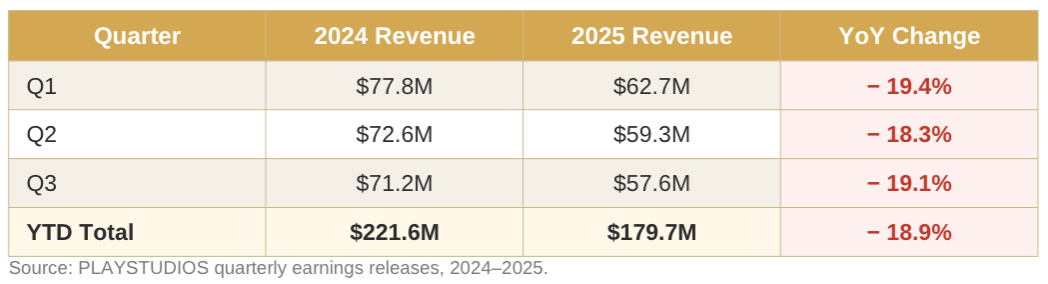
Revenue has declined consistently by roughly 19% year-over-year across every single quarter of 2025. This is not a one-off blip. It is a sustained, structural contraction in the company’s core business. And it is being driven by something deeper than bad luck: the company’s Daily Active Users declined 25.3% year-over-year in Q3 2025, and Monthly Active Users fell 24.9% over the same period.
The Economics of Free-to-Play: Why No Recurring Revenue Matters
To truly understand the bird count, we need to understand how PLAYSTUDIOS actually makes money. The company’s revenue comes almost entirely from in-app purchases — players buying virtual currency to spend inside casino-style games. There is no subscription. There is no recurring contract. Every single dollar of revenue is, by definition, voluntary and discretionary, earned fresh each day from a player who could, with one tap, delete the app and never look back.
This is a critical structural weakness. In mobile gaming, the industry benchmark for average lifetime value (LTV) of a game user is remarkably thin. According to AppsFlyer, the average 90-day LTV for gaming apps sits at just $0.32. PLAYSTUDIOS reported an ARPDAU (Average Revenue Per Daily Active User) of $0.26 in Q1 2025, which is broadly in line with industry averages for social casino titles but offers no premium. Meanwhile, the broader mobile gaming industry saw user acquisition costs (UAC) rise materially through 2024 and 2025 as competition intensified — meaning companies must now pay more to acquire users who, on average, generate less lifetime value than they used to.

The Dilution Problem: Shrinking Your Share of the Birds
Even if you accept the book value thesis, shareholders face another headwind that actively erodes the value of each share they hold: dilution.
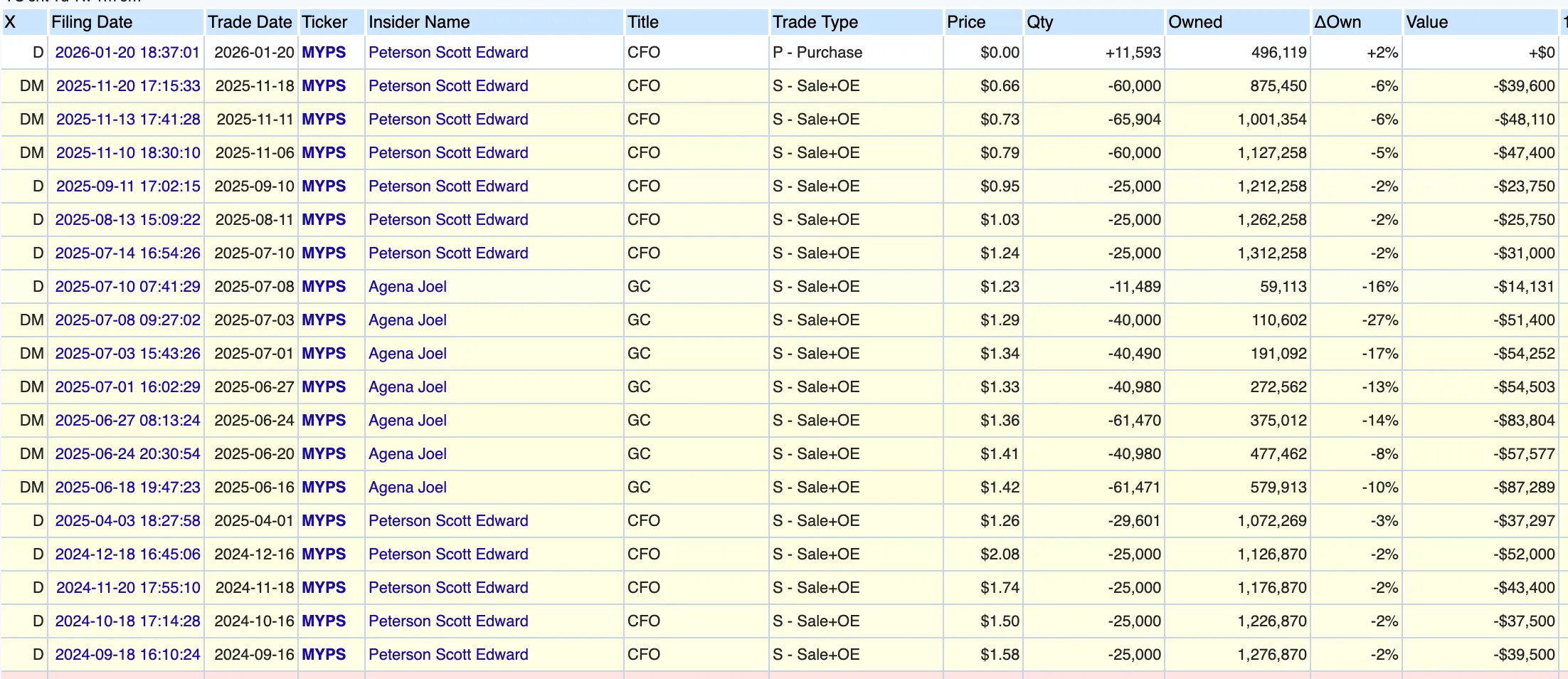
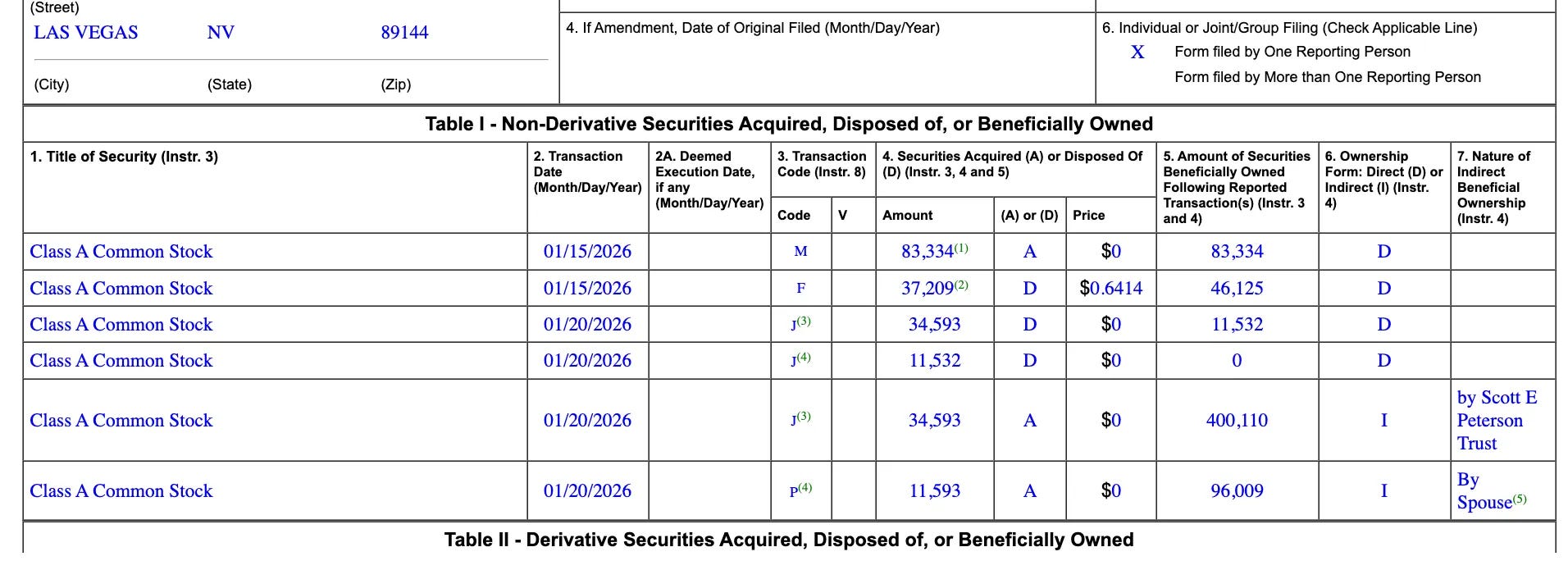
Table 3: Dilution & Capital Structure Snapshot (Sep 30, 2025)
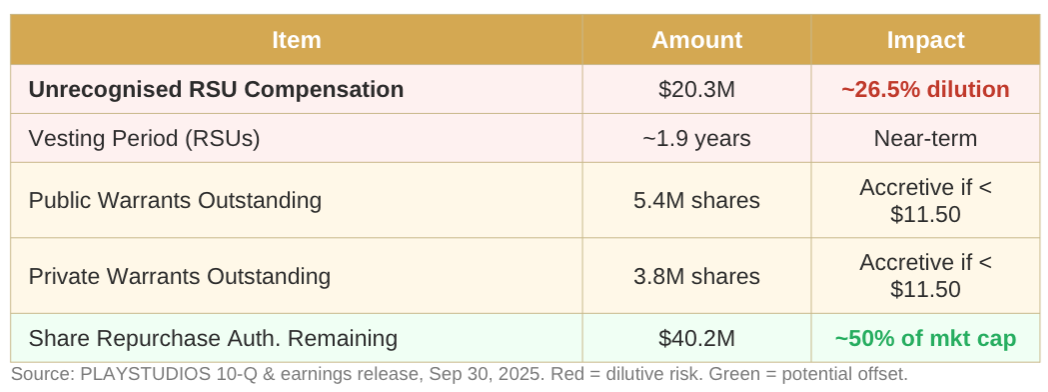

The company has approximately $20.3 million in unrecognised stock-based compensation tied to RSUs, which are expected to vest over a weighted-average period of 1.9 years. Against an $79 million market cap, this represents roughly a 26.5% dilution to existing shareholders. The company does have a share repurchase programme with $40.2 million remaining — which is substantial relative to the market cap — but buybacks are speculative. They depend on price, timing, and management discretion. They are not guaranteed. And notably, the company already used $24.6 million of cash to repurchase shares from Microsoft at $2.11 per share in mid-2024, when the stock was trading far above its current levels.

If we factor in the RSU dilution, the adjusted intrinsic value per share drops from the naive book-value figure to something closer to $176 million in equity value — still above the current market cap, but only by about 2.2x. And that 2.2x assumes all that goodwill and intangible value actually converts to cash, which, as we have seen, is far from certain.
Part Two: How Sure Are You?
Certainty is the second gate. Even if there are birds in the bush — even if the intrinsic value is genuinely higher than the market cap — the question becomes: how confident can I be that this value is real, sustainable, and reachable? The more uncertain I am, the wider the margin of safety I need to demand before I commit capital.
The Core Business Is in Structural Decline
PLAYSTUDIOS’ primary revenue engine is social casino gaming — a category that is experiencing what management itself acknowledges as “meaningful market headwinds”. This is not corporate spin. The data confirms it: DAU declined 25.3% year-over-year in Q3 2025. MAU fell nearly 25% over the same period. ARPDAU — the average revenue each daily active user generates — also declined. Every key operating metric is moving in the wrong direction, simultaneously.
The broader social casino market is a fascinating case study in the tension between market-level growth and company-level decline. Industry reports value the global social casino market at roughly $8.4 billion in 2024, with projected growth at a CAGR of 8.8% through 2030. So the overall pie is expanding. But PLAYSTUDIOS is losing its slice of that pie, which means the company is underperforming the market — not riding its tailwinds.
The Unit Economics Reality
This is where the certainty question becomes most uncomfortable. For any free-to-play mobile game, the fundamental economics come down to a single ratio: how much does it cost to acquire a user, versus how much does that user generate over their lifetime? If the ratio is healthy — if lifetime value exceeds acquisition cost by a comfortable margin — the business can scale profitably. If it is not, the company is essentially paying more to fill a leaky bathtub than the water is worth.
Table 4: Mobile Gaming Unit Economics — Industry Context
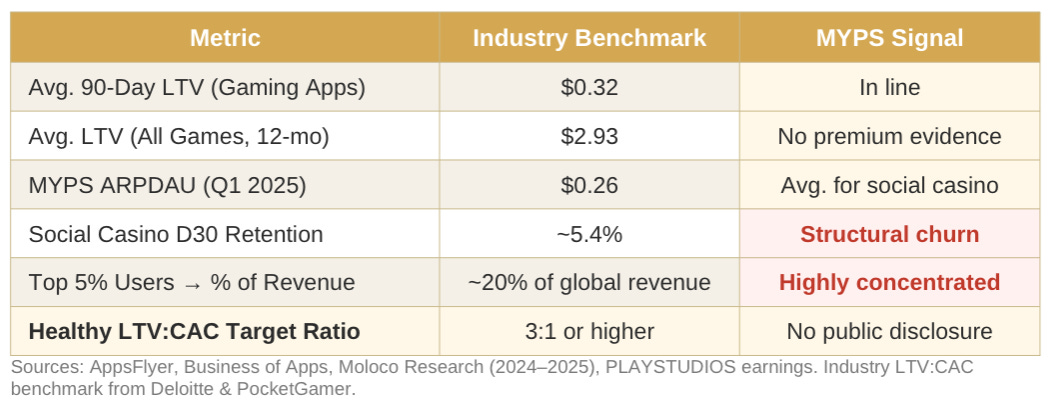
The healthy target ratio for LTV to Customer Acquisition Cost in mobile gaming is 3:1 or better. Anything below 2:1 is considered unsustainable at scale. PLAYSTUDIOS does not publicly disclose its LTV:CAC ratio, which is itself a yellow flag — companies with strong unit economics tend to trumpet them. What we do know is that the company’s ARPDAU sits at industry average, its DAU is declining rapidly, and the mobile gaming industry broadly saw rising user acquisition costs through 2024–2025 as competition for attention intensified. Rising CAC combined with flat or declining ARPDAU is, by definition, a compression of the LTV:CAC ratio.
And the churn picture is brutal across the category. Social casino games retain only about 5.4% of users at the 30-day mark. That means roughly 95 out of every 100 players who download the game are gone within a month. The revenue is overwhelmingly concentrated in a tiny fraction of “whales” — the top 5% of users on iOS alone account for approximately 20% of total global gaming revenue across all platforms.
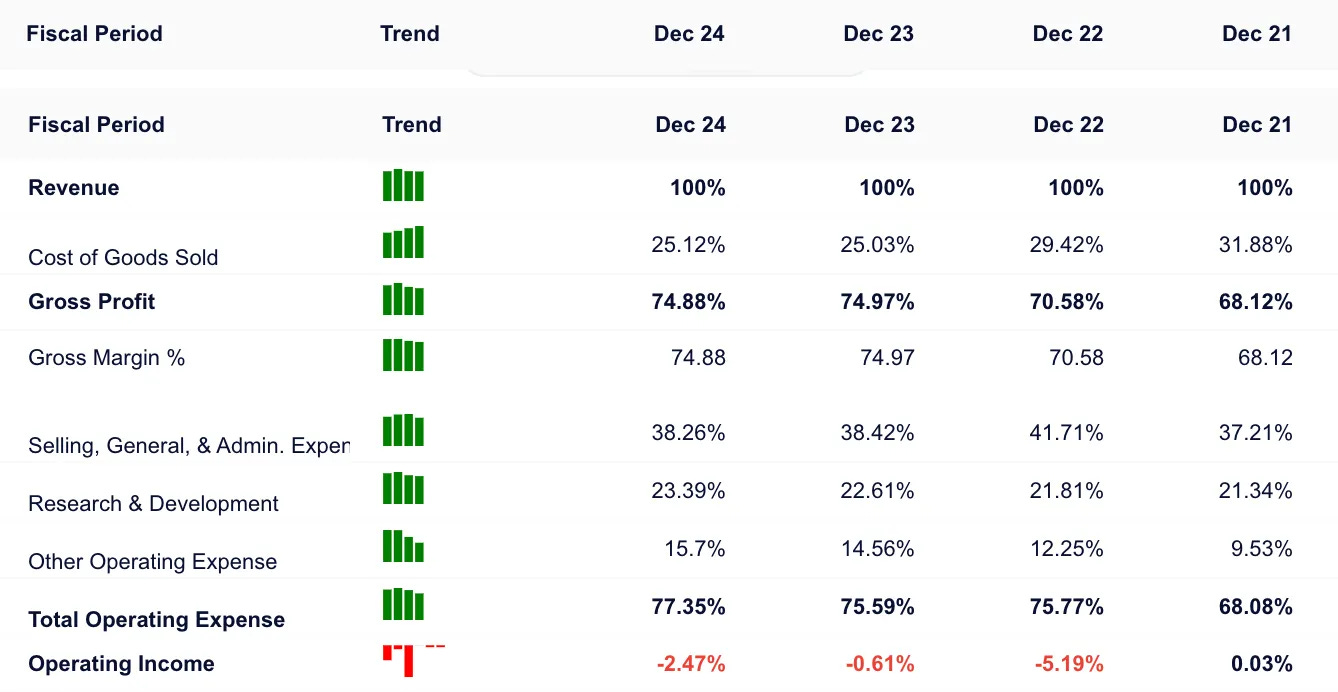
Furthermore, we notice that R&D and “Other operating expenses” has been increasing (which clearly is a result of dropping market share). After a little digging, we can see that it is due to restructuring and amortization:

The Switching Cost Question
For certainty to be high, we need to believe the company has some structural advantage that competitors cannot easily replicate. The obvious candidate here is playAWARDS — PLAYSTUDIOS’ loyalty platform, which partners with brands like MGM Resorts, Norwegian Cruise Line, IHG, and Wolfgang Puck to offer players real-world rewards in exchange for continued gameplay.
This is genuinely creative. It is also, upon closer inspection, more fragile than it appears. The loyalty points a player accumulates are only as valuable as the rewards they can redeem them for — and those rewards depend entirely on the willingness of partner brands to continue the arrangement. Moreover, while players may spend time and money building an in-game account, the actual switching cost is low. A competitor can launch a similar game with similar mechanics, and a player’s decision to stay or go hinges on engagement, not contractual obligation.
The company itself acknowledges this dynamic. It has begun launching loyalty programmes, apps, and sweepstakes initiatives — precisely because it recognises that the core social casino experience, however habitual, does not generate the kind of deep engagement that prevents substitution. As one industry analysis noted, “switching between platforms is simple for players, particularly when bonuses or promotions appear tempting on another platform.”

The Nasdaq Warning: A Red Flag That Demands Attention
On November 5, 2025, PLAYSTUDIOS received a notice from Nasdaq indicating non-compliance with the minimum bid price requirement — the company’s Class A common stock had closed below $1.00 for 30 consecutive business days. The company has 180 days to regain compliance or face potential delisting. Management has indicated it may consider a reverse stock split.
A reverse stock split does not create value. It consolidates shares to lift the per-share price, but it does nothing to address the underlying business deterioration that caused the price to fall in the first place. If anything, it is a signal that management is focused on maintaining the listing rather than solving the fundamental problem.
Adding to the uncertainty, the company’s CFO sold 30,000 shares on November 10, 2025 — the same week the Nasdaq warning was disclosed. Insider selling during periods of stress is not proof of anything on its own. But in context, it does nothing to inspire the kind of confidence that would justify accepting a thin margin of safety.

Finally the company has products which are quickly losing a lot of value (which explains the high depreciation and amortization figures in their income statement). Combining this fact with the fact that more than half the asset value in their balance sheet is made up of goodwills and intangibles. A more practical valuation would be $138 million in current assets - $61 million total liabilities = $77 million. This amount ($77million) is in the range of their current $79 million market capitalization, which gives us a pretty poor margin of safety when looking at it from a business operation standpoint. It is not very convincing that they will survive without requiring another round of financing
Part Three: How Long Until You Get Them Out?
Time is the third and final gate. Even if the birds are plentiful and the certainty is reasonable, an investor must ask: how long will it take for this value to be realised? Time is not free. Every month your capital sits in a position waiting for a catalyst is a month it could have been compounding elsewhere. And in options, time is actively working against you — every day that passes, the option loses value through theta decay.
The Catalyst Problem: No Clear Path to Value Realisation
For a company trading at or below its liquidation value, value realisation typically requires one of three things: a takeover bid from a buyer willing to pay a premium, a dramatic operational turnaround that the market reprices, or an activist investor forcing a strategic change. As of this writing, none of these catalysts appear imminent for PLAYSTUDIOS.
The company’s strategic bets — its sweepstakes initiative (“The Win Zone”), Tetris Block Party, and the expansion of direct-to-consumer revenue — are all early-stage. The Win Zone was in beta across select markets. Tetris Block Party was in open beta with “promising early performance” but no material revenue contribution. Direct-to-consumer revenue grew 48% quarter-over-quarter in Q3 2025, which sounds impressive, but from a base of $5.2 million to $7.7 million — a contribution that barely moves the needle against $57.6 million in total quarterly revenue.
Table 5: Strategic Initiatives — Status & Scale (Q3 2025)
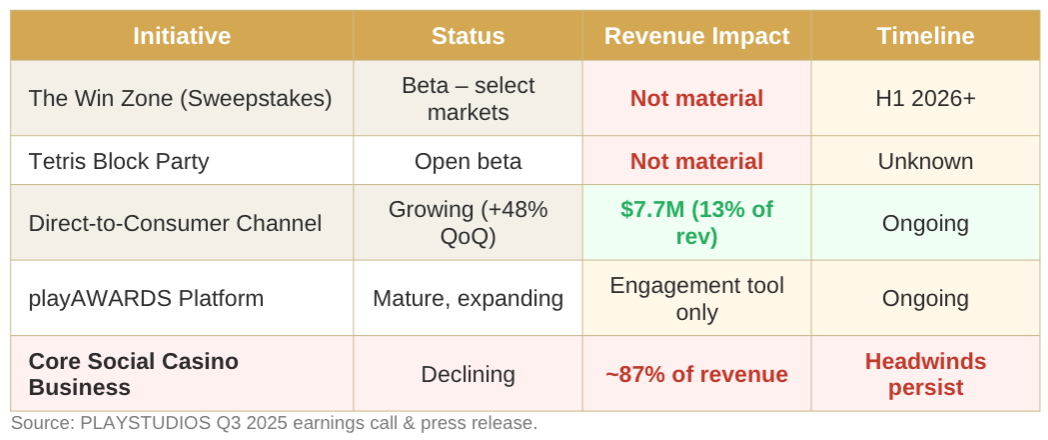
The core business — social casino gaming — still accounts for roughly 87% of revenue, and it is in sustained decline. The new initiatives are promising in concept but are years away from contributing meaningfully to the top line, if they succeed at all. Meanwhile, the company’s full-year 2025 guidance was revised downward, with management acknowledging that both revenue and adjusted EBITDA would “fall below the low end” of previously provided ranges.
Conclusion: The Verdict Is Not “Bad” — It Is “Not Enough”
Let me be clear about what this analysis is not saying. PLAYSTUDIOS is not a fraud. It is not a company with no value. It has $106 million in cash, no debt drawn on its credit facility, a creative loyalty platform, and a team that has been innovating in a difficult market. These are genuine strengths.
But investing is not about whether a company is good. It is about whether, at the current price, you are getting paid enough to take on the risk. And on that measure, PLAYSTUDIOS fails all three tests.
The Three-Question Verdict
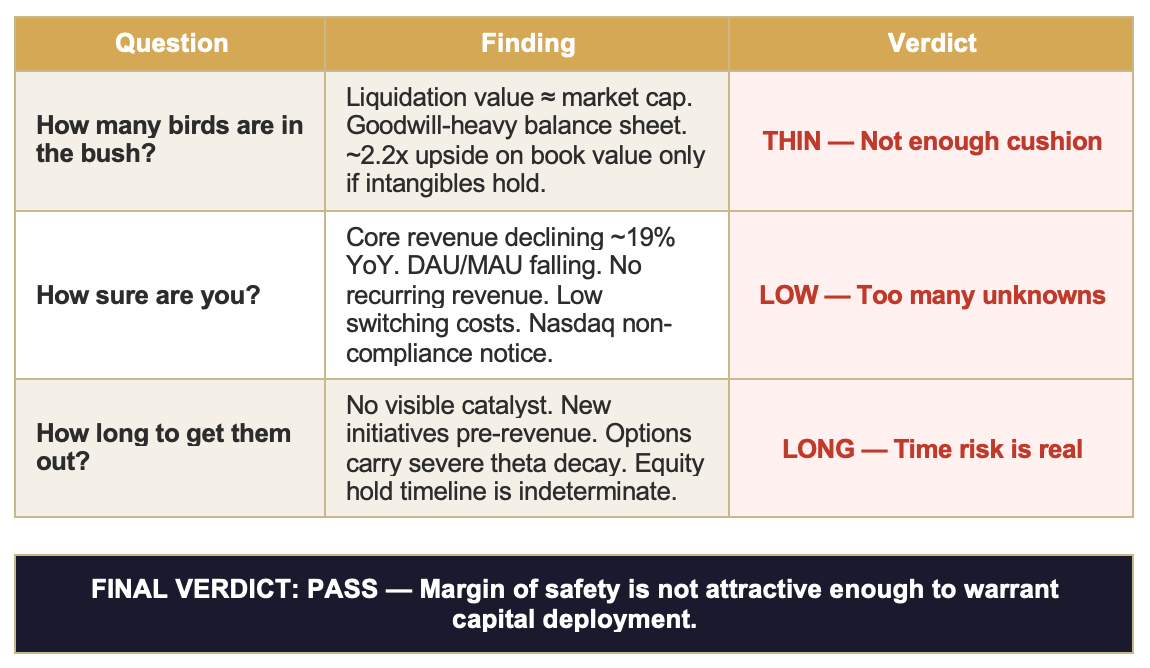
The birds in this bush number about as many as the price of the cage. The certainty is low, the timeline is long, and my capital has better opportunities — companies with deeper moats, wider margins of safety, and longer-dated options — waiting to be deployed. Sometimes the best investment decision is the one you choose not to make.

Sources & References
PLAYSTUDIOS 10-Q Filing, Quarter Ended September 30, 2025 — ir.playstudios.com
Author’s analysis: Current assets ($138M est.) minus total liabilities ($61M) = $77M liquidation floor.
PLAYSTUDIOS Q1, Q2, Q3 2025 Earnings Releases — ir.playstudios.com/financial-information
AppsFlyer, “Mobile App Trends” — Average 90-day LTV for gaming apps: $0.32. Business of Apps, “LTV App Rates (2025)”: avg game LTV $2.93 (12-month).
PLAYSTUDIOS 10-Q, Sep 30, 2025 — Unrecognised RSU compensation: $20.3M over 1.9-year vesting period.
Andrew Pascal, CEO, Q3 2025 Earnings Call: “Our core social casino business continues to encounter meaningful market headwinds.”
Deloitte, “Player LTV: The Secret to Profitable Growth” & PocketGamer.biz, “Financing LTV in Mobile Gaming” — healthy LTV:CAC ratio target of 3:1.
ASO World / MyTracker study: Social casino games retained 32.1% D1, 5.4% D30. Moloco Research (2024): top 5% iOS users generate ~20% of global gaming IAP revenue.
Symphony Solutions, “Customer Retention Techniques for Online Casinos” (2024): switching barriers in social casino category.
PLAYSTUDIOS 8-K Filing, November 5, 2025 — Nasdaq non-compliance notice (bid price below $1.00 for 30 consecutive days). Via TipRanks.
TipRanks, November 10, 2025 — CFO Scott Edward Peterson sold 30,000 shares at ~$0.79/share