
“The difference between successful people and really successful people is that really successful people say no to almost everything.” — Warren Buffett
Introduction: The Power of Subtraction
In the autumn of 1995, Steve Jobs returned to Apple and did something counterintuitive: he killed 70% of Apple’s products. Not because they were bad, but because they distracted from what mattered. This is the central paradox of value creation—the power lies not in what you do, but in what you refuse to do.
Warren Buffett keeps a list of companies he’s studied and rejected. Charlie Munger famously said his success came from “knowing the edge of my circle of competence.” Peter Lynch turned down hundreds of stocks for every one he bought. These aren’t stories about missing opportunities; they’re stories about the disciplined pursuit of only the best opportunities.
Sometimes, the companies we look at are perfectly fine companies at the wrong time or wrong price. A few are fascinating turnarounds that need more time. But all of them failed to answer three brutally simple questions satisfactorily:
1. How many birds are in the bush? (What’s the magnitude of return if the thesis works?)
2. How sure are you? (What’s the probability the thesis actualizes?)
3. How fast till you get them out? (What’s the realistic time horizon?)
For a LEAPs strategy—buying long-dated call options 12-24 months out—I need high conviction on all three. If any answer is unsatisfactory, the idea gets rejected. Period.
What follows is a detailed forensic examination of each rejection, complete with financial analysis, probability assessments, and the specific mechanical failures that killed each thesis. Think of it as a masterclass in what Charlie Munger calls “the psychology of misjudgment”—except here, we catch ourselves before the mistake.
Let’s begin.
MRX: The (Potential) Clearing House Accused of Accounting Fraud
Date Analyzed: October 7, 2025
Current Price: ~$13 | Market Cap: ~$3.8B
The Short Seller’s
Dream (or Nightmare?)
Marex Holdings provides clearing, execution, and market-making services for commodities and financial markets. They’re one of nine Category 1 members on the London Metal Exchange, giving them privileged access to trading by open outcry in “the ring.”
The business model is real. The accusation of fraud is... concerning.
The Business Segments
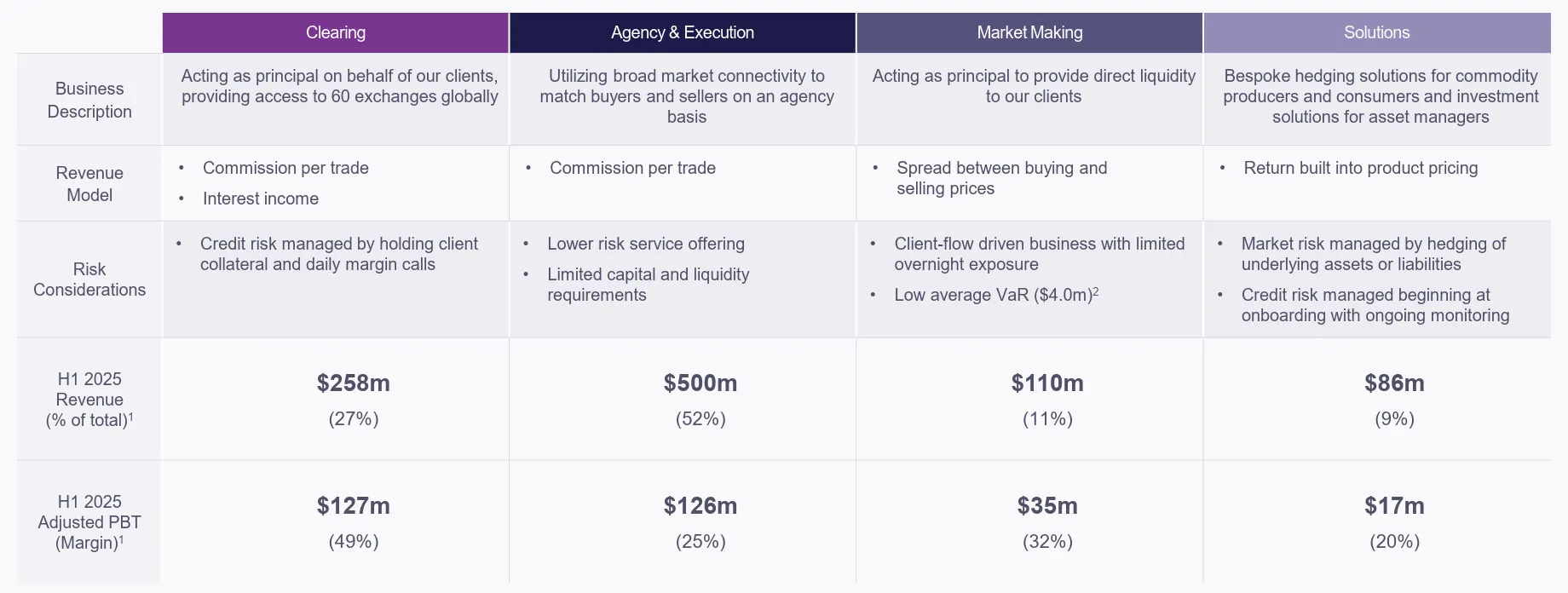
1. Clearing (29% of revenue)
Post-execution verification of trades
Central counterparty service (manages counterparty risk)
Metals (base and precious), agricultural, energy, financial futures
Revenue Sources:
Interest on cash balances held
Commissions from clearing trades
2. Agency and Execution (44% of revenue)
Matching buyers and sellers
Price discovery
Direct transaction facilitation
Revenue Sources:
Spread between buying/selling prices
Commission-based
3. Market Making (13% of revenue)
Principal trading (buying/selling for own account)
Holding positions intraday or overnight
Liquidity provision
Risk Management: Average VaR of $2-3.2 million (very conservative)
4. Hedging and Investment Solutions (10% of revenue)
OTC derivatives
Structured notes
Customized hedging solutions
The Numbers That Initially Attracted Me
EV/EBITDA Multiple: Appeared attractive compared to industry
EBITDA (2024): High, suggesting strong profitability
The Problem: When I dug deeper, that EBITDA was bloated by massive interest income that obscured the real economics.
The Interest Expense Minefield
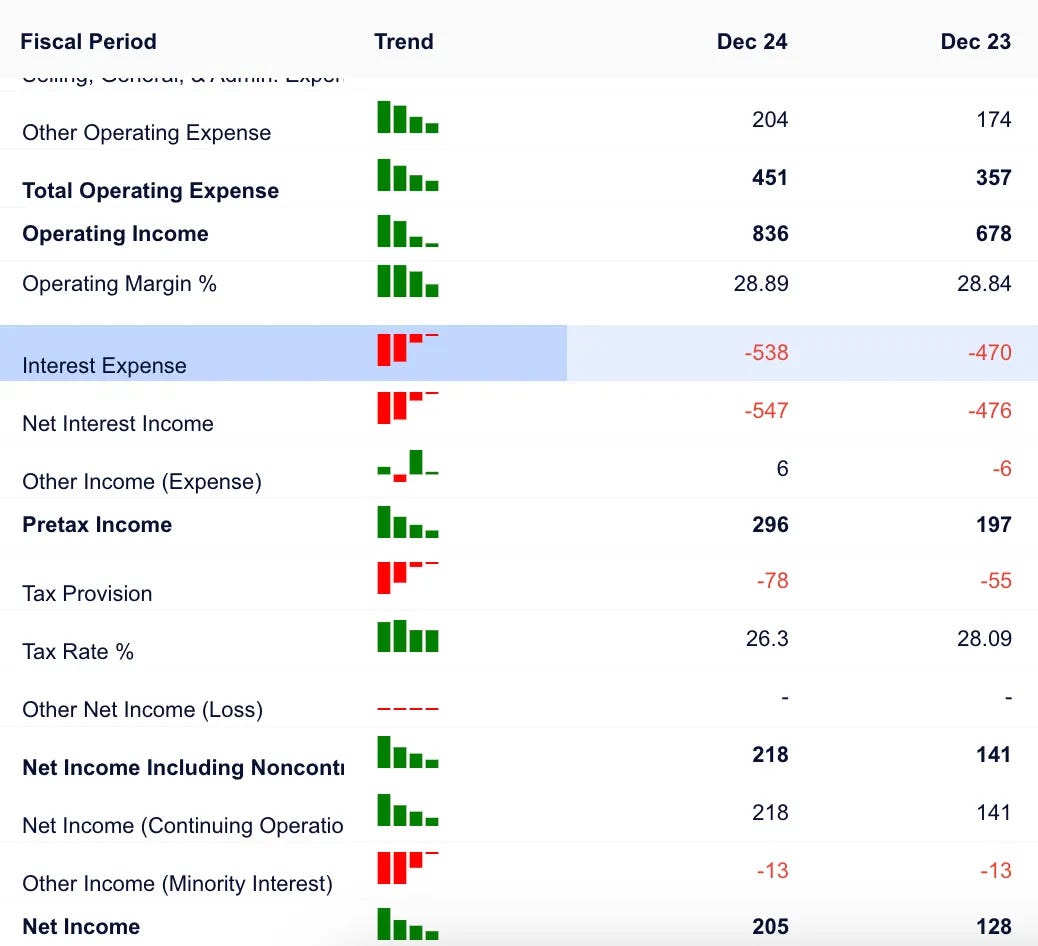
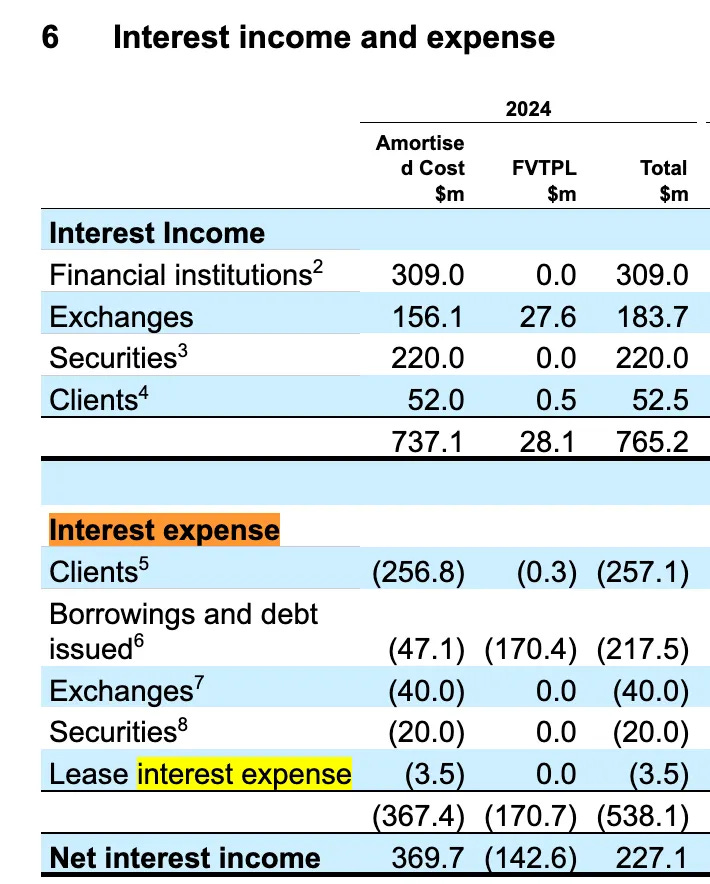
Total Interest Expense (2024): $538 million
Where was this coming from?
Component 1: Client Float Interest
Clients deposit cash as settlement collateral
Marex pays interest on these deposits
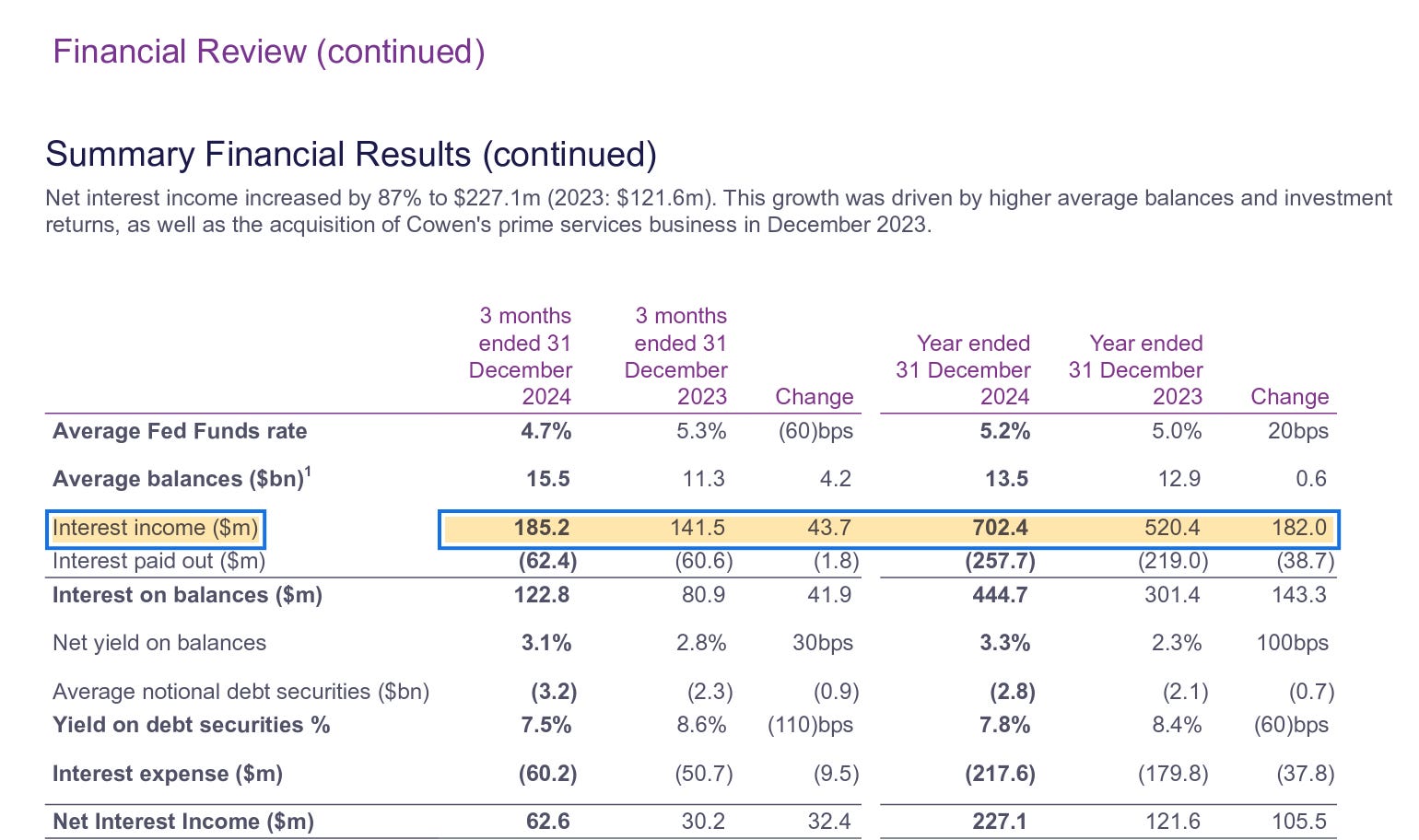
2024: $227M net interest income from $538M interest expense ≈ 42% of gross interest expense
This is normal—it’s the float business. You hold client money and earn a spread.
Component 2: Debt Securities
Structured notes: $170.4M interest expense
Group issuance: $44.7M interest expense
Total debt-related: $215.1M
Component 3: Borrowings
Various credit facilities
Stock lending arrangements
Total debt outstanding: ~$6.5 billion (!)
Effective Interest Rate: 8.6% (2024)

The Debt Breakdown Horror Show
As of June 30, 2025:
Long-term debt: $1,485 million
Short-term debt: $4,588 million (!)
Debt securities: $2,119 million
Stock lending: $4,952 million
Total debt-like obligations: ~$13.1 billion
Against a market cap of $3.8 billion.
This is a company running with 3.4x leverage (debt to market cap). One bad quarter could trigger covenant breaches.
The Operating Cash Flow Illusion
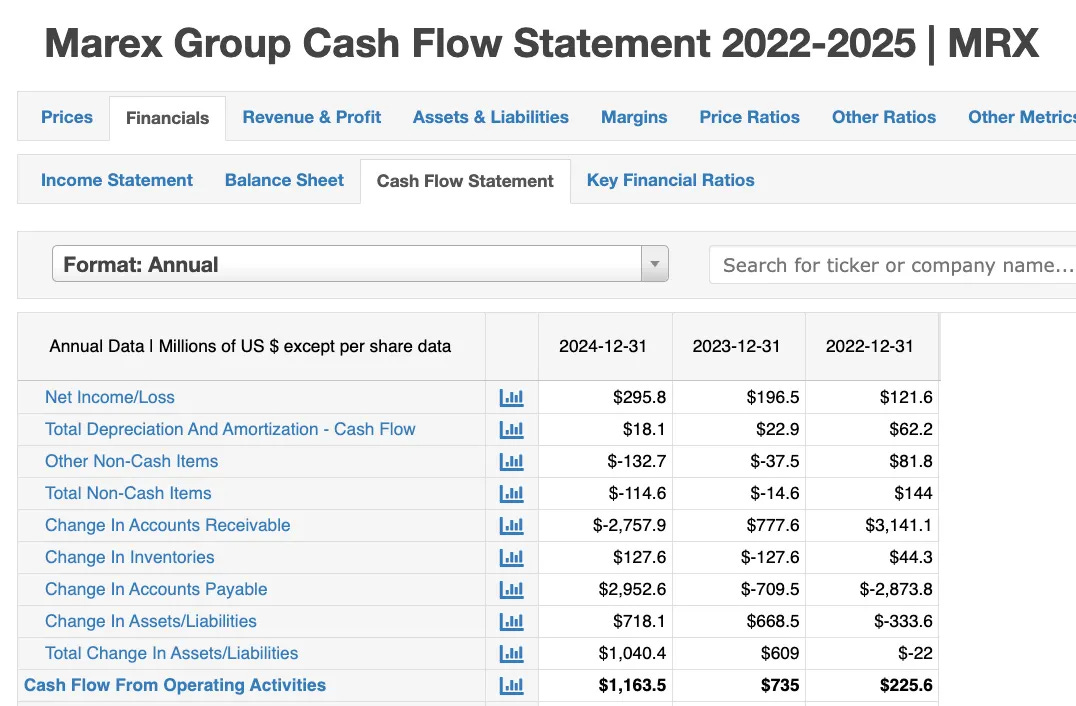
Operating Cash Flow (2024): $1,221 million (looks great!)
But when I decomposed it:
Major Sources:
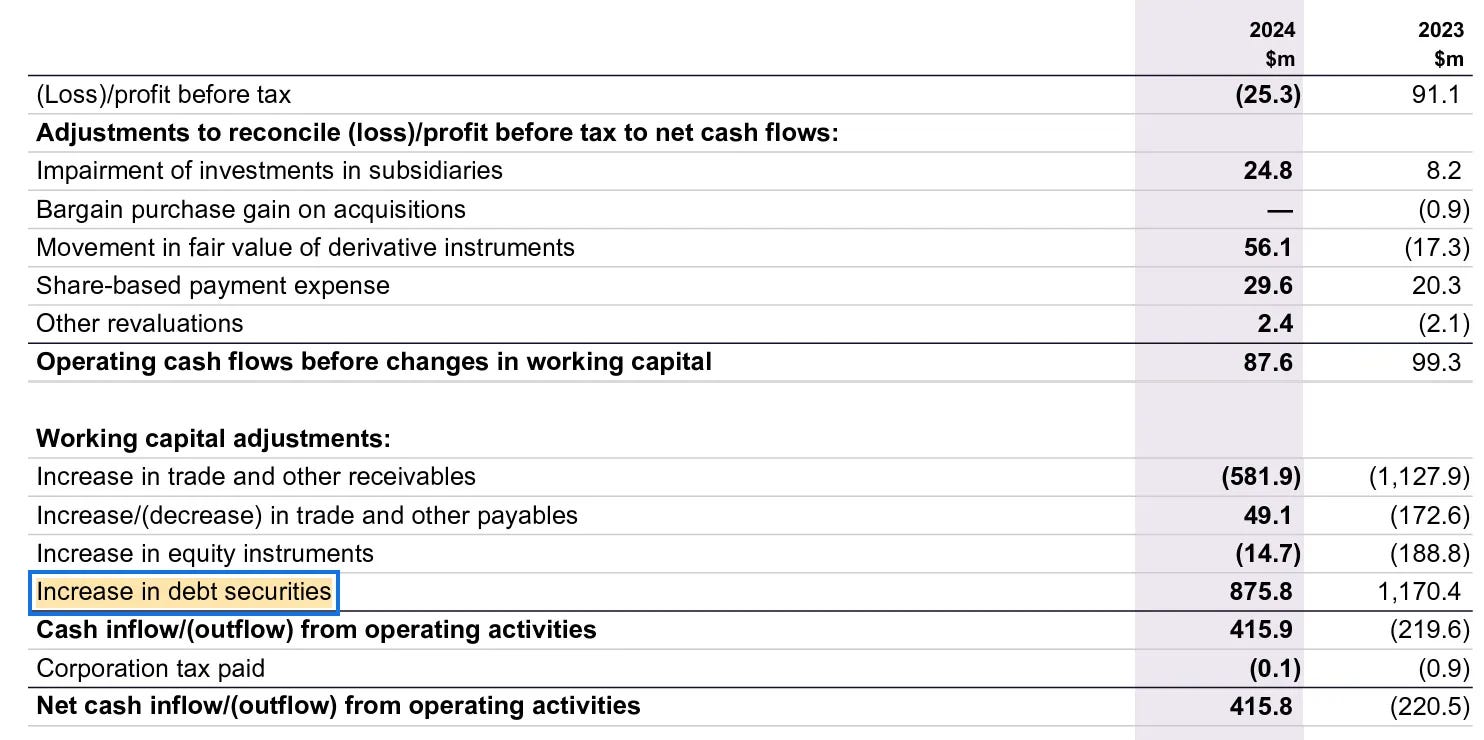
Increase in debt securities issued: Massive contributor
Operating activities (actual business): Much smaller
The Smoking Gun:
“I do not have the confidence that Marex holdings will be able to sustain their interest payments. Interest coverage ratio is only about 1.5x which is pretty risky. Even if we take a look at whether or not OCF can finance interest payments, it is unlikely because a majority of what contributes to the large OCF in the annual report is actually the debt (ˮincrease in debt securitiesˮ) → refer to this”
Translation: The cash flow is a Ponzi scheme. They’re issuing new debt to pay interest on old debt, and calling it “operating cash flow.”
The Short Seller Report
Ningi Research (anonymous short seller) published a damning report alleging:
Allegation 1: Off-Balance-Sheet Manipulation
Secretly controlled fund in Luxembourg (the “Marex Fund”)
Used to inflate earnings and mask risk
Fund holds $930 million in derivatives
Allegation 2: Inflated Revenue Recognition
Selling OTC instruments to own off-balance-sheet fund
Booking immediate “fair value” gains
Creating illusion of profitability
Allegation 3: Fictitious Cash Flow
Classifying debt issuance as “operating cash flow”
Actual operating cash flow in 2023-2024: Negative
Allegation 4: Vanishing Assets
$17 million receivable “created out of thin air”
Subsidiary profit inflated 150% before liquidation
Asset valued at $14.9M sold to Robinhood for $2.5M with no reported loss
$183 million intercompany loan disappeared from filings
Allegation 5: CEO’s Accounting Scandal History
CEO Ian Lowitt allegedly involved in Lehman Brothers’ “Repo 105” accounting scandal
Repo 105 was the accounting trick Lehman used to hide $50B in liabilities before bankruptcy
The Market Making Profitability Anomaly
Ningi’s Smoking Gun:
In 2024, peer firms like Winterflood saw profitability decline alongside collapsing equity trading volumes.
Marex claimed 206% revenue increase despite 86% drop in trading volume in its “Securities” subsegment.
How is this possible?

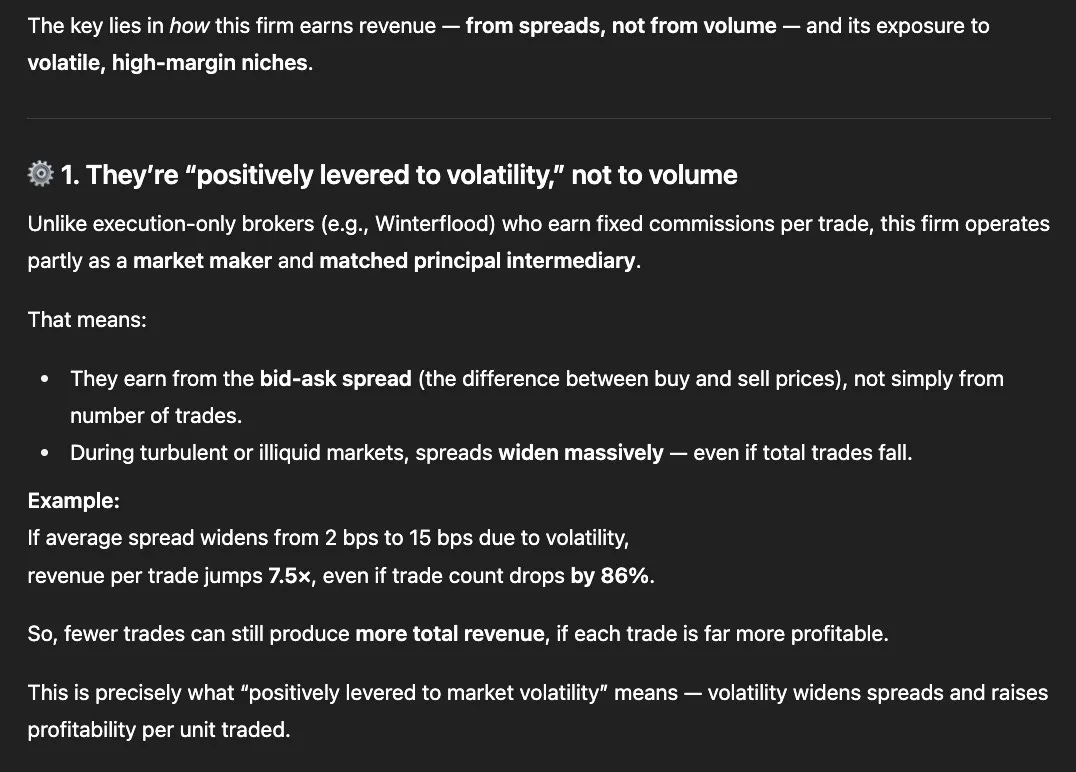
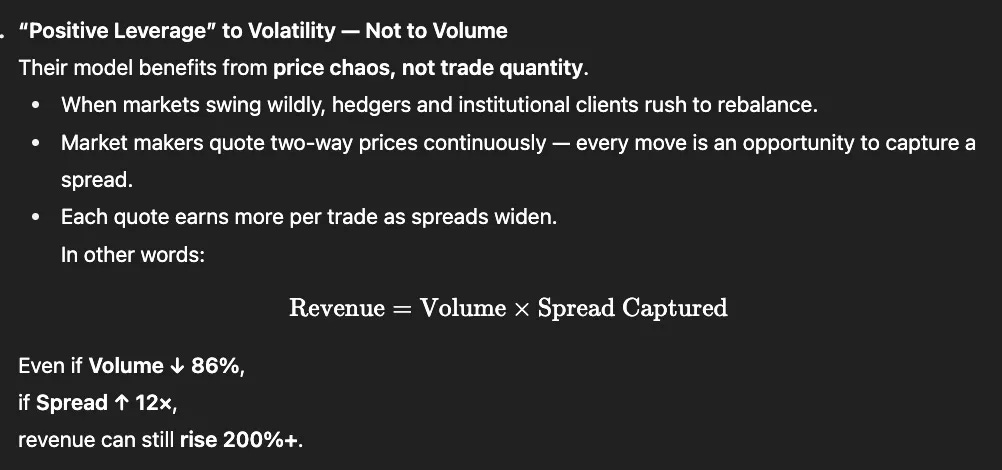
Either:
They’re extraordinary traders (unlikely—markets were down)
They’re taking massive risk (conflicts with their stated VaR)
The accounting is fraudulent (Ningi’s claim)
The EBIT Margin Comparison
To assess whether Marex’s profitability was reasonable, I compared to peers:
Industry Comps:
StoneX: ~79% EBIT margin (different business mix)
BGC Partners: 8-12% EBIT margin range
Marex: 13% EBIT margin
Marex’s 13% is slightly above industry average—not suspicious in isolation. But combined with the other allegations, it raises questions.
The Interest Coverage Reality
Interest Coverage (using EBIT): $215M ÷ $538M ≈ 0.4x (catastrophic)
Interest Coverage (using EBITDA): Better, but still concerning at ~1.5-1.7x
When interest coverage is this low, the company is one bad quarter away from covenant breach or default.
The Management Response
Marex issued a boilerplate response to Ningi’s allegations, basically saying “we disagree and our accounting is proper.”
They didn’t:
Address specific allegations point-by-point
Provide evidence refuting the claims
Explain the Luxembourg fund structure
Clarify the missing intercompany loan
Noteworthy Quote from CEO:
I noted that the CEO “mentioned that it is part of the market and accepts things. Neither does he seem worried about the short term drop in prices, or trying to sell the stock.”
This could mean:
He’s confident the allegations are false (bullish)
He’s resigned to the short attack (neutral)
He knows something we don’t (bearish)
The Intrinsic Value Assessment
If Marex is Legitimate:
The business has real competitive advantages:
Scale and market connectivity
Ring dealer status on LME (privileged position)
BBB credit rating from S&P and Fitch
Relationships with top-tier clients (Goldman Sachs, BNP Paribas, BlackRock)
But even if legitimate, the capital structure is problematic:
High leverage
Low interest coverage
Reliance on continued debt issuance
If Marex is Fraudulent:
Equity goes to zero. Debt holders get cents on the dollar.
The Expected Value Calculation
Bull Case (20% probability): Short report is false, business is real
Fair value: $25-30/share
Return: 2x
Base Case (40% probability): Business is real but overleveraged
Muddle through with moderate growth
Fair value: $15-18/share
Return: 1.3x
Bear Case (40% probability): Accounting irregularities confirmed
Stock crashes to $5-8
Possible delisting, investigations
Return: 0.5x
Expected Value: (0.20 × 2.0) + (0.40 × 1.3) + (0.40 × 0.5) = 1.12x
With a 40% chance of 50% losses, this fails the Kelly Criterion test.
Birds in the Bush: 2x if legitimate
Probability of Success: 20%—too much uncertainty
Time Horizon: 2-3 years if successful, or immediate implosion if fraud confirmed
The Lesson: When Smoke Appears, Don’t Wait for Fire
Short seller reports are often motivated by profit (they’re short the stock), so they’re biased. But that doesn’t mean they’re wrong.
Famous Short Reports That Were Right:
Enron (multiple short sellers warned years before collapse)
Wirecard (short sellers flagged fraud years before $2B hole discovered)
Luckin Coffee (Muddy Waters exposed fabricated revenue)
Nikola (Hindenburg Research exposed lies)
The Pattern:
Short seller publishes detailed allegations
Company issues vague denial
Initial stock drop (30-50%)
Dead cat bounce (retail “buys the dip”)
Investigation begins
Truth emerges
Stock craters 80-99%
The Question: Which stage are we at?
Given:
Ningi’s allegations are specific and detailed
Marex’s response was vague and defensive
The accounting red flags are visible in public filings (not just Ningi’s claims)
Interest coverage is genuinely problematic (1.5x)
CEO’s Lehman Brothers history adds credibility to concerns
I’m not willing to bet that Ningi is wrong.
Verdict: Rejection. Even if the fraud allegations are false (giving them 60% benefit of doubt), the capital structure is too fragile. And if the allegations are true (40% probability), equity gets wiped out. The risk/reward doesn’t justify the position.
As Munger says: “I’ve gotten so that I now use a kind of two-track analysis. First, what are the factors that really govern the interests involved, rationally considered? And second, what are the subconscious influences where the brain at a subconscious level is automatically doing these things—which by and large are useful, but which often malfunction?”
The rational analysis says: fragile capital structure, questionable accounting, specific fraud allegations. The subconscious temptation says: “But look at that EV/EBITDA multiple! What if the short seller is wrong and I make 2x?”
Don’t listen to the subconscious. Listen to the rational analysis.
Learnings To Stick To
1. Dilution is Value Destruction
It doesn’t matter if a company has $200 million in cash if they’re issuing $300 million in equity at pennies on the dollar. Per-share value is what matters, not absolute value.
2. Debt is Fragility
Interest coverage below 3x means one bad year could trigger covenant breaches. Below 2x is playing with fire. Below 1.5x is suicidal.
3. Insiders Always Know First
When CEOs, CFOs, and directors sell 60-80% of vested RSUs immediately, they’re voting with their wallets. Listen.
4. Business Models Matter More Than Operations
You can’t cost-cut your way to success if the fundamental value proposition is obsolete.
5. Timing Is Everything (For Options)
e.g. MDU Resources and Krispy Kreme might be great investments... in 2027. But for LEAPs expiring in 2026, the timeline doesn’t work.
6. Regulatory Red Flags Are Never False Alarms
When annual reports are encrypted, when revenue collapses without explanation, when short sellers publish specific fraud allegations—walk away. The risk isn’t worth the reward.
7. Pandemic Winners Are Usually Losers
Mean reversion is brutal. Companies that benefited from temporary behavioral shifts rarely maintain those gains.
The Philosophy of “No”
Charlie Munger said: “The art of being wise is the art of knowing what to overlook.”
In investing, success comes from:
Saying yes to the right opportunities (important)
Saying no to the wrong opportunities (more important)
Saying no to marginal opportunities (most important)
This article is about #3. None of these companies were obviously terrible (well, maybe CHR and WIMI). Most had legitimate businesses, real assets, and plausible turnaround stories.
But “plausible” isn’t “probable.”
And “interesting” isn’t “investable.”
The Buffett-Munger Standard
Before investing, ask:
Do I understand this business? (Circle of competence)
Does it have a sustainable competitive advantage (Moat)/ does it have a legitimate working business model (for LEAPs)?
Is management trustworthy and aligned? (Stewardship)
Is the price attractive relative to intrinsic value? (Margin of safety)
What could go wrong? (Risk analysis)
For LEAPs specifically, add: 6. Will value be realized in 12-24 months? (Timing) 7. Is the expected return 2x+ to compensate for time decay? (Return threshold)
If the answer to ANY of these is “no” or “uncertain,” walk away.
The Opportunity Cost Mindset
Every dollar invested in these marginal opportunities is a dollar not available for exceptional opportunities.
Your capital is finite. Your attention is finite. Your time is finite.
Protect all three zealously.
When I reject companies, I’m not losing opportunities—I was preserving capital and attention for better opportunities yet to come.
In investing, a 0% success rate at finding investments can be a 100% success rate at avoiding disasters.