
“The difference between successful people and really successful people is that really successful people say no to almost everything.” — Warren Buffett
Introduction: The Power of Subtraction
In the autumn of 1995, Steve Jobs returned to Apple and did something counterintuitive: he killed 70% of Apple’s products. Not because they were bad, but because they distracted from what mattered. This is the central paradox of value creation—the power lies not in what you do, but in what you refuse to do.
Warren Buffett keeps a list of companies he’s studied and rejected. Charlie Munger famously said his success came from “knowing the edge of my circle of competence.” Peter Lynch turned down hundreds of stocks for every one he bought. These aren’t stories about missing opportunities; they’re stories about the disciplined pursuit of only the best opportunities.
Sometimes, the companies we look at are perfectly fine companies at the wrong time or wrong price. A few are fascinating turnarounds that need more time. But all of them failed to answer three brutally simple questions satisfactorily:
1. How many birds are in the bush? (What’s the magnitude of return if the thesis works?)
2. How sure are you? (What’s the probability the thesis actualizes?)
3. How fast till you get them out? (What’s the realistic time horizon?)
For a LEAPs strategy—buying long-dated call options 12-24 months out—I need high conviction on all three. If any answer is unsatisfactory, the idea gets rejected. Period.
What follows is a detailed forensic examination of each rejection, complete with financial analysis, probability assessments, and the specific mechanical failures that killed each thesis. Think of it as a masterclass in what Charlie Munger calls “the psychology of misjudgment”—except here, we catch ourselves before the mistake.
Let’s begin.
KPRX: The Biotech That Might Work (In 5-8 Years)
Date Analyzed: September 29, 2025
Current Price: ~$3.50 | Market Cap: ~$12M
The Science Is Real. The Timeline Isn’t.

Kiora Pharmaceuticals is developing KIO-301, a “photoswitch” drug designed to restore vision in patients with retinal degeneration. This represents cutting-edge science—using light-activated molecules to restore photosensitivity in retinal ganglion cells that have lost their natural photoreceptors.
The Technology
What Are Photoswitches?
In healthy eyes, rod and cone cells detect light and send signals to the brain. In retinal degeneration diseases like retinitis pigmentosa (RP) and choroideremia, these photoreceptors die. But the retinal ganglion cells (RGCs) that transmit signals to the brain often remain alive.
KIO-301 works by making those dormant RGCs light-sensitive again using photochromic molecules. Think of it like installing solar panels on a house that lost its connection to the power grid.
The Phase 1b Data:
Early human trials showed:
Good safety profile (no serious ocular inflammation)
Some patients reported functional vision improvement
Tolerable dosing regimen
This is genuinely promising for a novel mechanism of action.
The Probabilistic Analysis
I ran a full probability tree to assess likelihood of success:
Stage 1: Safety in Larger Trials (Phase 2)
Probability: 65%
Rationale: Phase 1b showed good safety signals; preclinical data supports tolerability
Stage 2: Meaningful Efficacy (Phase 2/3)
Probability: 30-35%
Rationale: This is where most drugs fail. Showing statistically significant, clinically meaningful improvement in vision across broader patient populations is extraordinarily difficult.
The challenge: Photoswitches must:
Convert RGCs reliably across patients
Generate useful spatial/temporal vision (not just light perception)
Sustain effect with tolerable dosing
Work across the disease heterogeneity in RP/choroideremia populations
Stage 3: Regulatory Approval (5-8 years)
Probability: 25-35%
Rationale: Combines success in trials × regulatory acceptance × orphan designation advantage
Orphan drug status helps (fewer patients needed for trials, faster FDA review), but the standard for approval remains high.
Stage 4: Commercialization Within 2 Years
Probability: 10%
Rationale: Too soon given need for Phase 2/3 data and regulatory review
The Financial Reality
Balance Sheet (as of analysis date):
Cash: $14.9 million
Burn rate: ~$10 million annually
Runway: ~18 months
Translation: Another funding round is inevitable before any potential approval.
The Dilution Scenario:
Current shares outstanding: ~3.4 million
Outstanding Options:
Multiple tranches expiring April 1, 2026
Strike price: $2.93
Total shares: ~192,000 (6% dilution)
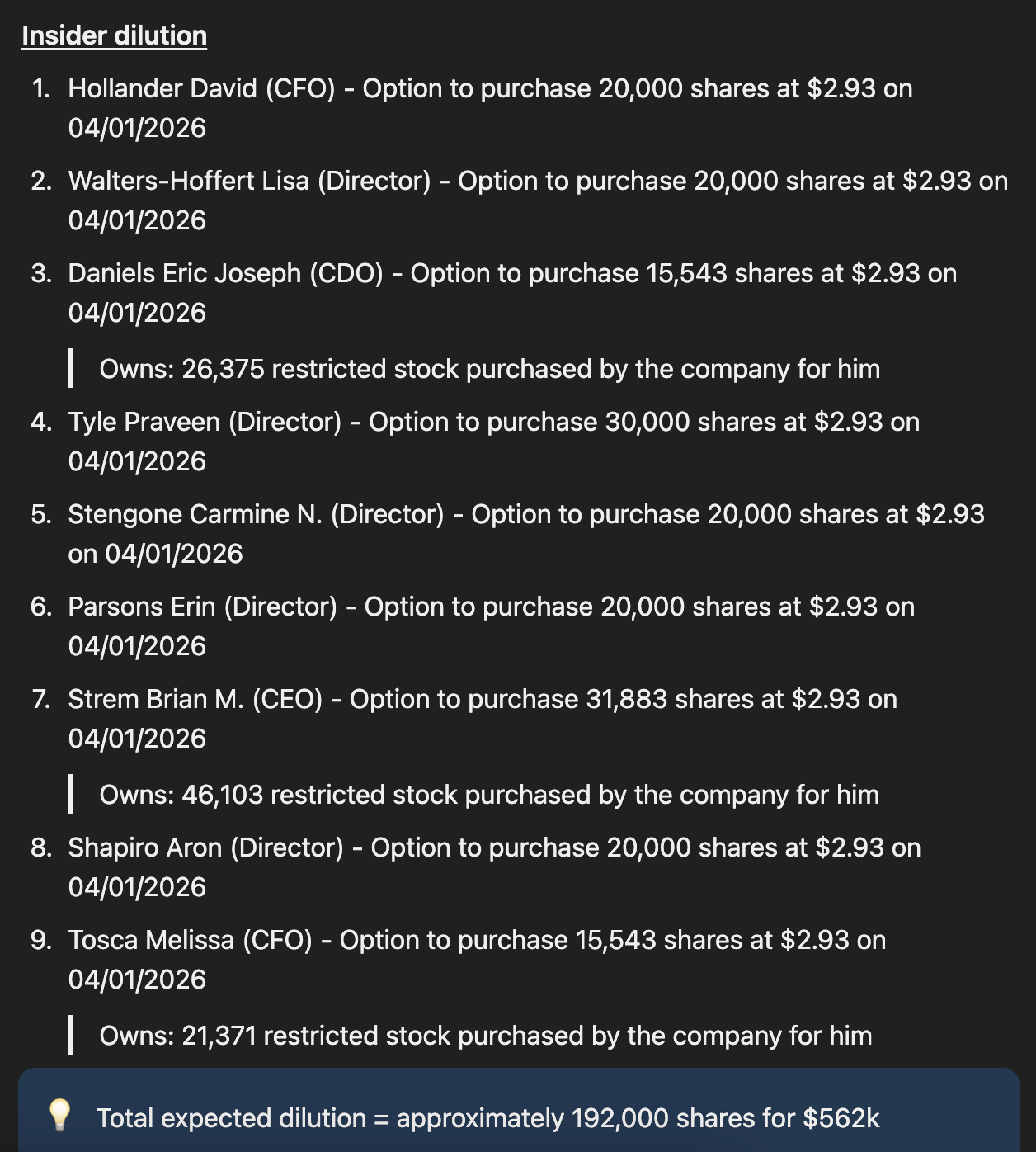
Total expected dilution = approximately 464,000 x 4 parties = approximately 1.8million shares dilutable


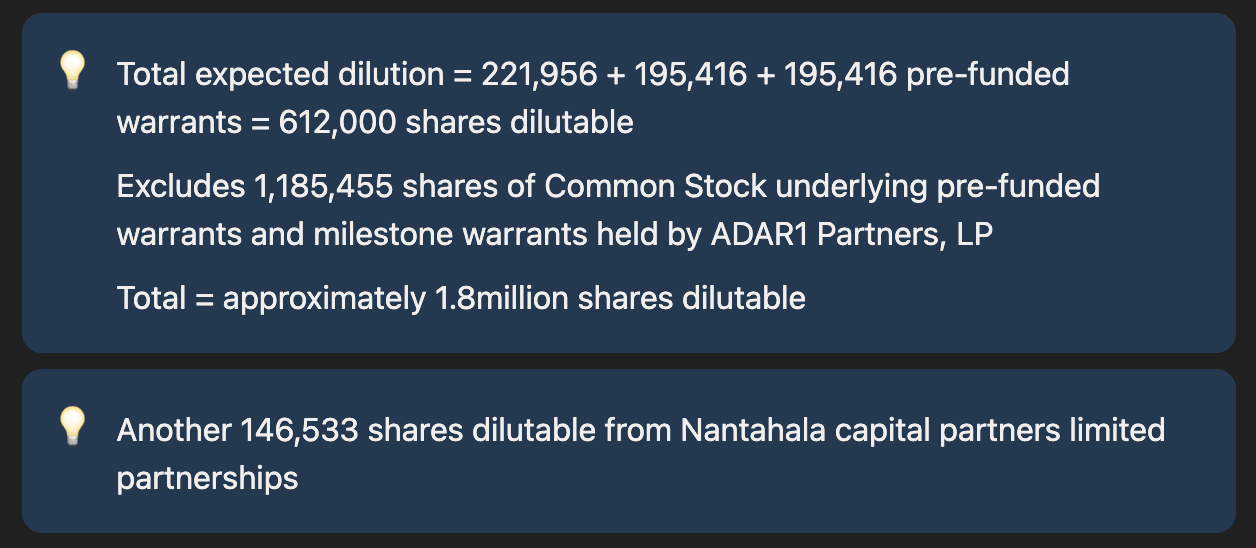
Additional Warrants:
Various series totaling ~1.8 million shares
Another round from ADAR1 Partners: ~1.8 million shares
Nantahala Capital: ~146,000 shares
Total Potential Dilution: 3.4M current + 3.9M new = 7.3 million shares (+115% dilution)
Post-Dilution Liquidation Value:
Cash: $24.7 million (assuming warrants exercised for $9.8M)
Liabilities: $9.8 million
Net: $14.9 million
Per share: $14.9M ÷ 7.3M = $2.04/share
Current price: ~$3.50
You’re paying 1.7x liquidation value for a binary bet on clinical trial outcomes 5-8 years away.
Why Pharma Doesn’t Work for LEAPs in This Case
Typical Pharma Stock Movement on News:
Positive Phase 2 results: +30-100%
Negative Phase 2 results: -50-80%
Approval: +100-300%
Rejection: -70-90%
But here’s the problem for LEAPs:
LEAPs typically expire in 24 months
Phase 2/3 trials take 3-5 years
Regulatory approval takes another 1-2 years
The timing doesn’t align. You’d need to perfectly time buying LEAPs right before positive Phase 2 data—and that’s just gambling on binary events, not investing.
The Opportunity Cost Problem:
Say KPRX succeeds wildly:
Phase 2 succeeds (2026-2027)
Phase 3 succeeds (2028-2029)
FDA approves (2029-2030)
Stock goes 10x from $3.50 to $35
That’s amazing! Except you can’t capture that with 2-year LEAPs purchased now. By the time the value crystallizes, your options have expired.
The Insider Ownership Check
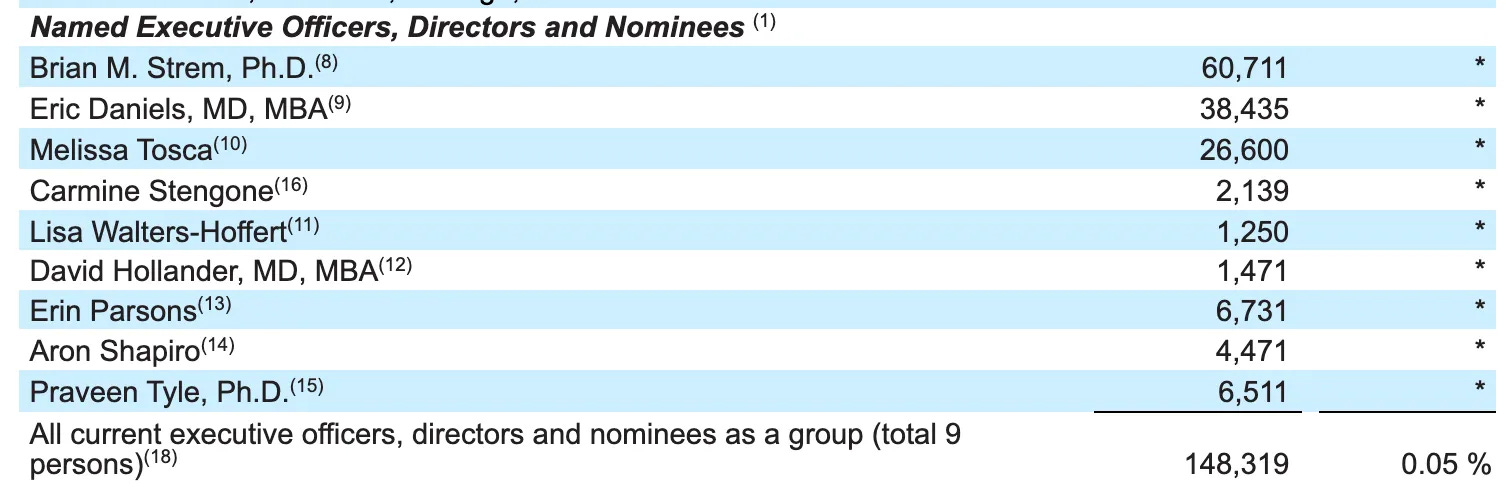
I looked at insider transactions to gauge conviction. Result: Mixed.
CEO Brian Strem: Owns 46,103 restricted shares (purchased by company for him)
CFO Melissa Tosca: Owns 21,371 restricted shares
Total insider ownership: Moderate, but mostly from RSU grants, not open market purchases
When insiders aren’t buying with their own money, treat that as information.
The Clinical Reality Check
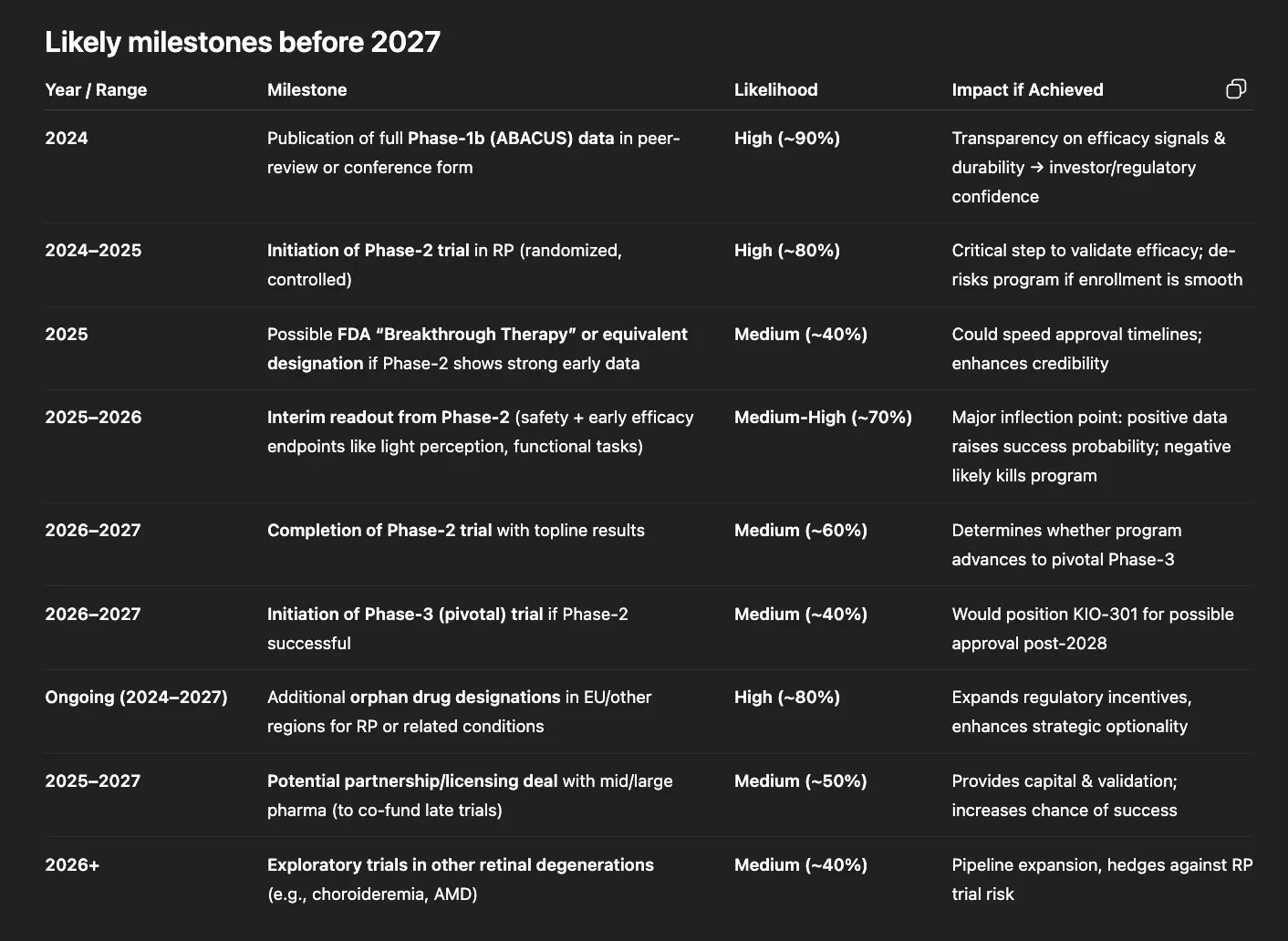
Best Case Scenario:
Phase 2 starts: 2025-2026
Phase 2 results: 2027
Phase 3 starts: 2027
Phase 3 results: 2029
FDA review: 2029-2030
Commercial launch: 2030+
What’s not likely before 2027:
Regulatory approval (10% probability)
Phase 3 completion
Partnership/licensing deals (buyers wait for de-risked data)
Without these catalysts, the stock muddles around burning cash and diluting shareholders through multiple rounds.
Birds in the Bush: 3-10x if successful
Probability of Success: 10-25% depending on timeframe
Time Horizon: 5-8 years to approval, 2 years is fantasy
The Lesson: Match Strategy to Asset Class
Verdict: Rejection. Not because KPRX is a bad company (the science is interesting), but because the strategy mismatch is fatal. This might work as a small speculative equity position if you can afford to hold 8+ years. It absolutely doesn’t work as a LEAPs play.
Simultaneously, it does not meet my very simple criteria of being a drug platform which is able to sustain itself of working capital without further raising for capital.
As Munger says: “The game of investing is not won by being clever, but by being rational and sticking to your process.”
Pharma + LEAPs = violating process = rejected.
Learnings To Stick To
1. Dilution is Value Destruction
It doesn’t matter if a company has $200 million in cash if they’re issuing $300 million in equity at pennies on the dollar. Per-share value is what matters, not absolute value.
2. Debt is Fragility
Interest coverage below 3x means one bad year could trigger covenant breaches. Below 2x is playing with fire. Below 1.5x is suicidal.
3. Insiders Always Know First
When CEOs, CFOs, and directors sell 60-80% of vested RSUs immediately, they’re voting with their wallets. Listen.
4. Business Models Matter More Than Operations
You can’t cost-cut your way to success if the fundamental value proposition is obsolete.
5. Timing Is Everything (For Options)
e.g. MDU Resources and Krispy Kreme might be great investments... in 2027. But for LEAPs expiring in 2026, the timeline doesn’t work.
6. Regulatory Red Flags Are Never False Alarms
When annual reports are encrypted, when revenue collapses without explanation, when short sellers publish specific fraud allegations—walk away. The risk isn’t worth the reward.
7. Pandemic Winners Are Usually Losers
Mean reversion is brutal. Companies that benefited from temporary behavioral shifts rarely maintain those gains.
The Philosophy of “No”
Charlie Munger said: “The art of being wise is the art of knowing what to overlook.”
In investing, success comes from:
Saying yes to the right opportunities (important)
Saying no to the wrong opportunities (more important)
Saying no to marginal opportunities (most important)
This article is about #3. None of these companies were obviously terrible (well, maybe CHR and WIMI). Most had legitimate businesses, real assets, and plausible turnaround stories.
But “plausible” isn’t “probable.”
And “interesting” isn’t “investable.”
The Buffett-Munger Standard
Before investing, ask:
Do I understand this business? (Circle of competence)
Does it have a sustainable competitive advantage (Moat)/ does it have a legitimate working business model (for LEAPs)?
Is management trustworthy and aligned? (Stewardship)
Is the price attractive relative to intrinsic value? (Margin of safety)
What could go wrong? (Risk analysis)
For LEAPs specifically, add: 6. Will value be realized in 12-24 months? (Timing) 7. Is the expected return 2x+ to compensate for time decay? (Return threshold)
If the answer to ANY of these is “no” or “uncertain,” walk away.
The Opportunity Cost Mindset
Every dollar invested in these marginal opportunities is a dollar not available for exceptional opportunities.
Your capital is finite. Your attention is finite. Your time is finite.
Protect all three zealously.
When I reject companies, I’m not losing opportunities—I was preserving capital and attention for better opportunities yet to come.
In investing, a 0% success rate at finding investments can be a 100% success rate at avoiding disasters.