
Picture this: a single telecommunications company — the dominant one — serves over 200 communities scattered across the largest state in the United States. Alaska. A state with just over one person per square mile. A state where 39% of residents are underserved by broadband. A state where, until recently, some villages received internet via satellite links so slow that students sat outside school buildings at night in freezing temperatures, huddled around faint Wi-Fi signals, trying to finish their homework.
That company is GCI Liberty (Nasdaq: GLIBK), and on paper, it reads like a textbook monopoly play. Geography locks out the competition. The customers have nowhere else to go. The government pours hundreds of millions of dollars in subsidies into the market every single year — and GCI captures the lion’s share.
So why, after a thorough analysis, did I say no?
This is not a story about a bad company. GCI has invested $4.7 billion in its Alaskan network over 45 years. It connects hospitals to the outside world. It carries the voices of Indigenous communities across mountain ranges and frozen tundra. What makes this a fascinating case study is precisely that the business sounds compelling — and yet, when you strip away the narrative and look at the numbers, the economics do not hold up to the scrutiny I demand before deploying capital.
To understand why, we need to apply three questions to every investment opportunity. The first: How many birds are in the bush? The second: How sure are you? The third: How long until you get them out? If any single question fails, the idea is rejected.
Let’s walk through them — together.
Part One: How Many Birds Are in the Bush?
The size of the prize — measured not by narrative, but by fact.
The Alaska Opportunity: Real, But Smaller Than It Sounds
The first question an investor must ask is deceptively simple: what is the total addressable value sitting inside this business, and how much of it can actually be captured?
Alaska’s population stands at roughly 734,000 people. Forty percent of them — close to 294,000 — live in the Anchorage metro area. The remaining 440,000 are spread across a landmass larger than the entire contiguous United States combined. This is the single most important fact about GCI’s business, because it dictates everything: the cost of infrastructure, the revenue per customer, and the long-term ceiling on growth.
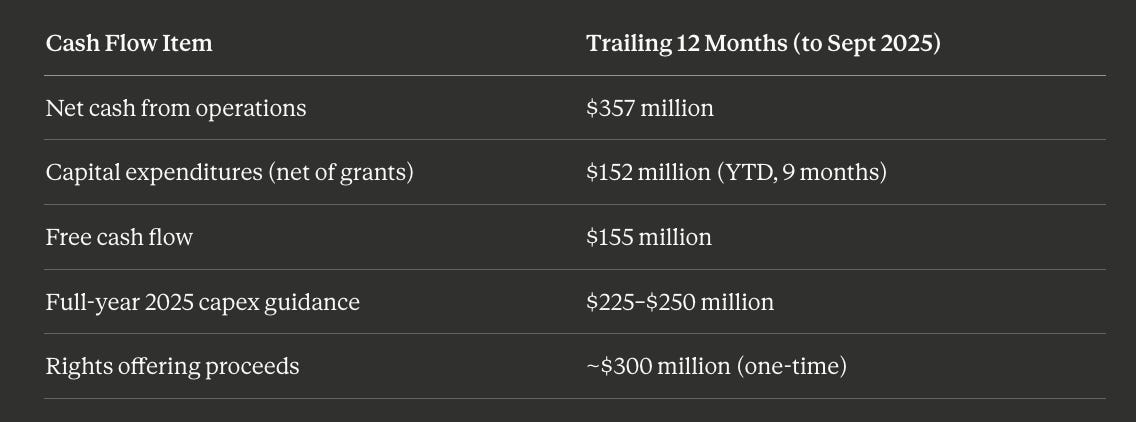
GCI Liberty reported quarterly revenue of $257 million in Q3 2025, which annualises to roughly $1.03 billion. On a trailing twelve-month basis, the company generated $357 million in net cash from operations and $155 million in free cash flow. These are not insignificant numbers for a regional telecom. But context matters.
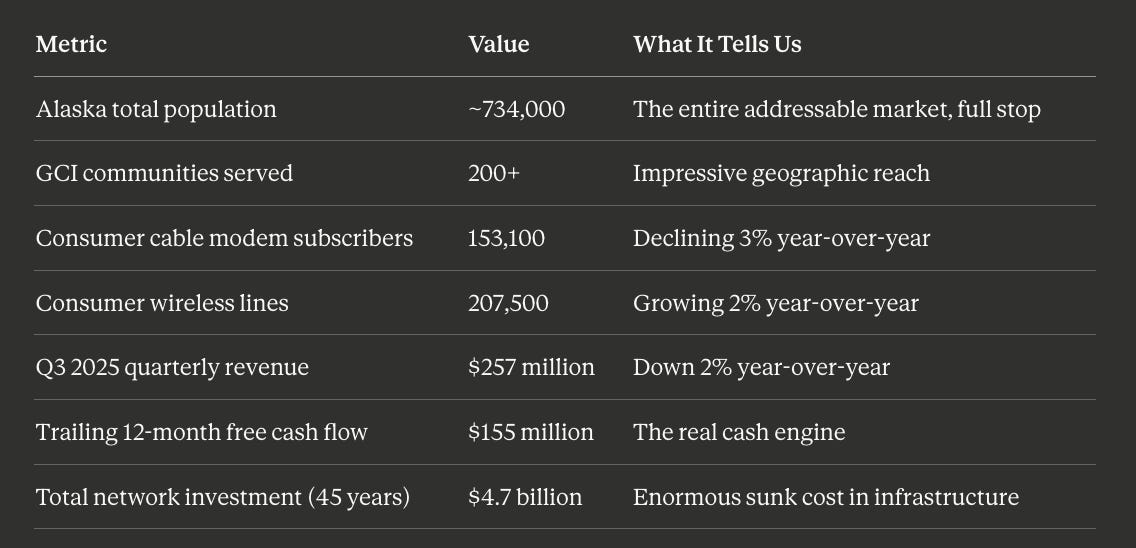
The bird count here is real but bounded. Alaska is not growing at a pace that will meaningfully expand GCI’s customer base. There is no “next state” to expand into. The total pie is what it is — and the company’s own subscriber numbers show that the pie is, in some segments, actually shrinking.
The Revenue Breakdown: Where the Money Actually Lives
GCI’s customer base breaks into four distinct segments, each with very different economics and very different vulnerability to disruption.
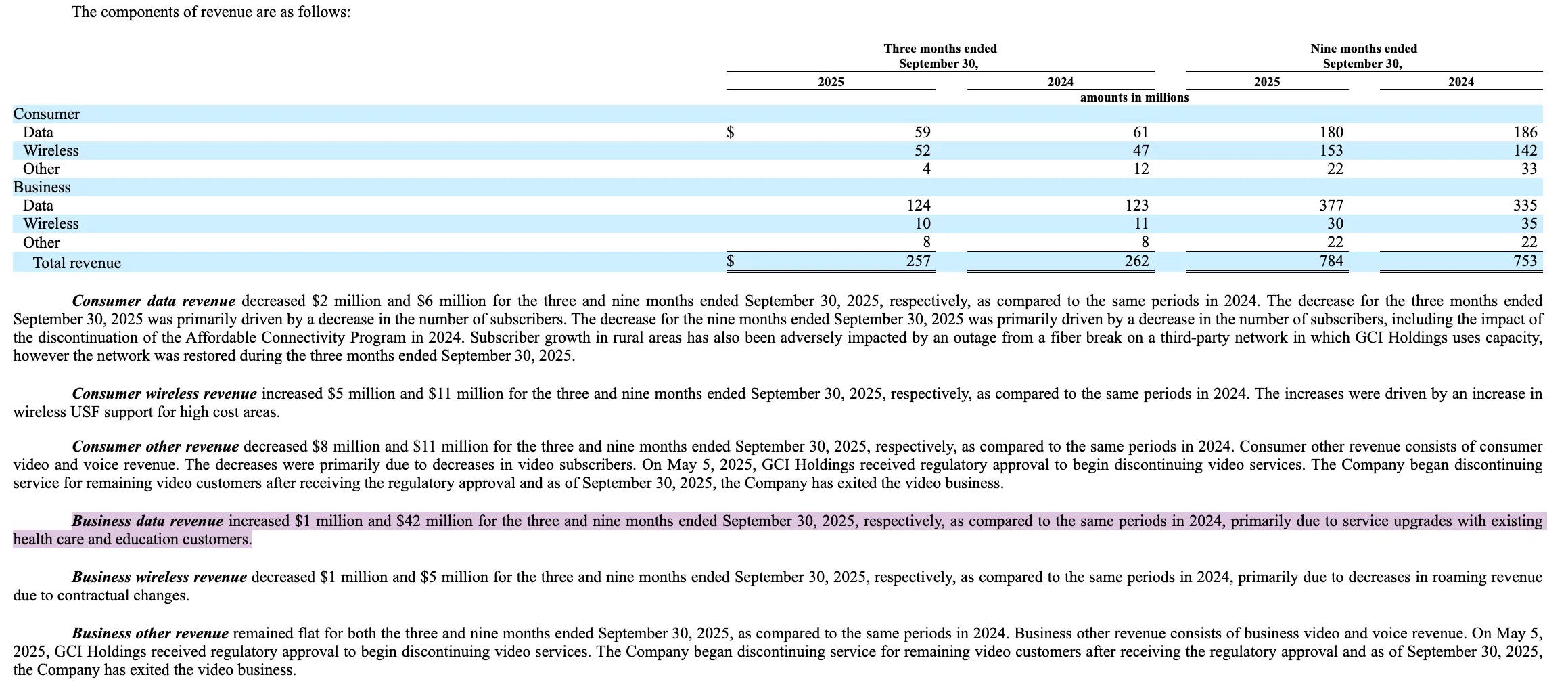
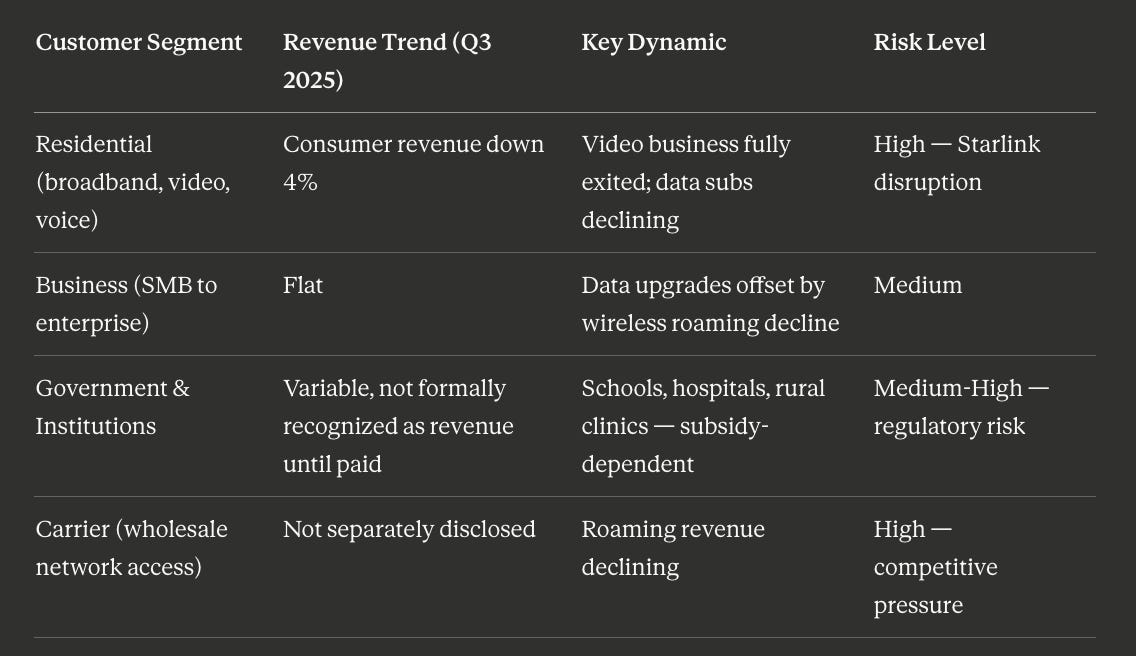
The residential segment — historically the backbone of consumer telecom — is in active decline. GCI exited its video business entirely by September 30, 2025, completing what management described as a “transition to a pure play broadband connectivity provider.” That sounds like strategic clarity. But it also means the company shed an entire revenue stream and now has fewer products to cross-sell to each household.
The Unsatisfied Revenue Pipeline: A Fact, Not a Forecast
One thing GCI disclosed in its filings that deserves attention is its backlog of contracted but unrecognised revenue — performance obligations not yet fulfilled. This is not a prediction. It is money already owed under existing contracts:
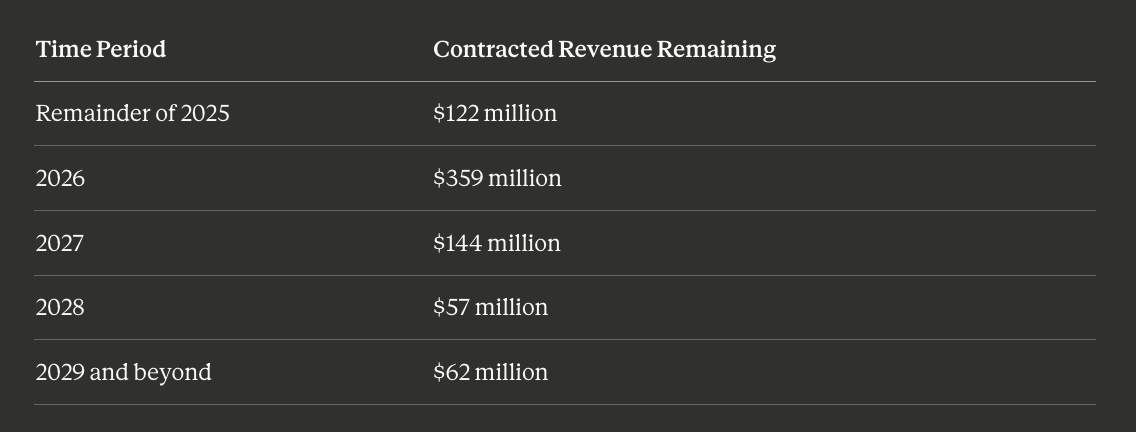
On the surface, this looks encouraging — particularly the $359 million slug in 2026. But notice the steep cliff after that. The pipeline thins dramatically from 2027 onward, and the “2029 and beyond” bucket is a mere $62 million. This is not a compounding growth engine. It is a business with a defined, near-term revenue base that requires constant renewal.
The Dilution Event: What Really Happened
In November 2025, GCI Liberty launched a rights offering — a subscription-based share issuance to raise approximately $300 million in fresh capital. Existing shareholders received the right to purchase new Series C shares at $27.20 each.
Here is the arithmetic of what this actually meant for shareholders:
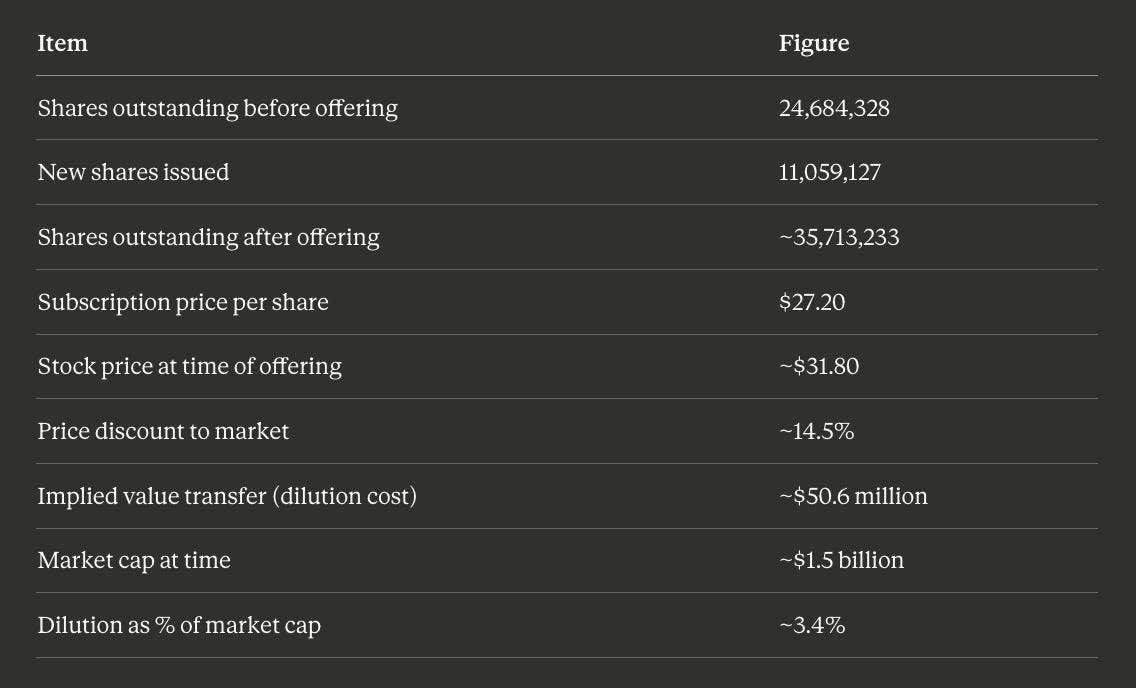

A 3.4% dilution is manageable in isolation. But the question is not whether this single event is survivable — it is what it reveals about the company’s capital needs. GCI needed $300 million. It did not generate it internally. It went to the market. This is a company that, despite a dominant geographic position, cannot fully fund its own growth from operations. The $140 million in provisional BEAD grants from the Alaska Broadband Office will help, but grants are not guaranteed revenue — they come with build-out obligations, regulatory strings, and political risk.

Note that there is also 10,000 shares of preferred stock worth $1,000 per share (excluding any accrued and unpaid dividends), with a yield of 12% ($120 per share x 10,000 = $1,200,000) and $10,000,000 in liquidated value - which is also fairly small relative to the value of the company (0.6% of market cap). However, the behaviour to do so and “in what context?” is something to take note of.
The Insider Purchases: Signal or Noise?

One detail that many investors seized upon was the significant insider buying activity around the time of the spin-off and rights offering. John C. Malone — the legendary chairman — indicated he intended to fully exercise both his basic subscription and oversubscription privileges in the rights offering.
Insider buying can be a powerful signal. But it must be read carefully. Malone’s purchase was made at $27.20 — a structured discount to market price, through a rights offering he helped design as chairman.
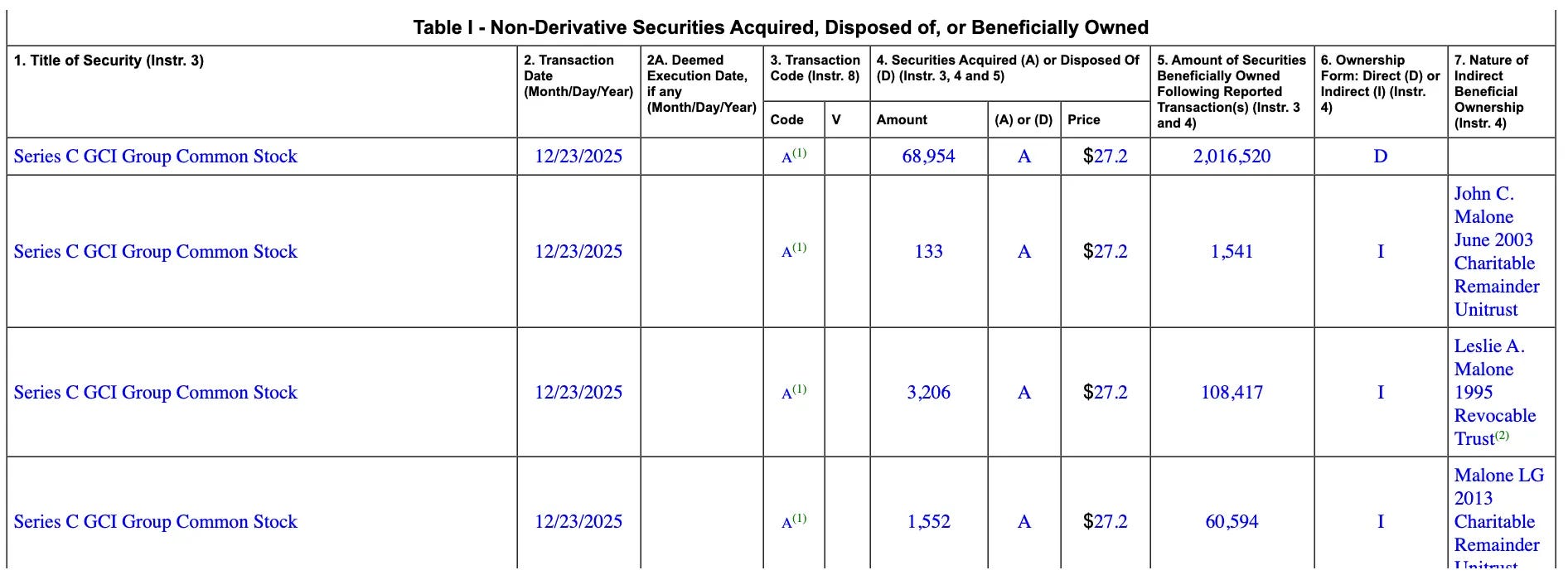
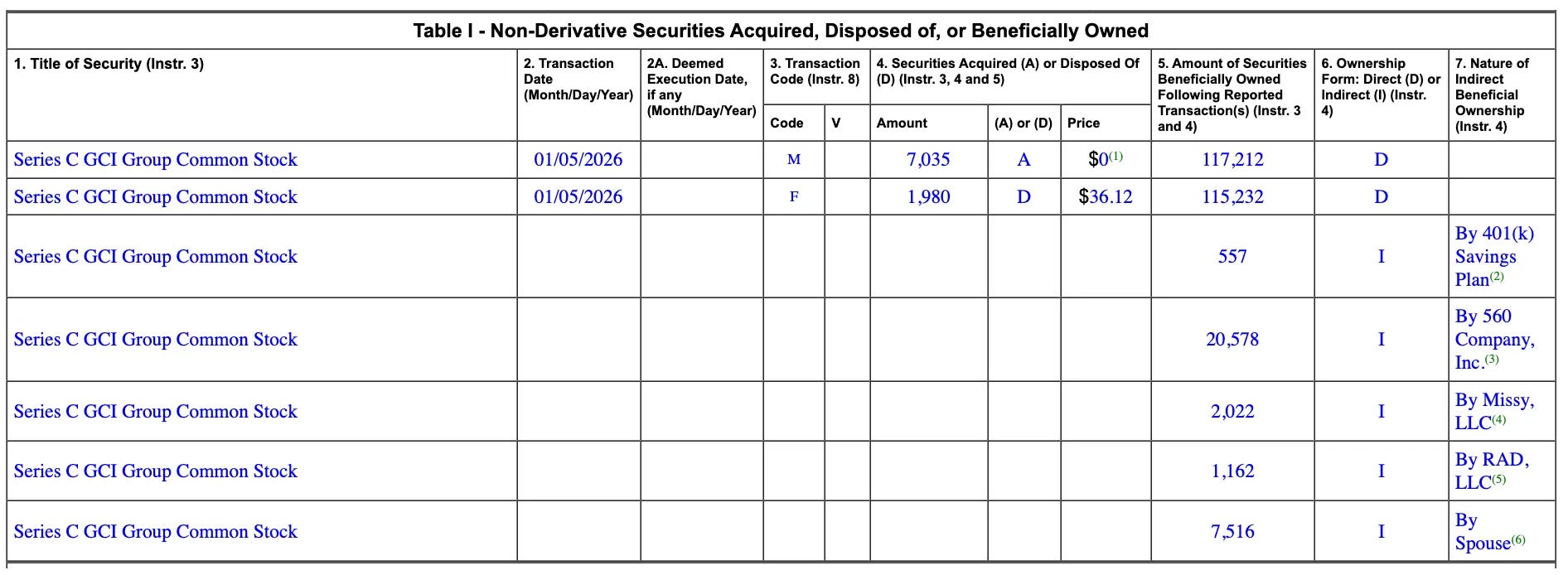
CEO Ron Duncan received shares primarily through RSUs — restricted stock units, which are compensation, not open-market conviction bets. The distinction matters: buying at a designed discount inside a corporate structure you govern is fundamentally different from an executive writing a personal check in the open market because they believe the stock is cheap.
Part Two: How Sure Are You?
The confidence test — built on facts, not faith.
The $525 Million Question: What the Impairment Really Says
If there is one number that defines the current chapter of GCI Liberty’s story, it is $525 million. In Q3 2025, the company recorded a non-cash impairment charge consisting of $108 million in goodwill write-down and $417 million in intangible asset impairment.
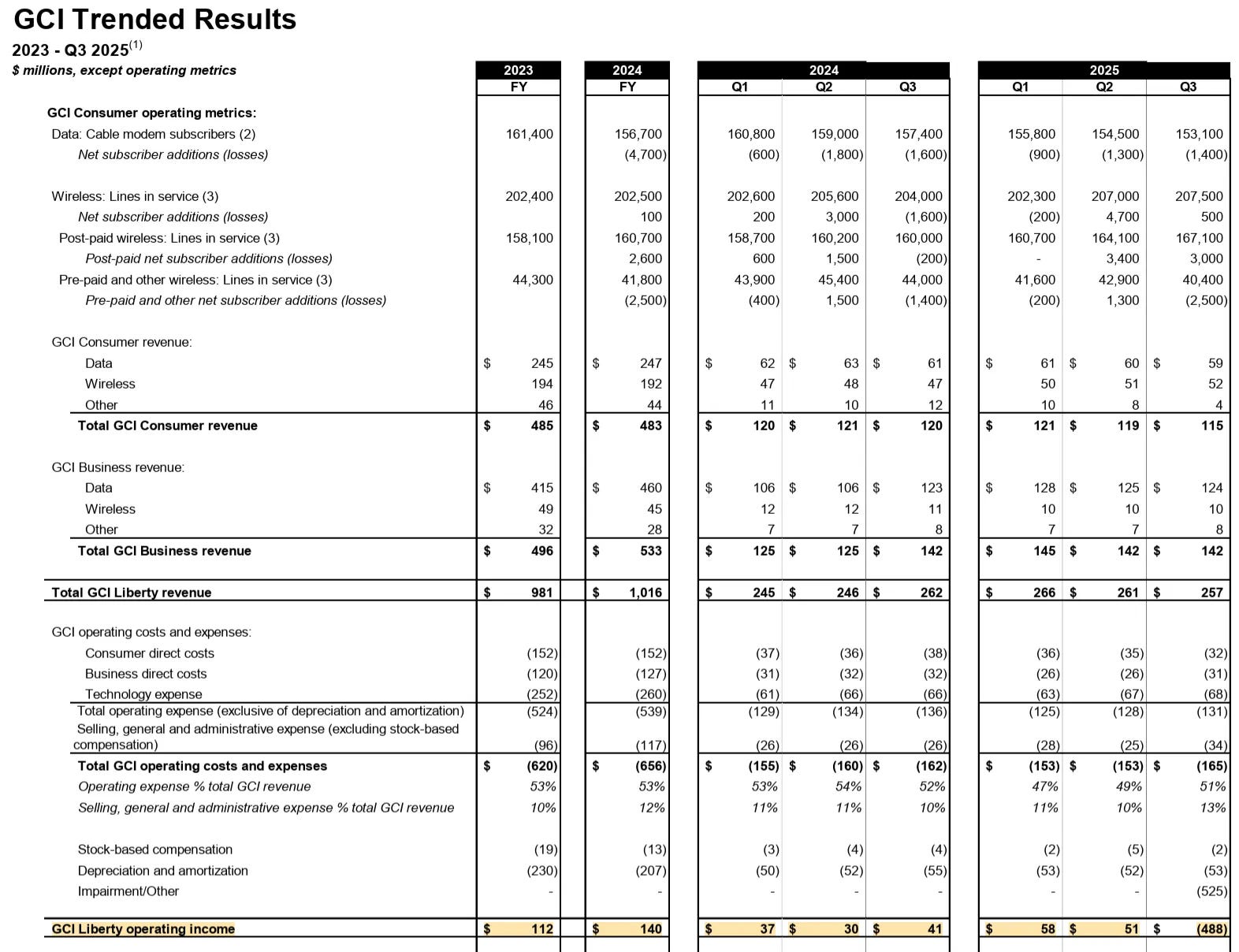
The company’s official explanation is that these intangible assets were originally acquired during Liberty Broadband’s 2020 purchase of GCI Liberty and were “re-evaluated during the spin-off in July 2025.” That is technically accurate. But it obscures a deeper accounting problem that should make any disciplined investor uncomfortable.
The bulk of this intangible asset value — roughly one-third of GCI’s total asset base — was attributed to what the company calls “cable certificates.” These are official documents that verify installed copper or fibre optic cabling meets specific industry performance standards (such as ANSI/TIA or ISO/IEC). They confirm that cabling has been tested, complies with required specifications, and can deliver expected speeds.
Here is the critical issue: cable certificates are time-bound. They expire. They require periodic re-certification. They do not compound in value over time. They do not create a lasting competitive moat — any provider with the same physical infrastructure can obtain identical certification. And yet, Liberty Broadband capitalised them as a long-lived intangible asset on GCI’s balance sheet without amortising them at a rate that reflected their actual useful life.
The result? A massive one-time write-down that wiped out over a third of a billion dollars in reported asset value in a single quarter.
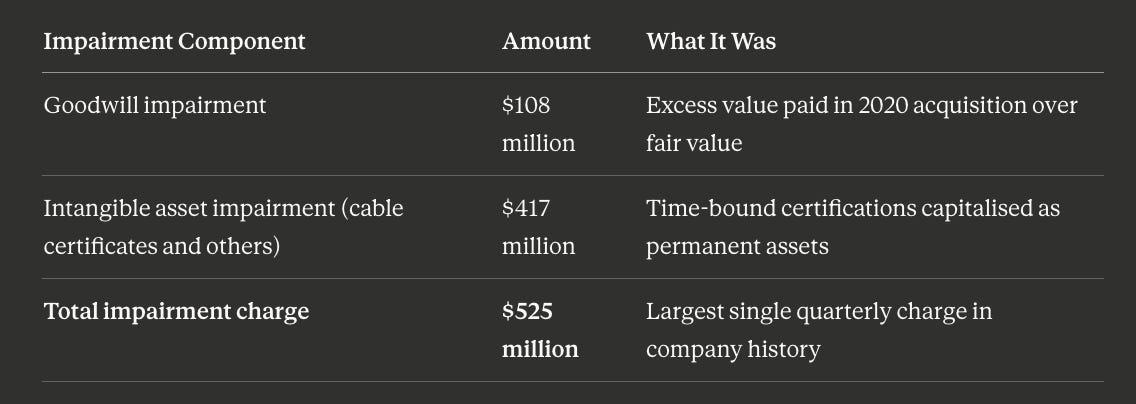
This is not simply an accounting quirk. It is a window into how this company — and its predecessor owner, Liberty Broadband — valued and presented its own assets. When a company capitalises a time-limited certification as though it were a permanent asset and then writes it off in a lump sum years later, it raises the question: what else on the balance sheet is being measured with the same generosity?

Reimbursement of tax and acquisition from associated party “liberty broadband”, decreases deferred tax liability and might temporarily raise earnings. Simultaneously, benefits such as the major $91 million reimbursement inflates the value of the balance sheet (albeit not very significant). This is (to be honest) not something that i am confident in nor in my circle of competence, as I still find that I lack an understanding/ clarity of the situation. Hence, it adds a +1 to my “why avoid it”.
The Balance Sheet: Book Value and Its Limits
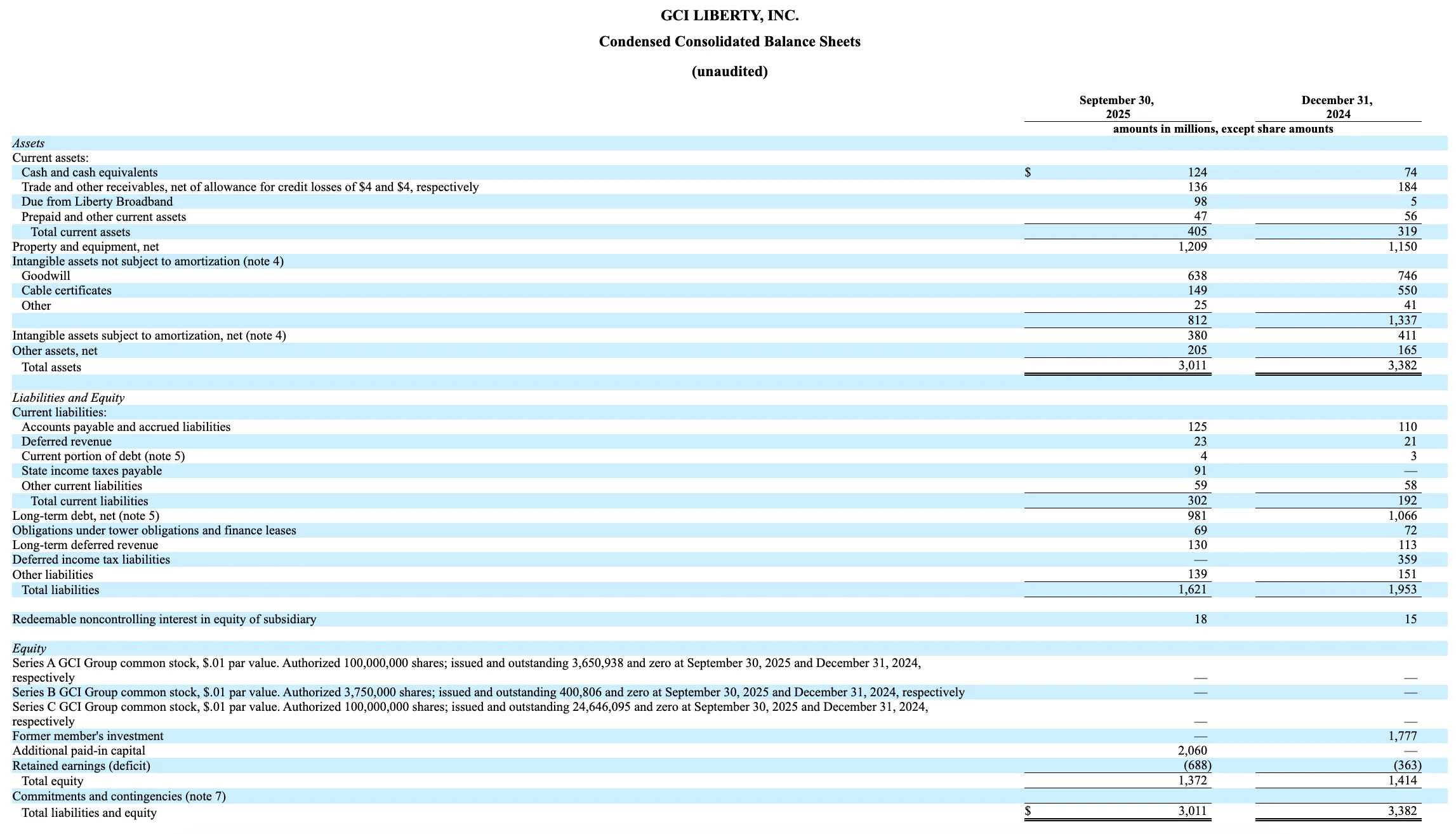
GCI Liberty’s book value at the time of analysis stood at approximately $1.39 billion, or roughly $38.90 per share on a fully diluted basis. At the time of writing, the stock was trading below book value — which is, on the surface, the kind of discount that value investors love.
But book value is only as reliable as the assets that compose it. We have just seen $525 million evaporate from that ledger in a single quarter. The remaining intangible assets — even after the write-down — still form a meaningful portion of total assets. The question is not whether the stock is cheap relative to book. The question is whether the book itself can be trusted.

The $40 Million Fraud Settlement: Character and Regulatory Risk
No analysis of GCI’s confidence level can ignore the 2023 settlement with the U.S. Department of Justice, in which GCI Communications Corp. agreed to pay $40,242,546 to resolve allegations that it violated the False Claims Act.
The allegations were specific and serious. Between 2013 and 2020, GCI allegedly failed to comply with FCC regulations governing how telecommunications companies calculate prices for subsidy payments under the Rural Health Care Program — a federal programme that distributes over $570 million annually to help rural healthcare providers with telecommunications costs. The company was accused of knowingly inflating prices, violating competitive bidding regulations, and causing a rural health care provider — Eastern Aleutian Tribes Inc. — to submit inflated claims to the FCC.
The case was brought to light by Robert Taylor, GCI’s own former Director of Business Administration, who filed a whistleblower complaint under the False Claims Act in 2019. Taylor received $6.4 million as his share of the recovery. Of the $40.24 million settlement, $26 million was restitution paid directly to the FCC.
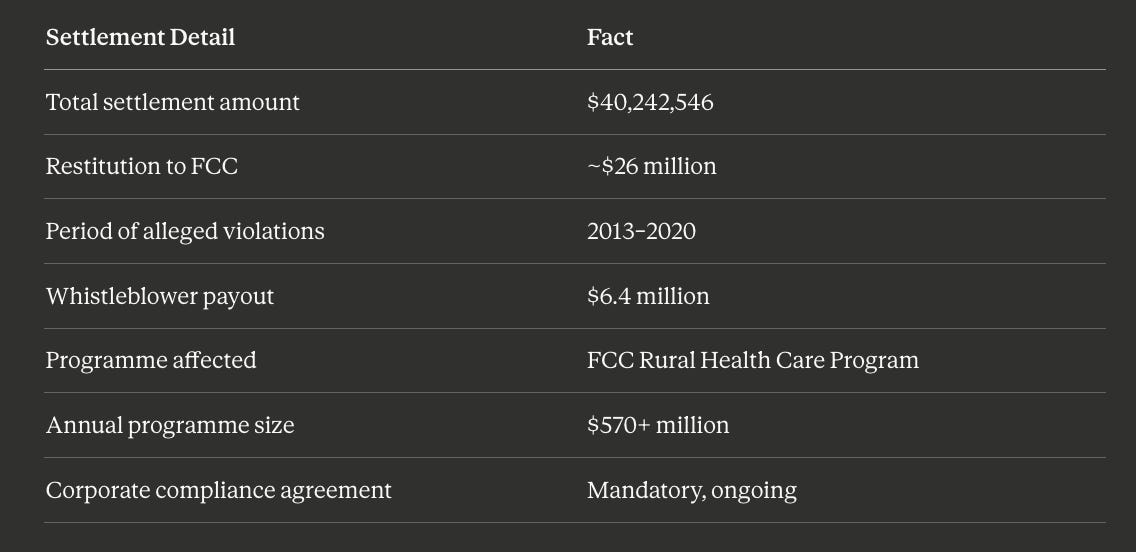
Why does this matter for a forward-looking investment thesis? Because GCI’s government and institutional segment — hospitals, schools, rural clinics — is one of its core revenue pillars. And that segment is funded, in large part, by the very federal programmes that GCI was found to have defrauded. The company now operates under a mandatory corporate compliance agreement with the FCC. Any future regulatory scrutiny of this segment — any tightening of subsidy rules, any expansion of the definition of “eligible telecommunications carrier” e.g. to include satellite providers or influence cost profit economics — could directly impact GCI’s revenue base.
Also note:

The Starlink Disruption: Not Hypothetical. Already Happening.
The most consequential competitive threat to GCI Liberty is not another terrestrial telecom. It is SpaceX’s Starlink — and unlike most competitive threats, this one is already measurable.
Alaska has 32 telecommunications carriers, but GCI has long dominated as the largest. Its dominance was partly earned through decades of infrastructure investment, and partly maintained through a structural advantage: the FCC’s definition of an “eligible telecommunications carrier” required voice service capability, which excluded satellite-only providers from accessing roughly one-third of federal broadband subsidies. This effectively locked Starlink out of the government funding pipeline.
But Starlink does not need subsidies to compete on price and speed. In rural Alaska, Starlink terminals cost $600 upfront with a monthly subscription of approximately $110 — often cheaper than comparable GCI service. An Alaska Starlink Users Facebook group now has over 15,000 members. Alaska Native corporations have begun purchasing Starlink terminals in bulk for their shareholders. The Kuskokwim Corp. purchased systems for 450 households, covering the terminal cost entirely.
GCI’s own subscriber data tells the story from the inside: consumer cable modem subscribers declined 3% year-over-year to 153,100 as of Q3 2025. Consumer revenue fell 4%. The company acknowledges the competitive pressure, and has responded with two major fibre projects — an 800-mile subsea cable from Kodiak to Unalaska and a network connecting 13 communities in the Yukon-Kuskokwim Delta. But these are multi-year, capital-intensive commitments that will not stop the bleeding in the near term.
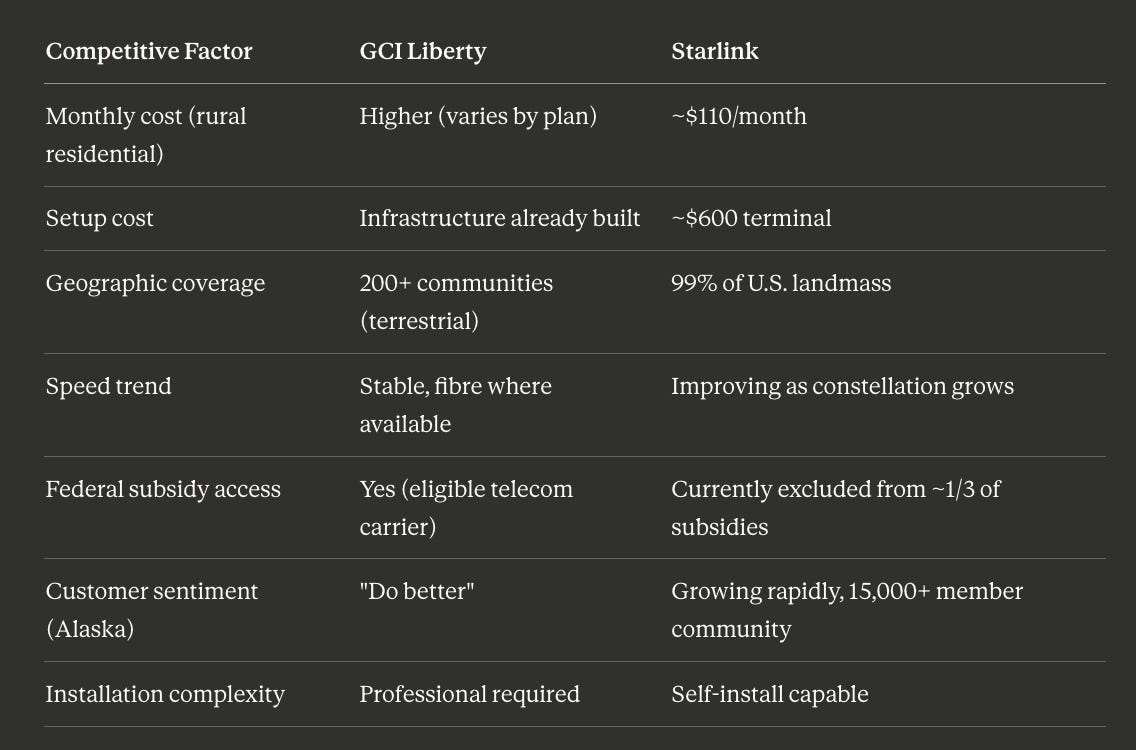
The question is not whether Starlink is a threat. It demonstrably is (at least to a significant portion of rural revenues). The question is whether GCI’s fibre investments and government subsidy relationships are sufficient to defend its position. And that is a question we cannot answer with confidence — which, by definition, fails the second test. A more important question is also the likelihood of GCI liberty’s growth moving forward.
The Spin-Off Motive: Why Liberty Broadband Let GCI Go
One detail that deserves scrutiny is the timing and motivation behind the spin-off itself. Liberty Broadband spun GCI Liberty off on July 14, 2025, just months before the $525 million impairment was recorded. The spin-off was necessary to separate GCI from Liberty Broadband ahead of Liberty Broadband’s planned merger with Charter Communications.
But there is a secondary narrative worth examining. GCI had been the subject of a major federal fraud investigation and settlement in 2023. It carried a history of regulatory risk. It was facing the emergence of Starlink competition in its core markets. And its intangible assets — which would soon be written down by $525 million — were still on the books at full value at the time of separation.
This is not an accusation. It is an observation about incentive structures. When a parent company separates a subsidiary ahead of its own merger, the subsidiary’s post-separation problems become someone else’s problems. Investors in the newly listed GLIBK inherited those problems on day one.
Part Three: How Long Until You Get Them Out?
The time test — because patience has a cost.
Capital Expenditure: The Treadmill That Never Stops
Telecommunications is one of the most capital-intensive industries on earth. For GCI, this is not a choice — it is a physical necessity imposed by Alaska’s geography. Year to date through September 2025, GCI spent $152 million (net of grant proceeds) on capital expenditures, primarily on wireless and data network improvements in rural Alaska. The company guided for full-year 2025 net capex of $225–$250 million.
To put that in perspective: GCI’s trailing twelve-month free cash flow was $155 million. Its annual capex guidance is $225–$250 million. The company is spending significantly more on network maintenance and expansion than it is generating in free cash flow after operating costs. The gap is being funded by the $300 million rights offering — a one-time capital raise, not a recurring cash flow source.
The FCC’s Alaska Plan build-out requirements are expected to be completed by end of 2026. A significant portion of 2025’s elevated capex is tied to this obligation. But even after that deadline, the underlying infrastructure in one of the most hostile operating environments on the planet will require ongoing, substantial investment just to maintain — let alone to grow.
The Lifetime Economics
For any subscriber-based business, the fundamental equation is this: what does it cost to acquire a customer, and how much gross profit does that customer generate over their lifetime with the company? If the lifetime gross profit does not substantially exceed the acquisition cost — with meaningful room to spare — the business model is, at best, marginal.
In Alaska, the customer acquisition cost for a terrestrial telecom provider is extraordinarily high. Laying fibre or microwave infrastructure to a community of 500 people across 70 miles of Arctic wilderness does not cost the same as running a cable to a suburban neighbourhood in Ohio. The $4.7 billion GCI has invested over 45 years across 200+ communities — even spread across hundreds of thousands of subscribers — implies a per-subscriber infrastructure cost that dwarfs what any lower-48 telecom faces.
We cannot calculate GCI’s precise customer acquisition cost from public filings, because the company does not disclose per-subscriber economics at that granularity. But we can reason from what we know:
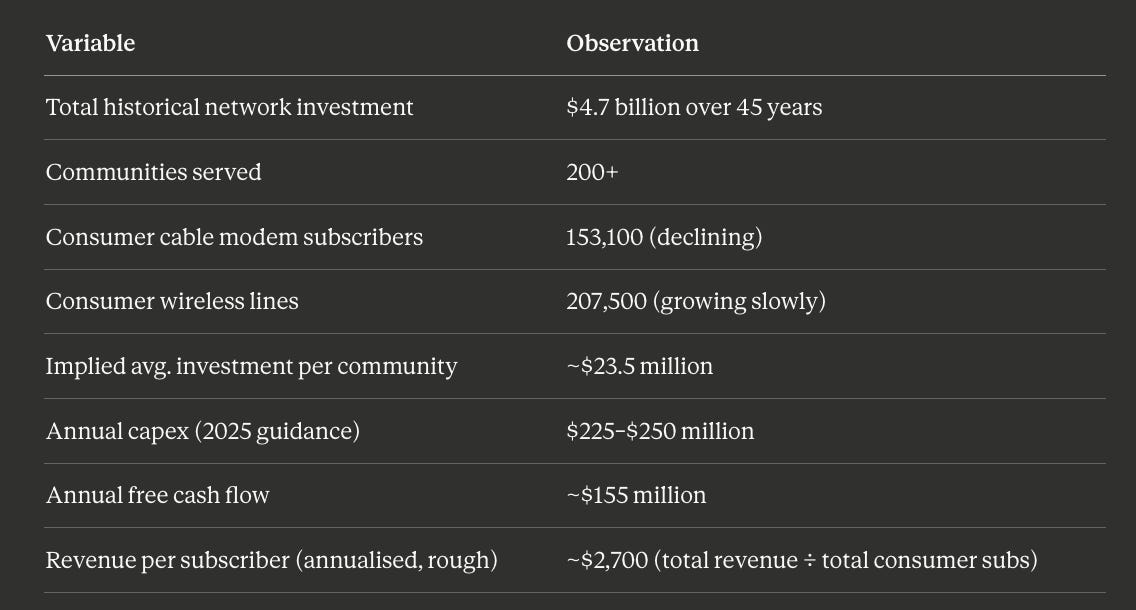
The rough math tells a story: GCI earns approximately $2,700 in annual revenue per consumer subscriber. Its annual capex exceeds its annual free cash flow. And its subscriber base — in the broadband segment — is shrinking. For lifetime gross profit to justify the economics, GCI would need each customer to remain loyal for many years while the company simultaneously holds down costs in one of the most expensive operating environments in the world. That is not an impossible outcome. But it is not one I can assign high confidence to.
The Time Horizon Problem
Even if one believed in GCI’s long-term position — the geographic moat, the government relationships, the fibre buildout — the time required to see a return on that conviction is substantial. The fibre projects are multi-year. The BEAD grant money will take an estimated five years to fully deploy. The Alaska Plan build-out extends through 2026. The competitive dynamics with Starlink will not resolve quickly.
An investor buying GLIBK today is not buying a business that will reward patience in six months or even two years. They are buying a bet that a capital-intensive telecom in the most remote state in the country will successfully defend its position against satellite disruption, maintain its government subsidy relationships, and grow revenue in a market with a fixed and non-expanding population — over a period of five to ten years or more.
That is not inherently wrong. But it is a long time to wait for a business where the confidence level — as established in Part Two — does not yet justify the patience required.
The Eureka Moment: Why the Answer Is Still No
There is a moment in every investment analysis where the threads come together — where the evidence either converges on conviction or reveals a gap too wide to cross. For GCI Liberty, that moment arrived not at a single dramatic revelation, but at the intersection of three quiet truths:
First: The bird count is real but capped. Alaska’s population is fixed. GCI’s subscriber base is declining in its largest segment. The contracted revenue pipeline thins sharply after 2026. The total addressable market does not grow — it only rotates. There is no high operating leverage that I am looking for as well.
Second: The confidence is shaken by facts, not fears. A $525 million impairment from assets that should never have been capitalised as permanent. A $40 million fraud settlement involving the very government programmes that fund a core revenue segment. A competitive threat — Starlink — that is not theoretical but measurable and accelerating. And a balance sheet whose book value has already been proven unreliable once.
Third: The time to payoff is long, and the cost of waiting is high. Capital expenditures exceed free cash flow. The company needed a $300 million external capital raise to fund its own obligations. The fibre buildout that could secure GCI’s future is a multi-year project in a market where satellite disruption is happening now.
This is not a verdict against GCI as a company. It is a verdict against GCI as an investment, evaluated against a disciplined framework. The business may well survive. It may even thrive — if the fibre buildout succeeds, if Starlink’s congestion issues worsen in Alaska’s latitudes, if government subsidies remain structurally favourable. But “may” is not “will.” And in the absence of the confidence required to justify the capital and the patience required to see it through, the rational decision is to pass.
As Warren Buffett has long observed, the hardest discipline in investing is not finding opportunities — it is saying no to the ones that sound compelling but do not meet your standards. GCI Liberty is exactly that kind of opportunity. Compelling on the surface. Insufficient beneath it.
The birds are in the bush. I am simply not sure enough — and not patient enough — to wait for them.
Sources & References
GCI Liberty Q3 2025 Earnings Release (November 5, 2025) — via GCI Liberty Investor Relations / BusinessWire
Liberty Broadband Spin-Off Completion Announcement (July 14, 2025) — via Liberty Broadband Corporation
U.S. Department of Justice: GCI Communications Corp. Settlement (May 2023) — justice.gov
Alaska Public Media / Anchorage Daily News: “In rural Alaska’s Starlink revolution...” (August 2024)
Anchorage Daily News: “Satellite internet has disrupted the market in Alaska...” (August 2024)
BroadbandNow / Broadband Breakfast: “Rural States Struggling with Affordable Broadband Access” (August 2025)
Nanalyze: “Affordable Broadband Internet for Everyone in Alaska”
First Alaskans Institute / Magazine: “Bridging Alaska’s Digital Divide” (Fall 2020)
Novogradac: “Broadband Access Narrows Digital Divide in Rural Alaska”
Stock Titan / GLIBA News Aggregation (January 2026)