
“The difference between successful people and really successful people is that really successful people say no to almost everything.” — Warren Buffett
Introduction: The Power of Subtraction
In the autumn of 1995, Steve Jobs returned to Apple and did something counterintuitive: he killed 70% of Apple’s products. Not because they were bad, but because they distracted from what mattered. This is the central paradox of value creation—the power lies not in what you do, but in what you refuse to do.
Warren Buffett keeps a list of companies he’s studied and rejected. Charlie Munger famously said his success came from “knowing the edge of my circle of competence.” Peter Lynch turned down hundreds of stocks for every one he bought. These aren’t stories about missing opportunities; they’re stories about the disciplined pursuit of only the best opportunities.
Sometimes, the companies we look at are perfectly fine companies at the wrong time or wrong price. A few are fascinating turnarounds that need more time. But all of them failed to answer three brutally simple questions satisfactorily:
1. How many birds are in the bush? (What’s the magnitude of return if the thesis works?)
2. How sure are you? (What’s the probability the thesis actualizes?)
3. How fast till you get them out? (What’s the realistic time horizon?)
For a LEAPs strategy—buying long-dated call options 12-24 months out—I need high conviction on all three. If any answer is unsatisfactory, the idea gets rejected. Period.
What follows is a detailed forensic examination of each rejection, complete with financial analysis, probability assessments, and the specific mechanical failures that killed each thesis. Think of it as a masterclass in what Charlie Munger calls “the psychology of misjudgment”—except here, we catch ourselves before the mistake.
Let’s begin.
CISS: The Shipping Company With Suspiciously Complex Warrants
Date Analyzed: September 18, 2025
Market Cap: ~$2.5M
The Reverse Split Red Flag
C3is Inc. trades post-reverse-split, which immediately raises questions. The company effected a 1-for-6 reverse split on April 3, 2025, reducing outstanding shares from 4.2 million to 0.7 million.
Reverse splits are corporate distress signals. They’re executed to:
Regain Nasdaq compliance (minimum $1 bid price rule)
Make the stock “look better” to institutional investors
Reset the share price before another dilutive offering
None of these reasons are bullish.
The Fleet and Liquidation Value

C3is owns four vessels:
3 Handysize drybulk carriers (97,664 DWT total)
1 Aframax oil tanker (115,800 DWT)
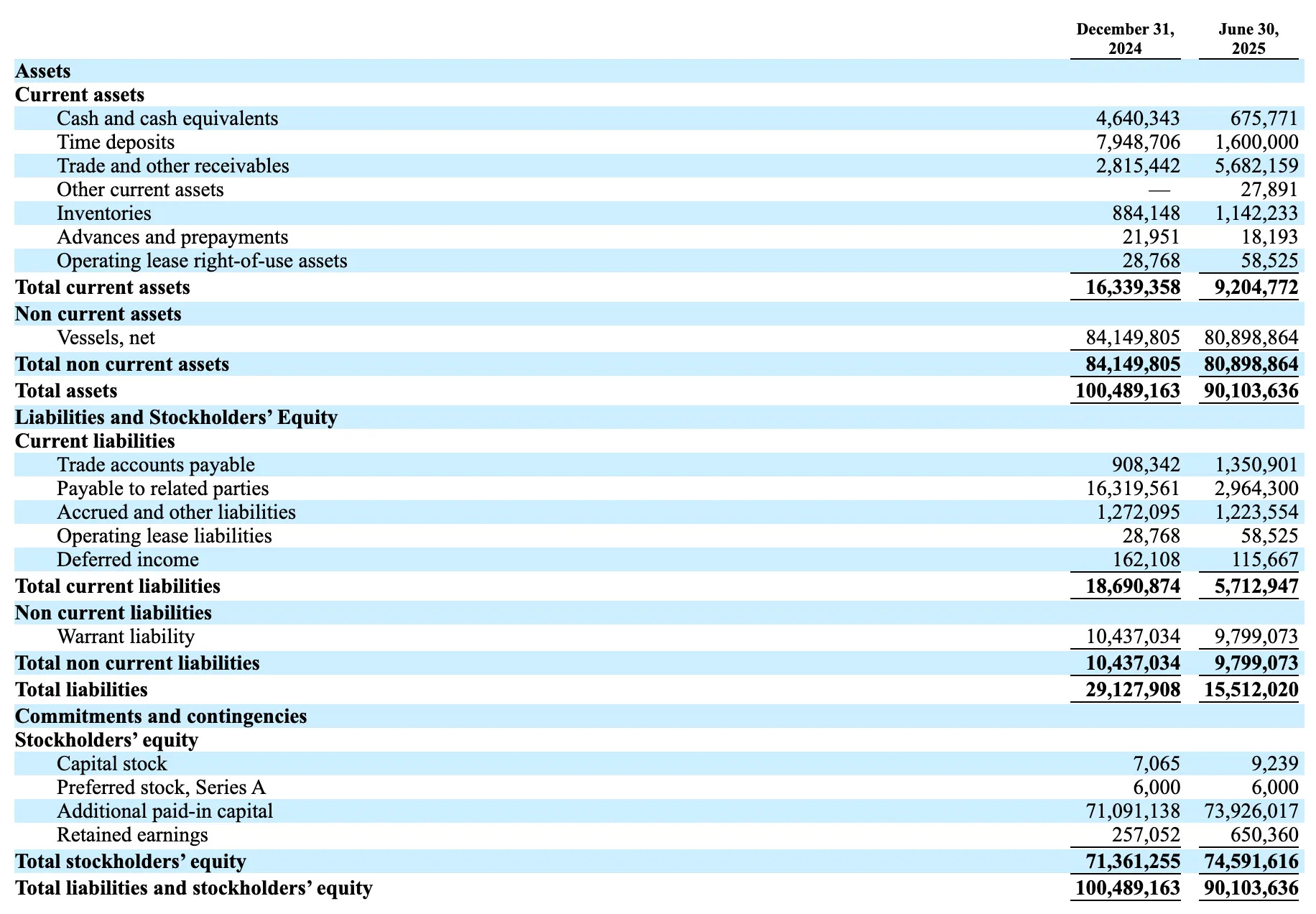
Assets:
Cash: $0.6 million
Accounts Receivable @ 90%: $5.04 million (original $5.6M × 90%)
Inventory: $1 million
Vessels: $80.8 million (book value)
Liabilities:
Total: $15.5 million
Gross Liquidation Value: $0.6M + $5.04M + $1M + $80.8M - $15.5M = $71.94 million
Current market cap: $2.5 million
That’s a 28.8x return if vessels can be liquidated at book value.
The Problem: Book Value Isn’t Market Value
The vessels are carried at $80.8 million on the balance sheet. But ships are depreciating assets in a cyclical industry. Real liquidation proceeds depend on:
Current freight rates (high rates = vessels worth more)
Age of vessels (older = worth less)
Condition (deferred maintenance destroys value)
Market conditions (forced sale = discount)
The company doesn’t disclose vessel ages or specifications in the limited financials available. That’s a red flag—companies with modern, valuable fleets tend to promote those facts.
Conservative liquidation estimate: Vessels worth 50-70% of book value = $40.4M to $56.56M
Revised Liquidation Value: $0.6M + $5.04M + $1M + $48.48M (midpoint) - $15.5M = $39.62M
The Warrant Overhang: Three Layers of Dilution
As of Dec 2024 the company is owned majority by insiders. But note that they are still diluting with warrants. Note that the company now has about 733k shares remaining only, with a $2million market cap only
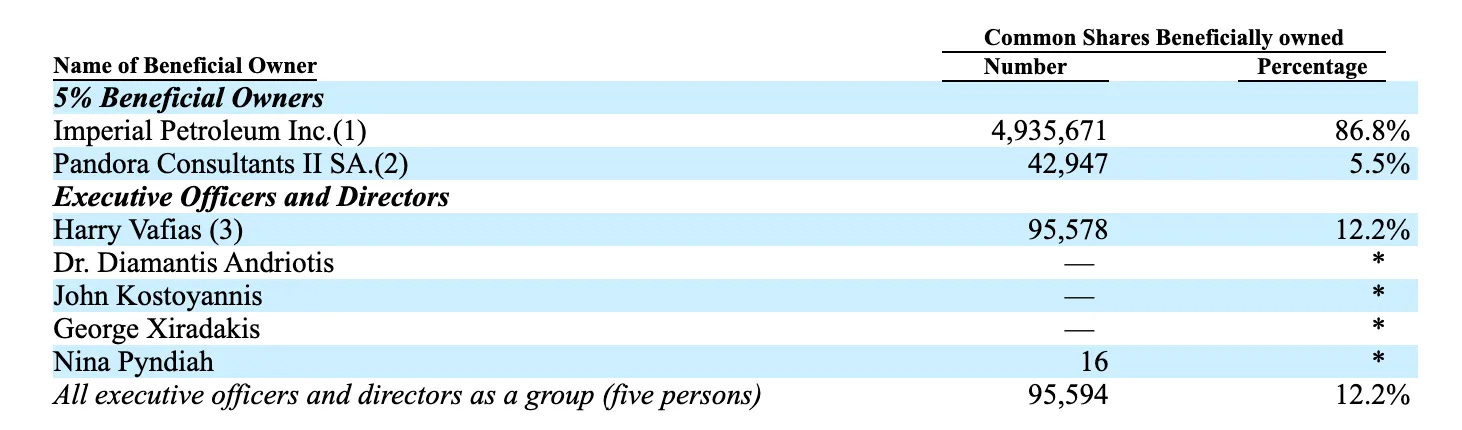
This is where the analysis gets messy. C3is has multiple warrant series outstanding:
Layer 1: The B-Series Warrants
Class B1 Warrants: $159,580 exercise value @ $3.00 per share = 53,193 shares
Class B2 Warrants: $9.38M exercise value @ $3.00 per share = 3,127,667 shares
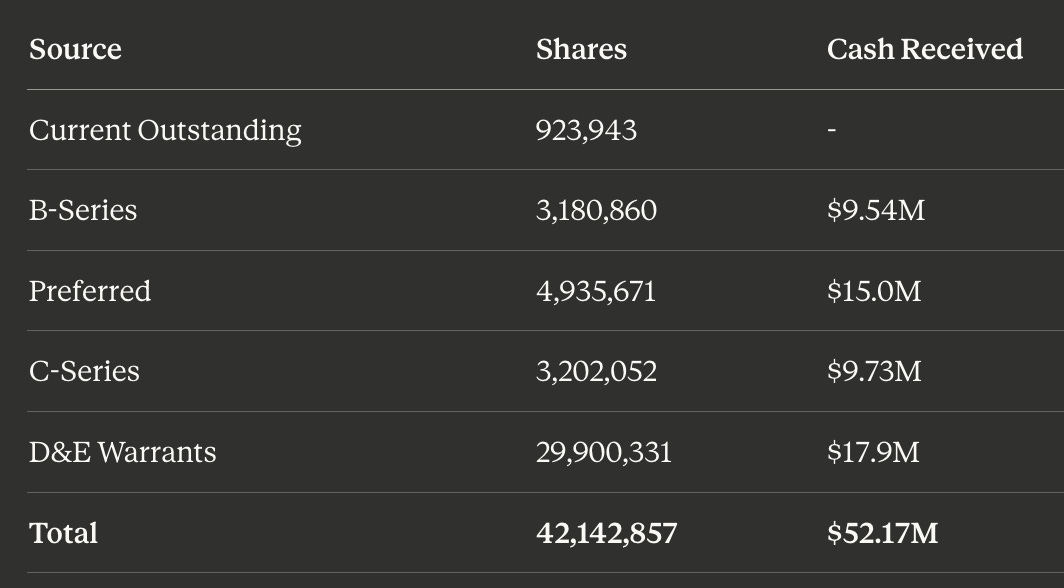
Total: 3,180,860 shares for $9.54M cash
Layer 2: The Convertible Preferred Stock
600,000 shares of Series A Convertible Preferred
Convertible at $3.0391 per common share
Total shares if converted: 4,935,671 shares
Cash to company if converted: $15M
Layer 3: The C-Series Warrants
Class C1 Warrants: 12,649 shares @ $3.0391
Class C2 Warrants: 3,189,403 shares @ $3.0391
Total: 3,202,052 shares for $9.73M cash
Layer 4: The D&E Warrants (The Killer)
Units Offered: 3,322,259
Each Unit Includes:
1 common share
1 Class D Warrant (exercise price $3, 5-year expiry)
1 Class E Warrant (exercise price $3, no expiry, but can reset down to floor price of $0.602)
The D&E Worst Case:
If the stock falls to $0.602 (the floor price), the E Warrants can reset such that each warrant converts to multiple shares. The math gets complex, but from the SEC filings:
At floor price, D Warrants could deliver: 16.6 million shares
At floor price, E Warrants could deliver: 13.3 million shares
Total worst case: 29.9 million shares from this tranche alone
The Adjusted Valuation
New Liquidation Value:
Original: $39.62M
Plus cash from warrants: $52.17M
Total: $91.79M
New share count: 42.14 million
Value per share: $91.79M ÷ 42.14M = $2.18 per share
Current price: ~$2.35 (based on $2.5M market cap ÷ 0.924M shares + assume some dilution already priced)
Upside: -7% (yes, negative)
The Fatal Flaw
Even after accounting for all the cash the company receives from warrant exercises, the per-share value is BELOW the current trading price once dilution is factored in. This assumes:
Vessels can be sold at 60% of book value (optimistic)
All warrants get exercised (company receives full $52M)
No operating losses during the liquidation process
No further dilution after this round
If any of these assumptions break, the investment thesis is underwater.
Birds in the Bush: 0.93x (negative expected value)
Probability of Success: Irrelevant
Time Horizon: N/A
Verdict: This isn’t a value play—it’s a value trap. The dilution structure ensures that any theoretical asset value gets transferred to warrant holders, not common equity holders. Hard pass.
Learnings To Stick To
1. Dilution is Value Destruction
It doesn’t matter if a company has $200 million in cash if they’re issuing $300 million in equity at pennies on the dollar. Per-share value is what matters, not absolute value.
2. Debt is Fragility
Interest coverage below 3x means one bad year could trigger covenant breaches. Below 2x is playing with fire. Below 1.5x is suicidal.
3. Insiders Always Know First
When CEOs, CFOs, and directors sell 60-80% of vested RSUs immediately, they’re voting with their wallets. Listen.
4. Business Models Matter More Than Operations
You can’t cost-cut your way to success if the fundamental value proposition is obsolete.
5. Timing Is Everything (For Options)
e.g. MDU Resources and Krispy Kreme might be great investments... in 2027. But for LEAPs expiring in 2026, the timeline doesn’t work.
6. Regulatory Red Flags Are Never False Alarms
When annual reports are encrypted, when revenue collapses without explanation, when short sellers publish specific fraud allegations—walk away. The risk isn’t worth the reward.
7. Pandemic Winners Are Usually Losers
Mean reversion is brutal. Companies that benefited from temporary behavioral shifts rarely maintain those gains.
The Philosophy of “No”
Charlie Munger said: “The art of being wise is the art of knowing what to overlook.”
In investing, success comes from:
Saying yes to the right opportunities (important)
Saying no to the wrong opportunities (more important)
Saying no to marginal opportunities (most important)
This article is about #3. None of these companies were obviously terrible (well, maybe CHR and WIMI). Most had legitimate businesses, real assets, and plausible turnaround stories.
But “plausible” isn’t “probable.”
And “interesting” isn’t “investable.”
The Buffett-Munger Standard
Before investing, ask:
Do I understand this business? (Circle of competence)
Does it have a sustainable competitive advantage (Moat)/ does it have a legitimate working business model (for LEAPs)?
Is management trustworthy and aligned? (Stewardship)
Is the price attractive relative to intrinsic value? (Margin of safety)
What could go wrong? (Risk analysis)
For LEAPs specifically, add: 6. Will value be realized in 12-24 months? (Timing) 7. Is the expected return 2x+ to compensate for time decay? (Return threshold)
If the answer to ANY of these is “no” or “uncertain,” walk away.
The Opportunity Cost Mindset
Every dollar invested in these marginal opportunities is a dollar not available for exceptional opportunities.
Your capital is finite. Your attention is finite. Your time is finite.
Protect all three zealously.
When I reject companies, I’m not losing opportunities—I was preserving capital and attention for better opportunities yet to come.
In investing, a 0% success rate at finding investments can be a 100% success rate at avoiding disasters.