
“The difference between successful people and really successful people is that really successful people say no to almost everything.” — Warren Buffett
Introduction: AFCG - The Dollar Bill Selling For 29 Cents
Date Analyzed: September 27, 2025
Current Price: ~$2.80 | Market Cap: ~$65.52M
There’s a hundred-dollar bill lying on the ground. The price tag says: $29.
You’d pick it up, right? Of course you would. It’s literally money trading at a discount to face value. Arbitrage so obvious a child could spot it.
Except this particular hundred-dollar bill has some asterisks:
*Redeemable only in cannabis businesses
*Subject to 70% federal tax upon redemption
*May be confiscated by federal authorities without warning
*Bankruptcy protections not available if issuer defaults
*Timeline to redemption: uncertain, possibly years
Your hand hovers. You hesitate. You walk away.
Welcome to Advanced Flower Capital Inc. (AFCG)—a cannabis lender trading at 29 cents per dollar of book value as of December 2025. Book value: $9.67 per share. Stock price: $2.80.
I spent two months analyzing this. Watched it fall 33% while I studied it. Saw the CEO buy 8% more shares after missing earnings. Read about Biden’s cannabis rescheduling executive order that could transform everything overnight.
And then I rejected it.
Not because it’s bad—it might be the single best risk/reward I’m passing on this year. But because it fails a brutally simple three-question test that Charlie Munger would appreciate:
1. How many birds are in the bush? (What’s the return if it works?)
2. How sure are you? (What could go wrong?)
3. How fast till you get them out? (When does this play out?)
Miss on any one question, and you lose money—no matter how cheap it looks.
But before we get to those questions, you need to understand something most investors miss: cannabis lending isn’t normal lending. It’s lending into a twilight zone where federal law and state law contradict each other, where borrowers can’t file bankruptcy, where taxes approach confiscatory levels.
If you don’t understand that context, AFCG looks like free money. Once you do, you’ll see why this “bargain” might be a trap (at least relative to my context).
Let me show you.
Part I: The Kafka-esque World of Cannabis Lending
When Your State Says “Legal” and Your Country Says “Felony”
Picture running a business where:
Your state government licenses you, regulates you, taxes you
Your federal government considers you a drug trafficker
Banks won’t touch your money (federal money laundering risk)
You can’t deduct rent, salaries, or insurance on your taxes
If you go bankrupt, federal courts won’t help you
This isn’t hypothetical. This is every cannabis business in America.
Cannabis is legal in 38 states for medical use, 24 for recreational. Yet it remains Schedule I under federal law—same category as heroin and LSD. The federal government could raid any cannabis business tomorrow and seize everything. They usually don’t (Obama/Biden policy), but they could.
This creates a $30 billion industry operating in permanent legal limbo.
Now imagine lending money to these businesses. That’s what AFCG does.
Section 280E: The Tax Code’s Middle Finger
In 1981, a cocaine dealer named Jeffrey Edmondson deducted his drug trafficking expenses—rent, phone bills, scales—on his tax return. The IRS challenged it. The Tax Court sided with the drug dealer: “Even illegal businesses get to deduct ordinary expenses.”
Congress was horrified. In 1982, they passed Section 280E:
“No deduction shall be allowed for any amount paid in carrying on any trade or business if such trade consists of trafficking in controlled substances.”
Translation: If you sell cannabis, you can deduct Cost of Goods Sold (seeds, soil, grow lights). Nothing else. Not rent. Not salaries. Not insurance. Not legal fees. Nothing.
Here’s what that means in practice:
THE SECTION 280E TAX TRAP
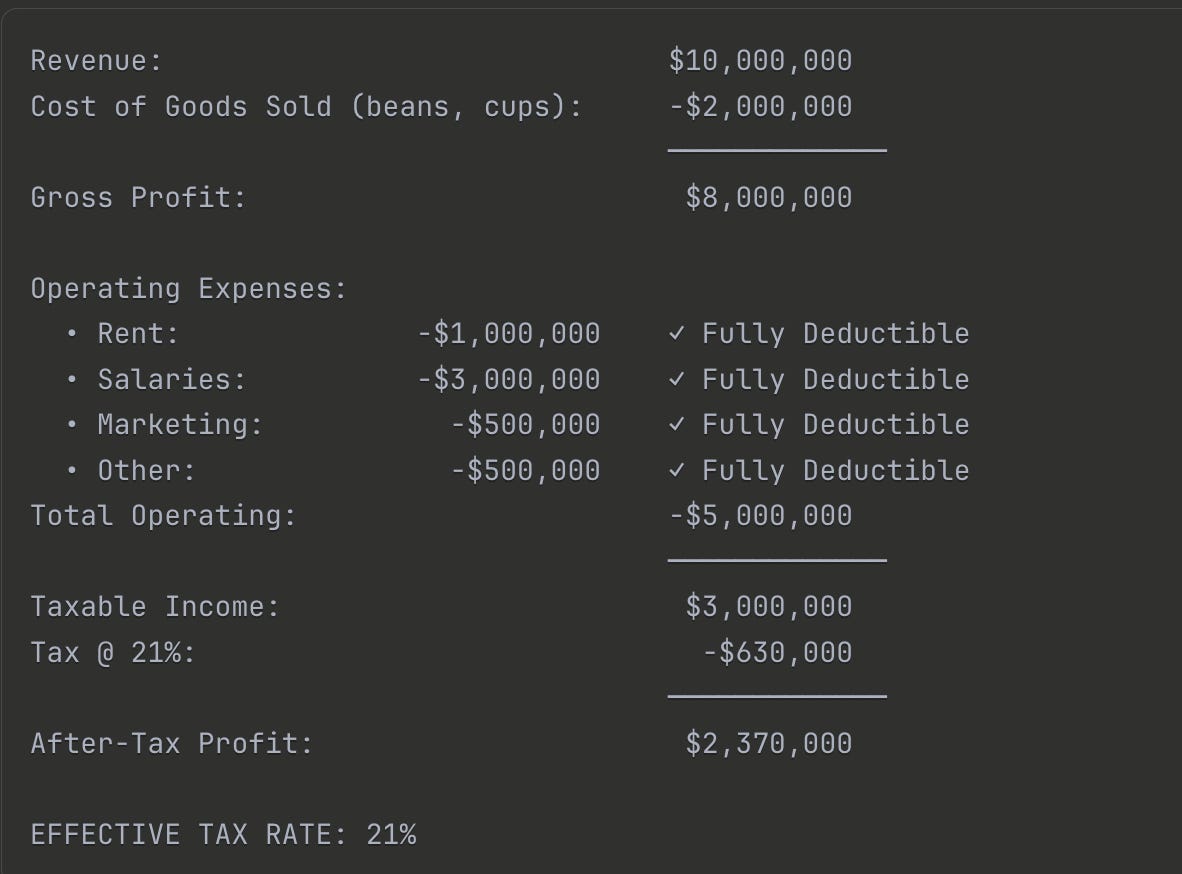
NORMAL BUSINESS (Coffee Shop):
CANNABIS BUSINESS (Dispensary):
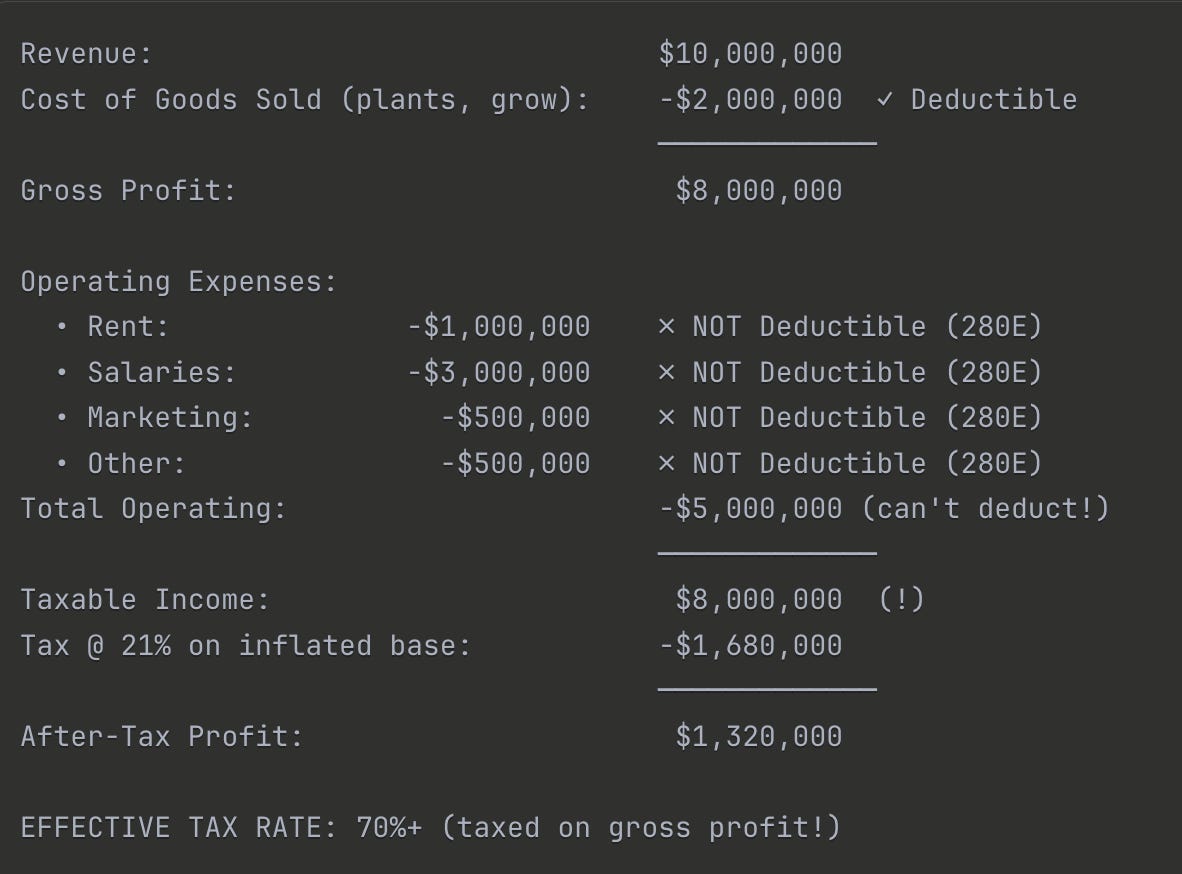
The Difference: Same revenue. Same costs. Same business economics.
Cannabis business pays $1,050,000 more in taxes purely due to Section 280E.
You’re reading that correctly. The cannabis dispensary has identical economics to the coffee shop—same revenue, same costs. But it pays $1.05 million more in taxes simply because of Section 280E.
This isn’t a technicality. It’s the financial equivalent of running a marathon with a 50-pound backpack.
Now ask yourself: If you’re a cannabis business paying 70% taxes and paying 18% interest to a lender like AFCG, how much margin do you need just to survive?
The Banking Black Hole and Bankruptcy Trap
Two more absurdities pile on:
You can’t use banks. Cannabis is federally illegal, so most banks refuse cannabis money (risk of federal money laundering charges). Cannabis businesses operate largely in cash—paying employees, vendors, taxes in literal bags of money. This creates security risks, accounting nightmares, and makes it nearly impossible to access normal credit markets.
You can’t file bankruptcy. If a cannabis business fails, it cannot file for federal bankruptcy protection. Bankruptcy courts are federal. Cannabis is federally illegal. Federal judges can’t oversee restructuring of illegal enterprises.
For lenders, this is catastrophic. In normal lending, if a borrower defaults, they file Chapter 11. There’s an orderly process: court supervision, creditor priorities, asset sales. Senior secured lenders (like AFCG) get paid first.
In cannabis lending, if a borrower defaults, there’s no structured process. State-law remedies are messy and uncertain. Foreclosure timelines stretch indefinitely. Recovery rates plummet.
This is why AFCG’s credit loss reserves are 6.4x higher than traditional banks. They’re not being paranoid—they’re being realistic.
Part II: Meet AFCG (The Company Lending Into This Madness)
Advanced Flower Capital does what most banks won’t: lends money to cannabis operators. Senior secured loans, $10M-$100M+, at interest rates around 18%.
Why 18%? Because borrowers can’t access normal credit markets. Banks won’t touch them. Public bond markets are closed. Private equity is cautious. AFCG steps into the void—and charges accordingly.
Here’s the portfolio:
AFCG LOAN PORTFOLIO (as of June 30, 2025)

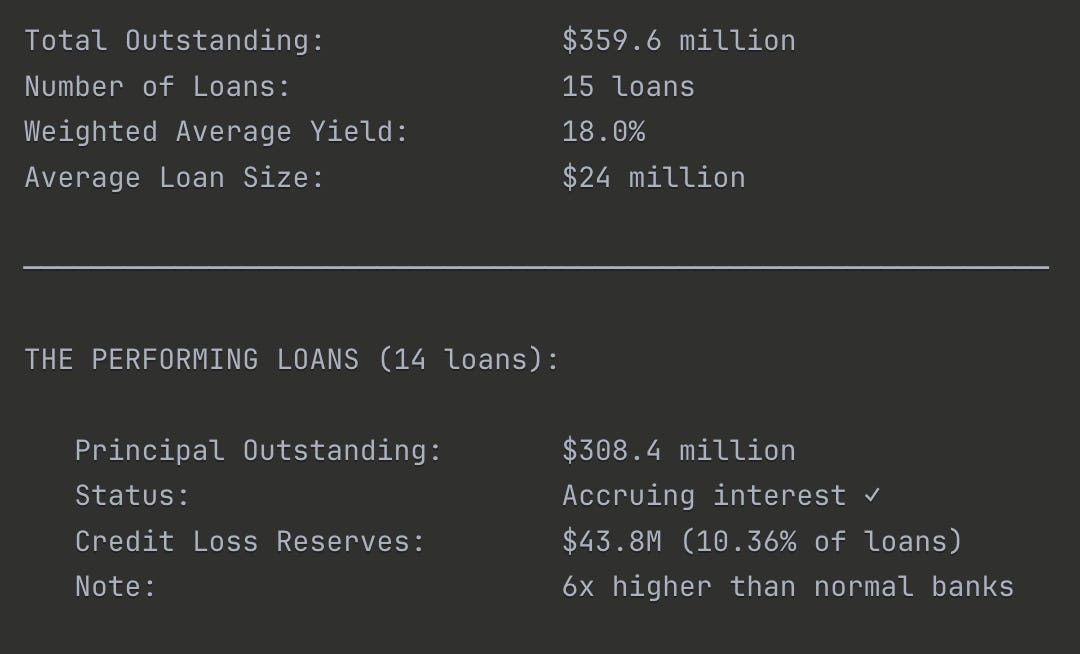

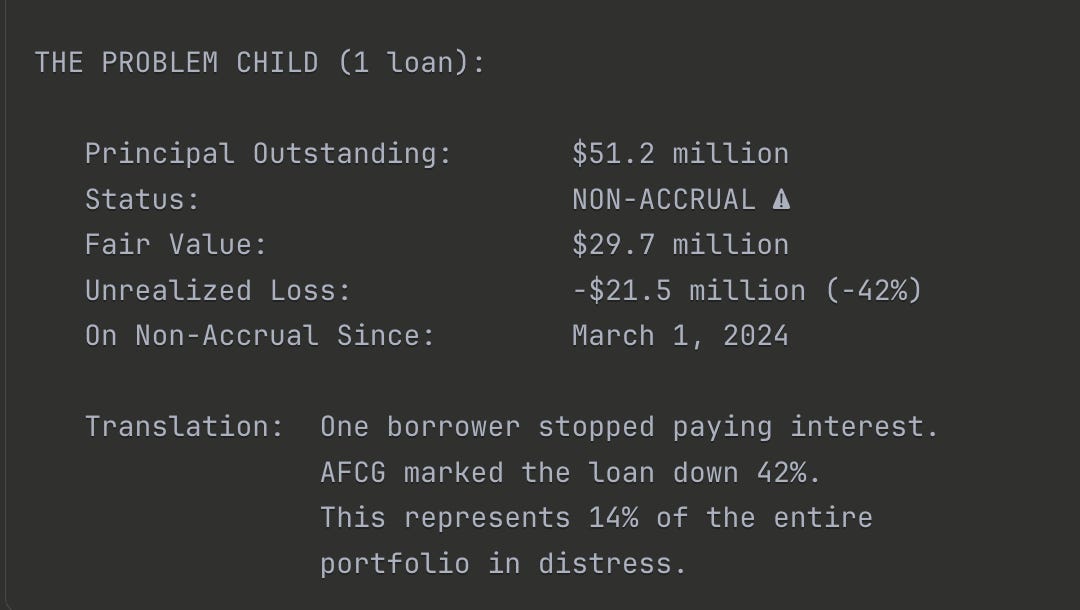
That non-accrual loan is the skeleton in the closet. It’s been non-performing since March 2024—nine months and counting. Management is “working through resolution,” which is code for: “The borrower can’t pay, and we’re trying to figure out how much we’ll lose.” - Note this loan and amount
In normal banking, one loan going bad isn’t catastrophic. But when it’s 14% of your portfolio and you have no bankruptcy courts to help, it’s a serious problem.
The collateral? Real estate (cultivation facilities, dispensaries), cannabis licenses (state-issued permits worth millions), and cash flow pledges. But try selling a cultivation facility in a fire sale when most buyers can’t get bank financing. Try valuing a cannabis license when federal rescheduling could make them worthless or priceless overnight.
The Big Pivot: Becoming a BDC
AFCG started as a Real Estate Investment Trust (REIT)—meaning they could only lend against real estate collateral. Many cannabis operators lease their facilities, so AFCG couldn’t lend to them.
Solution? Convert to a Business Development Company (BDC), which can lend against any collateral: equipment, working capital, IP, contracts.
WHY THE BDC CONVERSION MATTERS
AS A REIT (Old Structure):
Can only lend against REAL ESTATE
Problem: Many cannabis operators LEASE facilities
Market size: ~$5 billion addressable
Miss out on: High-growth software, equipment, services
AS A BDC (New Structure):
Can lend against ANY collateral
Can lend to cannabis retailers (no real estate needed)
Can lend to “ancillary” businesses: • Cannabis software (POS, compliance, analytics) • Equipment manufacturers (grow lights, HVAC) • Service providers (security, testing labs)
Market size: ~$30 billion addressable
The Unlock: 6x larger market
The conversion was approved by shareholders on November 6, 2025. Target completion: Q1 2026.
But corporate conversions rarely go smoothly. Systems need rebuilding. Fee structures get renegotiated. Management teams potentially reshuffled. Credit facilities might need amendments.
This is execution risk—and it’s real.
Part III: The Valuation (Why 29 Cents Might Not Be Cheap)
Now we get to the numbers that made my pulse quicken—then made me walk away.
THE ACCOUNTING SAYS “BUY”
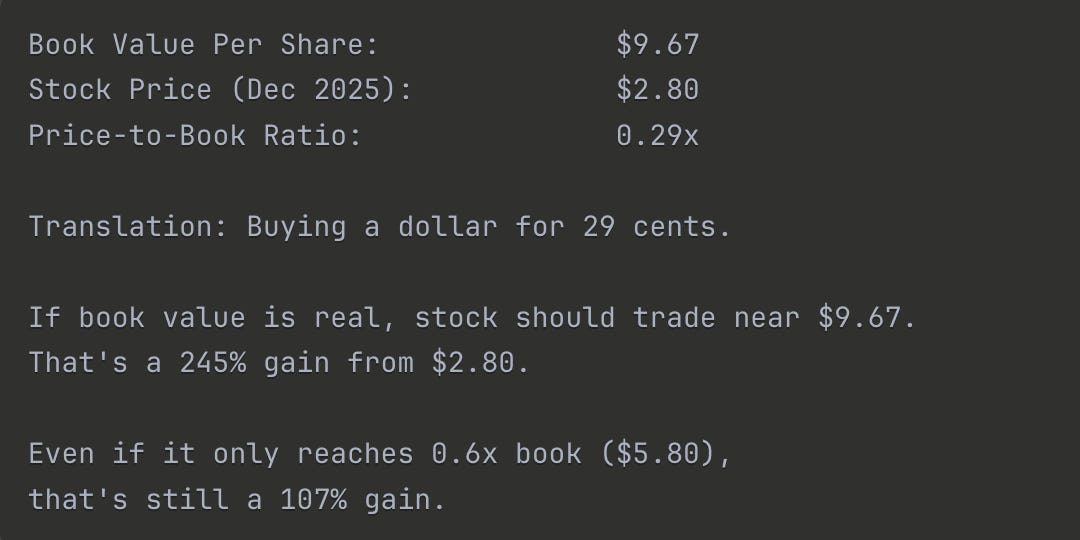
Looks irresistible, right? Here’s the problem: not all book value is created equal.
That $184.7M of shareholders’ equity is mostly loan assets marked at “carrying value” (accounting term for “what we think they’re worth”). The question isn’t what the accounting says—it’s what happens if things go wrong.
Let me stress-test the book value (keeping in mind the Book value of $9.67/ share):
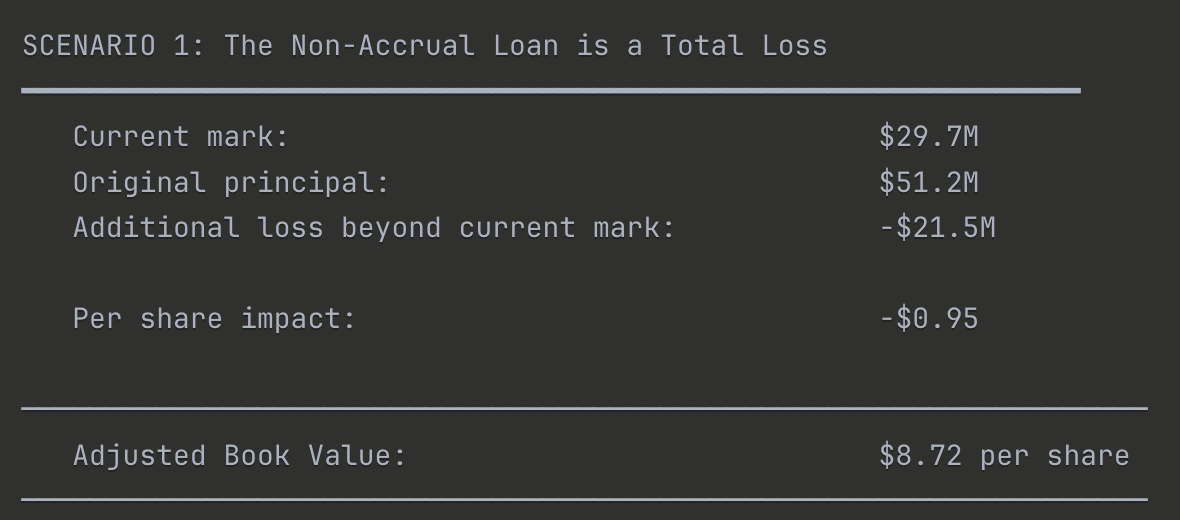
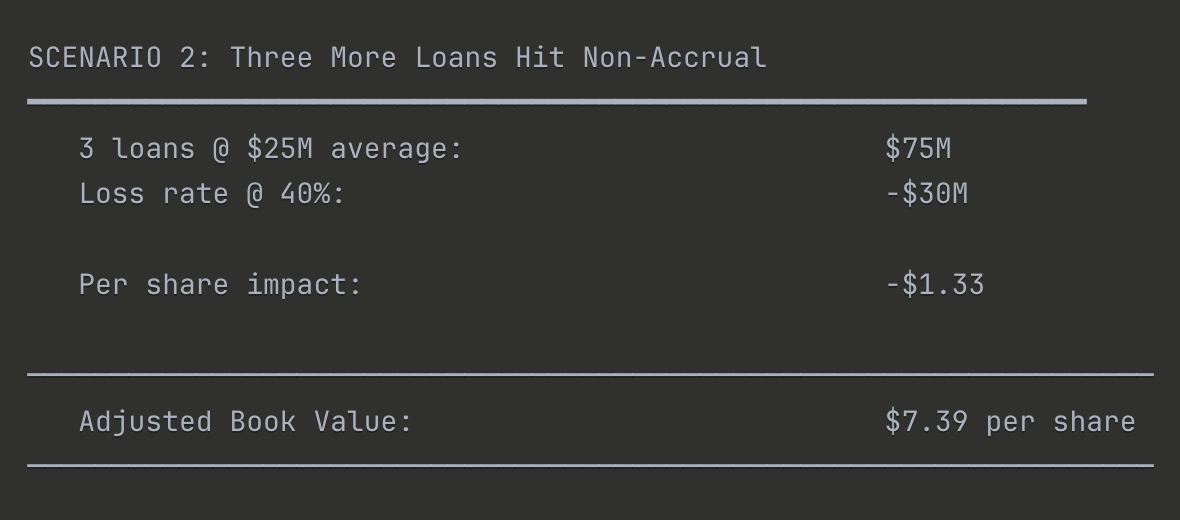
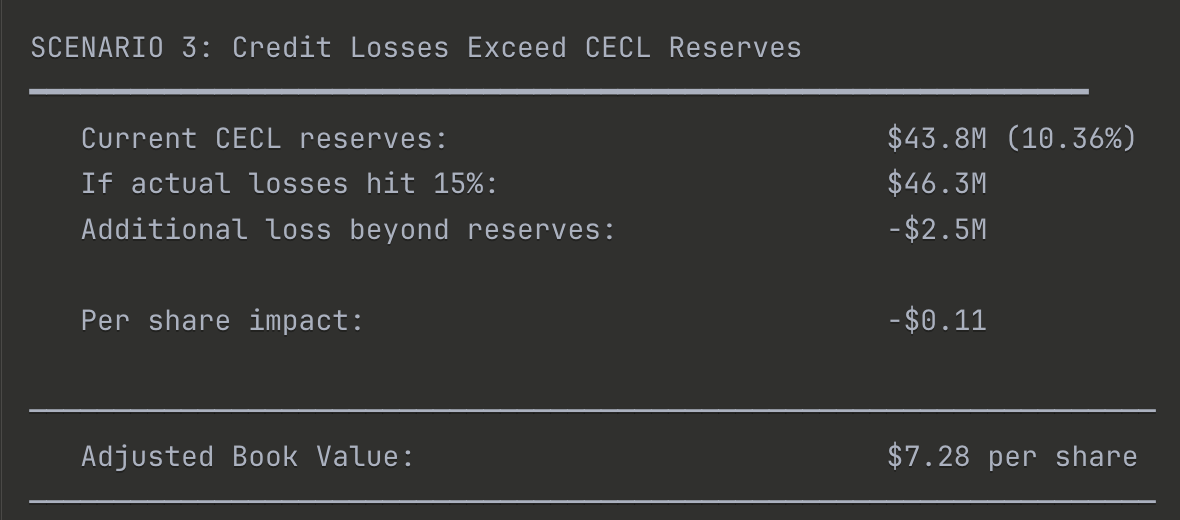
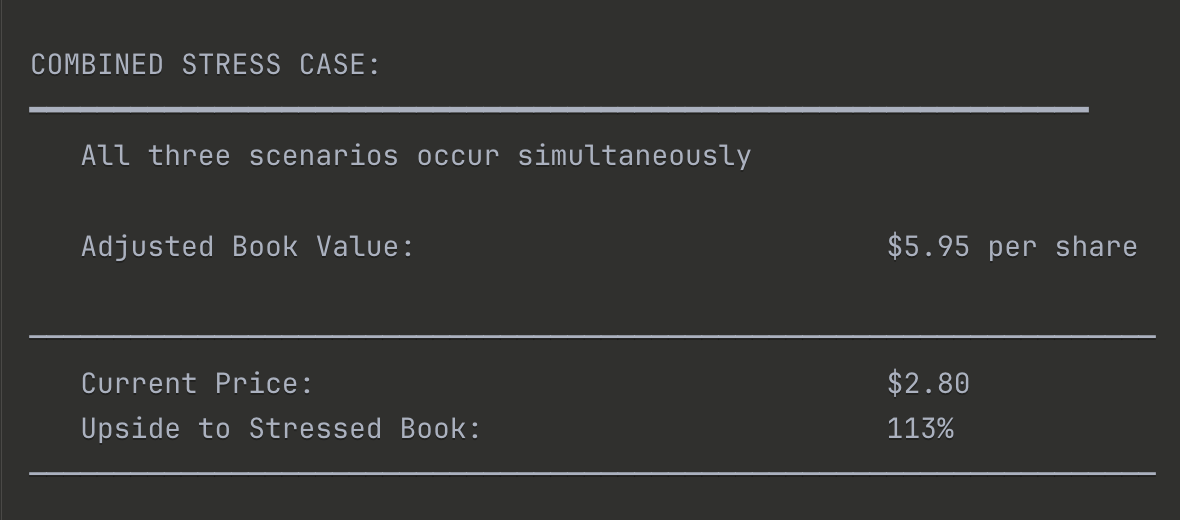
Even in a stressed scenario where multiple things go wrong (which is btw be a black swan event), book value is still $5.95—double the current price. So you’re still getting a bargain!
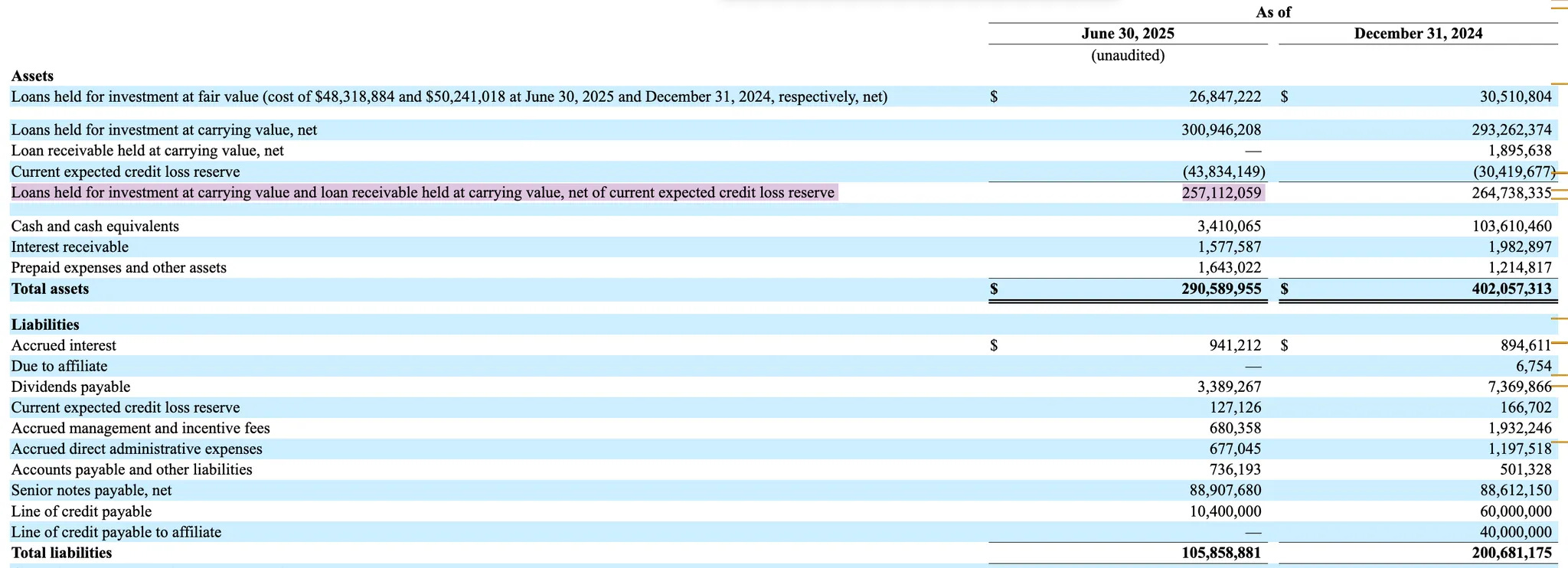
And even if we remove this non-performing loan (totally) from the assets:
$290.5 mil - $52 mil = $238.5mil Total asset
$238.5 mil - Total liability of $106 mil = $132.5 mil
$132.5 mil ÷ 22.6 million shares outstanding = $5.86/ share at minimum
We will still have an intrinsic value of about $5.86/ share
Question 1: How Many Birds Are in the Bush?
Translation: If everything goes right, what do you make?
Let me map the upside by looking at what could unlock value:
Catalyst #1: Cannabis Rescheduling
On December 18, 2025—literally days before I finalize this—President Biden issued an executive order directing the Attorney General to reschedule cannabis from Schedule I to Schedule III “in the most expeditious manner.”
If this happens, Section 280E disappears. Cannabis businesses could deduct operating expenses like normal companies. Tax rates drop from 70%+ to 21%. Borrower cash flows improve dramatically.
WHAT RESCHEDULING MEANS FOR AFCG’S BORROWERS
Cannabis Dispensary Under Current Law (Schedule I):
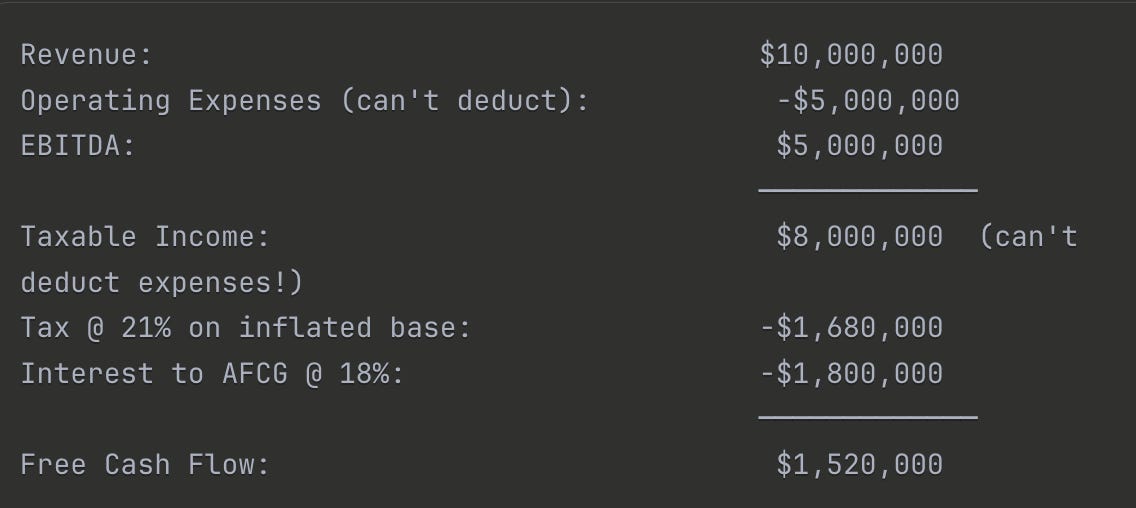
Same Dispensary After Rescheduling (Schedule III):
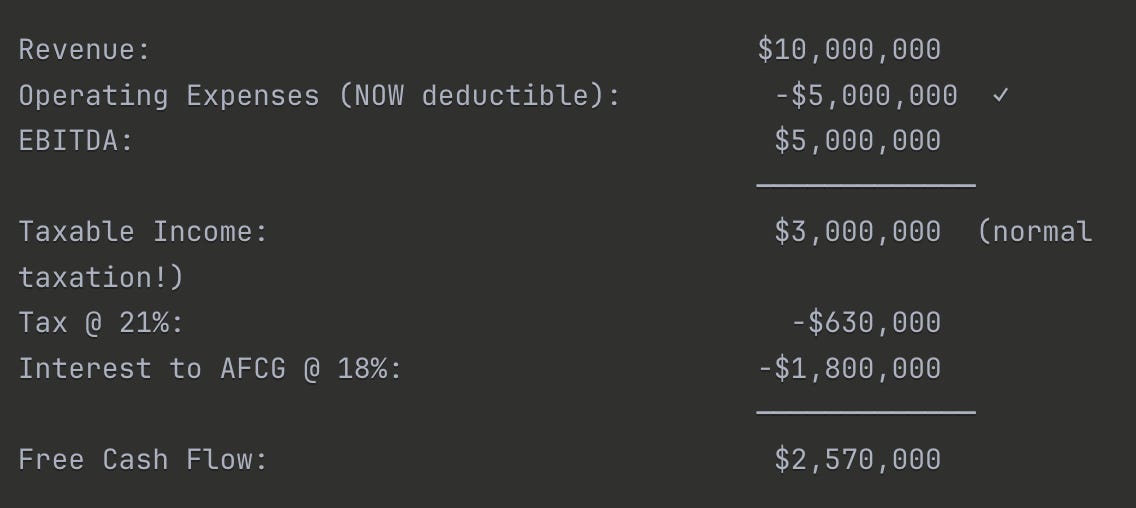
Cash Flow Improvement: +69% ($1.05M additional cash annually)
Impact on AFCG:
Default risk plummets (borrowers have 69% more cash to service debt)
Non-accrual loan could return to performing status
CECL reserves could be reversed (flows to earnings as recovery)
Book value increases due to reserve reversals
Multiple re-rates as cannabis becomes “normal” lending (not quasi-legal)
This is transformational. If rescheduling happens, AFCG’s portfolio quality strengthens overnight. The non-accrual loan might recover. Credit reserves get reversed. Book value jumps. Let’s put a number to this just purely based on industry re-rating:
A book value of $5.86/ share x 1.2 =
But here’s the catch: “expeditious” is not a timeline. The DEA has to finalize rulemaking. Comment periods. Implementation. This could happen in March 2026... or September 2026... or January 2027. Or get blocked in court. Or reversed by the next administration.
“Inevitable” is not “imminent.”
Catalyst #2: BDC Conversion Multiple Re-Rating
Cannabis REITs trade at 0.3-0.5x book. Traditional BDCs trade at 0.8-1.2x book.
If AFCG converts smoothly and the market treats it like a BDC instead of a cannabis REIT, the multiple expands.
WHAT IF THE MULTIPLE JUST... NORMALIZES?
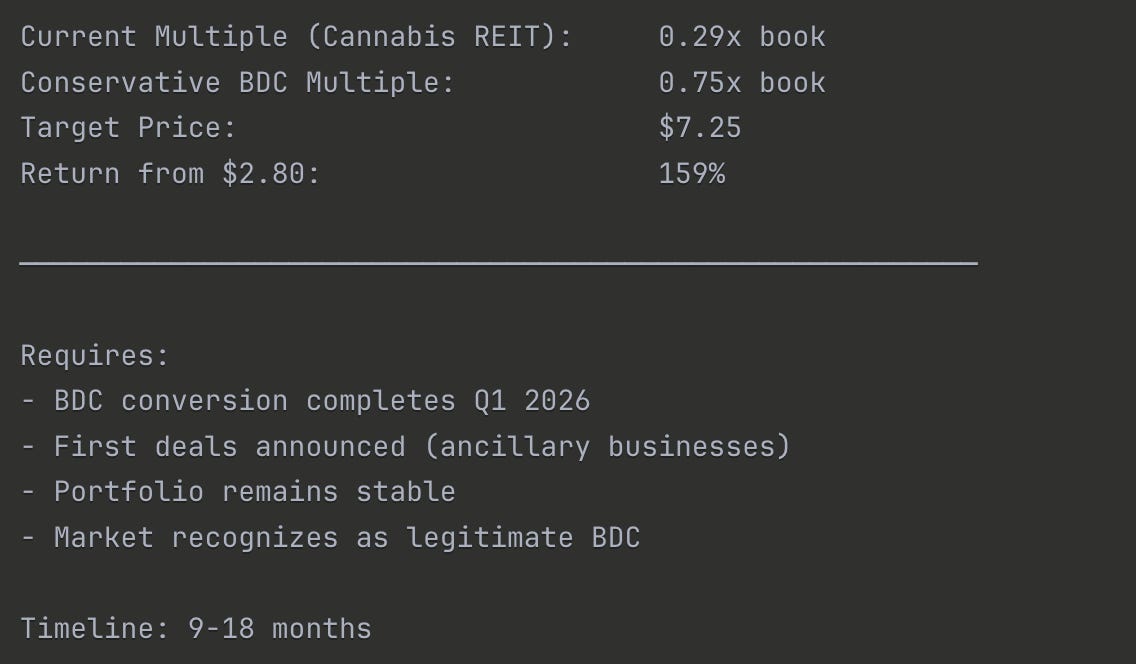
This is the “boring” catalyst—no federal law changes, just corporate structure improvement and multiple expansion. Still delivers 159% if it works.
Catalyst #3: The Hidden Asset (CECL Reserve Reversals)
AFCG has $43.8M in credit loss reserves—10.36% of loans versus 1.62% for normal banks. If actual losses come in lower than reserved (borrowers perform better than expected), those reserves reverse back into earnings.
This happened in 2021-2022 for many banks post-COVID. Reserves built in panic, reversed when defaults didn’t materialize. AFCG could do the same if the cannabis market stabilizes - the Company has historically targeted lending to vertically integrated cannabis companies with higher margins than peers (which tend to have lower default rates).
Question 2: How Sure Are You?
This is where AFCG crumbles for me.
The bulls say: “Look at all these catalysts! Rescheduling is coming! BDC conversion is approved! 29 cents on the dollar! Leonard Tannenbaum owns 45%! The CEO just bought more!”
The bears say: “One loan is already non-performing. Credit reserves are 6x normal. Cannabis operators are unprofitable. You can’t even bankruptcy these borrowers if they fail.”
Who’s right?
Both.
And that’s the problem. When the bull case and bear case are equally plausible, you’re not investing—you’re flipping a coin.
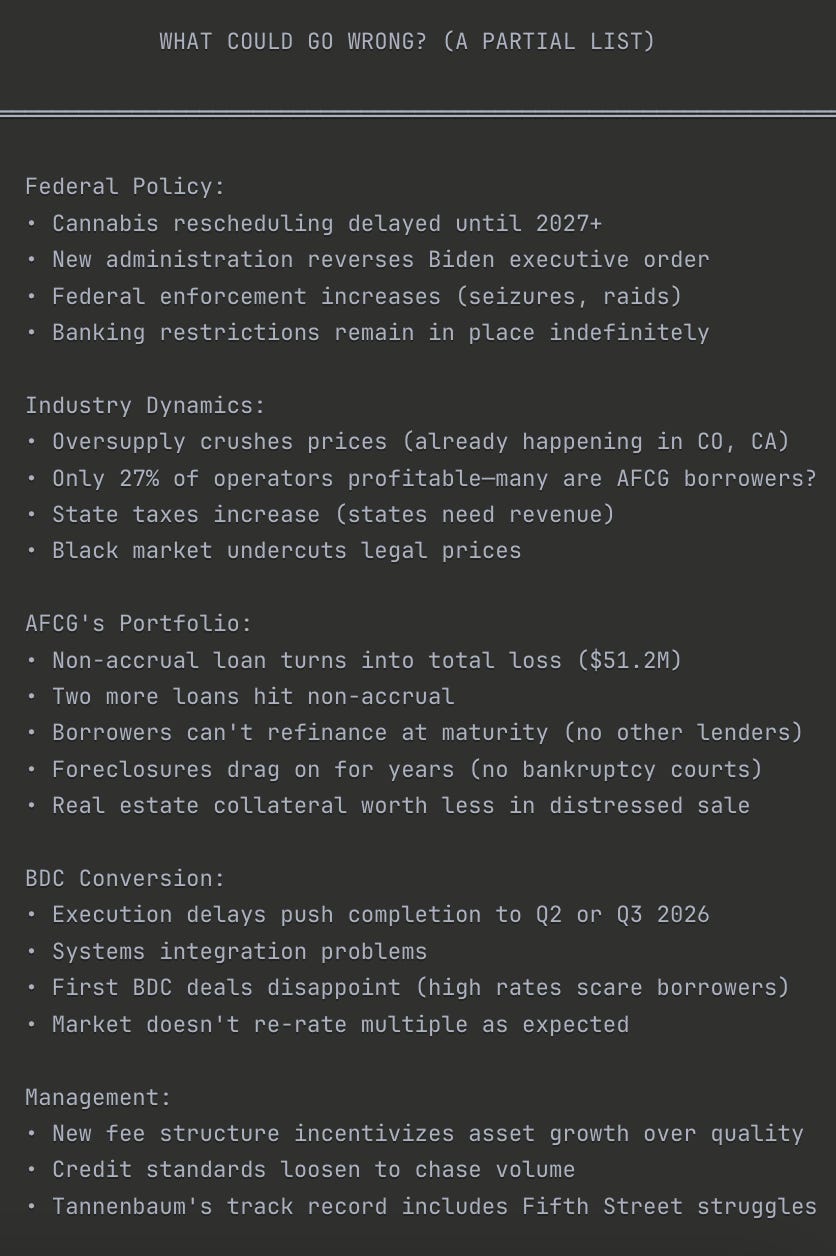
Now, not all of these will happen. But how many need to happen to break the thesis?
If cannabis rescheduling gets delayed two years, your timeline blows up. If two more loans hit non-accrual, book value drops 20%. If the BDC conversion stumbles, the multiple doesn’t expand. If any combination of these occurs, you lose money despite the “bargain” price. That being said, AFCG has a pretty solid and proven business:

The Chairman’s Conviction (And Why It Doesn’t Settle the Question)
Leonard Tannenbaum owns 45% of AFCG. In November, CEO Dan Neville bought 8% more after missing earnings. These are smart people with decades of experience in distressed credit.
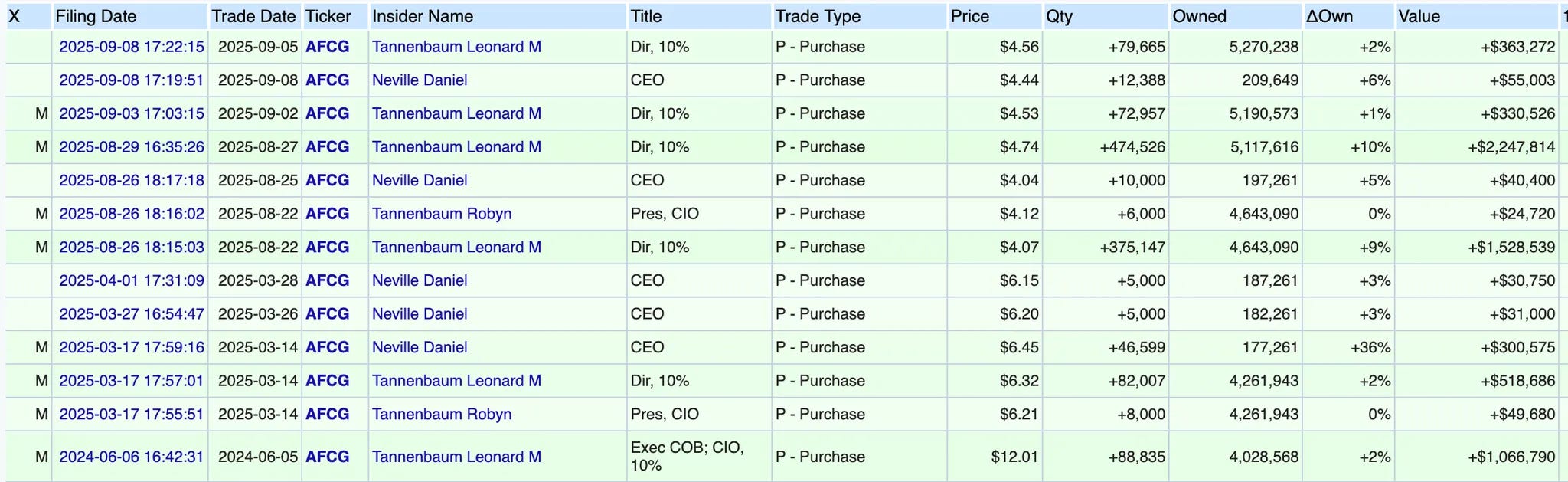
They’re betting big. Should that give you confidence?
Let’s look at something more tangible - Management Incentives
As munger said - “Show me the incentive, and I’ll show you the outcome,”
Advisors (which is the Chairman’s family and him) will be paid based on: 1.5% of the company’s gross assets (when previously, it is based on the equity value - which encourages equity value growth). The 1.5% would be applicable to assets financed by debt by up to “debt = 100% of equity”, and the 1.5% fee will drop to 1% if debt is ≥ of equity
As of June 2025, debt is only 57% of equity. Which also means that the company will still be able to double their book value with their loan book, hence, doubling their interest income as well. This incetive of 1.5% drop to 1% IF debt is ≥ equity, will also encourage the company to increase the equity value
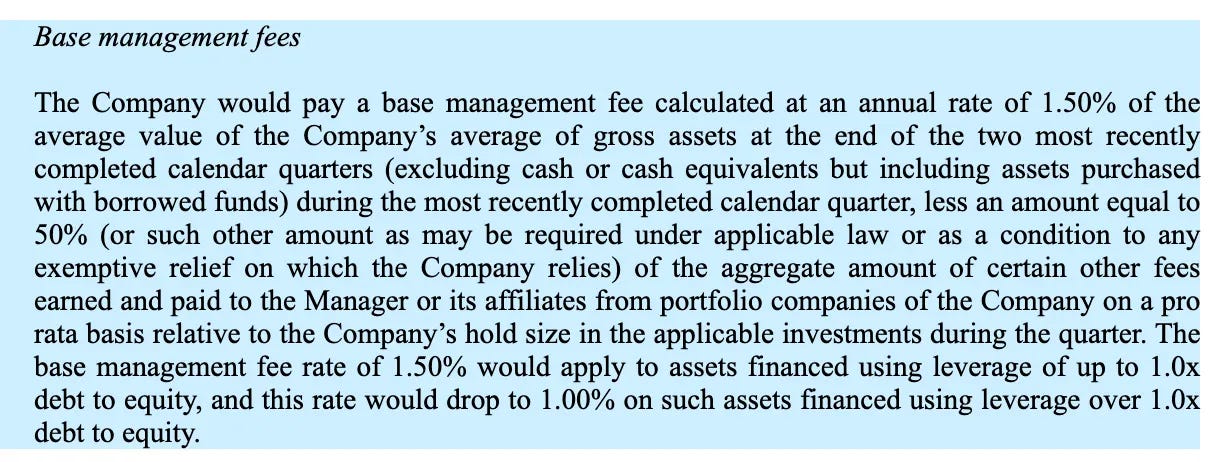
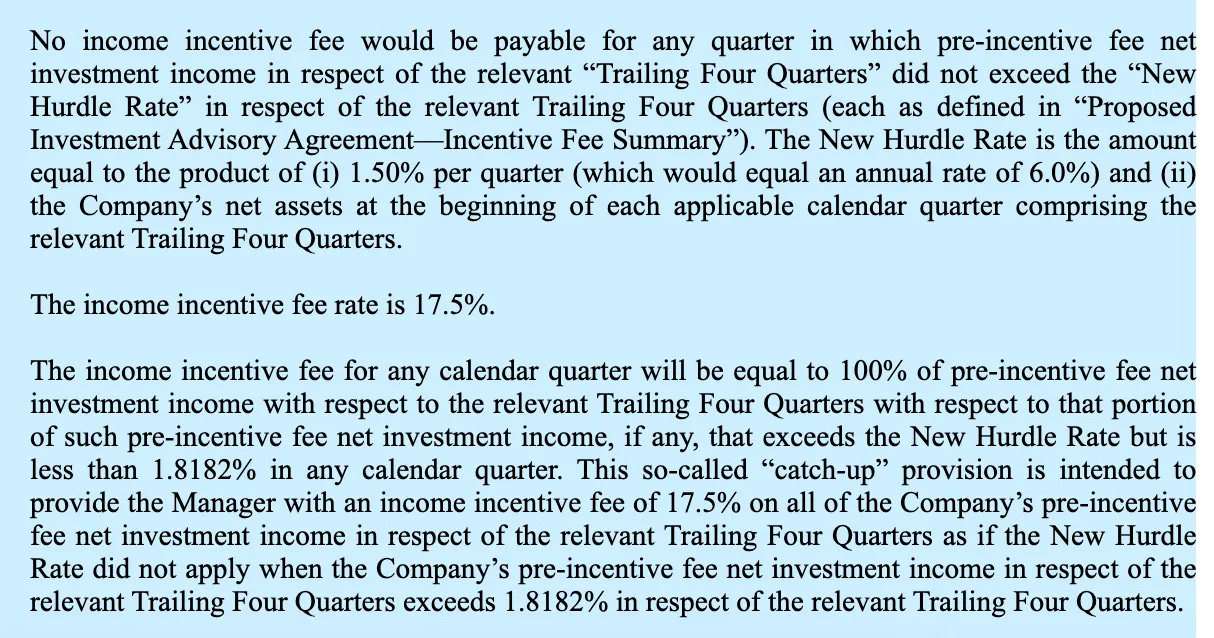
These incentive structure will be applied once the company starts to operate and starts being regulated as a BDC
The adviser (manager) only earns incentive fees if the company’s net investment income (NII) is above the hurdle rate.
The hurdle rate = 1.50% per quarter (≈ 6% annually) × the company’s net assets at the start of the quarter.
If NII is below that hurdle → no incentive fee is paid.
However, between the hurdle rate (1.50% per quarter) and 1.8182% per quarter, the adviser gets 100% of the income above the hurdle. In other words, the advisor will get 100% of the 1.2% above the 6% hurdle rate if it has a NII of 7.2% that year.
Anything above 7.2%, the company will earn approximately 17.5% e.g. if it performs 8.2%, it will earn (1) 17.5% of the 1% and (2) 100% of the 1.2% above the 6% hurdle rate
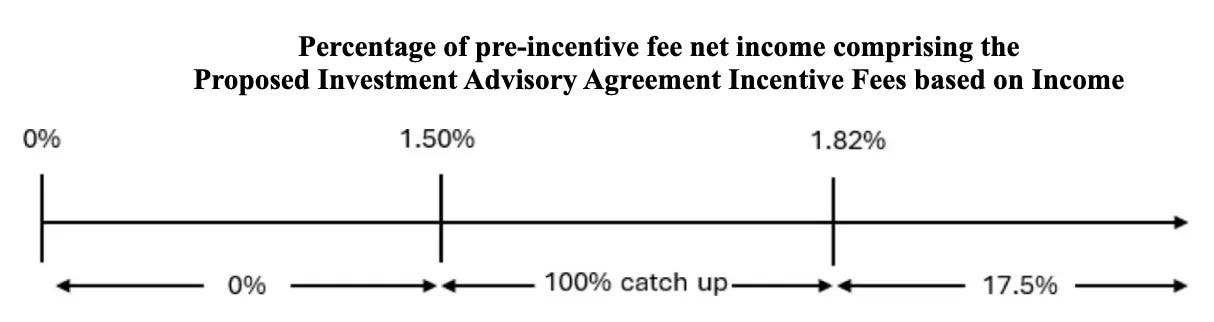
Worst case scenario possibility: The company might dilute existing shareholders (equity) in order to increase the gross asset portion (which subsequently increases their base pay). However, we also need to take note that the advisors that are incentivised to do this is also a shareholder of approximately 40%+ of the company. Moreover, this will not make sense, because the equity portion in the compensation formula will increase - this reduces their compensation, nullifying the effect of the added cash from the dilutive raise.
My Assessment: Too Many Unknowns
I can’t quantify the probability of success here. I don’t trust anyone who claims they can.
What I can say is this: The thesis requires multiple external dependencies (legislation, regulation, industry health) combined with execution success (BDC conversion, credit quality) over an uncertain timeline. There are too many “Ifs” and too little hedge.
Question 3: How Fast Till You Get Them Out?
Even if I believed the upside and trusted the execution, there’s a final killer: timing.
The catalysts here play out over 18-24+ months:
The Problem: LEAPs require value realization in 12-18 months, and whilst AFCG’s catalysts take 18-24+ months to fully play out, its options are generally short term and carry a significant time risk relative to my other opportunities at hand (with a larger margin of safety).
OVERALL VERDICT: REJECTED
But here’s the thing: I’m not rejecting AFCG forever. I’m rejecting it now.
This is one of those rare situations where “not yet” is the right answer. The opportunity might be real—it’s just not the right time to seize it.
What I’m Waiting For
I’ll revisit AFCG when 2 of 3 things happens
1. BDC Conversion Completes Cleanly and Cannabis Rescheduling Gets Finalized (Mid 2026)
If the conversion happens smoothly, first deals get announced, portfolio stays stable—then I’d reconsider at $3.00-3.50. The execution risk gets eliminated, confidence increases, timeline shortens. If the DEA finalizes rulemaking (not just announces comment periods), implementation timeline is clear, and market starts pricing it in—then I’d buy at almost any price under $4.50. This transforms the entire thesis.
2. There is no better opportunity on my table
Opportunities are always relative to those that are on your table. If your margin of safety is high and conviction is high, you portfolio positions should never be too diversified - diversification is only a hedge to risks which (1) are black swan (2) which you are ignorant of and didn’t bother finding out the information for.
3. LEAPs option is available
My safety of margin is increased when my time risk is significantly reduced
The Real Lesson:
Sometimes the best investments are the ones you don’t make.
As of January 1 2026, became a BDC company (ahead of schedule). This has removed one significant risk element for us. Simultaneously 👇
Following the December 2025 Executive Order to expedite moving marijuana from Schedule I to Schedule III, the DEA is expected to finalize this process in 2026 (this is not an "if" or speculation. An executive order has been passed and WILL finalize). That being said, legislation hurdles will still be signficant
Economic Impact: The elimination of Internal Revenue Code Section 280E will allow cannabis businesses to deduct normal business expenses, potentially saving typical dispensaries $268K annually and unlocking roughly $1.6B to $2.2B in annual after-tax cash flow for the industry.
Capital Access: While not fully legalizing cannabis, Schedule III makes it easier for mainstream financial institutions to provide banking, loans, and credit, which will lower capital costs and trigger increased M&A activity.
$MSOS Cannabis ETF have also doubled due to this reclassification (along with 10x increase in volume during December 2025). But $AFCG is clearly not responsive about this when we can expect an increasing probability of loans getting repaid - which is their hurdle in re-valuation now
The legal cannabis market in the United States is experiencing significant growth, with projections suggesting it will reach between $45 billion and $55 billion in revenue by 2025-2026. While growth rates vary by analysis, the market is generally expanding at a compound annual growth rate (CAGR) of approximately 11% to 14% through 2030.
That being said, the company has no durable moat of which i can identify (if i want to hold it long-term)