
A property company can own valuable buildings and still face a simple question with no simple answer: where will the principal come from on the date the loan matures?
Investors often put a rough value on assets, compare that value with debt, and conclude that refinancing should be possible. But a valuation is not a payment. A buyer who might close a property sale in three months does not pay a loan due next week. A lender’s indication of interest is not a funding commitment. And one missed maturity can trigger provisions that make other obligations arrive sooner.
The useful test is a calendar, not just a balance sheet: for each due date, which dollars are already available, which are contractually committed, which remain conditional, and which will arrive only later?
The difference between value and payment capacity
A business is often called solvent when the value of its assets appears sufficient to cover its liabilities. That is a broad judgment, and it depends on what the assets can actually be sold for and which claims have priority. Liquidity asks a narrower question: can the borrower pay the amount due when the contract requires it?
The two questions use different clocks. A building may produce rent for years. A factory may support a franchise for decades. A share portfolio may be worth much more than the company’s bank debt. Those facts can matter greatly to long-run value, but they do not automatically provide cash on a date written into a loan agreement.
A company can bridge the time gap in several ways: it can use cash already available at the borrowing entity, generate cash before maturity, draw a committed facility, close an asset sale, refinance, or negotiate an extension. Each source has a date and a condition. A forecast is not the same as a contract, a signed contract is not the same as a funded loan, and a sale agreement is not the same as settled proceeds.
The question is not whether the money may exist eventually. It is whether it can be used, in the right amount and currency, by the borrower, before principal is due.
A fictional sources-and-uses bridge
Consider a fictional property company. All amounts are in U.S. dollars millions. Its opening balance sheet shows assets of $1,500 million and liabilities of $1,000 million, including a $400 million loan due in six months. That leaves $500 million of positive book net assets. The balance sheet may look comfortable, but the company still needs cash for the scheduled payment.
Assume the company has $100 million of unrestricted cash at the borrower, expects $80 million of operating free cash flow by month six after interest, taxes, and maintenance spending, and has a $100 million committed facility that is drawable by then if its stated conditions are met. A separate asset sale is expected to produce $350 million net, but it will not close until month nine.
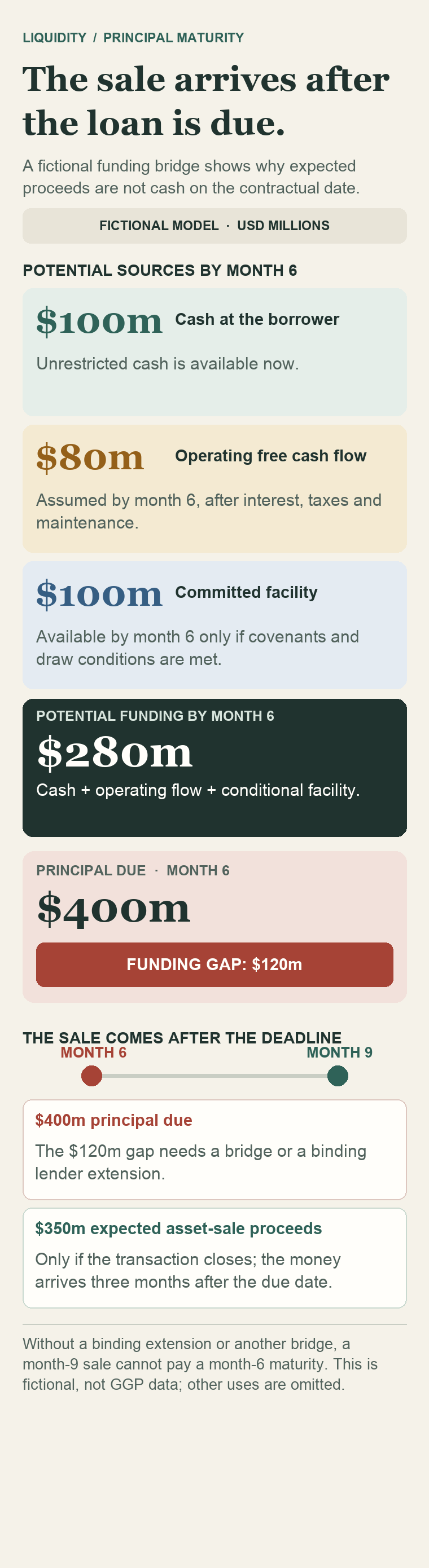
The bridge is visible in one line:
$100m cash + $80m operating free cash flow + $100m committed facility − $400m principal = a $120m shortfall at month six.
The company’s assets may be worth more than its liabilities. In this illustration the opening accounting balance sheet has $500 million of net assets. Still, the asset sale is three months late for the original due date. The company needs the lender to extend the maturity, or it needs another source of funding, before the date arrives.
If the lender grants a three-month extension and the asset sale actually closes in month nine, the sources total $630 million: $100 million of opening cash, $80 million of operating free cash flow, a $100 million line draw, and $350 million from the sale. After repaying the $400 million maturity and the temporary $100 million draw, $130 million remains before other uses omitted from this small model. That residual is not distributable surplus; payroll, other debts, transaction costs, and future operating needs have not been modeled.
Now change two assumptions. Operating free cash flow by month six falls to $40 million, and a covenant or draw condition makes the undrawn facility unavailable. The borrower has only $140 million by the original date, leaving a $260 million gap. A later asset sale may still support repayment if the lender extends the loan, but it does not erase the need for that extension. The outcome depends not only on asset value but also on the lender’s decision and the sale’s timing.
This example is fictional. It does not describe General Growth Properties, and positive book net assets do not prove market solvency. Its purpose is to make the date mismatch inspectable.
Graphic summary: fictional U.S. dollars in millions. Potential funding by month six totals $280 million against $400 million due; the expected $350 million sale proceeds arrive only in month nine, if the transaction closes.
What General Growth Properties expected, and what it reported later
General Growth Properties (GGP) offers a dated example of the difference between a financing expectation and cash already committed. On January 8, 2008, the company released a capital roadmap describing its company-portfolio debt maturities as of the end of 2007. It reported $2.621 billion maturing in 2008 and $3.344 billion in 2009, and said $359 million of the 2008–2009 maturities had already been refinanced. The release divided the 2008 amount into $1.816 billion of mortgage and other secured debt, $722 million of bridge-acquisition debt, and $83 million of notes. For 2009 it listed $2.744 billion of mortgage and other secured debt and $600 million of notes. The SEC-filed capital roadmap also cautioned that its maturity amounts were not calculated in accordance with GAAP and that the company believed any reconciliation differences would be immaterial. Treat these as the company’s financing disclosures, not as a substitute for an audited debt table.
The same release put forward a case for refinancing. For mortgage debt maturing in 2008, GGP estimated property-level income of $365 million in the twelve months after maturity. Applying a 7.5% capitalization rate gave a financing value of about $4.867 billion. The $1.816 billion mortgage-and-secured portion was 37.3% of that estimate. For 2009, the company estimated $415 million of property-level income and a financing value of about $5.533 billion; the $2.744 billion mortgage-and-secured portion was 49.6% of that estimate. These ratios compare the mortgage components with management’s financing-value estimates. They do not compare all debt due with an independent appraisal.
GGP said it was negotiating refinancing terms and expected significant excess proceeds from refinancing the maturing mortgage debt, but the release also said agreements had not been reached. The distinction is essential. Estimated income and collateral value can make refinancing plausible. They do not establish that a lender has agreed to lend a specified amount, on specified conditions, with funds available before a specified date.
The information changed. In its 2008 Form 10-K, filed February 27, 2009 for the year ended December 31, 2008, GGP said the commercial lending market had come to a “virtual standstill” and that it had been unable to refinance or repay a number of existing loans with scheduled 2008 maturities. The filing said these events triggered certain cross-default provisions on other financing arrangements. It also described short-term extension and forbearance agreements intended to forestall foreclosure or bankruptcy proceedings, along with lender operational oversight and lender control of operating cash receipts at certain properties. The filing detail confirms the reporting period and filing date; its liquidity discussion contains the company’s account.
That language is specific but limited. It does not say that every 2008 maturity went unpaid, quantify every affected loan in the passage, or show that the company lacked sufficient assets in a long-run valuation. It does show why the date and quality of financing sources matter: an inability to refinance some loans coincided with cross-defaults and lender control over some receipts. A short-term forbearance is breathing room, not proof that the ultimate payment has been funded.
On April 16, 2009, SEC filing detail and a Form 8-K reported that GGP, GGP Limited Partnership, and certain domestic subsidiaries filed voluntary Chapter 11 petitions. That later event is context, not proof that maturity timing alone caused the filing, that GGP was solvent, or that the January 2008 estimates were obviously wrong using only information available at the time.
The house-sale analogy, and where it stops
Imagine that you own a house worth more than the mortgage balance, but the mortgage has a balloon payment due next Friday. A buyer offers a good price but will not close for two months. The house’s value helps explain why the loan may eventually be repaid. It does not settle the payment next Friday. You still need cash, a lender willing to extend the loan, or another bridge that lasts until closing.
The analogy is useful because it separates the asset’s value from the timing of proceeds. It stops short of corporate finance: large borrowers may have many mortgages, separate property entities, cross-defaults, covenants, lenders, and court-approved restructurings. A house sale does not model those contracts. The analogy reminds us to check dates; documents determine the actual rights.
The strongest alternative: refinancing may really be available
A maturity schedule is not a prediction of default. A borrower with valuable collateral, stable income, and a diversified lending base may refinance before the date. A committed revolving facility may bridge the period. The borrower may also sell an asset and close early. In GGP’s January 2008 account, management described projected property income and financing value and said it expected refinancing proceeds. That view was a plausible competing explanation, not an irrational one.
To test it, look for evidence of a real financing commitment: executed agreements, amount, pricing, maturity, collateral, covenants, conditions precedent, and a funding date. A lender’s indication of interest, a management estimate of asset value, or a plan to sell is weaker evidence. It can still be informative, but should not be entered in the same column as cash already at the borrower.
Also distinguish a maturity extension from a full refinance. An extension can prevent an immediate default, but its fees, interest rate, collateral, cash-control provisions, covenants, and expiry date may shift rather than remove the risk. GGP’s 2008 Form 10-K described temporary extensions and forbearance as well as operational oversight. Those terms matter to the next due date and to the company’s ability to generate or use cash in the meantime.
The conclusion changes if the loan is refinanced on binding terms before maturity, the facility is drawable under the borrower’s actual covenant position, or cash flow arrives early enough to cover principal and other required payments. It changes in the opposite direction if a sale slips, a buyer can walk away, property values fall, a facility has a drawstop, or one default accelerates other obligations.
A practical maturity-date check
When a company has a large principal payment approaching, build a dated bridge for each relevant date:
Read the debt note, not just total debt. List principal amortization, balloon payments, bond maturities, extension options, and revolving-facility expiration dates. Keep the borrower, currency, collateral, and maturity for each instrument visible.
Start with cash that can pay that borrower. Identify cash already available to the legal entity that owes the debt. Do not assume a consolidated balance or restricted deposit can be used without evidence.
Classify future sources by certainty and date. Separate operating cash expected before maturity, committed and drawable facilities, signed refinancing, asset-sale proceeds with a realistic closing date, and management’s uncommitted plans. Do not count a source before its conditions are met and its money can settle.
Subtract other uses due before or on the same date. Include interest, taxes, essential maintenance, payroll, other maturing debt, and cash required to keep operations running. A gross source total can overstate the amount available for principal.
Calculate the gap at every due date. Use matched currencies and periods: available cash by date minus principal and other required uses by date. Repeat the bridge if a sale is delayed, free cash flow falls, refinancing costs rise, or a facility becomes unavailable.
Read the default and relief terms. Check cross-defaults, acceleration, collateral rights, covenant tests, waiver expiration, forbearance fees, and any lender control over cash. A bridge that solves one payment may leave the company with a tighter next date.
If the filing does not disclose enough to identify the cash source, write “unknown” rather than converting a likely refinancing into cash. A range is more honest than a single liquidity number when sale timing, lender approval, or draw conditions remain uncertain.
The practical decision is narrow: can the company meet each contractual principal date with funds that will actually be available then, without depending on a financing promise that has not become binding? A long-run asset may have value, but its value cannot rewrite a loan’s calendar.
Remember the rule: value can wait; principal usually cannot. Ask: if refinancing closes three months after the due date, which documented dollars bridge those three months?
The sources-and-uses bridge and its company figures are fictional teaching assumptions. General Growth Properties’ schedule and financing values are dated management disclosures; its 2008 Form 10-K and April 2009 Form 8-K are historical filings. The later Chapter 11 event is not attributed to one cause here. This article is educational, not an investment recommendation.