
Part One: The Problem — What the Numbers Say and Why You Should Be Suspicious of Them
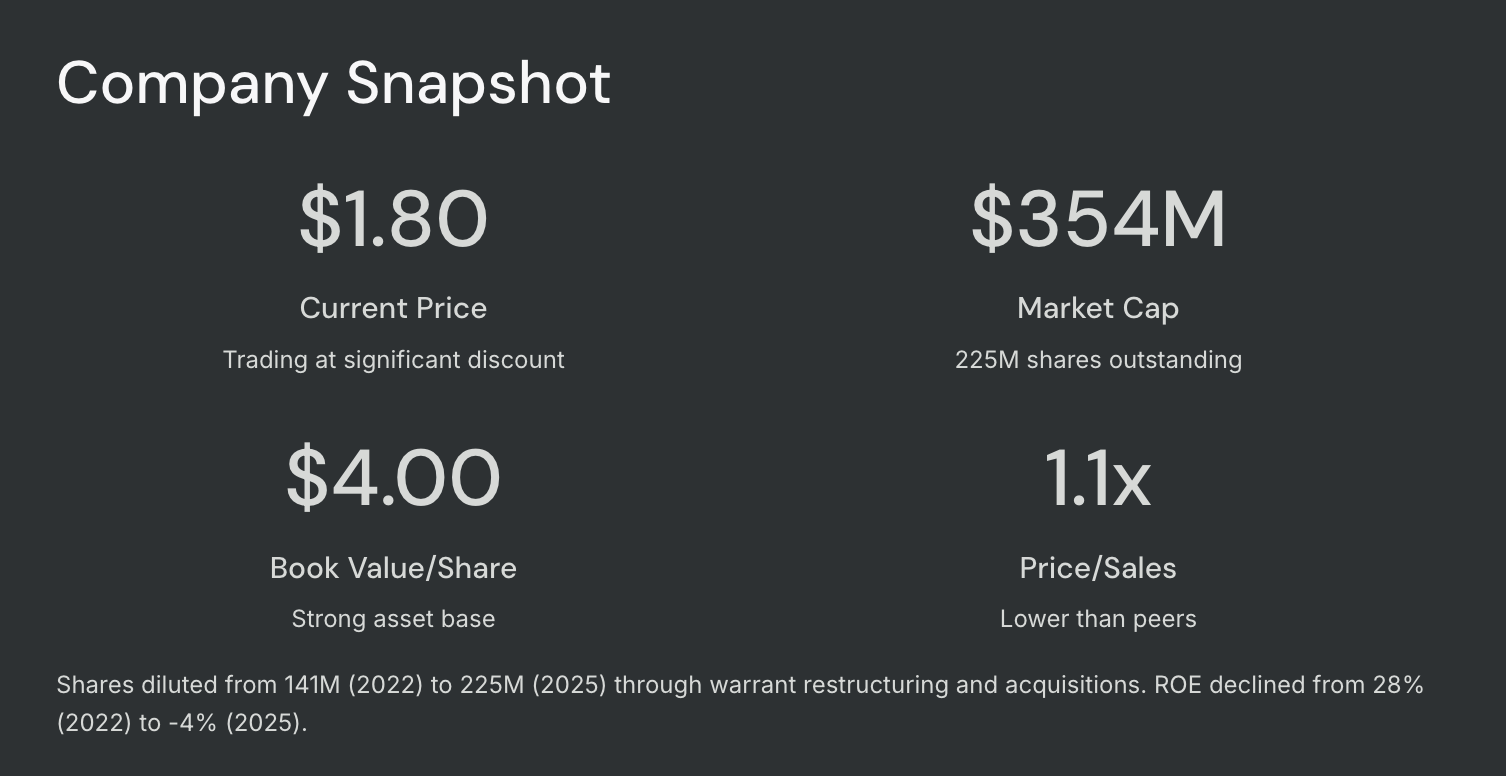
There is a particular kind of investment that only reveals itself to people willing to do the disagreeable work of reading past the headline. It does not appear on stock screeners. It gets rejected instantly by anyone relying on P/E ratios, because there are no earnings to build a ratio from. Its chart looks broken. Its largest institutional shareholder has been visibly selling. And its accounting statements, when read without context, suggest a company in freefall. Ring Energy Inc., trading at $1.80 per share with a market capitalization of $353.9 million, is that investment.
The case begins not with excitement but with a simple provocation: the company’s book value per share is $4.00. The stock trades at $1.80. That means the market is selling you a dollar of net assets for 45 cents. Before we even get to what those assets are, before we examine a single barrel of oil or a single cash flow line, the market is already telling you it does not trust this balance sheet. The question worth spending time on is whether that distrust is warranted — or whether the accounting, in this case, is doing what accounting in the oil and gas sector often does, which is paint a picture that is technically correct and economically misleading at the same time.
The ROE history is worth sitting with for a moment, because it tells the story of a company that has been methodically transformed over a very short period. In 2022, Ring Energy produced a 28% return on equity — a genuinely strong number for any capital-intensive business. By 2023 that had compressed to 14%. By 2024 it was 8%. And then in 2025 it turned negative at -4%. This sequential deterioration, viewed without context, looks exactly like a business whose competitive position is eroding and whose assets are generating progressively less value. That is the story the market has accepted. It is also, as we will work through carefully, almost entirely wrong — driven not by deteriorating economics but by a specific quirk of oil and gas accounting that has nothing to do with how much oil is actually in the ground or what it costs to lift it.
The price-to-sales ratio of 1.1 is worth noting as a rough anchor. Ring Energy is valued at just over one year’s revenues. That is a number that implies either very low margins, very high risk, or both. We will come back to the margins, which are actually unusually strong for a company of this size. And the risk — well, that requires understanding the debt, the reserve base, and the cash flow dynamics, which we will work through in sequence.
Part Two: The Dilution Story — Understanding What Actually Happened
A 60% increase in share count from 141 million to 225 million over three years is the first thing any careful investor must understand, because dilution is the most reliable destroyer of per-share value that exists. If a company is constantly issuing new shares to fund operations it cannot afford, equity holders get ground down regardless of what the underlying business is worth.
The good news, once you trace exactly what happened, is that the bulk of this dilution is historical, explained, and unlikely to repeat at anywhere near the same magnitude.
The current overhang from future dilution is genuinely trivial. There are 78,200 exercisable common warrants outstanding with a contractual exercise price of $0.80 per warrant. At a stock price of $1.80, every one of those warrants would be exercised eventually, but the number of shares that would result — 78,200 — is so small relative to 225 million shares outstanding that it is effectively noise. Alongside this, there are approximately 8 million restricted stock units outstanding, representing approximately 3.5% potential dilution on a fully diluted basis, spread across a standard vesting schedule. RSU dilution at this level is the normal cost of compensating employees at a company that does not pay cash bonuses generously enough to retain talent. It is not a red flag.
The real dilution story lives in 2022 and 2023, and it breaks into three distinct events that need to be understood in sequence.
The first event was the Stronghold acquisition in August 2022. Ring Energy agreed to acquire the Central Basin Platform assets of Stronghold Energy II — a company majority-owned by Warburg Pincus — for total consideration of approximately $465 million. The structure included $200 million in cash at closing, a $15 million deferred cash payment, $20 million of assumed hedge liabilities, and $230 million in Ring equity. That equity component translated to 21.3 million shares of common stock at $3.60 per share plus 153,176 shares of convertible preferred stock that subsequently converted into approximately 42.5 million additional common shares. In total, the Stronghold deal introduced roughly 63.8 million new shares into the float — the single largest source of dilution in Ring Energy’s history. The original $465 million purchase price represented approximately 0.65 times the estimated proved developed PV-10 of $719 million at strip prices. In other words, Ring paid 65 cents for every dollar of independently estimated proved developed reserve value. The dilution was real. The value received for that dilution was also real, and it was bought at a meaningful discount (relative to its long-term intrinsic value).
The second event was the Founders acquisition in August 2023, a much smaller bolt-on of 3,600 net acres in Ector County, Texas, producing approximately 2,500 barrels of oil equivalent per day with 9.2 million barrels of proved reserves, acquired for $75 million entirely in cash — no new shares issued. The total consideration worked out to approximately 2.3 times the next twelve months’ adjusted EBITDA, which is a reasonable price for high-working-interest conventional Permian assets with shallow decline rates.
The third event was the April 2023 warrant restructuring. Ring Energy amended 14.5 million outstanding warrants, lowering their exercise price from $0.80 to $0.62, to incentivize holders to exercise immediately rather than waiting. The result was 14.5 million new shares issued and approximately $9 million in gross proceeds flowing into the company’s balance sheet. The stock fell roughly 6% in premarket trading on the announcement because markets do not like hearing that management is handing warrantholders a discount to get cash sooner. The CEO’s defense — that clearing the overhang simplified the capital structure and removed a psychological ceiling on the stock — has merit as a long-term argument, even if the short-term optics were poor. The outcome was that by the end of 2023, only 78,200 warrants remained outstanding. The overhang was gone.
The critical insight across all three events is that none of them represent ongoing dilution to fund losses. The Stronghold shares were consideration for a large asset acquisition bought at a discount to independent reserve value. The warrant exercise was a one-time cleanup. The Founders deal involved no share issuance at all. What looks on a share count chart like a steady drip of equity destruction was actually a defined, bounded transformation of a small company into a meaningfully larger one. The dilution cycle is substantially complete.
Part Three: The Business Model — How Ring Energy Actually Makes Money
Understanding what a business does before trying to value it seems obvious, but in practice many investors skip this step and go straight to multiples. With Ring Energy, the mechanics of revenue generation matter because they determine both the upside and the risk profile.
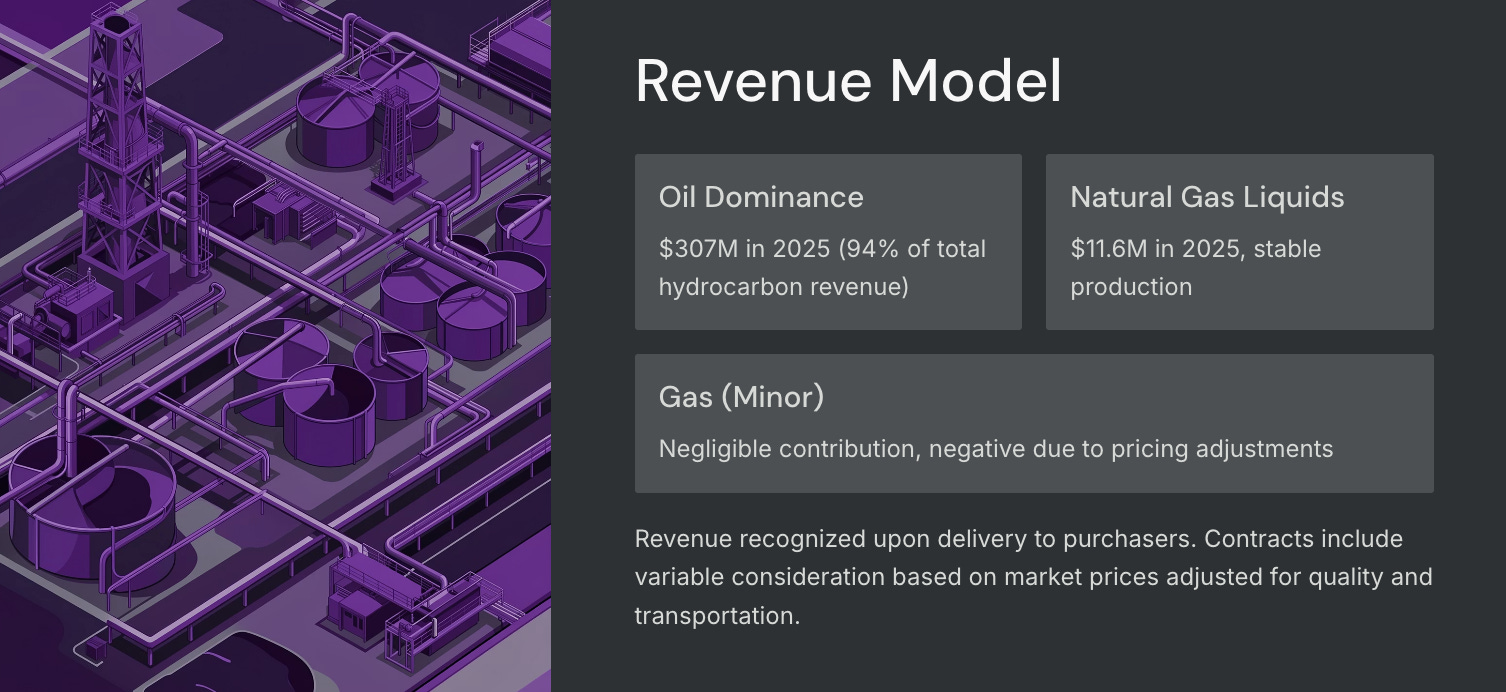
The business is simple in structure. Ring Energy extracts crude oil, natural gas, and natural gas liquids from wells it operates in the Permian Basin of West Texas. In 2025, that produced total revenues of $307.2 million. Oil carried nearly the entire business: oil revenues were $307.6 million. Natural gas revenue was actually negative at -$9.3 million, which sounds alarming but reflects the reality that in some Permian sub-markets, natural gas is so oversupplied that producers effectively pay to dispose of it — a nuisance cost rather than a catastrophe for a company whose assets are overwhelmingly oil-weighted. Natural gas liquids contributed $8.9 million, partially offsetting the gas drag.
The revenue decline from 2024’s $366.3 million and 2023’s $361.1 million is explained almost entirely by oil prices, not by volume. Ring Energy’s production volumes actually grew — from 19,658 barrels of oil equivalent per day in Q4 2024 to 20,253 barrels per day on average through 2025. The 18% reduction in realized prices between 2024 and 2025 accounts for the decline in revenues despite volume growth. This is important because it separates two things the market tends to conflate: a company whose business is deteriorating versus a company whose commodity price is cycling. The former is a structural problem. The latter is a timing issue.
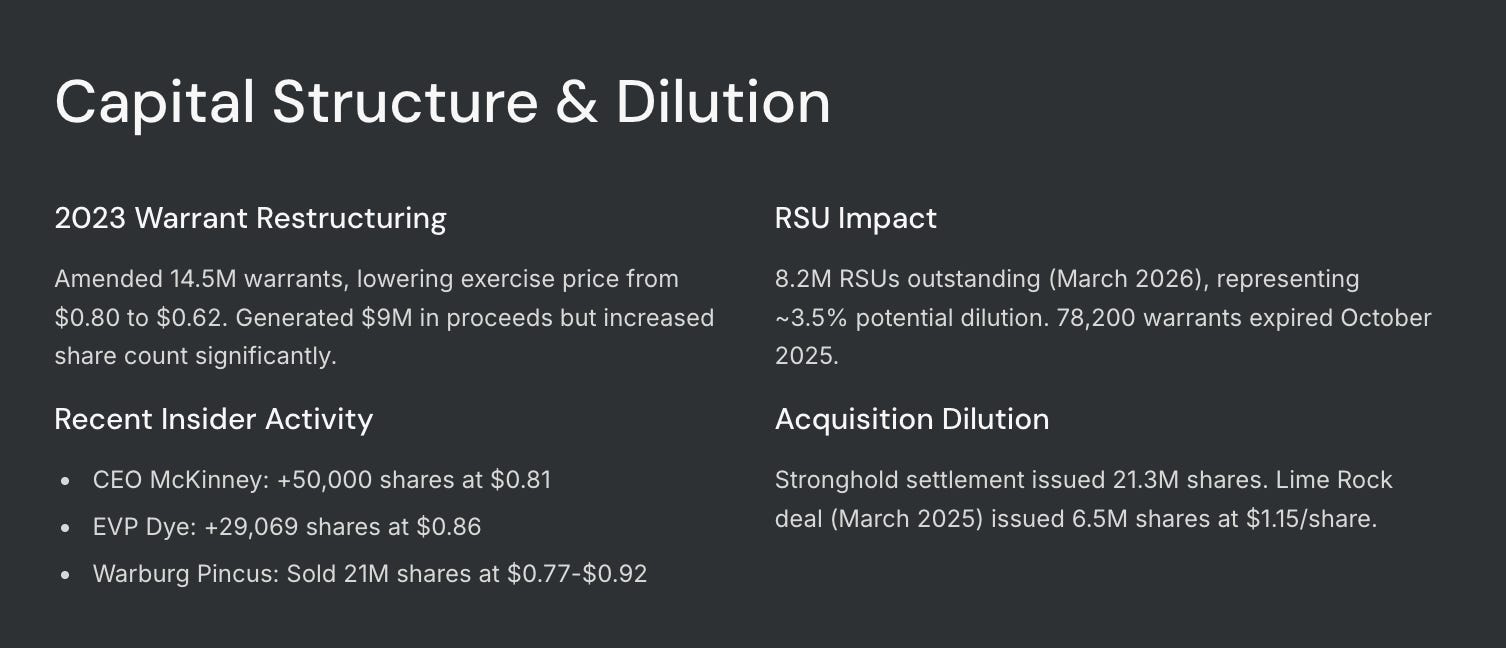
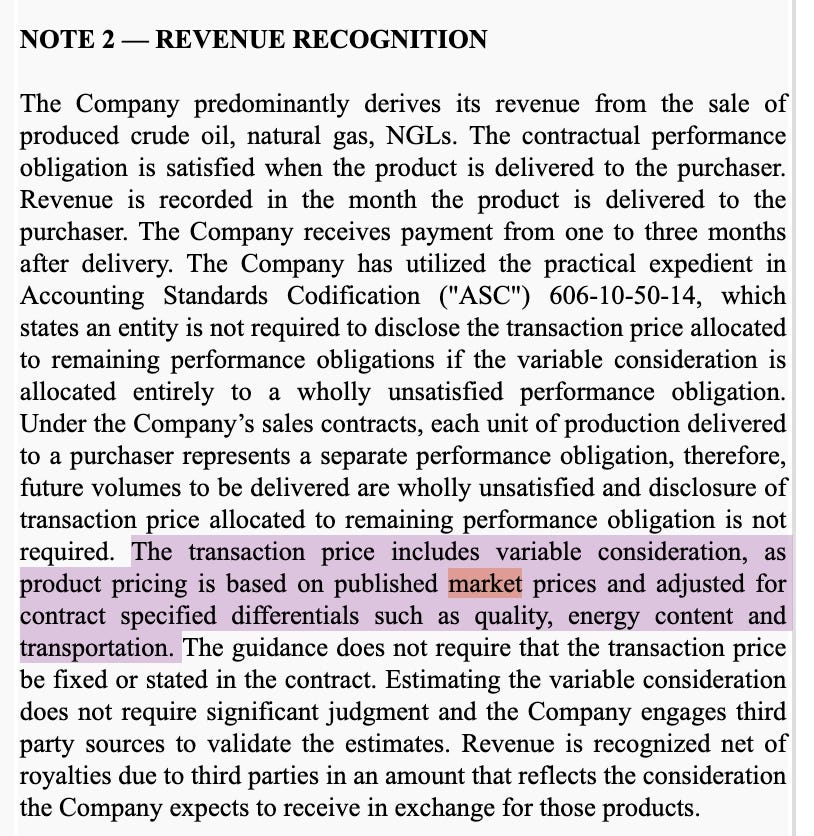
The pricing mechanism itself is worth understanding. Transaction prices are based on published market prices — primarily the WTI benchmark — adjusted for contract-specified differentials such as quality, energy content, and transportation. There are no fixed-price long-term contracts that lock Ring Energy into below-market realizations. The company is a price-taker, which means every dollar of improvement in the WTI benchmark translates almost directly into Ring’s revenue per barrel. This creates significant operating leverage to oil price on the upside — and significant vulnerability on the downside, which we address fully in the risk section.
Part Four: The Accounting Distortion — Why the Income Statement Is Lying to You
This is the section where the gap between perception and reality is widest, and it requires the most careful unpacking.
Ring Energy reported a large net loss for the period encompassing its most recent quarterly filings. At the total company level, results were materially impacted by two non-cash items: a $162.1 million full cost ceiling test impairment and a $77 million unrealized derivative mark-to-market adjustment resulting from changes in forward commodity prices. Together, these two items produced a reported net loss of $220.6 million for that quarter. This is the number that filters through to screens, gets picked up by retail investors, and produces the reflexive conclusion that something is fundamentally broken.
Let us take each item apart.
The ceiling test impairment is the more important of the two. Ring Energy uses the full cost method of accounting for its oil and gas properties, which is one of two methods permitted under US GAAP. Under this method, all costs incurred in the exploration and development of properties — drilling, completion, leasehold acquisition — are pooled together in a single account and depleted over time. Every quarter, the SEC requires a ceiling test: comparing the net book value of those pooled costs to a calculated ceiling, which is the present value of estimated future net revenues from proved reserves, discounted at 10%, using a mandated oil price. That mandated price is not today’s price. It is not a forward estimate. It is the unweighted arithmetic average of the first-day-of-the-month WTI price for each month over the preceding 12-month period.
Here is the mechanism that creates the illusion. When oil prices fall significantly over several months, the trailing 12-month average lags and eventually catches up. As it falls, the calculated ceiling falls. If the ceiling drops below the book value of the properties, GAAP mandates a write-down — and crucially, once recorded, any write-off may not be reversed even if higher oil and natural gas prices increase the ceiling applicable to future periods. The impairment is permanently carved into the income statement and balance sheet, regardless of what the physical reality of the reserves looks like the following quarter.
The physical reality of Ring Energy’s reserves is unambiguous: they grew. The company’s year-end 2025 proved reserves totaled 153.3 million barrels of oil equivalent, up 14%, or 19.1 million barrels, from 134.2 million at year-end 2024. During 2025, Ring recorded reserve additions of 14.0 million barrels for acquisitions, 11.2 million barrels for extensions and discoveries, and 1.3 million barrels of positive revisions. More oil in the ground. More barrels independently certified by Cawley, Gillespie & Associates, a third-party petroleum engineering firm. A ceiling test impairment of $162.1 million recorded simultaneously. These two facts coexist because they are measuring completely different things — one is measuring the present value calculated at a temporarily depressed trailing price, the other is measuring the physical inventory of hydrocarbons under Ring’s acreage. The accounting loss is a response to a price cycle. The barrels do not disappear.
The derivative loss is similarly mechanical. Ring Energy, like most prudent oil producers, hedges a portion of its future production by entering into price swaps and collars — contracts that give it a degree of protection against oil price declines by locking in a floor price on some barrels. The Strait of Hormuz tensions caused shifts in forward oil price curves, which changed the mark-to-market value of those hedging contracts. A $77 million unrealized loss on derivatives means the contracts, measured at current market prices, are worth $77 million less than when they were entered into. It does not mean Ring Energy wrote a $77 million check to anyone. It will not — the contracts will settle at actual oil prices as production is delivered, and the realized economic impact will likely be materially different from the mark-to-market snapshot. Importantly, Ring’s hedge book includes over 6,300 barrels of oil per day with a weighted average downside protection of $64.44 per barrel. That is insurance, not speculation.
Strip out the ceiling test impairment and the unrealized derivative loss, and the underlying business generated $38.4 million of adjusted net income in 2025 on revenues of $307.2 million. That is a business that works. And the company’s focus going into 2026 reflects exactly that understanding: management has stated clearly its intention to prioritize maximizing cash flow through cost monitoring and prudent capital allocation, seeking only acquisitions and combinations that provide high-margin properties with attractive returns at current commodity prices, while pushing to reduce debt and maximize liquidity.
Part Five: Management Alignment — Who Is Getting Paid for What
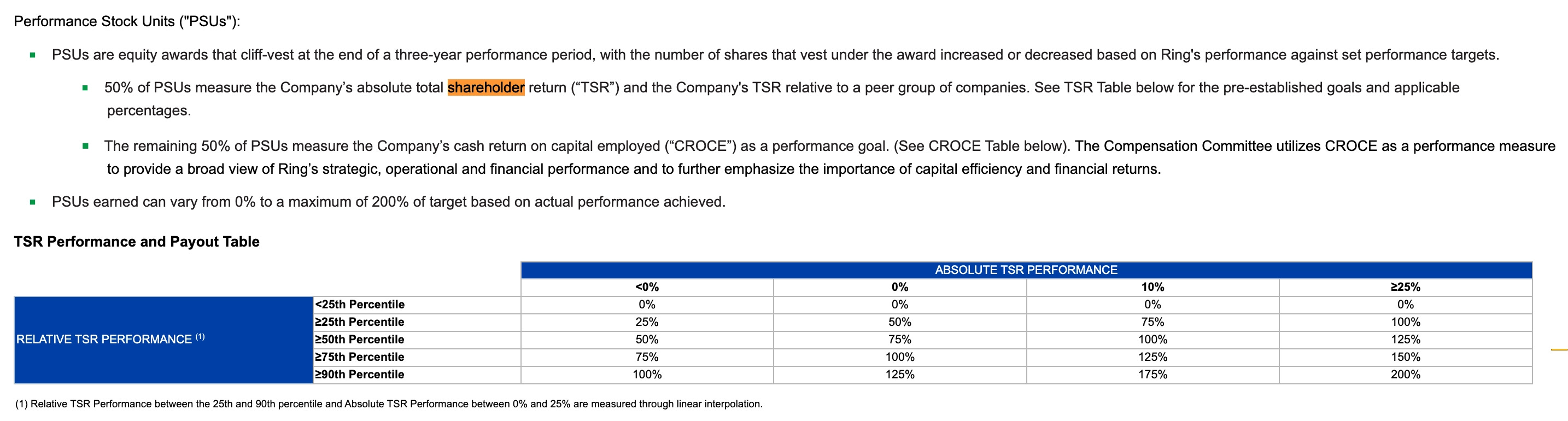
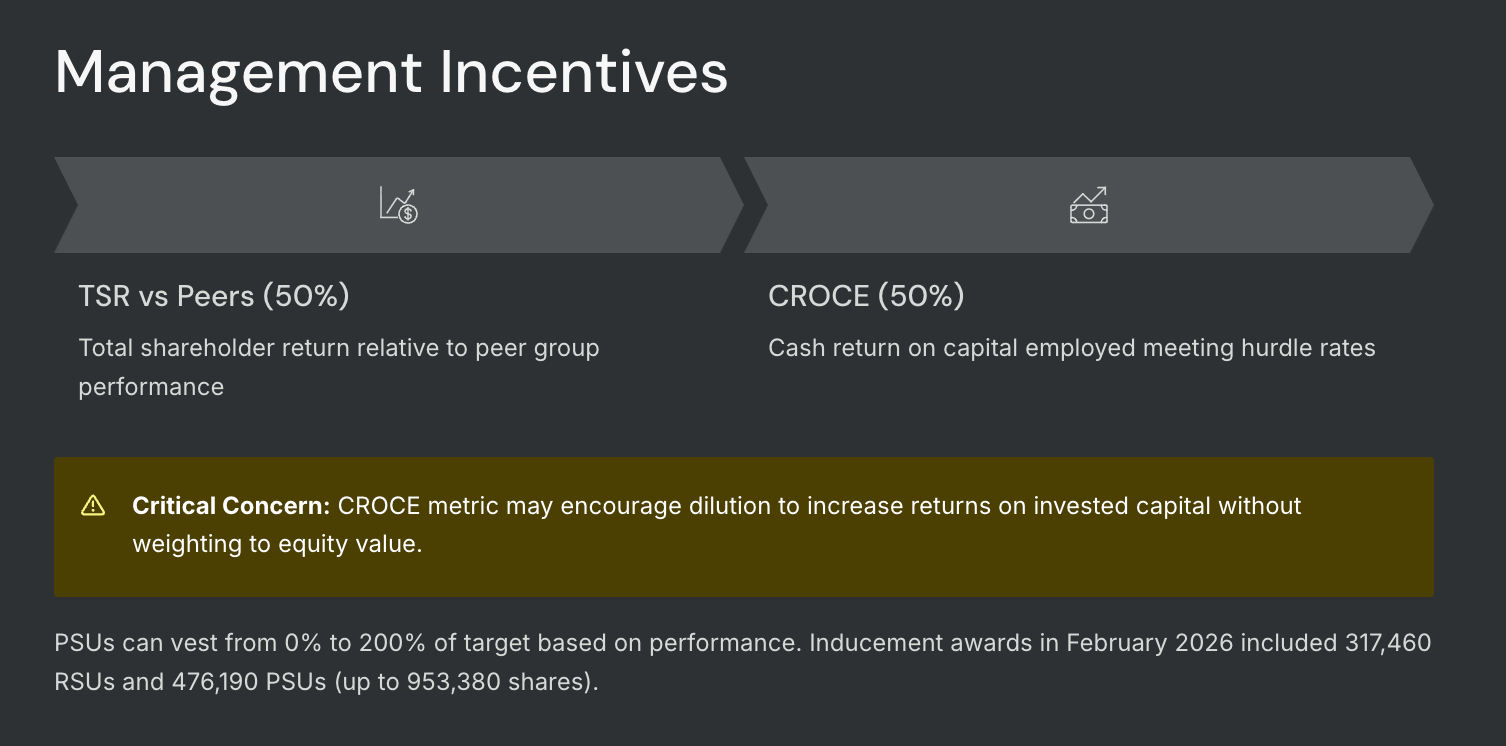
Before trusting any management team with a leveraged, capital-intensive business, it is worth understanding what metrics they are actually being paid to optimize. At Ring Energy, the performance stock units — the main long-term incentive for executives — vest based on two criteria in equal 50% weightings. Understanding each is important, because one of them is well-designed and one creates a subtle misalignment.
The first half vests based on total shareholder return relative to a peer group of oil and gas companies. Under this structure, the only way management gets paid is if Ring Energy’s stock outperforms its competitors over the measurement period. This is one of the cleanest possible incentive designs — it directly aligns management wealth with shareholder outcomes and prevents the scenario where executives get rich while stockholders get diluted. PSUs vest based on Ring’s absolute TSR performance and its TSR relative to a peer group, with payout potential ranging from 0% to 200% of target.
The second half vests based on the company’s annual cash return on capital employed, or CROCE. This is where a subtle problem lives. CROCE measures the cash return generated on the total capital base — equity plus debt combined. It is a useful metric for understanding how efficiently a management team is deploying all sources of capital. But it has a critical blind spot: it does not adjust for per-share equity value. A management team could issue shares at a significant discount to intrinsic value to fund acquisitions that generate acceptable returns on the total invested capital, and the CROCE metric could be satisfied even if the dilution destroyed value for existing equity holders. The metric measures the efficiency of capital deployment but is blind to the price at which the capital was raised. In a company that has already demonstrated willingness to use equity as acquisition currency — as Ring Energy has — this second incentive creates a risk that future acquisitions could prioritize scale over per-share value accretion.

This is not a crisis. The TSR component counterbalances the CROCE component, because dilutive acquisitions that harm per-share value will show up negatively in the TSR measurement. But it is a second-order risk to monitor, particularly as the company continues pursuing its stated strategy of Permian consolidation. When evaluating future acquisitions, the right question to ask is not just “was the asset bought at a good price?” but “was the financing chosen in a way that rewarded existing shareholders?”
Part Six: The Acquisition Story — How Ring Energy Built What It Owns
To understand what Ring Energy is worth today, you need to understand how the asset base was assembled, because the acquisition history reveals both the quality of the management team’s judgment and the embedded discount at which those assets were accumulated.
The management team has extensive experience studying, drilling, and producing the San Andres formation over 35 years, having drilled numerous vertical and horizontal wells across the Central Basin Platform and Northwest Shelf assets. This is not a management team that stumbled into the Permian Basin. The co-founders of Ring Energy were formerly co-founders of Arena Resources, a Permian Basin operator whose core production was located just ten miles south of Ring Energy’s original acreage. They knew the rock personally before they drilled the first well under the Ring Energy banner.
Founded in 2012, the team built an initial position by acquiring select properties that offered immediate positive cash flow and future development opportunities. By the end of 2013, proved reserves had grown to 7.2 million barrels of oil equivalent. Over the following years, the company drilled horizontal wells into the San Andres formation and proved that horizontal technology — borrowed from the shale revolution happening in the deeper Delaware and Midland basins — could be applied profitably to the conventional, shallow carbonate rock of the Central Basin Platform. In 2018, Ring drilled 57 new horizontal San Andres wells with one-mile laterals in the Central Basin Platform, achieving an average initial production rate of 432 barrels of oil equivalent per day, with drilling, completion, and tie-in costs of approximately $2.3 million per well, generating internal rates of return above 70% at $50 WTI oil.
Then came the transformation phase. In July 2022, Ring announced the acquisition of Stronghold Energy’s Permian Basin assets — a deal that effectively doubled the company in a single transaction. Stronghold’s operations were concentrated in Crane County, Texas, centered on approximately 37,000 net acres in the Central Basin Platform. The assets included long-life proved developed reserves of 41.2 million barrels of oil equivalent with a PV-10 of $719 million, and PDP reserves of 24.8 million barrels with a PV-10 of $481 million. The total consideration of approximately $465 million represented approximately 0.65 times the PD PV-10 of $719 million at strip prices. Buying 41.2 million barrels of proved developed reserves at a 35% discount to independent reserve value is, by any measure, a disciplined entry price.
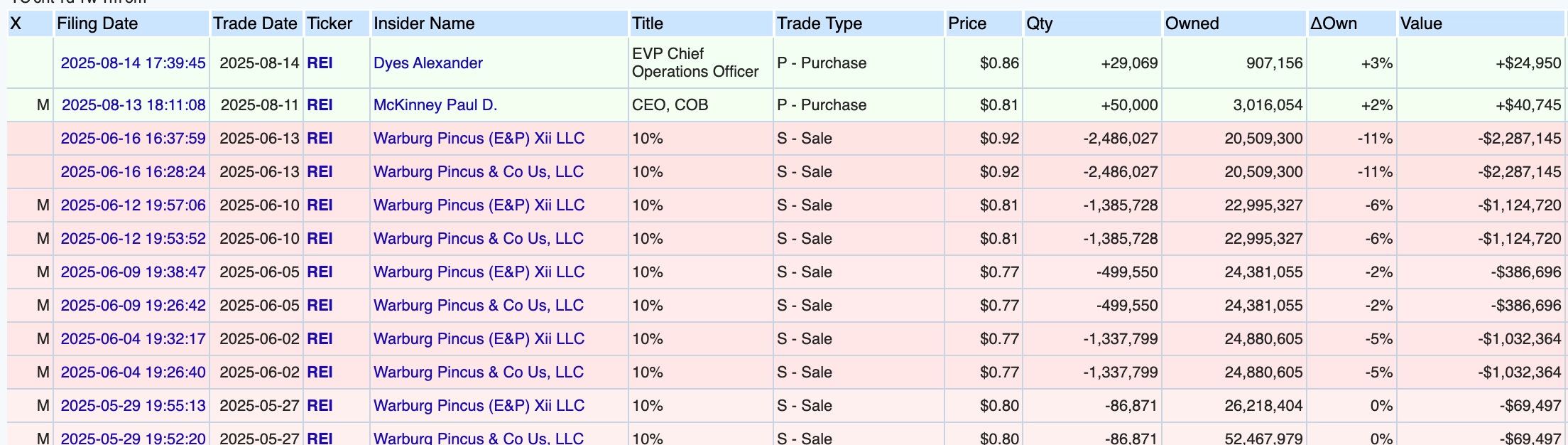
The critical background context for the Stronghold deal is that Stronghold was majority-owned by Warburg Pincus. The same institutional seller whose recent share sales have rattled retail holders of Ring Energy was, in 2022, the counterparty who sold Ring Energy its most transformative asset package. Warburg Pincus became Ring Energy’s largest stockholder — owning approximately 34% of the company post-closing — through the equity component of the Stronghold consideration. Their subsequent selling of that position is not a signal about Ring Energy’s future. It is a private equity fund returning capital to its limited partners on the timeline that fund’s lifecycle demands. Understanding this distinction is the difference between seeing a signal where there is only noise.
In August 2023, Ring followed the Stronghold acquisition with the much smaller Founders bolt-on: 3,600 net acres in Ector County, Texas, producing 2,500 barrels of oil equivalent per day at 86% oil, with 9.2 million barrels of proved reserves, for $75 million all-cash at approximately 2.3 times next-twelve-month adjusted EBITDA. No share issuance. A clean cash transaction that expanded the inventory of drill locations and brought the production base into Ector County, building further contiguity of operations.
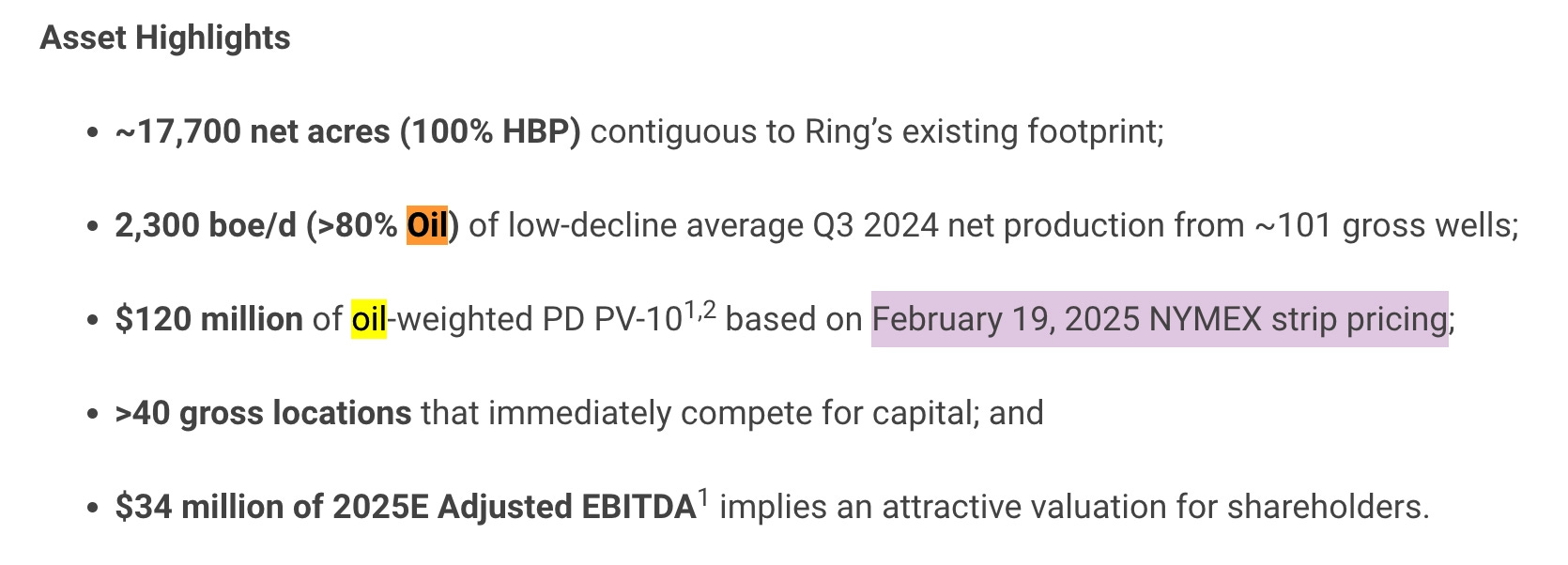
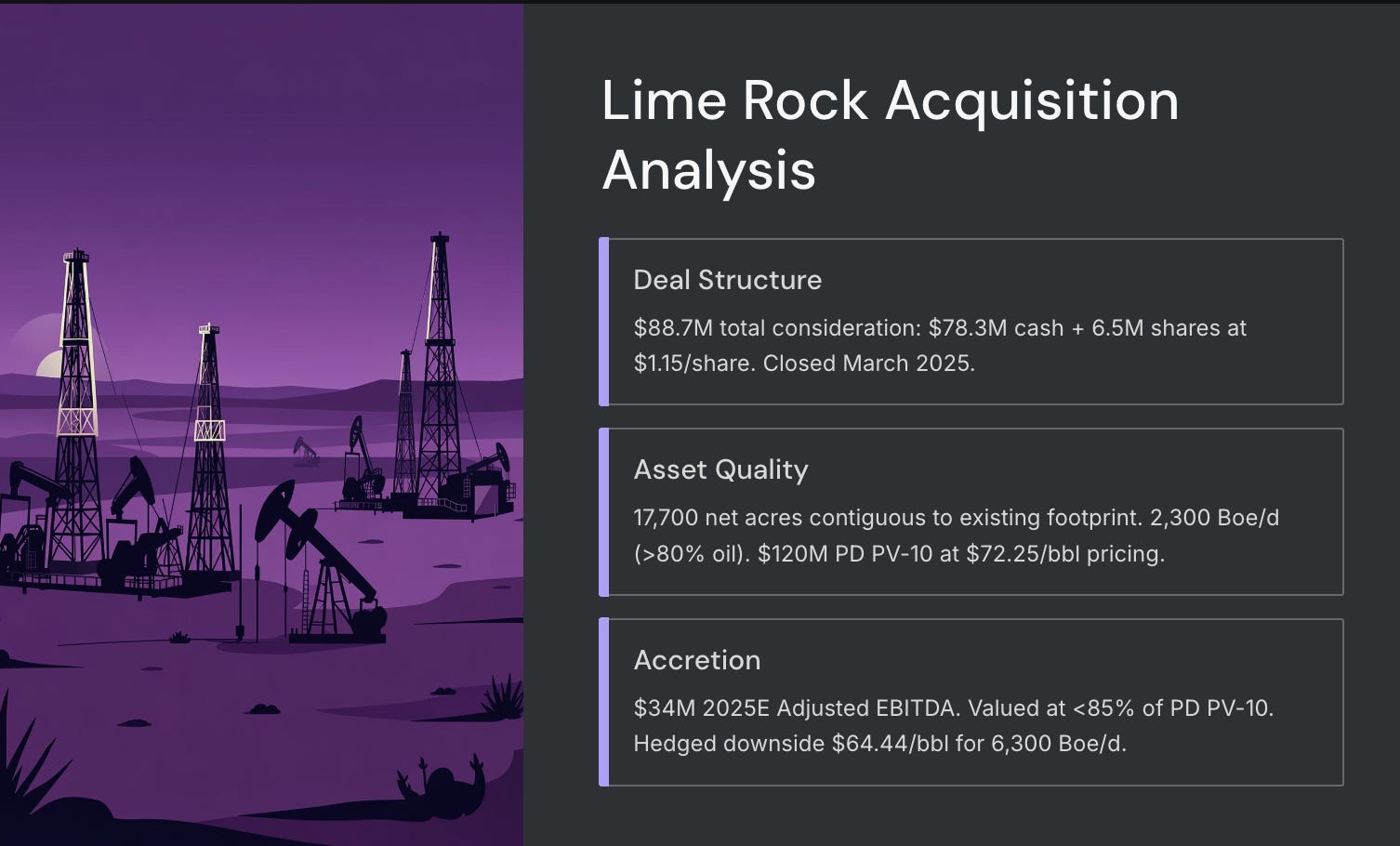
Then came the Lime Rock acquisition in March 2025: 17,700 net acres adjacent to Ring’s existing footprint, producing 2,300 barrels of oil equivalent per day at over 80% oil from approximately 101 gross wells, with a PD PV-10 of $120 million at strip pricing and an estimated 2025 adjusted EBITDA of $34 million — acquired for total consideration of approximately $88.7 million. Ring paid 74 cents for every dollar of independently estimated proved developed reserve value, at a price of 2.6 times next-year EBITDA. The deal was also structured to include approximately 6 million shares of Ring common stock issued at $1.15 per share as part of the consideration — a meaningful detail, because it means Ring used its equity at $1.15 when, as we will show in the reserve valuation section, each share was worth considerably more than $1.15 in terms of underlying reserve value. That share issuance was dilutive at the margin, though the quality and price of the asset acquired substantially justifies it. Following the acquisition, Ring achieved LOE reductions of over 5% in the initial weeks of integration — a fast demonstration that the operational synergies management promised were real.

What all three major acquisitions share is a consistent logic: conventional Permian Basin assets acquired at discounts to independent reserve value, with shallow decline rates, high oil cuts, and existing production infrastructure. The playbook has not changed. What has changed is the scale.
Part Seven: The Geological Edge — Why These Are Not Generic Oil Wells
The Central Basin Platform is the most misunderstood real estate in the Permian Basin, which is precisely why Ring Energy has been able to accumulate it so cheaply. To understand why, you need a brief detour into geology.
The Permian Basin is not a single geological unit. It is a collection of distinct sub-basins and platforms, each with different rock types, different depths, and radically different economics. The two sub-basins that attract most investor and analyst attention are the Midland Basin and the Delaware Basin — the home of the Wolfcamp, Bone Spring, and Spraberry shale formations that have made operators like Pioneer Natural Resources, Diamondback Energy, and Devon Energy household names among energy investors. These shale formations require expensive horizontal wells drilled thousands of feet into tight, low-permeability rock, stimulated with hydraulic fracturing to produce economic rates.
The Central Basin Platform, which sits between the Midland and Delaware Basins, is a fundamentally different animal. The primary producing formation — the San Andres — is a shallow, oil-saturated dolomite carbonate reservoir that has been producing continuously since the 1920s. Of the over 30 billion barrels produced from the Permian Basin in its history, approximately 40%, or 12 billion barrels, came from the San Andres reservoir alone. This is one of the most proven, most understood oil reservoirs in North America.
What makes the San Andres different from shale at the economic level is the decline curve. Shale wells are characterized by what petroleum engineers call hyperbolic decline — they produce at very high rates immediately after being completed, then decline sharply, often losing 70-80% of their initial production rate within the first 12 months. Maintaining flat production in a shale business requires constant drilling just to offset the aggressive natural depletion of existing wells. Capital expenditure is not optional — it is the treadmill price of staying in place.
Ring Energy’s wells in the Central Basin Platform have over 35 years of productive life, with a PDP decline rate of approximately 13% per year. A 13% annual decline is not nothing — left completely unattended, production would halve in approximately five years. But it is so different from the 70-80% first-year shale decline that the capital requirements are in an entirely different category. Ring Energy can maintain its production base with far less drilling activity than a shale operator of equivalent production scale. That difference flows directly to free cash flow. Ring’s long-life conventional assets and oil-weighted production mix enabled cash operating margins of approximately $26 per barrel, exceeding shale peers’ typical $15-20 per barrel averages.
Ring finds that San Andres horizontal wells have lower production declines and higher primary recovery than shale wells. Being a conventional play, cycle times are much shorter than shale — wells can be drilled in five to six days, at depths of approximately 5,000 feet, versus the much longer and more expensive programs in the deep Midland and Delaware formations. The economics of the individual well — a two-million-dollar horizontal San Andres well yielding above 70% IRR at $50 WTI — sit comfortably in the top quartile of Permian Basin well economics, but attract none of the attention lavished on the shale formations because the formation lacks the narrative excitement of a 2,000-barrel-per-day initial production rate.
CEO Paul McKinney has said directly that the Central Basin Platform has been overlooked for a long time. That statement captures the entire investment thesis in twelve words. The geological quality of the San Andres is not a secret — it has produced 12 billion barrels over a century. What is overlooked is that modern horizontal drilling technology, applied to a reservoir designed for vertical wells, unlocks economics that the market has not priced into the companies operating there.
Part Eight: What the Assets Are Actually Worth
Now we build the valuation from the ground up, the way a business owner would. Not a discounted cash flow model built on five-year revenue forecasts, not a multiple applied to next year’s EBITDA, but a direct assessment of what the physical asset — the barrels of oil in the ground — are worth right now, at prices we can observe today, minus every liability the company carries.
The starting point is the proved developed producing reserves as of December 31, 2025: approximately 60 million barrels of oil. These are the most conservative cut of the reserve base. They represent only barrels from wells that are already drilled, already completed, and already producing. No future capital expenditure is assumed to unlock them. They flow from the ground daily, generating cash, without requiring Ring Energy to drill another well. The additional 30 million barrels of proved undeveloped reserves — which require future drilling to develop — are set aside entirely for this analysis. We are valuing only what already exists and is already working.
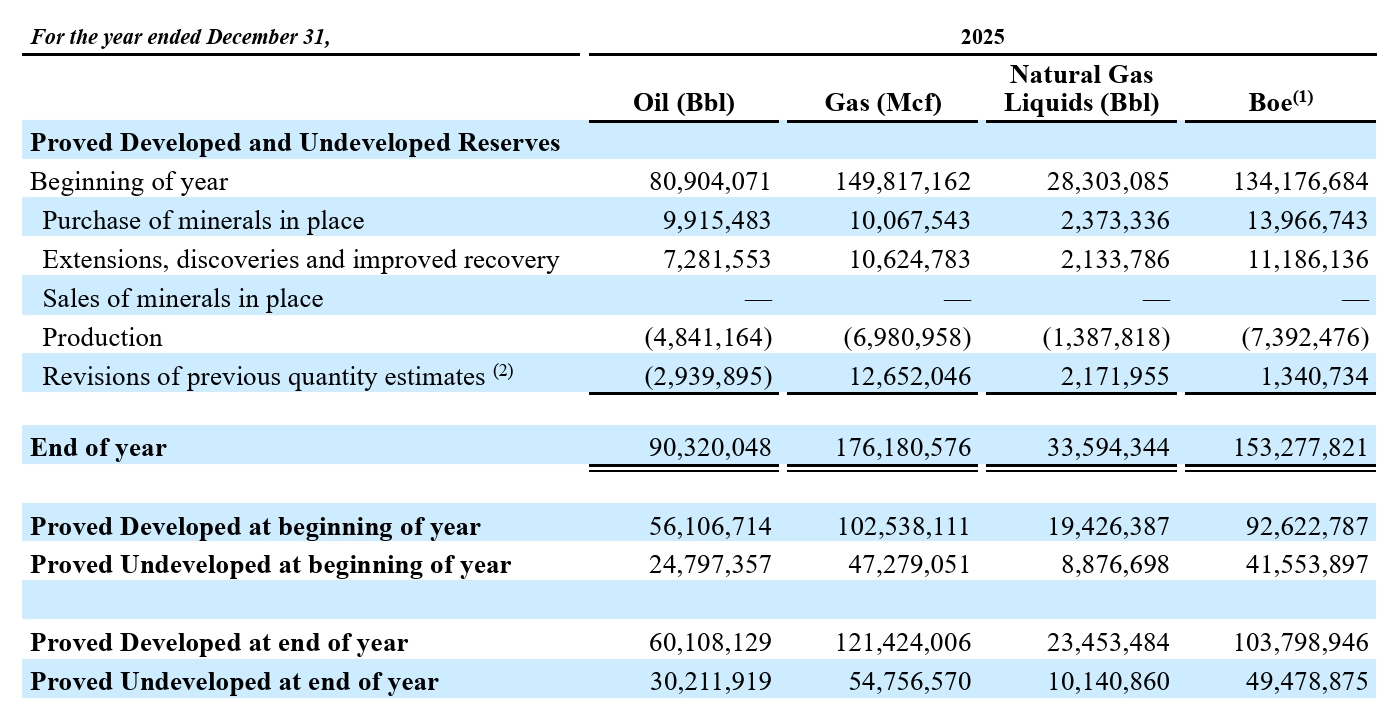
To price those barrels, the operational cost structure matters. Ring Energy’s actual lease operating expense in 2025 was $10.73 per barrel of oil equivalent — a number that reflects genuine operational efficiency at this scale of production. However, LOE alone does not capture all the costs of running the business. Production taxes, gathering and transportation costs, and a proportional allocation of general and administrative expenses add up to a more complete picture of what it truly costs to lift oil and deliver it. Borrowing the all-in cost framework used to analyze California Resources Corp — a larger, more established Permian operator used as a peer benchmark — a conservative total production cost assumption of $26 per barrel provides a substantial buffer above Ring Energy’s actual cost structure while capturing the full cost of operating the business.

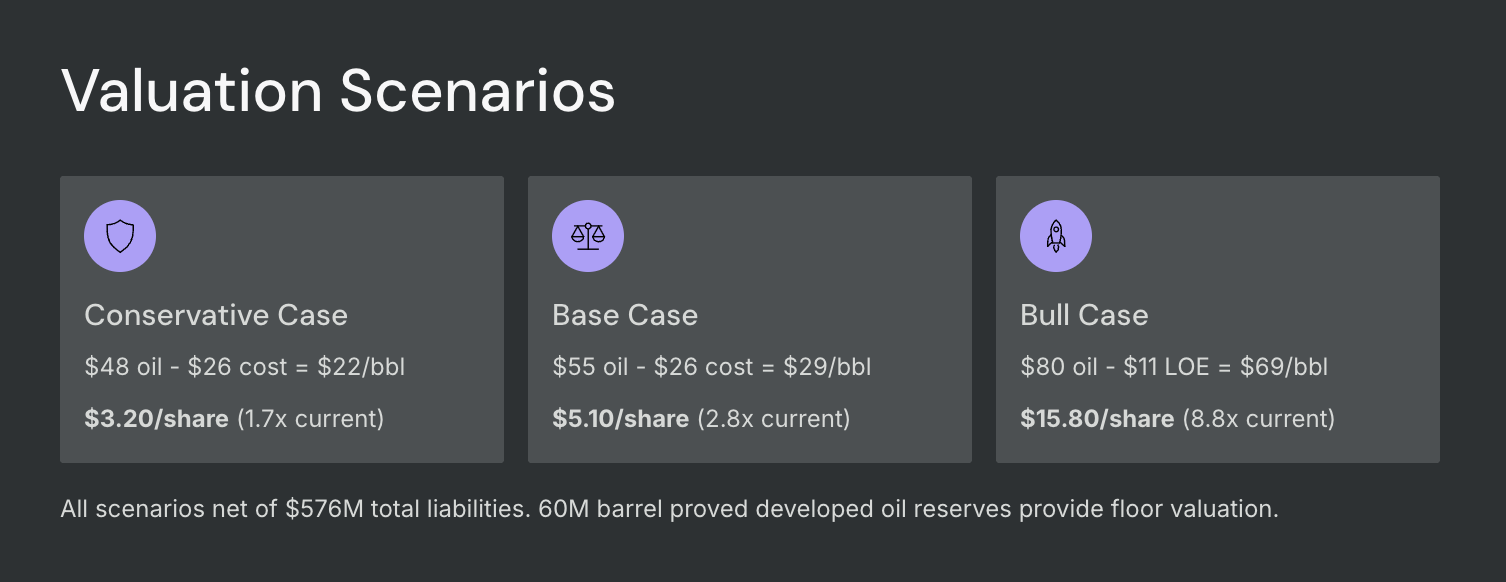
The conservative case assumes WTI oil at $48 per barrel — a level that would represent one of the most sustained oil price collapses outside of the March 2020 COVID crash. At $48 oil minus $26 of fully loaded costs, the net value per barrel is $22. Multiply that by 60 million proved developed barrels: $1.32 billion of gross reserve value. Subtract the total liabilities of $576 million. The result is approximately $744 million of net asset value, or $3.20 per share based on 225 million shares outstanding. That is 1.7 times the current stock price in a scenario where oil is catastrophically cheap by historical standards and costs are materially higher than what management actually achieves.
The base case assumes $55 WTI oil — a reasonable representation of a mid-cycle price that neither assumes an energy supercycle nor a prolonged demand collapse. At $29 net per barrel, 60 million barrels produces $1.74 billion of gross value. After $576 million of liabilities: $1.164 billion net, or approximately $5.10 per share. That is 2.8 times the current stock price, in a scenario that does not require oil to do anything particularly impressive.
The bull case assumes oil reverts toward $80 per barrel — not unprecedented given geopolitical volatility around key shipping corridors, structural underinvestment in global oil production since 2016, and the demonstrated capacity of supply shocks to send prices well above what any model predicts. In the bull case, we also give full credit to Ring Energy’s actual LOE of approximately $11 per barrel rather than the conservative $26, because at $80 oil the company would almost certainly be extracting efficiency rather than experiencing cost blowouts. Net value approaches $69 per barrel. Gross reserve value on 60 million proved developed barrels: $4.14 billion. After liabilities: approximately $3.56 billion net, or roughly $15.80 per share. That is 8.8 times the current price.
The range of outcomes is therefore 70% to 780% upside from the current price of $1.80, depending on where oil settles and how costs evolve — and this range uses only the proved developed reserves. The additional 49 million barrels of proved undeveloped reserves are real, are independently audited, and represent further value that has been set aside entirely.
For context, the independent petroleum engineers at Cawley, Gillespie & Associates assigned a PV-10 of $1.318 billion to the total proved reserve base of 153.3 million barrels at the SEC’s mandated trailing 12-month average price of $61.82 per barrel. The market is paying a total enterprise value — market cap plus net debt — of approximately $774 million to own a reserve base with a present value of $1.318 billion at oil prices that were already in a trough. That is 59 cents of enterprise value for every dollar of independently audited reserve value, at conservative pricing.
Part Nine: The Survival Test — Can Ring Energy Hold On Long Enough for the Value to Matter?
Identifying the gap between price and value is the easy part. The hard part — the part that separates deep value investing from value traps — is determining whether the business can survive long enough for that gap to close. A cheap company that runs out of cash before the thesis plays out destroys capital as surely as an expensive one. This is where the inverse due diligence begins.
The fundamental question is whether Ring Energy can finance its operations from internally generated cash flows, without needing to issue new equity or draw dangerously on its credit facility. The test is operating cash flow — the cash generated from the core business before any capital investment decisions.
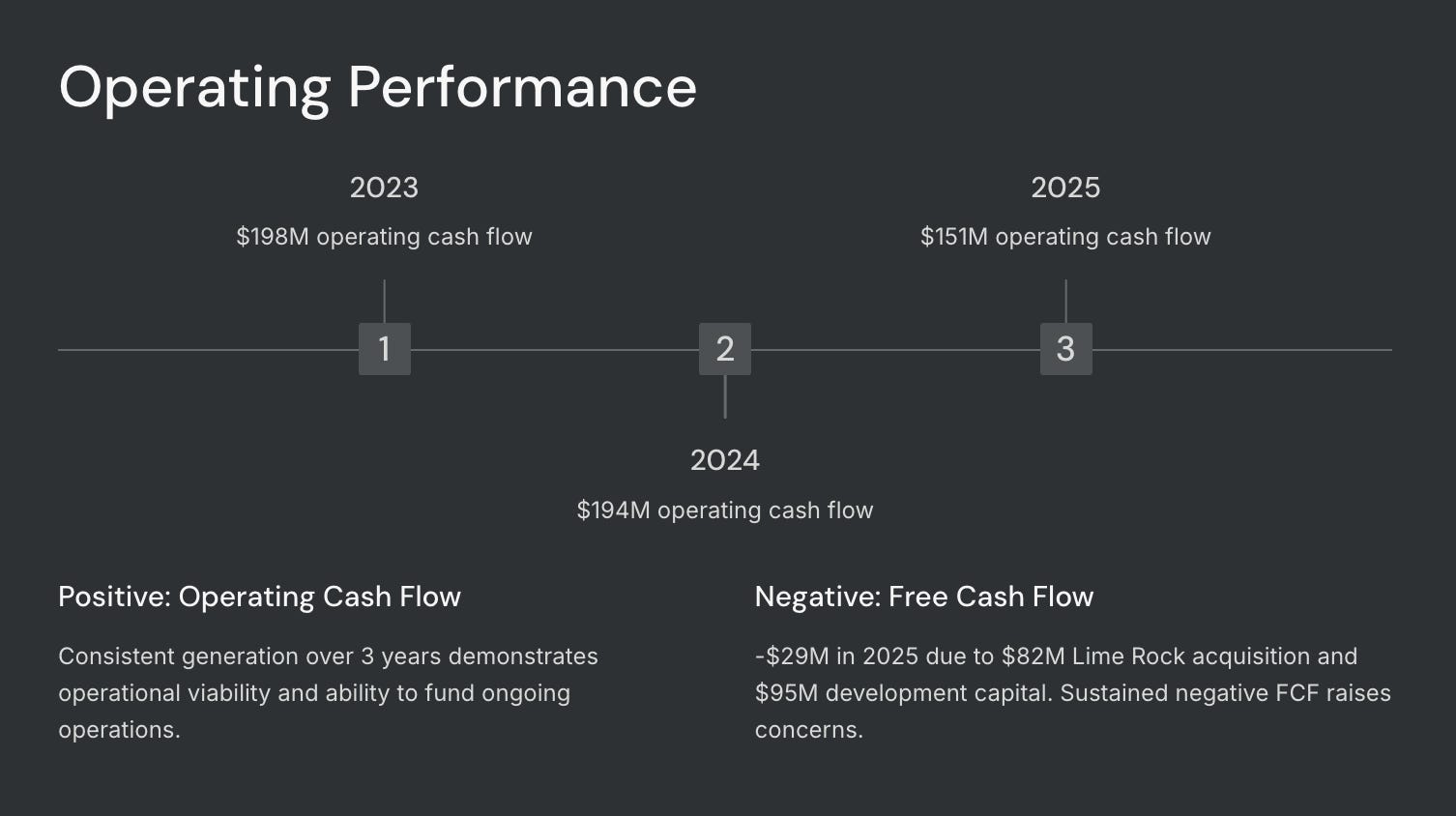
The operating cash flow record is unambiguous. In 2022, Ring Energy generated $197 million of operating cash flows. In 2023: $198.2 million. In 2024: $194.4 million. In 2025: $150.8 million. The company remained cash flow positive for 25 consecutive quarters — more than six years without interruption. The 2025 decline from prior years reflects lower oil prices, not higher costs or operational deterioration. The business generated real cash through the entire period.
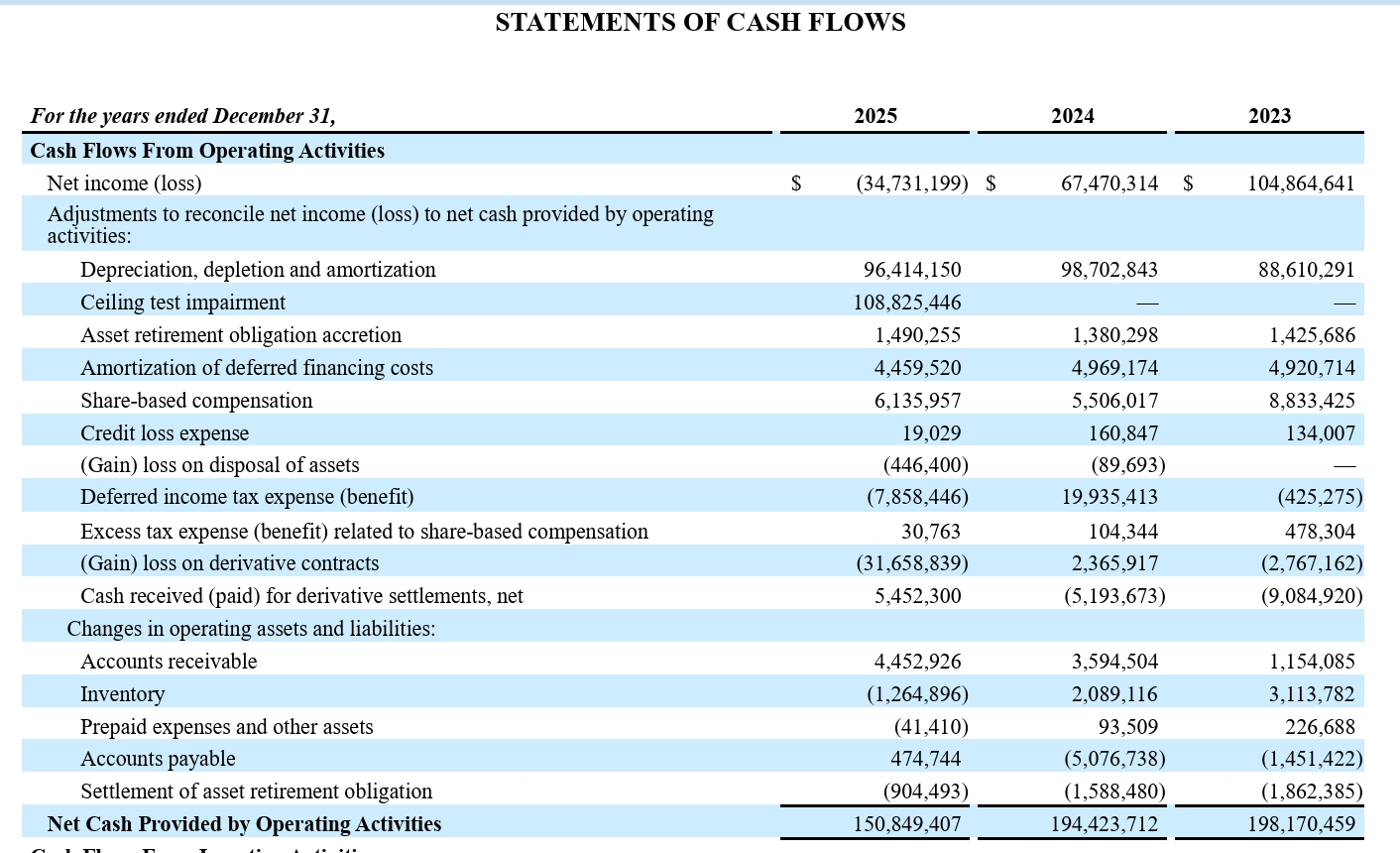
Free cash flow — operating cash flow minus capital expenditures — tells a more complicated story, and it requires careful interpretation. In 2022, free cash flow was positive $65.8 million. In 2023: positive $43 million. In 2024: positive $37.9 million. In 2025: negative $28.9 million. The swing into negative territory in 2025 is the first break in what had been a consistent pattern of positive free cash flow, and it warrants scrutiny.
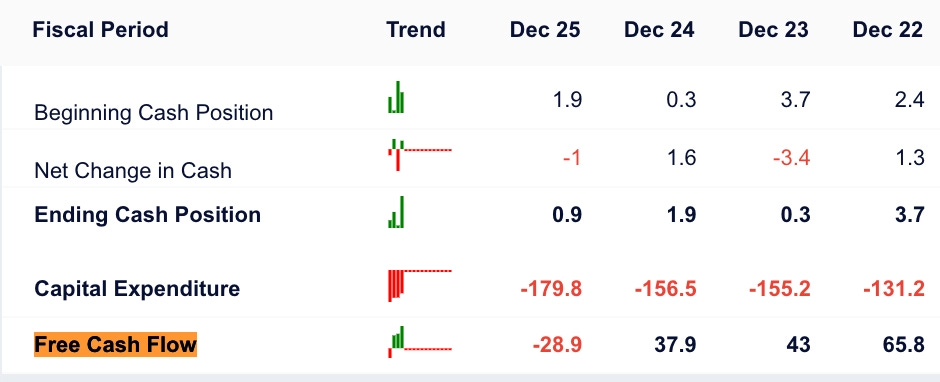
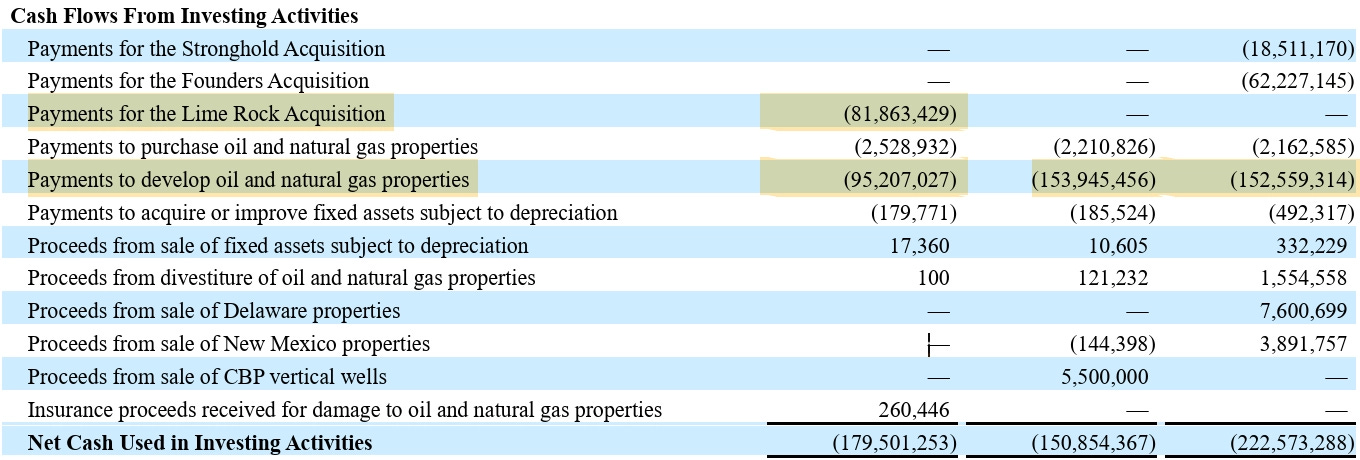
The explanation is entirely contained in a single line of the investing activities section of the 2025 cash flow statement: $81.9 million paid for the Lime Rock acquisition. This was a deliberate, one-time capital deployment — a strategic acquisition of adjacent producing assets at below-PV-10 pricing. Remove the Lime Rock acquisition payment from the investing activities, and Ring Energy’s organic free cash flow in 2025 was comfortably positive. The total capital expenditure for 2025 was $179.8 million, of which $95.2 million was development drilling and $81.9 million was the acquisition. The drilling program itself generated positive free cash flow. The negative free cash flow number the market sees is the cost of buying more barrels, not the cost of sustaining existing operations.
The debt structure merits equally careful examination. Ring Energy exited 2025 with $420 million of borrowings outstanding against a $585 million borrowing base — a $165 million cushion, representing a leverage ratio of 2.20 times adjusted EBITDA, well within the covenant maximum of 3.00 times. The borrowing base is determined by lenders through semi-annual redeterminations, assessing the value of Ring’s proved reserves using commodity price decks that the banks set themselves. The most recent redetermination reaffirmed the borrowing base at $585 million. The next redetermination was scheduled for May 2026 — a near-term event, and one of the genuine risk points in the thesis, because a significant oil price decline could trigger a borrowing base reduction that tightens the financial cushion.
That said, the 14% growth in proved reserves provides meaningful buffer. Lenders price borrowing bases on reserve volumes as well as commodity prices, and a 19-million-barrel increase in total proved reserves partially offsets downward pressure from lower oil prices in any redetermination calculation. Ring paid down $40 million of debt in the nine months following the Lime Rock acquisition — the clearest possible evidence that the acquired assets are already generating the cash flow that management projected when they justified the deal. A company that is paying down debt from acquired assets, not drawing further on credit lines to sustain operations, is a materially different risk profile from one that needs external capital to survive.
The cash position at year-end 2025 was $0.9 million — thin by any measure. Ring Energy runs its business with essentially zero cash balance, relying on its revolving credit facility as the operational liquidity backstop. This is not unusual for leveraged E&P companies, and the $165 million of available borrowing base capacity provides real cushion. But it does mean that any significant disruption to the credit facility — a covenant breach, an oil price collapse that triggers a borrowing base redetermination, or a lender-specific credit market issue — would create immediate pressure. This is the tightest part of the rope, and investors must be clear-eyed about it.
Part Ten: How This Compares — The Peer Reference
No analysis of a company is complete without a sanity check against what similar businesses are priced at in the market. The relevant comparison for Ring Energy is California Resources Corporation — a larger, more established California-focused oil producer that we have analyzed separately, and which trades at a meaningfully higher price-to-sales multiple than Ring Energy despite operating in a more regulatory-constrained environment.
Ring Energy trades at a P/S ratio of 1.1. California Resources Corp trades at a materially higher multiple (approx 1.6). The irony is that Ring Energy, the cheaper company on a revenue multiple basis, actually carries a lower lease operating expense per barrel of oil equivalent — $10.73 versus CRC’s higher production cost profile — even though Ring Energy carries more debt in absolute terms. Lower cost of production at a lower valuation multiple is a combination that the market would normally reprice aggressively. That it has not, in Ring Energy’s case, reflects the optical distortions described throughout this analysis: the GAAP net loss, the ceiling test impairment, the Warburg Pincus selling pressure, and the structural small-cap discount that prevents large institutions from owning meaningful positions.
The structural small-cap discount deserves specific acknowledgment because it is one of the most reliable sources of persistent mispricing in public markets. At a $354 million market capitalization with average daily trading volumes that fluctuate based on news flow, Ring Energy is simply too small for most institutional investors to own meaningfully. A fund managing $5 billion cannot build a 2% position — $100 million — in a company where that would represent 28% of market cap. The practical result is that Ring Energy’s price is set almost entirely by retail investors, smaller funds, and the technical selling pressure from Warburg Pincus’s liquidation. None of these are pricing the company based on a careful assessment of what 153 million barrels of Permian Basin reserves are worth to a knowledgeable buyer.
Part Eleven: The Conclusion — A Long Lens on a Patient Bet
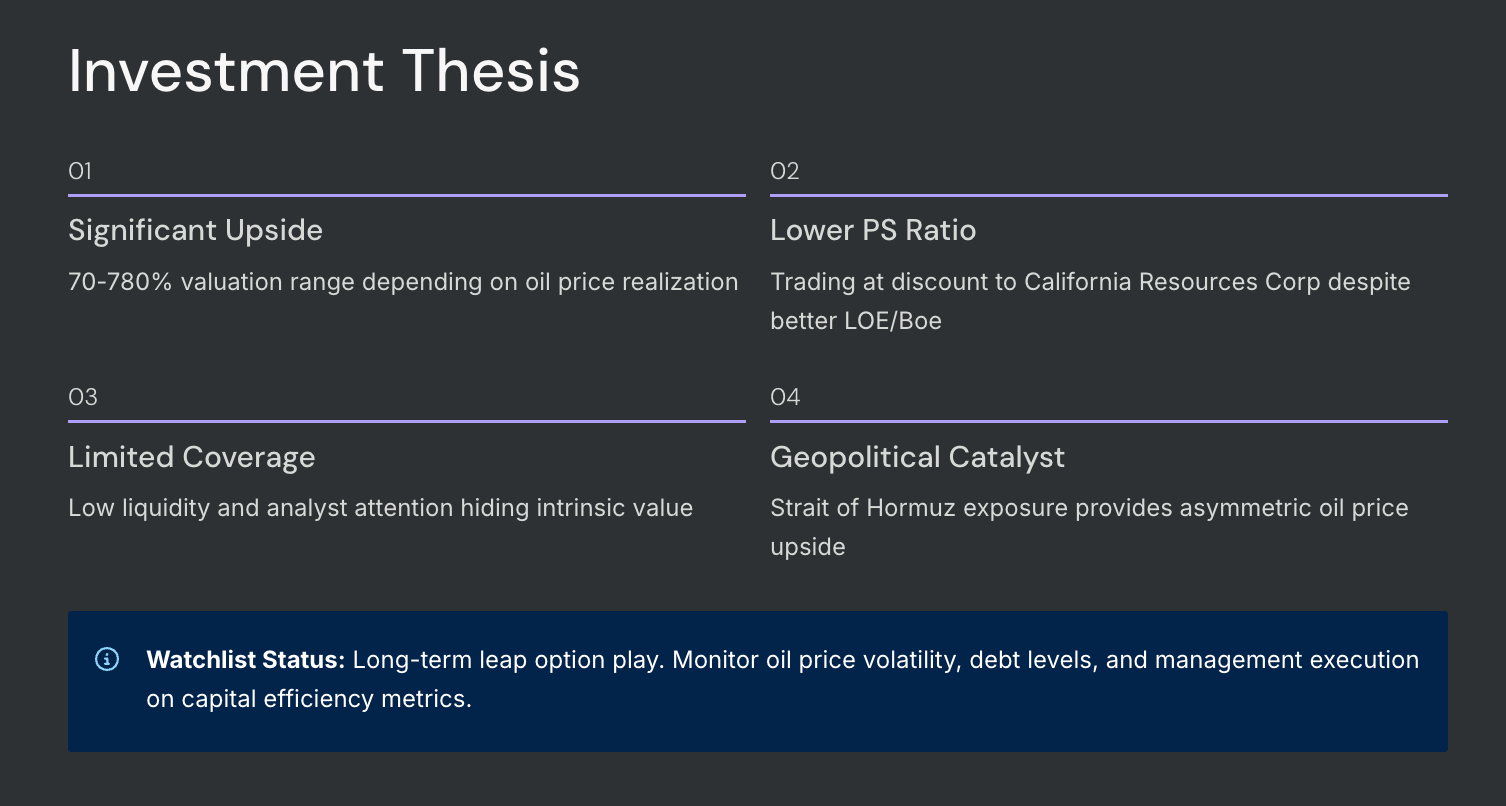
Putting all of this together, Ring Energy is a company that owns $1.318 billion of independently audited proved reserve value — priced at $61.82 oil, which was a trough price — and is being sold in the public market at an enterprise value of approximately $774 million. The underlying business has been cash flow positive for 25 consecutive quarters. Its wells have productive lives measured in decades, not years. Its production costs are genuinely competitive. And the gap between the market price and the asset value is explained almost entirely by a non-cash accounting mechanism, a private equity fund’s capital return cycle, and the structural inability of large institutions to own small-cap names.
This sits on the watchlist rather than the buy list because two things need to be true for the thesis to work cleanly. First, oil prices need to stay above approximately $50 per barrel — the level at which the conservative reserve valuation still yields $3.20 per share, well above the current $1.80. Second, the May 2026 borrowing base redetermination needs to confirm the $585 million ceiling without material reduction. If oil is in the mid-$50s or higher and the reserve base is intact, that confirmation is highly probable. If oil has collapsed further, the redetermination introduces real risk.
The upside range — 70% in the conservative case, 780% in the bull case — reflects genuine optionality. Buying into a company at 45 cents per dollar of book value, at 59 cents per dollar of independently audited reserve value, generating positive operating cash flow through 25 consecutive quarters, with 35-year productive life wells and a cost structure below $11 per barrel of LOE, is not a lottery ticket. It is a bet on the weighing machine eventually doing its job.
The catalyst that closes the gap could be an oil price recovery, a strategic acquisition of Ring Energy by a larger Permian operator recognizing the reserve value discount, continued debt paydown that reduces financial risk and forces the market to re-rate the equity, or simply time — as Warburg Pincus completes its exit and the technical selling pressure dissipates. Any of these can happen independently of management doing anything different from what they are already doing.
The Central Basin Platform has been overlooked for a long time. Ring Energy has spent over a decade quietly assembling its best acreage, demonstrating its economics, and building cash flow from a formation that the market treats as unglamorous. The unglamorous ones, priced by people who have not looked carefully, are often exactly where the work is rewarded.
All financial data sourced from Ring Energy’s SEC filings including the 2025 Annual Report (Form 10-K), Q1 2026 Quarterly Report (Form 10-Q) for the period ending March 31, 2026, and the independently audited reserve report of Cawley, Gillespie & Associates, Inc. Acquisition details sourced from respective press releases and SEC 8-K filings. This is not investment advice and represents a personal analytical exercise. Conduct your own due diligence before making any investment decisions.
May 2026 Update
Operators like Vital Energy and Ring Energy historically lock in 50% to 70% of their near-term production to protect debt covenants. Consequently, they suffered severe, disproportionate non-cash mark-to-market hedging losses in Q1 2026.
Because forward oil curves moved higher during the quarter, Ring was forced to take a massive $82.2 million total loss on derivative contracts ($77.0 million of which was a non-cash, unrealized mark-to-market adjustment). Combined with a $162.1 million non-cash asset write-down (ceiling test impairment), Ring reported a staggering GAAP Net Loss of $220.6 million for the quarter. Stripping out those adjustments, they generated an Adjusted Net Income of $7.4 million ($0.04 per share) and notched their 26th consecutive quarter of positive free cash flow.
The driving force behind Ring’s heavy hedging program isn’t a lack of faith in oil prices; it is debt management. As of March 31, 2026, Ring had $426 million in borrowings outstanding on its revolving credit facility. The regional banks that provide these massive lines of credit to mid-cap E&Ps almost always write mandatory hedging covenants into the contract. Banks require them to lock in 50% to 75% of their production to ensure the company generates enough guaranteed revenue to service its interest payments even if oil prices collapse.
This is why: On May 12, 2026, just days after reporting their quarterly loss, Ring launched a $60 million public offering of common stock, with the explicit intention of using 100% of the proceeds to pay down its revolving credit facility and remove the debt “covenant” so the company gets larger exposure to the upside (which will completely erase the small dilution on the $60 million public offering).
If you like this read, check out my other writings 👇
Rust, Rigs, and the Recurring Revenue Hidden in Plain Sight: A Deep Dive into Beng Kuang Marine (SGX: BEZ)

The Old Steel and the Sea: Why You Should Care About a Ship Maintenance Company
Investment Reflection #2 — The Grand Play: 100 Years of the World’s Nations as Characters in the Greatest Story Ever Told

“The world is not a chessboard. It is a living organism, where every cell — every nation — eats, competes, cooperates, and occasionally tries to eat the others. Understanding it requires not just memorizing moves, but understanding hunger.”

The Tide Is Going Out: Commodity Houses, Private Credit, and the AI Debt Bomb

Start Here: What This Article Is About
Why I Passed on Graftech (EAF): Riding The Battery Hype, Or Perhaps Not...

There is a kind of company that is the most dangerous thing in investing. It is not the fraudulent company. It is not the obviously bad company with terrible products and incompetent management. Those are easy — you just avoid them. The truly dangerous company is the one with a
The Beautiful Trap: Why I'm Passing on The Hour Glass (SGX: AGS)

There’s a peculiar kind of investment that keeps you up at night — not because it’s bad, but because it’s genuinely good. Good enough to admire. Not good enough to buy.
The Diamond in the Rough That Isn't Quite Yours: Why I Passed on Boustead (SGX: F9D)

There is an old saying that investors have borrowed, bent, and quoted so many times it has nearly lost its sharpness: a bird in the hand is worth two in the bush. Warren Buffett, characteristically, gave it a precise mathematical form. The value of any investment, he wrote, is determined by three questions:
The Schoolteacher's Secret Insurer: Why Horace Mann (NYSE:HMN) Is Sitting on My Watchlist

“The stock market is a device for transferring money from the impatient to the patient.” — Warren Buffett

The Dormitory King That Couldn't Leave Home: Why I Passed on Centurion (SGX: OU8)

There is a deceptively simple question that Warren Buffett borrowed from Aesop’s ancient fable, and has repeated across decades of shareholder letters: “How many birds are in the bush? How sure are you they’re there? And how long until you get them out?”
The Children's Place: A $90 Million Bet on a Company That Used to Be Worth $2 Billion (NYSE: PLCE)

There is a classic scene in every heist movie. The detective walks into a room, sees the chalk outline, the scattered evidence, the broken window, and immediately knows something went terribly wrong long before anyone called the police. You do not need the full autopsy report to read the body.
World War 3 In Iran and Why Oil Price Will Continue Increasing — It Arrived Sooner Than Anyone Expected

This is Part 2 of a continuing analysis of California Resources Corp (CRC). Part 1 built the foundational investment case: a company trading at $44 per share against a conservative intrinsic value of $108–$156, built on 567 million barrels of proved developed oil reserves in California, and a management team spending hundreds of millions buying back its…
The Most Overlooked Oil Company in America — And Why That Might Be the Opportunity of the Decade

Date of analysis: 28 December 2025
The Art Of Saying No - MYPS: Playstudios Inc

PLAYSTUDIOS (MYPS) is a Las Vegas-based mobile gaming company that operates free-to-play social casino games and a loyalty platform called playAWARDS, which lets players redeem points for real-world rewards at places like MGM Resorts, Norwegian Cruise Line, and Wolfgang Puck restaurants. On the surface, this sounds like a clever moat. A loyalty program.…
The Art Of Saying No - UGP: Ultrapar Participacoes S.A (Part 2 of 2)

Question 2: How Certain Are You?
The Art Of Saying No - GLIBK: GCI Liberty Inc

Picture this: a single telecommunications company — the dominant one — serves over 200 communities scattered across the largest state in the United States. Alaska. A state with just over one person per square mile. A state where 39% of residents are underserved by broadband. A state where, until recently, some villages received internet via satellite li…

The Art Of Saying No - UGP: Ultrapar Participacoes S.A (Part 1 of 2)

The Setup: A Value Investor Dream?


The Art of Saying No - RIG: Transocean LTD

“The difference between successful people and really successful people is that really successful people say no to almost everything.” — Warren Buffett
The Art of Saying No - KPRX: Kiora Pharmaceuticals Inc

“The difference between successful people and really successful people is that really successful people say no to almost everything.” — Warren Buffett
The Art of Saying No - DNUT: Krispy Kreme Inc

“The difference between successful people and really successful people is that really successful people say no to almost everything.” — Warren Buffett

🎓 A Business Strategy Primer Part 7 - Learning From Great Companies

The Billion-Dollar Playbook: How Market-Based Management Powered Koch Industries’ Unstoppable Rise
The Art of Saying No - MRX: Marex Group PLC

“The difference between successful people and really successful people is that really successful people say no to almost everything.” — Warren Buffett


The Art of Saying No - SFIX: Stitch Fix Inc

“The difference between successful people and really successful people is that really successful people say no to almost everything.” — Warren Buffett
🎓 A Business Strategy Primer Part 2 - Brainstorming Solutions With Value At The Core

Creating An Irresistible Offer
The Art of Saying No - TDOC: Teladoc Health Inc

“The difference between successful people and really successful people is that really successful people say no to almost everything.” — Warren Buffett

The Art of Saying No - MDU: Mdu Resources Group Inc

“The difference between successful people and really successful people is that really successful people say no to almost everything.” — Warren Buffett


The Art of Saying No - AFCG: Advanced Flower Capital Inc

“The difference between successful people and really successful people is that really successful people say no to almost everything.” — Warren Buffett
The Art Of Saying No - VYX: NCR Voyix Corp

“The difference between successful people and really successful people is that really successful people say no to almost everything.” — Warren Buffett
The Art of Saying No - VSTS: Vestis Corp

“The difference between successful people and really successful people is that really successful people say no to almost everything.” — Warren Buffett

🛢️Basic Energy Primer Part 2 - Business and Competitive Landscape

The Man Who Bet Everything on Being Wrong
The Art of Saying No - CISS: C3is Inc

“The difference between successful people and really successful people is that really successful people say no to almost everything.” — Warren Buffett
The Art of Saying No - PSHG: Performance Shipping Inc

“The difference between successful people and really successful people is that really successful people say no to almost everything.” — Warren Buffett

The Art Of Saying No - MAGN: Magnera Corp

The Magnera Corporation Analysis Nobody Asked For (But Everyone Needs)
The Art of Saying No - CHR: Cheer Holding Inc

“The difference between successful people and really successful people is that really successful people say no to almost everything.” — Warren Buffett
The Art of Saying No - WIMI: WiMi Hologram Cloud Inc.

“The difference between successful people and really successful people is that really successful people say no to almost everything.” — Warren Buffett
⚡️Alternative Energy Primer Part 3 - Industry and Sector Technicals

The €2.2 Billion Mistake That Revealed Everything
⚡️Alternative Energy Primer Part 2 - Business & Competitive Landscape

The Shipwreck That Changed Everything

🏥 A U.S. Health Insurance (Managed Care Organizations) Sector Primer

1️⃣ Industry Fundamentals & Macro View


The Remainder of 2026 (Highest Restriction): Ring currently has 2.6 million barrels of oil hedged for the rest of the year. This traps roughly 72% of their guided oil production under the strict $73.27 average upside ceiling.
The 2027 Shift (Massive Exposure to Bull Run): When the calendar flips to January 1, 2027, the 72% mandate disappears. For the full year of 2027, Ring’s existing hedge book drops off dramatically to a mix of roughly 18% swaps and 20% collars, leaving a massive 62% of their projected 2027 oil production completely unhedged.
This sharp cliff is precisely why management explicitly stated that investors will see a "materially different earnings and cash flow profile"