
The Art of Translating Information into Compounding Knowledge
A Deep Reflection on a Week of Investment Research — May 2026
“An investor needs to do very few things right as long as he or she avoids big mistakes.” — Warren Buffett
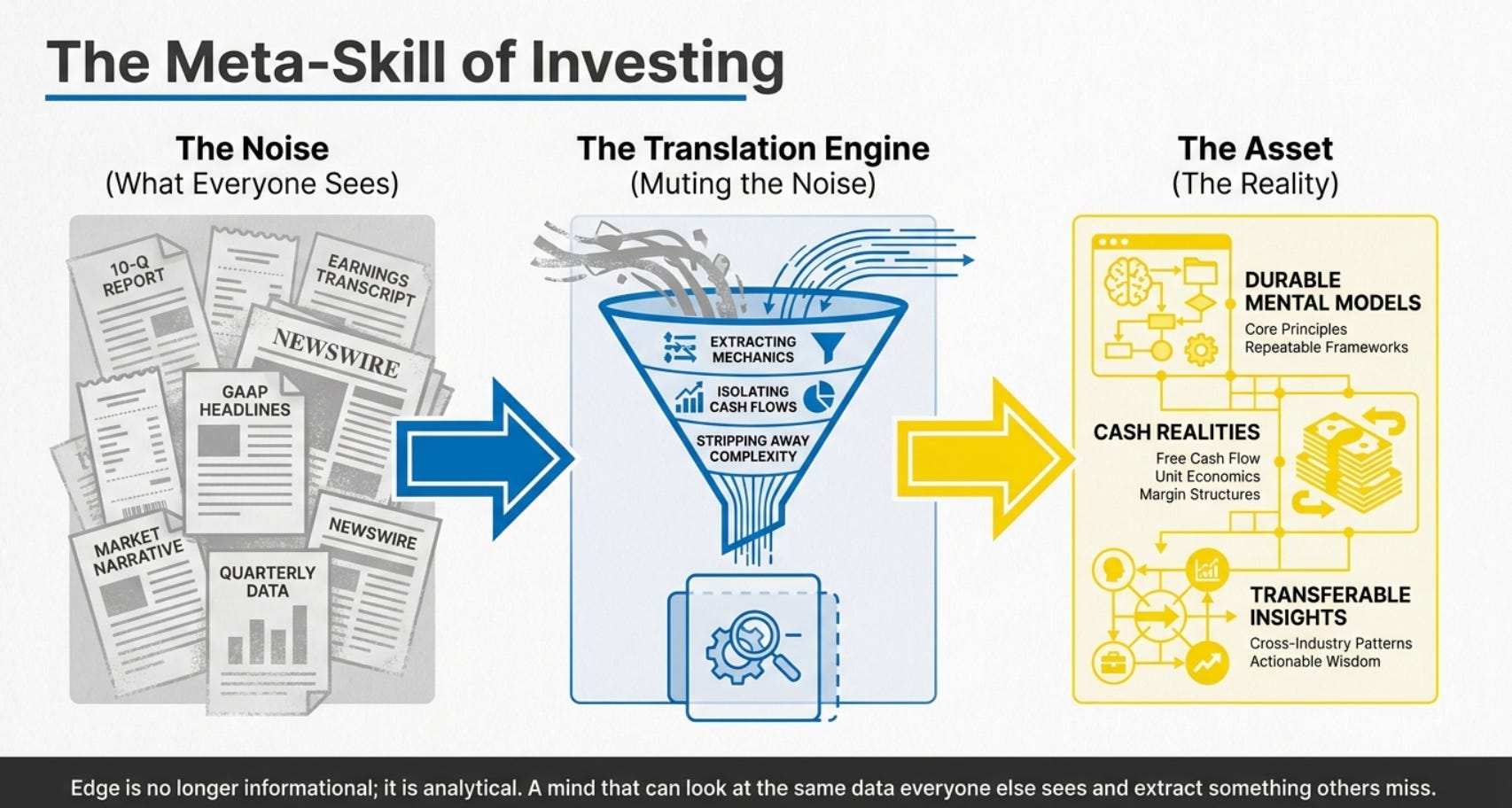
Most people think investing is about finding the right stock. It isn’t. It’s about building the right mind. A mind that can look at the same data everyone else sees and extract something others miss — not because of superior information, but because of superior translation.
This week, working across five business analyses — Gran Tierra Energy (GTE), Proficient Auto Logistics (PAL), Gumtree Australia Markets (GUM), Goodyear Tire (GT), and Red Robin (RRGB) — I didn’t just collect facts. I practiced a more difficult and more valuable skill: turning raw financial and operational data into durable mental models.
This article is a rigorous unpacking of what I actually learned, why it matters, and how I plan to compound it.
Part I: The GAAP Illusion — Learning to Read Two Sets of Books
“Accounting is the language of business, but it is a language with dialects — some of which obscure more than they reveal.”
The Problem With Reported Numbers
One of the most persistent traps in equity research is letting GAAP net income anchor your entire view of a business. This week, two companies forced me to confront that trap directly.
Gran Tierra Energy reported a GAAP net loss of $119 million in Q1 2026. On the surface, that looks like a catastrophe for a company with a market cap in the hundreds of millions. But strip away the noise:
The loss was dominated by unrealized hedging paper losses — mark-to-market charges on oil price protection contracts that hadn’t settled yet. These are not cash outflows. They reverse if oil moves the other direction.
Depletion and asset valuation adjustments — also non-cash, driven by accounting conventions on reserve drawdowns, not by the physical business deteriorating.
The cash story told a completely different picture: funds flow from operations jumped 60% quarter-over-quarter. Full-year 2026 EBITDA guidance was set at $345–395 million.
Proficient Auto Logistics did the same thing. A $27.8M goodwill impairment in Q4 2025 felt alarming at first glance — a signal that an acquisition was mispriced, perhaps a sign of broader misjudgement by management. But goodwill impairments are backward-looking accounting entries, not forward-looking cash charges. They tell you what a prior deal was worth, not what the current network generates. The underlying adjusted operating metrics told a far more constructive story about customer pull and competitive positioning.
The Translation Framework
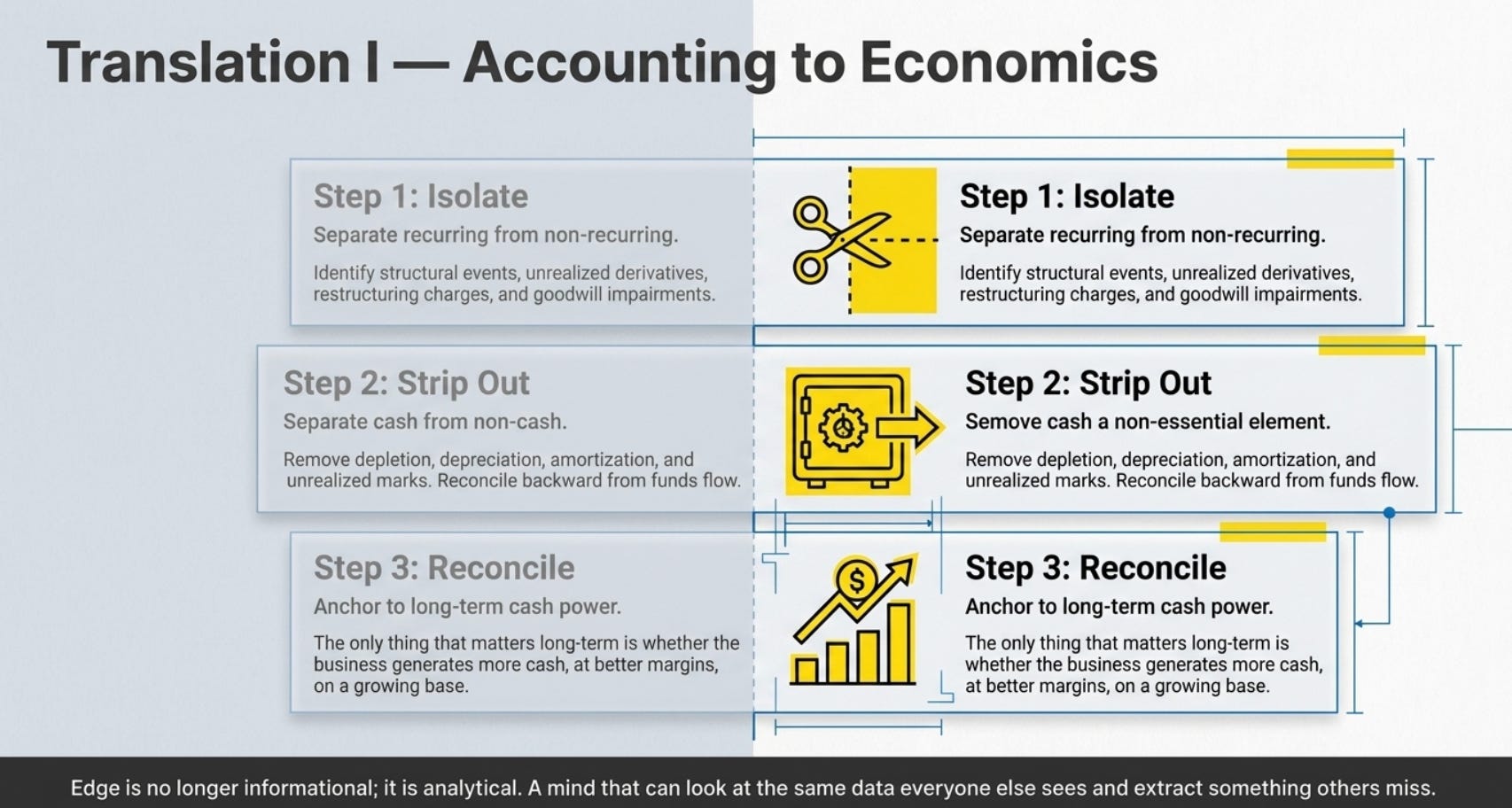
What I’m building — almost unconsciously — is a three-step translation discipline whenever I look at a P&L:
Step 1: Separate recurring from non-recurring. Is this charge something that will appear every quarter, or is it a one-time accounting or structural event? Goodwill impairments, restructuring charges, and unrealized derivatives are frequently one-time.
Step 2: Separate cash from non-cash. Depreciation, amortization, depletion, unrealized gains/losses — these don’t move the bank account. Start with operating cash flow or funds flow, and reconcile backward.
Step 3: Ask what changes the long-term cash power. The only thing that matters long-term is whether the business can generate more cash, at better margins, on a growing base. Everything else is noise you have to learn to mute.
Why This Is a Compounding Skill
The reason this matters isn’t just for these two companies. It’s that this gap — between GAAP headlines and economic reality — is structurally persistent in several sectors: oil & gas, industrials with heavy capex, turnarounds with restructuring charges, businesses using derivatives for hedging. These sectors produce large, systematic mispricings precisely because most market participants anchor on reported numbers. Investors who can read through the accounting earn a durable informational edge.
Principle I’m internalizing: The bigger the gap between GAAP earnings and free cash flow / funds flow, the more important it is to understand the character of that gap. Sometimes it signals fraud or value destruction. More often, it signals opportunity.
Part II: The Anatomy of a Real Catalyst
“Everyone has a plan until they get punched in the mouth.” — Mike Tyson (applicable to investment theses)
Why Most Catalysts Aren’t Real Catalysts
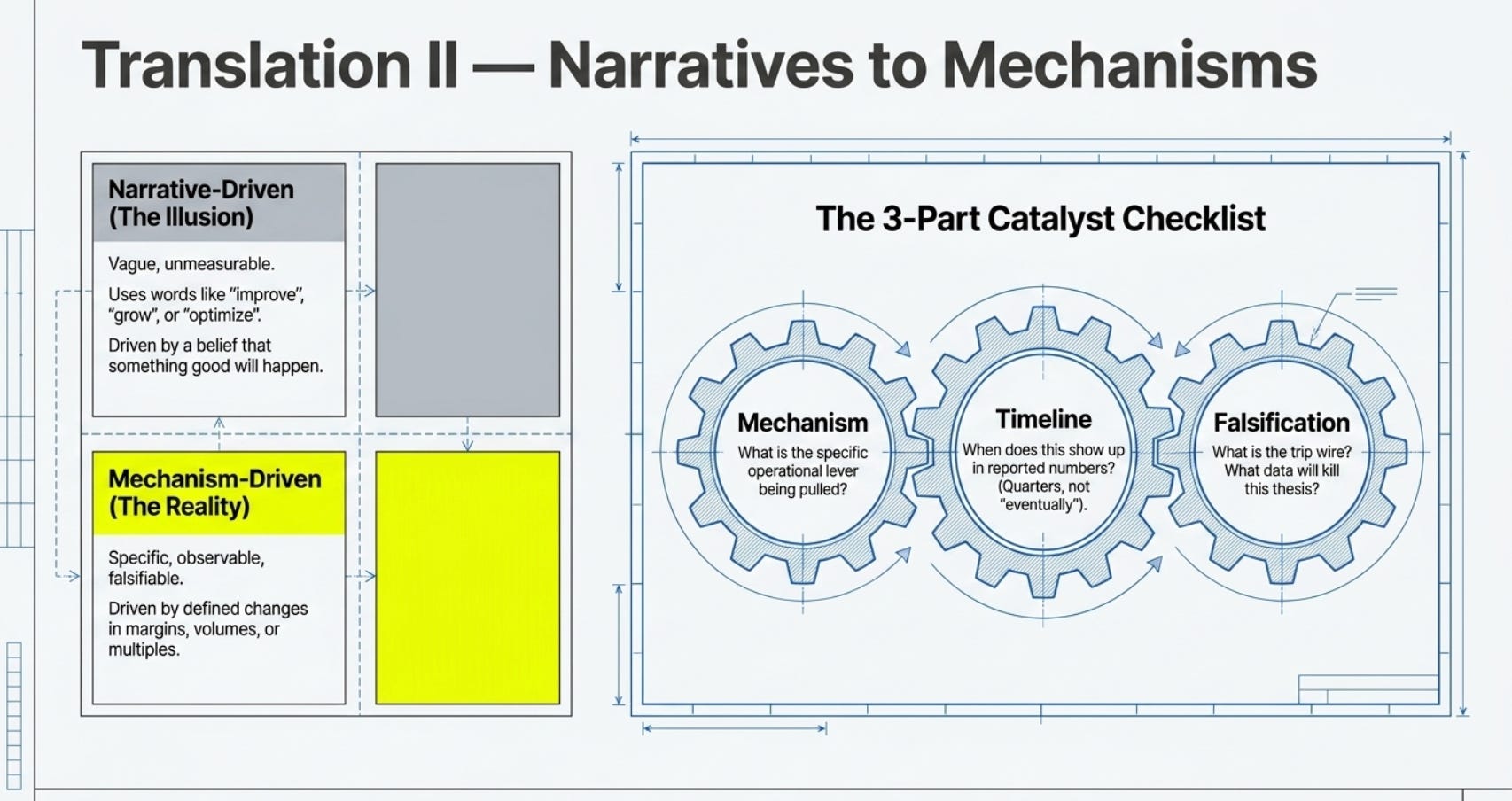
In investment circles, the word “catalyst” gets thrown around loosely. It often just means: I believe something good will happen. That’s not a catalyst. That’s a hope. Real catalysts are specific, observable, mechanism-driven changes that cause measurable improvement in cash flow, margins, volumes, or valuation multiples — and they are falsifiable: if they don’t show up in data within a defined timeframe, the thesis is wrong.
This week, I started to feel the difference.
Gran Tierra Energy: Mechanisms, Not Stories
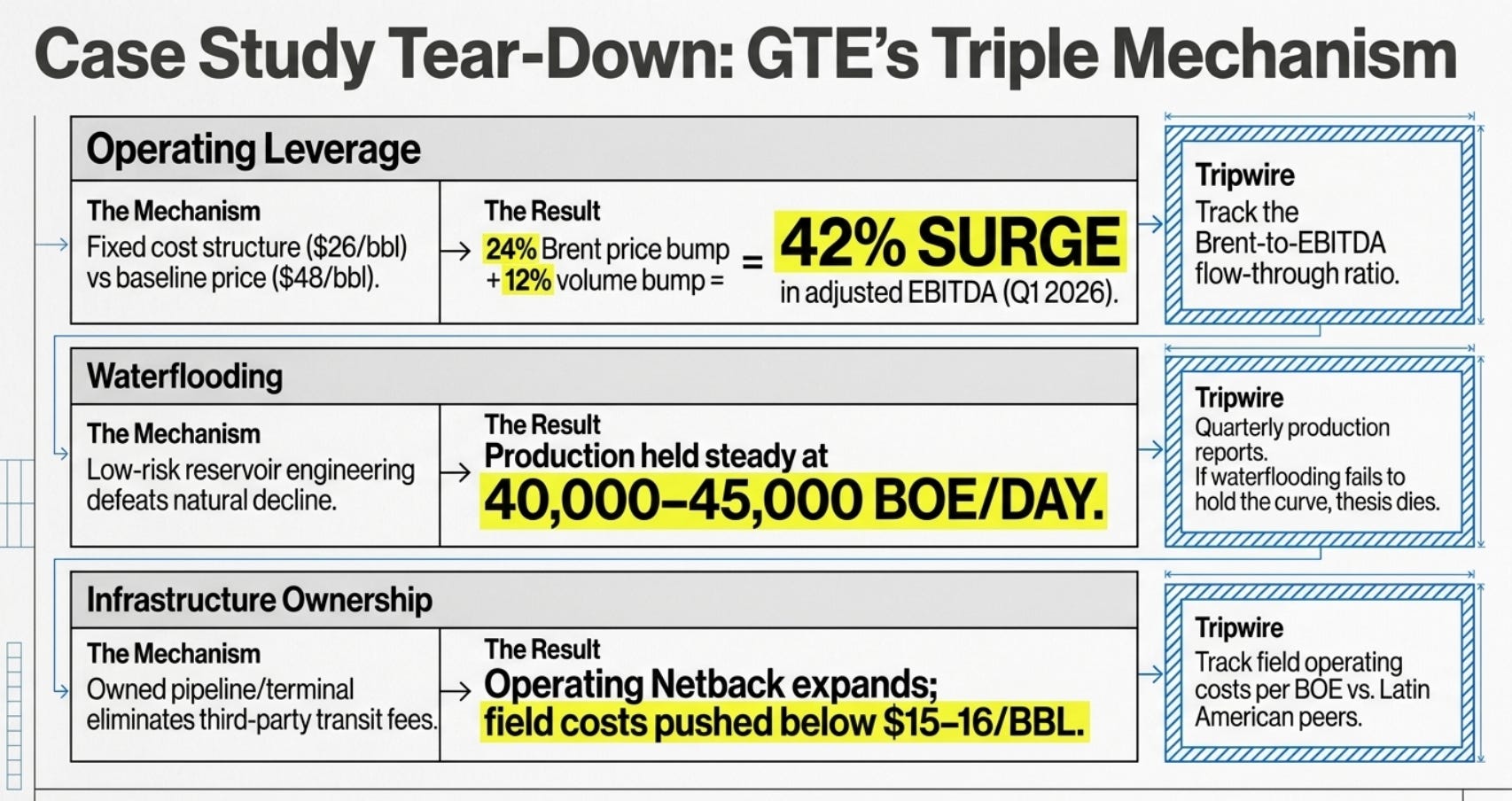
GTE’s three catalysts aren’t stories — they’re operational mechanics:
Catalyst 1 — Oil Tailwind Operating Leverage. GTE’s cost structure is largely fixed. At a $48/barrel price baseline and $26/barrel cost, every dollar of Brent price increase above $48 flows almost entirely to the bottom line. In Q1 2026, a 24% quarter-over-quarter increase in realized Brent prices plus a 12% volume increase drove a 32% sequential jump in oil sales revenue and a 42% surge in adjusted EBITDA. This is not a narrative — it’s operating leverage doing what operating leverage does. The key monitor: track the relationship between Brent moves and EBITDA flow-through. If that ratio degrades, something structural has changed.
Catalyst 2 — Volume Growth via Waterflooding. GTE’s Acordionero field in Colombia is being waterflooded — injecting water to repressurize reservoirs and extend productive life of mature wells. This is proven, low-risk reservoir engineering, not exploration risk. The result: production is being held at 40,000–45,000 BOE/day rather than declining naturally. The key monitor: watch quarterly production reports. If waterflooding isn’t holding the curve, the thesis degrades.
Catalyst 3 — Infrastructure Ownership and Netback. GTE owns its own pipeline and loading terminal. This eliminates third-party transit fees, directly expanding the Operating Netback (profit per barrel after field costs and transport). Colombia field operating costs are frequently below $15–16/barrel — one of the lowest cost structures among Latin American independents. The key monitor: watch field operating costs per BOE and compare to peers.
Goodyear Tire: Already-Triggered Catalysts
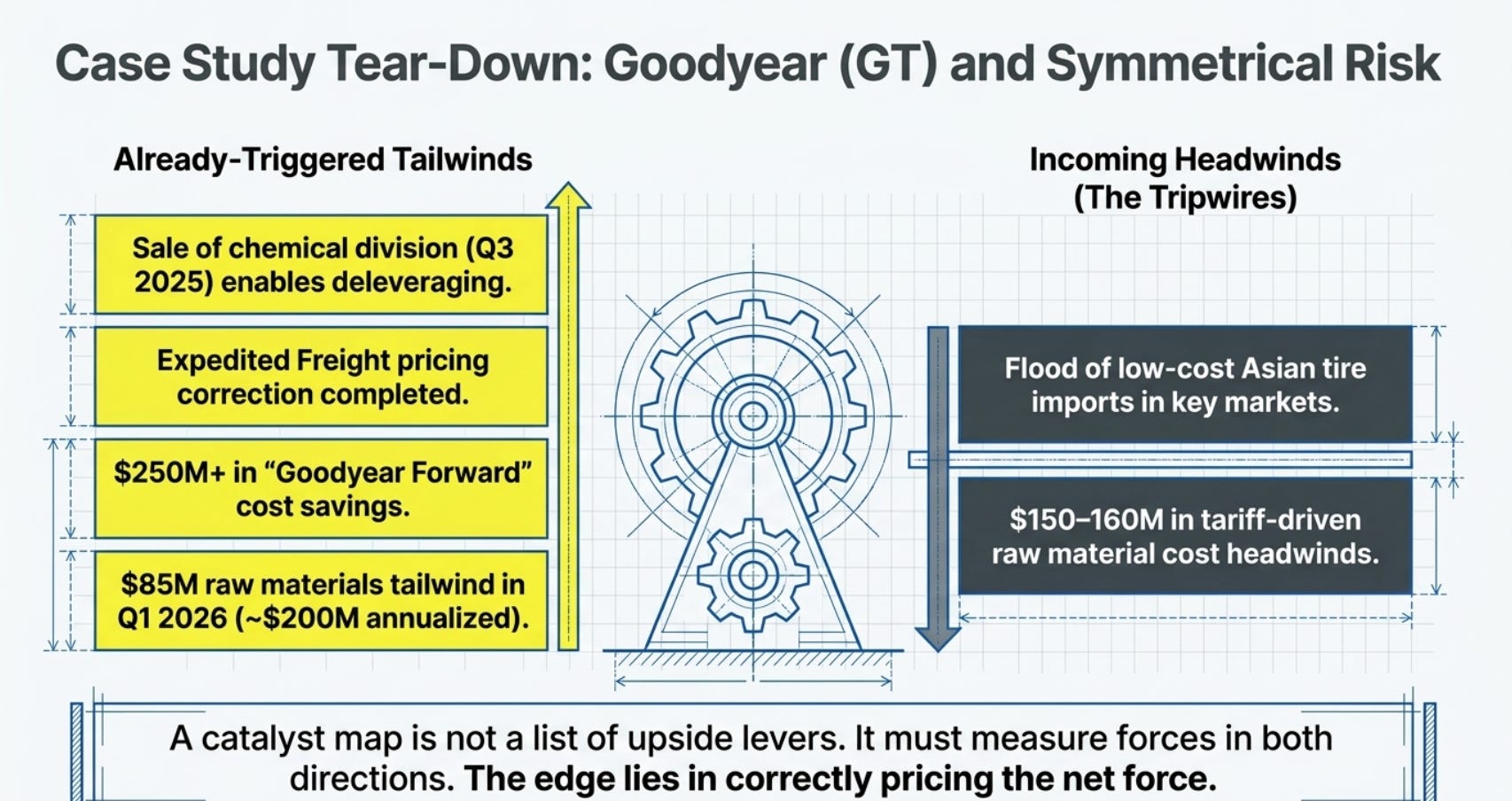
Goodyear presented a different challenge: the catalysts had already triggered. The question was whether the market had correctly priced in the benefits, or whether the sequential improvements in margins, deleveraging, and cost savings were still being undervalued.
The clean trigger list:
Sale of chemical division completed (Q3 2025) → removes capital-intensive, volatile drag → deleveraging enabled
Corrective pricing in Expedited Freight completed (February 2025) → revenue per hundredweight rising for two consecutive quarters
$250M+ of “Goodyear Forward” cost savings expected to flow through in 2026
~$85M raw materials tailwind in Q1 2026 alone; ~$200M annualized benefit
But the risks are real and symmetrical: low-cost Asian tire imports flooding key markets and tariff-driven raw material cost headwinds of $150–160M. This is the correct way to think about a catalyst map — it’s not just upside levers, it’s levers in both directions, and the question is which force is larger.
The Catalyst Checklist I’m Building
From this week, I’m formalizing a three-part catalyst evaluation:
Mechanism: What is the specific operational or financial lever being pulled? Can I describe it without using the words “improve,” “grow,” or “optimize”?
Timeline: When should this show up in the reported numbers? Quarters? Years? If it’s “eventually,” that’s not a catalyst.
Falsification: What would I expect to see in the data if this catalyst isn’t working? What’s my trip wire?
If I can’t answer all three cleanly, I don’t have a catalyst. I have a hope.
Part III: Saying No — And Winning Anyway
“The most important thing to do if you find yourself in a hole is to stop digging.” — Warren Buffett
Red Robin and the Discipline of the Honest Pass
The Red Robin writeup was, counterintuitively, one of the most valuable pieces of work this week — and I passed on the stock entirely.
Red Robin is a casual dining operator in a structurally difficult business. But the reason I studied it carefully was that their tactical execution is genuinely interesting:
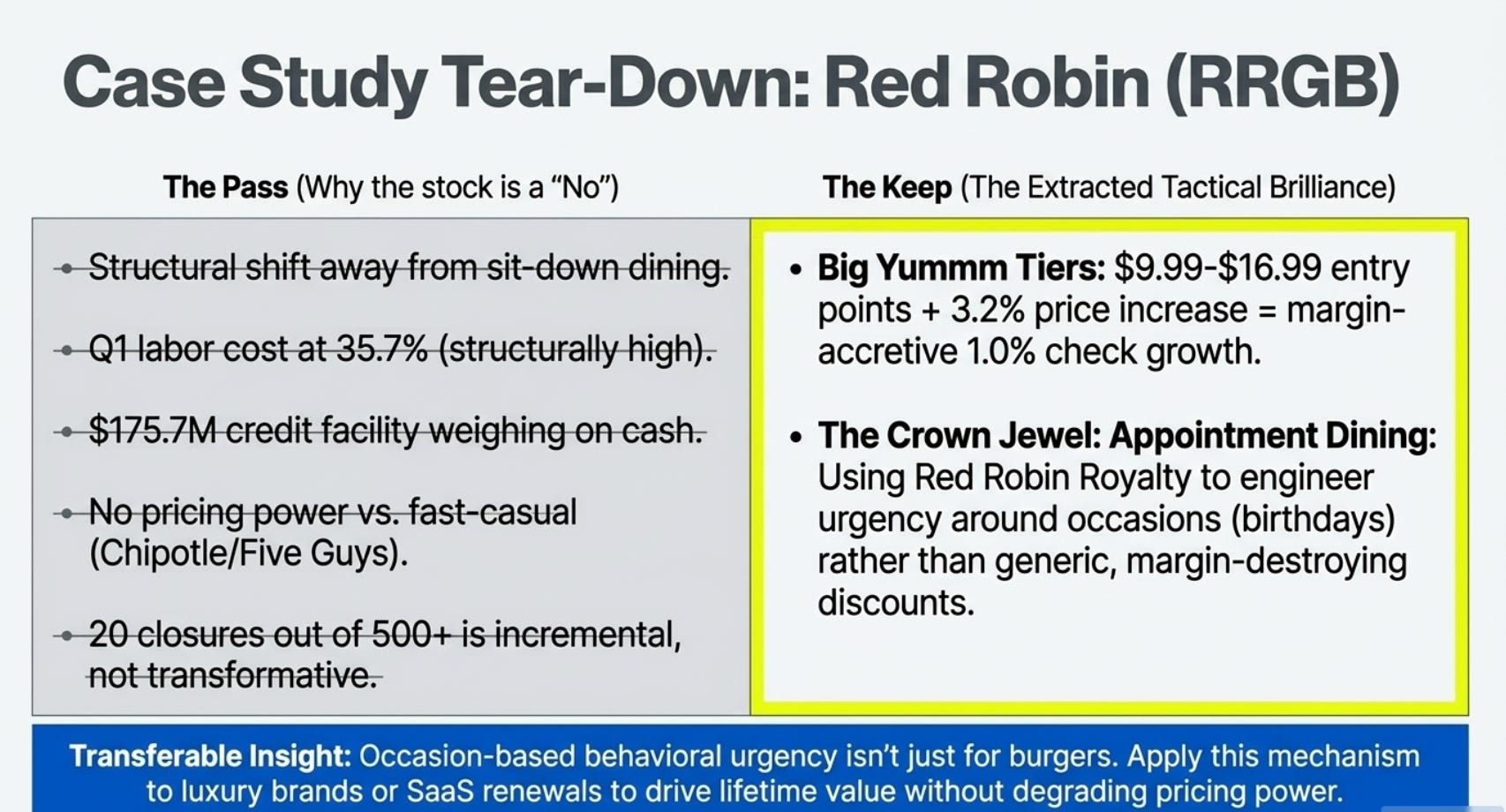
Appointment Dining via Red Robin Royalty®: Instead of generic discounting (which destroys margins), they engineer urgency around specific calendar events — birthdays, graduations, seasonal moments. They create occasions rather than just transactions. A birthday-burger upgrade when you hit a yearly spend milestone isn’t a coupon. It’s behavioral engineering that increases customer lifetime value.
Big Yummm Tiered Value Platform: Rather than random discounting, they created a structured entry price point ($9.99–$16.99 tiers) that now represents 13% of total sales. This is smart: it gives price-sensitive customers an on-ramp without collapsing check averages for everyone else. Combined with a 3.2% menu price increase, average guest check grew 1.0% — modest, but directionally correct and margin-accretive.
Labor Efficiency via Accountability: Total Q1 2026 labor cost fell to 35.7% — the lowest in three years. This was achieved by pushing real P&L accountability to local restaurant managing partners, not just central mandates.
Refranchising and Portfolio Cleaning: They closed 6 underperforming restaurants in Q1 2026 and are on track for ~20 closures for the year. Refranchising converts fixed corporate costs into variable franchise fees. These are the right moves. But 20 closures out of 500+ is still incremental, not transformative.
The Honest Assessment
All of this is fine. New CEO David Pace (formerly Dine Brands) knows the turnaround playbook. But casual dining is a business fighting multiple simultaneous headwinds:
Secular shift away from full-service, sit-down dining toward fast-casual and delivery
Structurally high and rising labor costs (even at 35.7%, this is among the highest cost lines in any business)
Dependence on foot traffic, which doesn’t compound
No pricing power in a world where Chipotle and Five Guys exist
$175.7 million credit facility to pay down with thin cash generation
Conclusion: No. But here is where the real learning lives.
The Meta-Lesson: Transferable Structural Insights
The appointment dining model — engineering occasion-based urgency rather than relying on passive discounting — is a transferable framework. It works at Red Robin only as a defensive survival tactic. But the same mechanism, applied in a business with genuine pricing power, could be extraordinarily powerful. Think of how luxury brands create urgency around limited releases. Or how SaaS companies tie renewals to usage milestones. The mechanism is universal; the context determines whether it creates value or just delays decline.
This is what it means to study “No” businesses. The stock was a pass. The mental model was a keep.
Principle: Every company I study, even ones I reject, should leave me with at least one reusable principle. If I can’t articulate it, I didn’t study hard enough.
Part IV: The Power of Subtraction — Focused Businesses and Structural Clarity
“The difference between successful people and really successful people is that really successful people say no to almost everything.” — Warren Buffett
Gumtree Australia Markets — A Case Study in Deliberate Simplification
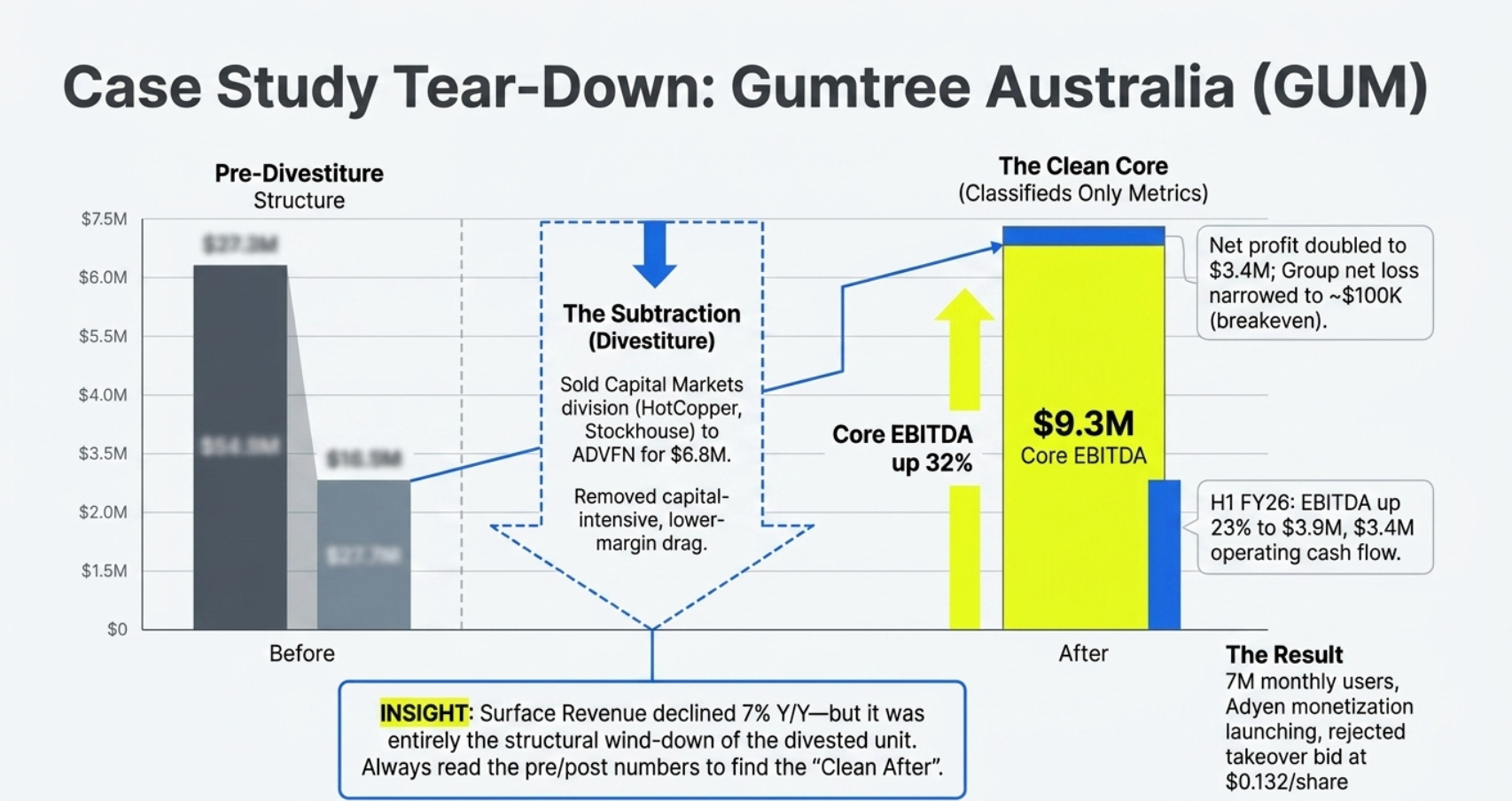
Gumtree Australia Markets (GUM) is not glamorous. It’s an online classifieds marketplace — think Australian Craigslist — focused on Motors, Pets, Jobs, and Real Estate. But what caught my attention was a deliberate, multi-year process of strategic subtraction that is now beginning to show up cleanly in the numbers.
In FY25, GUM completed a pivotal move: it sold its Capital Markets division (HotCopper, Stockhouse, The Market Online) to ADVFN for $6.8M. This sounds like a routine divestiture. But the effect was transformative. That division was lower-margin, capital-intensive, and structurally unrelated to classifieds. Removing it meant that the remaining business — pure-play Australian classifieds — could be evaluated on its own economics.
And the economics, once visible, looked quite different:
Core classifieds EBITDA: $9.3M, up 32% year-on-year post-divestiture
Net profit nearly doubled to $3.4M (classifieds only)
Group net loss narrowed to approximately $100K — essentially breakeven
H1 FY26: EBITDA up 23% to $3.9M, pre-tax profit returned at $1.4M, operating cash flow $3.4M
$2.2M in loan repayments made; balance sheet actively cleaning up
Revenue declined 7% year-on-year — but this is explained entirely by the wind-down of Capital Markets. The core unit economics are improving. The CEO who executed the turnaround (Tommy Logtenberg) was formally appointed Managing Director, signaling board confidence. A takeover bid at $0.132/share was rejected by major shareholders who believed the standalone story would deliver more.
The Adyen integration for Gumtree Pay is launching, introducing monetization beyond listings. Monthly users have grown to 7M via a partnership with Australian Community Media.
Why Simplification Is Underrated as an Investment Signal
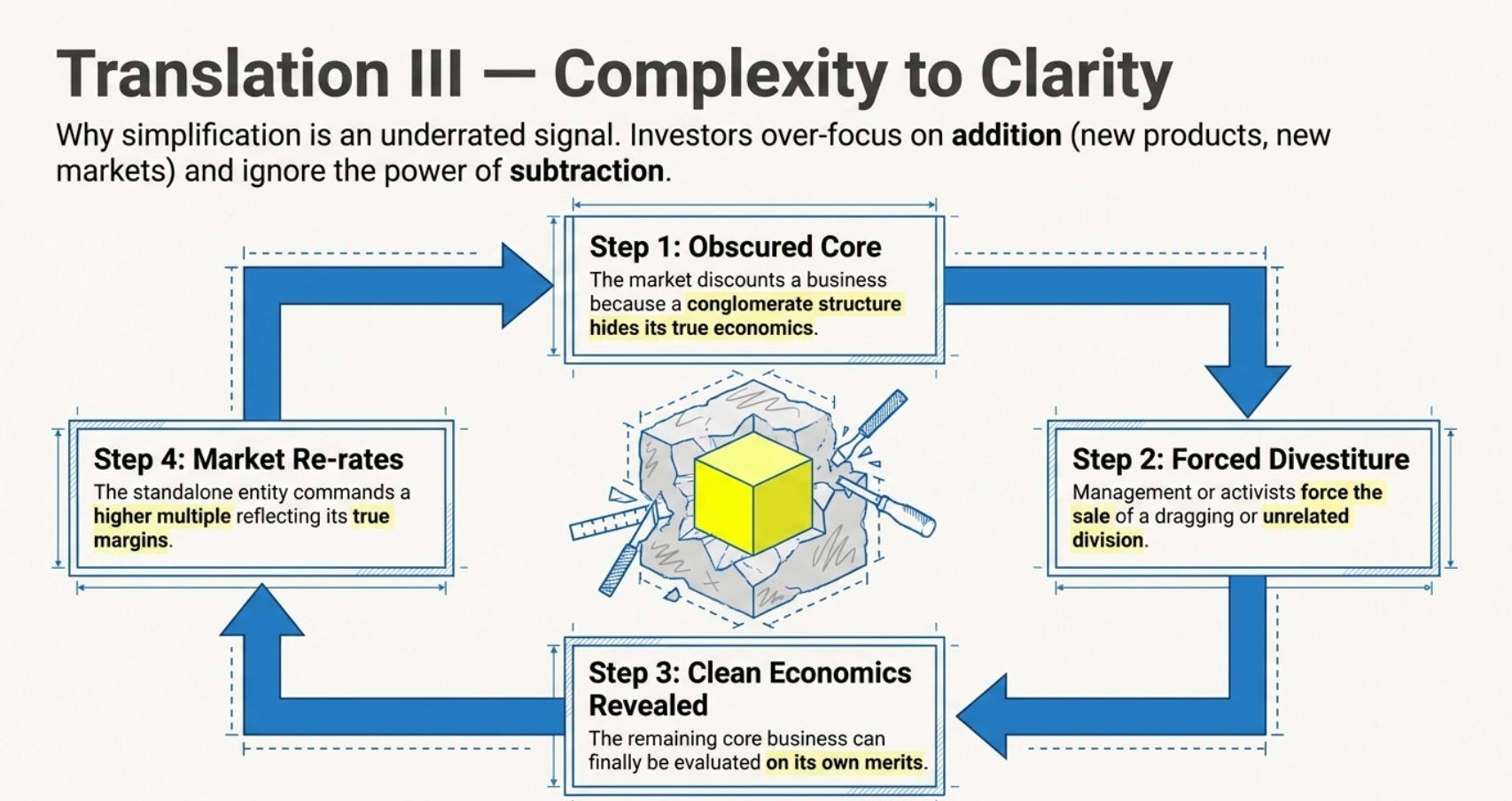
Most investors focus on addition — new products, new markets, new segments. But some of the most reliable early signals of an impending re-rating come from subtraction: selling divisions that obscure core economics, closing loss-making units, narrowing focus.
The pattern looks like this:
A conglomerate or diversified business is undervalued partly because the market can’t cleanly value its core.
Management or activists force a divestiture.
The remaining core business is now clearly visible — and its economics are better than the blended group suggested.
The market re-rates to reflect the clean core.
GUM is in step 3, potentially moving toward step 4. This is a structurally interesting risk/reward if the classifieds EBITDA can sustain its growth trajectory.
Principle: When a business has recently simplified — sold a division, exited a geography, shut down a segment — read the pre and post numbers carefully. The “before” may have been obscuring a clean “after” that is now visible for the first time.
Part V: The Deeper Meta-Skill — Systematic Translation
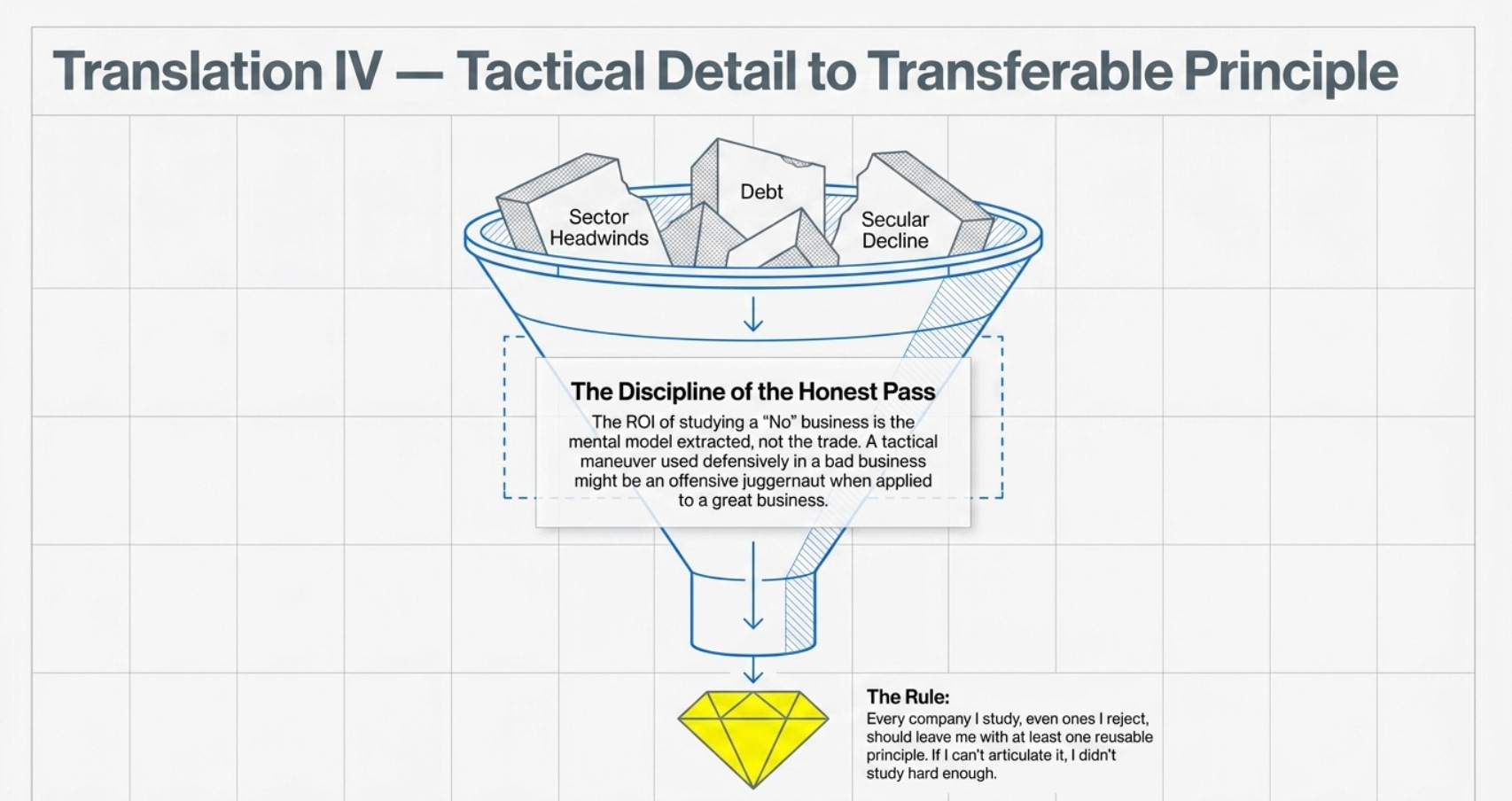
If there is one overarching theme from this week, it is this: the most valuable investor skill is not finding information. It’s translating it.
Everyone has access to the same 10-Q, the same earnings call transcript, the same financial data. The edge is not in finding data others don’t have — it’s in seeing what the data means when others only see what it says.
This week I practiced several forms of translation:
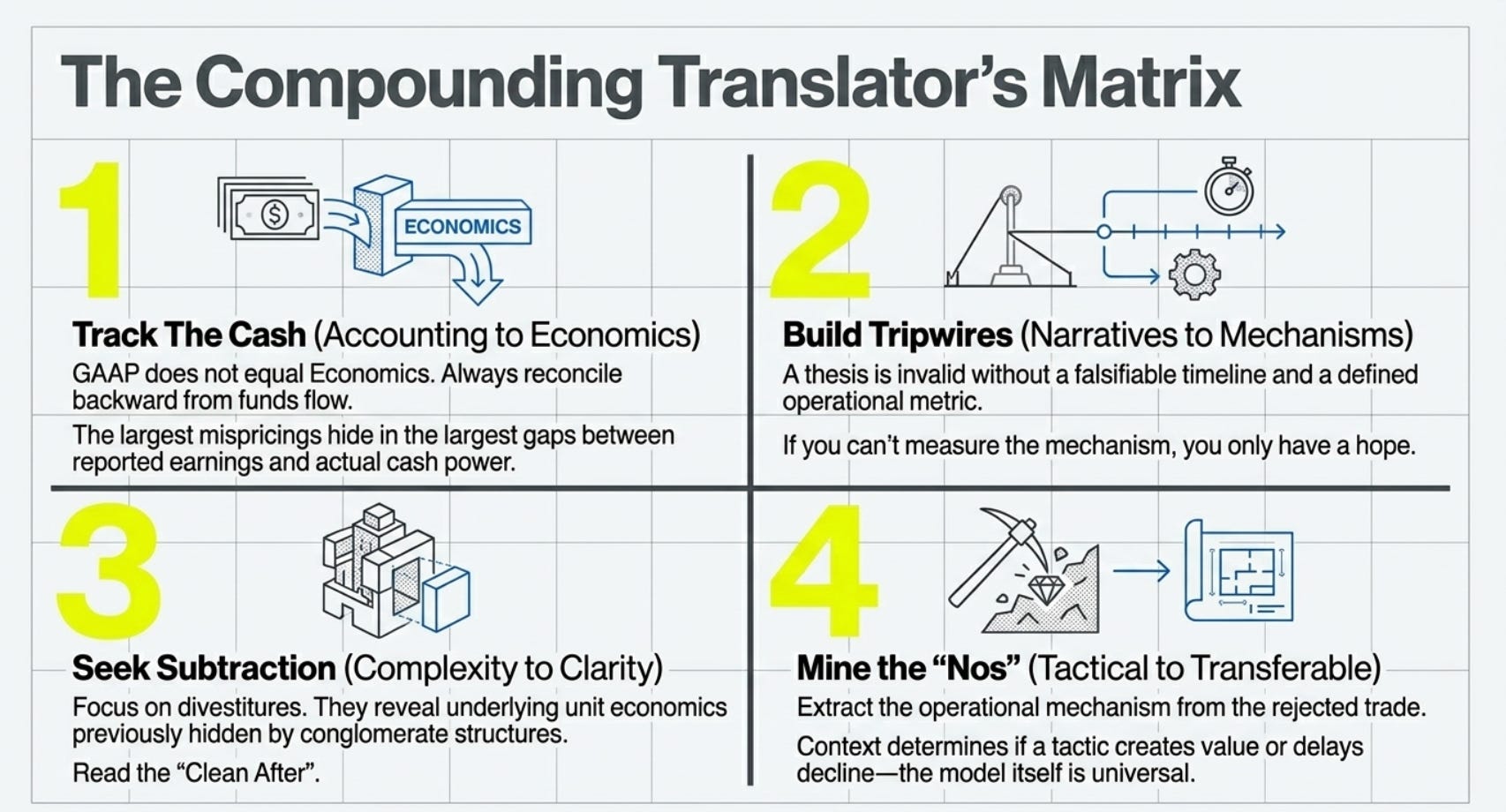
Translation 1: Accounting → Economics. Strip out non-cash, non-recurring, and derivative items. What is the business actually generating in cash? (GTE, PAL)
Translation 2: Tactical detail → Transferable principle. The Red Robin loyalty mechanics are interesting not because Red Robin is a buy, but because the mechanism of occasion-based behavioral urgency can be applied anywhere. (RRGB)
Translation 3: Complexity → Clarity. When a business sheds divisions, the complexity was hiding economics. Learn to read the “after” balance sheet, not just the “before.” (GUM)
Translation 4: Catalyst narrative → Measurable mechanism. Don’t let a thesis live as a story. Convert it to a specific, observable, falsifiable lever — and attach a timeline and a trip wire. (GTE, GT)
Closing: The Compounding Commitment
Charlie Munger famously said that in his entire life, he has known no wise person who didn’t read all the time. The implicit follow-up is: reading is necessary but not sufficient. The value is in the synthesis — in pulling the thread across disparate observations and building something durable.
This week I read five businesses. Across them, I extracted five first-order principles. But more importantly, I’m beginning to extract meta-principles — principles about how to think, not just what to think.
The commitment going forward is to close the loop more explicitly:
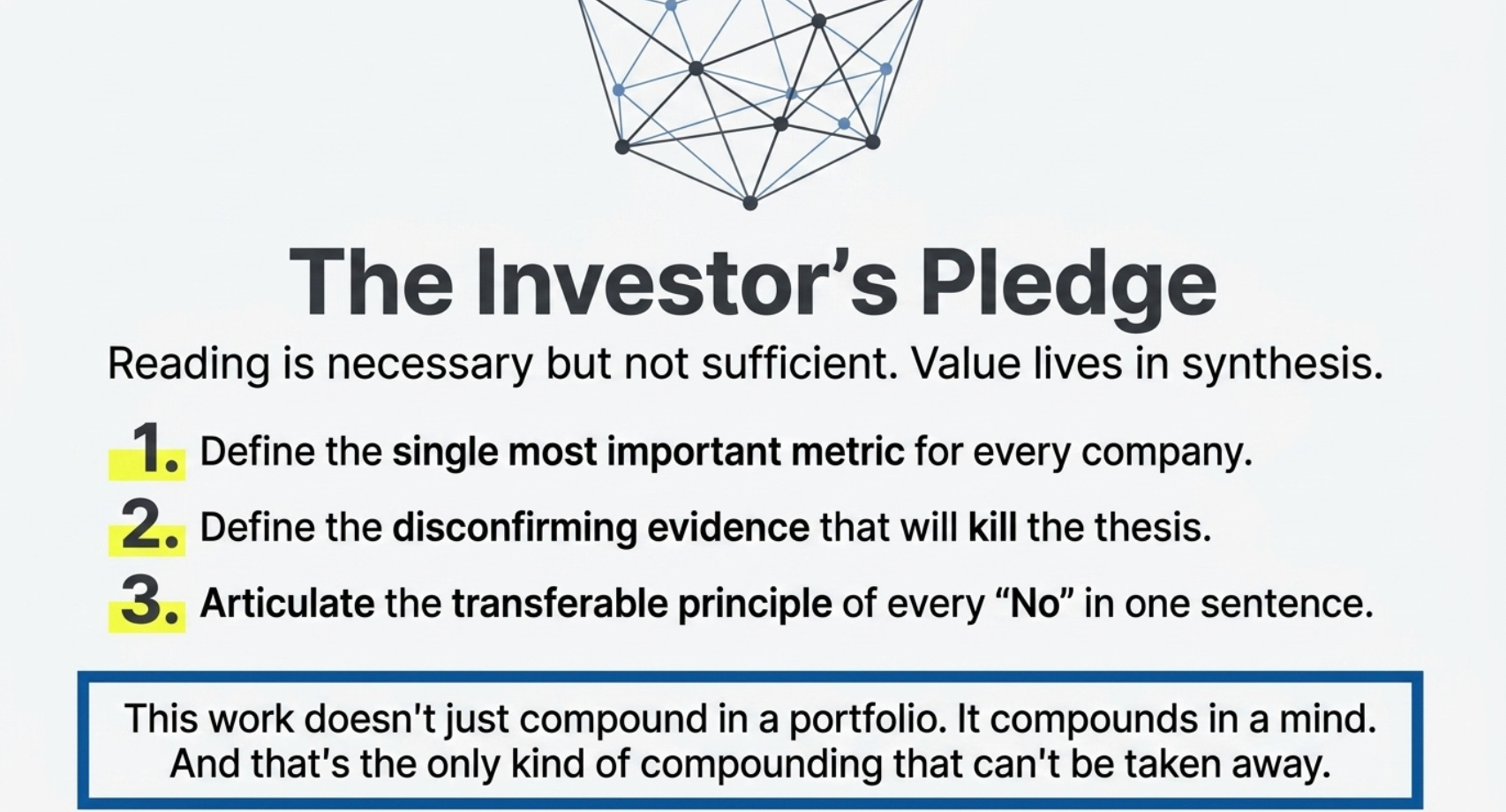
For each company studied, define the single most important metric to track going forward.
For each thesis formed, define the disconfirming evidence that would kill it.
For each “No,” articulate the transferable principle in one sentence.
Because this work doesn’t just compound in a portfolio. It compounds in a mind. And that’s the only kind of compounding that can’t be taken away.
📌 Week’s Core Principles — Consolidated
GAAP ≠ economics. Always reconcile to cash; the biggest opportunities hide in the largest gaps.
A catalyst must be a mechanism. If you can’t measure it, you don’t have a catalyst.
Operating leverage cuts both ways. Fixed costs are a weapon in upturns and a vulnerability in downturns — size your conviction accordingly.
Study “No” businesses rigorously. The ROI is the mental model extracted, not the trade.
Subtraction reveals truth. Divestitures and focus can make visible what complexity was hiding.
Every thesis needs a trip wire. What would I need to see — or not see — in the next two quarters to know I’m wrong?
If you like what you read, check out my other writings 👇
Rust, Rigs, and the Recurring Revenue Hidden in Plain Sight: A Deep Dive into Beng Kuang Marine (SGX: BEZ)

The Old Steel and the Sea: Why You Should Care About a Ship Maintenance Company
Investment Reflection #2 — The Grand Play: 100 Years of the World’s Nations as Characters in the Greatest Story Ever Told

“The world is not a chessboard. It is a living organism, where every cell — every nation — eats, competes, cooperates, and occasionally tries to eat the others. Understanding it requires not just memorizing moves, but understanding hunger.”

The Tide Is Going Out: Commodity Houses, Private Credit, and the AI Debt Bomb

Start Here: What This Article Is About
Why I Passed on Graftech (EAF): Riding The Battery Hype, Or Perhaps Not...

There is a kind of company that is the most dangerous thing in investing. It is not the fraudulent company. It is not the obviously bad company with terrible products and incompetent management. Those are easy — you just avoid them. The truly dangerous company is the one with a
The Beautiful Trap: Why I'm Passing on The Hour Glass (SGX: AGS)

There’s a peculiar kind of investment that keeps you up at night — not because it’s bad, but because it’s genuinely good. Good enough to admire. Not good enough to buy.
The Diamond in the Rough That Isn't Quite Yours: Why I Passed on Boustead (SGX: F9D)

There is an old saying that investors have borrowed, bent, and quoted so many times it has nearly lost its sharpness: a bird in the hand is worth two in the bush. Warren Buffett, characteristically, gave it a precise mathematical form. The value of any investment, he wrote, is determined by three questions:
The Schoolteacher's Secret Insurer: Why Horace Mann (NYSE:HMN) Is Sitting on My Watchlist

“The stock market is a device for transferring money from the impatient to the patient.” — Warren Buffett

The Dormitory King That Couldn't Leave Home: Why I Passed on Centurion (SGX: OU8)

There is a deceptively simple question that Warren Buffett borrowed from Aesop’s ancient fable, and has repeated across decades of shareholder letters: “How many birds are in the bush? How sure are you they’re there? And how long until you get them out?”
The Children's Place: A $90 Million Bet on a Company That Used to Be Worth $2 Billion (NYSE: PLCE)

There is a classic scene in every heist movie. The detective walks into a room, sees the chalk outline, the scattered evidence, the broken window, and immediately knows something went terribly wrong long before anyone called the police. You do not need the full autopsy report to read the body.
World War 3 In Iran and Why Oil Price Will Continue Increasing — It Arrived Sooner Than Anyone Expected

This is Part 2 of a continuing analysis of California Resources Corp (CRC). Part 1 built the foundational investment case: a company trading at $44 per share against a conservative intrinsic value of $108–$156, built on 567 million barrels of proved developed oil reserves in California, and a management team spending hundreds of millions buying back its…
The Most Overlooked Oil Company in America — And Why That Might Be the Opportunity of the Decade

Date of analysis: 28 December 2025
The Art Of Saying No - MYPS: Playstudios Inc

PLAYSTUDIOS (MYPS) is a Las Vegas-based mobile gaming company that operates free-to-play social casino games and a loyalty platform called playAWARDS, which lets players redeem points for real-world rewards at places like MGM Resorts, Norwegian Cruise Line, and Wolfgang Puck restaurants. On the surface, this sounds like a clever moat. A loyalty program.…
The Art Of Saying No - UGP: Ultrapar Participacoes S.A (Part 2 of 2)

Question 2: How Certain Are You?
The Art Of Saying No - GLIBK: GCI Liberty Inc

Picture this: a single telecommunications company — the dominant one — serves over 200 communities scattered across the largest state in the United States. Alaska. A state with just over one person per square mile. A state where 39% of residents are underserved by broadband. A state where, until recently, some villages received internet via satellite li…

The Art Of Saying No - UGP: Ultrapar Participacoes S.A (Part 1 of 2)

The Setup: A Value Investor Dream?


The Art of Saying No - RIG: Transocean LTD

“The difference between successful people and really successful people is that really successful people say no to almost everything.” — Warren Buffett
The Art of Saying No - KPRX: Kiora Pharmaceuticals Inc

“The difference between successful people and really successful people is that really successful people say no to almost everything.” — Warren Buffett
The Art of Saying No - DNUT: Krispy Kreme Inc

“The difference between successful people and really successful people is that really successful people say no to almost everything.” — Warren Buffett

🎓 A Business Strategy Primer Part 7 - Learning From Great Companies

The Billion-Dollar Playbook: How Market-Based Management Powered Koch Industries’ Unstoppable Rise
The Art of Saying No - MRX: Marex Group PLC

“The difference between successful people and really successful people is that really successful people say no to almost everything.” — Warren Buffett


The Art of Saying No - SFIX: Stitch Fix Inc

“The difference between successful people and really successful people is that really successful people say no to almost everything.” — Warren Buffett
🎓 A Business Strategy Primer Part 2 - Brainstorming Solutions With Value At The Core

Creating An Irresistible Offer
The Art of Saying No - TDOC: Teladoc Health Inc

“The difference between successful people and really successful people is that really successful people say no to almost everything.” — Warren Buffett

The Art of Saying No - MDU: Mdu Resources Group Inc

“The difference between successful people and really successful people is that really successful people say no to almost everything.” — Warren Buffett


The Art of Saying No - AFCG: Advanced Flower Capital Inc

“The difference between successful people and really successful people is that really successful people say no to almost everything.” — Warren Buffett
The Art Of Saying No - VYX: NCR Voyix Corp

“The difference between successful people and really successful people is that really successful people say no to almost everything.” — Warren Buffett
The Art of Saying No - VSTS: Vestis Corp

“The difference between successful people and really successful people is that really successful people say no to almost everything.” — Warren Buffett

🛢️Basic Energy Primer Part 2 - Business and Competitive Landscape

The Man Who Bet Everything on Being Wrong
The Art of Saying No - CISS: C3is Inc

“The difference between successful people and really successful people is that really successful people say no to almost everything.” — Warren Buffett
The Art of Saying No - PSHG: Performance Shipping Inc

“The difference between successful people and really successful people is that really successful people say no to almost everything.” — Warren Buffett

The Art Of Saying No - MAGN: Magnera Corp

The Magnera Corporation Analysis Nobody Asked For (But Everyone Needs)
The Art of Saying No - CHR: Cheer Holding Inc

“The difference between successful people and really successful people is that really successful people say no to almost everything.” — Warren Buffett
The Art of Saying No - WIMI: WiMi Hologram Cloud Inc.

“The difference between successful people and really successful people is that really successful people say no to almost everything.” — Warren Buffett
⚡️Alternative Energy Primer Part 3 - Industry and Sector Technicals

The €2.2 Billion Mistake That Revealed Everything
⚡️Alternative Energy Primer Part 2 - Business & Competitive Landscape

The Shipwreck That Changed Everything

🏥 A U.S. Health Insurance (Managed Care Organizations) Sector Primer

1️⃣ Industry Fundamentals & Macro View

