
China’s Great Oil Illusion
Ever since the war in the Strait of Hormuz started, China has low-key been making headlines as its weak crude imports has been suggesting that global oil demand is decreasing significantly. However, the truth could never be further; China may just be hiding demand, not destroying it. And Wall Street may have just been watching the wrong thing.
All along.
Let’s start with an analogy: Imagine Asia’s largest bakery (which makes up a significant amount of global flour demand) suddenly started to order 32% less flour.
The traders who are betting for bread demand to plummet are celebrating. Because they conclude that since the bakery has ordered less flour, it must be baking less bread — assumingly due to “people ordering/ having less demand for bread than before”.
Then the owner opens the bakery door and everyone starts noticing that many ovens are broken or running slowly, hence it is not able to produce as many bread. And as a result, orders less flour. This doesn’t change the fact that people are still going to the bakery at the same rate to order the same amount of bread. And because the production has slowed, the queue (demand) now becomes longer.
Flour orders collapsed, but that number alone cannot reveal how much the city’s appetite changed.
That is China’s oil market.
Crude oil is the flour. Refineries are the ovens. Petrol, diesel and jet fuel are the bread—the products cars, trucks and aircraft actually use.
The market is watching China’s flour orders. It should be watching the ovens.
Manipulation In Plain Sight
Every car that you see out on the street today (probably) doesn’t run on crude oil. Refineries must first convert crude oil into usable fuel before it can be utilized by consumer products.
That creates two layers of demand: consumers need petrol, diesel and jet fuel; refineries need the crude used to make them.
Normally, both rise and fall together. But when refineries slow, that connection breaks.
China can import much less crude even when its underlying fuel use has not fallen by the same amount.
The data show this clearly.
China imported 8.1 million barrels of crude a day in the second quarter of 2026—32% less than in the previous quarter. Imports fell by 3.9 million barrels a day. Yet Chinese refineries also processed 2.2 million fewer barrels a day. In June alone, crude processing was 17.7% below the previous year.
That means roughly 56% of the import decline coincided with the ovens slowing down (along with Middle Eastern refineries being affected). Because imports fell further than refinery processing, the EIA concluded that China was also drawing oil from storage instead of buying every barrel abroad.
Every cargo China does not buy remains available to another buyer. Its retreat reduces competition for crude and helps restrain global prices.
But it creates no new oil.
The bakery is keeping flour prices calmer by leaving the auction. Inside, however, its warehouse is shrinking and fewer loaves are being made.
China has not solved the shortage. It has absorbed part of it.
In a calculated maneuver to manipulate global energy markets, Washington and Beijing appear to have coordinated a massive pullback in Chinese foreign crude purchases. To drive this strategic pause, Beijing orchestrated widespread shutdowns and run-rate cuts across its independent ‘teapot’ refiners and state-owned processing plants — if you think about it, independant refiners would only shut down when it is mandated. Otherwise, why would they shut down if they are earning windfall profits?
Global news headlines claims “Refineries scaled back operations because rising crude import costs and tightening margins made processing oil heavily unprofitable” but the reality says otherwise.
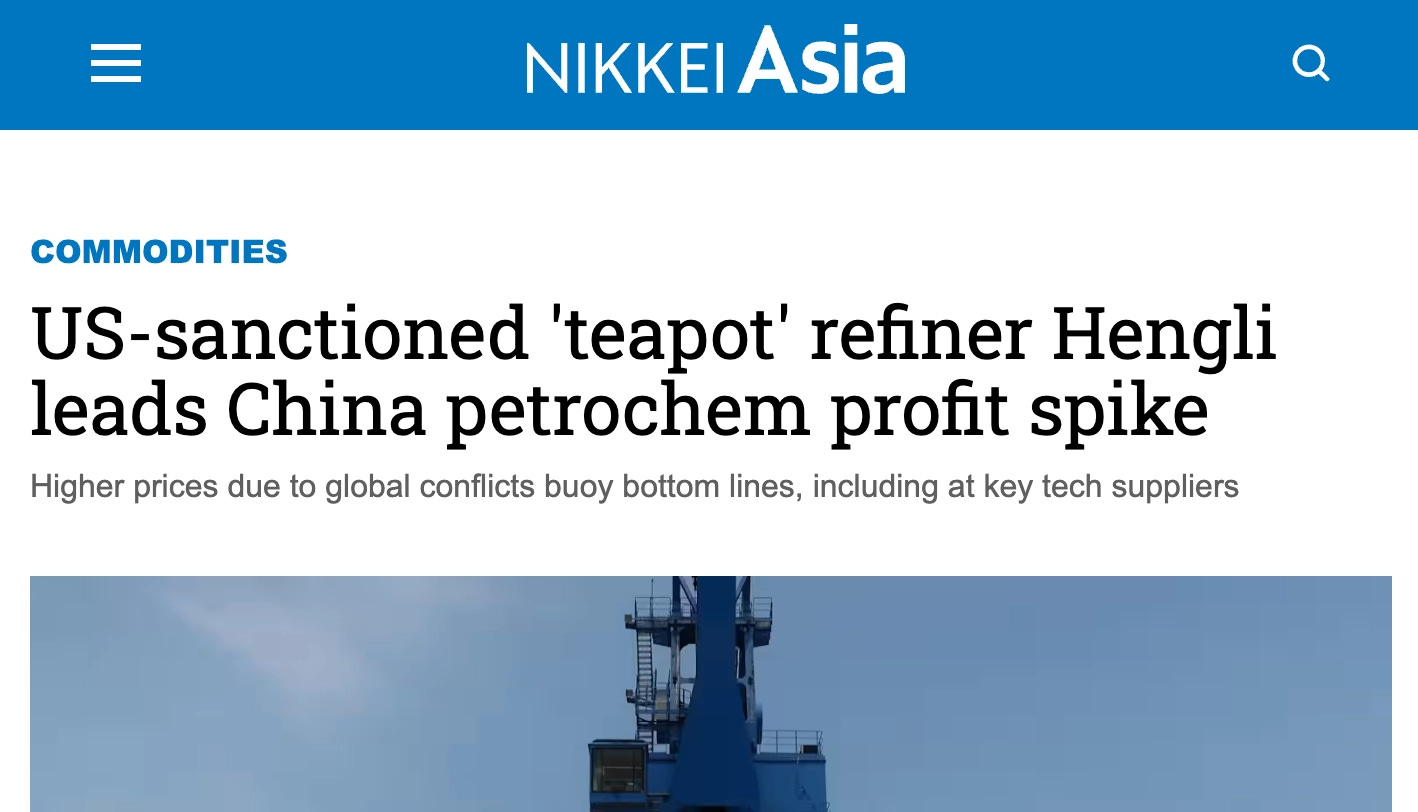
By idling this refining capacity and slashing a major portion of its usual 11-million-barrel-per-day import volume, China has effectively paralyzed global oil demand. To sustain its domestic economy during this operational freeze, Beijing is aggressively drawing down its colossal crude stockpiles—estimated at over 1.2 billion barrels—allowing it to supply domestic fuel needs while bypassing the international market entirely.
Time Is The Essence Of Truth
The trigger is the crack spread.
A crack spread is roughly the selling value of the fuels produced from one barrel of crude, minus the cost of that crude.
Suppose crude costs $80, while the petrol, diesel and jet fuel made from it are worth $110. The crack spread is about $30 before wages, energy and other operating costs.
When refineries are offline, usable fuel becomes scarce. Fuel prices rise faster than crude prices, so the crack spread widens.
That widening spread is the market offering refiners a larger reward to repair equipment, restart idle plants and process more crude. In July, global refinery throughput was still nearly five million barrels a day below the previous year, while refining margins across Europe and North America reached record highs. Global observed oil inventories were also 410 million barrels lower than when the conflict began.
Once an oven restarts, it needs flour.
Once a refinery restarts, it needs crude.
Refiners return to the market and bid for cargoes. If crude supply has not recovered, those bids push crude prices higher.
Fuel shortage → higher fuel prices → wider crack spread → refineries restart → crude buying rises → crude prices rise.
The shortage moves backwards—from bread to flour.
For China, that restart is not automatic. Refiners must be allowed to capture the higher margin through domestic sales or fuel exports. But the price signal already rewards every plant capable of increasing output.
Delayed Is Not Destroyed Demand
Some Chinese oil demand is genuinely weakening because of electric vehicles, greater efficiency and slower economic growth.
In my opinion: 1 Quarter of China EV sales would barely influence the 6 months of oil supply “dent” caused by the conflict
But China’s import number is not a clean measure of that decline. It also measures how many refineries are operating and how much stored crude China is willing to use.
That distinction is the entire thesis:
China’s weak crude imports may be suppressing oil prices today—not proving that oil demand has disappeared.
When the ovens restart, China does not need millions of new drivers to create new crude demand. Its refineries need raw material to restore fuel production and replace part of the oil removed from storage.
Do not watch the flour orders alone.
Watch what the market is willing to pay to restart the ovens.
Insights You Might Have Missed
My view is simpler than most. Watch China’s teapots. These are the independent refiners that move on price instead of state guidance, and they are the release valve here. As they start lifting barrels again in size, the diesel they push back into the export market is what fills the void that is currently pricing at $170. Crude does not rally on the shortage. It rallies when China gets back over 10 million bpd of crude imports, and to me that is a when, not an if. The fix for diesel is Chinese refinery runs going back up.
Markets often react to the headline before the physical system underneath it has caught up. In an earlier Daily Lens, I looked at how oil prices began pricing peace before shipping, insurance and physical flows had fully normalised, another example of why the most visible market number may hide the real mechanism underneath.

The thesis claims a big point on watching the details behind the headlines, how a real macroeconomic variable really impacts on markets, and where the eyes should be pointing at, the example with the oil is a very practical and present way to see the strategy on where to look for data in order to anticipate possible outcomes, but that applies to any sector actually, If you look to another industry, for example, AI and data centers the way demand and supply is controlled or moved is also a great opportunity to look into. Headlines are designed always to feed and trigger different cognitive biases that normally all readers have, so this strengthens the framework to see each economic movement from a deeper perspective.

Amazing, timely piece — the distinction between headline crude imports and actual fuel demand is crucial, and the refinery‑run/inventory angle explains why markets are complacent. The crack‑spread signal is especially persuasive: when refining economics diverge from crude flows, the physical system is telling us demand is still there.
This exactly echoes my Substack, Why Cycles Still Rule Everything — inventories and idled capacity only mask cycles, they don’t break them.

Good thing to look out for, please keep us in the loop!
“Watch the ovens, not just the flour” is such a strong way to frame it, and I like how closely it connects to the idea of looking past the headline number to what’s actually happening underneath. Great piece 👏❤️