
Being a Contrarian is Lonely, But it Always Pays
In the 1990s, Wall Street was drunk on leverage — Private equity firms were using mountains of debt to execute leveraged buyouts (LBOs). They were loading companies with debt and and flipping them subsequently for obscene multiples.
If you’ve ever read Barbarian at the gate, this was what followed. This story is about a guy that was the opposite of the disgusting charismatic main character (Ross Johnson).
Because of the massive (record breaking) KKR deal on RJR Nabisco, if you weren’t using cheap debt to buy cash flows (companies) during this era, you were considered a dinosaur. Or what they call — a boomer (nowadays).
But one guy, Larry Mendelson, refused to follow the herd.
When Larry, alongside his sons Eric and Victor, took the helm of HEICO in 1990 (due to their growing equity stake), the company was a “horrible beaten down”, single aircraft part, company. They were generating only roughly $26 million in revenue. “Everybody told us it was impossible,” recalls Victor Mendelson. “Couldn’t be done,” adds his brother Eric. “That we were going to fail.”. But little did we know……
That they were going to make history with a 47,500% Return
The Time Value of Money: Why Private Equity Could Not Compete
The aerospace aftermarket (maintenance activities after intial sale) was a brutal one that was dominated by OEMs (Original Equipment Manufacturers). They held monopoly power over replacement parts. If an airline needed a turbine component, they could only pay the OEM’s exorbitant ransom sum, because they (unfortunately) did not have a choice. The Mendelsons knew they could steal market share by offering parts at a significant fraction of what the OEMs are charging.
The only hurdle standing between them and the goal was the manufacturing FAA (Federal Aviation Administration) approval — these approvals were known as PMA (Parts Manufacturer Approval).
To Wall Street (the private equity firms), the FAA’s PMA was a dealbreaker. Because, earning a PMA requires a grueling multi-year long testing and safety validation. Private equity operates on a five-year clock could not afford to wait. Their investors demand fast returns, meaning they cannot afford to wait for even three years. The very “time value of money” that fueled the LBO boom acted as a “blindfold”, keeping leveraged buyers away from the opportunity that the Mendelsons identified.
The Irony: Massive Returns Without Debt?
The Mendelsons recognized Wall Street’s impatience as an asymmetrical opportunity. While PE firms started chasing EBITDA-rich targets, the Mendelsons went hunting in the shadows for small, family-owned aerospace component manufacturers. These unglamorous, slow-growth businesses generated steady cash, but were choked by the time and capital required for the FAA’s PMA certifications. Because of this, traditional leveraged buyers wouldn’t touch them.
Without the threat of a leveraged bidding war i.e. auctions, the Mendelsons NEVER paid a premium. They acquired these “unglamorous, slow-growth businesses” companies as “bolt-ons” (into HEICO), at depressed cash multiples—often less than 5x EBITDA. But the true masterstroke was their refusal to use debt. HEICO maintained relentless, near-zero leverage, funding purchases entirely with their own internal cash flow. An irony right? — since leverage could signficantly inflate your returns.
However, by rejecting leverage, HEICO was able to avoid cyclical cash flow risks.
As they say, the true role of an investor and capital allocator is a risk manager first. In other words, a top-tier investor and capital allocator is weighted based on their ability to first protect capital, before multiplying it.
The Mendelsons weren’t just avoiding risk as well; they were buying the one thing PE firms structurally could not afford: Time.
Patience is Underrated
The Mendelsons weren’t buying these small companies for their current cash flows. They were actually buying their “foot in the door.” — these small businesses already had established relationships with airlines. However, they only had the engineering bandwidth to manage one specific part of what the airlines bought. The moment HEICO acquired them, the alchemy began.
On Customer Relationships — one of the greatest advantage that any person and entity can have is the ability to impose control over distribution of their products/ services — which reinforces the point in our era that “attention is the new currency”.
HEICO deployed its massive team of elite engineers to ask the airline a simple question: “What other parts are you overpaying the OEMs for?” Using the acquired company’s steady, debt-free cash flow to fund the grueling, multi-year FAA testing process, HEICO’s engineers designed entirely new, cheaper alternatives to those expensive OEM parts.
In their first year, the Mendelsons secured FAA approval for just five parts. Today, HEICO spits out roughly 500 new PMA parts annually, with over 13,000 across the company. Once the FAA cleared a new part, HEICO immediately sold it back to that same airline (leveraging the relationship they “bought”, and undercutting the greedy OEMs). By the time the OEMs realized what was going on, it was too late.
The 47,500% Magic of Avoiding the Spotlight
Over three decades, the Mendelsons repeated this hundreds of times: buy an un-financeable, boring aerospace manufacturer at a distressed multiple using pure cash. Then:
Use the acquired cash flow to fund the PMA
And the acquired customer relationship to directly sell the approved PMA product to the airlines
Effectively removing the OEMs from the value chain.
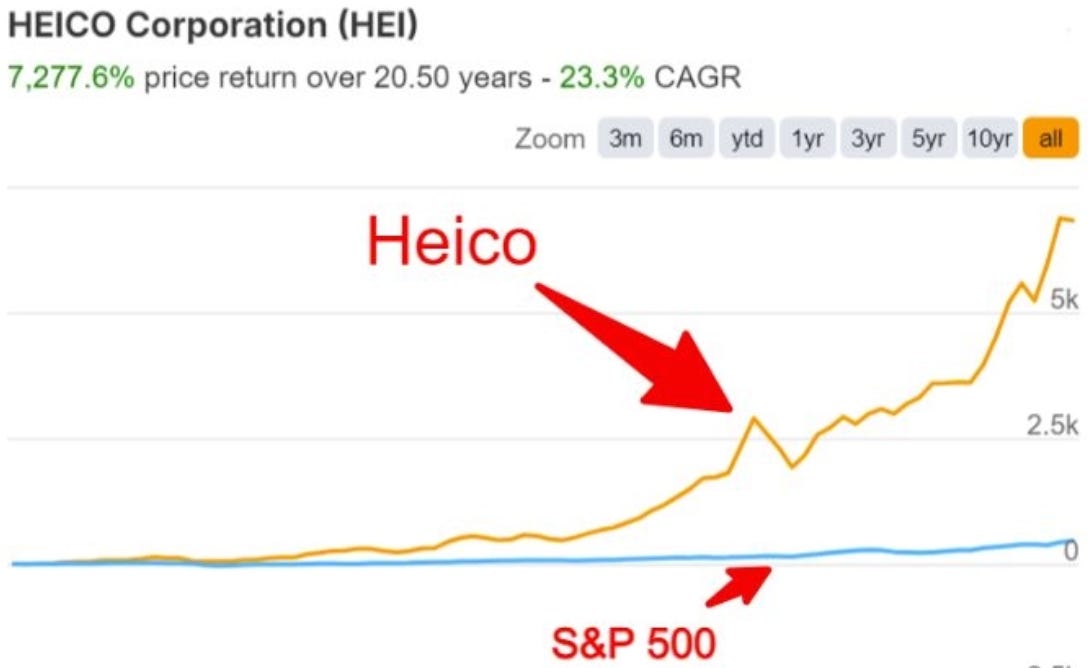
Today, HEICO is a multi-billion dollar juggernaut that has generated a total return of roughly 47,500% since 1990 — crushing the S&P 500 and even Berkshire Hathaway over the same stretch. Larry Mendelson, alongside Eric and Victor, is hailed as one of the greatest but little known capital allocators of our era.
The key takeaway from the Mendelsons: the most lucrative acquisitions aren’t found in the spotlights. They’re are found in the trenches of what one woudn’t touch i.e. regulatory friction. And to unlock its value, one needs to ensure they can stay in the game long enough, without the risk of defaulting from debts.
Fantastic piece! The Mendelsons proved that patience is the ultimate competitive advantage.
While private equity was blinded by the quick returns of debt, HEICO used time as a weapon. By staying debt-free, they could endure the slow FAA approval process, turning regulatory red tape into an impenetrable economic moat. A brilliant lesson in long-term investing!
This is why taking a longer view approach is so important. If you’re a PE firm, why bother with building relationships if your simply trying to get all the value possible in five years and then dump a company. But treating your relationships with respect wins in the end!