
Introduction: How Derivatives Eat the Float
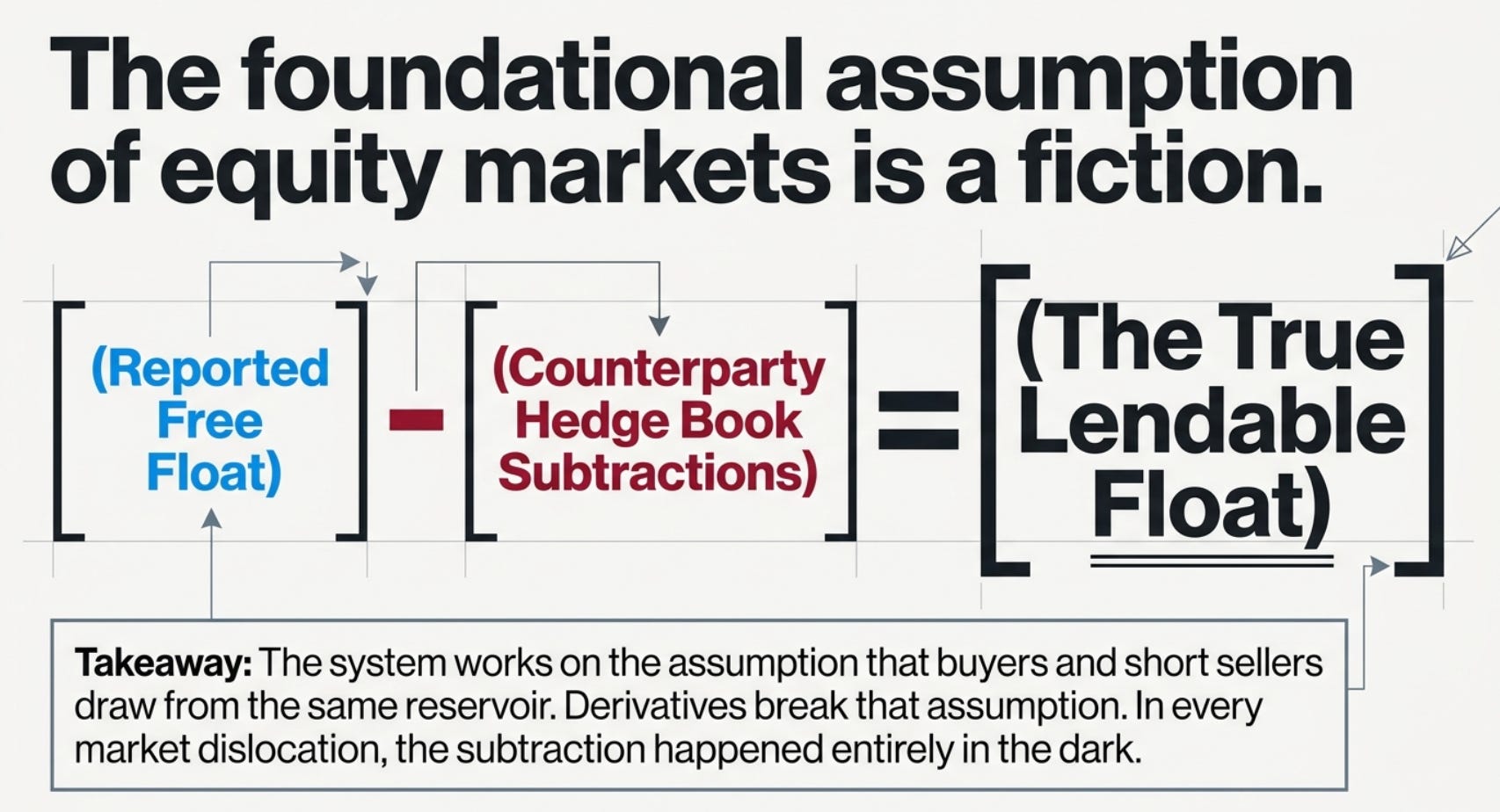
Every equity market runs on a simple assumption: the shares that are reported as outstanding are also available to trade. When you short a stock, you borrow from the lendable float. When you buy, you buy from sellers in that same pool. The system works because the two sides are drawing from the same reservoir.
Derivatives break that assumption — quietly, and often invisibly to everyone except the two parties in the private contract. The mechanism is always the same:
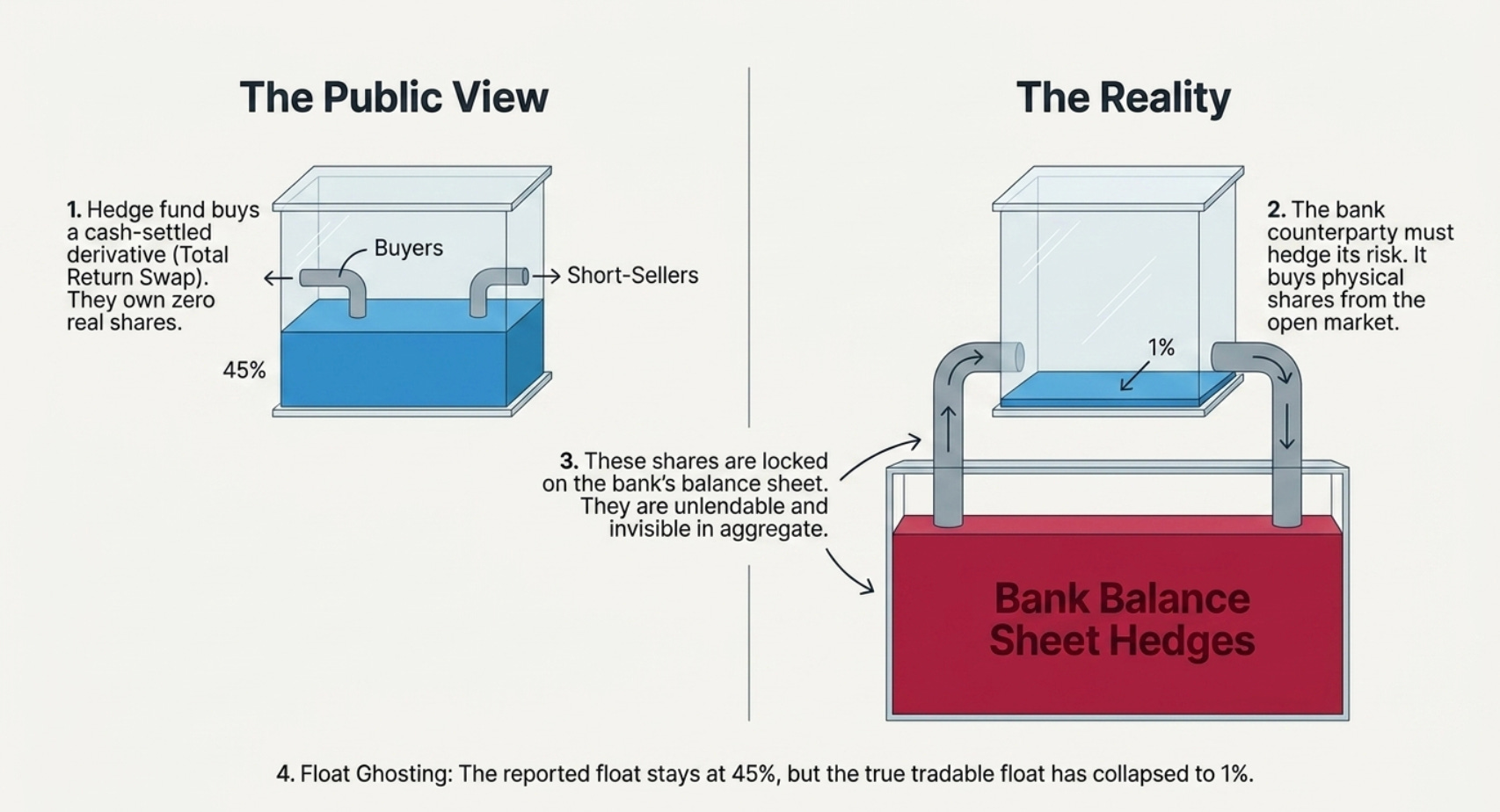
A hedge fund enters a cash-settled derivative — a total return swap, a contract for difference, a cash-settled call option — with a bank counterparty. The fund receives the economic return of, say, 5 million shares of Company X. It never owns a single real share.
But the bank does. To hedge the risk it just took on, the bank goes to the open market and buys those 5 million physical shares. Those shares sit on the bank’s balance sheet. The bank has no reason to lend them. They are not available to short sellers, not available to other market participants, and critically: they are not reflected in any public disclosure if the bank keeps each position below reporting thresholds.
This is what the documents in each case study call “float ghosting” — the tradable free float shown on Bloomberg or Yahoo Finance shrinks in reality, while the reported number stays unchanged. When short sellers check their data, they believe the float is healthy. It isn’t.
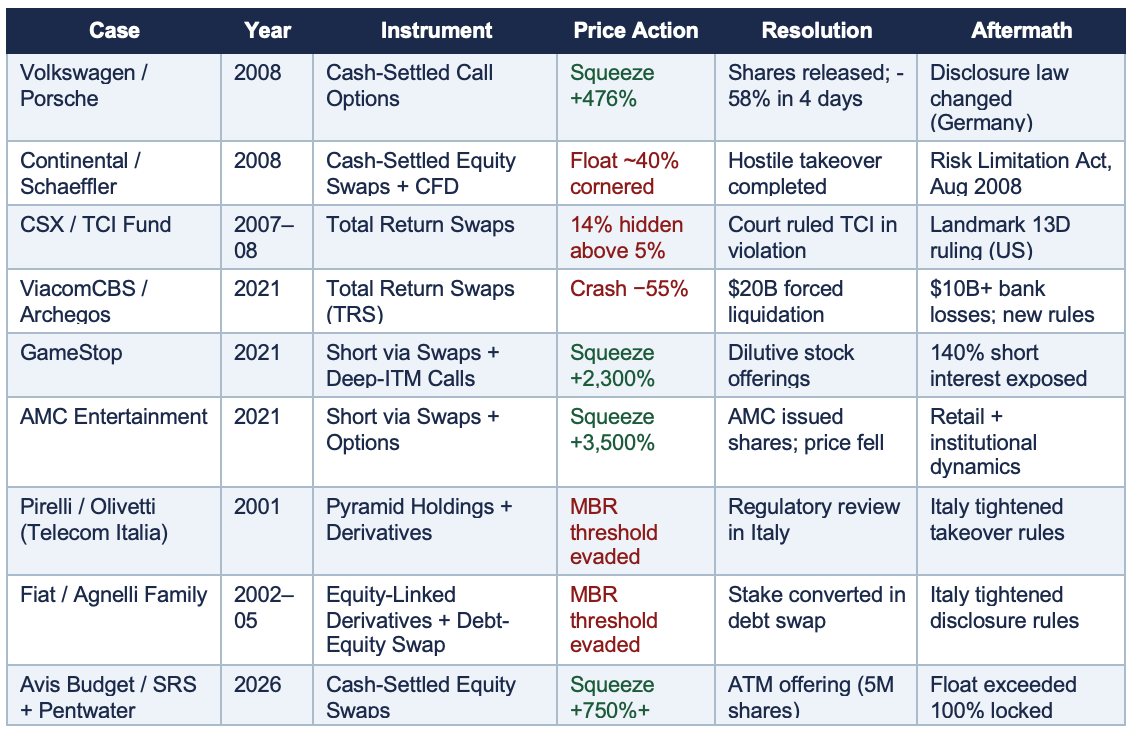
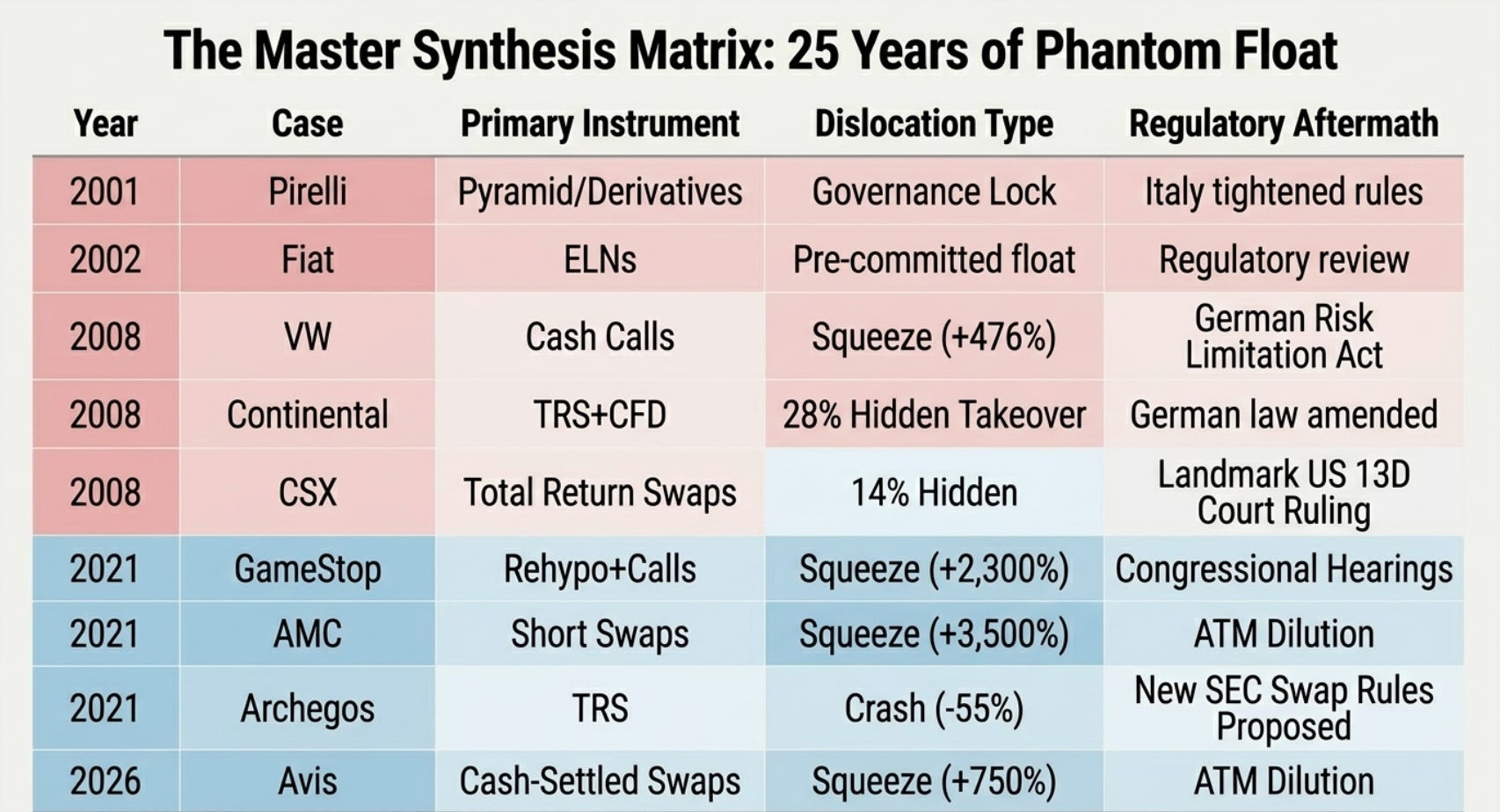
The nine cases in this document span 25 years, four countries, and eight distinct derivative structures. Some resulted in violent upward squeezes. Others caused catastrophic downward implosions. All of them share the same underlying physics: the economic value of derivative positions exceeded the real liquidity of the public float, and when reality was forced to reconcile itself, the price moved violently.

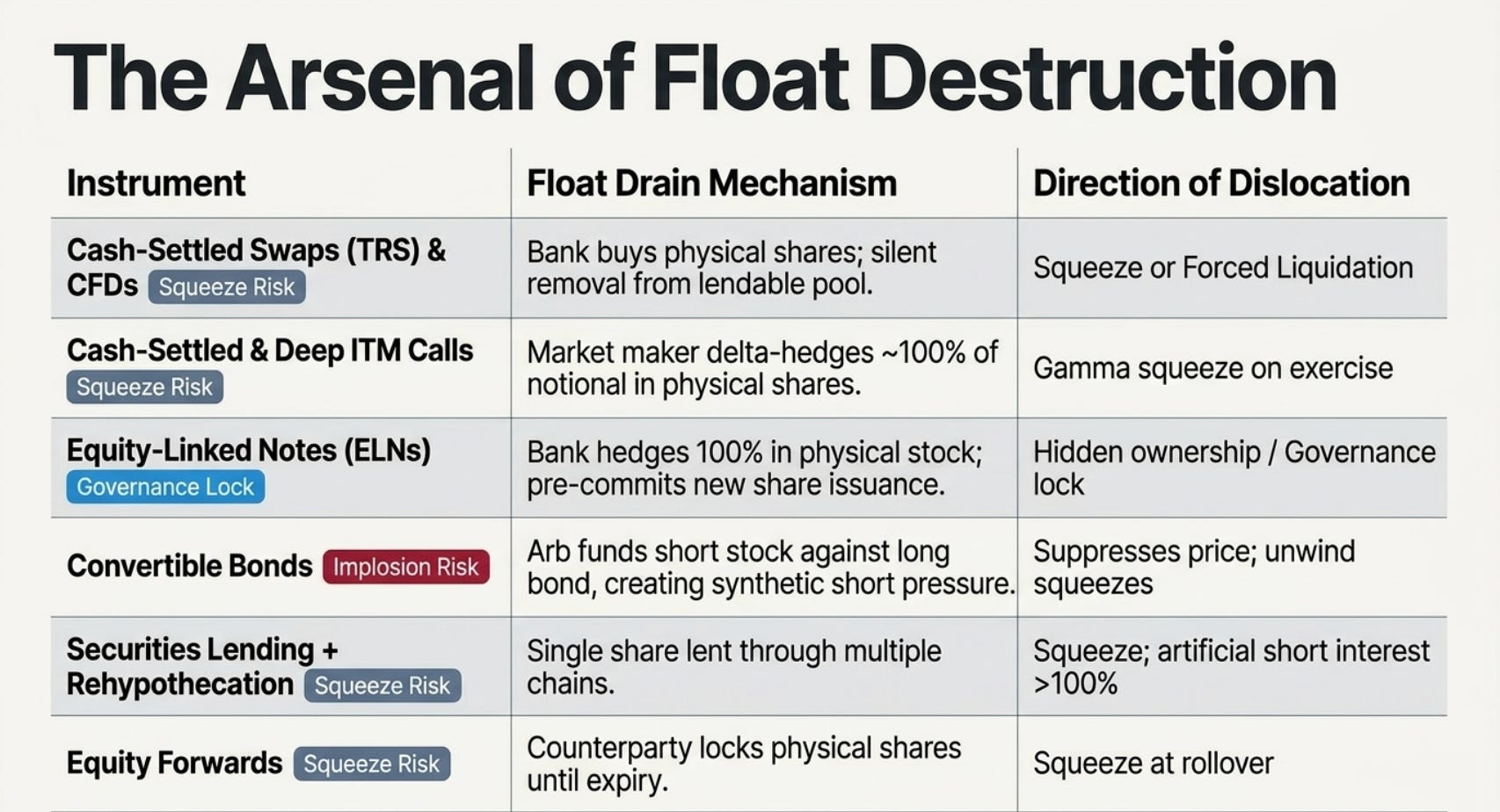
The Eight Instruments: How Each One Drains Liquidity
Before the case studies, it is worth mapping each instrument to its float-draining mechanism. The physics differ slightly — but the endpoint is always the same.
Volkswagen/ Porche

Background & Setup
In 2006, Porsche SE began quietly accumulating an interest in Volkswagen AG. Volkswagen was a deeply cyclical, debt-laden German automaker — exactly the kind of company that attracts short sellers who believe the market is overpricing sentiment over fundamentals. By 2007, hedge funds had built substantial short positions in VW, confident that a company with heavy liabilities could not sustain its elevated price. What none of them saw was how systematically Porsche was absorbing the real float using a regulatory blind spot.
The Derivative Instrument: Cash-Settled Call Options
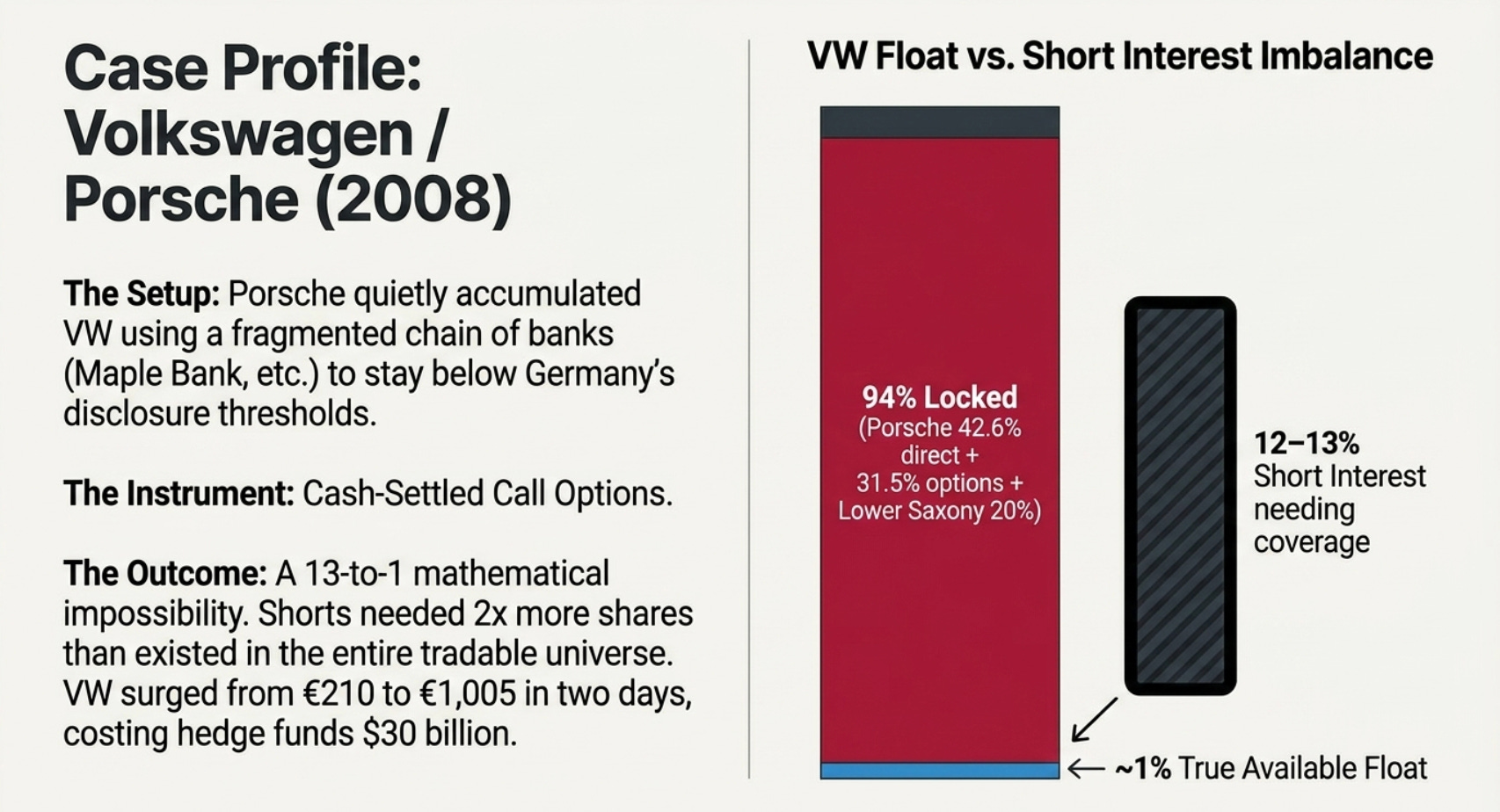
Porsche used cash-settled call options — contracts that, upon exercise, pay out the price appreciation in cash rather than delivering physical shares. The crucial regulatory detail: under German law at the time, cash-settled instruments did not carry voting rights and therefore did not trigger the disclosure requirements that apply to physical share ownership above certain thresholds.
Porsche structured these options through Maple Bank and a chain of other banks, each holding VW shares as hedges below the 5% individual disclosure threshold. Across the chain, Maple Bank’s counterparties collectively held a substantial percentage of VW’s real float — none publicly visible.
How Liquidity Dried Up
Think of VW’s float like a water tank. Before Porsche’s operation, roughly 45% of shares were freely circulating — a reasonably healthy pool. As Porsche bought options, each bank counterparty filled a bucket from that tank to hedge. No individual bucket crossed the disclosure threshold. No one in the market could see the tank draining. By October 2008, the actual free float had collapsed from 45% to approximately 1% of outstanding shares, while public databases still showed a 45% float.
Short sellers had borrowed and sold 12–13% of outstanding shares. On paper, 12% short against 45% float looks manageable. In reality, it was 12% short against 1% available — a thirteen-to-one mismatch. On October 26, 2008, Porsche disclosed its total position: 42.6% in direct shares and 31.5% in cash-settled options. The state of Lower Saxony held another 20%. Total locked: 94%.

VW surged from €210 to €1,005 in two trading days — briefly making it the most valuable company on Earth by market capitalization, overtaking ExxonMobil. Hedge funds lost an estimated $30 billion.
Is It Replicable?
In Germany after August 2008: no. The Risk Limitation Act required aggregation of direct holdings and derivative positions for disclosure purposes, closing the specific loophole Porsche used. In jurisdictions with fragmented disclosure rules, or where a determined accumulator uses many small counterparties each below individual thresholds, the underlying mechanic absolutely persists. The Avis 2026 case proves this.
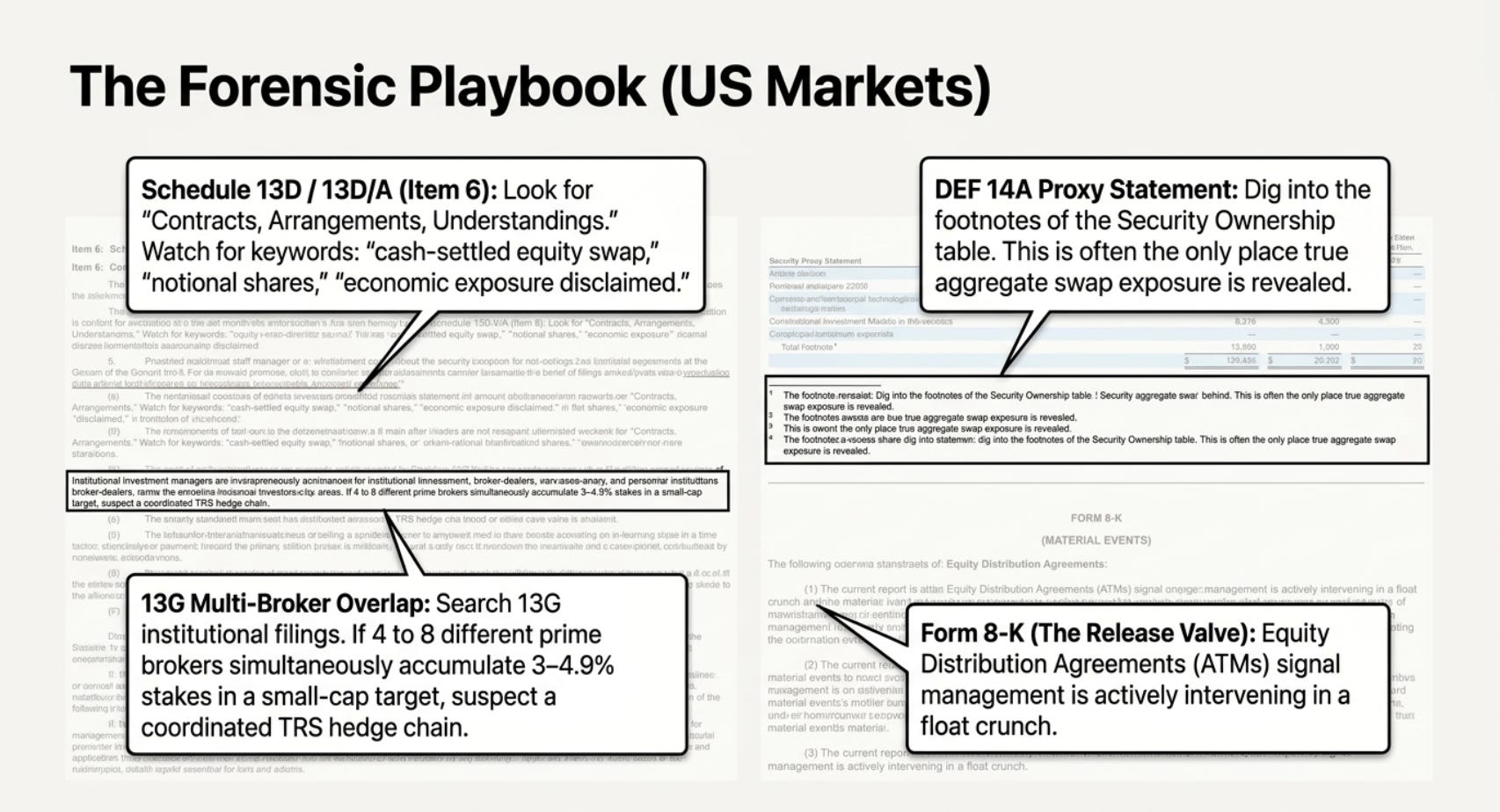
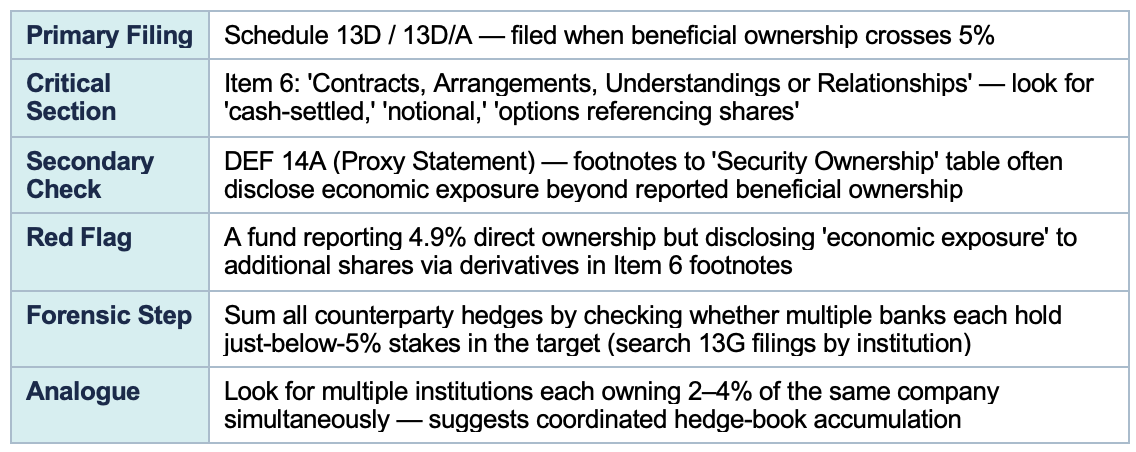
What to Look For in Filings
Continental AG/ Schaeffler KG

Background & Setup
Three months before the VW explosion, an almost identical playbook was executed at Continental AG, the German tyre and automotive components giant. The acquirer was Schaeffler KG, a privately held Bavarian family conglomerate — famously described as ‘a Goliath versus a very rich David’ since Schaeffler was roughly one-third Continental’s size by revenue. Its approach to taking control of a company three times its size was a masterclass in derivative-based stealth accumulation.
The Derivative Instrument
Schaeffler used two structures in tandem. First, it held physically-settled call options for approximately 5% of Continental’s shares — these were disclosed because physical settlement required disclosure. Second, and critically, it quietly built cash-settled equity swaps (Contracts for Difference) for approximately 28% of Continental’s shares through Merrill Lynch as the primary counterparty. Merrill Lynch then recruited a group of other investment banks to participate in hedging. Each bank took a position of exactly 2.999% — one basis point below the 3% threshold that would trigger individual disclosure under German law at the time.
How Liquidity Dried Up
Continental’s normally available float was roughly 40% of outstanding shares (the rest held by large institutional investors with long lock-ups). Schaeffler’s swaps effectively reserved 28% of that float through the hedge-book of counterparty banks — shares sitting on bank balance sheets, not lendable, not visible.
Continental’s CEO Manfred Wennemer put it bluntly: Schaeffler had ‘secured access to 36% of Continental’s shares in an unlawful manner.’ In practical terms, the company that was supposedly freely available for public takeover defense had already lost majority of its meaningful float to a single party’s derivative positions. Continental’s defense options — finding a white knight, issuing new shares — were structurally constrained because the true float was far smaller than reported.

Is It Replicable?
The specific German loophole has been closed. However, the multi-bank hedge-chain structure — where each counterparty holds just below individual disclosure thresholds — is a general technique and remains viable wherever disclosure rules are fragmented by counterparty rather than aggregated by beneficial controller. Regulators in the UK and EU tightened rules post-2008, but enforcement varies significantly across jurisdictions. In US markets, the CSX ruling (Case 3) established some precedent, but it is not universal.
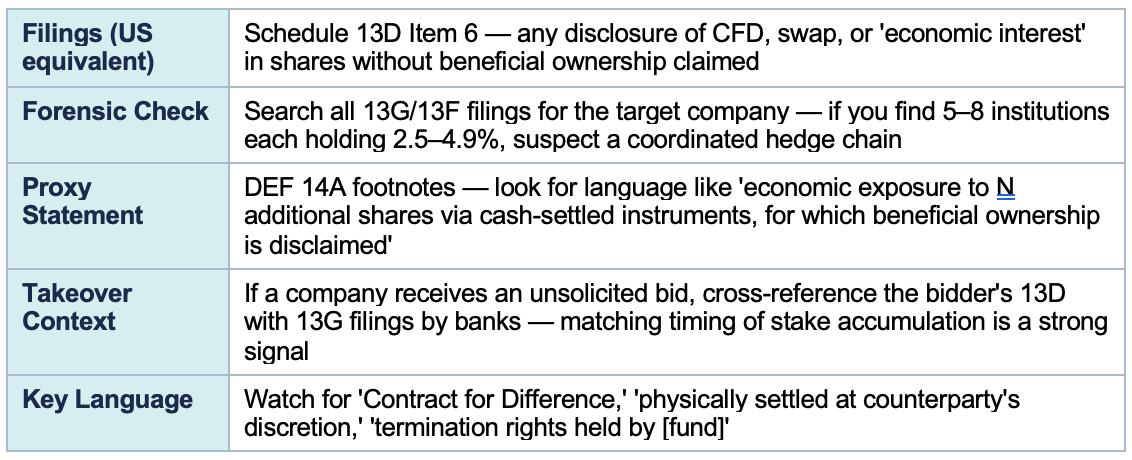
What to Look For in Filings
CSX Corporation / The Children’s Investment Fund (TCI)

Background & Setup
CSX Corporation is one of America’s largest railroad and freight transport companies. In 2006–07, two activist hedge funds — The Children’s Investment Fund (TCI) and 3G Capital — began building a substantial economic position in CSX with the intent to launch a proxy contest and elect their nominees to the board. Rather than buy shares directly and trigger Section 13(d) reporting above 5%, they used total return swaps with eight separate bank counterparties. This case became the first US court proceeding to seriously examine whether TRS positions constitute ‘beneficial ownership’ under securities law.
The Derivative Instrument: Total Return Swaps
TCI entered into TRS contracts with eight different banks. Under each TRS, TCI received the total economic return of a specified number of CSX shares — price appreciation and dividends — while paying a financing fee to the bank. The banks, to hedge their obligations, purchased physical CSX shares. TCI deliberately structured each TRS so that no single counterparty needed to hold more than 5% of CSX shares as a hedge, meaning no individual bank had a 13G filing obligation. Across the eight counterparties, TCI’s combined economic exposure reached roughly 14% of CSX’s outstanding shares.
Simultaneously, TCI held approximately 4.2% in direct shares — just below the disclosure threshold — and 3G held another 4.1%. Only when they filed a joint 13D in December 2007 did the full picture emerge: 8.3% direct plus 11% economic via swaps, plus an undisclosed coordinated group relationship dating back much earlier.
How Liquidity Dried Up
This case is different from VW and Continental in one important respect: TCI was an activist, not a takeover bidder. The float drain happened not to corner the company for acquisition, but to acquire covert voting leverage and position for a proxy fight. The physical shares held by eight counterparty banks as hedges were concentrated in institutional hands with no incentive to lend them into the short market, reducing the lendable supply. The impact was less a price dislocation and more a governance dislocation — TCI controlled far more economic influence over CSX than any public disclosure suggested.

Is It Replicable?
The court’s ruling established important US precedent, but the Second Circuit on appeal took a narrower view — declining to hold that TRS always confers beneficial ownership, instead focusing only on TCI’s specific evasive intent. This leaves the law unsettled. A fund that enters TRS in a purely economic capacity — without documented intent to influence voting — may still avoid the 13(d) requirement. The Avis 2026 structure operates in precisely this space. The instrument is fully replicable; detection depends on the quality of Item 6 disclosures and a researcher’s willingness to read footnotes.
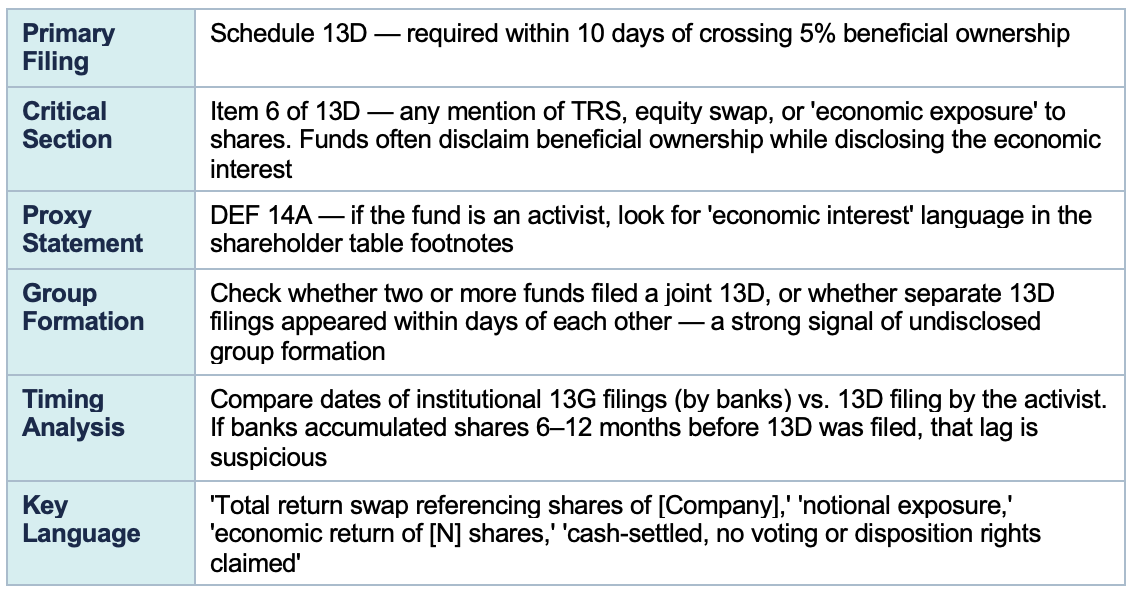
What to Look For in Filings
ViacomCBS & Discovery / Archegos Capital

Background & Setup
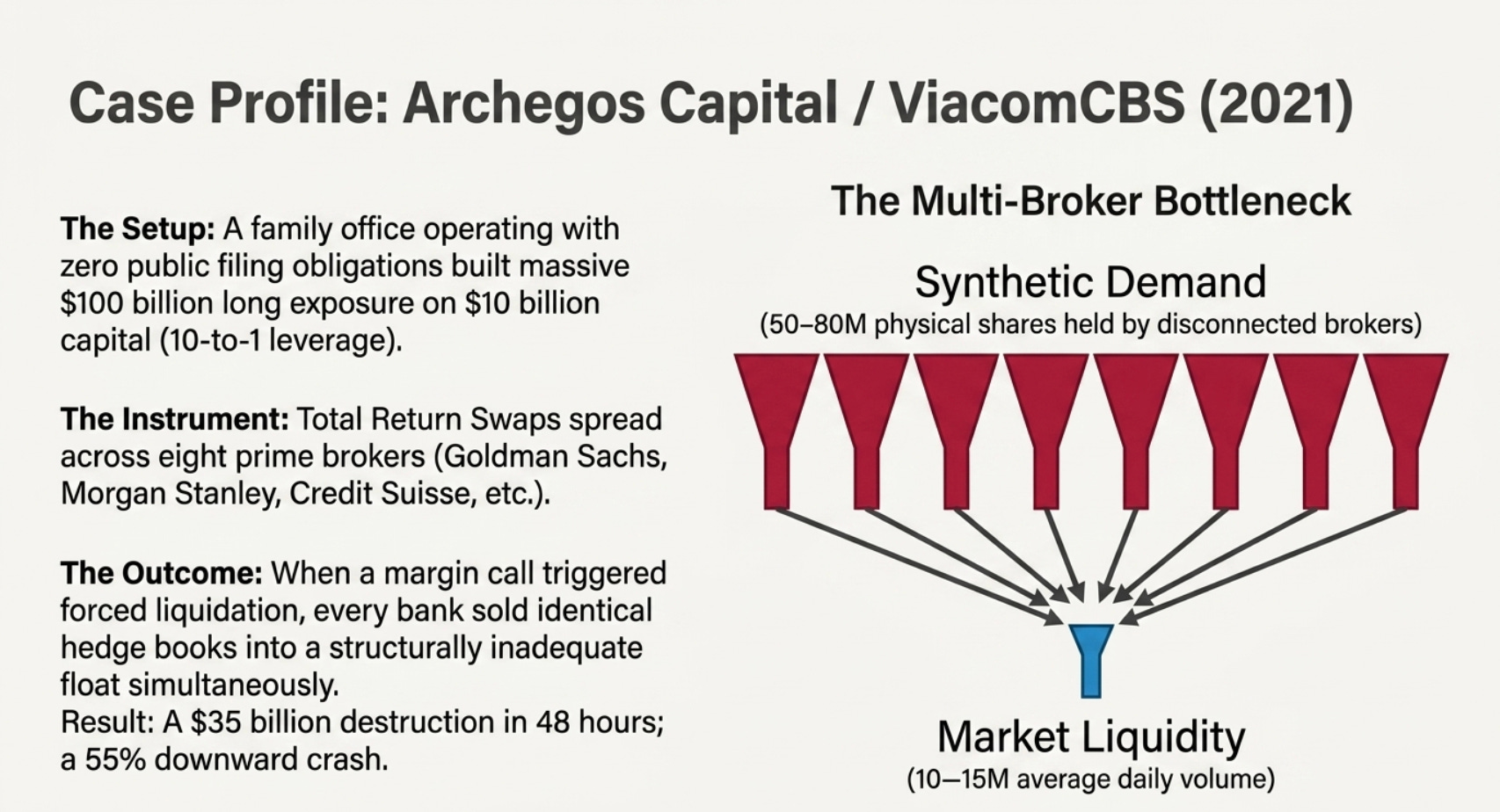
All prior cases involved derivatives used to accumulate a position. Archegos is the structural inverse: a case where total return swaps were used to build enormous long exposure, and when the position collapsed, the physical shares held as counterparty hedges flooded into a market that had no capacity to absorb them. The result was a downward short squeeze — or more precisely, a forced liquidation that destroyed $35 billion in market value across multiple stocks in 48 hours.
The Derivative Instrument: Total Return Swaps Across Multiple Banks
Bill Hwang’s Archegos Capital operated as a family office — a structure that, unlike a hedge fund, faced minimal regulatory scrutiny and no requirement to disclose holdings publicly. Archegos built massive TRS positions in ViacomCBS, Discovery, Baidu, GSX Techedu, Vipshop, and several others across multiple prime brokers simultaneously: Goldman Sachs, Morgan Stanley, Credit Suisse, Nomura, Deutsche Bank, MUFG, UBS, and Wells Fargo.
Each bank executed TRS contracts and hedged by purchasing the underlying physical shares. Crucially, because Archegos used multiple brokers rather than one, no single bank had visibility into the total position. Goldman Sachs knew its own hedge but not Credit Suisse’s. Credit Suisse knew its own but not Nomura’s. The total economic exposure Archegos had built was $100 billion on roughly $10 billion of actual capital — a 10-to-1 leverage ratio. No one had the full picture.
How Liquidity Dried Up — And Then Burst
Unlike the squeeze cases, where the float dried up and shorts had no shares to buy, the Archegos implosion caused the float to be overwhelmed by sellers. Here is the sequence:
When ViacomCBS announced a $3 billion equity offering in late March 2021, the price dipped. This dip triggered margin calls from banks. Archegos could not meet them. Banks began to liquidate the hedge positions — the physical shares they had purchased to back the TRS contracts. But every bank had hedged the same stocks, so every bank simultaneously needed to sell ViacomCBS, Discovery, Baidu into the same thin market.
ViacomCBS had an average daily trading volume of roughly 10–15 million shares. Archegos’s counterparties needed to unload positions of 50–80 million shares. The float could not absorb it. The stock fell 27% on March 26 alone, and 55% over the following week — not because of any fundamental change in the business, but because the market’s physical absorption capacity was about one-tenth of the forced selling pressure.

Is It Replicable?
The SEC’s 2022 response to Archegos proposed new disclosure rules for large TRS positions — specifically targeting ‘security-based swaps’ that give exposure above 5% to a single issuer. As of 2025, rule implementation has been slow and enforcement uneven. The multi-broker fragmentation technique — using several banks simultaneously to avoid any one of them seeing total exposure — remains structurally possible and is the key vulnerability. It is replicable until prime brokers share position data with each other in real time, which they currently do not.
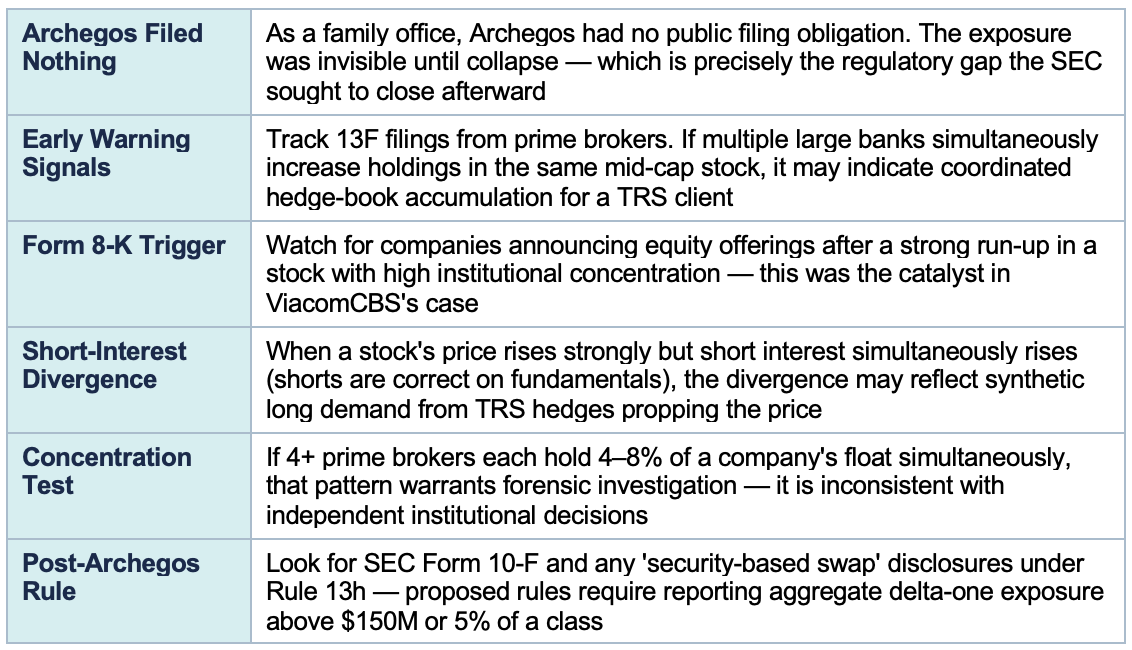
What to Look For in Filings
GameStop (GME)

Background & Setup
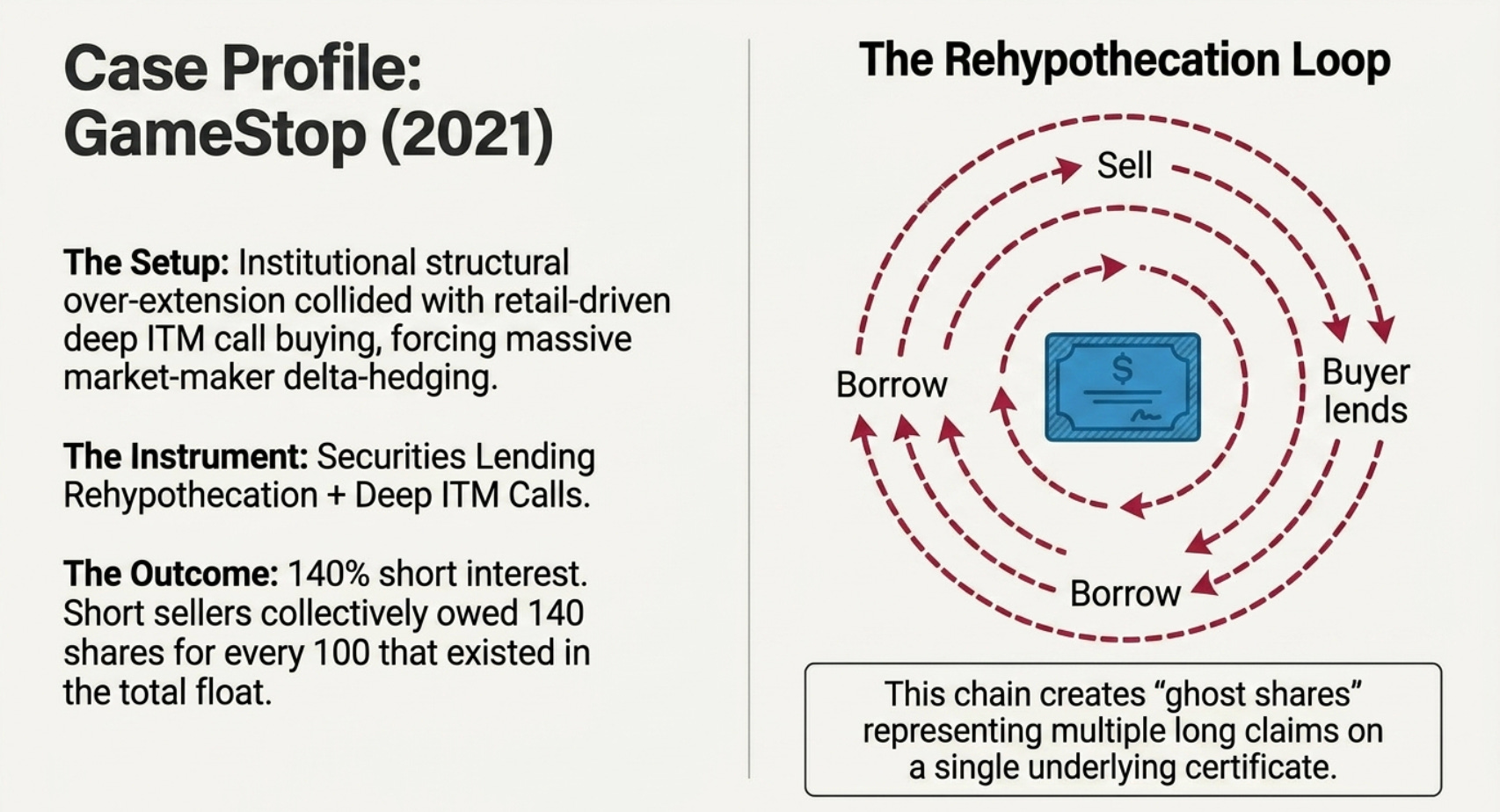
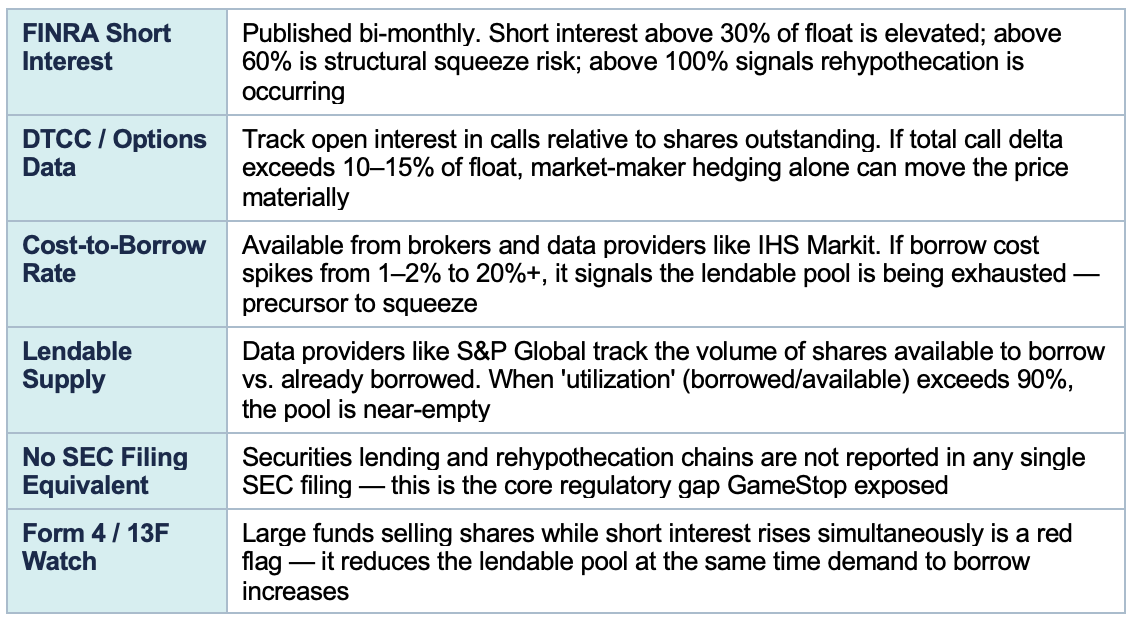
GameStop is the most famous retail-driven short squeeze in history. But the reason the squeeze reached such extremes — shares going from $20 to $483 pre-split in two weeks — was not simply retail enthusiasm. It was the underlying structure of derivatives and securities lending that had allowed short interest to reach approximately 140% of the entire float. That number is not an exaggeration or a rounding error. It means more shares had been borrowed and sold short than actually existed in freely circulating form. How does that happen?
The Derivative Instruments: Rehypothecation + Deep ITM Calls
Two mechanisms combined to produce the 140% short interest figure.
The first was securities lending with rehypothecation. When a short seller borrows a share from Lender A and sells it, the buyer of that share can in turn lend it to a second short seller. That second short seller sells it, and the new buyer can lend it yet again. Each link in this chain creates what the document calls ‘ghost shares’ — shares that appear in multiple accounts simultaneously (as ‘long’ to buyers at each step), but represent one underlying certificate. The lendable pool for GameStop had been loaned out multiple times over, creating a notional short interest that exceeded 100% of float.
The second was the aggressive use of deep in-the-money call options and short-dated out-of-the-money calls by retail traders on Robinhood and Reddit’s WallStreetBets. When a market maker sells a call option, it must delta-hedge by buying physical shares proportional to the option’s delta. Deep ITM calls have a delta near 1.0 — meaning the market maker must buy almost one full share per option contract. As retail buyers accumulated millions of call contracts, market makers were forced to absorb physical shares at an accelerating pace, further compressing the effective float available to short sellers trying to cover.
How Liquidity Dried Up
The rehypothecation chain had created a situation where short sellers collectively owed 140 shares for every 100 that existed in the float. Any event that caused lenders to recall their shares — or caused covering pressure — would force short sellers to bid against each other for a pool that was structurally insufficient. When retail buying pressure drove the price up slightly, the first wave of shorts began covering. Their buying drove the price higher, which triggered the next wave, which drove it higher still. Market makers simultaneously buying shares to delta-hedge call options amplified every upward move. The feedback loop became self-reinforcing.

Is It Replicable?
The rehypothecation mechanic is fully replicable and present in many highly-shorted small- and mid-cap stocks today. The specific retail options cascade is harder to replicate intentionally — it emerged organically from social media coordination. However, any stock with short interest above 50–60% of float, combined with heavy options open interest and a low lendable pool, carries structural squeeze risk regardless of whether retail is involved. Institutional actors can trigger the same cascade through large call purchases.
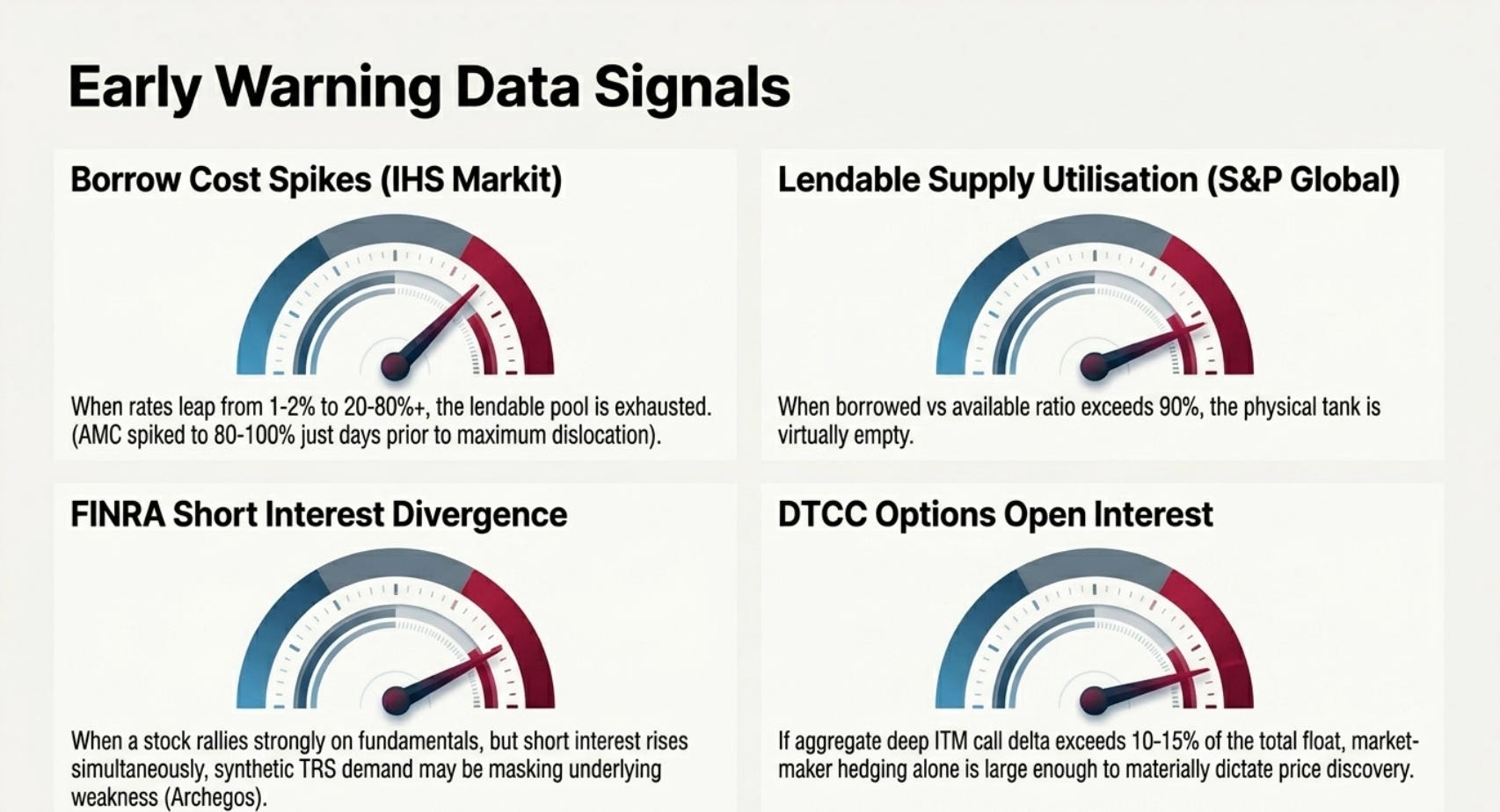
What to Look For in Filings and Data
AMC Entertainment (AMC)

Background & Setup
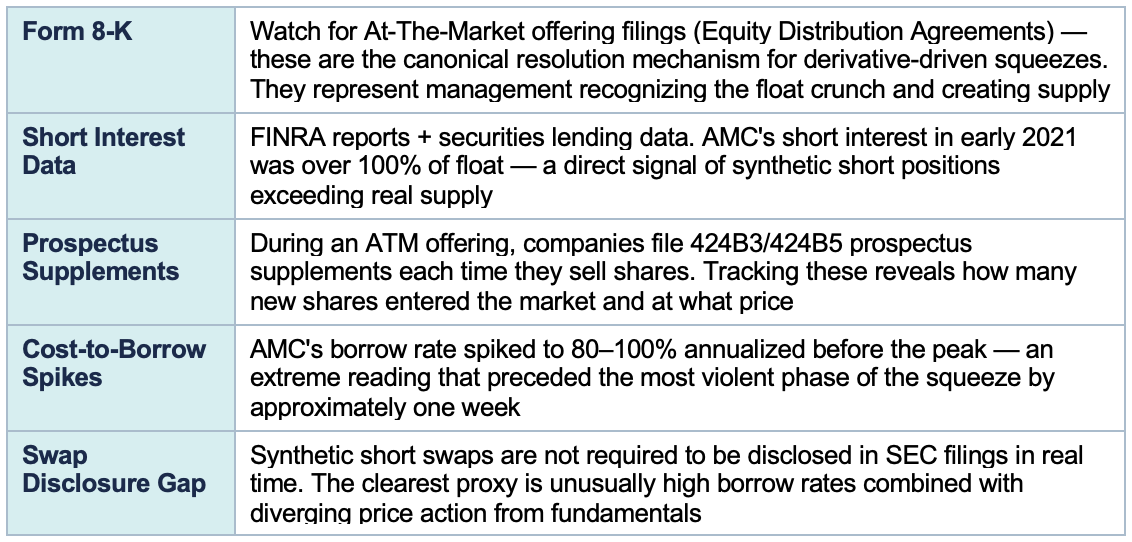
AMC Entertainment was a structurally impaired business entering 2021 — a cinema chain devastated by COVID lockdowns, carrying enormous debt, and widely expected by institutional analysts to file for bankruptcy. This made it a magnet for short sellers, who borrowed and shorted its shares aggressively. Short interest at its peak exceeded 100% of the reported float, using the same rehypothecation mechanics described in GameStop (Case 5). AMC’s price rose from approximately $2 in January 2021 to a peak of $72 in June 2021 — a move of over 3,500% — before collapsing.
The Derivative Instrument
The short exposure in AMC was built primarily through two channels: direct securities lending (shorts borrowing shares and selling them) and synthetic short positions via swaps. In the swap structure, a hedge fund pays a bank a fixed rate in exchange for receiving the downside price movement of AMC — economically identical to being short, but without needing to locate and borrow physical shares. Banks executing these swap positions also did not lend out their hedge shares, further depleting the lendable pool.
On the upside, retail traders again used short-dated call options, forcing market-maker delta-hedging that absorbed more physical shares from the float.
How Liquidity Dried Up — and AMC’s Unusual Response
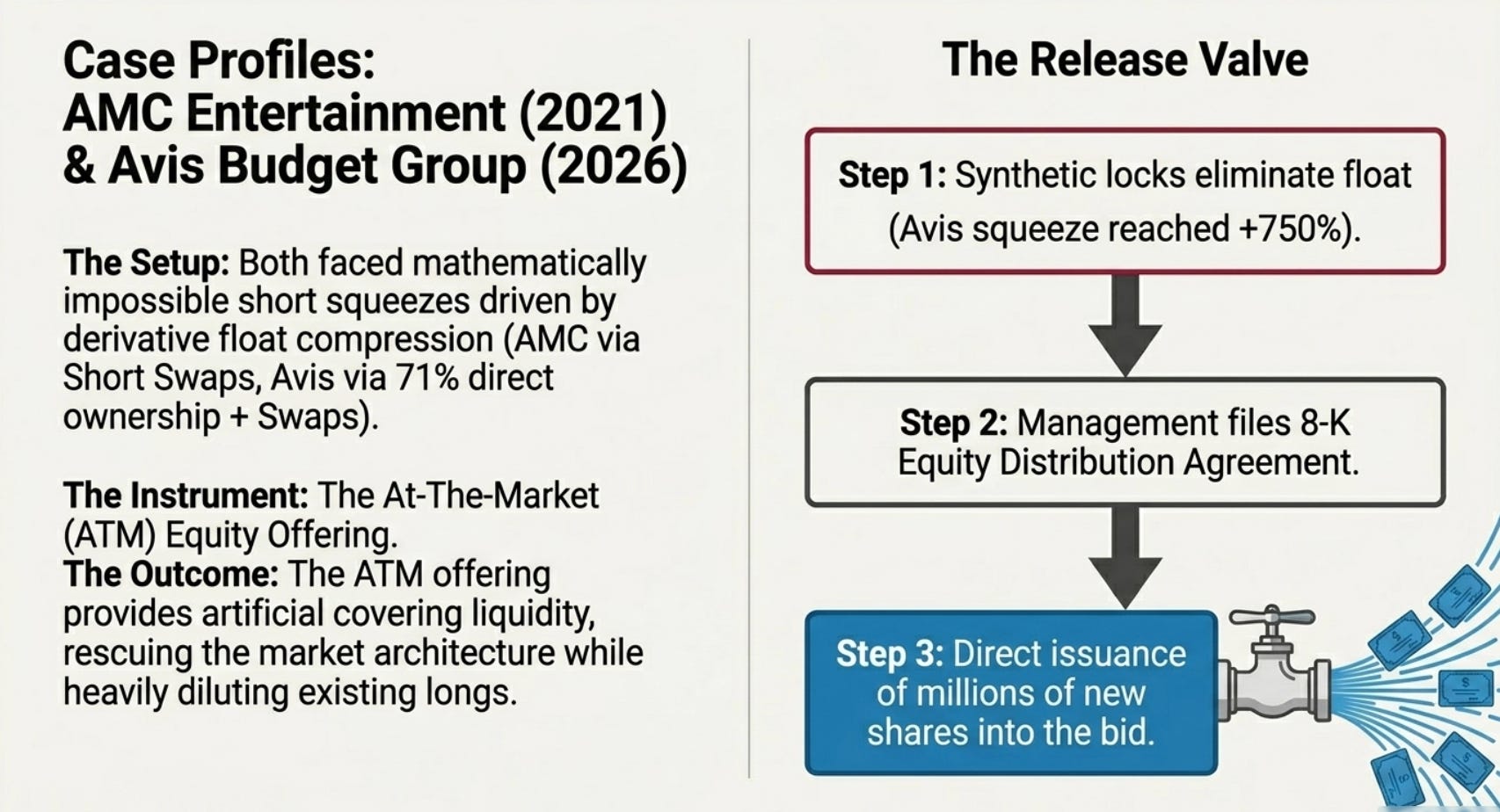
What makes AMC particularly instructive for this case study is management’s reaction: unlike most squeezed companies, AMC’s leadership explicitly weaponized the squeeze. CEO Adam Aron announced multiple At-The-Market (ATM) equity offerings directly into the surging price, issuing new shares at prices ranging from $10 to $50. This is identical in mechanics to the Avis 2026 ATM offering — diluting shareholders to provide artificial liquidity that allowed short sellers to cover and the price to normalize. AMC raised over $1 billion in fresh equity capital during the squeeze, effectively solving its bankruptcy risk on the backs of retail squeeze participants.

Is It Replicable?
The mechanic is fully replicable in any heavily shorted, low-float stock where synthetic short positions have been layered via swaps on top of a depleted lendable pool. The signal — short interest near or above 100% of float — is publicly available. The limiting factor is identifying when the lendable pool has simultaneously collapsed, which requires combining short interest data with cost-to-borrow and utilization rates from securities lending databases.
What to Look For in Filings
Pirelli / Olivetti–Telecom Italia

Background & Setup
Italy in the early 2000s had a peculiar corporate governance problem: many of its largest companies — Telecom Italia, Fiat, Mediobanca — were controlled by a small number of interconnected industrial families through ownership pyramids so complex they required academic papers to decode. The Pirelli–Olivetti–Telecom Italia case is the most dramatic example of how derivatives, layered on top of these pyramids, allowed a group of private investors to control a €50 billion telecommunications empire with a sliver of actual economic ownership.
The Derivative Instrument
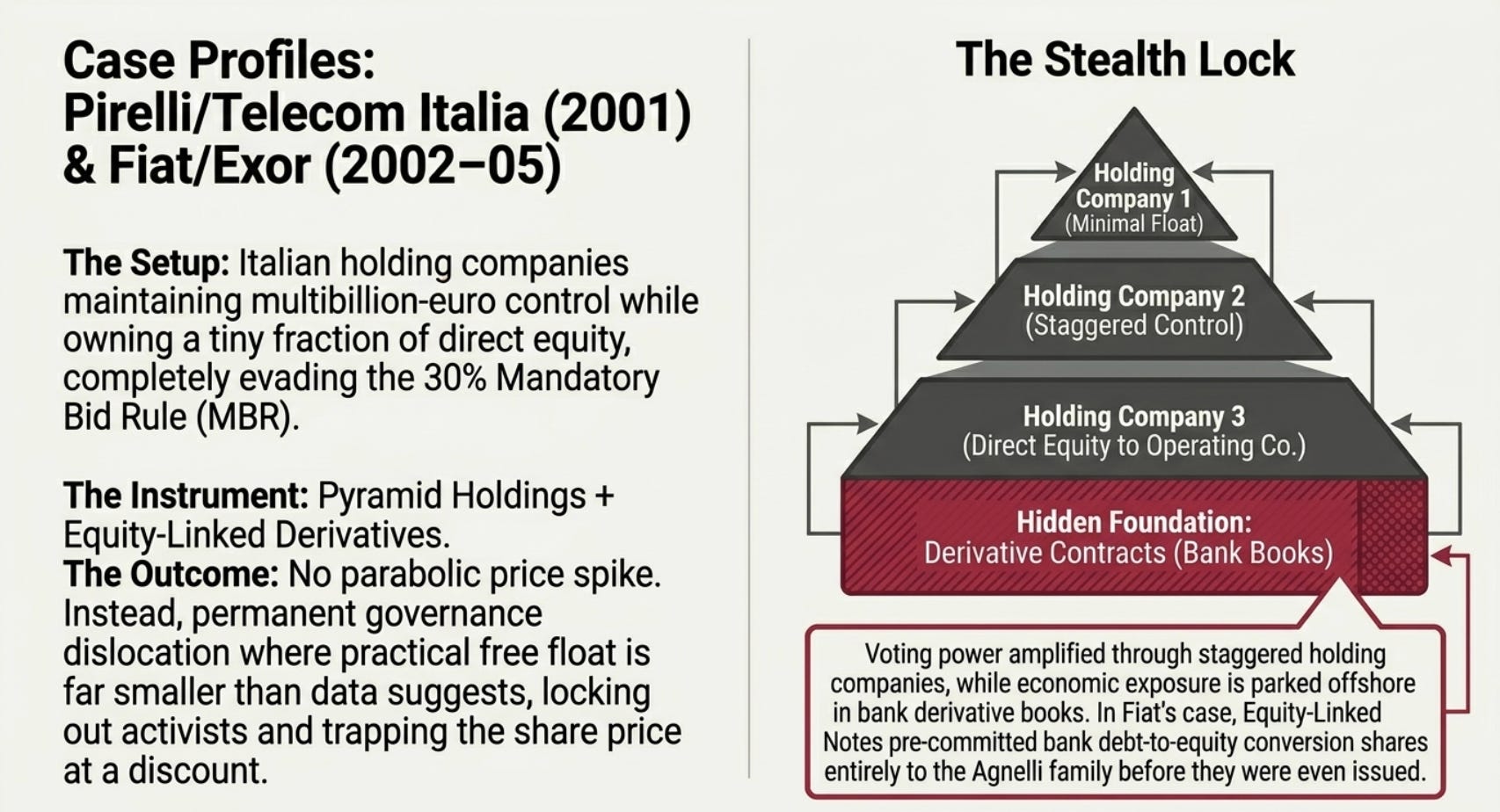
The Pirelli group, controlled by the Tronchetti Provera family, used a combination of staggered equity pyramid holding companies and cash-settled derivative contracts to maintain effective control of Olivetti, which in turn controlled Telecom Italia. The pyramid meant that voting rights were amplified far beyond economic ownership at each level. Derivatives — principally cash-settled options and equity-linked structures — were used to stay just below the mandatory bid rule (MBR) threshold of 30%, above which an acquirer would be required by Italian law to make a public offer for the whole company.
By building economic exposure through derivatives held by financial intermediaries, Pirelli’s principals controlled voting outcomes without the derivative positions appearing in consolidation with their direct stakes under Italian disclosure rules of the period.
How Liquidity Dried Up
The mechanism here is conceptually different from a short squeeze, but the underlying principle is the same: more economic interest was locked up than the float could support. The pyramid structure meant that shares at each level of the holding company chain were effectively pledged as collateral upward. The derivatives held by financial intermediaries created additional phantom locks on the underlying Telecom Italia shares. For any investor attempting to build a competing stake — or for an activist seeking to challenge management — the practical free float of Telecom Italia was far smaller than official data suggested.
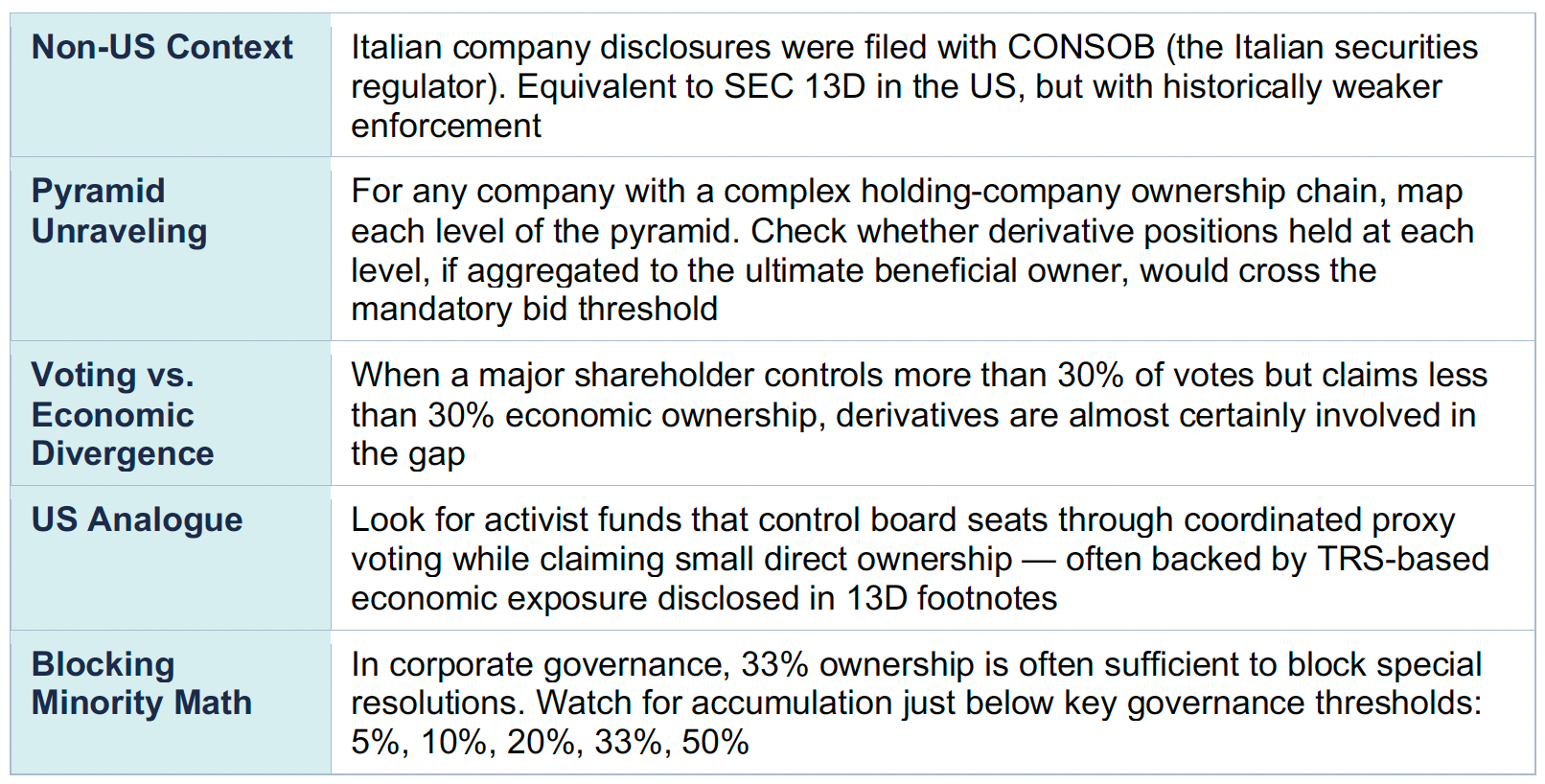
No parabolic price spike occurred because there was no external short-covering pressure. The float distortion was structural and permanent — not created by a triggering event. Instead, the damage was to price discovery and corporate governance: the stock persistently traded at a discount to fair value because investors knew that control was concentrated in ways that could not be challenged or monetized.
Is It Replicable?
The European Transparency Directive of 2004 and subsequent Italian implementation required broader aggregation of derivative stakes with direct ownership. Pure pyramid-plus-derivative hidden control is harder in post-2008 Europe. However, the governance dislocation version — using derivatives to build blocking minority stakes below mandatory bid thresholds — remains viable in many markets, including the US, where disclosure rules focus on economic ownership but do not require aggregation across all related derivative positions in real time.
What to Look For
Fiat SpA / Agnelli Family (Exor)

Background & Setup
The Agnelli family’s control of Fiat SpA through their holding company Exor (formerly IFIL Investments) is a study in maintaining decisive corporate control while managing the gap between voting power and economic ownership through derivatives. The key episode occurred between 2002 and 2005 when Fiat was in deep financial distress and the Agnelli family faced dilution risk as major banks converted debt to equity. The family used equity-linked derivative structures to protect its controlling stake without crossing the Italian mandatory bid threshold — and without disclosing the full position to the market.
The Derivative Instrument: Equity-Linked Notes + Debt-Equity Swap
IFIL (the Agnelli vehicle) entered into equity-linked note arrangements with financial intermediaries. These structured notes gave IFIL the economic right to receive new Fiat shares at a pre-determined conversion price, without IFIL immediately acquiring or disclosing those shares. The financial intermediary purchased or reserved the underlying physical shares, holding them off the market. The notes were structured so that IFIL’s total stake — direct plus derivative exposure — remained just below the 30% MBR threshold.
When Fiat’s major banking creditors converted their debt to equity (creating a large block of new shares), IFIL exercised its derivative rights to absorb those new shares at the pre-agreed price, maintaining its proportional control. The conversion was revealed after the fact, triggering a CONSOB investigation. CONSOB ultimately concluded that IFIL had been required to disclose its derivative positions earlier and fined the company — but the control structure was by then locked in.
How Liquidity Dried Up
Fiat’s free float throughout this period was significantly smaller than reported because the Agnelli equity-linked notes had effectively pre-allocated a portion of potential new shares to IFIL before they were issued. New Fiat shares being issued by banks as debt-equity conversions were, in economic terms, already spoken for — absorbed immediately into IFIL’s derivative position. Any investor modeling available float from public data alone would have overestimated the genuine tradable supply by the size of IFIL’s derivative reservation.
Is It Replicable?
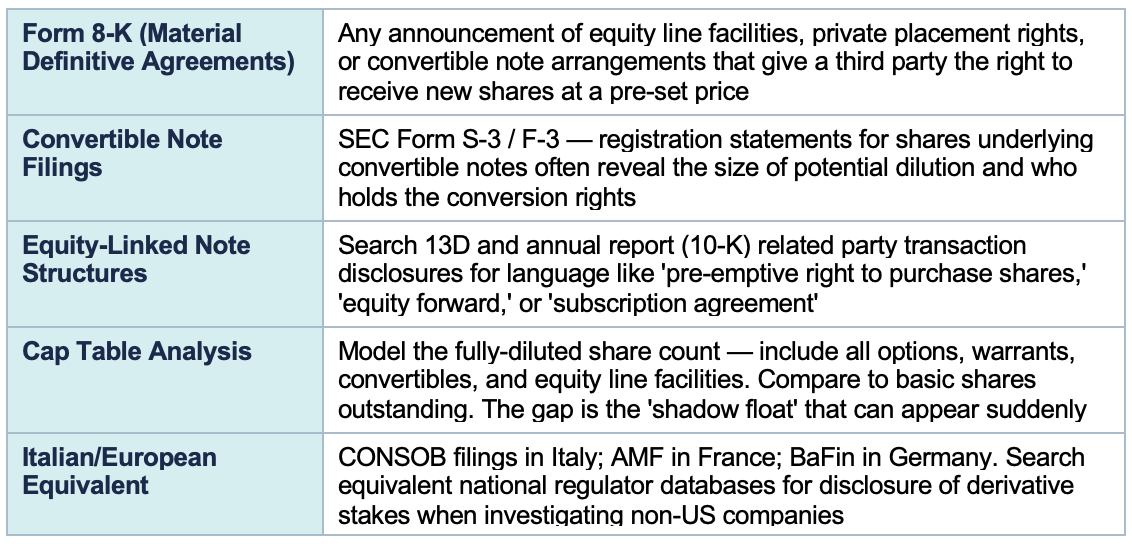
Equity-linked notes as a vehicle for hidden pre-commitment of shares are absolutely replicable. In the US context, the most common equivalent is a PIPE transaction (Private Investment in Public Equity) with a lock-up, or an equity line of credit where a private investor has pre-agreed purchase rights that aren’t visible to the public market. When a company has an equity line facility with a large investor, that facility represents a potential future dilution of float that current short interest data will not capture. Convertible note arbitrage — funds long the convert, short the stock — is a standard instrument with similar dynamics.
What to Look For in Filings
Avis Budget Group (CAR)

Background & Setup
The Avis Budget Group squeeze of spring 2026 synthesizes every mechanic described in this document into a single episode. Two hedge funds — SRS Investment Management and Pentwater Capital — built combined direct ownership of approximately 71% of Avis’s outstanding shares, layered with additional economic exposure through cash-settled equity swaps. The company’s fundamental profile was classically squeeze-prone: a 2025 net loss of $995 million, over $25 billion in debt, and a bearish institutional consensus driving short interest to 50–62% of float. The bears were right about the fundamentals. They were completely wrong about the float.
The Derivative Instrument
SRS and Pentwater used cash-settled equity swaps — contracts in which the bank counterparty receives the economic return of a block of Avis shares without either party holding the shares under a direct ownership arrangement. The bank, to hedge its obligations, bought physical Avis shares. Those shares were held on the bank’s balance sheet, not lendable to short sellers, and not counted in SRS’s or Pentwater’s publicly-disclosed direct ownership figure.
Pentwater executed the trigger: in late March 2026, it exercised a massive block of deep in-the-money call options, forcing market makers to deliver physical shares that did not practically exist in the free float. The combination of these exercises with the existing swap-driven float lockup created the mathematical impossibility at the center of the squeeze.
How Liquidity Dried Up
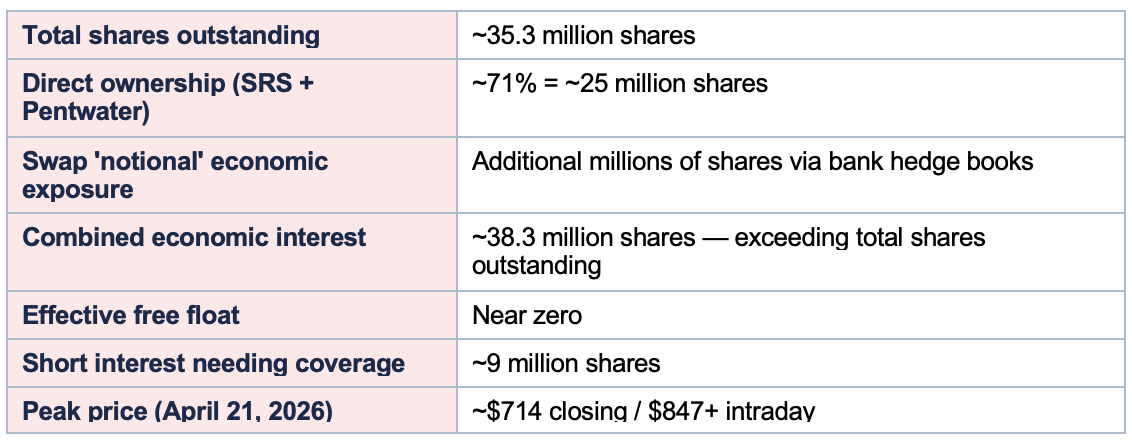
The float had not merely shrunk — it had been arithmetically eliminated. The economic claims on Avis shares exceeded the total number of shares in existence. Every short seller trying to cover was competing with every other short seller for shares that, for practical purposes, did not exist in the market. The price discovery mechanism had no anchor.
Resolution: The ATM Offering
On March 27, 2026, Avis management filed an Equity Distribution Agreement via Form 8-K to sell up to 5 million new shares via an At-The-Market (ATM) facility. This is the “release valve” pattern seen in both AMC (Case 6) and the Pirelli/Schaeffler situations: management creates new supply directly into a market with structurally insufficient float, allowing short sellers to finally cover and causing the parabolic price to collapse. By late April 2026, the stock had corrected approximately 50% from its peak as covering pressure was absorbed by the new issuance.
Is It Replicable?
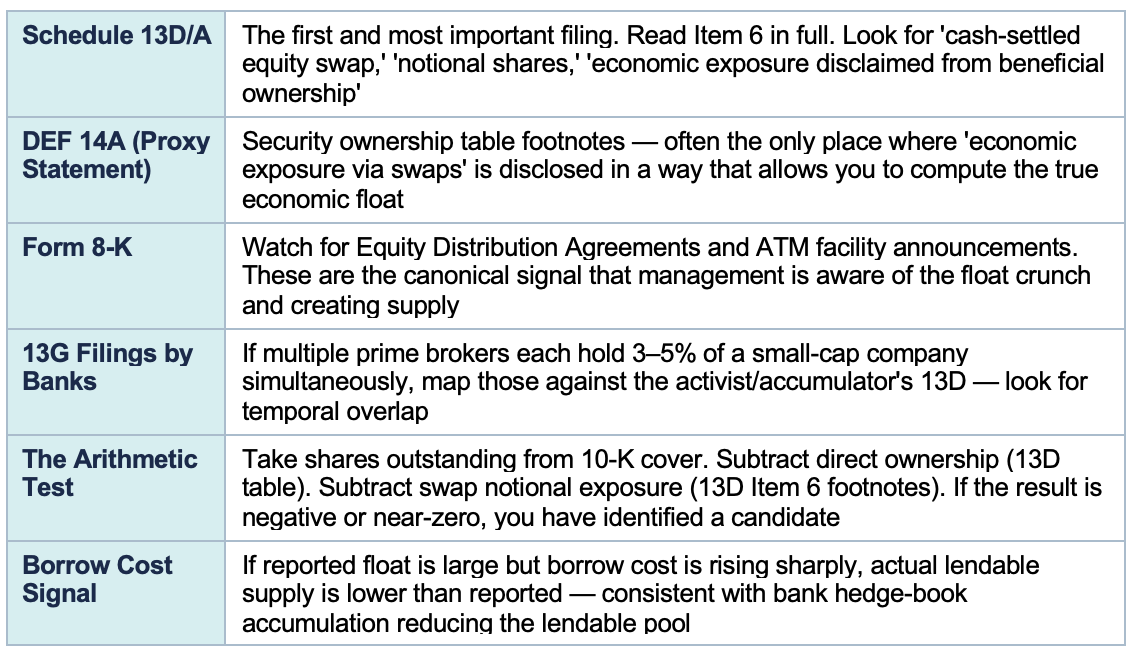
The Avis 2026 case confirms that, 18 years after VW/Porsche, the core mechanic — derivatives creating a hidden reduction in effective float — remains fully operative in US markets under existing disclosure rules. The SEC’s existing Item 6 requirements catch it only after the fact, when the fund’s 13D discloses the swap arrangements. Real-time prevention requires intraday disclosure of aggregate economic exposure across all derivative structures — a rule change that has been proposed but not implemented.
What to Look For in Filings
Master Reference: All Nine Cases at a Glance
Synthesis: The Four-Step Pattern
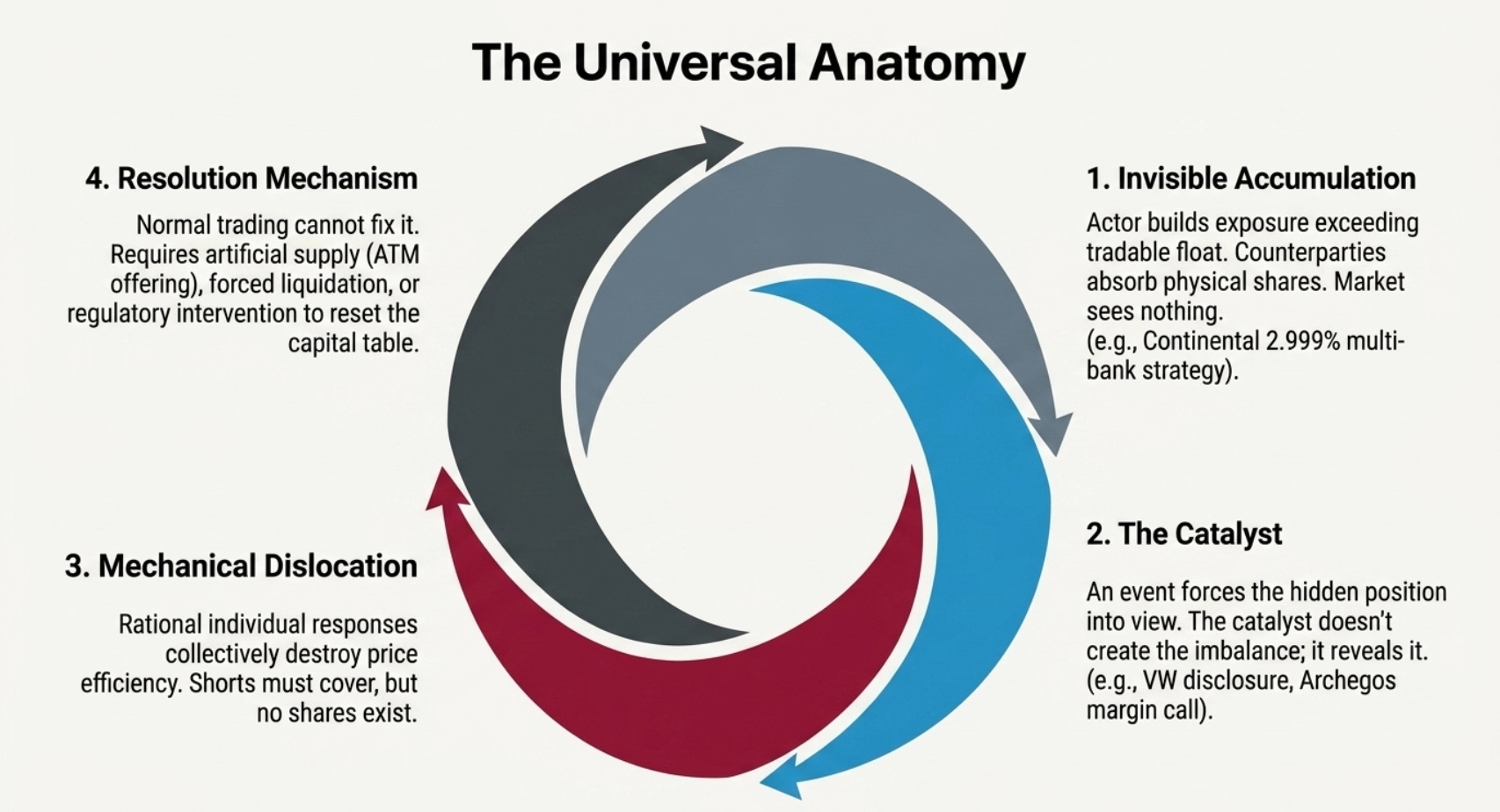
Across nine episodes spanning 25 years and four continents, the same four-step sequence appears with near-perfect regularity. Understanding each step makes the pattern detectable before prices dislocate.
Step 1 — The Invisible Accumulation
An economic actor — whether an acquirer (Schaeffler), an activist (TCI), a concentrated long (Archegos, SRS), or a distributed short base (GameStop) — builds exposure to a stock that exceeds the genuine tradable float. They do this using derivatives specifically because derivatives allow them to remain below disclosure thresholds and avoid moving the price during accumulation. The counterparty banks absorb physical shares into hedge books. The market sees none of this.
Step 2 — The Disclosure Event or Catalyst
Something forces the hidden position into view. In VW and Avis, it was a voluntary disclosure (the accumulator chose to reveal). In Continental, it was a takeover bid announcement. In Archegos, it was a margin call. In GameStop, it was a Reddit post going viral. In AMC, it was institutional short sellers adding to positions that were already structurally over-extended. The disclosure event does not create the problem — it reveals it. The imbalance was already there; the catalyst simply switches on the lights.
Step 3 — The Mechanical Dislocation
With the supply-demand mismatch now visible, market participants respond rationally to local incentives — but those rational individual responses collectively destroy price efficiency. Short sellers must cover, but there are no shares. Banks must sell hedge positions, but there are no buyers. Each participant’s rational move makes the situation worse for every other participant. The price moves violently in whichever direction resolves the imbalance: up in a squeeze, down in a forced liquidation.
Step 4 — The Resolution Mechanism
Price dislocations this severe require an artificial injection of supply or demand to resolve. The resolution mechanisms across these nine cases form a short taxonomy: an ATM equity offering injects new supply (Avis, AMC, VW’s share release); regulatory intervention forces disclosure and halts accumulation (Continental, Pirelli); a bankruptcy or fundamental reset restructures the capital table (GameStop’s subsequent equity offerings); or the positions are forcibly liquidated at whatever price the market bears (Archegos). Without an intervention, the dislocation cannot resolve through normal trading alone.

If you like what you read, check out my other writings 👇
Rust, Rigs, and the Recurring Revenue Hidden in Plain Sight: A Deep Dive into Beng Kuang Marine (SGX: BEZ)

The Old Steel and the Sea: Why You Should Care About a Ship Maintenance Company
Investment Reflection #2 — The Grand Play: 100 Years of the World’s Nations as Characters in the Greatest Story Ever Told

“The world is not a chessboard. It is a living organism, where every cell — every nation — eats, competes, cooperates, and occasionally tries to eat the others. Understanding it requires not just memorizing moves, but understanding hunger.”

The Tide Is Going Out: Commodity Houses, Private Credit, and the AI Debt Bomb

Start Here: What This Article Is About
Why I Passed on Graftech (EAF): Riding The Battery Hype, Or Perhaps Not...

There is a kind of company that is the most dangerous thing in investing. It is not the fraudulent company. It is not the obviously bad company with terrible products and incompetent management. Those are easy — you just avoid them. The truly dangerous company is the one with a
The Beautiful Trap: Why I'm Passing on The Hour Glass (SGX: AGS)

There’s a peculiar kind of investment that keeps you up at night — not because it’s bad, but because it’s genuinely good. Good enough to admire. Not good enough to buy.
The Diamond in the Rough That Isn't Quite Yours: Why I Passed on Boustead (SGX: F9D)

There is an old saying that investors have borrowed, bent, and quoted so many times it has nearly lost its sharpness: a bird in the hand is worth two in the bush. Warren Buffett, characteristically, gave it a precise mathematical form. The value of any investment, he wrote, is determined by three questions:
The Schoolteacher's Secret Insurer: Why Horace Mann (NYSE:HMN) Is Sitting on My Watchlist

“The stock market is a device for transferring money from the impatient to the patient.” — Warren Buffett

The Dormitory King That Couldn't Leave Home: Why I Passed on Centurion (SGX: OU8)

There is a deceptively simple question that Warren Buffett borrowed from Aesop’s ancient fable, and has repeated across decades of shareholder letters: “How many birds are in the bush? How sure are you they’re there? And how long until you get them out?”
The Children's Place: A $90 Million Bet on a Company That Used to Be Worth $2 Billion (NYSE: PLCE)

There is a classic scene in every heist movie. The detective walks into a room, sees the chalk outline, the scattered evidence, the broken window, and immediately knows something went terribly wrong long before anyone called the police. You do not need the full autopsy report to read the body.
World War 3 In Iran and Why Oil Price Will Continue Increasing — It Arrived Sooner Than Anyone Expected

This is Part 2 of a continuing analysis of California Resources Corp (CRC). Part 1 built the foundational investment case: a company trading at $44 per share against a conservative intrinsic value of $108–$156, built on 567 million barrels of proved developed oil reserves in California, and a management team spending hundreds of millions buying back its…
The Most Overlooked Oil Company in America — And Why That Might Be the Opportunity of the Decade

Date of analysis: 28 December 2025
The Art Of Saying No - MYPS: Playstudios Inc

PLAYSTUDIOS (MYPS) is a Las Vegas-based mobile gaming company that operates free-to-play social casino games and a loyalty platform called playAWARDS, which lets players redeem points for real-world rewards at places like MGM Resorts, Norwegian Cruise Line, and Wolfgang Puck restaurants. On the surface, this sounds like a clever moat. A loyalty program.…
The Art Of Saying No - UGP: Ultrapar Participacoes S.A (Part 2 of 2)

Question 2: How Certain Are You?
The Art Of Saying No - GLIBK: GCI Liberty Inc

Picture this: a single telecommunications company — the dominant one — serves over 200 communities scattered across the largest state in the United States. Alaska. A state with just over one person per square mile. A state where 39% of residents are underserved by broadband. A state where, until recently, some villages received internet via satellite li…

The Art Of Saying No - UGP: Ultrapar Participacoes S.A (Part 1 of 2)

The Setup: A Value Investor Dream?


The Art of Saying No - RIG: Transocean LTD

“The difference between successful people and really successful people is that really successful people say no to almost everything.” — Warren Buffett
The Art of Saying No - KPRX: Kiora Pharmaceuticals Inc

“The difference between successful people and really successful people is that really successful people say no to almost everything.” — Warren Buffett
The Art of Saying No - DNUT: Krispy Kreme Inc

“The difference between successful people and really successful people is that really successful people say no to almost everything.” — Warren Buffett

🎓 A Business Strategy Primer Part 7 - Learning From Great Companies

The Billion-Dollar Playbook: How Market-Based Management Powered Koch Industries’ Unstoppable Rise
The Art of Saying No - MRX: Marex Group PLC

“The difference between successful people and really successful people is that really successful people say no to almost everything.” — Warren Buffett


The Art of Saying No - SFIX: Stitch Fix Inc

“The difference between successful people and really successful people is that really successful people say no to almost everything.” — Warren Buffett
🎓 A Business Strategy Primer Part 2 - Brainstorming Solutions With Value At The Core

Creating An Irresistible Offer
The Art of Saying No - TDOC: Teladoc Health Inc

“The difference between successful people and really successful people is that really successful people say no to almost everything.” — Warren Buffett

The Art of Saying No - MDU: Mdu Resources Group Inc

“The difference between successful people and really successful people is that really successful people say no to almost everything.” — Warren Buffett


The Art of Saying No - AFCG: Advanced Flower Capital Inc

“The difference between successful people and really successful people is that really successful people say no to almost everything.” — Warren Buffett
The Art Of Saying No - VYX: NCR Voyix Corp

“The difference between successful people and really successful people is that really successful people say no to almost everything.” — Warren Buffett
The Art of Saying No - VSTS: Vestis Corp

“The difference between successful people and really successful people is that really successful people say no to almost everything.” — Warren Buffett

🛢️Basic Energy Primer Part 2 - Business and Competitive Landscape

The Man Who Bet Everything on Being Wrong
The Art of Saying No - CISS: C3is Inc

“The difference between successful people and really successful people is that really successful people say no to almost everything.” — Warren Buffett
The Art of Saying No - PSHG: Performance Shipping Inc

“The difference between successful people and really successful people is that really successful people say no to almost everything.” — Warren Buffett

The Art Of Saying No - MAGN: Magnera Corp

The Magnera Corporation Analysis Nobody Asked For (But Everyone Needs)
The Art of Saying No - CHR: Cheer Holding Inc

“The difference between successful people and really successful people is that really successful people say no to almost everything.” — Warren Buffett
The Art of Saying No - WIMI: WiMi Hologram Cloud Inc.

“The difference between successful people and really successful people is that really successful people say no to almost everything.” — Warren Buffett
⚡️Alternative Energy Primer Part 3 - Industry and Sector Technicals

The €2.2 Billion Mistake That Revealed Everything
⚡️Alternative Energy Primer Part 2 - Business & Competitive Landscape

The Shipwreck That Changed Everything

🏥 A U.S. Health Insurance (Managed Care Organizations) Sector Primer

1️⃣ Industry Fundamentals & Macro View

