A consolidated balance sheet reports $1.37 billion of cash and cash equivalents. The parent company has debt coming due. Can the investor treat that $1.37 billion as a ready source of repayment?
Not without asking where the cash sits, who has claims on it, and how quickly it can move. Consolidation combines the accounts of a controlled group for reporting. It does not turn every subsidiary bank account into a checking account at the parent. A local reserve rule, a lender’s pledge, a minimum operating balance, a minority owner, or a transfer approval can make the difference between cash inside the group and cash available at headquarters.
The useful question is not simply, “How much cash does the group report?” It is: “How much can reach the parent, legally and economically, before the parent needs it?”
Consolidation does not erase the corporate boundary
A parent may control a subsidiary and include its assets, liabilities, revenue, and expenses in consolidated financial statements. That presentation helps an investor see the business as one economic group. It does not eliminate the subsidiary as a separate legal entity.
The subsidiary may need its own cash to pay workers, suppliers, taxes, interest, or project costs. Its lenders may have first claims on certain deposits. Local company law may limit dividends to accumulated earnings or require statutory reserves. A regulator may require approval before a capital distribution. If the parent owns less than all of a consolidated subsidiary, some of the economic claim belongs to other shareholders. And even a permitted transfer may take time, involve withholding tax, or depend on a board decision.
These are different constraints. A cash deposit pledged to a lender is not the same as a statutory reserve. A statutory reserve is not the same as a subsidiary’s entire cash balance. Minority ownership is not a cash lien, but it can change how much of a distribution belongs to the parent. A transfer that is legally possible next quarter may still be unavailable for a debt payment due next week.
So separate four quantities before making a liquidity judgment:
1. Consolidated cash and cash equivalents: the amount reported for the controlled group.
2. Restricted cash: cash presented separately or subject to a specified use or restriction. Read the relevant note to learn what the restriction means and when it ends.
3. Restricted net assets: assets or equity that cannot be transferred freely under applicable rules. This is not a cash balance.
4. Cash actually upstreamed: dividends, loans, or advances that did move from a subsidiary to the parent. This is a historical flow, not necessarily the maximum the subsidiary could distribute in the future.
Conflating these amounts can produce a false “net cash” calculation. In particular, subtracting a restricted-net-assets figure from consolidated cash may be meaningless: the first may include registered capital and reserves, while the second is a cash balance. They are not necessarily the same assets, and they may overlap in ways the summary figures do not reveal.
What Canadian Solar’s filing shows, and what it does not
Canadian Solar Inc.’s 2025 Form 20-F was filed on April 10, 2026, for the year ended December 31, 2025. Its consolidated balance sheet reports U.S. dollar amounts in thousands. At year-end it showed $1,370.418 million of cash and cash equivalents, down from $1,701.487 million a year earlier. It separately presented $541.705 million of current restricted cash and $28.312 million of noncurrent restricted cash. Those are consolidated group balances, not a parent-only cash schedule. The filing’s balance-sheet presentation does not by itself say how much of the cash-and-equivalents line is held at the parent or could be transferred to it.
Note 15 addresses a different question. It says CSI Solar may pay dividends only from retained earnings determined under local accounting standards. It also says at least 10% of annual after-tax income must be allocated to a statutory general reserve until that reserve reaches 50% of registered capital, and that distribution of registered share capital requires local authority approval. The note identifies the statutory reserve and registered share capital, totaling $1,483.016 million in the filing’s reported scale, as restricted net assets that cannot be transferred to Canadian Solar through dividends, loans, or advances. Note 15, “Restricted Net Assets”
The same note reports that Canadian Solar received $26.958 million in cash, net of $2.995 million of withholding tax, from CSI Solar dividends in 2025. That is evidence that a dividend transfer occurred. It is not a measure of the subsidiary’s maximum distributable cash, the amount of cash located there, or the amount that would be available at a different date. The filing does not say that all $1,483.016 million of restricted net assets is cash; it describes the amount as the statutory reserve and registered share capital. Nor do these lines establish the exact amount of Canadian Solar parent cash available for a particular debt payment.
That distinction is the lesson in miniature. A reported cash balance, a separate restricted-cash balance, a restricted-net-assets disclosure, and an actual dividend payment each answer a different question. The filing gives an investor reasons to investigate transfer capacity, but it does not justify inventing a parent-available-cash total from these numbers.
A small model makes the boundary visible
Consider a clearly fictional group, with all amounts in U.S. dollars millions:
Visual summary: in this fictional group, $900m of consolidated cash maps to $444m of potential parent cash, but only $100m is already at the parent.
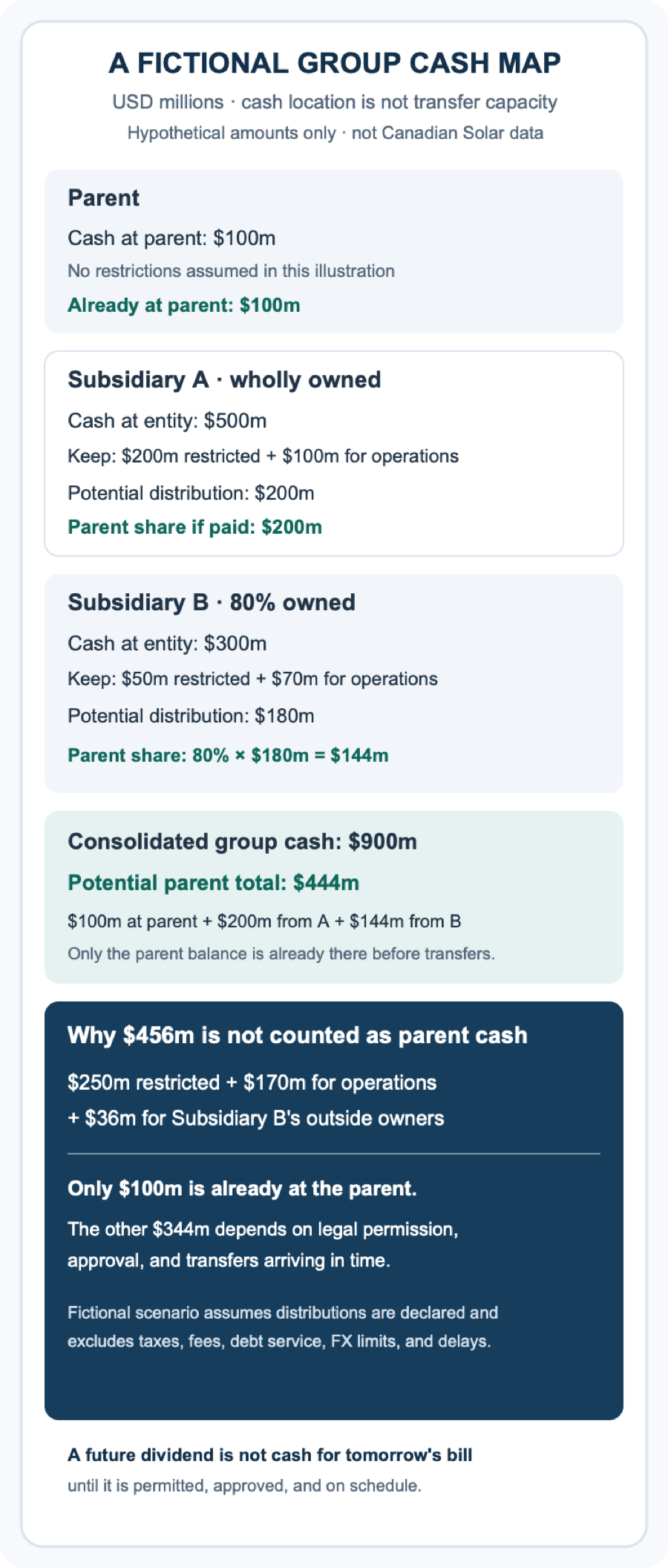
For Subsidiary A, the model leaves $200 million after subtracting the $200 million restriction and $100 million operating minimum. The parent owns all of A, so the scenario’s potential distribution to the parent is $200 million.
For Subsidiary B, $300 million of cash less $50 million restricted and $70 million needed for operations leaves $180 million potentially distributable. If the subsidiary declares a pro-rata distribution and every legal condition is met, the parent’s 80% share would be $144 million. The remaining $36 million would go to the outside owners under this simplified assumption.
The arithmetic is:
$100m at the parent + $200m from A + (80% × $180m from B) = $444m of potential parent cash.
The group reports $900 million in this fictional example, but only $100 million is already at the parent before any transfer. The other $344 million in the upper scenario depends on permitted distributions arriving in time. The remaining $456 million is not counted as parent-available here: $250 million is restricted, $170 million is retained for operating needs, and $36 million is the outside owners’ share of B’s possible distribution.
This is a scenario bridge, not a standard accounting measure. It assumes no subsidiary debt service, taxes, transfer fees, foreign-exchange limits, or approval delays; assumes the parent owns 100% and 80% as stated; and assumes the boards declare the distributions. The restrictions and operating minimums are fictional, not Canadian Solar data. In a real analysis, local creditors and operating needs may have claims ahead of any parent distribution.
The model also shows why timing matters. If the parent must pay a bill tomorrow, a dividend that can arrive in three months is not today’s liquidity. If a transfer is denied, the parent may have only the $100 million already on its own balance sheet. The correct range can therefore run from cash confirmed at the parent to a higher conditional amount supported by specific legal permissions and a realistic transfer schedule.
Think in reservoirs, but check the pipes
Imagine a group as several reservoirs connected by pipes. Consolidated cash is the water across the system. A legal restriction can close a gate; operating needs set a minimum level; an outside owner has rights to part of an allowed flow. A parent obligation is due at a particular time, so a pipe that opens after the due date does not solve the immediate problem.
The analogy has limits. Cash is fungible and can sometimes be moved after approval; laws and contracts are not literal gates, and restrictions may be temporary or conditional. The analogy is useful only if it prompts a search for actual terms, entities, claims, and dates. It cannot tell you which cash is available.
The strongest alternative: maybe the cash really is flexible
A large group cash balance is not automatically trapped. The parent may hold most of it directly. A subsidiary may be wholly owned, have surplus cash beyond operating needs, and face no relevant covenant or regulatory restriction. Its board may regularly distribute excess funds, and the transfer route may be routine. In that case, consolidated cash could be a reasonable approximation of parent liquidity.
There is also a less dramatic explanation for cash sitting in an operating subsidiary: it may be the working balance required to run that business, rather than a legal prohibition on transfers. That still matters to a parent seeking to extract cash, but it is a different problem. If the investor labels every subsidiary balance “trapped,” the analysis becomes as careless as treating every group dollar as immediately available.
Distinguish the alternatives with evidence. Read the legal restriction and any covenant language. Look for dividend history, but do not assume one past payment proves unlimited capacity. Compare subsidiary cash with payroll, supplier, tax, debt, and planned capital needs. Identify whether regulators or lenders must consent. If the filing gives only a restricted-net-assets figure, do not treat it as a cash-location schedule.
A practical parent-liquidity check
For a parent with a debt maturity or proposed distribution, build a short, dated map rather than relying on a consolidated “net cash” headline:
1. Start with the parent. Find parent-only cash, investments, debt, and committed facilities if the filing provides them. Separate committed borrowing from cash already on hand.
2. Map the subsidiaries. Record cash by legal entity where disclosed, ownership percentage, and whether each entity is consolidated or accounted for differently. Control does not mean the parent owns every dollar.
3. Read each restriction. For restricted cash, identify collateral, escrow, regulatory, or other terms. For restricted net assets, identify whether the restriction covers reserves, capital, dividends, loans, or advances. Do not substitute one label for another.
4. Subtract what must stay. Estimate local debt service, operating liquidity, payroll, taxes, supplier needs, and committed investment. A cash balance can be legally movable and still economically needed in the subsidiary.
5. Trace the transfer. Check who must approve it, whether lenders or authorities have rights, how taxes apply, and how long the route takes. Use actual transfers as evidence of what happened, not as proof of the maximum possible amount.
6. Respect outside claims. If there are noncontrolling shareholders or different share classes, read the dividend rights and ownership structure before assigning all potential distributions to the parent.
7. Match cash to the obligation date. Put parent maturities and other required payments on a timeline. A future transfer is not cash for a near-term payment until it is permitted, approved, and expected to arrive in time.
When evidence is incomplete, report a range. The lower end can be cash verified at the parent. A higher case can include subsidiary funds only when the legal route, remaining operating needs, ownership share, and timing are supported. Keep the unknown amount visible instead of hiding it in a single net-cash figure.
Consolidated cash is an inventory of balances across a group, not a promise that every dollar can cross a corporate boundary on demand. Before using it to assess parent debt capacity or a possible distribution, ask: Which entity holds this cash, who else has a claim on it, and can it reach the parent before the bill is due?
Sources
• Canadian Solar Inc. 2025 Form 20-F filing detail, filed April 10, 2026; period ended December 31, 2025.
• Canadian Solar Inc. 2025 Form 20-F, Consolidated Balance Sheets, U.S. dollars in thousands, as of December 31, 2025 and 2024.
• Canadian Solar Inc. 2025 Form 20-F, Note 15, “Restricted Net Assets”, retrieved November 6, 2026.