
The Billion-Dollar Playbook: How Market-Based Management Powered Koch Industries’ Unstoppable Rise
Market-Based Management (MBM), the brainchild of Charles Koch, transformed Koch Industries from a mid-sized oil company into one of the largest privately held businesses in the world, now valued at over $150 billion. This decentralized management philosophy replaces rigid hierarchy with principles of value creation, opportunity cost, and mutual benefit, empowering employees to think and act like owners.
By focusing on market signals, internal entrepreneurship, and relentless capital discipline, MBM created a culture where resources naturally flow to the most productive opportunities. The result? Koch outperformed its peers for decades, delivering compound growth far beyond industry norms — proving that this management model isn’t just theory; it’s a multi-billion dollar competitive advantage. We will be looking into that exact same model in this section.
What is Market Based Management (MBM)
MBM is a management philosophy that empowers individuals and organizations to succeed long-term by applying the principles of mutual benefit. We will only be zooming into the 5 dimensions in this section to keep things short but impactful.
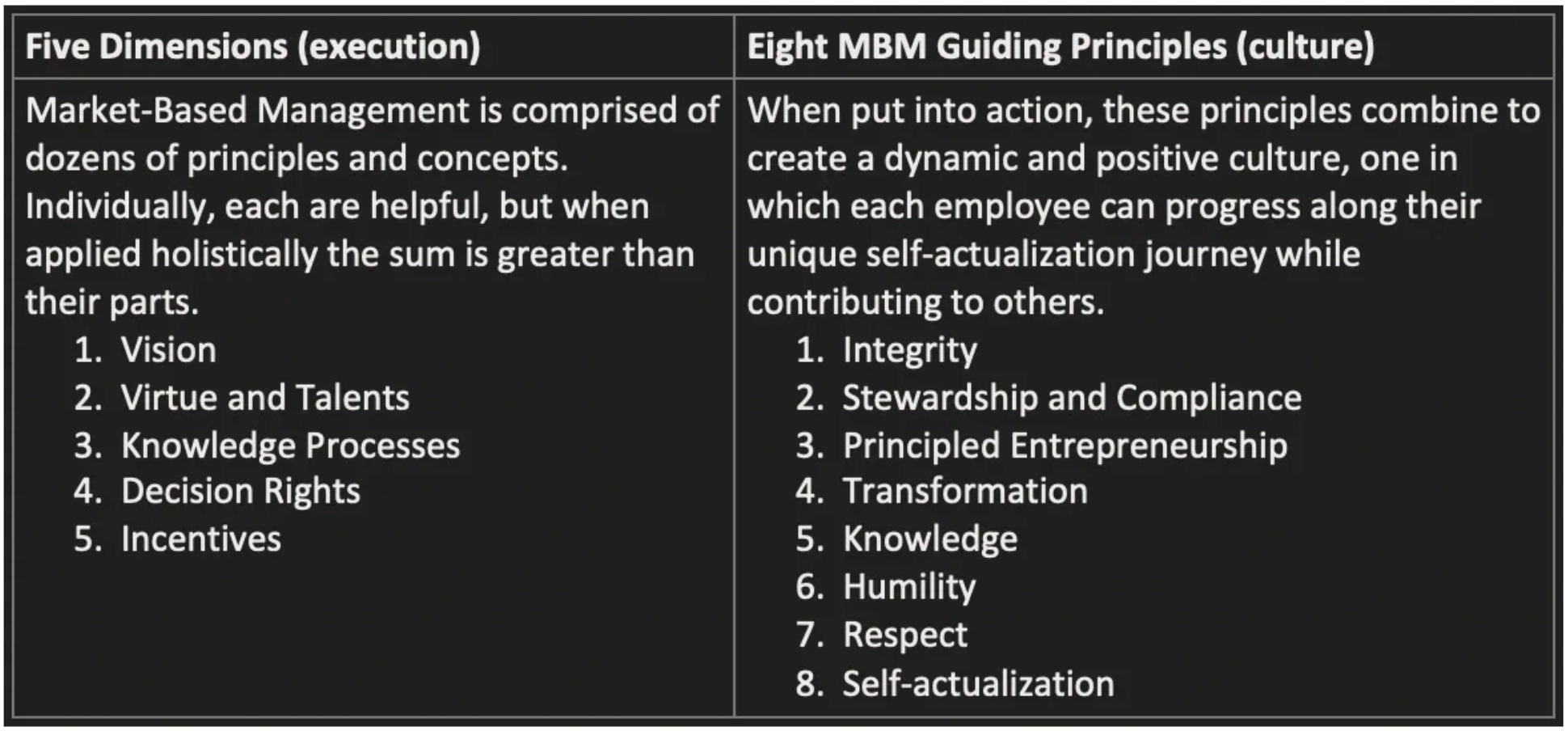
MBM is a management philosophy that empowers individuals and organizations to succeed long-term by applying the principles of mutual benefit. We will only be zooming into the 5 dimensions in this section to keep things short but impactful.
History demonstrates that peaceful and prosperous societies tend to practice certain common principles,
such as guaranteeing free speech, protecting private property rights, and ensuring that the inherent dignity and rights of all are equally protected. Koch found that these principles can be analogously applied within organizations to help employees fulfil their potential, and in doing so help the organization grow and succeed as it creates value for others
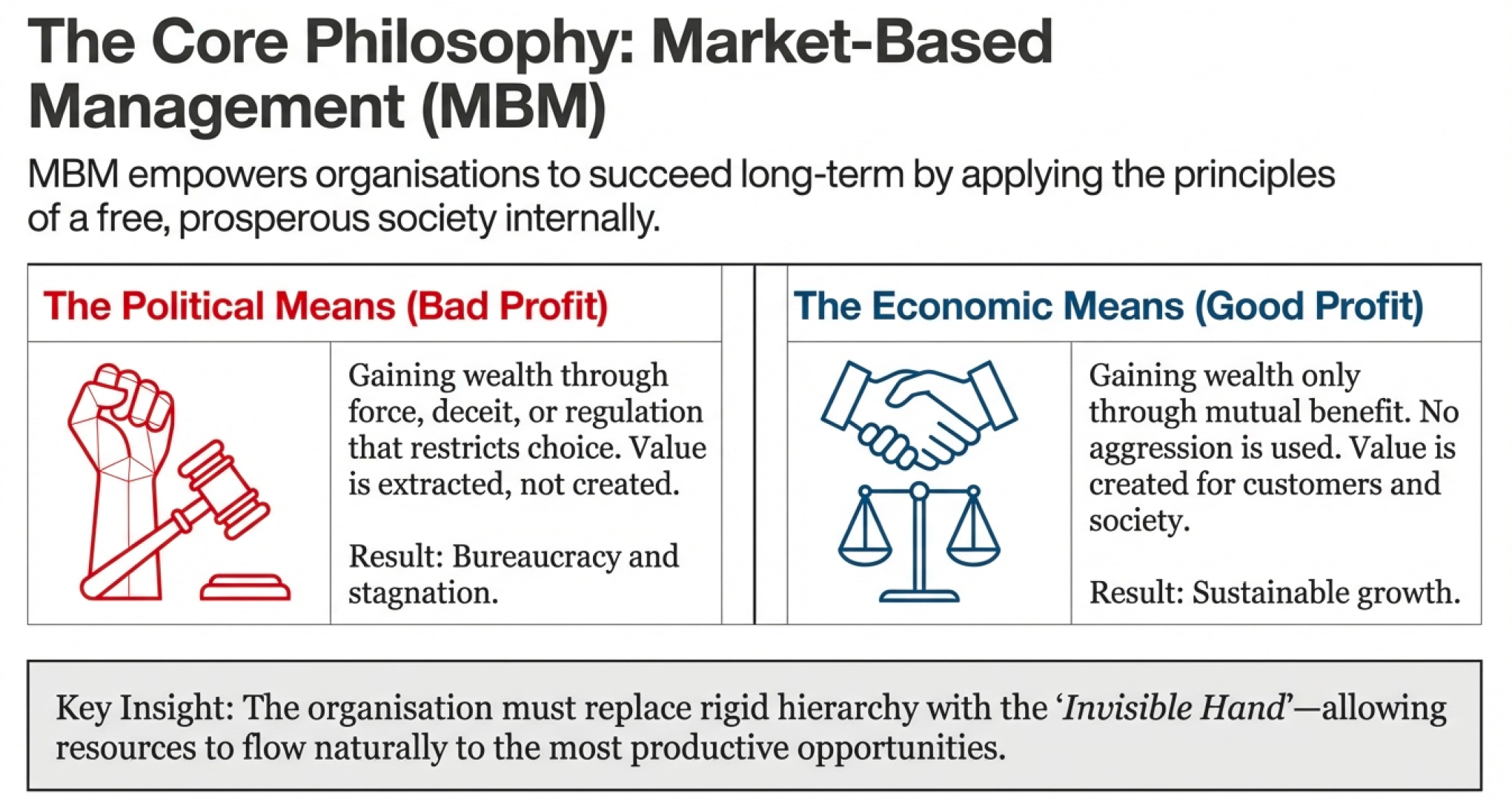
Businesses that profit by economic means (good profit) and not political means creating value and not undermining value for all
Such profit can only come when mutual benefit is achieved and no aggression (force or deceit) is used to advance their self-interest. Some examples of aggression (force or deceit) can be seen from laws or regulations that redirect consumer choices or result in non-voluntary entrance to exchange a good or service for money. MBM is built based on the foundation of the invisible hand.
A Company Must Have Fundamental Principles That...
guide behaviour and a vision that enables it to create real value for its customers and in society. That’s what good profit is all about.
Economic Concepts That Lay The Foundations of MBM
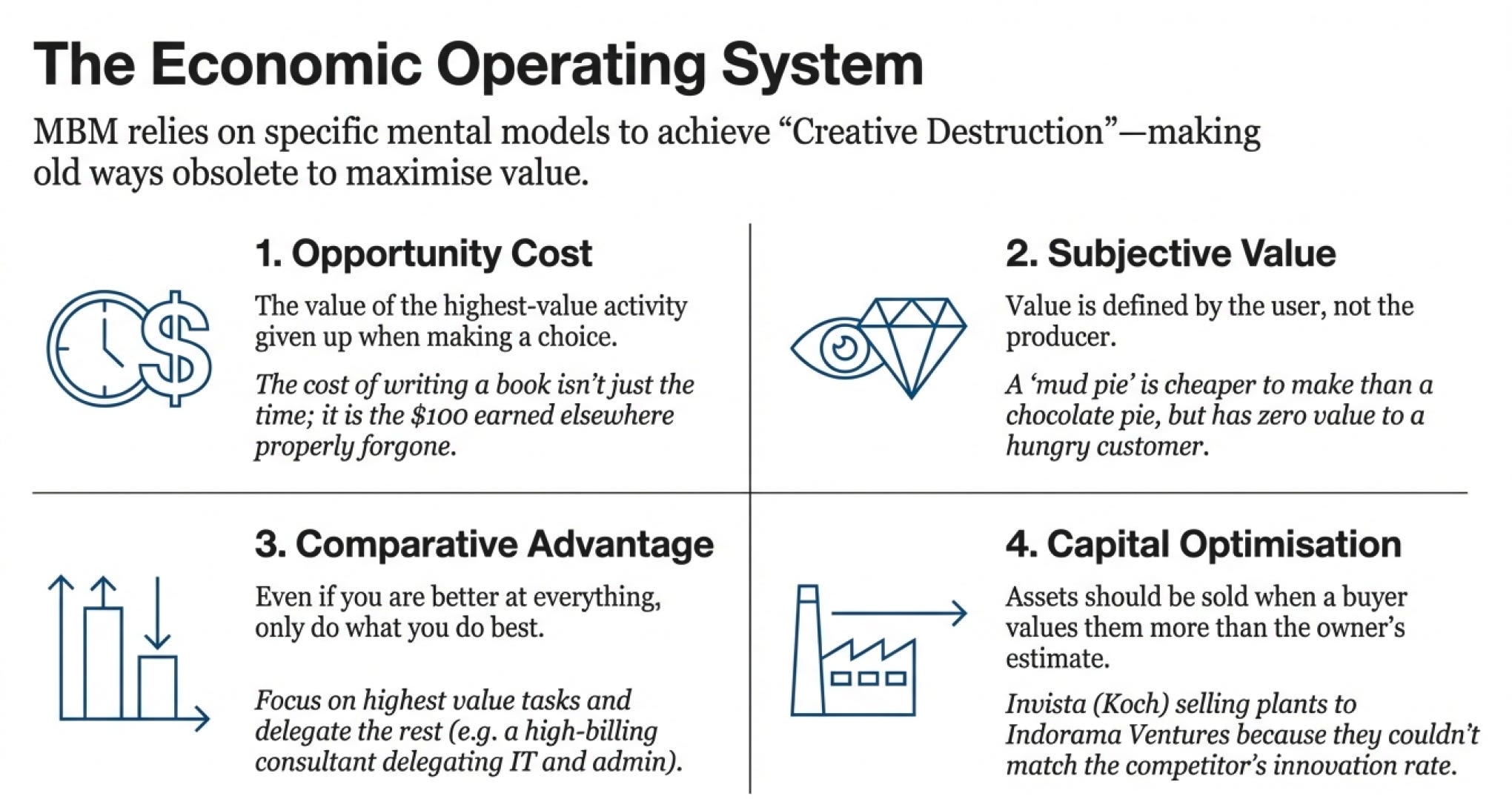
All concepts in MBM are applied to help a company achieve creative destruction - finding new and better ways, making old ways obsolete to maximize value and growth. Some Economic concepts that assists this are
💸 Opportunity costs
Opportunity cost is the value of the alternatives you give up when making a decision to focus on a specific opportunity. It’s what you’re missing out on by choosing one option over another.
E.g. Sell inventory based on the fact that supply is now lower than demand, where demand is relatively high; and not on the assumption that prices might move higher than what the inventory is bought for - especially at a loss
E.g. When writing a book; even though you feel that grammatical errors are horrible and you feel like taking the time to edit them, it is not worth the time as your time can be spent to earn $100 while only paying editors $1
Sunk cost (unrecoverable cost) - such as price paid for inventory should not govern decisions. Decisions should be driven by forward-looking analysis of FACTS, not based on what has happened in the past or assumptions.
The true cost of any activity is the highest-value activity that is abandoned - that is the opportunity cost. So your main goal is to focus on the highest value activity and forgo the others
🔑 Subjective value
What is the value your product is delivering to customers? Not all product has the same value to customers and not all customers have the same value to you. The same applies to partners and employees. Be flexible and know what is valuable to your [subject] - values are subjective and each company/ being has its own value, optimize that value
E.g. Koch salespeople understand each customer’s subjective value and tailor the way they deal with them accordingly. Because many public companies value steady predictable earnings than larger volatile earnings (steady earnings = higher stock price), Koch could arbitrage the situation by absorbing the price risk in the contracts and get the public clients to compensate them for it
👥 Comparative advantage
Each person, organization, and nation can compete and make a contribution even if others can do even better. No person, organization, and nation should attempt to do everything no matter how good they are. The reason comes down to comparative advantage - in other words, FOCUS on the most important and DELEGATE
E.g. a talented consultant opens his shop where he is required to be both a great advisor and a great office managing dynamo - billing, IT, database organization, making his own travel itinerary. However, he does not have time to do everything. His opportunity cost is a $100 business loss for spending time on a $1 work that he can delegate out in billing, IT, database organization.etc
🧠 Personal knowledge vs Conceptual knowledge
Do not confuse conceptual knowledge with personal knowledge: e.g. there are those who can beautifully articulate the technicalities of underground formations and reservoirs but never manage to find oil (conceptual knowledge). On the other hand, there are those who aren’t fluent in explaining why or how but are very good at finding oil (personal knowledge)
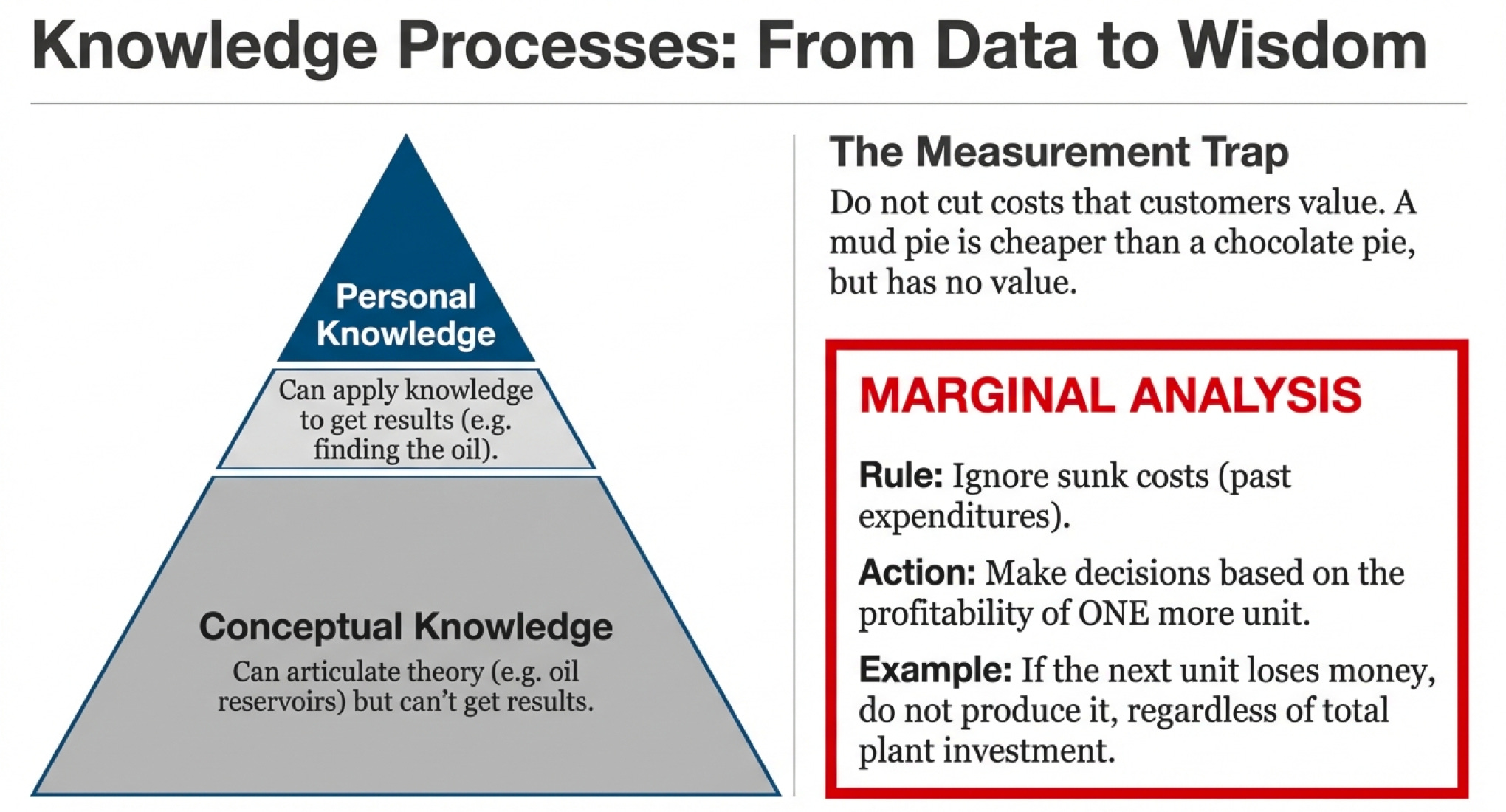
Another example is how beautiful i am writing this out (conceptual knowledge) but truly, the personal knowledge would come from you.
We only truly know something when we can apply it to get results - this is personal knowledge. Ensure that your team has personal knowledge instead of conceptual knowledge like a salesperson
💰 Capital optimisation
An asset should be sold when a buyer will pay more than the owner’s estimate of its remaining value. This can be when an industry’s rate of change overcomes an owner’s ability to innovate (similar concept to Moat where slow growth industry tends to have a better moat theoretically).
Slow growth industries tend to have companies with a better moat because the owner’s ability to innovate is usually faster than the industry. This allows the incumbent to protect their margins better than their industry competitors
E.g. the rapid increase in polyester plants being built in China resulted in dramatic innovations that reduced the construction costs of the newer plants and improved their operating efficiency. INVISTA (Koch subsidiary) was unable to capitalize on this and since Indorama Ventures was willing to pay more than its remaining value, the plant was sold to them in 2010
👀 Vision
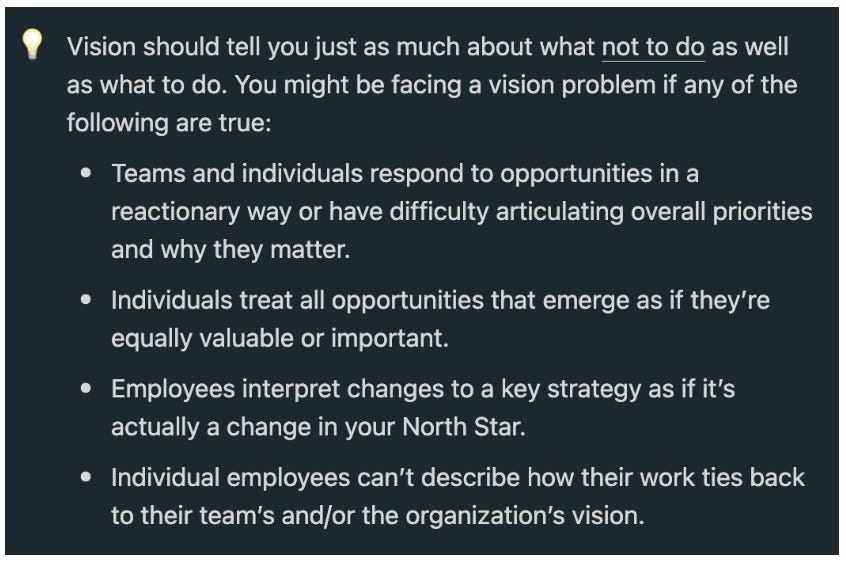
A vision statement should be specific; how the organization/ department can create value based on realistic assessments of its capabilities (as well as improvement needs).
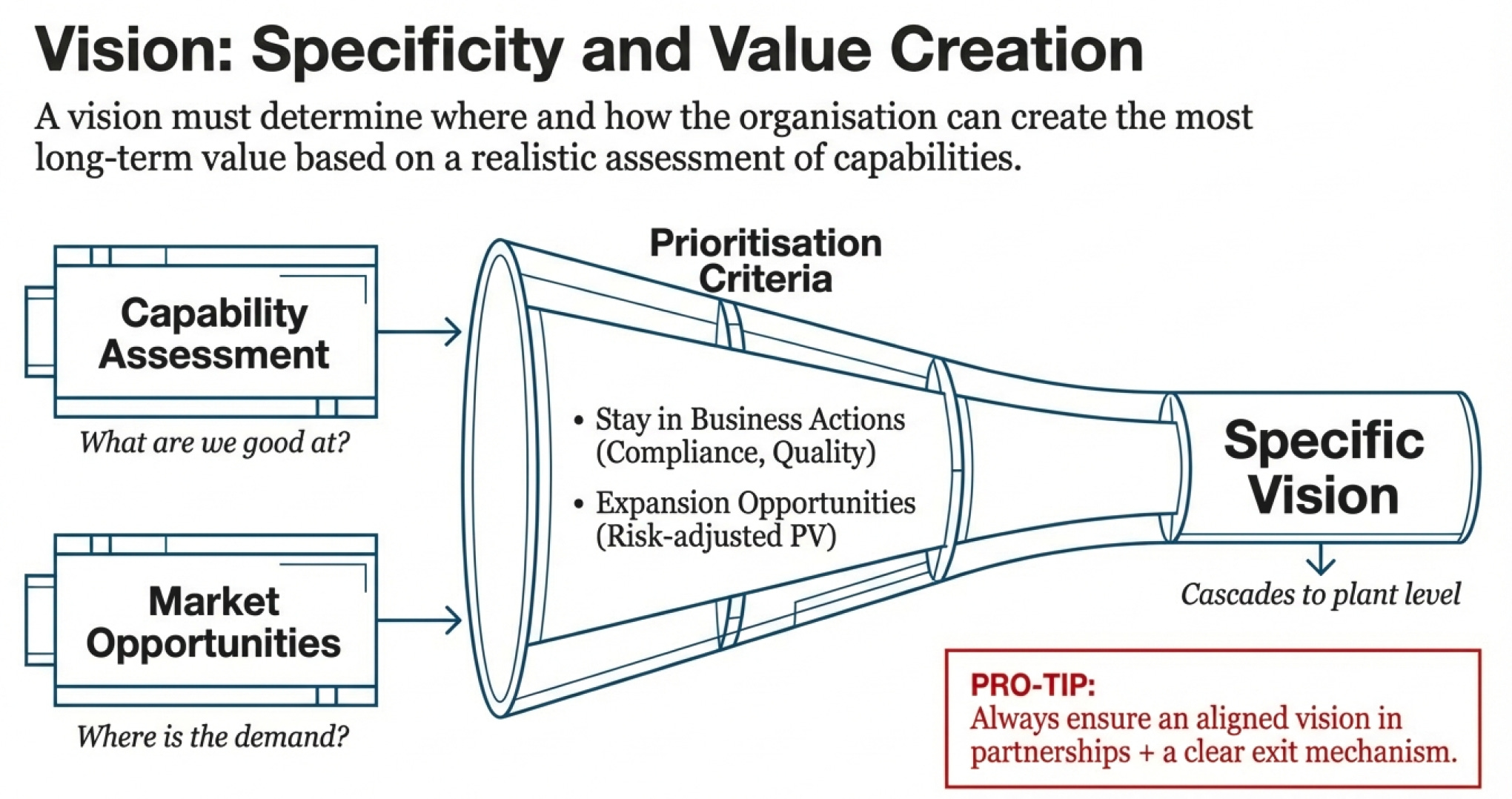
It should also help determine the opportunities where the capabilities can create the most value. Vision must be set all the way down to the plant level and it should coincide with the group/ company’s main vision.
Do you know what you’re trying to accomplish (both in the context of goals you want to achieve long-term and the market opportunities you can capitalize on today)
Do you know the capabilities you need in order to move toward your goals?
Determine where and how, given your capabilities and available opportunities, the organization can create the most long-term value for customers and society.
At least 2 sets of criteria are needed to determine priorities
Actions that are required to stay in business
e.g. meeting a deadline for complying with a government regulation //or// helping a major customer to improve quality or volume
Actions of opportunities to expand the business - where the risk adjusted present value of an opportunity outweighs that of another
e.g. after gap analysis, a $100mil risk adjusted PV relative to resources used, will take priority over the other which only gives a PV of $20mil utilizing the same resources
When parties share vision and values and contributes according to their comparative advantages, the partnership can be a powerful vehicle for superior value creation. However, when vision is not shared and the partnership develops into a hostile one with no separation mechanism, you have just invited yourself into a nightmare
Always ensure aligned vision + have a exit mechanism
😇 Virtue and Talents
Do you have people with the right culture and knowledge and skills? Develop a culture based on principles. Ensure that people with the right virtue and talents are hired, developed, and retained.
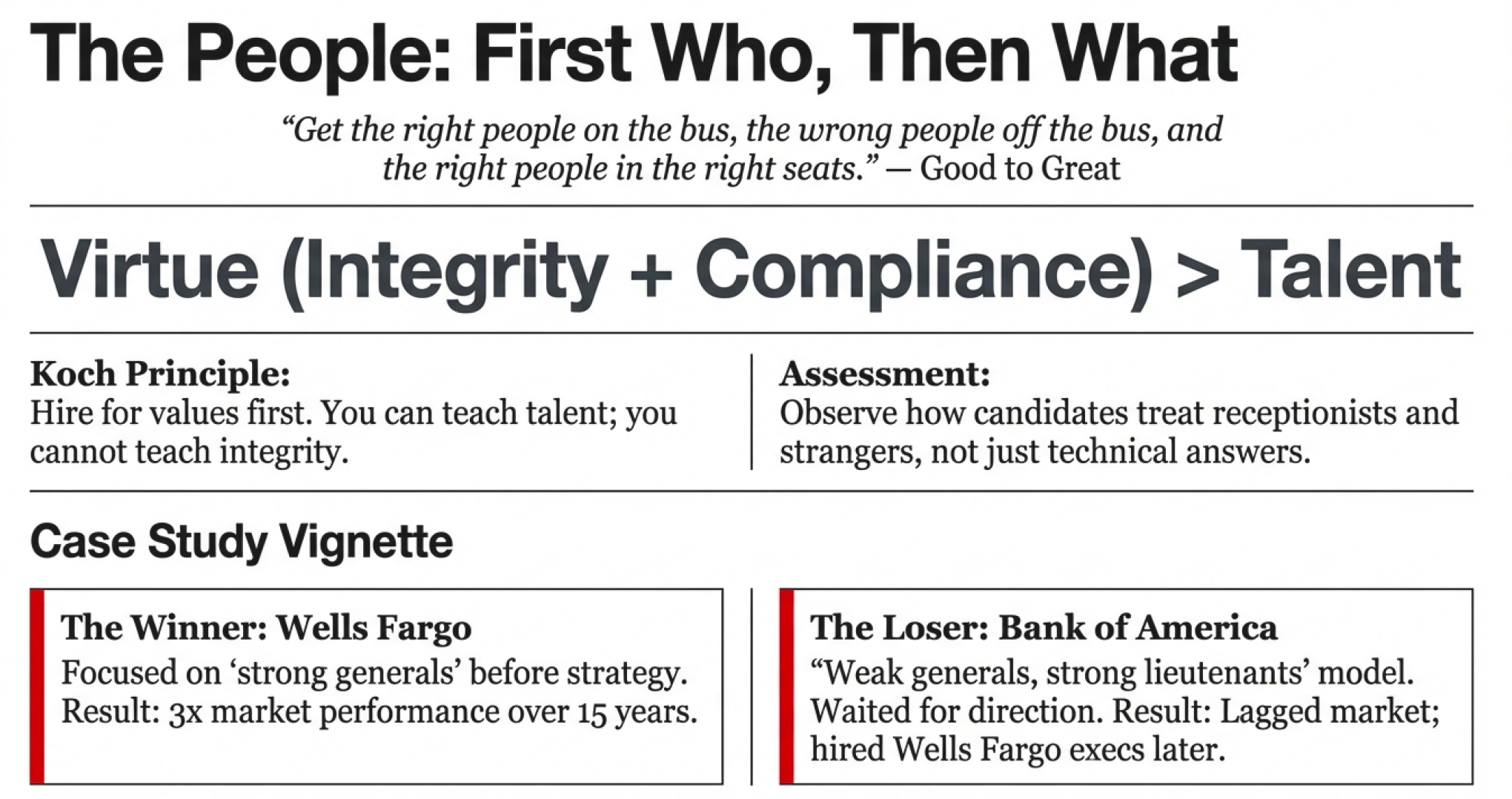
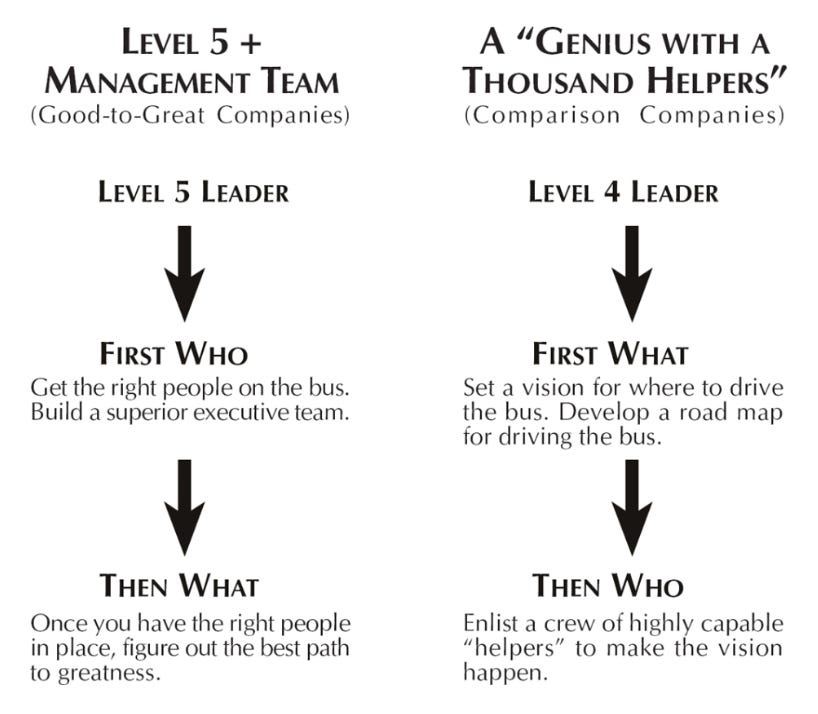
The book “Good to Great” mentions that it is important to get the right people on the “bus” (the business) in the right seats, and the wrong ones off the “bus” - rather than focusing on the direction and vision of the company first. The direction and vision comes second.
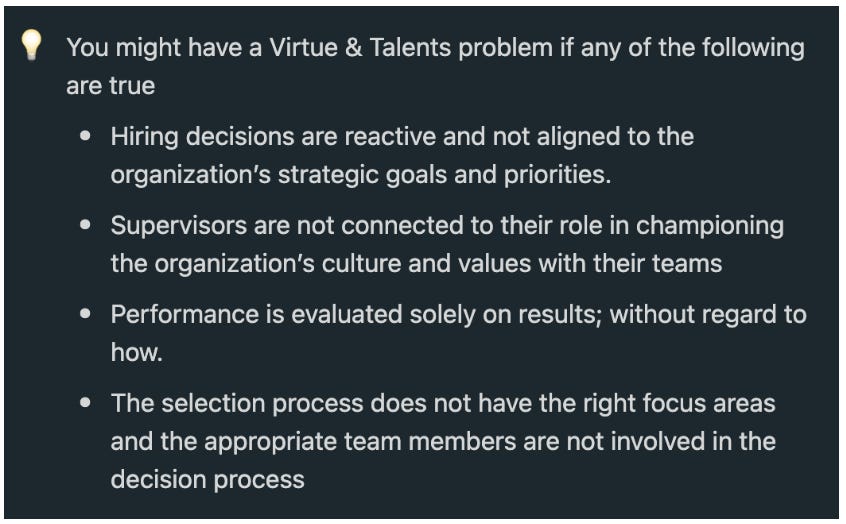
Virtue First Principle
In order to comply with its “virtue” first principle, Koch industries hire by inquiring candidates’ past behaviour through a series of separate interviews that assesses the Guiding principles:
Integrity and compliance
Value creation, Principled entrepreneurship, Customer focus
Knowledge and change
Humility and respect
Skills and knowledge required for the role
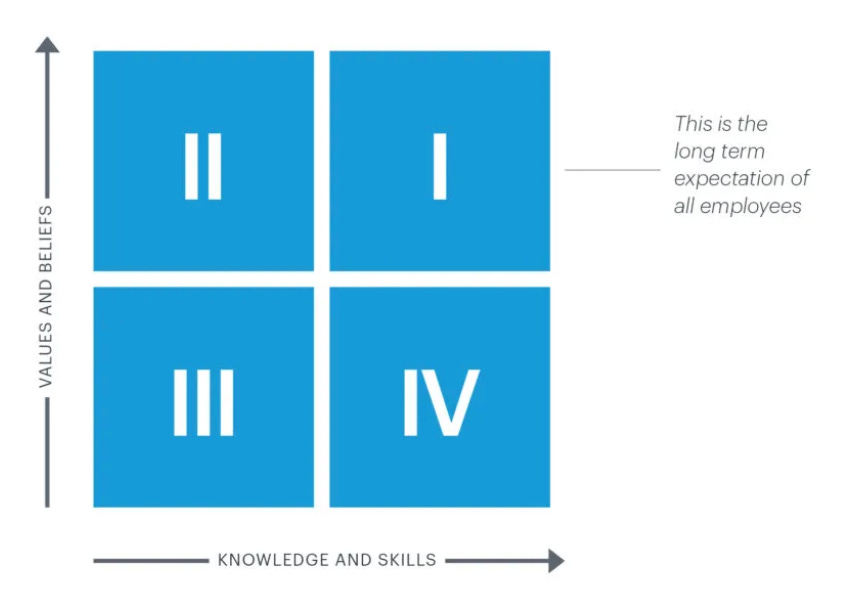
Recruiters are listening for behaviours as how candidates dealt with difficult situations, weather they are respectful when speaking about others, if they are bureaucratic, or if they have difficulties admitting mistakes. During the on-site interview, recruiters also assess their interactions with the receptionist, strangers in the elevator, and cafeteria workers.etc
3G Partners hired with its PSD framework (Poor, Smart, and Desire). But before all that, integrity and character came first!
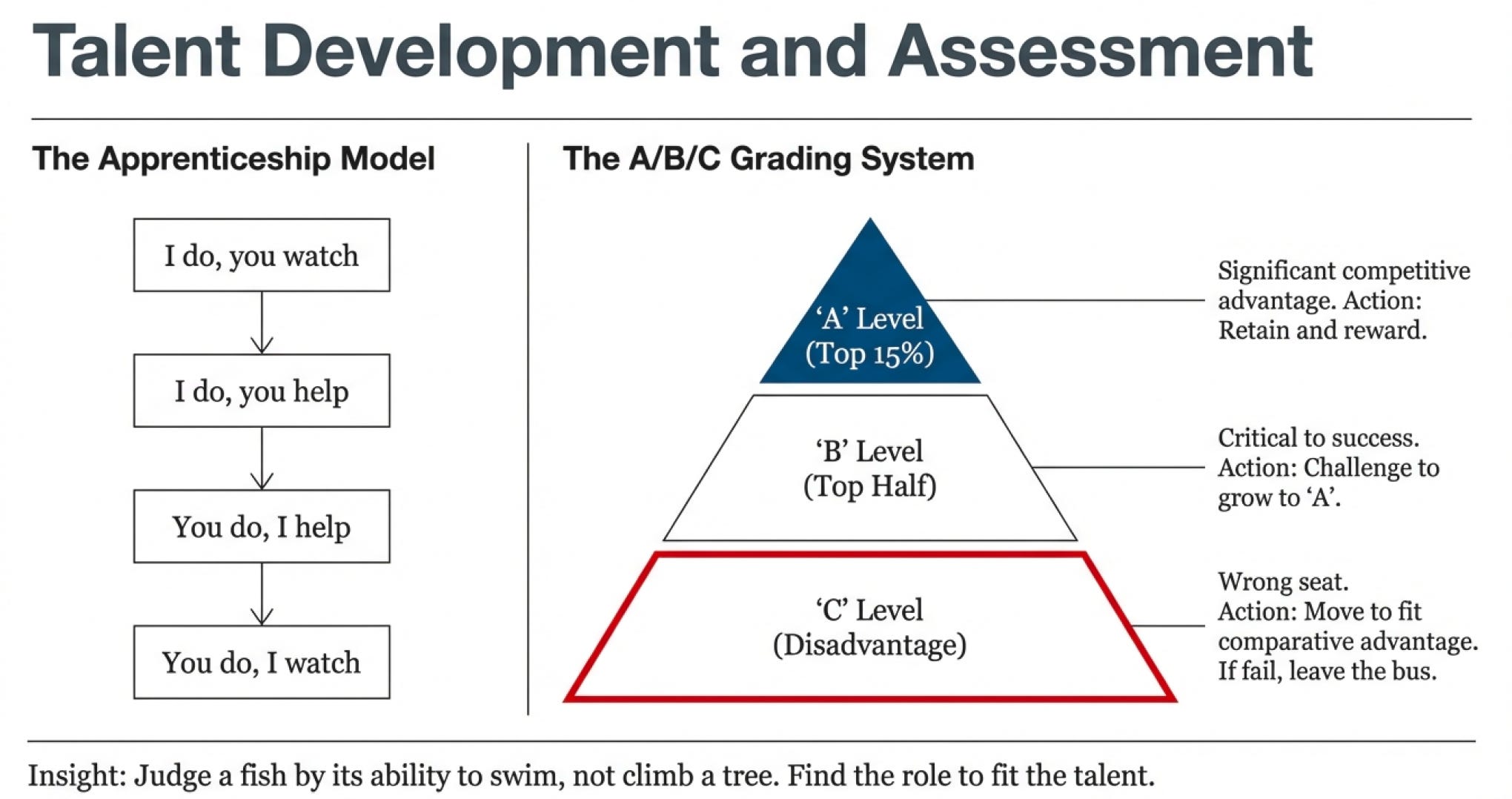
Everybody Is a Genius. But If You Judge a Fish By Its Ability To Climb a Tree, It Will Live Its Whole Life Believing That Its Stupid
As virtue has been achieved, the company then seeks to develop the “talent” capability portion.
Employees are subsequently trained and mentored with regular HONEST feedback (candour) according to the “Guiding principles”
Talent Development Step 1: Feedback
Creating a beneficial culture is impossible without mentoring and positive examples where mentors WALK THE TALK. As part of mentoring, feedback is critical. Let’s take a look at what are the 3 main areas of feedback that koch seeks to give
Major contributions
Strengths
Improvement areas
Talent Development Step 2: Apprenticeship
An apprentice model is effective in developing employees once feedback is given. At Koch, this model entails four phases
I do, you watch
I do, you help
You do, I help
You do, I watch
Talent Development Step 3: Employee Assessment
Leaders assess employees’ comparative advantages, development, opportunities, and readiness for next assignments, and then assign their performances a letter grade: A, B, or C
A level - Employee is able to performance and contribute in their role, providing a significant competitive advantage over similar roles at principal competitors. These are usually the top 15% talents and are key contributors to a company’s long-term success
B level - Employee performance and contribution is equivalent to peers at principal competitors. While not in the top tier, it is in the top half of performers in the industry and are critical pieces to a company’s success. They should be challenged to grow and improve to A level
C level - Employee’s performance and contribution puts the company at a competitive disadvantage relative to peers at principal competitors. The employee may be in the wrong role, meaning he could contribute at a B or even an A level if he were in a role that better leveraged his comparative advantages. If after switching, he is still unable to hit B, he should not be retained
A person’s capacity to perform in a given role is not only determined by training and experience, but by the aptitude or the kinds of intelligences in which that person excels e.g. interpersonal, intrapersonal, linguistic, logical-mathematical, spatial, naturalist, kinesthetics, and musical
No one is perfect and everyone is deficient in at least one intelligence. e.g. Michael Jordan can’t play baseball but is great at basketball. Therefore, performance increases markedly whenever roles are designed to fit employees’ individual aptitudes
If they fare poorly, just find another role where their aptitudes are of a better fit to the role - refer to quote above
💎 Take a more proactive approach to hiring
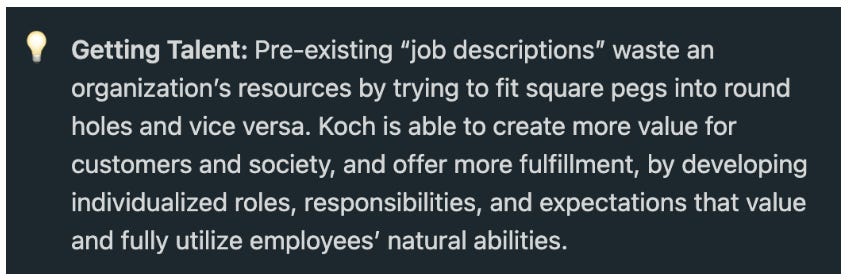
Hire those you think have the potential to add superior value, regardless of whether they can fill an existing role. Instead of finding the talent to fit a role, find the role to fit the talent (remember what we mentioned about getting the right people on the bus and in the right seats?)
e.g. finding opportunities for these talents in other part of the company. Roles should be determined by the nature of the business, organization’s vision , strategies, and comparative advantage of individuals executing those strategies.
A great employer hires virtue well and allocates talent like a NFL coach
If he has a great pocket passer as quarterback, a good offensive line, and superior receivers, he will choose to pass most of the time.
If he has great pass rushers, he will use a more aggressive defense. If he gets a new quarterback who is faster and more elusive, he will redesign the role to include more running options.
If a guard is better at pass blocking than run blocking, he may be shifted to tackle on the quarterback’s blind side.
Since NFL line-ups are in constant flux due to injuries, trades, and other factors, coaches must frequently re-evaluate individual roles.
Maximizing Long-term Value Through Innovation Also Involves Attaining New Knowledge and “Secrets”
-Reference to Peter Thiel’s book “Zero to One”
🧠 Knowledge Processes
Are people seeking the knowledge they need to make decisions? Ensure knowledge is optimally acquired, shared, and applied. Develop measures that lead to valuable action—action that creates the greatest value at the lowest cost.
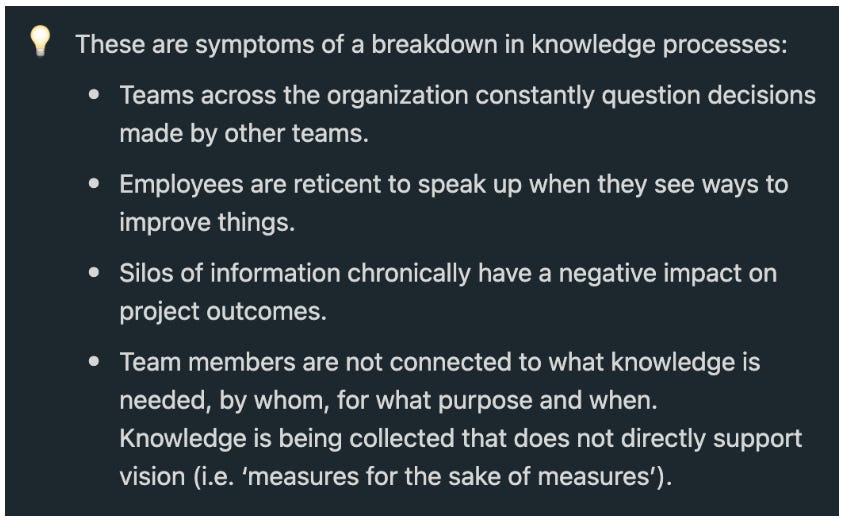
Knowledge process on innovation
Maximizing long-term value through innovation also involves attaining new knowledge and “secrets”. In order to attain these “knowledge/ secrets” many experimental discovery process must be created - always expect failure BUT experiment prudently with a risk averse appetite
Create an innovation process that enables technology advances to be assessed and mastered quickly under guidance. Technology implementation need to be adopted internally and not through external vendors. Because, more often than not, vendors have knowledge about the technologies but are unable to utilize it in a profitable way. On the other hand, internal business leaders do not have knowledge about new technologies
Use measures for knowledge processes
Even an asset that isn’t directly part of a business should have both a P&L and a return-on-capital measure. This ensures that holding it is the best use for that capital. However, measures are only beneficial if they lead to profitable action
as Einstein said “not everything that counts can be counted, and not everything that can be counted counts.
Similarly, it is wasteful to develop detailed information beyond what is necessary to make good decisions; as seen in the investment industry “it is better to be vaguely right, than accurately wrong”.
Measuring the wrong things lead to waste & value destruction
Cost-cutting for its own sake is often just as shortsighted as overspending and can seriously damage future profitability. In order to increase margins, businesses tend to cut-costs that contributes to a higher revenue.
Various fast-food chains have commoditised their products by cheapening their ingredients. It is tempting to forget what the customer values and instead focus on improving margins using cheaper ingredients - a mud pie is certainly cheaper than a chocolate pie, but it has no value to a hungry customer
Marginal analysis in knowledge processes
Most decisions should be made using marginal analysis. Marginal analysis is mainly looking at “what is the profitability of one more unit of production, of one more or less plant, or of a more expansive vs a more modest investment?”. It ignores sunk costs and looks at the extra benefits relative to the costs from a specific change
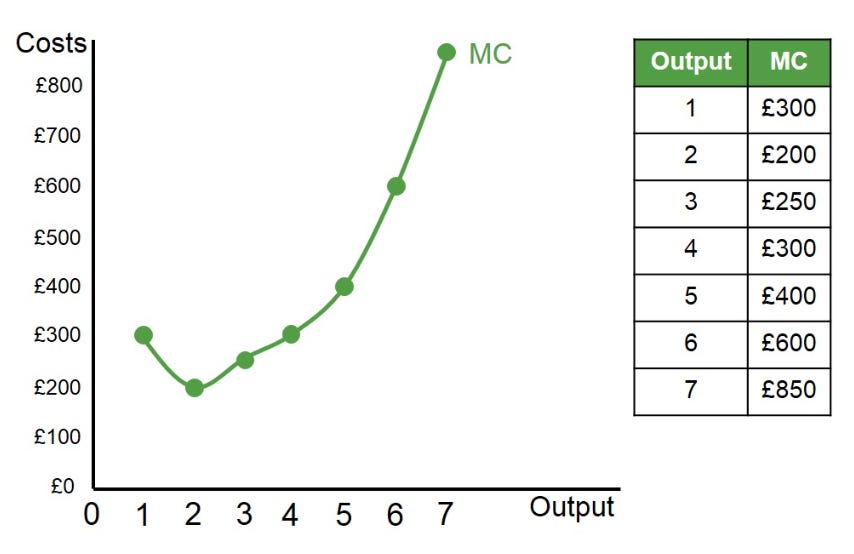
E.g. if producing one more unit would require an expansion of another plant, there will be a significant increase to the marginal cost thereby fulfilling the “law of diminishing returns”. In the case above, law of diminishing returns starts kicking in at output 3
Decision rights when forming knowledge processes
When no one owns or sufficiently benefits by conserving a resource, no one takes responsibility for it, and the resource tends to be used inefficiently, overused, or even extinguished. Many of the things that go wrong or opportunities that go unrealized in business are a result of the tragedy of “shared areas with unclear demarcation of responsibilities”.
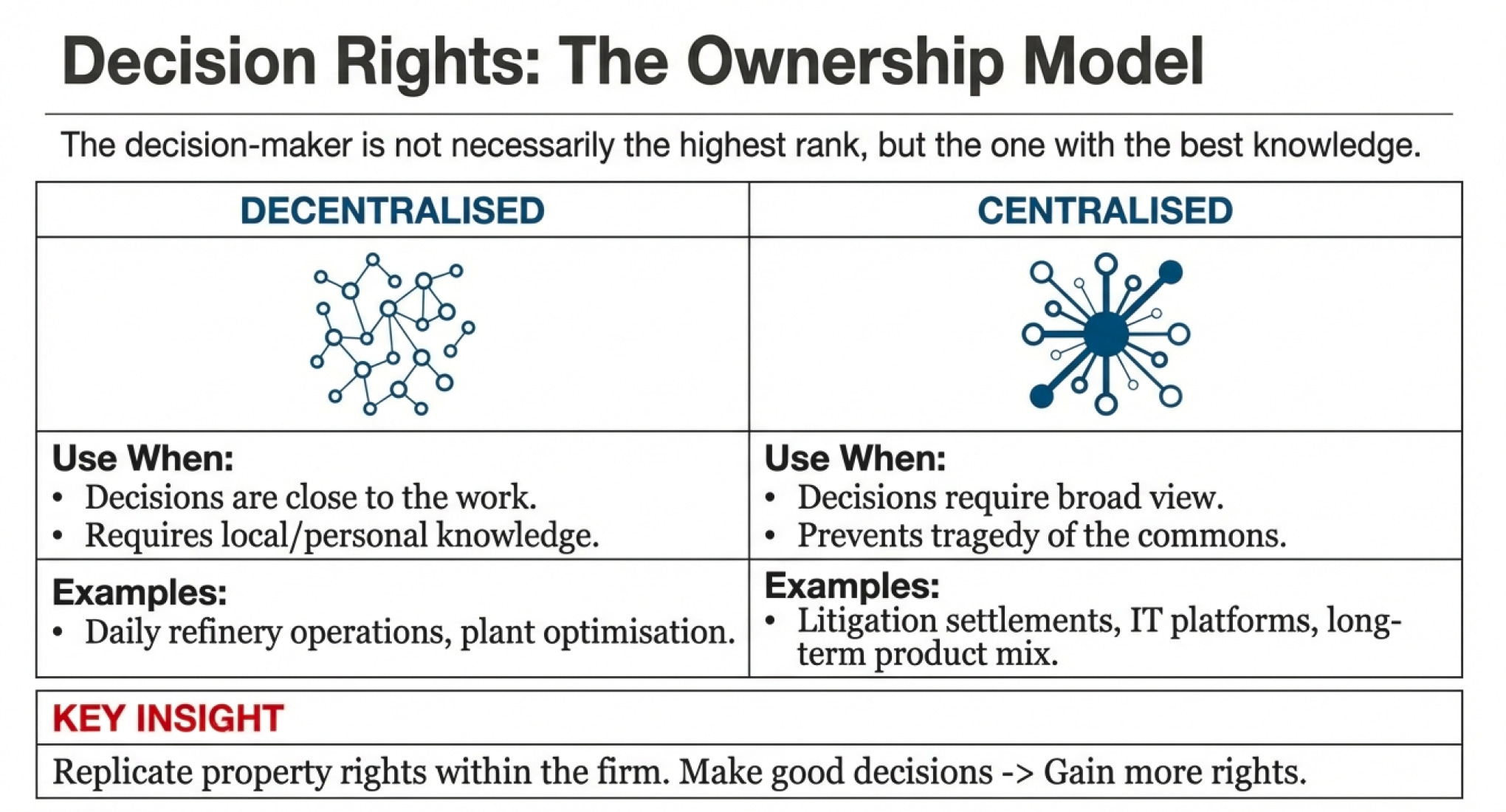
To negate this, Koch uses decisions rights to replicate property rights in the organization; when an owner of “X” serves her customers well, they reward her, but when she doesn’t, they abandon her.
Property rights are continually gained when one most effectively satisfy a customer, and lost by those who don’t.
Something to note is that employees with broad decision rights over how their daily work is done may have less authority over other matters relating to other workers.
Decision rights should also reflect an employee’s demonstrated comparative advantages so he/she can create the greatest valued compared to the opportunity cost of his/her time
Understanding this and delegating decision rights based on one’s comparative advantage would mean that the decision make would not necessarily be the highest-ranking person. This is one of the significant ways in which MBM sets apart Koch industries from other companies
Let’s take a deeper look at Decision rights next...
Decisions Should Not Be Made By Those In Closest Proximity or Highest in Power
but rather by those with the comparative advantage to make sound decisions, including the best knowledge.
🤔 Decision Rights
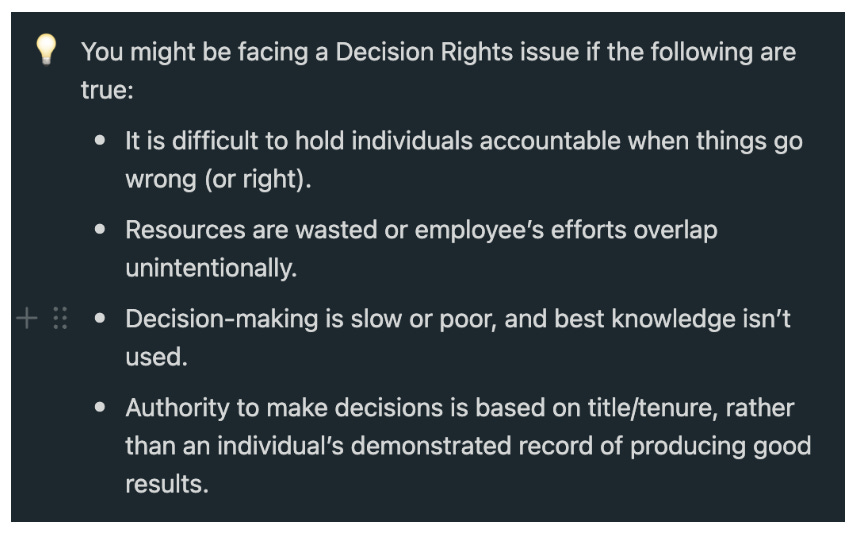
Do people understand what they’re responsible for and where they should focus their entrepreneurship? Expect employees to demonstrate entrepreneurship and ensure they have the right roles, responsibilities, and decision rights.
Employees should be held accountable for their individual contribution to advancing the vision of the company.
Centralised vs Decentralised decision rights (and when to use them)
Centralised decision rights: Decisions are made by people who have a broader view and broader knowledge
e.g. Decision on what the most profitable product mix will be in five years (which includes factoring in the time needed today to design, get government approval for, and build a new processing unit)
Decentralised decision rights: Decisions are made by people closer to the work.
e.g. Decisions about how to optimize daily operations in a refinery, are generally best made by on-site employees
Decisions about commencing or settling litigation almost always need to be centralized - this is because leaders of individual facilities or business units can seldom anticipate the second- or third-order consequences of litigation. The same is true for IT platforms. When each plant selects its own systems, it becomes impossible to effectively optimize the overall business.
Making decision well by being aware of psychological biases
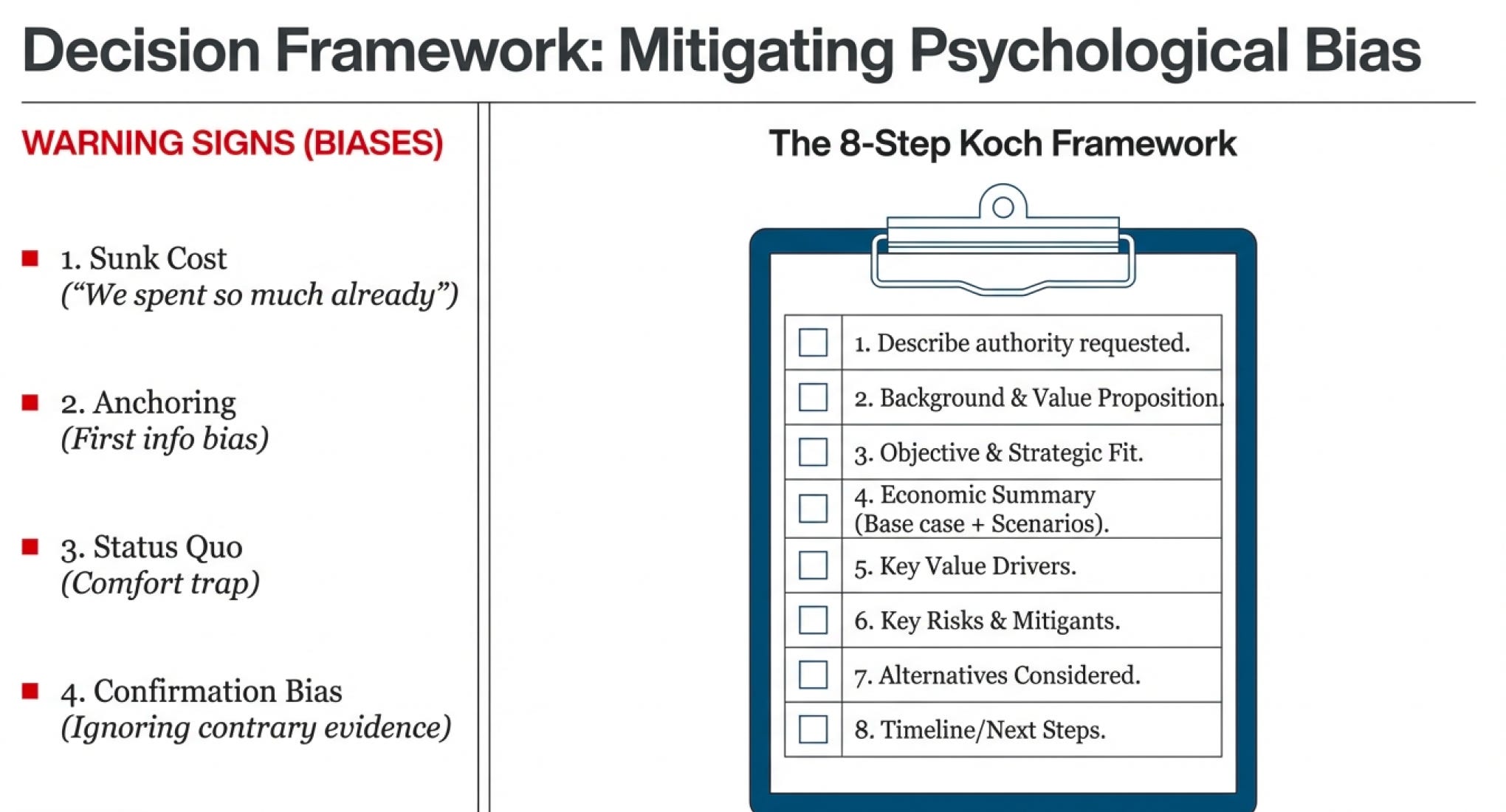
Confusing random events with pattern. This leads people to believe they can predict future events when they are actually unpredictable
Allowing a leader’s past rejection to stop a effort/ the consideration/ bringing up of good future opportunities
Allowing person risk aversion to get in the way of taking risks suitable for the company’s appetite, and therefore not maximizing value for the company
Counting sunk costs: Making decisions based on past expenditure rather than future prospects. This lead to decisions that don’t reflect economic reality e.g. sunk cost thinking
Information or confirmation bias where one preferentially look for evidence based on what they want to believe, ignoring evidence that contradicts their belief.
Anchoring: irrelevant information/ first impression that have undue influence on our decisions
Recency bias: overly influenced by dramatic, memorable, or recent events e.g. drilling rigs Koch purchased in the 1980s, believing the oil boom would last, became worthless when crude oil prices collapsed.
Status quo trap: biased decisions made in favour of doing nothing out of the norm/ nothing different. This fosters an unwillingness to change or innovate
Framing questions in a way that biases our thinking toward a faulty conclusion. Many times this happens when one fails to optimize/ consider the base case properly - not asking the right question to resolve the right problem
Overconfidence in our ability to make predictions and estimates. By not considering the whole range of outcomes, one can underestimate the downside/ upside and miss attractive opportunities. This can also happen when one believes they can make major improvements in something that they have little or no experience
Now that we have identified psychological biases when making decisions, we know how to avoid them. But in order to make sure the whole organization is able to commit to it, it needs to be implemented and engineered into the “business machine”. Therefore, here is a 8 step checklist to ensure you’re making a great decision from the top (please use this in reference to preemptive game if required).
Eights steps in Koch decision making framework (not every step must be utilised - based on nature & complexity)
Briefly describe the authority being requested
Give the background and summary of the value proposition
Outline the objective with the strategic fit
Prepare and economic summary with a base case, as well as other plausible scenarios that could make the project much better or much worse
Identify the key value drivers
Describe the key risks and mitigants
List the alternatives considered and why the one shown is the best.
Project the timeline for future steps
🪙 Incentives
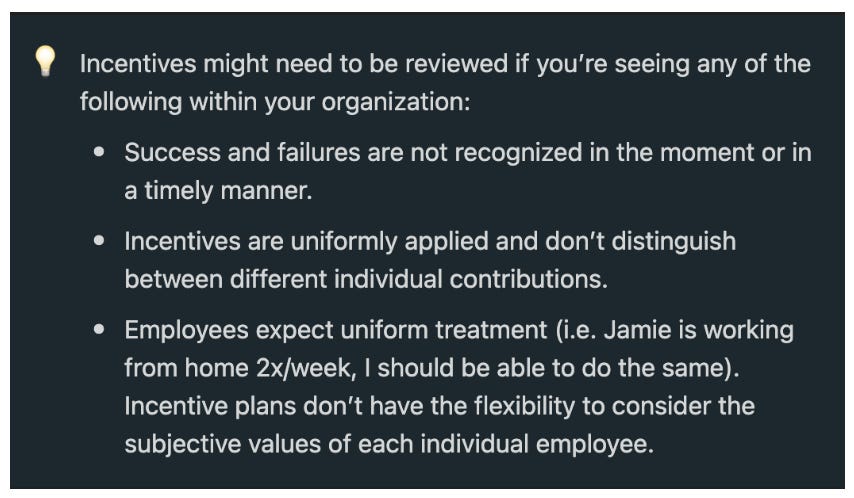
Are people motivated to maximize their contribution and become self-actualizing? Motivate each employee to make the maximum contributions to the long-term value of the organization.
Instead of replicating the beneficial entrepreneurial incentives of a free society, many companies rely on bureaucratic, one-size-fits-all point systems or pay grades
e.g. COLAs, detailed formulas, profit sharing, and cost-of-living adjustments
Despite the fact that these (like Mao Ze Dong’s rat quota), usually motivate employees to do the wrong things. Note on what happened with Mao Ze Dong’s rat quota: When people were given a quota of rat tails to be delivered to the authorities, they started breeding the rodents
On the other hand; Koch treats a portion of the potential profit from a missed opportunity as an actual loss when determining an employee’s incentive compensation
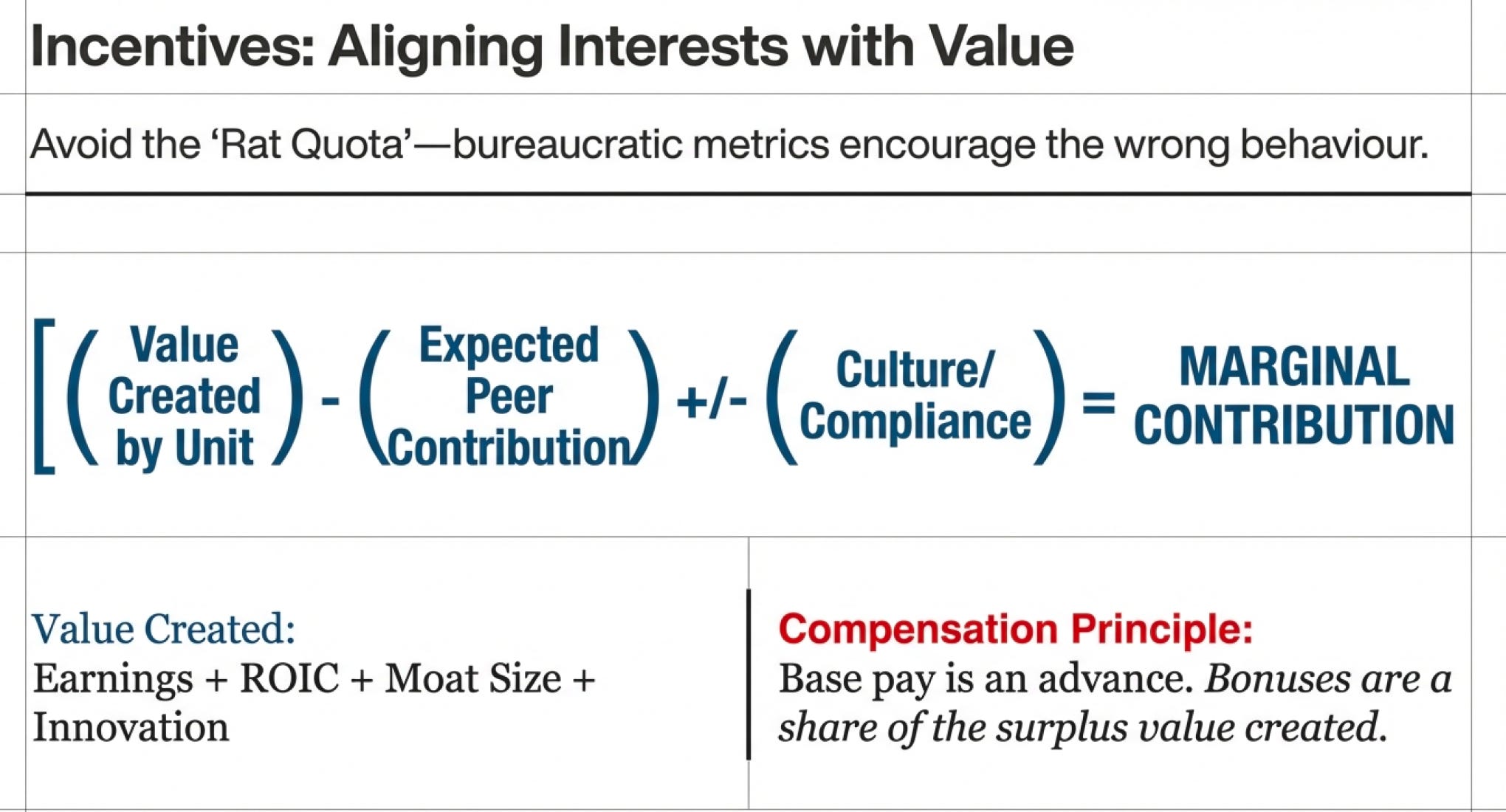
Determining incentive compensation
Compensation should be consistent with the notion that no two employees are alike (vision, desire, value, ability.etc); thus, their compensation can vary considerably depending on the value of their contributions. It is however, impossible to accurately determine contributions, but these byte-sized steps help us to get as close as possible:
Step 1: Determine the value created by the employee’s business unit. This is done by considering
Current earnings
ROIC
Improvements in capabilities
Moat size (refer to competition demystified)
Risk adjusted value of innovation
Growth initiatives (prospect for future earnings)/ contributions that haven’t been fully contributed
Step 2: Determine the employee’s contribution to the value the business unit created (+ve and -ve).
This is then compared to the base compensation of the employee.
If it is a surplus value, the employee would receive a bonus/ other incentive compensation
Step 3: Deductions are done if there are any compliance/ EH&S problems that the employee contributed to.
Additions however, will be made if the employee has made significant contributions to the company’s culture
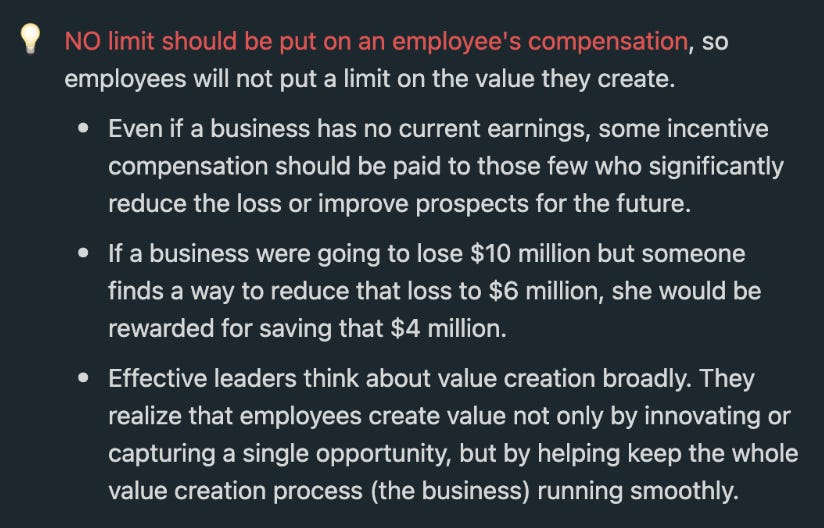
An employee’s marginal contribution is estimated as the contribution/ value created above that expected of a typical contributor (peers doing similar work; especially peers of competitors). These employees create a competitive edge and shall be compensated with incentives

Leaders throughout the company must make sure to get the numbers right and before doing this, make sure that the calculation rationale is effectively and clearly communicated to the employee.
Contributions to the numbers are gotten from reviews done by the supervisors, co-workers, partners, and themselves.
These evaluations are then compiled and reviewed together to get a better gauge
Note: Base pay is recognized as an advance payment for the value an employee is expected to create for the company.

Roles, Responsibility, and Expectations
A role tends to have an associated bundle of responsibilities. These clearly define the products, services, assets, activities, and employees assigned to the person in that role. The RR&E document highlights these expectations of the employee
Expectations should always be
Clear, specific, and measurable (short and sweet)
Open-ended
Challenging enough to expand an employee’s vision of what can be contributed
These encourages experimentation and innovation by optimizing self-actualization of the employee through RR&E.
Building an Extraordinary Business
Stated below are additional concepts/ elements identified from a five-year study of 1,435 companies, identifying just 11 that achieved sustained, extraordinary performance-defined as stock returns at least three times the market over 15 years. Note that we will not go through elements that have been covered above
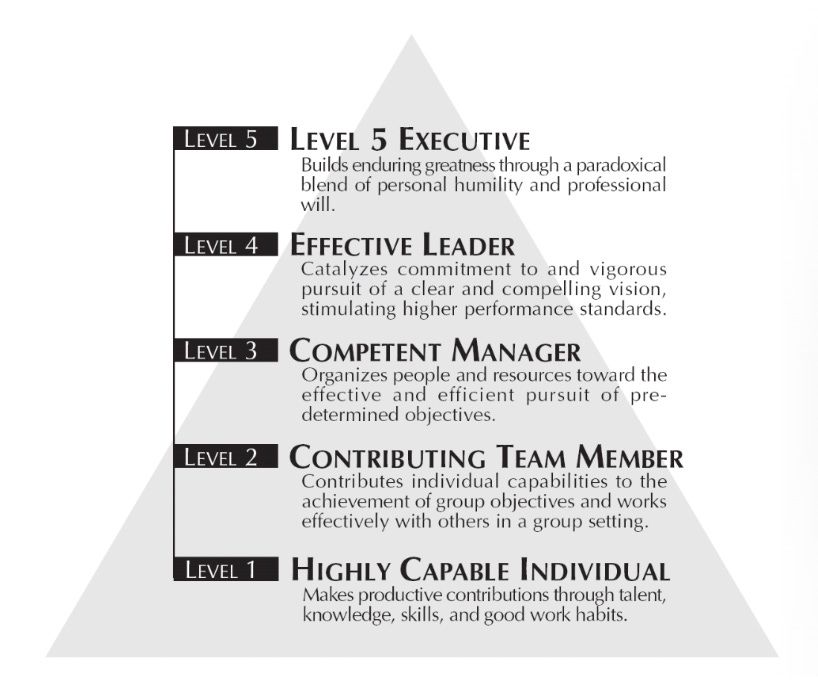
Level 5 Leadership
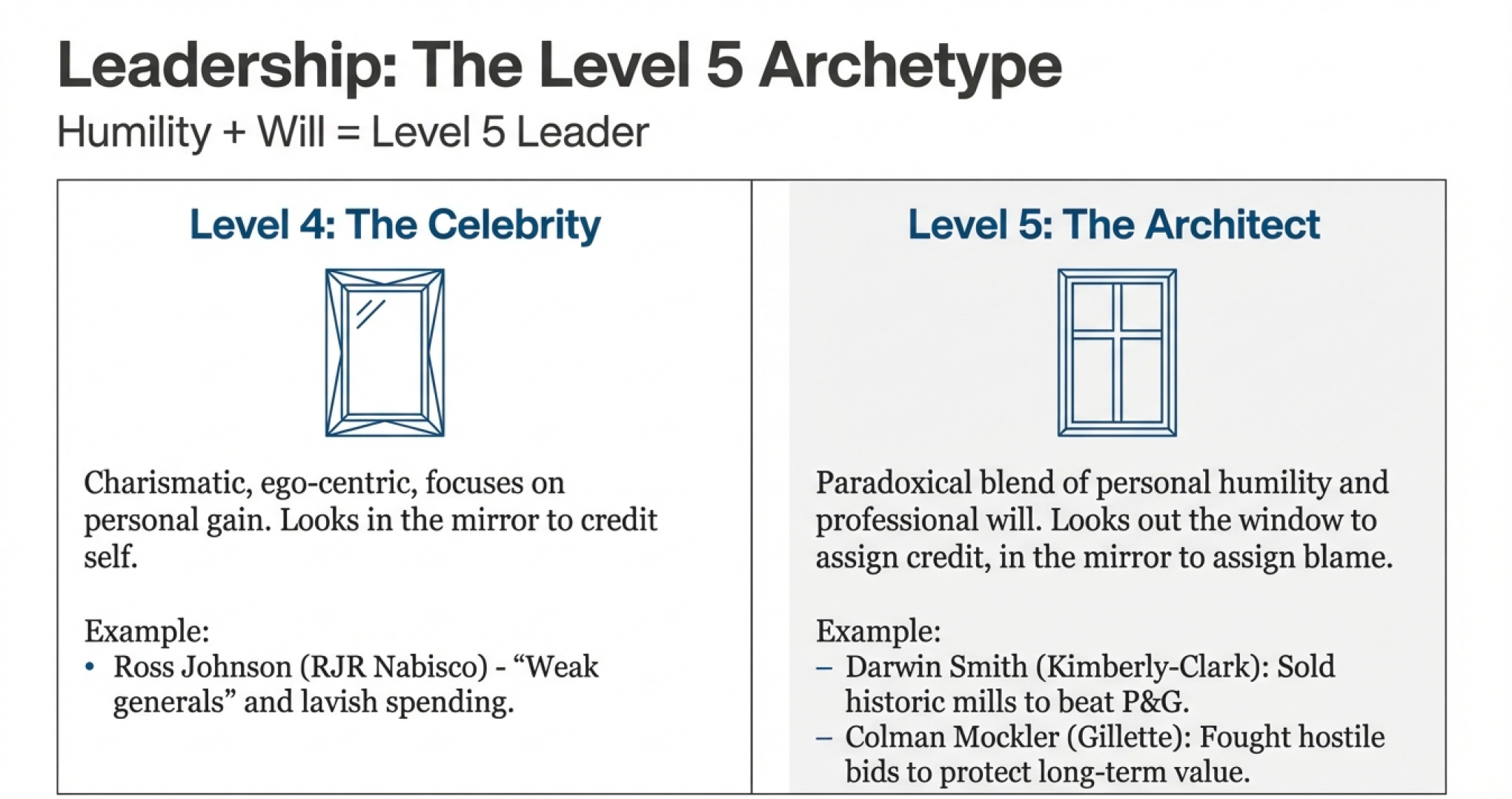
Kimberly Clark
In 1971, a reserved in-house lawyer became CEO of a struggling paper company whose stock had significantly underperformed the market. Though unsure about his own qualifications, he led the company for two decades, transforming it into a global leader in paper-based consumer products and delivering returns far above the market average.
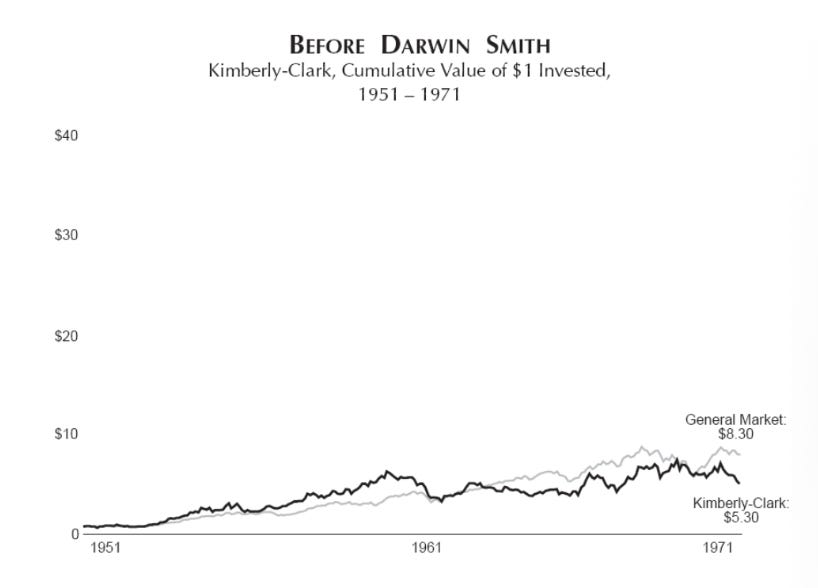
He was modest and preferred to stay out of the spotlight, but was also fiercely determined e.g. 2 months into his tenure, he was diagnosed with throat and nose cancer, and he once lost part of his finger but showed up to work the next day as if nothing happen.
His most decisive action was shifting the company away from its traditional core business by selling the mills and focusing on consumer brands (like Huggies and Kleenex), believing that direct competition with industry leaders would force the company to achieve excellence. 25 years later, Kimberly Clark beat Proctor & Gamble in 6 out of 8 product categories.
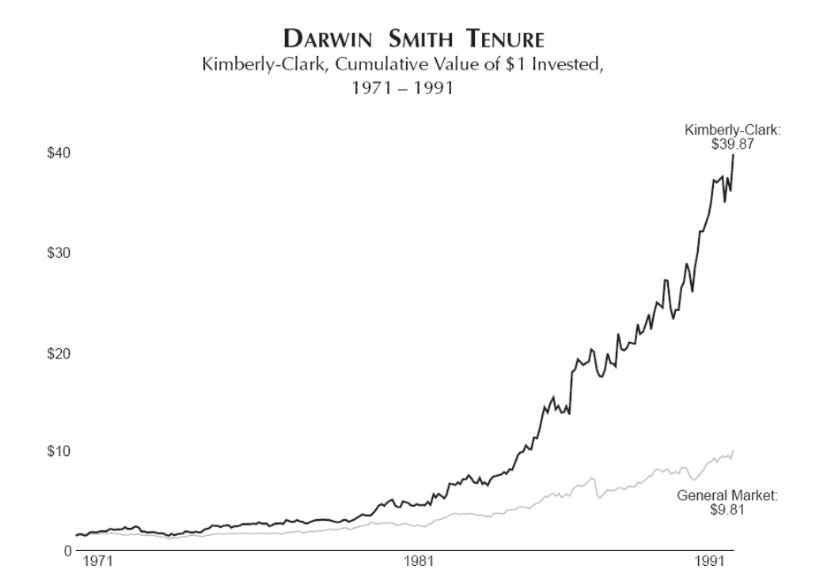
Humility + Will = Level 5 leader
Level 5 leaders direct their ambition and ego toward the success of the company rather than personal gain (whilst Level 4 leaders are still stuck and geared towards personal gain + less humility). They are highly driven, but their primary focus is on advancing the organization, not themselves. They give credit to others or external factors for success, even attributing it to luck if needed. When things go wrong, they take personal responsibility and never blame bad luck.
Every company that exhibited a hockey stick growth had Level 5 leadership during its crucial transition period.
Level 5 leaders prepare their successors to achieve even greater things, while self-centered Level 4 leaders often leave their companies worse off.
They are modest and understated, unlike many comparison company leaders whose large egos led to poor results or mediocrity.
Level 5 leaders are relentlessly driven to achieve lasting results, willing to make tough decisions for the company’s greatness.
They work diligently and quietly, focusing on results rather than seeking attention.
These leaders credit others or external factors for success and take personal responsibility when things go wrong, unlike many peers who do the opposite.
Colman Mockler’s Gilette
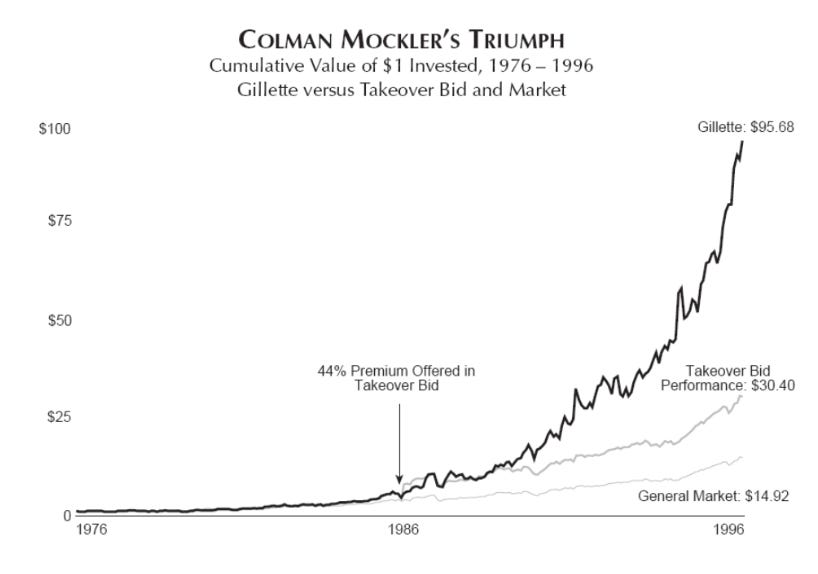
During his time as CEO, Colman Mockler led Gillette through three major takeover threats, including hostile bids from Revlon and a proxy fight from Coniston Partners. Despite the lure of a quick and attractive $2.3billion profit (44% premium), Mockler refused to sell, believing in the company’s long-term potential.
He and his team invested heavily in breakthrough products like the Sensor razor, convinced these innovations would deliver far greater value over time. Mockler’s steady leadership ensured Gillette remained independent, ultimately allowing it to outperform rivals and reward long-term shareholders.
Sadly, Mockler was never able to enjoy the full fruits of his labour. Minutes after seeing Forbes acknowledgement of his 16 years struggle, Mockler crumpled to the floor, struck dead by a massive heart attack. This, is a level 5 leader - selfless, ever giving, filled with humility, and never asking what he’ll receive in return.
First Who Then What
Similarly to what was covered in “Virtue and Talents”, great leaders started their transformation by first ensuring they had the right people on board-and the wrong people off-before deciding on direction. The main lesson is that “who” comes before “what”: choosing the right team is more important than setting vision, strategy, or structure.
Wells Fargo and Bank of America
Before the 1980s:
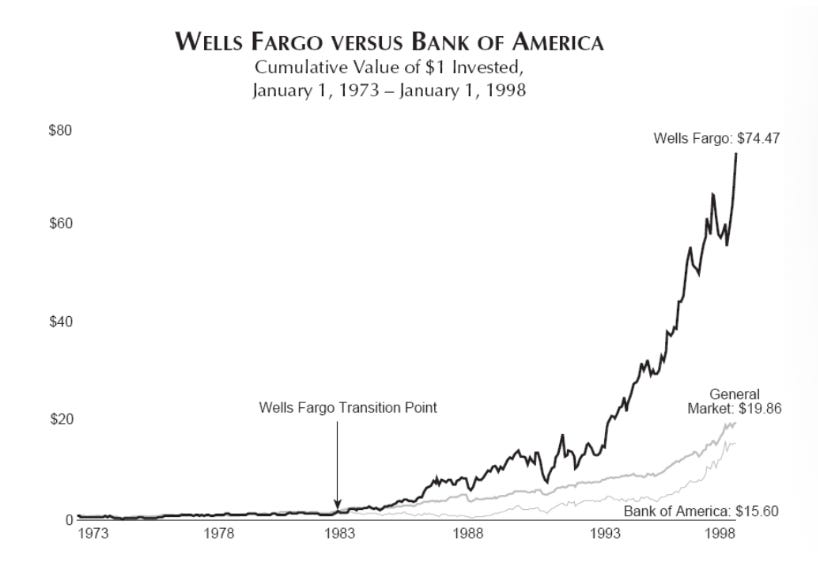
Bank of America was one of the largest and most dominant banks by assets, topping global rankings in 1970 and maintaining a leading position through the 1980s and 1990s. However, its management culture relied on a “weak generals, strong lieutenants” model, resulting in a passive leadership team that waited for direction and was slow to adapt to change.
Wells Fargo, on the other hand, began in the early 1970s to focus on assembling an outstanding management team, hiring top talent even without specific roles in mind. This proactive approach created a deep bench of leaders who could handle industry disruptions.
Performance in the 1980s and 1990s:
When deregulation and industry upheaval hit, Wells Fargo’s strong team allowed it to outperform the sector. While its banking peers fell 59% behind the general market, Wells Fargo outperformed the market by more than three times over a 15-year period. Something to also note, is that many Wells Fargo upper management also went on to lead other major companies as CEOs, highlighting the strength of its leadership pipeline.
Bank of America, meanwhile, lagged behind. Its cumulative stock returns from 1973 to 1998 did not keep pace with the general market, and it eventually had to recruit many Wells Fargo executives to help turn the company around.
Yes, compensation and incentives are important, but for very different reasons in great companies. The purpose of a compensation system should not be to get the right behaviors from the wrong people, but to get the right people on the bus in the first place, and to keep them there.
Nucor rejected the old adage that people are your most important asset. In a good-to-great transformation, people are not your most important asset. The right people are.
Six of the eleven good-to-great companies recorded zero layoffs from ten years before the breakthrough date all the way through 1998, and four others reported only one or two layoffs. These companies exhibited a distinct pattern at the top: leaders either stayed on board for the long haul or exited swiftly if they were a poor match. In essence, these companies didn’t churn more people-they churned the right people.
Packard’s Law, from HP cofounder David Packard, states that no company can grow its revenues faster than it can attract and retain enough of the right people to support that growth and still become great. If your revenue growth consistently outpaces your ability to build a strong team, building a truly great company becomes impossible
3 Principles of Great Companies
(1) Don’t rush hiring, (2) act quickly when a change is needed, and (3) assign top talent to the biggest opportunities rather than the toughest problems. Their management teams engaged in robust debate to find the best solutions, but always united behind final decisions.
Data Shows: Charismatic Leaders Rarely Produce Returns That Define a Great Company
Larger-than-life, celebrity leaders who ride in from the outside are negatively correlated with the growth of great companies e.g. Ross Johnson of RJR Nabisco.
Ten of eleven CEOs in the study came from inside the company, whereas the average companies tried outside CEOs six times more often. Would you want to leave behind a legacy like Coleman Mockler? Or remembered as a person like Ross Johnson?
Confront the Brutal Facts
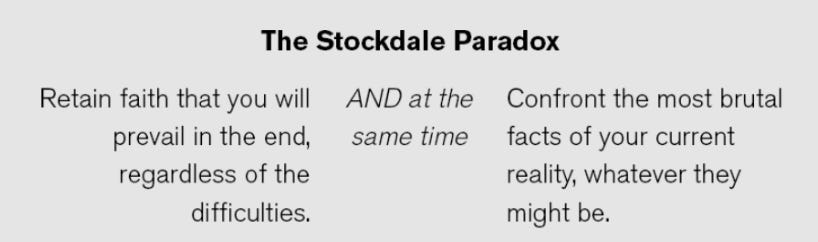
The Stockdale Paradox
The Stockdale Paradox is named after Admiral Jim Stockdale, who was the highest-ranking U.S. military officer held at the “Hanoi Hilton” during the Vietnam War. Over eight years as a prisoner of war, he endured more than twenty instances of torture, lived without prisoner’s rights, had no set release date, and faced constant uncertainty about survival.
Stockdale went so far as to disfigure himself to prevent being exploited in propaganda videos and exchanged secret intelligence with his wife through coded letters, risking further torture. He developed rules to help prisoners withstand torture and created a tap code communication system to reduce isolation. During his captivity, Stockdale’s actions and leadership became a model of resilience and resistance. After his release, he became the first three-star officer in Navy history to wear both aviator wings and the Medal of Honor.
When asked who did not survive, Stockdale replied, “The optimists.” These were the prisoners who believed they would be released by a specific date, such as Christmas or Easter. When those dates came and went, hope turned to despair, and many died of broken hearts. Stockdale explained that survival depended on never losing faith that you would ultimately prevail, while also having the discipline to confront the harshest facts of your current reality.
What helped Stockdale survive was this very mindset: unwavering faith in the end of the story, combined with a clear-eyed confrontation of brutal facts. For example, he never doubted he would get out, but he also accepted the reality of his situation and adapted his actions accordingly-whether by organizing resistance, creating systems for communication, or supporting fellow prisoners. This dual approach-balancing hope with realism-became a key lesson in leadership and decision-making, showing that greatness comes from focusing on what matters most and facing reality head-on regardless of how painful it is. Great companies demonstrate this.
Kroger and A&P
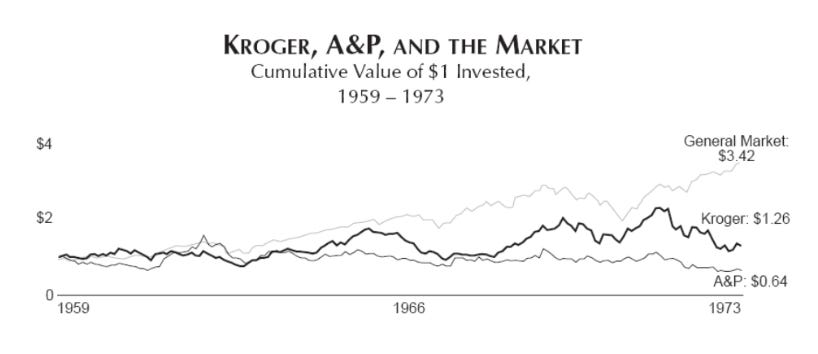
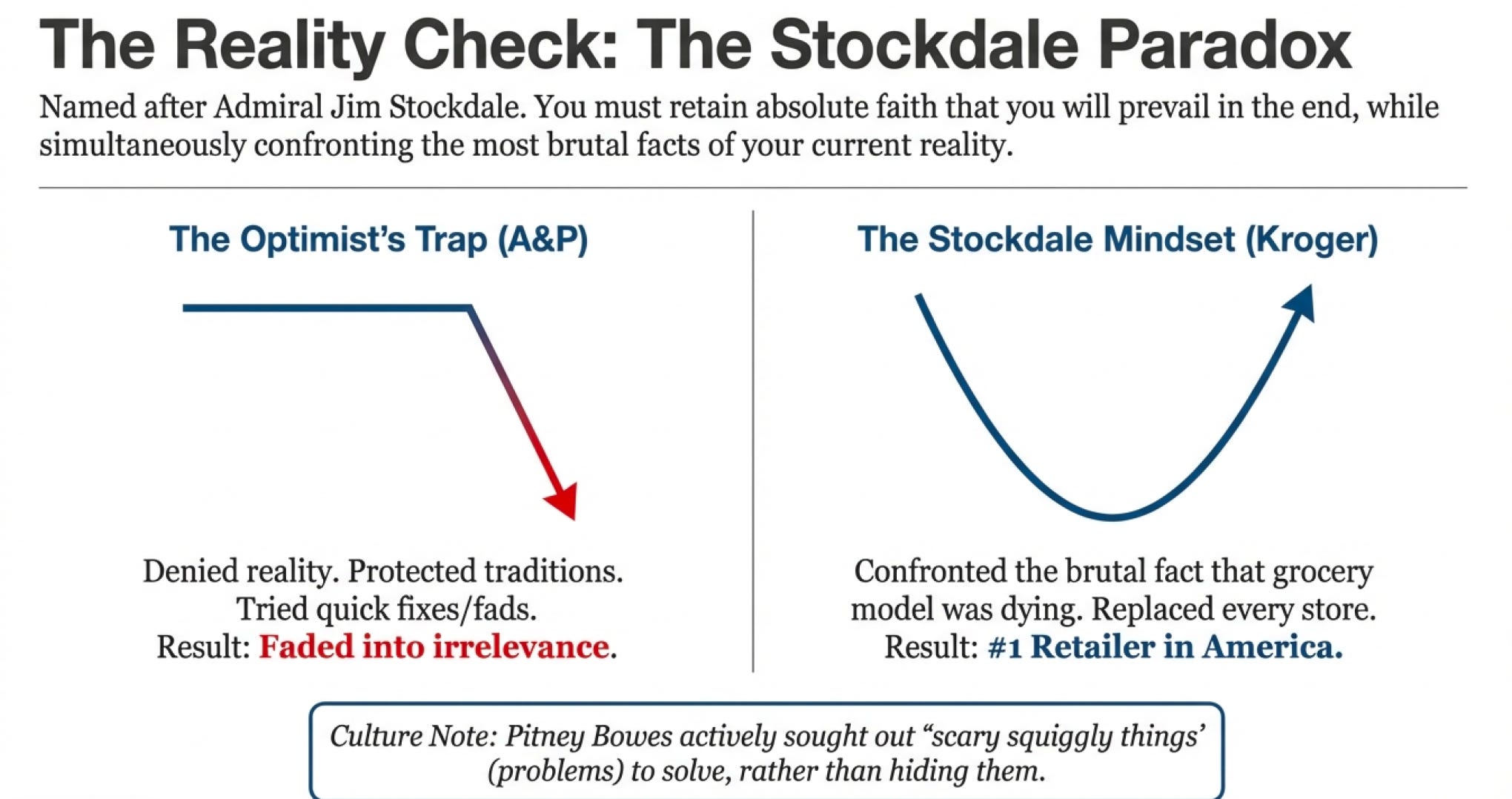
In the early 1950s, A&P was the world’s largest retailer, while Kroger was a much smaller, unremarkable grocery chain. Both companies were mature, with most assets tied up in traditional grocery stores and both aware that the market was changing. As American consumers began demanding larger, more modern stores with greater variety and services, both companies faced the same challenging reality: their old model was becoming obsolete.
A&P, however, refused to fully accept these facts. Even when experiments like The Golden Key store showed customers wanted a new kind of shopping experience, A&P’s leadership, fixated on past success, shut down the experiment because it threatened the old way of doing things. Instead of addressing the core problem, A&P lurched from one quick fix to another-slashing prices, launching fads, and cycling through CEOs-while its stores became increasingly outdated and unappealing. This denial of reality led to a downward spiral of declining service, dirty stores, and lost customers.
Kroger, in contrast, embodied the Stockdale Principle. Despite skepticism and the daunting prospect of overhauling nearly its entire business, Kroger’s leadership confronted the brutal truth: the old grocery format was dying. Extensive research confirmed that superstores were the future, and Kroger acted decisively. The company committed to replacing or transforming every store and exiting markets that didn’t fit the new model. This meant enduring short-term pain, uncertainty, and the risk of failure-but leadership maintained faith that the company would prevail if it adapted to reality.
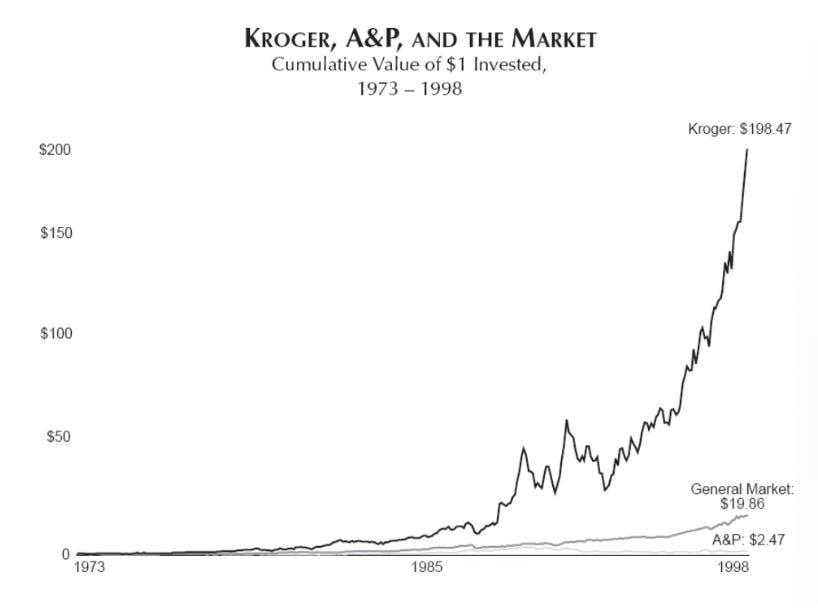
By the early 1990s, Kroger had rebuilt itself as a modern superstore chain and went on to become the number one grocery retailer in America by 1999. Over twenty-five years, Kroger’s returns were ten times the market and eighty times better than A&P’s. Meanwhile, A&P, still clinging to its past, faded into irrelevance.
Pitney Bowes and Addressograph
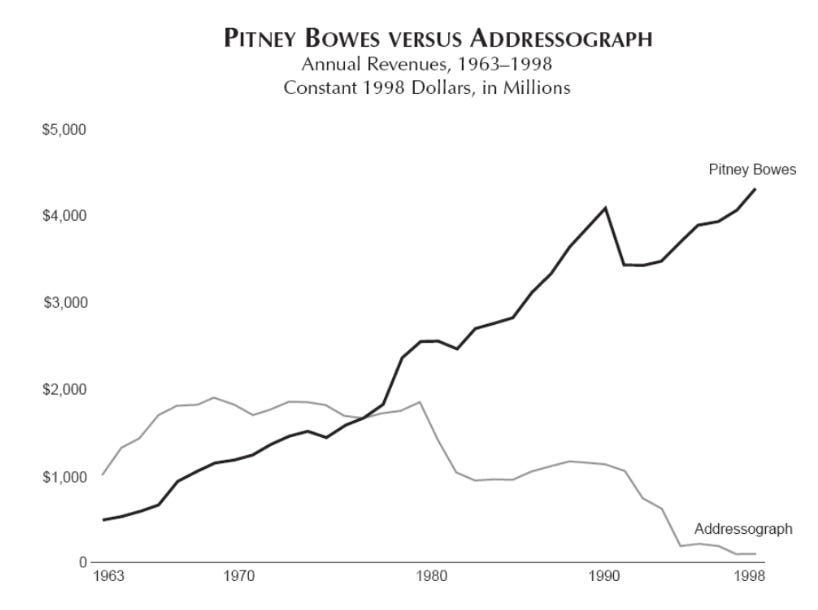
In the early 1970s, both companies were nearly identical in size, profitability, and market dominance-Pitney Bowes in postage meters and Addressograph in address-duplicating machines. Both faced the looming loss of their monopoly positions. Yet, by 2000, Pitney Bowes had grown to more than 30,000 employees and over $4 billion in revenue, while Addressograph had dwindled to less than $100 million and only 670 employees. For shareholders, Pitney Bowes outperformed Addressograph by a staggering 3,581 to 1.
Under Roy Ash, Addressograph pursued a grand vision to transform into an office automation giant, aiming to compete with IBM and Xerox. However, he became so attached to this vision that he disregarded mounting evidence that the strategy was failing. Profitable core businesses were drained to fund the risky expansion that they weren’t even competent in, and when results faltered, Ash refused to acknowledge reality-even after bankruptcy, insisting the company was “winning the war.” This denial led to the departure of key talent, who were frustrated by leadership’s refusal to face facts.
Pitney Bowes, in contrast, built a culture obsessed with confronting reality. Executives routinely sought out problems-what they called the “scary squiggly things”, and openly discussed threats to future performance. Management meetings focused far more on potential risks than on celebrating past achievements. Salespeople were encouraged to challenge senior leaders with tough questions, and forums were created where employees could directly point out what the company was doing wrong. No matter how uncomfortable something is, it was brought up, preventing complacency and enabling Pitney Bowes to adapt and thrive by facing their problems head on.
Charisma can be both a strength and a weakness, as a strong personality may discourage honest feedback. Churchill, aware of this risk, set up a special office during WWII to ensure he always received the unfiltered facts, balancing his bold vision with a clear-eyed view of reality. True leaders recognize they don’t have all the answers, so they listen deeply and ask the right questions (regardless how hard it is) to uncover the best solutions.
All great companies in the research thrived on intense, honest debate-described as “loud,” “heated,” and “healthy”-focused on finding the best answers, not just letting people voice opinions for show. Their journey to greatness began by facing the hard facts of their reality, believing that honest truth-telling leads to clear decisions and lasting success.
To build this culture, they:
Asked questions instead of dictating answers,
Encouraged open debate rather than forcing consensus,
Examined failures without assigning blame,
Created systems to ensure critical information couldn’t be ignored.
While facing just as much adversity as others, these companies confronted challenges directly and grew stronger. Their leaders embodied the Stockdale Paradox: maintaining unwavering faith in eventual success while confronting the harshest realities head-on.
Hedgehog Concept
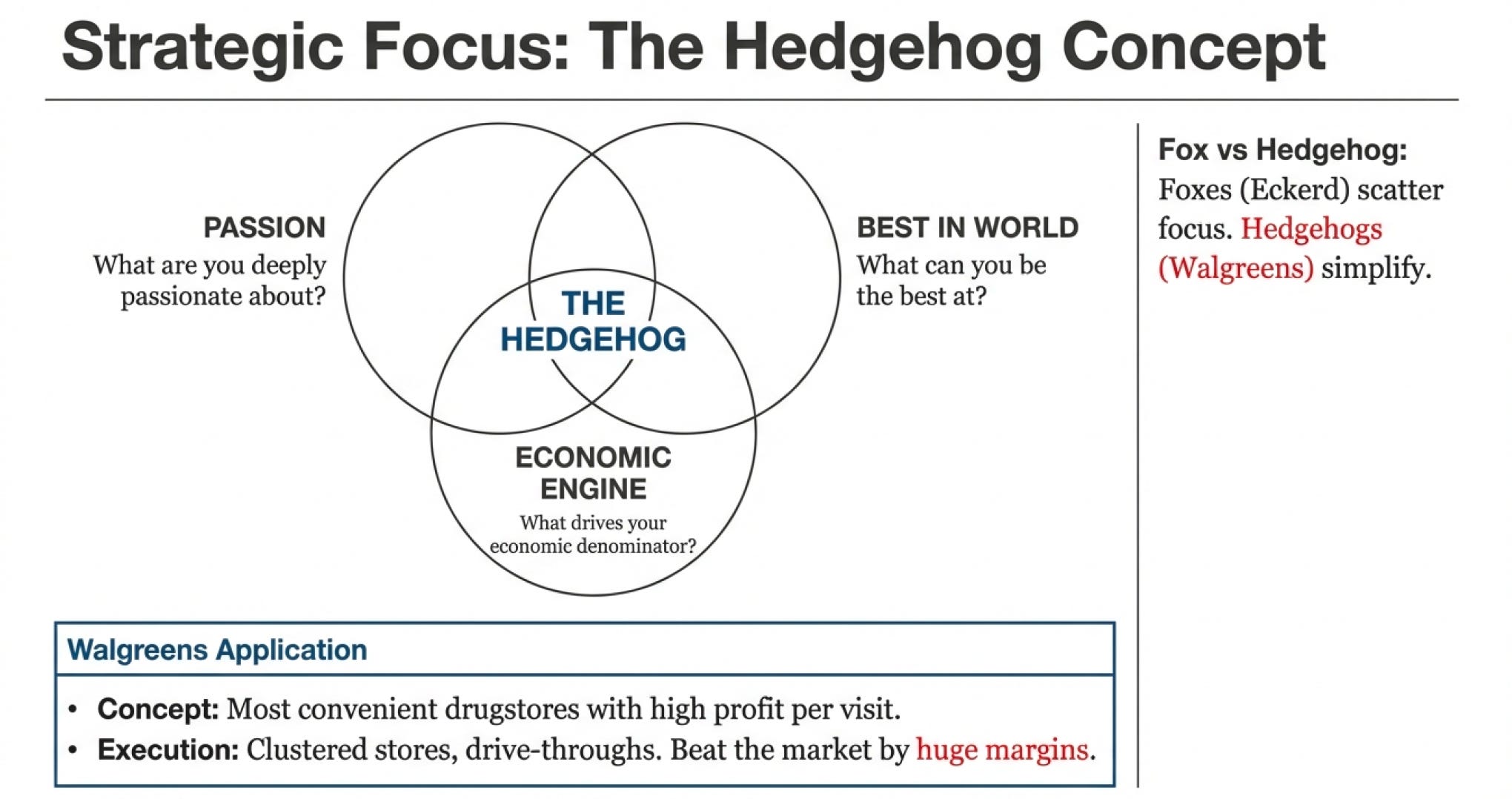
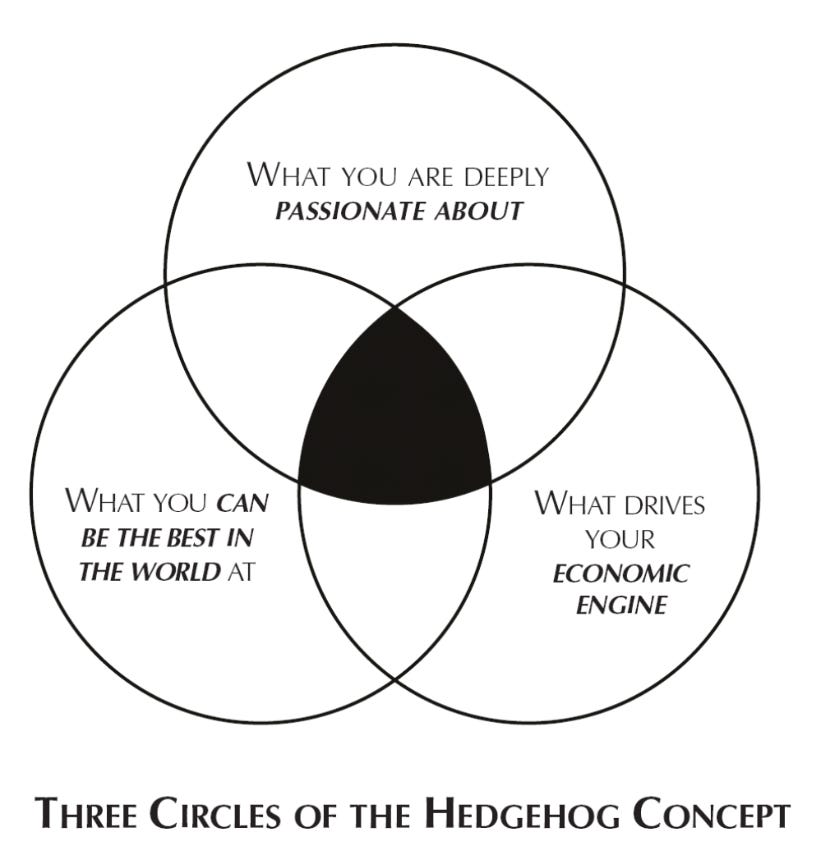
In Isaiah Berlin’s essay “The Hedgehog and the Fox,” he describes hedgehogs as those who focus on one big idea, simplifying complex problems, while foxes pursue many amazing and wonderful ideas but without a unifying vision. The most impactful leaders, like those behind great companies, are hedgehogs-they cut through complexity to find a single guiding concept, while others who act like foxes remain scattered and inconsistent.
What you can be the best in the world at (and, equally important, what you cannot be the best in the world at)?
What you (your organization) are deeply passionate about?
What drives your economic engine (you are getting paid for what you do, and know how to assess it - the Economic Denominator covered below)
Walgreens
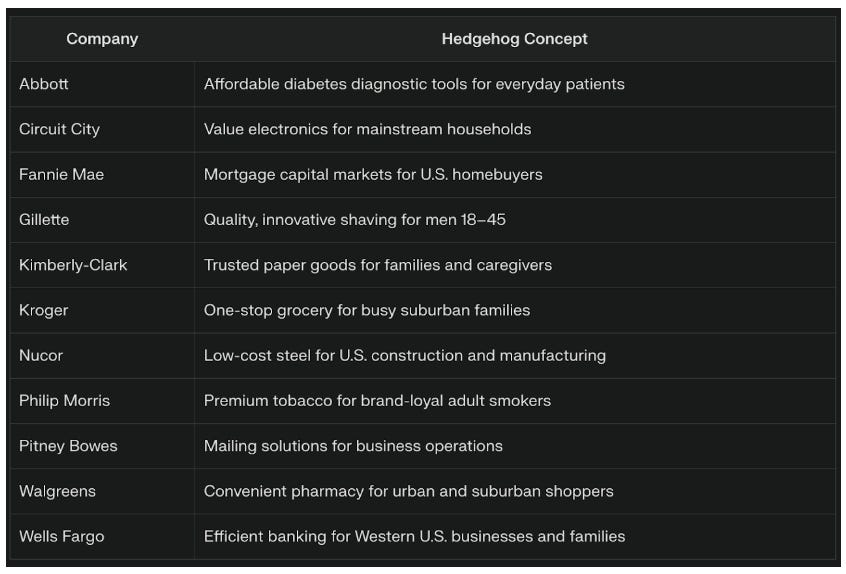
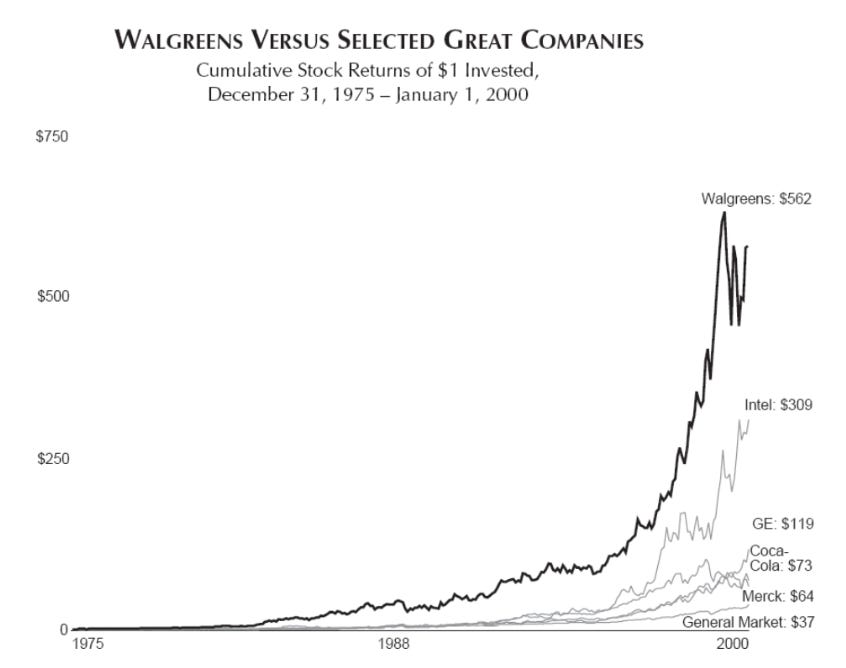
Walgreens identified its Hedgehog Concept as creating the most convenient drugstores with the highest profit per customer visit. Every major decision and investment aligned with this core idea. Walgreens systematically replaced less convenient locations with prime corner sites, even if it meant paying millions to exit existing leases. The company pioneered drive-through pharmacies and tightly clustered stores in urban areas, ensuring that no customer would have to walk more than a few blocks to reach a Walgreens. In downtown San Francisco, for example, Walgreens operated nine stores within a one-mile radius-a testament to its focus on convenience.
Walgreens prioritized investments that supported its Hedgehog Concept, such as centralized pharmacy records, enabling customers to refill prescriptions at any location nationwide. By the mid-1990s, Walgreens had a complete inventory tracking system across its entire chain, while Eckerd lagged far behind, only partially implementing similar systems a decade later.
Eckerd, pursued growth for its own sake, buying up store chains in a patchwork fashion and even venturing into unrelated businesses like home video rentals, which resulted in millions in losses. While Walgreens focused on its core competency-convenient, profitable drugstores. By the end of the 1980s, Walgreens had a $1 billion sales lead over Eckerd.
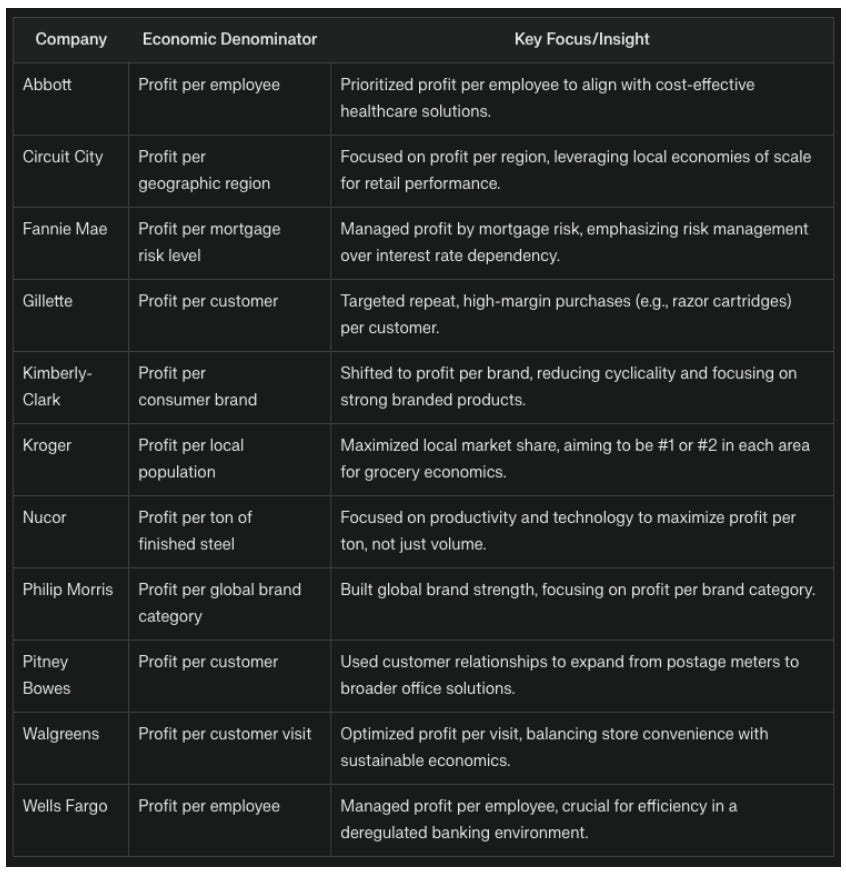
The Economic Denominator
The economic denominator is a single, clear metric that best drives a company’s economic engine, reflecting the core of what it can be best at-its Hedgehog Concept. Instead of tracking dozens of financial ratios, great companies identify the one denominator (such as profit per employee, per customer, or per region) that most powerfully links to long-term success. This focus helps them make disciplined decisions and consistently outperform competitors, even in tough industries. e.g. Walgreens economic denominator is “Profit per employee”
Fannie Mae and Great Western
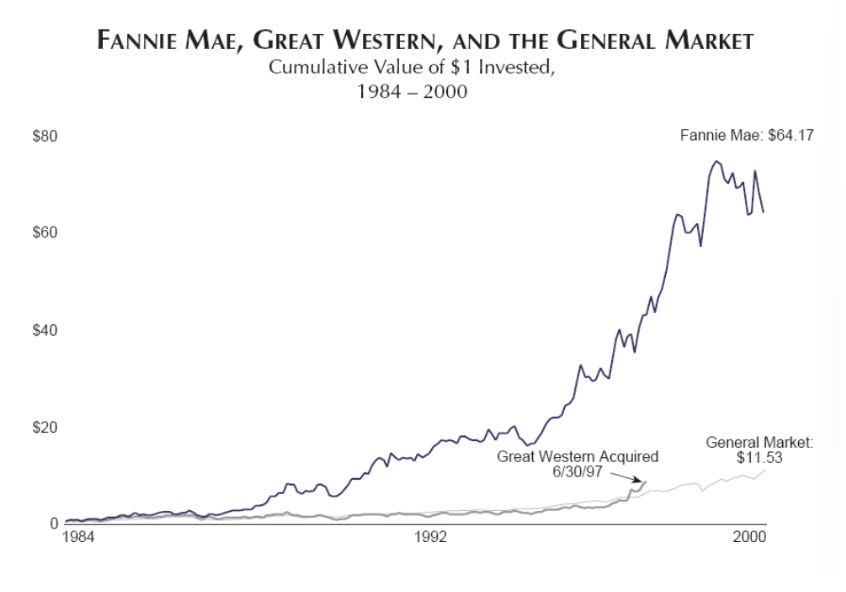
Great Western exemplified the fox-constantly seeking expansion in every direction. The company ventured into finance, leasing, insurance, and manufactured housing, acquiring businesses in a scattershot pursuit of size and diversification. Its leadership made it clear that growth itself was the goal, regardless of industry or strategic fit, famously stating, “Don’t worry about what you call us-a bank, an S&L, or a Zebra.” This lack of a unifying concept led to an unwieldy organization with diluted focus and limited long-term performance.
Fannie Mae, by contrast, developed a simple, crystalline understanding of what it could be the best in the world at: serving as the leading capital markets player in mortgages. Fannie Mae reframed its business model around risk management and capital markets expertise, moving away from simply selling mortgages to building a robust economic engine based on securitizing and guaranteeing mortgage-backed securities. This focus allowed Fannie Mae to outperform even the most prominent investment banks in its niche, democratizing home ownership and inspiring employees with a clear sense of purpose.
Between 1984 and 1996, despite its acquisition spree, Great Western’s revenues and earnings grew only 25%, and it ultimately lost its independence in 1997. Meanwhile, Fannie Mae’s revenues nearly tripled from 1984 to 1996, and the company generated sustained, superior returns, far outpacing Great Western.
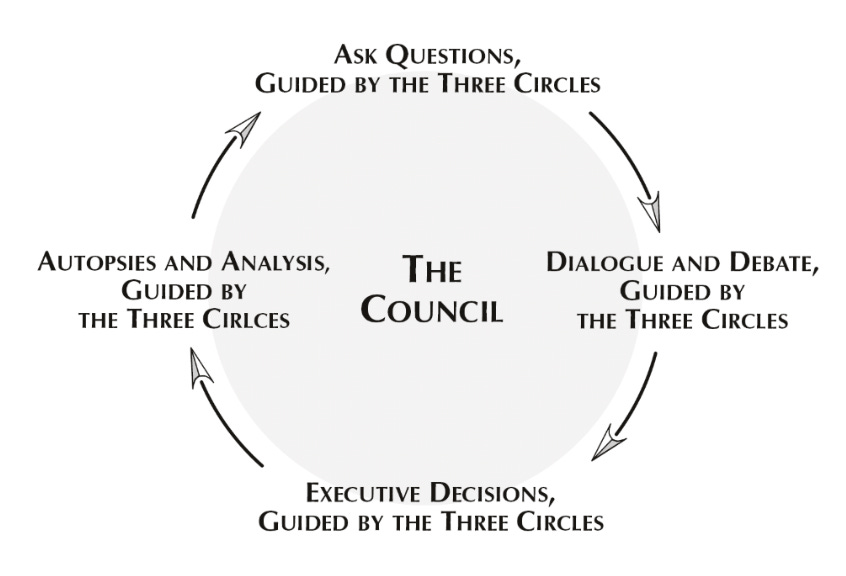
The council
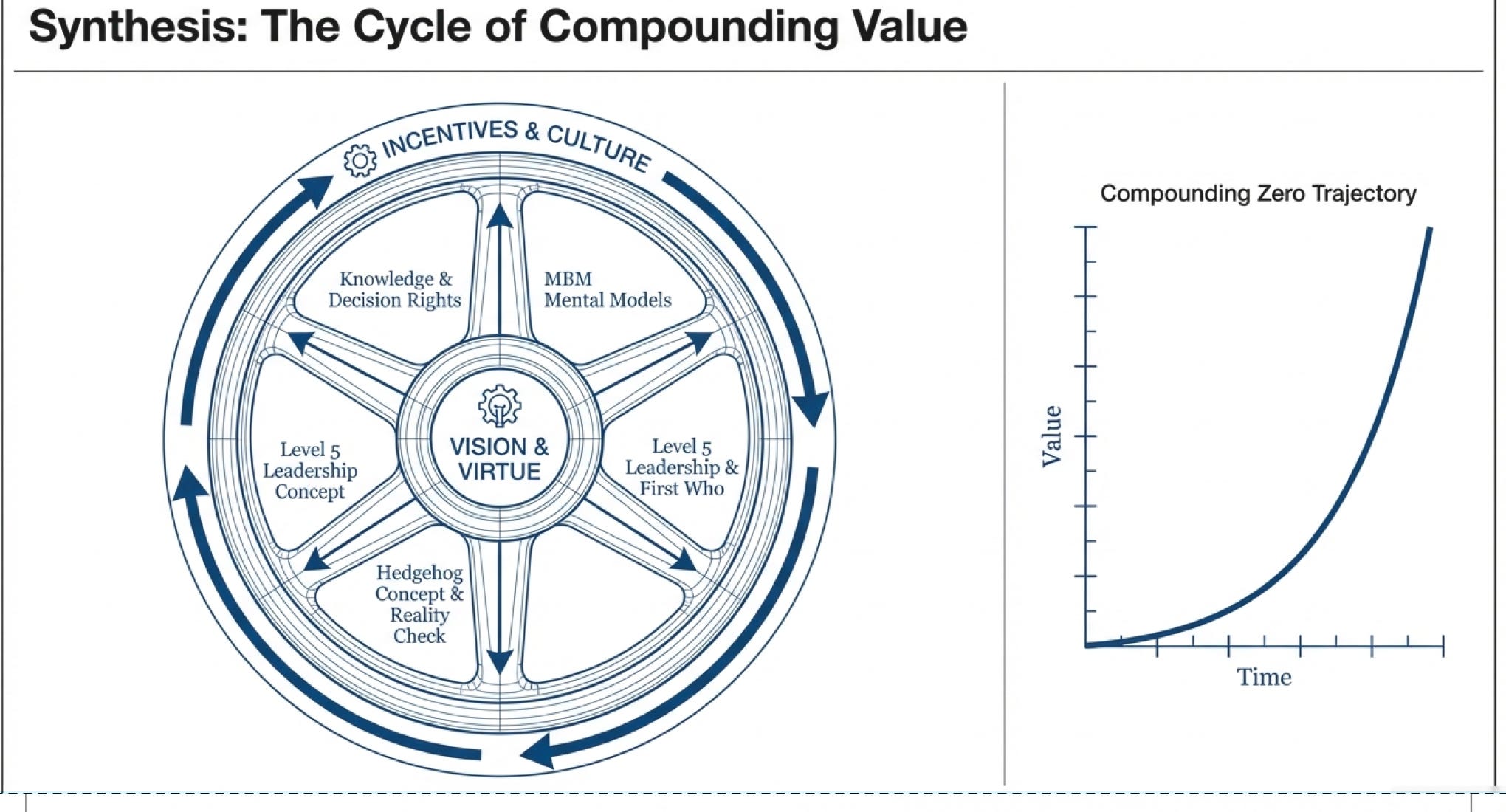
Arriving at your Hedgehog Concept is an iterative process, and great companies always have a “council” in place to maintain the hedgehog concept/ create it. The council operates very similarly to a feedback loop as seen below:
References
Hormozi, Alex. $100M Offers: How To Make Offers So Good People Feel Stupid Saying No. Acquisition.com Publishing, 2021
Hormozi, Alex. $100M Leads. Acquisition.com Publishing, 2023. ASIN: B0CFDR3TYV.
Brunson, Russell. DotCom Secrets: The Underground Playbook for Growing Your Company Online. Morgan James Publishing, 2015. ISBN: 9781630474775.
Koch, Charles G. Good Profit: How Creating Value for Others Built One of the World’s Most Successful Companies. Crown Business, 2015. ISBN: 9780804189323.
Sullivan, Dan, and Hardy, Benjamin. The Laws of Lifetime Growth: Always Make Your Future Bigger Than Your Past. Berrett-Koehler Publishers, 2006.
Munger, Charles T., edited by Peter D. Kaufman. Poor Charlie’s Almanack: The Wit and Wisdom of Charles T. Munger. Donning Company Publishers, 2005.
Priestley, Daniel. 24 Assets: Create a Digital, Scalable, Valuable and Fun Business That Will Thrive in a Fast Changing World. Rethink Press, 2016.
Collins, Jim. Good to Great: Why Some Companies Make the Leap... and Others Don’t. HarperBusiness, 2001.
Godin, Seth. Purple Cow: Transform Your Business by Being Remarkable. Portfolio, 2003.
Godin, Seth. This is Marketing: You Can’t Be Seen Until You Learn to See. Portfolio, 2018.
Suby, Sabri. Sell Like Crazy: How to Get As Many Clients, Customers and Sales As You Can Possibly Handle. King Kong, 2019.
Priestley, Daniel. Oversubscribed: How to Get People Lining Up to Do Business with You. Capstone, 2015.
Greenwald, Bruce, and Judd Kahn. Competition Demystified: A Radically Simplified Approach to Business Strategy. Portfolio, 2005.
Slow Ventures. “Franchising Thesis - Why Venture Should Care About Franchises.” DocSend, accessed May 7, 2025. https://docsend.com/view/68uxgs3jawk2szrv