
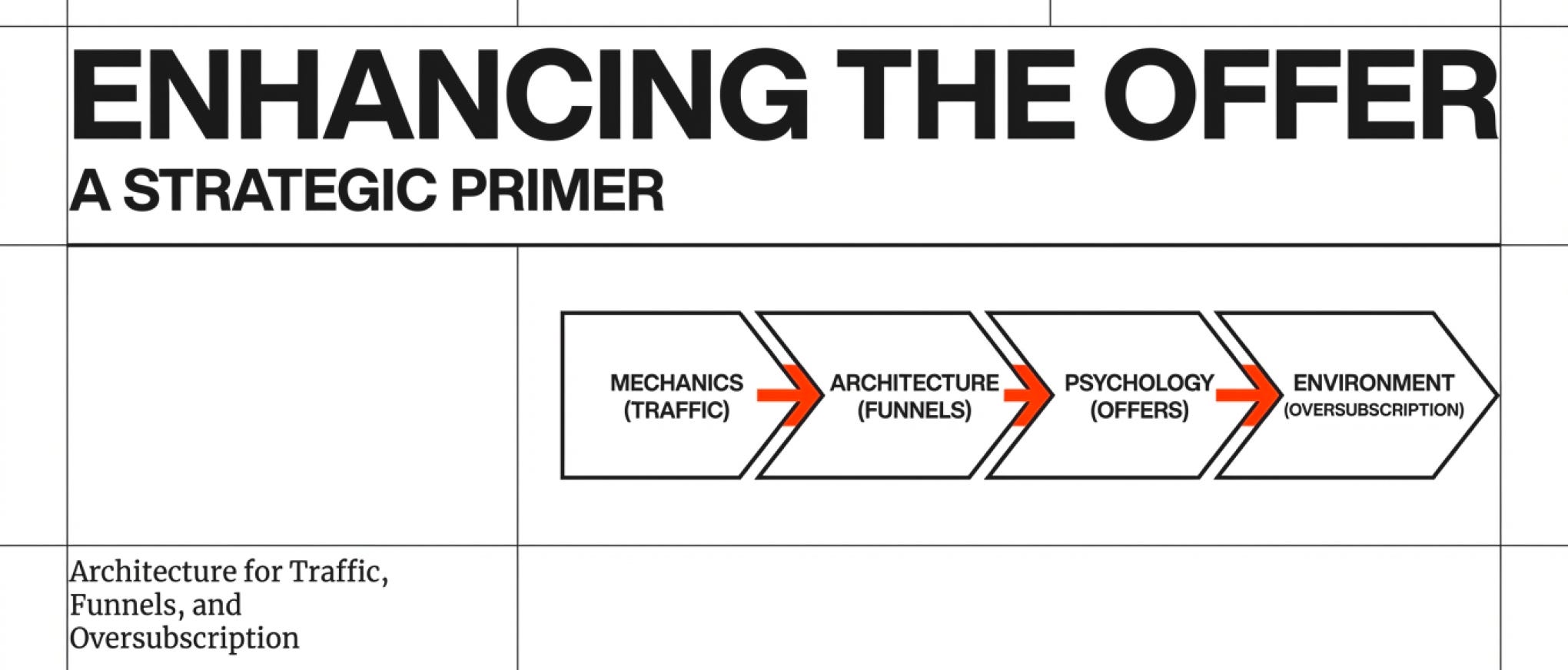
Breaking Down Advertising
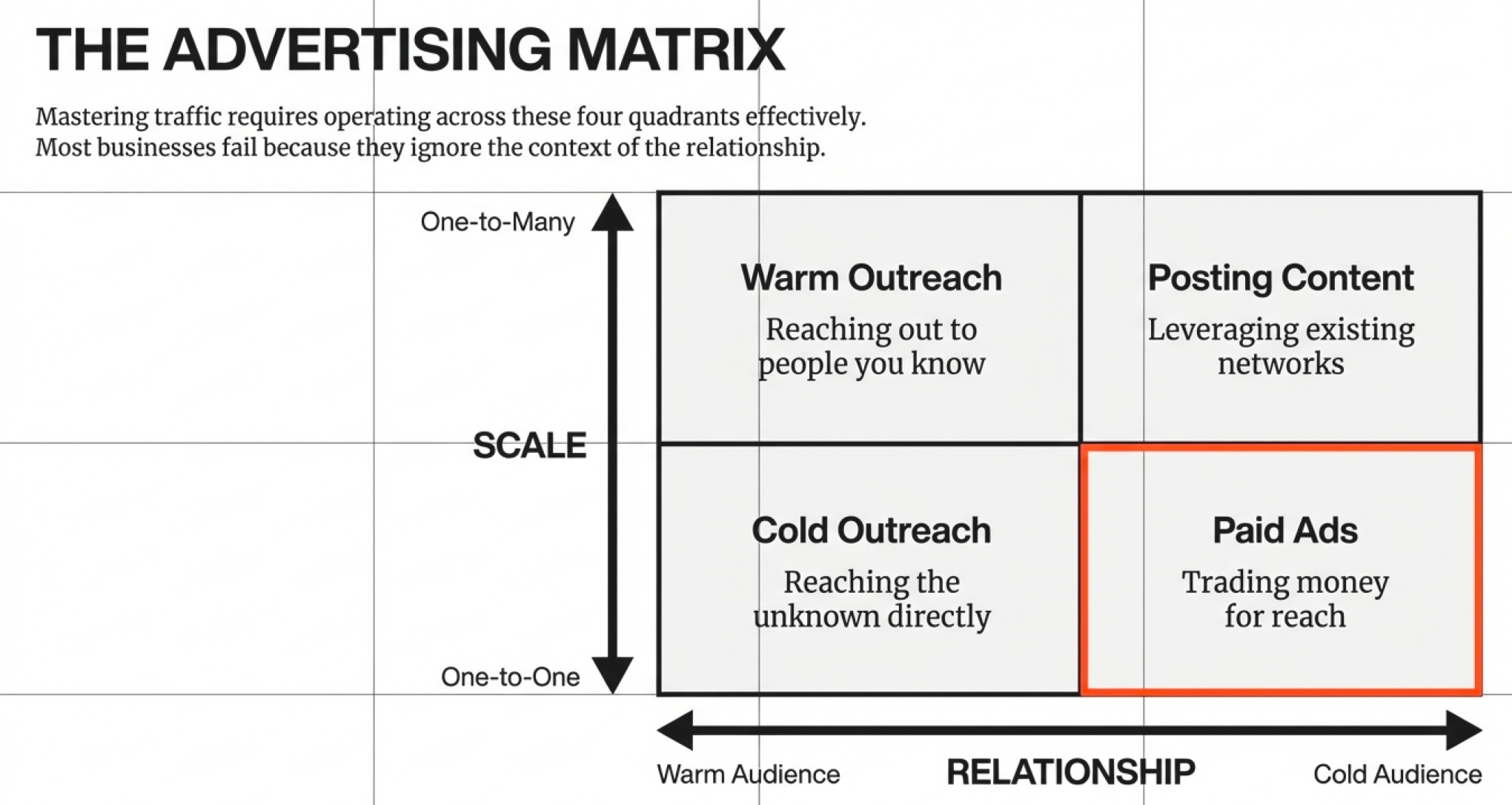
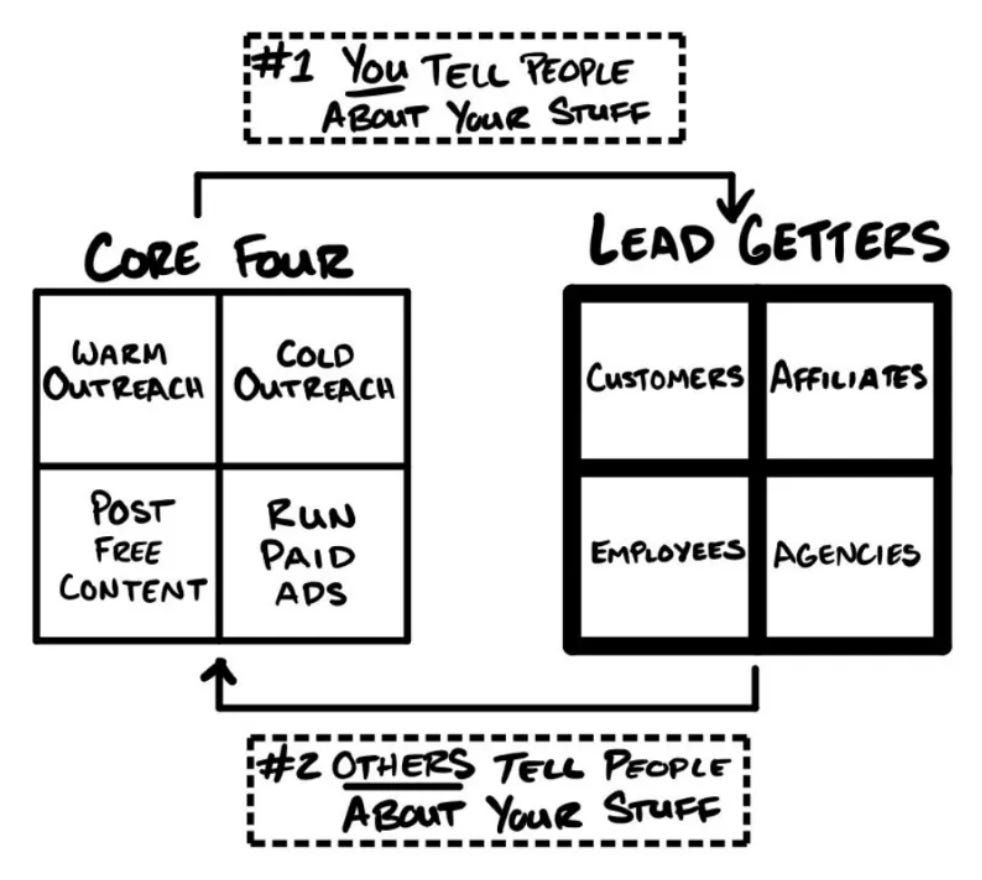
When we look at advertising, we either advertise to (1) people who know us or (2) people who don’t know us. Similarly, advertising is usually done on a (1) one-to-one basis or (2) one-to-many basis. With these, we can breakdown advertsiing into 4 main forms:
1-to-1 to a Warm audience = Warm outreach
1-to-many Warm audience = Posting content
1-to-1 to a Cold audience = Cold outreach
1-to-many Cold audience = Paid ads
Let’s go through each of them quickly given that you might have already mastered all of them (given that you have access reading this now). What we want to focus on would be the core concept of LTGP:CAC under paid ads section - but with all things, let’s take it one-step at a time (feel free to skip this section tho)...
👥 Warm outreach - how to reach out to people you know
9/10 times (just my own opinion), when owners pitch/ introduce their product, they do a horrible horrible job. As humans we want to convey all the benefits of what we’re selling otherwise it will feel like it is a loss - however, this is counterproductive. The “Paradox of Choice,” popularized by psychologist Barry Schwartz, suggests that having more options, while seemingly desirable, can paradoxically lead to less satisfaction and even more stress, anxiety, and regret.
Similarly with so much new information to digest, it will be a wonder if someone even remembers anything other than your name and the first product you mention. Therefore, it is ALWAYS better to identify their problem before using the template below to convey how you can help them 👇
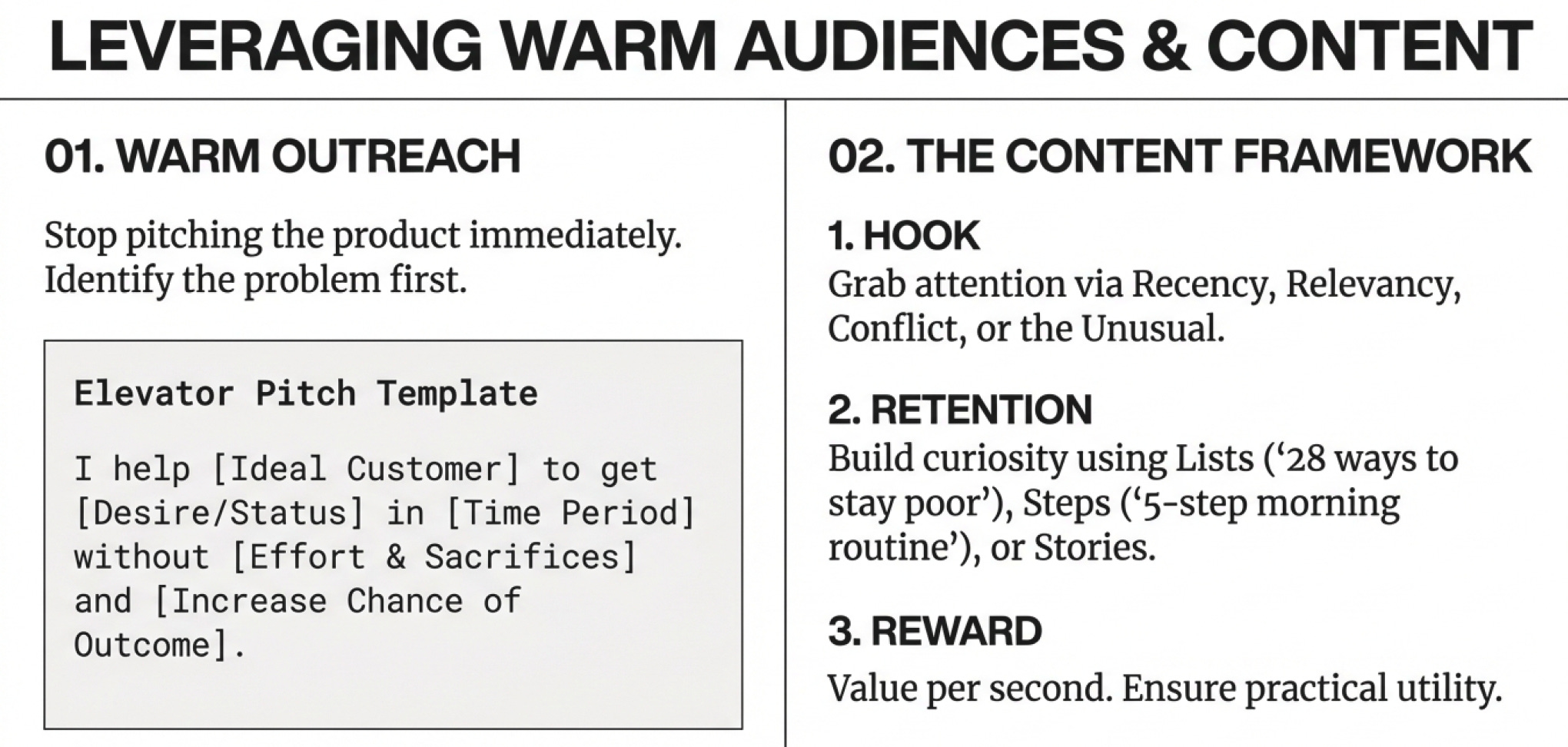
Your elevator pitch: I help [Ideal customer] to get [the status/ desire/ experience they want] in [time period] without [effort & sacrifices] and [increase chance of achieving the outcome] - consider backing that up with testimonials/ endorsements/ guarantees/ demonstration of outcome
🌆 Posting content
💡 Narrow the focus of your content when you are first starting out. Like business, don’t compete with the big boys first. Be the best in your niche first before competing with the big boys
Always talk about what YOU will do, not what’s best or what others will do:
Past experience (your past. stories with learnings)
Present ideas (take down the ideas that come to you while working)
Trending (go where attention is and apply your own experience to it)
Manufactured (pick something people are interested in and do it e.g. I live on $100 per month, here’s how)

Here’s a framework on creating a content
Hook: Get people’s attention, pick topics that are trending and people find interesting. Here’s how news headlines hook people:
Recency - people pay attention to things an hour ago rather than 1 year ago
Relevancy - personally meaningful
Celebrity - prominent people
Proximity - close to home geographically
Conflict - opposing ideas, people, nature e.g. good vs evil, justice vs mercy
Unusual - odd, unique, rare, bizarre
Ongoing - stories that are in progress, dynamic and have plot twists
Retention: A good way to retain people are usually curiosity. Here is how to generate curiosity
Lists - facts, tips, opinions or ideas of a theme. Giving a number helps retention as well e.g. 28 ways to stay poor
Steps - actions that occur in order and accomplish a goal e.g. My 5 step morning routine that boosts my productivity
Stories - events that are real/ imaginary and have a takeaway lesson e.g. My Journey from sleeping in the gym to the top floor of a 5 star hotel
Reward: Value per second of your content. Make sure its real value, practical and useful. Always measure & track (1) Total followers & reach - how big (2) Rate of getting followers and reach - how fast.
Your best performing contents can be (1) recycled as content, (2) facilitating brainstorm, (3) closing the audience (4) retaining existing customers
📩 Cold outreach
Let’s keep cold outreach short to what i’ve found worked. Keeping the elevator pitch in mind, also implement these:
Who is your target and where are such quality audience “hanging out” at? - this is super important to get right
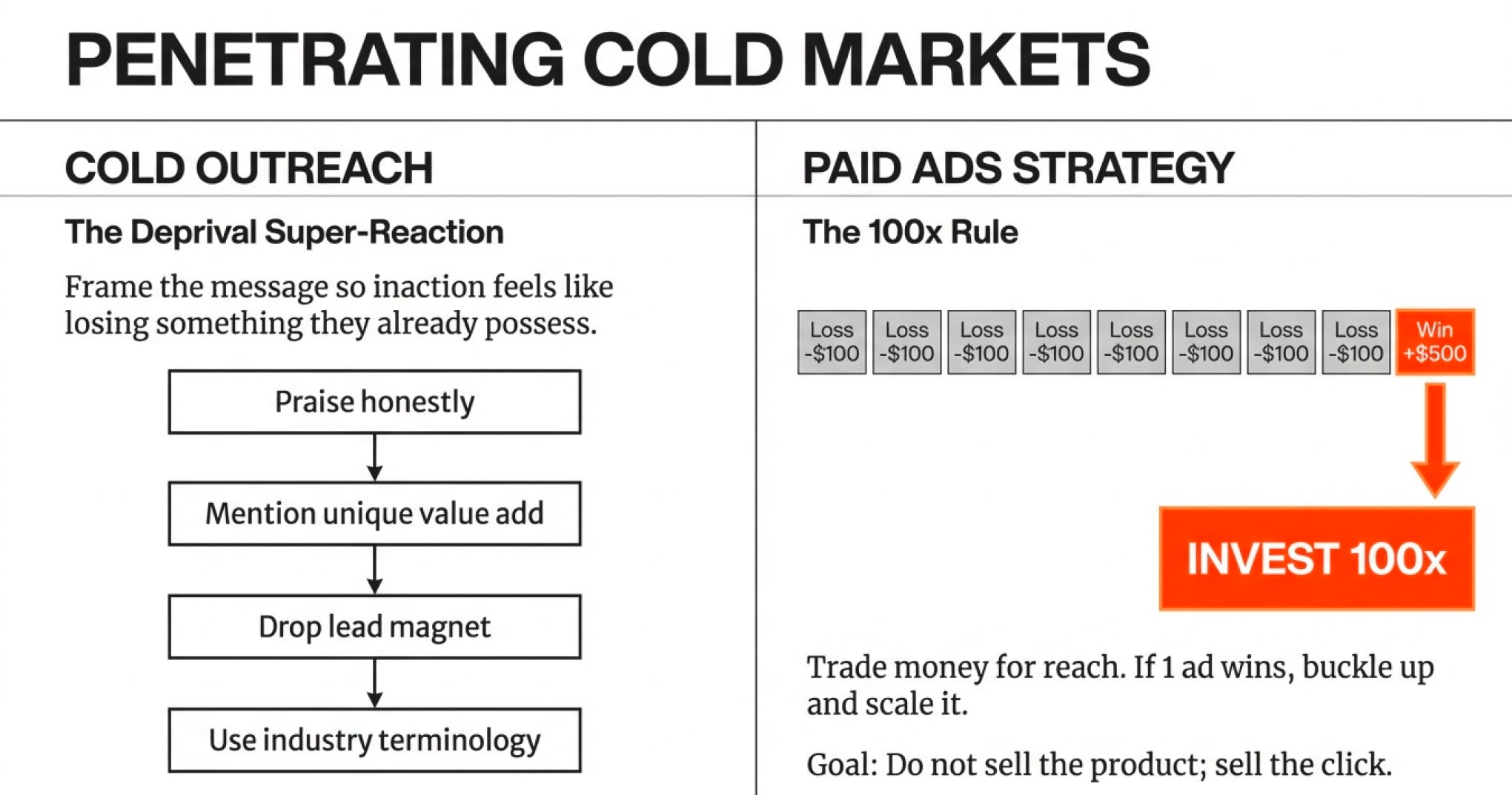
Praise them - honestly, not superficially
Mention how can you add value to them that no-one else can, this is where you can drop your lead magnet (usually niching down helps as you are able to give a solution that address their pain-points more)
Implement Deprival super-reaction tendency - they will lose something they already have if they don’t take action
Use Industry terminologies
Here’s how it should roughly look like: Hey xxxx, [praise]. Just wanted to reach out because [how you can add value/ solve their pain point with your lead magnet]. Just thought i’d drop this message because [Deprival super-reaction tendency].
This is just a guideline and WILL NOT work - there is a huge emphasis here on needing to test this out but applying the same concept. Every audience and markets think differently and have different economics.
💡 Tip once you implement sales reps: Limit leads to sales-reps so they treat each lead with quality and try to close it e.g. only if they can close X then they get Y number of leads to them. Every closing they get $C, but only implement incentives after you have tested out X calls get X closing and $X in profit.
💳 Run paid ads
Some of the best returning ads tend to come from the best free content you make (sometimes its UGC - user generated content like testimonial/ reviews).
In paid ads, you trade money for reach - ads are riskier but when done right, they can get you more leads than any other method
Pick a platform that contains your ideal audience
Use targeting methods in that platform to find your audience
Craft your ads in a way that repels everyone else except your idea audience
CTA: Tell your ideal audience to take the next step
Once the advertising has found its small pool of ideal audience, slowly expand it to a larger pond, lake, and sea, then ocean. Imagine you sepnd $100 on 10 ads ($1,000) in total. 9 of them lose $100 ($900), but one of them makes $500 back from the $100. But you’re still $500 down. Most people stop here because they see a $500 loss. But this is where you should buckle up and 100x down on the winning ad that delivered the 5x return - spend $10,000 and make $50,000 back.
Replicate other successful business first before you reinvent anything
Zoom in from “targeting everyone in the world”. Be specific e.g. language, gender, age PRO-TIP: local targeting be as specific as possible but no further. The local market is already 0.1% of the global market so you’re already pretty narrow
Target “lookalike audience” or with factors of your choosing e.g. interests
Call-outs: People noticing your ad is the most important part of the ad. 80 cents of the dollar is spent already when people see your headline. Make your call-outs specific to your audience e.g. a child calling “Mom” to get his mother’s attention. This is where your “Attractive Character” in step 2 plays a huge role
PRO-TIP: Use the [Platform] Ad Library to get content ideas - you can find the ad library from google. If you see an ad that runs for a long time, it’s usually profitable. Copy that; note down their (1) Call-outs (2) words they use and how they demonstrate them (3) CTAs. Breakdown 50 of this and you’d have a huge headstart
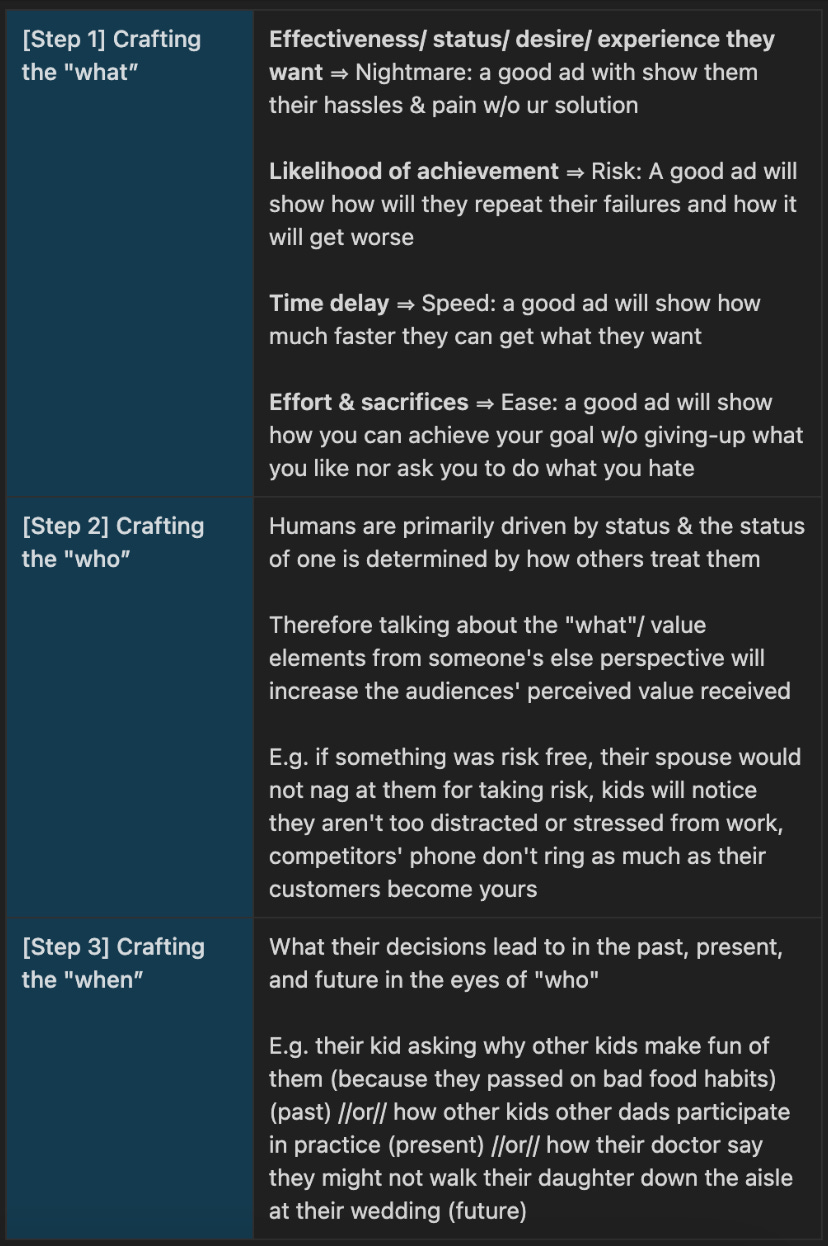
Always tell a story using your “Attractive character” - people relate to that the most
👉 High drama (selling begins): start with the middle exciting part of story (w problem/ wall)
👉 Epiphany: you realize something you haven’t thought of before (this ties to the core offer that you’re offering)
👉 Hidden benefits: use parables to point out the (non-obvious) benefits of following you & using your product. How it solves their pain-points
👉 Implement the big 3: Exclusivity, Urgency, Guarantee
The goal is to create an instant bond between your Attractive Character and the person viewing your advertisment. And your main goal here is not to sell, but to get them to give you their contact information in exchange for solving their problems with your lead magnet
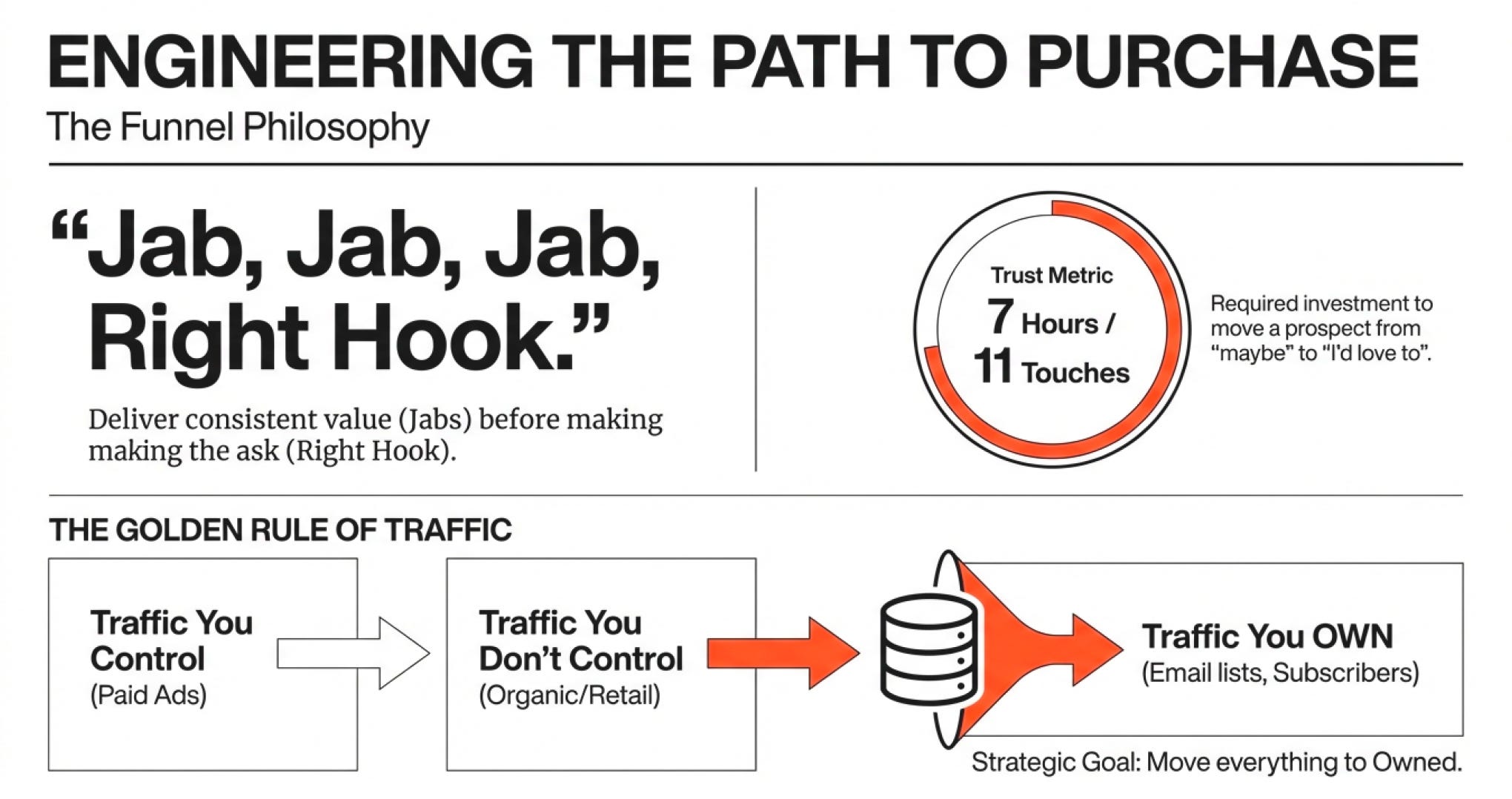
Always Remember Jab, Jab, Jab, Right Hook
In Gary Vaynerchuk’s book “Jab, Jab, Jab, Right Hook” a core concept that is emphasised repeatedly is to establish a relationship with your audience through consistent and valuable deliverables (the “jabs”), before making a direct offer or call to action (the “right hook”). This approach emphasizes building trust and engagement before pushing for a sale. With reference to the book “Oversubscribed”, research have shown that it takes almost 7 hours and 11 touches of “relationship building/ valuable deliverables” to make people go from “maybe i would” to “i’d love to”
Now, Combine Your Advertising With Lead Getters
Optimizing Touch-points in a Funnel
When driving traffic to a website, you need to carefully engineer the process (of the funnel) the customer goes through. His whole experience, how he reacts, and where he clicks from the landing page to the sales conversion page - the whole customer journey needs to be engineered. When we walk through this section, you would realize that some of you (business owners) have already done an astonishingly amazing job on certain aspects - awesome job on that, give yourself a pat on the back. Now its time to optimize the rest
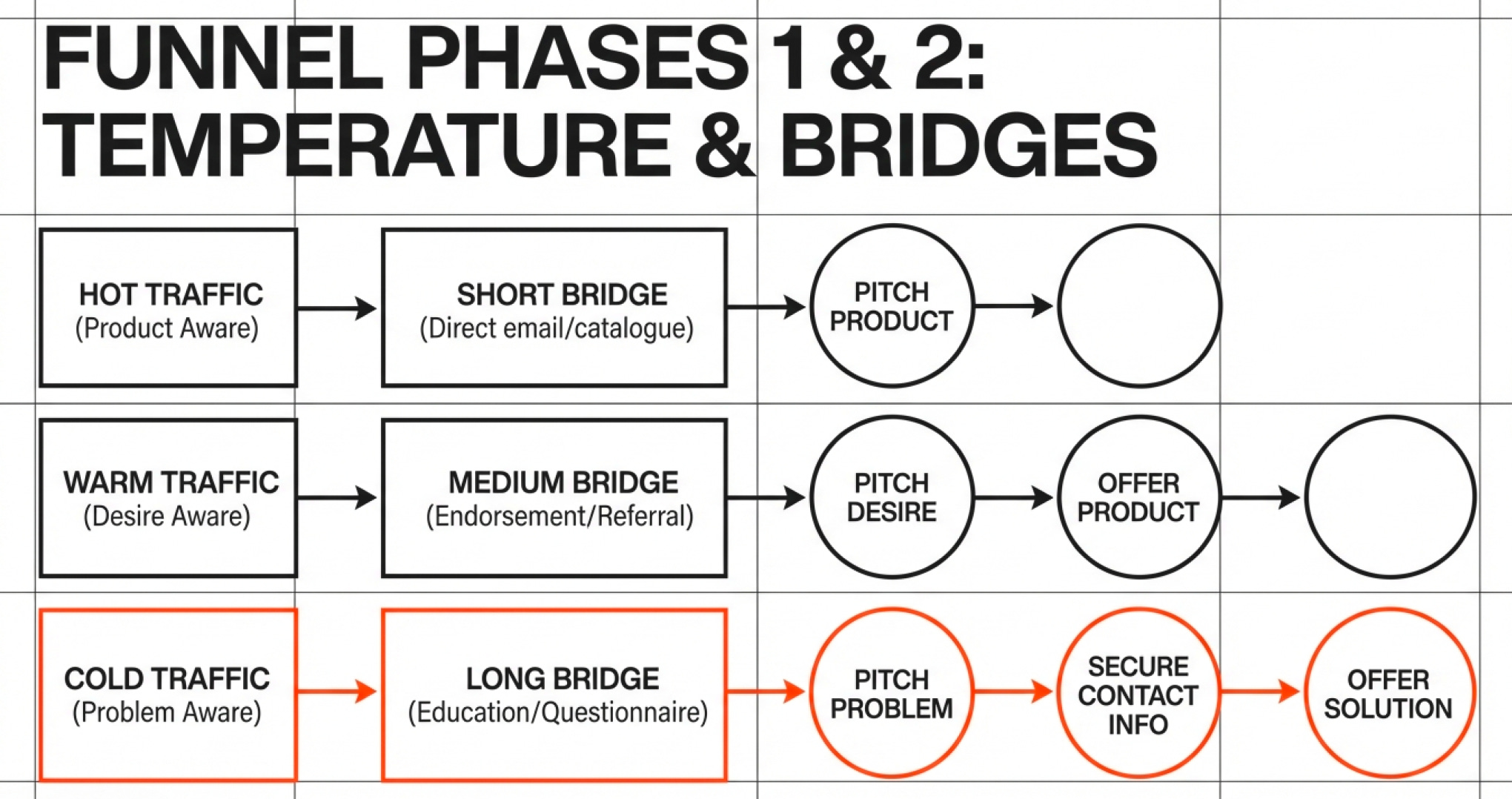
🚦Phase 1 - Determine The Traffic (Front-end) Temperature
what is the temperate of the traffic you’re driving?
There are 3 different traffic
Hot,
Warm,
and Cold
Therefore, it is crucial to have 3 seperate customer journey for each type of Traffic on the Front-end of your funnel - all 3 have different pre-frames.
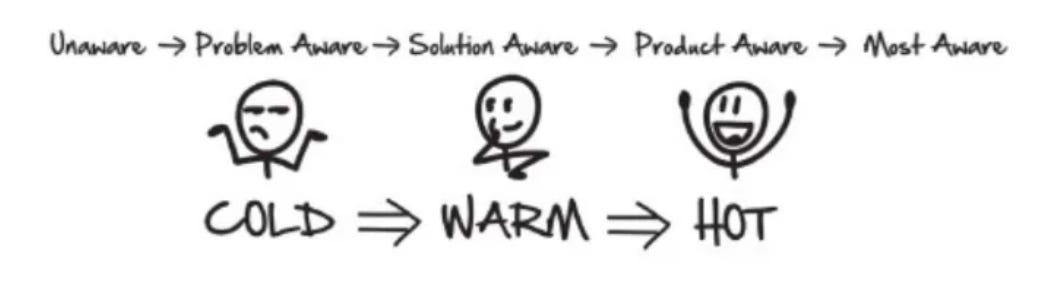
In simpler terms:
If target is aware of your product and has realized it can satisfy his desire, your “hook/ headline/ elevator pitch” starts with the product (Hot)
If he is not aware of the product, but only the desire itself, your “hook/ headline/ elevator pitch” starts with the desire (Warm)
If he is not aware of what he really seeks, but is concerned with the general problem, your “hook/ headline/ elevator pitch” starts with the problem and crystalizes it into a specific need (Cold)
🌉 Phase 2 - Setup The Pre-frame Bridge
What is the pre-frame bridge you are taking potential buyers through?
A Hot traffic bridge: typically short as your already have the relationship and a established credibility. You can probably just send a email/ catalog and ask them to purchase, that’s it!
A Warm traffic bridge: a little longer than hot traffic. The only difference is that it just needs an additional “note of endorsement” from the person they trust e.g. email referral from your JV partner
A Cold traffic bridge: the longest bridge and requires preliminary work to get the traffic/ audience into the right frame before you start selling them e.g. they might not know your industry jargon/ the technicalities of your product yet, or they might not know their problem exist, and these can be value 1 that you give
e.g for cold traffic bridge:
if you have nerve pain, its probably caused by neuropathy 👉 Do a YouTube or Blog post referral JV with a account that has a neuropathy audience 👉 Audience/ traffic lands on a page/ scorecard questionnaire for problem revealing 👉 Email is collected to secure contact + deliver the result 👉 “Thank you” Conversion landing page to sell neuropathy supplement 👉 If that fails, you still have their contact to provide more value, then sell again
Note that these EXACT same concept can be remodeled to secure Governments and other Businesses - except that it might require new low-ticket product and more unique physical touchpoints rather than online touchpoints - you will just need to test them out
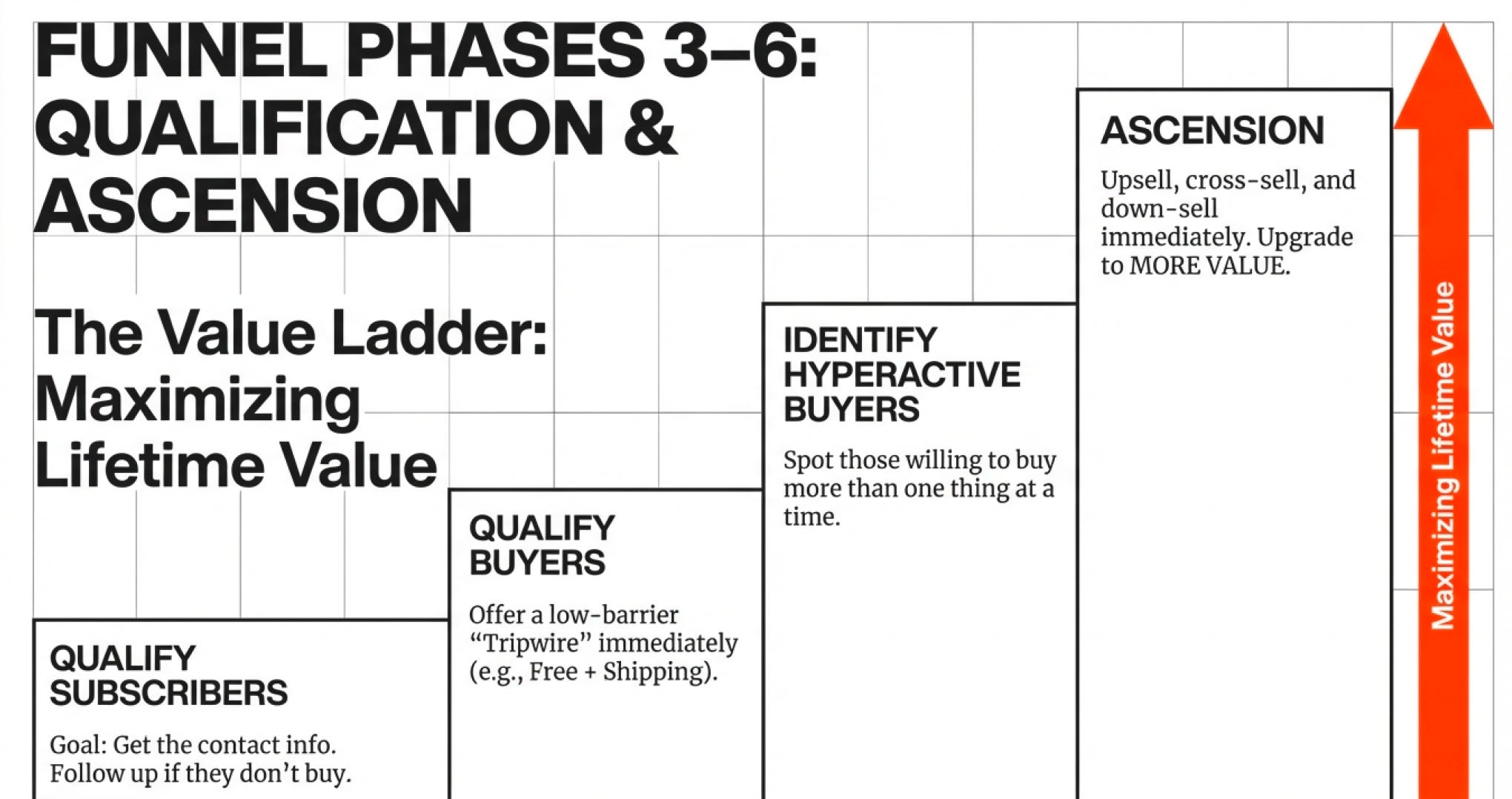
💳 Phase 3 & 4 - Qualify Subscribers Then Qualify Buyers
Are you getting people to subscribe/ give you their contact
so you can follow-up if all else fails? 👉 Offer a free/ discounted value and get traffic to give you their contact! Their contact is EVERYTHING
Are you getting people to buy?
👉 Qualify buyers straight away, NEVER delay. Offer a bait a little higher up in the value-ladder. Consider using “FREE plus execution/ shipping” or something cheap and low barrier to purchase
💰Phase 5 & 6 - Identify Hyperactive Buyers & Ascend The Relationship
Are you upselling/ cross-selling/ down-selling hyperactive buyers?
People that will buy more than 1 thing at a time. Then upsell, cross-sell, and downsell. Just SELL!
Are you matchng the buyer with the offer they really need the most?
Allow sometime to pass and provide them more value. Then let them move themselves up the value-ladder suite of products - remember to always upgrade them with MORE VALUE
The Traffic Rule
There are only 3 types of traffic to your business. (1) Traffic you control e.g. Facebook ads (2) Traffic you don’t control e.g. retail store pedastrians (3) Traffic you OWN e.g. Email list, Subscribers, Customers, Followers. Realize that you don’t have to spend any money to sell to traffic you own?
Therefore, your ONLY goal when driving traffic online: OWN ALL the traffic you can. The bigger [the list you OWN] the more money u make
The Big 3 When Presenting an Offer
🥜 Scarcity
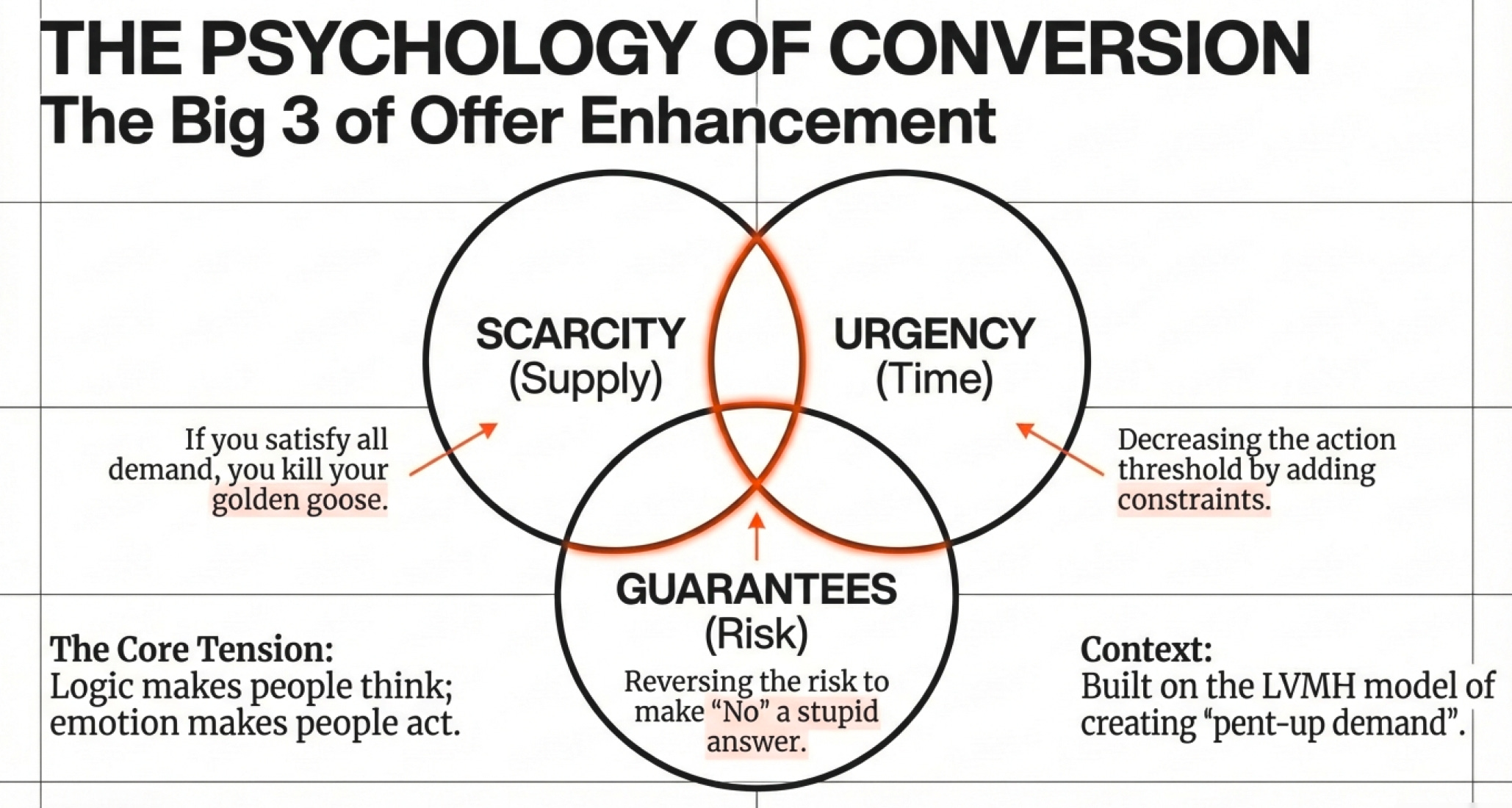
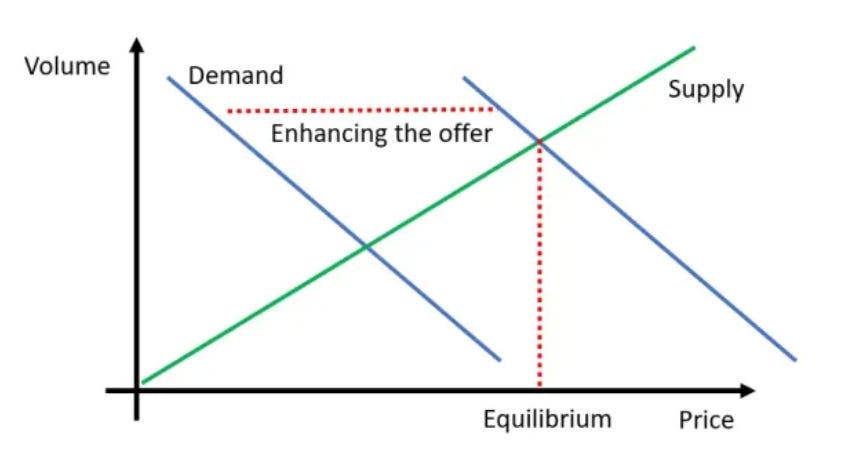
Think “if you sleep with your significant other everday, they will have less desire than if you haven’t sleep with them for a week”. Balance the interplay between supply and demand. If you have an oversubscribed prospect base that perceive no supply, price will increase significantly. Conversely, if you satisfy all demand, you kill your golden goose.
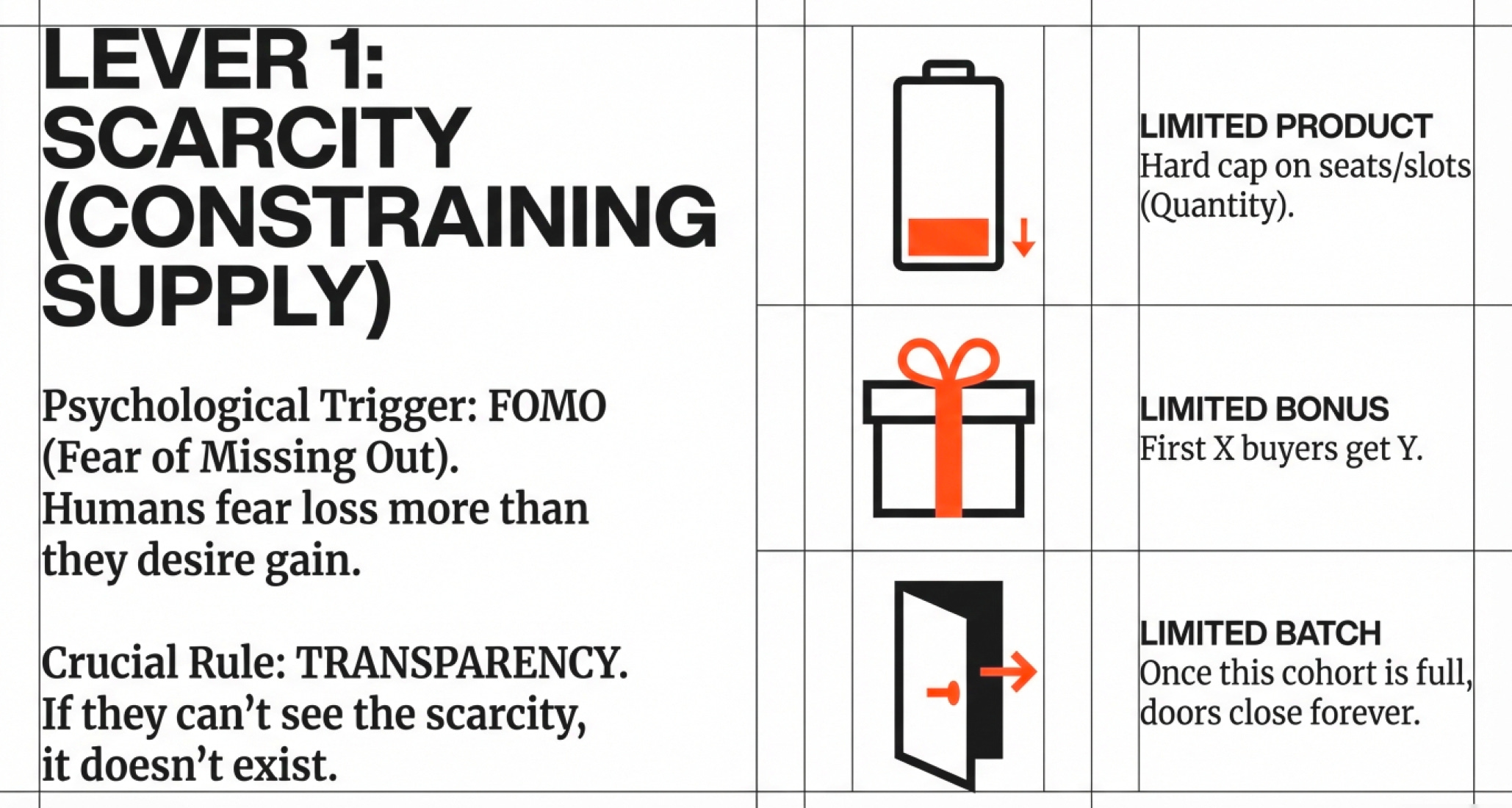
Use scarcity to to indirectly increase demand through perceived exclusiveness. FOMO: Humans are more likely to hoard on something than act on something that could help them. Fear of loss is greater than the desire to gain (deprival super reaction tendency). Taking an example from an amazing company that made their fortune through this; refer to LVMH Moet Hennessy Louis Vuitton SE
3 types of scarcity (constrained by supply)
Limited product: Limited supply of seats/ slots in general [scarcity/ function of quantity] or over a “x” period of time/ “x” session [urgency/ function of time] - important to always let people know you’re sold out. Scarcity also works greatly with social proof theory
Limited bonus: Limited supply of bonuses
Limited batch: Never available again/ once you’re out, you can never return (best in small groups)
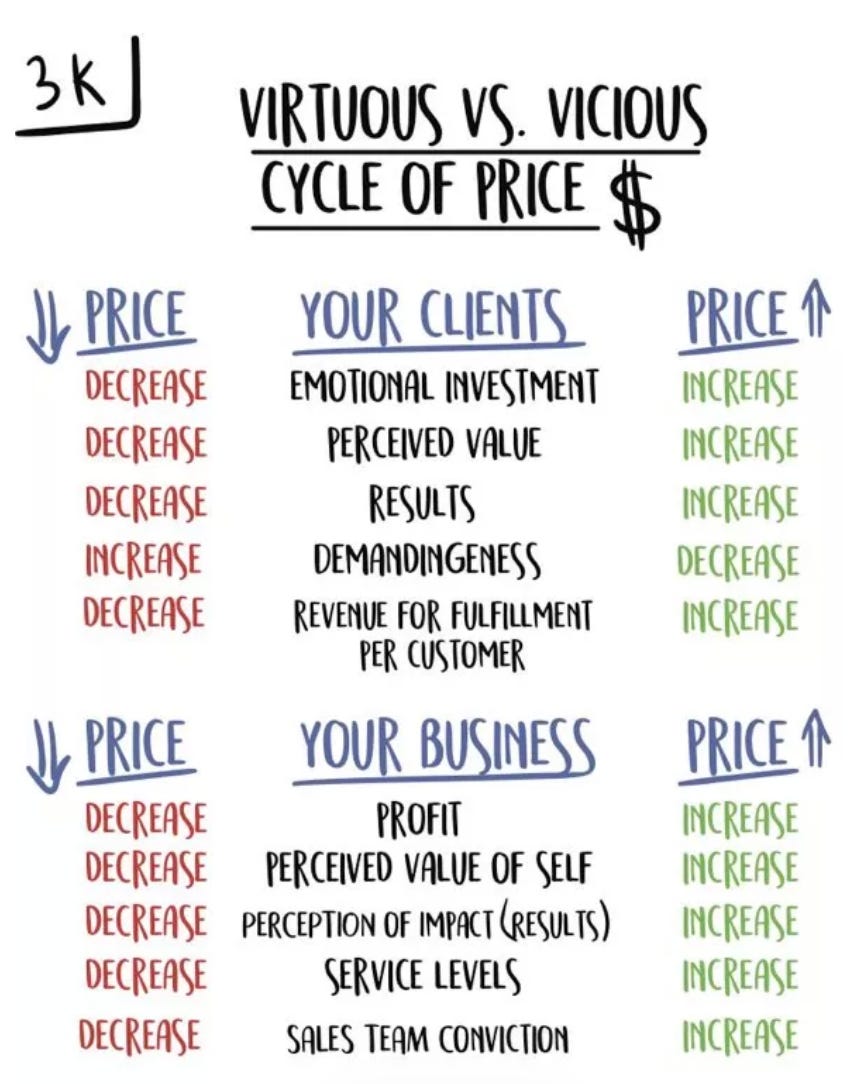
It is important to note that transparency is extremely important here. If the audience can’t SEE the scarcity, they will not perceive what you want them to. A simple way of achieving this is think of how to get your offer to oversubscription. It is common for us to get caught up with what was taught in school where everything is binary. Where everything is either “1” or “2”, “true” or “false”, “BUY” or “NOT BUY”. What school didn’t teach us is that answers/ responses are always subjective and they vary on a continuum.
Factors such as scarcity create “pent-up demand” where other are not able to buy and they feel like they are missing out on something good. The longer (the delay) they are not able to buy, the stronger the desire and demand. By adding urgency to the competition, people are afraid of loosing out more, and hence fuelling a stronger desire to act.
‼️ Urgency
Use urgency to increase demand by decreasing the action threshold of a prospect. Note: Never raise your price without letting people know.
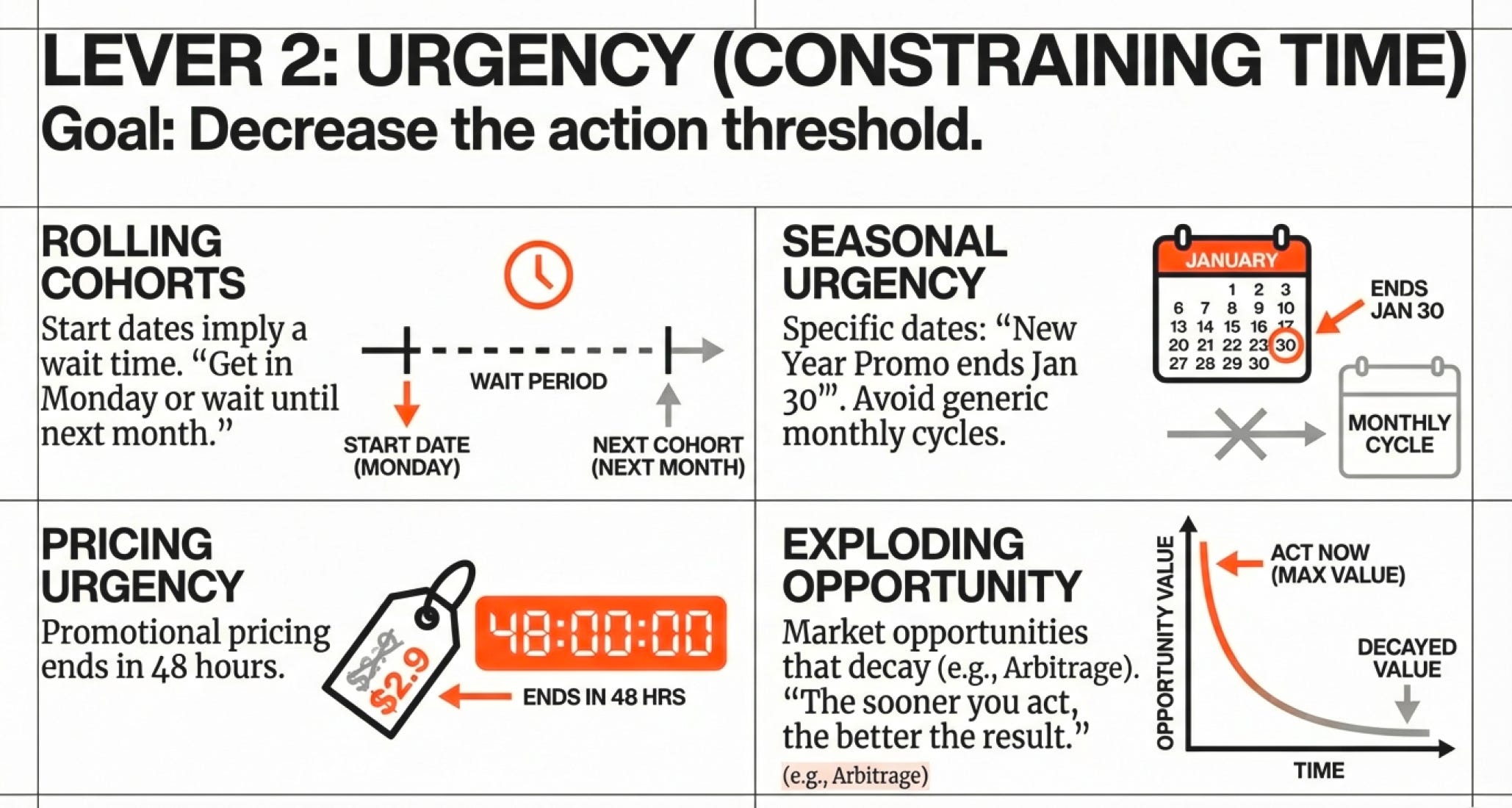
Four ways to utilise urgency
Rolling cohorts: E.g. I actually had a client that signed up a week ago but dropped out, so I have an opening and if you sign up today, I can get you in the next group that kicks off on Monday, otherwise you have to wait off until our next kickoff date”
Rolling seasonal urgency: E.g. Our new year promo ends 30th Jan, Our Valentines lovers promo ends 30th Feb, Our sexy by spring special ends 31st March, Our Fools in April ends 30th April (don’t do monthly. Will dilute brand)
Promotional/ pricing urgency: E.g. I’m not sure how long we’ll be running the promotion for (usually 4 weeks or so) but let’s get you started so you don’t miss out this advantage.
Exploding opportunity - market opportunities that decay with time: E.g. An arbitrage opportunity from buying products on eBay and selling them on Amazon, the sooner someone acts, the better it is for them, because the market inefficiency would over time correct itself. This applies for trading stocks, investing stocks, & getting onto a new platform to advertise before competitors jump on the bandwagon
If you noticed, these are all “campaign” related. A great business does not only have a “continuity program”/ retainer/ subscription (remember in “Step 1?”). A great business has BOTH a Continuity program whilst being run as a “campaign” enterprise. And campaigns tend take (on average) a year
👷♂️ Guarantees
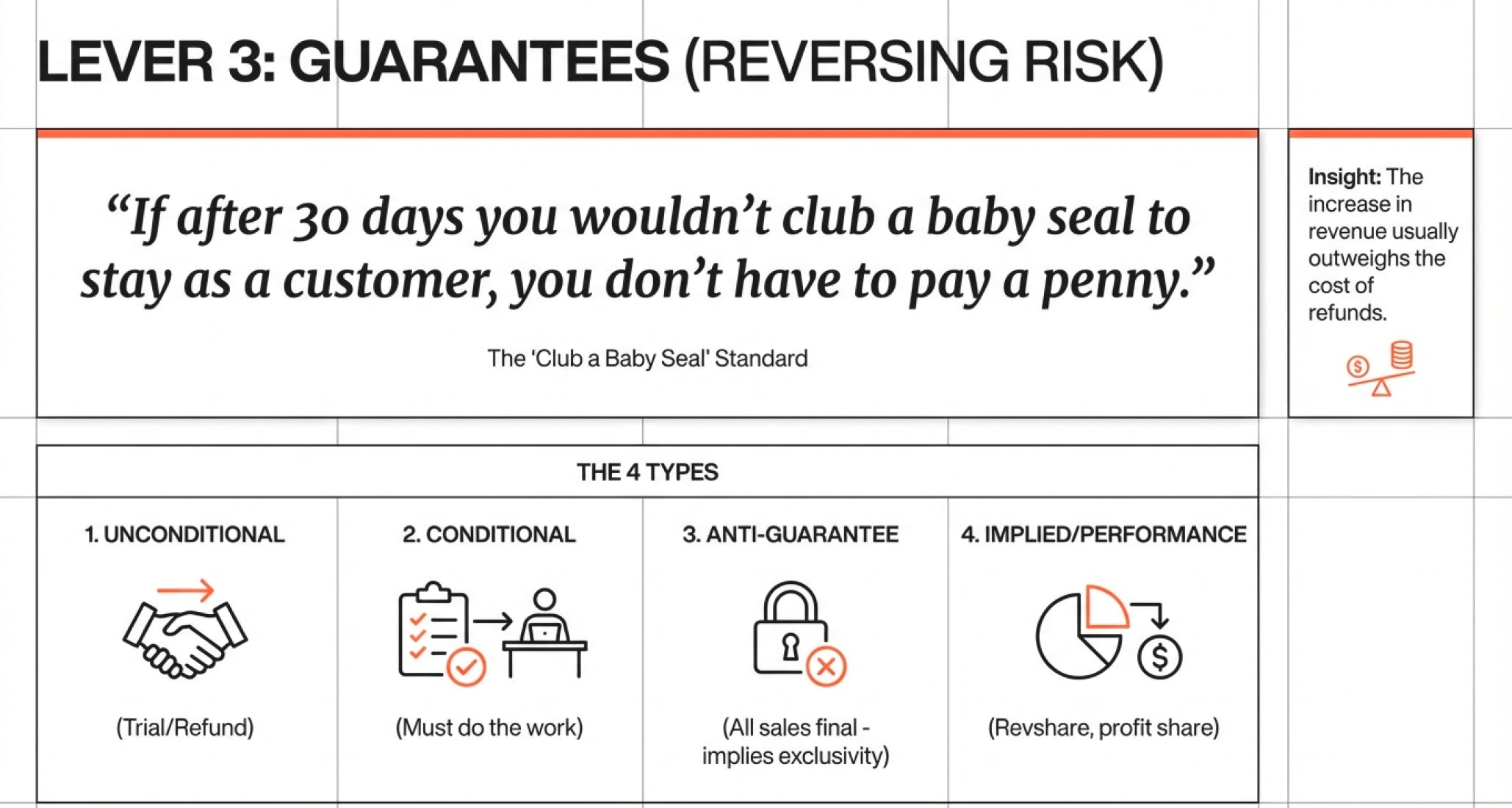
There are mainly 4 types of guarantees....
Unconditional: Trial where customers pay first and see if they like the product.
If you feel that we don’t give that level of service I’ll write you a cheque the day you tell me we suck. Best case you solve your [problem], and worst case i write you a check and you get a free [offer]
Conditional: Guarantee includes “terms & conditions”. You must be creative with this and make as little term/ conditions as possible and it must be better than money back guarantees. You can make “terms & conditions” be tied to the key actions the customer needs to take to achieve the product/ be successful. In a perfect world, 100% of your customers will get the conditional guarantee but because they are satisfied with their achieved results, they will not take it.
e.g. if customer does not participate in building the house, they cannot refund (since participating in the construction is a key action that creates their ideal end product)
Anti-guarantee (“All sales all final”) guarantee: usually used on products that are consumable/ massively diminish in value once given. - be creative and show the vulnerability of your product, such that they think “yes, it makes sense”
e.g. all sales of this utensil is final, as we cannot be giving a used utensils to our customers/ something that cannot be unseen like a special code, script.etc/ we have a “all sales are final” policy but that is because our product is so exclusive and powerful once used cannot be unused
Implied guarantees (performance based): “if I don’t perform, I don’t get paid” e.g.Revshare, profitshare, triggers, ratchets, monetary bonuses
Performance: only pay me $X per sale/ $X per kg lost
Revshare: X% of top-line revenue/ X% of revenue growth from baseline
Profit share: X% of profit/ X% of gross profit
Ratchets: 10% if over X, 20% if over Y, 30% if over a
Monetary bonuses: I get X when Y occurs
If you are going to give a guarantee, spice it up. Instead of using “satisfaction” or some other “vanilla” word, describe it more strongly using imagery e.g. “You’ll get our famous “Club a Baby Seal Guarantee”After 30 days of using our services, if you wouldn’t club a baby seal to stay on as a customer, you don’t have to pay a penny”
Guarantees Increase Sales by Folds
Despite having increased cost due to your guarantee, the increase in sales usually outweighs these costs (e.g. refunds)
Despite guarantees being effective sellers, if used as a core tactic, you may get shitty customers. Because a person who buys because of a guarantee is a person who may not be willing to put in the work necessary to see success with your product. To counter this, tie your guarantees to the things they need to do to achieve the product, not the product.
Rules of a campaign driven oversubscribed business that drive exclusivity
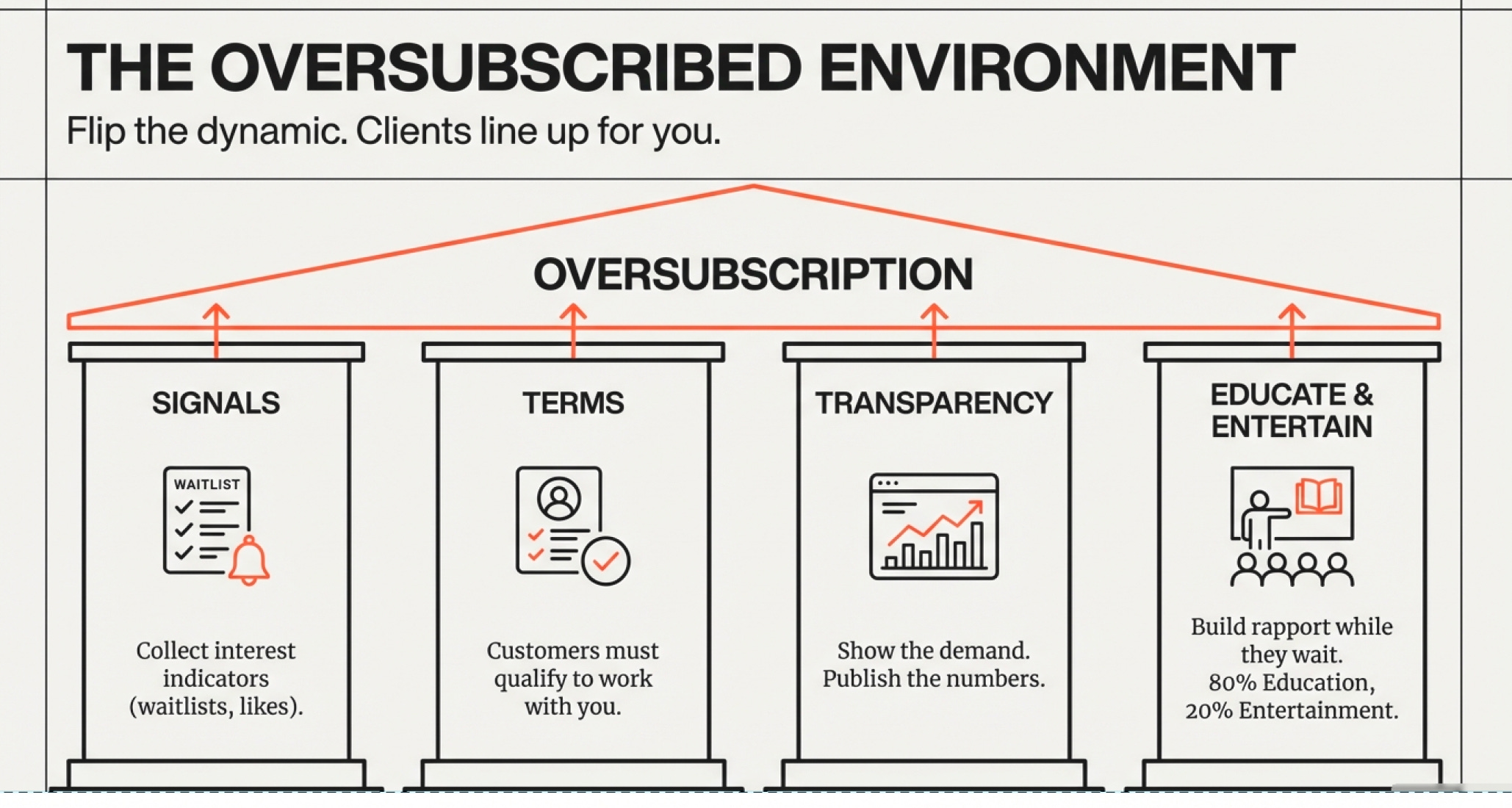
By getting someone to chose between buying something and not buying something, you fail to consider that they are maybe 90% away from purchasing and that 10% gap might be caused by small hurdles like “wanting it delivered at another time” or “not liking the color”. It is way better to get people to indicate interest.
That way, you catch traffic that is not 100% ready to purchase and this helps in “showing demand”. Here are some ways to indicate interest:
Interest indication survey/ forms, Pre-signups, Pre-launch events, Click like, Comment, Multiple PR reports, Queues, Replying to an email as indication of interest, Screenshots of traffic/ data from site analytics

1. Signals 🚨
That there is limited capacity available e.g. interest indication forms, pre-signups, pre-launch events, click like, comment, multiple PR reports, queues, or reply to an email
2. Terms/ standards 📝
Customers are no longer king, they have to behave a certain way to work with u, this prevents less ideal customers and simultaneously shows you have “quality” in deliverables.
‼️ Remember to explain why you have these standards
3. Transparency 👀
Show people you have sent your signal and how many have signaled back. Facts and figures help prove your “oversubscribed” claims e.g. google analytics screenshot, good form responses collected, comments on your CTA.etc
4. Educate and entertain 🥳
These are the best ways to build rapport but never overdo them. If 80% of that task at hand is education, make 20% entertain/ humour vice versa e.g. If you’re entertaining people at a sporting event, hand out some information kits

‼️ You don’t release your capacity until you are Oversubscribed
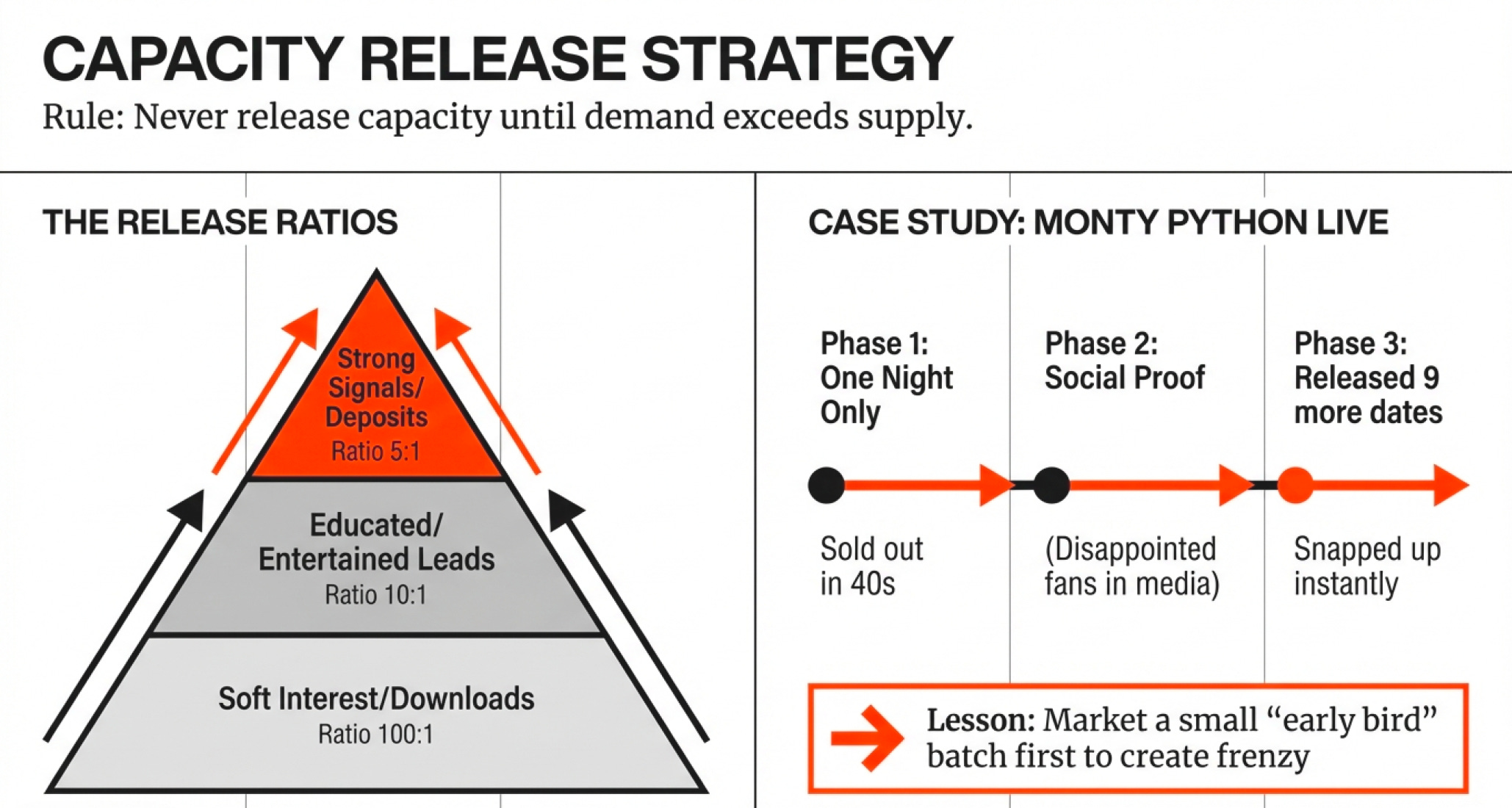
5:1 - Five times capacity for strongly signalled interest
e.g. you have capacity to sell 5 products and 25 people have paid a small holding deposit/ The highest quality signals are pre-payments or deposits. If you pre-register your interest in an exclusive sports car you usually have to put down a deposit and if you’re not selected, you’ll get the deposit refunded
10:1 - Ten times capacity for educated or entertained customers
e.g. you have capacity for 5 clients and 50 perfect clients have attended/ you can also use demand and show-up rate and data from previous sales campaign to show “oversubscription”
A great stage release example:
In November 2013, the original cast of British comedy group Monty Python announced they would be rejoining for one night only to do a stage production at the O2 Arena in London. It was the first time in decades that they had performed together and the media buzzed with enthusiasm. “For one night only,” the newscasters chorused, “these comedic geniuses will entertain just a few thousand lucky fans!” This was big news for anyone who loves Monty Python and many people set an alarm to try and buy a ticket on the day of the release. Sadly, however, unless you bought in the first 40 seconds of tickets going on sale, you missed the boat.That night on the evening news, sad fans were interviewed and shared how disappointed they were to miss out. “It’s just not fair on us real fans who’ve waited so long for this” one man said sadly to camera. “I wouldn’t sell my ticket for £1,000” said a lovely lady who was fortunate enough to have got through in time and snap up a ticket for £32. Many people felt cheated that they wanted something that they simply couldn’t buy.
Or so they thought.....The next day, original Python John Cleese proudly announced that the performers and promoters had agreed to do another nine dates, making another 45,000 tickets available for all those unlucky people who missed out. Once again, the evening news carried the story. “Due to outstanding demand from dedicated Monty Python fans, the cast and crew have agreed to another 10 shows but be warned, tickets previously sold out in 45 seconds flat. If you want a ticket, you better get in early when tickets go on sale tomorrow at 10am.”
Ticket then cost £149 and people gladly snapped it up. This technique first markets a “first batch” small “early bird” quantity of your product and then follow up at a later date with additional availability. You’ll often see Apple do this by announcing through the press that they have an “initial shipment” of phones that is limited and the future shipments won’t arrive until a later date.
100:1 - One hundred times capacity for soft interest
e.g. your capacity is five clients and you have 500 people who have downloaded a 20-page report from your website

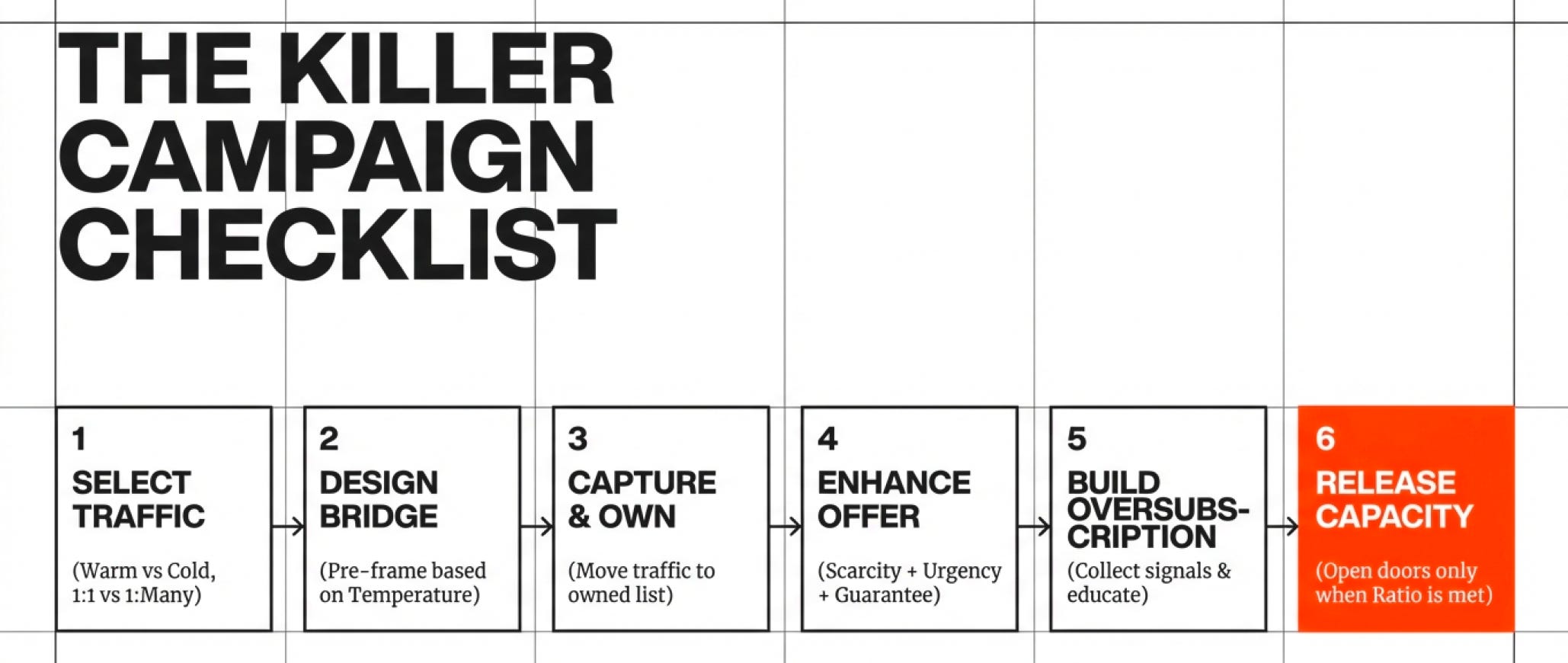
Test, Rinse, Repeat - It Takes an Average of 20 Tries Create a Remarkable Asset Package
All the above ideas must be generated based of the EXACT words, used in Halo research (words that your dream customers use)
Tool: Buzzsumo helps in researching trending posts to identify pain points
NOTE: People relate to pain and losing more than benefits and gains
References
Hormozi, Alex. $100M Offers: How To Make Offers So Good People Feel Stupid Saying No. Acquisition.com Publishing, 2021
Hormozi, Alex. $100M Leads. Acquisition.com Publishing, 2023. ASIN: B0CFDR3TYV.
Brunson, Russell. DotCom Secrets: The Underground Playbook for Growing Your Company Online. Morgan James Publishing, 2015. ISBN: 9781630474775.
Koch, Charles G. Good Profit: How Creating Value for Others Built One of the World’s Most Successful Companies. Crown Business, 2015. ISBN: 9780804189323.
Sullivan, Dan, and Hardy, Benjamin. The Laws of Lifetime Growth: Always Make Your Future Bigger Than Your Past. Berrett-Koehler Publishers, 2006.
Munger, Charles T., edited by Peter D. Kaufman. Poor Charlie’s Almanack: The Wit and Wisdom of Charles T. Munger. Donning Company Publishers, 2005.
Priestley, Daniel. 24 Assets: Create a Digital, Scalable, Valuable and Fun Business That Will Thrive in a Fast Changing World. Rethink Press, 2016.
Collins, Jim. Good to Great: Why Some Companies Make the Leap... and Others Don’t. HarperBusiness, 2001.
Godin, Seth. Purple Cow: Transform Your Business by Being Remarkable. Portfolio, 2003.
Godin, Seth. This is Marketing: You Can’t Be Seen Until You Learn to See. Portfolio, 2018.
Suby, Sabri. Sell Like Crazy: How to Get As Many Clients, Customers and Sales As You Can Possibly Handle. King Kong, 2019.
Priestley, Daniel. Oversubscribed: How to Get People Lining Up to Do Business with You. Capstone, 2015.
Greenwald, Bruce, and Judd Kahn. Competition Demystified: A Radically Simplified Approach to Business Strategy. Portfolio, 2005.
Slow Ventures. “Franchising Thesis - Why Venture Should Care About Franchises.” DocSend, accessed May 7, 2025. https://docsend.com/view/68uxgs3jawk2szrv